The GEO Hub

Generative Engine Optimization, in 30 deep guides.

GEO is two optimization problems sharing one acronym — training-corpus presence and live-retrieval citation. They have different levers, different timelines, and different ways to measure whether anything is working. The 30 guides on this page split the surface cleanly. They are also the pages I send to anyone who asks “how do I get cited by ChatGPT?” on the assumption that the real question is bigger than that.

The two GEO mechanics, in one paragraph

Training-corpus presence governs what the model says without browsing. It updates only when OpenAI, Anthropic, or Google ships a new model — a multi-month-to-annual cadence. The levers are slow: Wikipedia presence, Reddit mentions, consistent entity data, third-party citations from authoritative publishers. You will not move this in a week.

Live-retrieval citation governs the ChatGPT search / Perplexity / AI Overview surfaces that fetch live pages at query time. It updates within days to weeks. The levers are fast: schema markup, FAQ blocks, direct-answer formatting, freshness, primary-source citations, clean canonical URLs. This is where most operator gains come from in the first 90 days.

Most published GEO advice conflates the two and produces frustrating timelines (“why did my structured-data fix not move my no-browse answer?”). Throughout this hub, when a guide is specifically about one mechanic or the other, we name it.

Foundations — what GEO actually is

GEO is two different optimization problems sharing one acronym. Training-corpus presence is slow and earned through authority signals (Wikipedia, Reddit, consistent entity data). Live-retrieval citation is fast and earned through structure (schema, direct-answer formatting, freshness). Most guides conflate them; the four pieces below pull them apart and tell you which lever moves which surface.

AI Overviews & Google AI surfaces

Google AI Overviews and AI Mode are the GEO surface most likely to move your existing SEO numbers (positively or negatively) before any other engine does. These three pieces map the mechanics, the recovery playbook for traffic loss, and the difference between AIO and the newer AI Mode that ships behind the same UI label.

Content strategy for AI search

The content layer is where most teams over-rotate. Writing more is not the move — writing the specific shapes that AI engines lift cleanly is. These pieces cover the citation-friendly content shape, when to refresh existing pages, and the citation-vs-backlink debate (they are not the same signal, despite what some SEO blogs imply).

Original research

The benchmark and citation-rate studies we have run on attrifast.com and the 200-site Stripe-connected cohort. These are the pieces I link to when someone asks "what does the data actually say?" — and the pieces I write up first when someone asks for our methodology.

Frequently asked questions

What is Generative Engine Optimization (GEO)?

GEO is the practice of optimizing your content so it gets cited and recommended by generative AI engines — ChatGPT, Perplexity, Claude, Gemini, and Google AI Overviews. It is not a single technique. It is the union of two separate optimization problems: training-corpus presence (slow, governed by authority signals like Wikipedia and Reddit mentions) and live-retrieval citation (fast, governed by structural signals like schema markup and direct-answer formatting). Most "GEO guides" conflate the two and tell you to optimize for both without acknowledging that the levers are completely different.

Is GEO the same thing as AEO?

In practice, the terms are used interchangeably and the technical content underneath is ~80% the same. "GEO" (Generative Engine Optimization) leans toward the broader generative-AI surface — ChatGPT chat answers, Perplexity, Claude. "AEO" (Answer Engine Optimization) leans toward answer-shaped queries and the AI Overview surface on Google. We use both. The aeo-vs-seo-2026 article in the foundations section above lays out where the terms diverge.

How is GEO different from SEO?

Three structural differences. (1) Citation density matters more than backlinks — primary-source citations in your content correlate with AI citation in a way backlinks do not. (2) Structural signals (schema, direct-answer blocks, FAQ formatting) are weighted more heavily because LLMs parse them cleanly. (3) The training-corpus surface introduces a multi-month lag that pure SEO does not have. SEO improves with crawl + index; the training-corpus side of GEO only updates when the model itself does. We cover this in detail in aeo-vs-seo-2026.

Does GEO actually drive revenue?

Yes, but proving it requires more attribution architecture than most teams have. The honest answer is in the article of the same name in the measurement section above. Short version: AI traffic converts at materially higher rates than search traffic in our 200-site cohort, but a lot of that traffic gets misattributed to Direct in GA4, which means most teams are looking at a fake "AI traffic is small" number while the real channel is larger and converting better. Fix the attribution first, then judge the revenue.

How long does GEO take to work?

Two timelines, because there are two surfaces. The live-retrieval surface (ChatGPT search, browse mode, AI Overviews) can pick up a freshly published, well-structured page within days to a few weeks of being crawled. The training-corpus surface (the no-browse model answers) only updates when OpenAI / Anthropic / Google ship a new model or knowledge cutoff — a multi-month-to-annual cadence. A page can rank in ChatGPT search next week and remain invisible to the default model for a year. Plan for both timelines and stop conflating them.

What is the single highest-leverage GEO move?

For the live-retrieval surface: ship a 40-80-word direct-answer block at the top of the page, then mirror your visible H2 questions exactly in FAQPage schema. That combination is the most consistently citation-positive move in every test I have run. The Princeton GEO research paper (Aggarwal et al., 2024) showed adding statistics and primary citations lifts visibility 30-40%, which I have replicated on a smaller sample. For the training-corpus surface: get an accurate, well-sourced mention into Reddit and Wikipedia-adjacent properties. Both corpora are disproportionately weighted in LLM training data.

Do I need a GEO tool or can I do this manually?

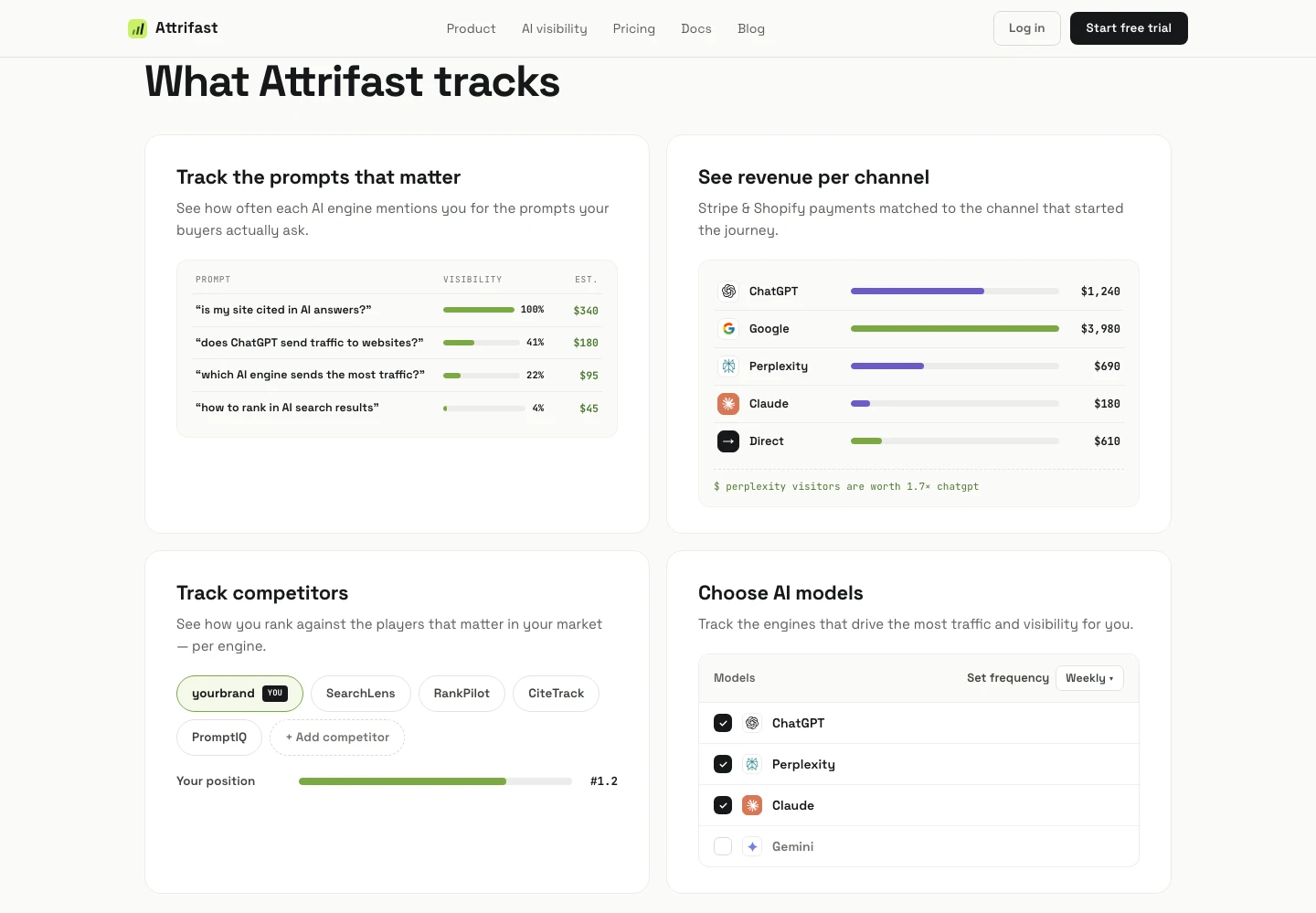
You can do the structural work manually — schema markup, content shape, llms.txt — without buying anything. What you cannot do manually at scale is monitor whether your changes actually moved citation rates across 100+ prompts on 5+ engines weekly. That is where GEO tools earn their keep. The best-aeo-tools-2026 article in the competitive section above walks through 12 platforms with honest pros and cons. Attrifast covers the revenue-attribution half (what actually pays), not the prompt-tracking half (who cites you) — most teams need both.

Every GEO move is a hypothesis. Attrifast tells you which ones paid.

Ship a schema change, a llms.txt update, or a new direct-answer block — then watch the per-engine revenue split move (or not) in your Stripe-joined dashboard. The closed loop most GEO tooling stops short of.

Start the 5-day free trial →

5-day free trial · $29/mo · cancel anytime