Revenue channel attribution
Revenue by channel.
Decisions become obvious.
Stop guessing whether email or paid social drives more revenue. Attrifast attributes every Stripe payment to the marketing channel that brought the customer — automatically.
7-day free trial. First-touch & last-touch supported.
ChannelVisitorsRevenueRPV
Organic search5,420$9,210$1.70
Email1,140$6,118$5.37
Paid social3,205$3,640$1.14
Organic social2,515$2,922$1.16
Referral1,084$1,072$0.99
Direct842$1,610$1.91
Channels are auto-grouped from sources. You can customise the grouping at any time.
Pick the attribution model that fits the question
Attrifast supports both first-touch and last-touch out of the box. Switch the model and watch the channel revenue change — without re-instrumenting anything.
First-touch
Credits the channel that originally discovered the customer. Best for deciding where to invest top-of-funnel budget.
Last-touch
Credits the channel that closed the conversion. Best for evaluating bottom-funnel offers and retargeting.
Blended
Splits credit across the touch path. Useful for honest reporting when both top and bottom funnel matter.
Everything channel attribution should include
Channel revenue
Total revenue per channel, refreshed in real time.
Channel RPV
Revenue per visitor for fair channel comparison.
Spend & ROI
Pair each channel with ad spend to see ROI per dollar.
Campaign drilldown
Drill into utm_campaign within each channel.
Cohort retention
See how channels compare on customer lifetime, not just first sale.
Custom channel groups
Map sources to channels however your team thinks about them.
Revenue channel attribution: common questions
What is revenue channel attribution?
Revenue channel attribution is the practice of assigning each dollar of revenue to the marketing channel — search, social, email, paid, referral, direct — that brought the customer in. It is the difference between knowing you grew and knowing why you grew.
How do I attribute revenue to a marketing channel?
Capture the source of every visit, persist it across the user session, then match it to a payment when one happens. Attrifast does all three automatically: cookieless source detection, durable session stitching, and native Stripe revenue ingest.
Which attribution model does Attrifast use?
Attrifast supports first-touch, last-touch, and a blended model. First-touch credits the channel that originally found the customer; last-touch credits the channel that closed them. We default to first-touch because it is the most useful for budget allocation.
Can I see channel attribution in real time?
Yes. Channel revenue updates within seconds of a Stripe charge. You do not have to wait for a daily aggregate or build a separate report.
How is this different from marketing attribution tools like HubSpot?
HubSpot attribution requires CRM seats, complex setup, and a lot of manual reporting. Attrifast is a small, fast tool that gives you channel revenue out of the box for $9.99/month. See /vs/google-analytics and /blog/hubspot-attribution-alternative for comparisons.
See which AI engines actually send you paying customers
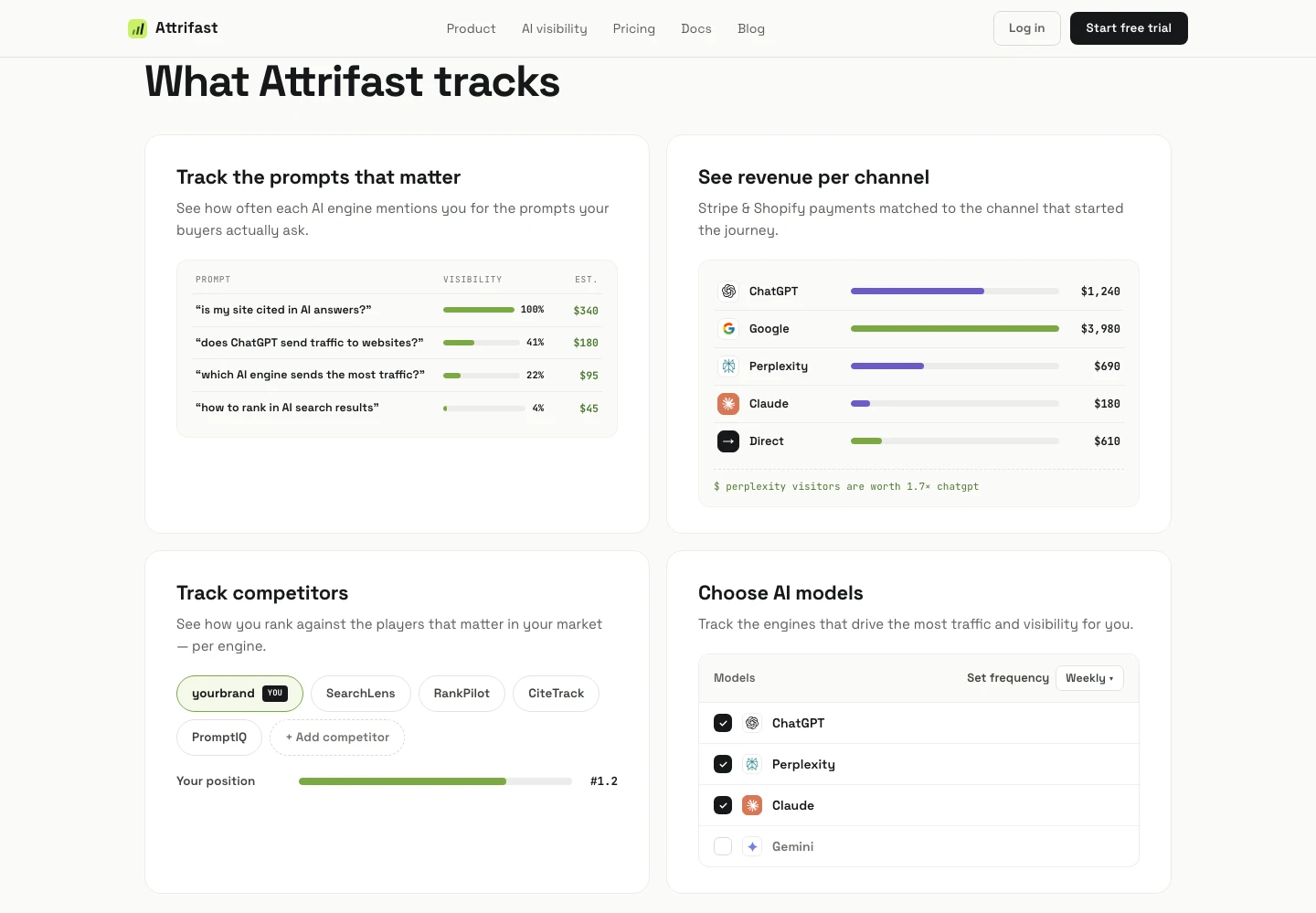
Attrifast splits ChatGPT, Perplexity, Claude and Gemini into their own revenue lines — joined to real Stripe payments, not estimates.
- One script tag and a Stripe key — live in minutes
- First-party measurement without third-party cookies
- Recognized AI referrals joined to Stripe payments
7-day free trial · $0 due today · then $9.99/mo · cancel anytime