AI revenue attribution · defined by Attrifast
Know which AI engines create revenue.
A citation is attention. A visit is intent. Attrifast connects that AI-sourced session to the Stripe payment it produced — so ChatGPT, Perplexity, Claude, and Gemini become measurable revenue channels.
2 min
to first data
4 KB
cookieless script
Stripe
payment-level proof
The definition
What is AI revenue attribution?
AI revenue attribution is the practice of tying AI-engine referrals (ChatGPT, Perplexity, Claude, Gemini) to actual revenue — joining each AI-sourced visit to the payment it produced — rather than measuring citations, mentions, or visit counts alone.
The attribution chain
How one AI answer becomes attributable revenue.
01
AI answer
A buyer sees your brand or source inside ChatGPT, Perplexity, Claude, Gemini, or an AI Overview.
02
Detected visit
Attrifast classifies the AI referrer and recovers visits that analytics often hides inside Direct.
03
Preserved journey
The first-party session keeps the source, landing page, campaign context, and later return visits together.
04
Verified payment
Stripe revenue is joined back to the originating AI session, producing revenue and RPV by engine.
What becomes measurable
Move past mentions and measure business outcomes.
Visibility tells you whether AI engines talk about you. Revenue attribution tells you whether that attention creates a customer.
Revenue by AI engine
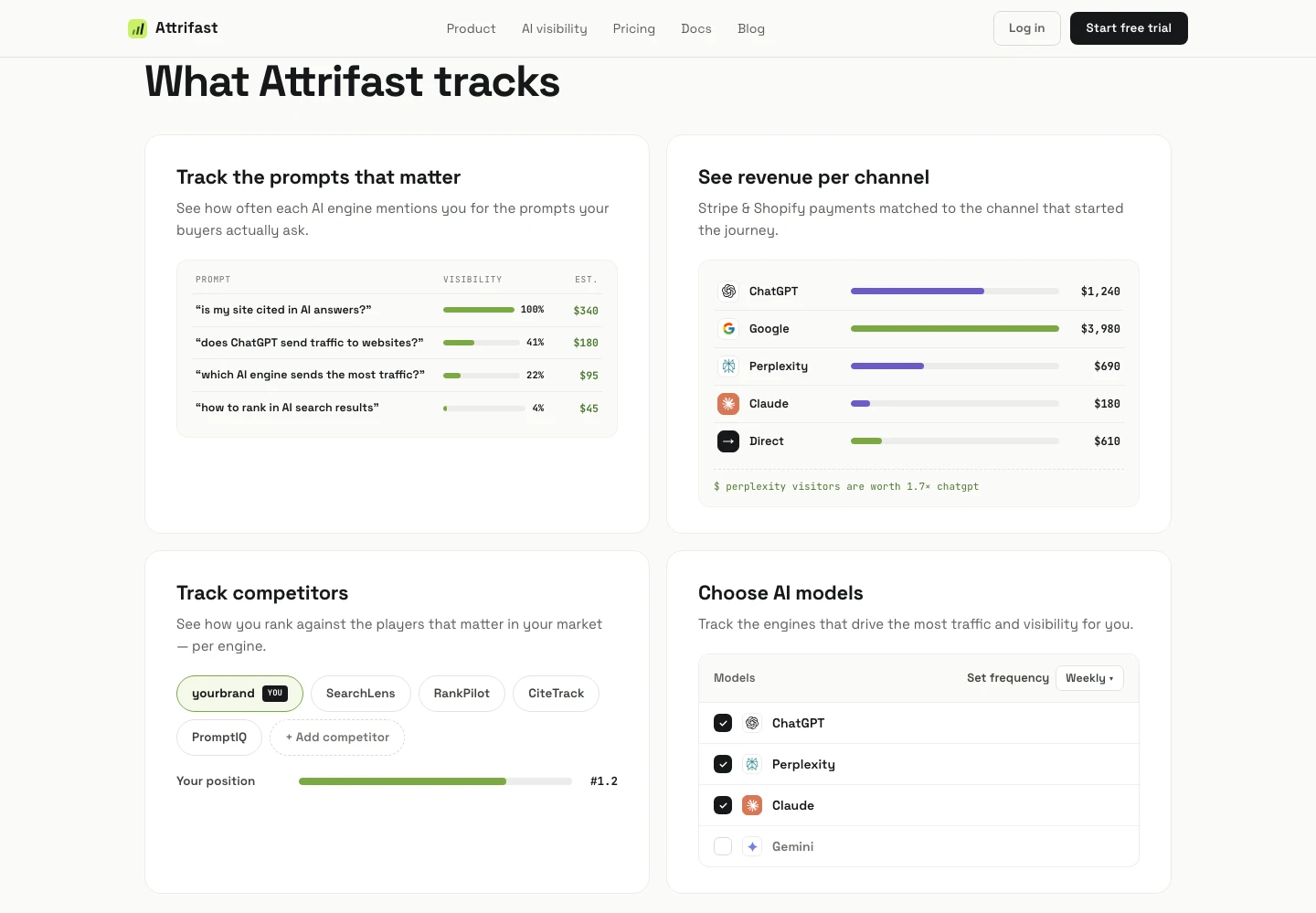
Compare ChatGPT, Perplexity, Claude, Gemini, and AI Overviews as distinct channels.
Revenue per visitor
See which engine sends the most valuable traffic, not simply the most traffic.
Recovered dark AI
Reclassify AI referrals that would otherwise remain buried inside Direct / (none).
Conversion rate
Measure how often each AI-sourced session becomes a verified payment.
Landing-page value
Find the content and product pages that turn AI attention into revenue.
Customer-level journeys
Preserve first-touch and last-touch context across return visits before purchase.
Evidence, not estimates
The 200-site AI revenue benchmark.
These five numbers come from the Attrifast cohort of 200 Stripe-connected sites. They are the statistics most operators are missing — and the reason judging AI engines by visibility alone gives you the wrong answer.
- 34%
- of GA4 "Direct" traffic is actually AI-referred
- Attrifast 200-site benchmark
- 1.6×
- Perplexity Revenue Per Visitor vs ChatGPT ($1.42 vs $0.87)
- Attrifast 200-site benchmark
- 2.7%
- AI-traffic conversion rate vs 1.4% for Google organic
- Attrifast 200-site benchmark
- 64%
- median amount SMBs under-count their AI traffic
- Attrifast 200-site benchmark
- $1.94
- Claude Revenue Per Visitor on B2B SaaS specifically — its highest-value vertical, at just 6% of AI volume
- Attrifast 200-site benchmark (B2B SaaS cohort)

Source: Attrifast 200-site benchmark, blended RPV across all verticals, 2025-06 to 2026-05
The ranking inverts when you sort by volume instead of value: ChatGPT sends ~71% of AI sessions but Perplexity earns 1.6× its Revenue Per Visitor. A tool that only counts citations would tell you to chase the wrong engine.
Full methodology, sample sizes, and the per-engine breakdown are in the 2026 AI Search Revenue Benchmark and on the research page. For how ChatGPT visitors compare with Google organic on engagement and conversion, see ChatGPT vs Google traffic quality; to run this on your own numbers, start with attribution software that joins traffic to Stripe payments natively.
Why AI revenue is invisible by default
AI engines strip the referrer, so AI-referred visits collapse into GA4’s Direct / (none) bucket. Two numbers describe the same problem from opposite ends, and they are easy to confuse — so here they are side by side:
- 34% of everything sitting in the GA4 Direct bucket is actually AI-referred (median across the cohort).
- ~70% of ChatGPT sessions end up inside that Direct bucket in the first place.
Different denominators — one is “share of Direct that is AI,” the other is “share of AI that lands in Direct” — but the same root cause: without server-side detection the channel is unattributable. The donut is the first number.

Source: Attrifast 200-site benchmark — median, server-side reclassification of Direct/(none), 2026
Visibility tracking vs revenue attribution
The two layers are complementary, not interchangeable. You earn the visit with visibility work (GEO / AEO); you prove it paid with revenue attribution.
| AI visibility tracking | AI revenue attribution | |
|---|---|---|
| Question answered | Did an AI engine mention me? | Did that mention produce revenue? |
| Core metric | Citations, mentions, share of voice | Revenue & RPV by AI engine |
| Data source | Querying AI engines | Server-side sessions joined to Stripe |
| Typical tools | Otterly, Profound, Peec, Loamly | Attrifast |
| Indicator type | Leading | Result |
Go deeper
- The 2026 AI Search Revenue BenchmarkThe full per-engine RPV, conversion-rate, and ROI-vs-paid-search tables from the 200 Stripe-connected sites these statistics come from.
- AI-influenced conversions: the hidden 30-40% of revenueMost AI revenue is not last-click. How to attribute the influenced share without overclaiming the channel.
- Dark AI traffic: why ChatGPT visits show as "Direct" in GA4The mechanism behind the 34% number — stripped referrers, and how server-side detection recovers them.
- How to measure GEO / AEO ROIThe practitioner methodology: baseline, detect AI traffic, join to Stripe, compute (revenue − cost) / cost with honest confidence intervals.
- Multi-touch attribution for AI searchFirst-touch vs last-touch vs influenced — which model to use when an AI engine appears mid-journey.
- How Attrifast attributes revenueThe Stripe-native, cookieless mechanism that joins each AI-sourced session to the payment it produced.
AI revenue FAQ
The questions behind the category.
Definitions, measurement limits, setup, RPV, dark AI traffic, and the difference between attribution and GEO.
What is AI revenue attribution?+
AI revenue attribution is the practice of tying AI-engine referrals (ChatGPT, Perplexity, Claude, Gemini) to actual revenue — joining each AI-sourced visit to the payment it produced — rather than measuring citations, mentions, or visit counts alone. It is the revenue layer that sits beneath AI visibility tracking: visibility tools tell you whether an AI engine mentioned you; AI revenue attribution tells you whether that mention produced a paying customer.
How is AI revenue attribution different from AI visibility tracking?+
AI visibility tracking (Otterly, Profound, Peec, Loamly) measures presence — citations, mentions, share of voice, average position in AI answers. AI revenue attribution measures outcome — the Stripe revenue each AI engine actually generated. Visibility is a leading indicator; revenue is the result. The two are complementary, but most teams only buy the visibility layer and never close the loop to revenue, which is why "is this channel real?" stays unanswered.
Why can't most AI visibility tools measure revenue?+
Because they have no connection to your payment system. Visibility tools query AI engines and parse the answers; they never see your Stripe data, so they cannot join a ChatGPT-sourced visit to the order it produced. Measuring AI revenue requires (1) server-side detection of AI-referred sessions — which is hard because engines strip referrers, so ~34% of AI traffic hides inside GA4 "Direct" — and (2) a native payment-processor integration to match those sessions to revenue. Attrifast is built on both.
Why does so much AI traffic show up as "Direct" in analytics?+
When someone clicks a link inside a ChatGPT, Perplexity, or Claude answer, the referrer is often stripped or set to the app domain, so GA4 buckets the visit as "Direct / none." In the Attrifast 200-site cohort, a median of 34% of GA4 "Direct" traffic was actually AI-referred. Multi-signal, server-side detection (referrer + known AI domains + landing-page patterns) is what recovers it — without that, the channel is invisible and its revenue is unattributable.
What does Revenue Per Visitor (RPV) by AI engine look like?+
In the 200-site benchmark, the engines rank very differently by quality than by volume. On cohort-blended RPV, Perplexity leads at $1.42, Claude is second at $1.18, ChatGPT third at $0.87, Gemini $0.41, and AI Overviews $0.29 — so Perplexity's RPV is 1.6× ChatGPT's. Cut by vertical the order shifts: Claude tops B2B SaaS specifically at $1.94 despite carrying only ~6% of AI volume. AI traffic overall converted at 2.7% vs 1.4% for Google organic. The headline: judging AI engines by visit count alone inverts their actual revenue value, which is exactly the mistake a visibility-only tool leads you into.
How do you set up AI revenue attribution?+
Install a cookieless tracking script (one tag) and connect your payment processor. Attrifast does this in about two minutes: a 4KB script tag detects and classifies every visit including AI-referred ones server-side, and pasting a restricted Stripe API key (the webhook is provisioned automatically) matches each payment back to the session that produced it. The result is revenue and Revenue Per Visitor split by AI engine — ChatGPT, Perplexity, Claude, Gemini — alongside search, social, paid, and email, with no third-party cookies, no fingerprinting, and no cross-site tracking.
Is AI revenue attribution the same as GEO or AEO?+
No — they answer different questions. GEO (Generative Engine Optimization) and AEO (Answer Engine Optimization) are about getting cited in AI answers in the first place. AI revenue attribution is about measuring whether that citation produced revenue. You do GEO/AEO to earn the visit; you do AI revenue attribution to prove the visit paid. Our GEO hub and AEO hub cover the earning side; this page covers the measuring side.
Turn AI citations into AI revenue.
Attrifast is the Stripe-native tool that splits ChatGPT, Perplexity, Claude, and Gemini referrals into their own revenue line — server-side, cookieless, no cross-site tracking. See whether your AI traffic actually pays.
- One script tag and a Stripe key — live in minutes
- First-party measurement without third-party cookies
- Recognized AI referrals joined to Stripe payments
7-day free trial · $0 due today · then $9.99/mo · cancel anytime