Share of Voice — AI Search
Brand share of voice
across every AI engine.
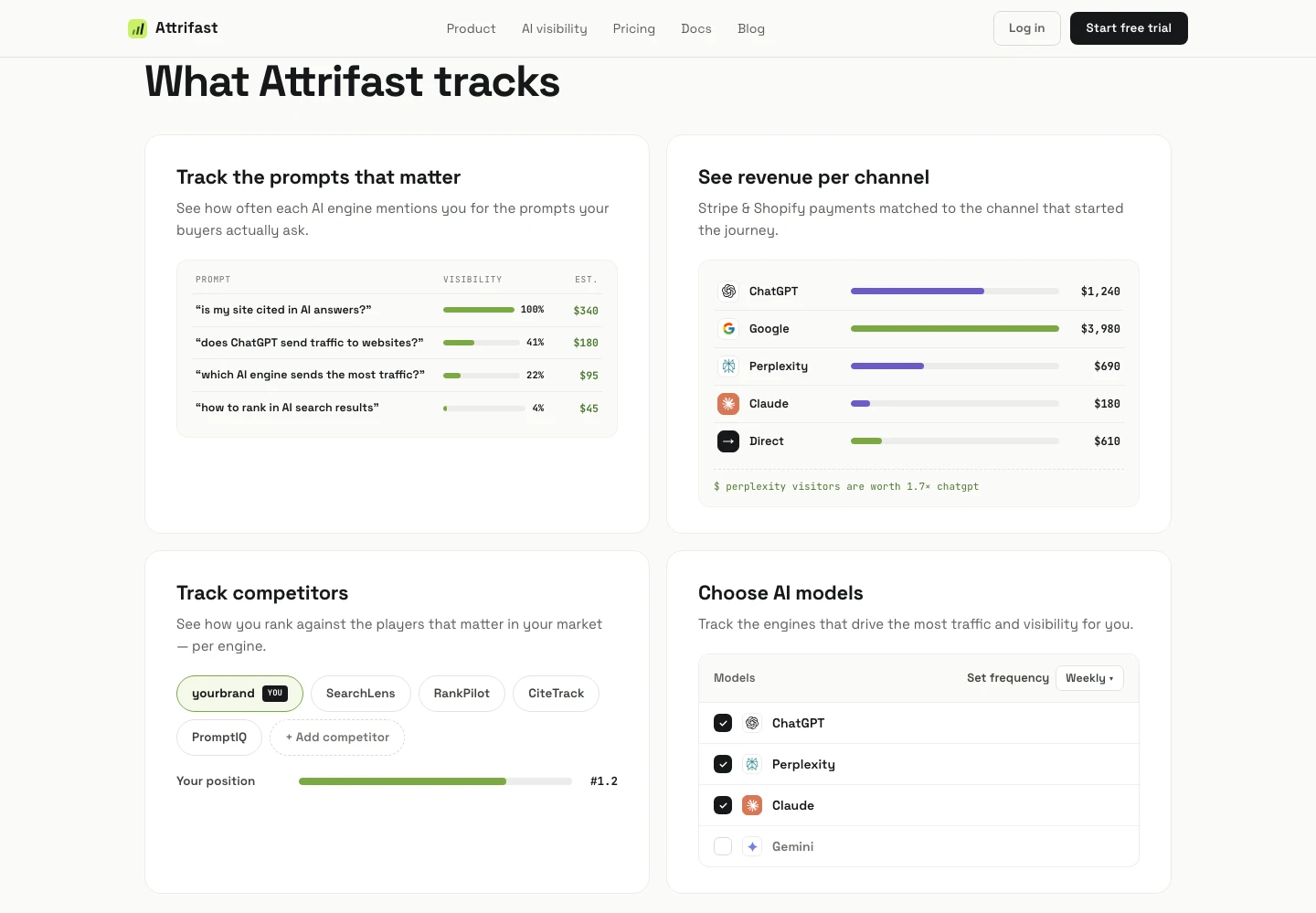
Share of voice in classic SEO is impressions you might have earned. In AI search it is citation share across the prompts your buyers actually ask. Attrifast computes both — per engine and per dollar of Stripe revenue.
7-day free trial · from $9.99/mo · cancel anytime
Classic SOV is impressions. AI SOV is citations.
Both call themselves "share of voice." They measure two different things, and only one of them is grounded in the answer the buyer actually reads.
Classic SEO share of voice
- ·Computed from estimated search volume × rank
- ·Upstream proxy: how many SERP impressions you could have earned
- ·Reported by Ahrefs, Semrush, SimilarWeb
- ·Blind to AI answer surfaces above the blue links
AI search share of voice
- ·Computed from parsed citation lists per AI engine
- ·Downstream measure: how often you actually appear in the answer
- ·Reported per engine: ChatGPT, Claude, Gemini, Perplexity
- ·Joined to Stripe revenue via first-party session match
A worked example: 30 buying-stage prompts
You give Attrifast up to 30 prompts from your category. Each rescan — scheduled every 10 days, or triggered by you — runs them across ChatGPT, Claude, Gemini, and Perplexity. Here is what the share of voice leaderboard looks like after one month of scans.
BrandCitations across scansShare %Revenue (your data only)
Your domain3838%$2,940
Competitor A3131%—
Competitor B1717%—
Competitor C99%—
Long tail (others)55%—
38% citation share · $2,940 in Stripe revenue joined back to AI engines that month. Competitor revenue is necessarily unknown — only your own Stripe data joins back.
One number per engine, because each engine behaves differently
Aggregating share of voice into a single number hides the structural differences between the engines. Attrifast reports the breakdown explicitly for the engines it scans today — ChatGPT, Claude, Gemini, and Perplexity. Here is how the major answer engines behave:
EngineCitation densityLink-out behaviorBest signal for SOV
ChatGPT SearchModerate (3-5)Usually linksBrand familiarity in corpus
PerplexityHigh (3-7)Always linksAnswer-shaped structure + freshness
Google AI OverviewsVariableLinks to sourcesClassic ranking + schema
Claude (web)LowOften no linkCorpus presence, brand mention density
GeminiModerateOften linksGSC + Google entity signals
Citation density and link-out behavior are publicly documented or directly observable per engine[1][2].
How the share of voice number is computed
The math is intentionally simple. For each engine, your prompt list is rerun on a schedule — every 10 days on Pro, and you can trigger a rescan yourself at most once every 7 days — and we parse the returned answer for every cited source URL and every bare brand mention. Your domain's share is your citation count divided by the combined count for you plus the competitor domains you track (up to eight on Pro), recomputed live every time you open the dashboard.
The hard part is parsing. ChatGPT with web search and Perplexity return structured source lists on most queries, so extraction is near-100% accurate. Claude and Gemini answers require regex on the rendered answer plus entity disambiguation against your declared brand and competitor list. We log every parsed event so any disputed movement can be drilled into the raw engine response — no black box.
The Princeton GEO research suggests that adding citations, statistics, and quotations to a page lifts generative-engine visibility by up to 40%, while keyword stuffing does almost nothing[3]. That finding plus the engine-specific observations from Ahrefs and Backlinko[4][5] are what informs the prompt-set recommendations Attrifast surfaces during onboarding. Your share of voice is only as honest as the prompt list you scan; we try to make that list defensible from day one.
Attrifast vs Profound vs Loamly
All three measure brand share in AI answers. Only one ties it to Stripe revenue.
CapabilityAttrifastProfoundLoamly
Share of voice in AI answers
Per-engine sub-share breakdown
Stripe revenue per engine
Intent-tagged prompt list
Competitor share leaderboard
CSV + JSON API export
Sub-$50/mo entry tier
Share of voice in AI search — FAQ
How citation share is computed, which prompts count, and how the Stripe revenue join works.
›What is share of voice in AI search?
Share of voice in AI search is the percentage of cited sources, across your tracked prompt set, that point at your domain versus the competitor domains you track. Attrifast computes it from the actual citation lists ChatGPT, Claude, Gemini, and Perplexity return for your monitored prompts: your citation count divided by the combined count for you plus your declared competitor domains (up to eight on Pro, three on Starter), recomputed live every time you open the dashboard. Unlike classic SEO share of voice — which is computed from estimated SERP impressions — AI share of voice is a presence metric, not an impression estimate, and it should always be reported alongside the revenue those engines produced.
›How is brand share of voice in ChatGPT different from SEO share of voice?
Classic share of voice (Ahrefs, Semrush, SimilarWeb) is computed from estimated keyword impressions: total search volume across your keywords, weighted by your rank position. It is an upstream proxy for traffic. Brand share of voice in ChatGPT (and the other AI engines) is downstream: it counts whether your brand or domain actually appears in the answer the user sees. The first metric estimates how often you could be seen on a SERP; the second measures how often you are actually named inside an AI answer. They overlap roughly 60-70% in my own measurement, the same way backlinks and AI citations overlap, and the divergence zone is where teams burn the most effort.
›Why tie share of voice to revenue?
Because a 50% share of voice on prompts that send no buyers is worse than a 10% share on prompts that send paying trials. I have watched a SaaS founder grind a Perplexity share-of-voice number from 8% to 22% on a prompt set that turned out to be almost entirely research-stage queries. The score moved; revenue did not. The fix was not "get more citations" — it was "scan a different prompt set," which only became visible once revenue per citation was reported alongside share. That is the loop Attrifast was built to close.
›Which AI engines are included in the share of voice number?
ChatGPT (with web search), Claude, Google Gemini, and Perplexity — all four are scanned on every run. Each engine carries its own sub-share so you can see whether your share is concentrated in one model or distributed. This matters because each engine has different citation behavior: ChatGPT with web search links out reliably and weights brand familiarity in its training corpus, Gemini leans on Google's index, Perplexity always links but favors answer-shaped, freshly updated pages, and Claude often summarizes without a clickable link at all. A single aggregate number hides those differences; the engine-level breakdown is what you actually act on.
›How do you decide which prompts to include in the share calculation?
You bring the prompt list and tag intent (buying, comparison, research). We seed it for you during onboarding using your existing GSC keyword data and your category, but the list is yours and editable. The share calculation is then run only on the prompts you mark as commercially relevant — so the number reflects buyer queries, not vanity queries. The transparent prompt list is also why the score is auditable: if your team disputes a movement, you can drill into the exact prompt, the exact engine output, and the parsed citation list.
›How does the Stripe revenue join work for share of voice?
When a visitor lands from chatgpt.com, perplexity.ai, gemini.google.com, or any other AI engine, Attrifast captures the referrer server-side on the first visit and stores a first-party session id. When that session later completes a Stripe checkout, the payment_intent.succeeded webhook fires and we join the payment to the originating AI engine. Aggregate that join across a month and you get share of revenue per engine, alongside share of voice per engine. The two numbers usually disagree — which is the entire point.
›Can Attrifast track competitor share of voice too?
Yes. Every scan parses the full citation list each engine returns, not just whether you appeared. So the dashboard shows your share alongside each named competitor's share — you declare up to eight competitor domains on Pro, three on Starter, and can swap them at any time. We cannot tell you the revenue your competitors earned from those citations — only your own Stripe data joins back — but the citation-share leaderboard is fully reported.
›How does this compare to Profound's Answer Engine Insights and Loamly's audits?
Profound and Loamly both publish brand share of voice in AI answers; that is essentially the category they pioneered. The Attrifast difference is the revenue join. Profound is sold by demo into Fortune 500 marketing teams and prices accordingly; Loamly's deeper Intelligence reports start at hundreds to thousands of dollars per report. Attrifast packages the citation-share scan together with the Stripe-side revenue attribution in one product, from $9.99/mo on Starter — the $49/mo Pro plan adds sentiment, answer position, topics, and gap analysis on top. We are not the deepest AI-search analytics platform — we are the only one that ties citation share to actual paid trials at SMB pricing.
Sources
Primary sources for the claims in this article. Numbered citations in the text link to the matching entry.
- [1]How does Perplexity work? (citations and sources) — Perplexity FAQ (2025).
- [2]ChatGPT search and citations — OpenAI Help Center (2025).
- [3]GEO: Generative Engine Optimization — Princeton University / KDD (Aggarwal et al.) (2024).
- [4]Generative Engine Optimization: Growth Strategies and Metrics For the AI Era — Ahrefs (2025).
- [5]Google AI Overviews study (citation patterns) — Backlinko (2025).
- [6]Answer Engine Insights — methodology — Profound (2026).
- [7]AI Visibility Audit — sample reports — Loamly (2026).
See your share of voice — and the revenue behind it
Scan ChatGPT, Claude, Gemini, and Perplexity on your real buyer prompts. See citation share per engine, joined to your Stripe data.
- One script tag and a Stripe key — live in minutes
- First-party measurement without third-party cookies
- Recognized AI referrals joined to Stripe payments
7-day free trial · $0 due today · then $9.99/mo · cancel anytime