
Part of the AI Search Hub — browse all 36 AI Search guides.
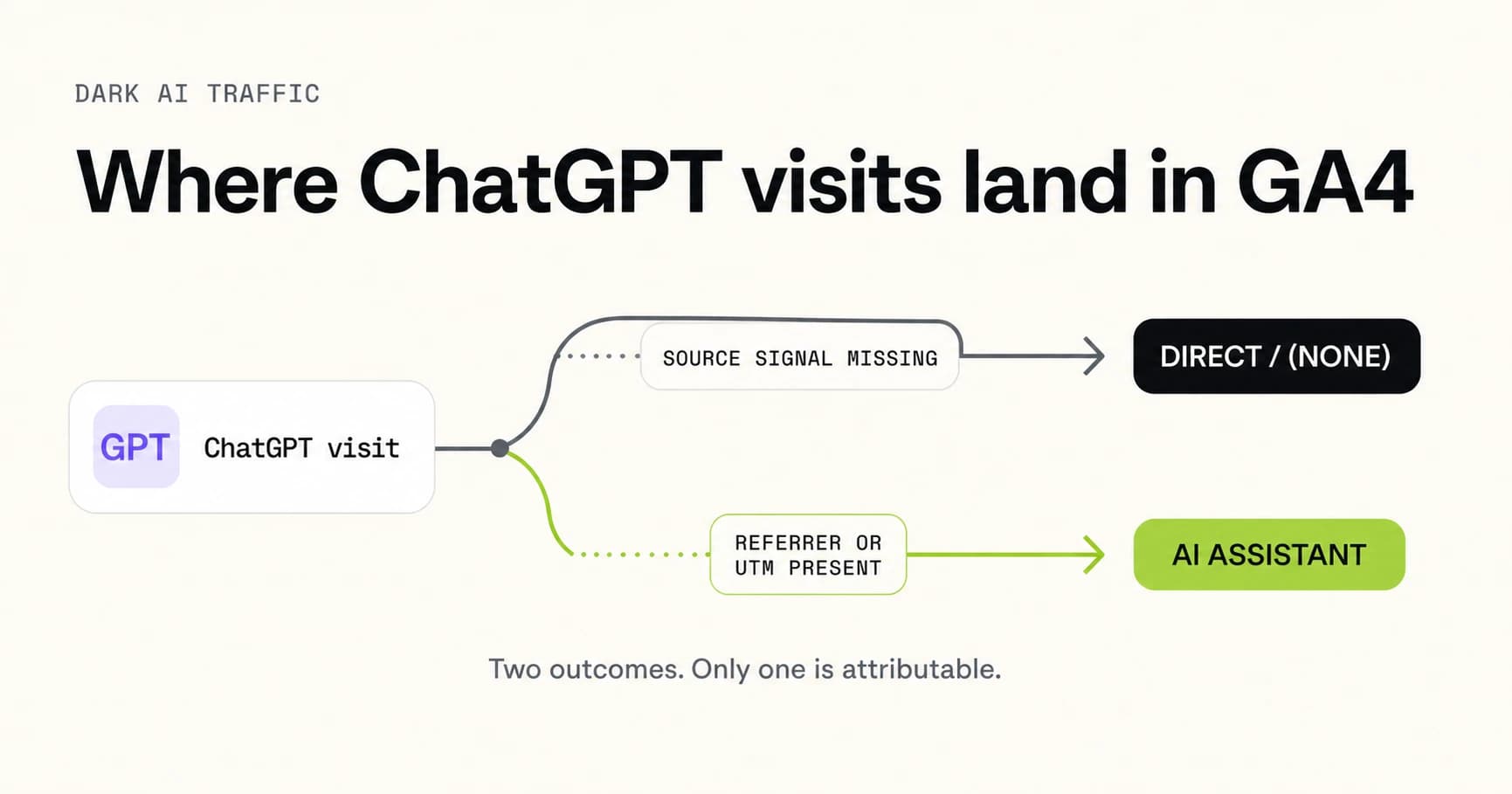
A founder recently showed me a GA4 channel report with one row circled: Direct/(none), up sharply month over month and now his second-largest channel. His question was simple: "Is this brand growth, or traffic from AI answers?" The honest answer was that the report alone could not tell us. Direct is a residual bucket, not a single audience, and a missing source signal cannot be reverse-engineered with certainty after the fact.
That blended row is what I call dark AI traffic, and it is a recurring attribution problem in 2026. This piece is the measurement companion to the ChatGPT referral analytics guide and the GA4 AI traffic setup walkthrough. Here I explain precisely why traffic can go dark, show you how to size the uncertainty on your own site, and rank the fixes by what they actually solve.
Measurement rule: source-visible AI traffic and suspected dark AI traffic are different series. A recognized referrer or UTM is attributable. A Direct landing-page pattern is only a diagnostic signal and must never be reported as a known AI visit.
What "dark AI traffic" actually means
Dark traffic is not new. What has changed is the number of discovery journeys that begin inside an assistant rather than a traditional search results page. The definition is narrow and worth stating precisely.
Dark AI traffic is a visit that (1) originated from an AI assistant answer — ChatGPT, Perplexity, Claude, Gemini, Copilot, or a Google AI Overview — and (2) arrives at your site with no readable referrer and no campaign parameter, so your analytics tool classifies it as Direct or Unknown rather than as the AI engine that actually sent it.
It is not the same as bot traffic. GPTBot and ChatGPT-User[6] or PerplexityBot[7] are documented user agents with different purposes. Crawlers belong in a crawl report; human sessions belong in traffic and conversion reporting.
| Concept | What it is | Where it shows in GA4 |
|---|---|---|
| Dark AI traffic | Human, AI-referred, referrer stripped | Direct / (none) |
| AI referral (visible) | Human, AI-referred, referrer survived | AI Assistant for supported sources, or another source/channel label |
| AI crawler | Bot indexing your pages | Filtered (or noise in Direct if not) |
| True direct | Typed URL, bookmark, returning user | Direct / (none) |
The problem is that dark AI traffic and true direct share the same GA4 bucket, and they are completely different audiences with completely different value.
Why the source signal disappears
By the time GA4 receives a page view, attribution depends on evidence carried into the landing session. The browser may supply a Referer; the destination URL may contain campaign parameters; or neither may arrive. Referrer-Policy controls how much referrer information a document sends, and rel="noreferrer" explicitly suppresses it[2][4]. Privacy controls and storage limits can reduce continuity after the landing page[3].
| What reaches your site | What you can claim | What you cannot claim |
|---|---|---|
| Recognized AI referrer | This session came from the named assistant | The exact prompt or answer, unless the source explicitly supplies it |
| UTM on a controlled link | This session came through the tagged campaign link | That every organic citation uses the same campaign |
| No referrer and no campaign value | The session is unattributed and may appear as Direct | That the visit came from AI, search, email, a bookmark, or a copied link |
| AI crawler user agent | A documented crawler requested a URL | That a human visited, converted, or paid |
Fetch Metadata can tell a server whether a navigation was cross-site, but Sec-Fetch-Site: cross-site does not name the referring service[5]. It is useful context, not an AI attribution key.
Why visible referrals still have limits
GA4's default channel definitions now include AI Assistant for recognized sources[1]. That is useful taxonomy, but it does not change the evidence available on the request.
- A hostname can identify the assistant, but usually not the conversation or prompt.
- A channel rule can classify a surviving source; it cannot recreate a missing one.
- Server-side collection can capture requests that a blocked client tag misses; it cannot name an origin the browser never transmitted.
- A later branded search may have been influenced by an AI answer, but the individual visit is still organic search unless you have separate experiment or survey evidence.
A numerical audit you can reproduce
Do not start with an industry estimate. Start with three counts from the same date range and timezone.
| Symbol | Number to collect | Source |
|---|---|---|
A_ga4 | Human sessions in GA4's AI Assistant channel plus explicitly tagged AI campaigns | GA4 acquisition report |
A_log | Human landing requests whose referrer matches a documented AI hostname | Origin or CDN access logs |
R_ai | Settled revenue joined to those source-visible AI sessions | Payment processor + session join |
Then calculate:
| Metric | Formula | What it answers |
|---|---|---|
| Client collection coverage | A_ga4 / A_log × 100 | Of the AI referrals your server could identify, how many reached GA4? |
| Attributable AI revenue per visit | R_ai / A_ga4 | How valuable were the sessions you can actually name? |
| Source-loss gap | A_log − A_ga4 | How many source-visible requests were lost between the server and analytics tag? |
The source-loss gap is not dark AI traffic. Those requests still carried a recognizable referrer at the server. It is a collection gap. Truly source-less AI visits cannot be counted deterministically from GA4 or server logs after the fact.
Use Direct as a diagnostic, never as attributed revenue
For the same window, export deep-page Direct entries from GA4 and branded-query clicks from Search Console[10]. Plot both against the dates when important pages began receiving AI citations. A divergence can justify an investigation, but it cannot identify individual sessions.
Report the result as two separate series:
- Measured AI: recognized referrers and controlled UTMs.
- Unattributed Direct: optionally annotated with citation dates and landing-page patterns.
Never add a modeled share of Direct to measured AI and present the sum as observed traffic.
Measure the AI traffic you can verify
Connect named AI referrals to revenue
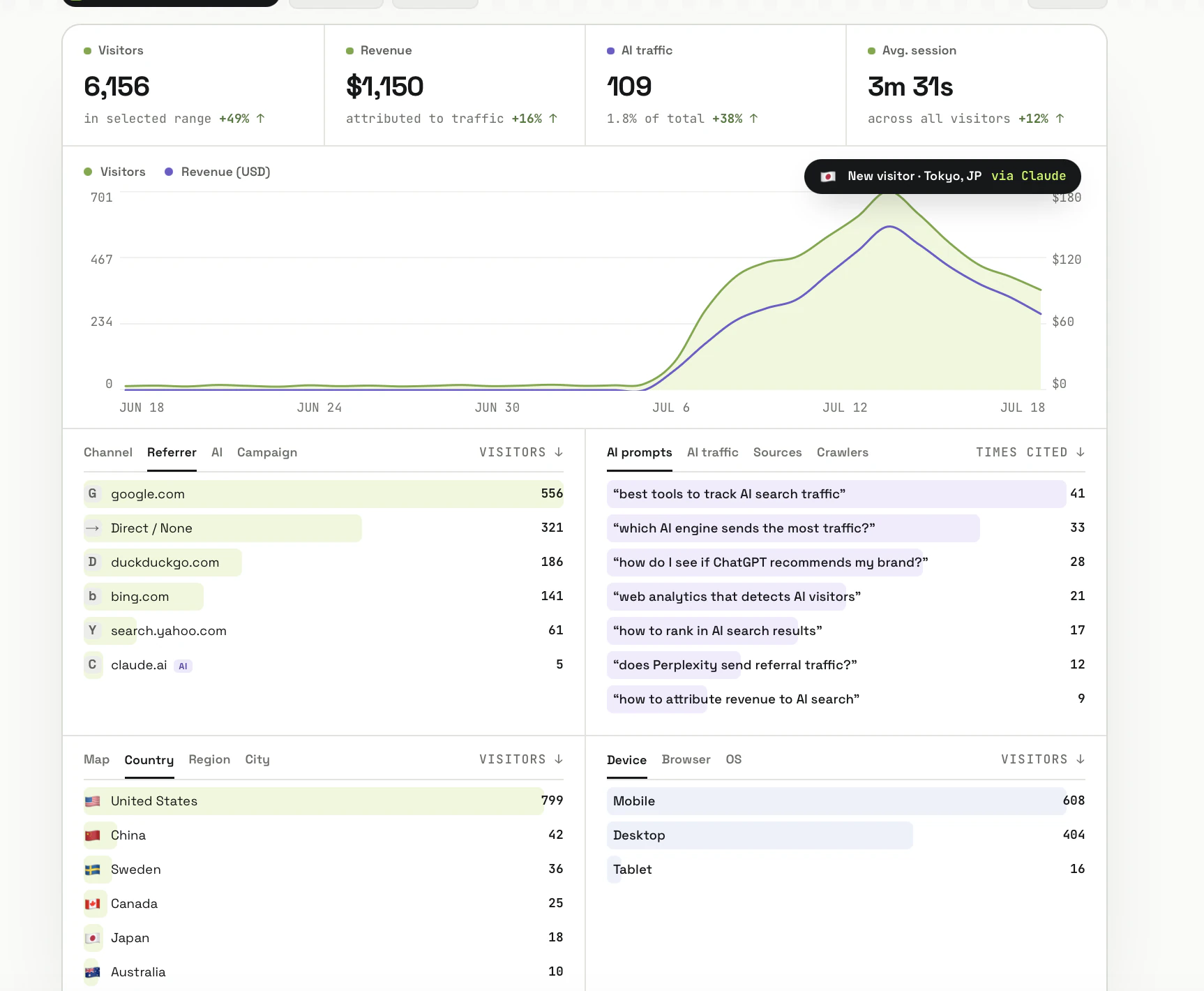
Attrifast recognizes a known AI referrer or UTM at session start, then joins that first-party session to Stripe revenue. Referrer-less visits stay Direct unless another explicit source signal exists.
- ChatGPT, Perplexity, Claude and Gemini on separate rows
- No fingerprinting or cross-site identity graph
- Stripe revenue joined to the original website session
7-day free trial · $0 due today · then $9.99/mo · cancel anytime
How to size dark AI traffic on your own site in 30 minutes
You do not need a tool to get a first estimate. Three steps, all doable with GA4 and your server logs.
Step 1 — Tag everything you control (10 minutes)
Add UTM parameters to every URL you can influence in AI surfaces: your llms.txt links, your structured-data sameAs URLs, citations you place in Reddit or docs. This will not capture organic AI citations (you do not control those links), but it establishes a floor and confirms the mechanism.
Step 2 — Grep your server logs (10 minutes)
Your access logs see the Referer header even when GA4's client-side tag does not fire cleanly. Pull the AI-referred hits directly:
# Human AI referrals that DID pass a referer
grep -E 'chatgpt\.com|perplexity\.ai|claude\.ai|gemini\.google\.com|copilot\.microsoft\.com' access.log \
  | grep -v -E 'GPTBot|ClaudeBot|PerplexityBot|Google-Extended' \
  | wc -l

# AI crawlers, counted separately (filter these OUT of human numbers)
grep -E 'GPTBot|ClaudeBot|PerplexityBot|OAI-SearchBot|Google-Extended' access.log | wc -l
This catches the visible portion. Compare it to the same period's GA4 AI referral count — if the log count is much higher, your client-side tag is already losing AI referrals that the server can see.
Step 3 — Compare Direct against branded search (10 minutes)
This is the inference for the invisible portion. Pull, for the same date range:
| Metric | Where | What it tells you |
|---|---|---|
| Direct/(none) sessions, deep-page entries | GA4 landing-page report, filtered to Direct | Candidate dark traffic — true direct lands on homepage more |
| Branded search volume trend | Search Console | If branded search is flat but deep-page Direct jumped, the jump is not brand lift |
| Direct trend vs AI-citation start date | GA4 + your content calendar | A Direct jump after you got cited = dark AI traffic |
If deep-page Direct entries rose after you started getting cited while branded search stayed flat, you have found a reason to investigate—not a measured AI total. Keep the delta labeled as unattributed and test whether the pattern repeats across several comparable windows.
Four responses, ranked by what they can actually measure
Response 1 — Custom GA4 channel grouping
GA4 already includes an AI Assistant default channel for recognized sources[1]. If you need to extend the taxonomy, create a custom channel group with documented source rules[8]. For example:
^(chatgpt\.com|chat\.openai\.com|perplexity\.ai|claude\.ai|gemini\.google\.com|copilot\.microsoft\.com)
This classifies only the visible slice. It does nothing for an unreferred visit, because Direct is used when no qualifying source or campaign information is available[1]. It is a useful extension, not a source-recovery mechanism.
Response 2 — GTM referrer capture
A Google Tag Manager tag can persist document.referrer and campaign parameters into custom dimensions. It can improve reporting consistency for signals that exist, but it cannot read the Sec-Fetch-Site request header from page JavaScript and cannot restore a referrer that was removed before navigation.
Response 3 — Server-side collection
Move collection server-side to reduce losses caused by blocked client scripts and to preserve the Referer header that reaches your origin. This improves reliability for signals that are present; it does not restore an origin that the browser never transmitted. The cost is engineering: you run an endpoint, maintain the AI-domain list, and write the session-to-revenue join.
Response 4 — A dedicated attribution tool
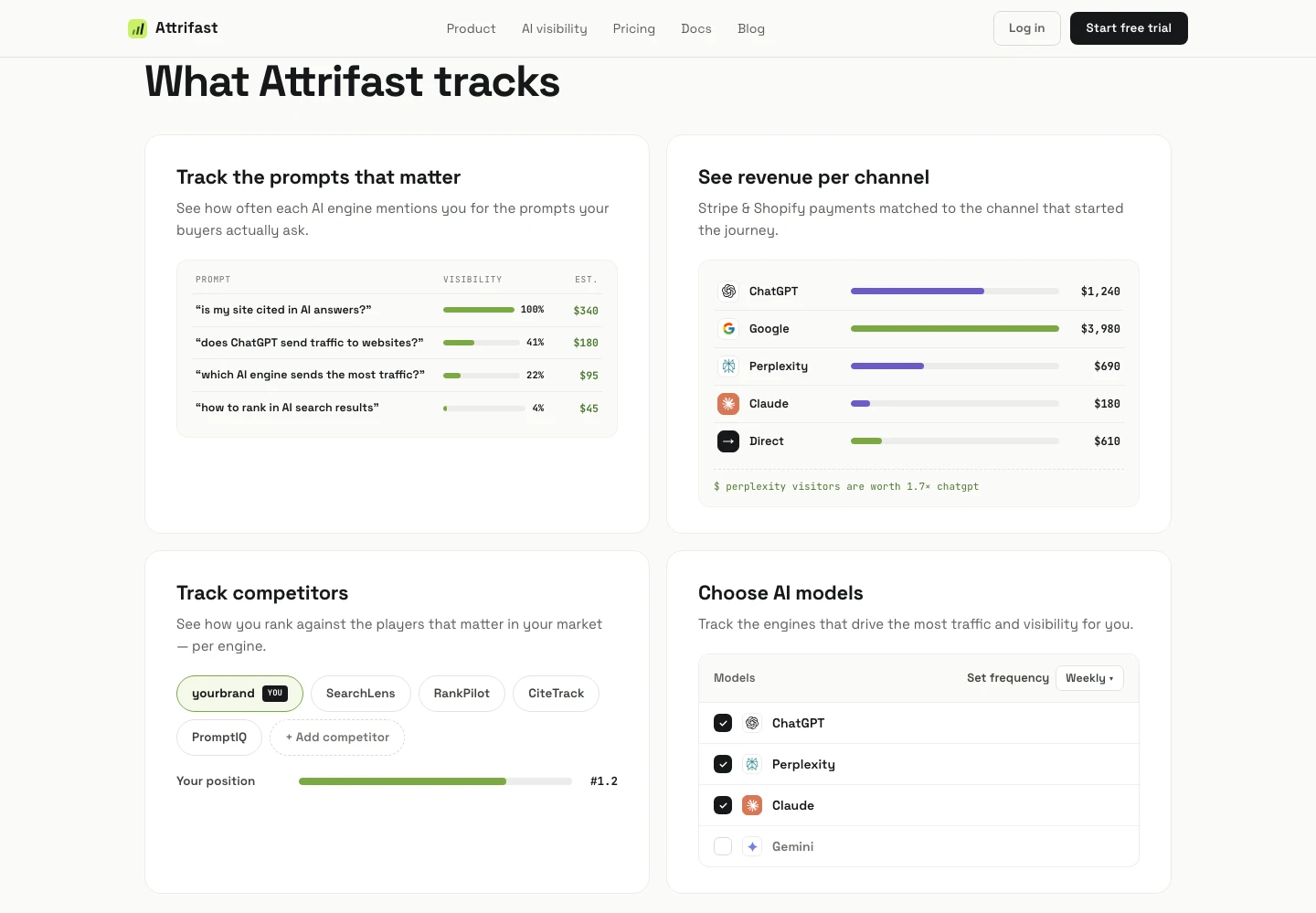
A purpose-built tool maintains the engine list and joins recognized sessions to revenue. Attrifast uses the referrer or UTM available at session start, stores a random first-party session ID, and connects the resulting session to Stripe. It does not fingerprint visitors or relabel unattributed Direct sessions as AI.
| Fix | Recovery | Setup effort | Maintenance | Joins revenue? |
|---|---|---|---|---|
| 1. GA4 AI Assistant channel | Supported visible referrers | Built in | Google maintains default list | Only with ecommerce implementation |
| 2. GTM referrer capture | Visible referrers + campaign persistence | Low–medium | You maintain variables and rules | Only with additional implementation |
| 3. Server-side collection | Signals that reach your origin | High | You own collection and source rules | If you build the join |
| 4. Dedicated tool | Recognized referrers and UTMs | Low | Vendor maintains source rules | Yes, when the payment integration is connected |
Evidence scorecard: what each approach can honestly support
The useful comparison is not a promised recovery percentage. It is the claim each method can defend from the evidence available at collection time.
| Approach | Can name a source-visible AI visit? | Can name a source-less visit? | Can join a payment? | Verification |
|---|---|---|---|---|
| GA4 AI Assistant | Yes, for supported recognized sources[1] | No | Yes, with ecommerce implementation | Compare source/medium and completed orders |
| Custom GA4 channel | Yes, for rules you maintain[8] | No | Yes, with ecommerce implementation | Test known hostnames and UTMs |
| GTM persistence | Yes, when a referrer or campaign value reaches the page | No | Only with additional implementation | Compare first-page values with stored session values |
| Server-side collection | Yes, when the request contains source evidence | No | Yes, if you build the join | Reconcile request logs and processor events |
| Attrifast | Yes, for recognized referrers and UTMs | No | Yes, through its Stripe-oriented join | Reconcile named source rows against Stripe totals |
The principle is simple: a taxonomy can improve labels, storage can preserve evidence, and a payment join can connect outcomes. None of them can turn missing evidence into deterministic attribution.
How to keep AI source rules current
Source taxonomies are a moving target. Each assistant controls its own hosts, redirects, native-app behavior, and referrer policy[2]. Whether you use GA4, a warehouse, or a dedicated analytics product, record the source rule, test it with controlled clicks, and watch for abrupt reporting changes. A maintained default channel reduces manual work; it does not remove the need to verify the underlying request signal.
That is the strategic case for not treating this as a one-time GA4 config: the problem is not static, so a static fix decays.
Common mistakes when chasing dark AI traffic
| Mistake | Why it bites |
|---|---|
| Reading a Direct jump as brand lift | You invest in brand when you should invest in the AI channel that is actually working |
| Blocking all AI crawlers to "clean up" Direct | Crawlers were never in your human Direct number; you just cut future citations |
| Trusting client-side fixes for the dark portion | If the source signal never arrives, neither client-side nor server-side collection can recreate it |
| Setting up the regex once and forgetting it | Engine referrer behavior shifts; the rule rots silently |
| Measuring visits but never revenue | Visit volume alone cannot tell you whether a source produced customers or revenue |
Five integrity checks before you trust the report
- Separate humans from crawlers. GPTBot, ChatGPT-User, PerplexityBot, and other fetchers are not ordinary website sessions. Use vendor user-agent documentation and server logs to keep them out of conversion reporting[6][7].
- Keep visible and modeled traffic in separate series. A recognized referrer or UTM is attributable. A landing-page pattern is a hypothesis. Never sum them into one unlabeled “AI traffic” total.
- Audit GA4's current AI Assistant definition. Google's default list can evolve[1]. Add custom rules only for a documented source you can test, and record when the rule changed.
- Reconcile revenue, not just visits. Compare the total payment amount joined to website sessions with settled processor revenue for the same window. Document refunds, delayed webhooks, and cross-device gaps.
- Watch for breaks. Alert on a sudden loss of recognized AI sources, then compare browser requests, server logs, UTMs, and payment joins before assuming demand disappeared.
Debugging checklist when your AI channel goes silent
Run these in order. The first one that returns "no" is usually the bug.
| # | Check | How to verify | If "no" |
|---|---|---|---|
| 1 | Are relevant crawlers allowed in robots.txt? | curl https://yoursite.com/robots.txt and inspect | Align crawler access with your publishing policy[6][7] |
| 2 | Is your sitemap fresh and submitted? | Search Console → Sitemaps tab[10] | Fix discovery before diagnosing attribution |
| 3 | Is your article crawlable and canonical? | Inspect robots directives, canonical URL, and the rendered page | Fix indexing signals before testing citations |
| 4 | Are the AI engines actually citing you? | Manual check across ChatGPT, Perplexity, Claude on a brand+topic query | If not, the issue is GEO/AEO, not measurement — see the AI citations vs backlinks guide |
| 5 | Does the server log show AI referers in the window? | grep from the worked example above | Engines are sending traffic but referer is being stripped — move to fix 3b |
| 6 | Does the GA4 BigQuery export agree with your report definition? | Query the documented traffic-source fields for the same date window[9] | Reconcile scope, timezone, filters, and session definition before choosing a number |
| 7 | Is your custom channel grouping rule still matching? | GA4 → Admin → Channel groups → inspect recent source values[8] | Update only after confirming a documented hostname or campaign value |
| 8 | Are your custom dimensions populated on recent sessions? | GA4 Explore → check that the dimension is not blank | Confirm the value exists before the event is sent[11] |
| 9 | Is the tracking script itself being blocked client-side? | DevTools → Network → look for googletagmanager.com blocked entries | Heavy ad-block share — move to server-side (server-side analytics guide) |
| 10 | Is consent configuration suppressing analytics storage or collection? | Inspect consent state and tag behavior[12] | Verify the implementation against your consent policy and legal requirements |
The honest bottom line
Dark AI traffic is a real measurement gap, but the honest answer is not to manufacture precision. Measure the AI referrals whose source survives, tag every link you control, and use Direct-pattern analysis only as a directional diagnostic. A server-side layer improves collection reliability and can join attributable sessions to revenue; it cannot prove a source that never arrived.
If you want the revenue side without building the join, Attrifast website and AI analytics names recognized AI referrals and attaches Stripe revenue in one dashboard. If you want to go deeper on the per-engine mechanics, read the ChatGPT referral analytics guide and the GA4 AI traffic setup walkthrough.
FAQ
What is dark AI traffic?
Dark AI traffic is AI-referred traffic that arrives without a readable referrer or campaign parameter, so analytics files it under Direct or Unknown. Its exact share cannot be measured deterministically after the source signal is gone.
Why does ChatGPT traffic show up as Direct in GA4?
AI referral behavior varies by engine, device, and surface. GA4 now includes an AI Assistant channel for recognized sources[1]. When a click arrives with neither a referrer nor campaign parameter, however, GA4 has no source evidence and uses Direct; no channel definition can recreate the missing information.
How much of my Direct traffic is actually AI?
There is no universal percentage. Build a measured floor from surviving AI referrers and UTMs, then treat landing-page and citation-timing analysis as a directional estimate with explicit uncertainty.
Can I fix dark AI traffic with a GA4 setting?
Partially. GA4's built-in AI Assistant channel and custom channel groups can classify visits whose source survives. Server-side collection can reduce collection loss. Neither method can deterministically identify a referrer-less, untagged visit as AI.
Does dark AI traffic convert better than regular Direct?
Not universally. Source-visible AI sessions may convert differently by engine, query, landing page, and business model. Compare revenue per visitor and conversion rate on your own attributable traffic; the source-less portion of Direct cannot be isolated as ground truth.
Will the dark AI traffic problem get worse?
AI discovery can grow while attribution quality improves or declines independently. The durable approach is to preserve explicit source signals, monitor source-loss separately, and reconcile attributable sessions against real payment outcomes.
Sources
Primary sources for the claims in this article. Numbered citations in the text link to the matching entry.
- [1]Default channel group — Direct and AI Assistant definitions — Google Analytics Help (2026).
- [2]Referrer-Policy header — MDN Web Docs (2026).
- [3]Intelligent Tracking Prevention — WebKit (2026).
- [4]rel=noreferrer and link types — WHATWG (2026).
- [5]Sec-Fetch-Site and Fetch Metadata request headers — MDN Web Docs (2026).
- [6]GPTBot and ChatGPT-User documentation — OpenAI (2026).
- [7]PerplexityBot documentation — Perplexity (2026).
- [8]Set up custom channel groups in GA4 — Google Analytics Help (2026).
- [9]GA4 BigQuery export schema — Google Analytics Help (2026).
- [10]Search Console performance reporting — Google Search Console Help (2026).
- [11]GA4 event implementation and page_referrer — Simo Ahava Blog (2020).
- [12]Consent mode on websites and mobile apps — Google Analytics Help (2025).
Related reading from the Attrifast research stack
For hands-on tools and deeper context, see track ChatGPT traffic, track Claude traffic, and revenue attribution.