
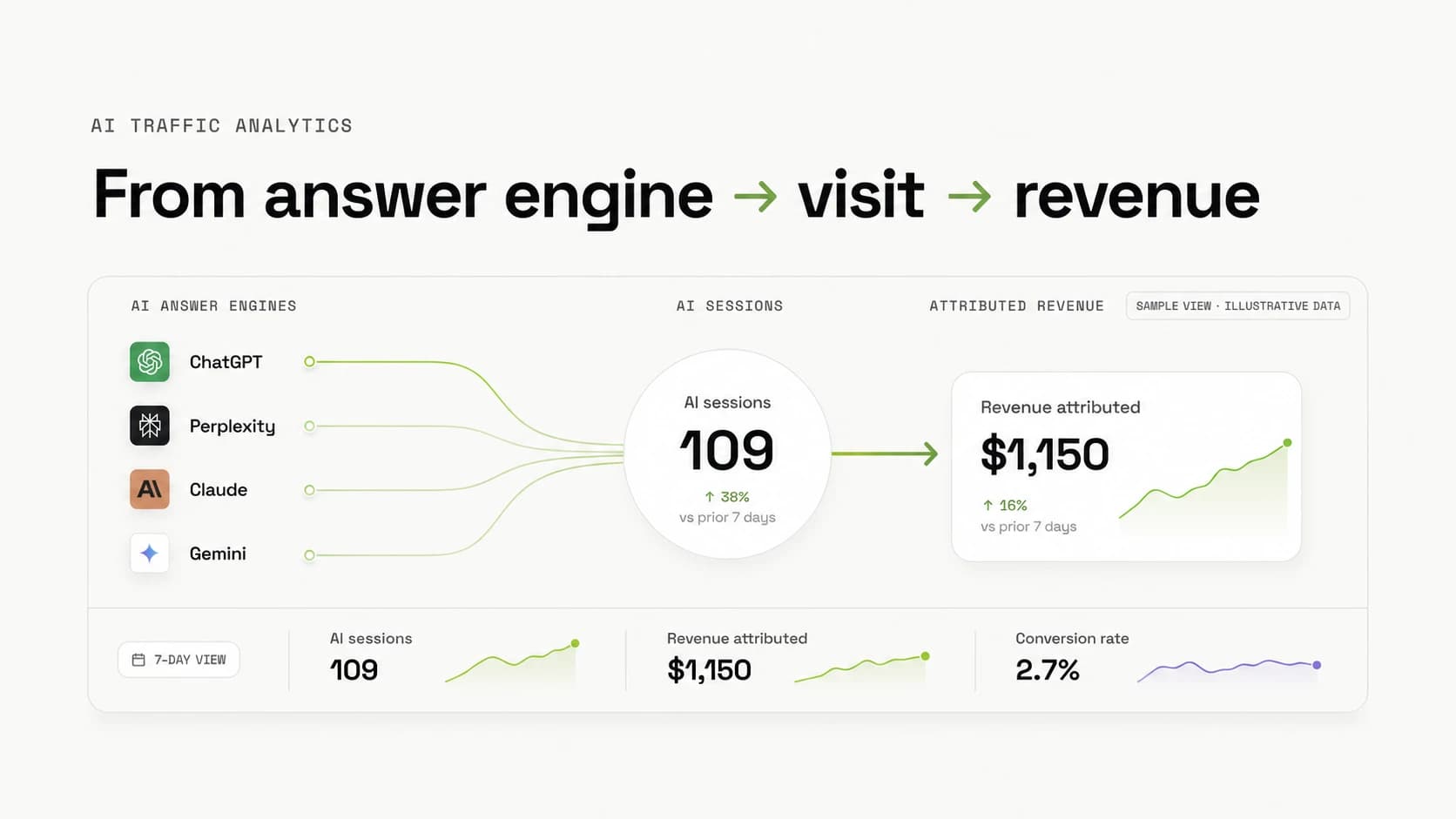
Part of the AI Search Hub — browse all 36 AI Search guides.
The market uses “AI analytics” for three different questions. Mixing them produces impressive dashboards and weak decisions.
| Question | Evidence required | Correct output |
|---|---|---|
| Is an assistant mentioning or citing us? | Repeated prompt sample and captured answers | Visibility or citation share |
| Did an assistant send a website visit? | Recognized referrer or campaign parameter | Source-visible AI sessions |
| Did that visit create revenue? | Website session ID joined to a completed payment | Revenue and RPV by attributable source |
This guide focuses on the second and third questions. For prompt and citation monitoring, use the AI visibility tracker comparison.
Measurement standard: a named AI session requires an explicit source signal such as a recognized referrer or UTM. A pattern inside Direct is a hypothesis, not product-level attribution.
The three numbers worth reporting
Every useful AI traffic report can begin with three auditable numbers from the same property, date range, and timezone.
| Metric | Formula | Decision it supports |
|---|---|---|
| Recognized AI share | attributable AI sessions ÷ all measured sessions | Whether observable AI traffic is growing |
| AI revenue per visitor | settled revenue from attributable AI sessions ÷ attributable AI visitors | Which named source creates more commercial value |
| Revenue reconciliation | revenue joined to measured sessions ÷ settled processor revenue | Whether the attribution system is complete enough for budget decisions |
These formulas are intentionally more useful than a global benchmark. If another site's engine mix, checkout coverage, or attribution rule differs, its percentage is not comparable to yours.
How an AI visit becomes a revenue line
The flow has three gates. Each gate can only use evidence preserved by the previous one.
1. Detect only evidence that exists
| Signal | Use it for | Do not use it for |
|---|---|---|
| Recognized referrer hostname | Naming a source-visible assistant visit | Claiming every visit from that assistant was captured |
| UTM on a link you control | Naming that campaign and source | Assuming organic citations contain your tags |
| Documented crawler user agent | Measuring crawler requests | Counting human sessions, citations, or conversions |
| Deep-page Direct pattern | Diagnosing a possible attribution gap | Assigning a specific engine to an individual visit |
GPTBot and ChatGPT-User have documented, distinct purposes [3]. Google also documents Google-Extended separately from its search crawlers [4]. Keep crawler activity outside the human conversion funnel.
2. Classify the assistant without inventing the prompt
A maintained hostname dictionary can separate ChatGPT, Perplexity, Claude, Gemini, and Copilot when a source signal survives. The receiving website usually cannot see the visitor's private prompt. Record the engine and landing page; do not manufacture prompt-level certainty.
| Captured field | Why it matters |
|---|---|
| Source evidence | Referrer hostname or campaign value used for classification |
| Rule version | Which source dictionary produced the label |
| Landing page | Content that received the visit |
| First-touch timestamp | Start of the attributable journey |
| Session ID | Join key carried into conversion and payment events |
3. Join the session to the payment
Store a random first-party session ID, pass it into checkout metadata, and resolve it when the payment event arrives. Stripe exposes metadata on Checkout Sessions for this purpose [2]. The revenue report should reconcile against settled processor totals and document refunds, delayed webhooks, and unmatched sessions.
| Outcome | Report as |
|---|---|
| Recognized AI session + completed payment | Attributable AI revenue |
| Recognized AI session + no payment | Attributable visit, no revenue yet |
| Direct session + completed payment | Direct/unknown revenue |
| Citation with no observed visit | Visibility, not traffic or revenue |
Measure each surface with the same evidence rule
The assistants differ in product design, but your attribution standard should not. A source is named only when evidence reaches the site.
| Surface | What may be observable | What remains unknown |
|---|---|---|
| ChatGPT, Claude, Gemini, Copilot | Surviving hostname or campaign value | Private prompt and source-less handoffs |
| Perplexity | Surviving hostname or campaign value | Prompt unless explicitly exposed by the source |
| Google AI Overviews | Google search traffic and landing page | Whether a later untagged visit was influenced by an overview |
| Public shared answer | Referrer or tagged shared URL | Whether the visitor authored the original conversation |
Prioritize engines using your own attributable sessions, RPV, landing-page fit, and sampled visibility—not a global audience-size table.
What GA4's AI Assistant channel solves — and what it does not
Google's current default channel documentation includes AI Assistant for recognized sources such as ChatGPT, Gemini, DeepSeek, Copilot, and Grok [1]. That fixes an important labeling problem: supported AI hostnames no longer have to remain buried in generic Referral. It does not solve missing evidence. If an app, browser handoff, redirect, or link policy sends neither a referrer nor campaign parameter, GA4 still has no deterministic source to classify.
The mechanical chain of failures:
| Failure | Mechanism | Result in GA4 |
|---|---|---|
| Referer stripped by AI client | HTTP header missing | Direct/(none) |
| Recognized AI hostname present | GA4 AI Assistant rule matches | AI Assistant |
| UTM parameter absent | Operator didn't pre-tag the URL | Whatever the referer says, usually Direct |
| Storage or consent restrictions | Identifier is unavailable or shortened | Reduced continuity, depending on implementation |
| Adblocker drops the gtag.js call | Beacon never fires | Visit unrecorded |
| In-app browser webview | Inconsistent JS sandbox | Mixed behavior, often Direct |
A custom channel can still be useful for sources or naming conventions not covered by Google's default definition. Treat it as taxonomy maintenance, not traffic recovery: it can relabel a surviving source, but it cannot identify a visit whose evidence disappeared before collection.
| Attribution method | What the report can support | What remains unknown |
|---|---|---|
| GA4 AI Assistant default channel | Supported source-visible assistant visits | Referrer-less visits and unsupported sources |
| GA4 + custom channel maintenance | Additional source-visible hostnames you define | Referrer-less visits |
| Default/custom channels + UTM discipline | Visible hostnames plus links you tagged | Organic citations with no signal |
| First-party session + Stripe join | Revenue from recognized sources | Revenue from source-less Direct sessions |
The useful distinction is label quality versus signal availability. Better instrumentation can preserve more evidence and join it to revenue, but it cannot certify the origin of a visit that arrived with no source signal.
Turn verified source signals into a revenue line
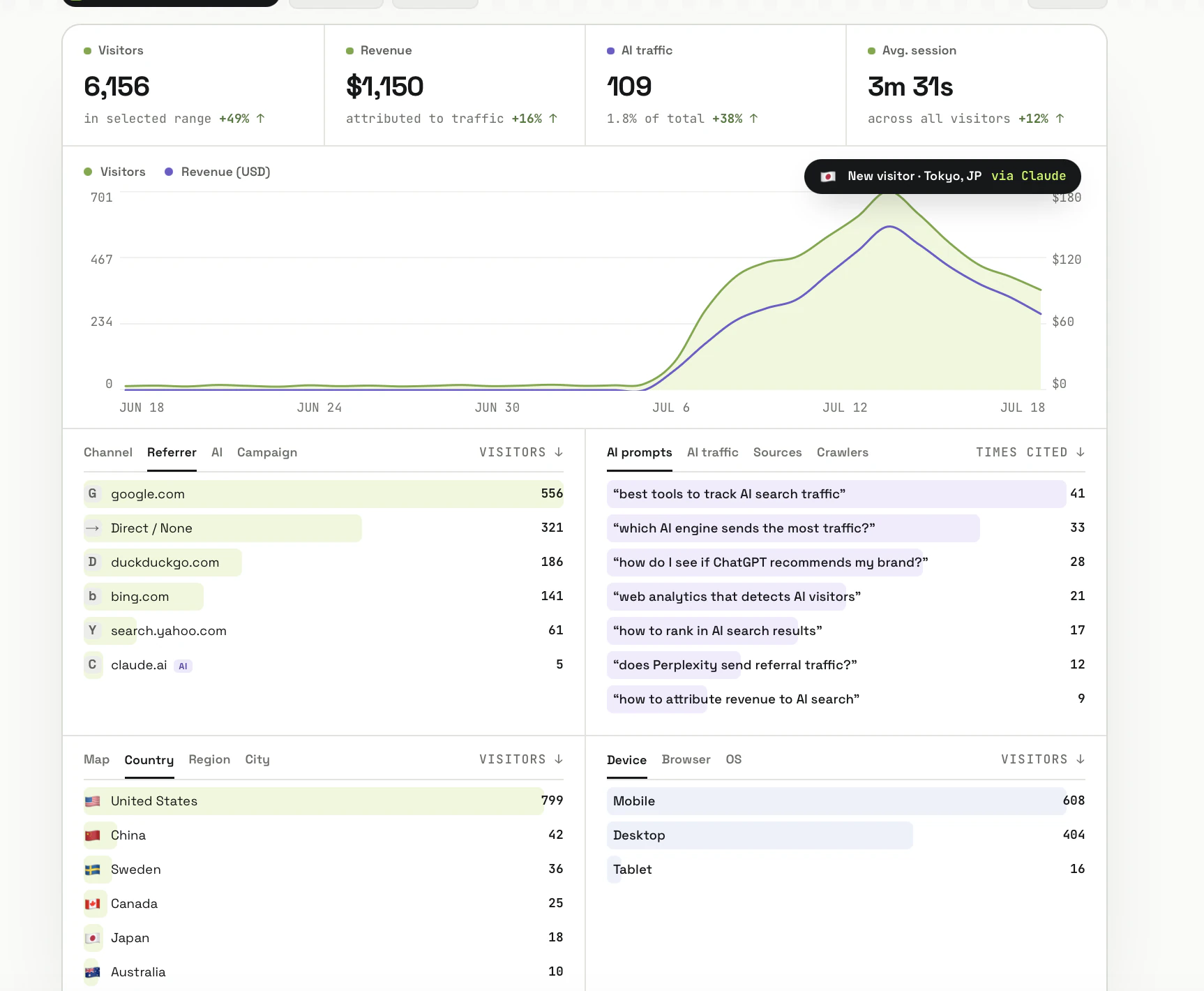
See which AI engines send customers — not just clicks
Attrifast separates ChatGPT, Perplexity, Claude and Gemini, then joins each first-party session to the Stripe payment it produced.
- Named engine rows only when a referrer or UTM survives
- Revenue per visitor and conversion rate by engine
- Lightweight script plus a Stripe integration
7-day free trial · $0 due today · then $9.99/mo · cancel anytime
The other GA4-specific issues that compound:
| GA4 issue | Effect on AI traffic | Workaround |
|---|---|---|
| Explorations can sample above 10M events per query | Small AI segments can be harder to inspect inside large ad-hoc queries | Narrow the query or use export workflows [5] |
| Built-in AI taxonomy can change | Historical labels and your internal reporting definitions may drift | Keep a versioned source dictionary and audit it quarterly |
| Source-less visits remain Direct | The originating assistant cannot be proven | Report the gap separately; do not manufacture engine-level precision |
| Revenue events require implementation | A channel label alone does not create a payment join | Reconcile analytics revenue against completed orders |
| Reporting definitions can evolve | Period comparisons can mix different source dictionaries | Version the rule set used for each report |
Compare tools by the decision they support
Product names, prices, and engine lists change. A durable comparison begins with the evidence each category collects.
| Approach | Measures citations? | Measures source-visible visits? | Can join revenue? | Main limitation |
|---|---|---|---|---|
| AI visibility monitor | Yes, on a sampled prompt set | Usually no | Usually no | Sampling does not equal all buyer prompts or clicks |
| GA4 | No | Yes, including its documented AI Assistant channel [1] | Yes, with ecommerce implementation | Missing source signals remain unattributed |
| Privacy-focused web analytics | No | Yes, when referrer or campaign evidence survives | Product-dependent | Often optimized for visit counts rather than payment joins |
| Origin/CDN logs | No | Yes, when a referrer reaches the server | Not by themselves | Requires bot filtering, session logic, and a separate payment join |
| Custom first-party pipeline | Only if you build prompt monitoring | Yes | Yes | Engineering and maintenance burden |
| Attrifast | Separate AI visibility plus recognized-source traffic | Yes | Yes, with its Stripe integration | Source-less visits remain Direct; payment support is product-specific |
Use this purchasing checklist before comparing screenshots:
- Can the vendor show the raw source evidence behind a named AI session?
- Does “visibility” mean sampled answers or observed website visits?
- Can revenue totals be reconciled to the payment processor for the same window?
- How are source-less sessions labeled?
- Are crawler requests separated from human sessions?
- What storage is used, and what consent configuration does your jurisdiction require?
Attrifast is built for the recognized-AI-session-to-Stripe workflow. If your main question is citation share across a large prompt set, use a dedicated visibility monitor. If your team already has a reliable warehouse and payment join, a custom pipeline may be the better fit.
Setup workflow: the four implementation paths
You have four practical setup options. They trade coverage for effort, and many teams combine two or three of them.
| Approach | Catches | Misses | Effort | Cookieless? | Revenue-joinable? |
|---|---|---|---|---|---|
| UTM tagging on links you control | Visits through those tagged URLs | Organic citations and copied links without your tags | Low, ongoing discipline | Yes | Yes if your analytics joins campaign data to payments |
| Server-log parsing | Human requests carrying a recognized referrer; documented crawler requests | Source-less human visits | Medium | Yes | Not by itself |
| Client-side source capture | Browser sessions where referrer or campaign evidence survives | Requests blocked before the script runs; source-less visits | Medium | Depends on storage and implementation | Depends on stack |
| First-party session attribution | Recognized sources, campaign values, and payment-session joins | Referrer-less untagged visits, voice queries, zero-click | Vendor-assisted or custom | No third-party cookies required | Yes when the payment join is implemented |
Path 1: UTM hardcoding (the underrated cheap win)
Add UTM tags to links you control: partner placements, newsletters, public demos, ads, social posts, and documentation campaigns. Use a convention that describes the real placement rather than labeling every reusable link as an AI citation:
?utm_source=<publisher>&utm_medium=referral&utm_campaign=<campaign-name>
If that exact URL is later reused elsewhere and the query string survives, the campaign value remains observable. That does not prove the AI engine created or endorsed the link; it proves the visitor used the tagged URL.
| Where to tag | UTM scheme | Why |
|---|---|---|
| Partner article | utm_source=partner-name&utm_medium=referral | Preserves the actual publisher relationship |
| GitHub README | utm_source=github&utm_medium=referral | Separates documentation discovery from other referrals |
| Newsletter | utm_source=newsletter-name&utm_medium=email | Keeps issue or campaign analysis consistent |
| Conference deck | utm_source=event-name&utm_medium=presentation | Identifies a controlled offline-to-web placement |
Path 2: Server-log grep
This is the quickest free option: search your raw access logs for known AI-engine domains. Here is the Nginx command I use:
grep -E "(chatgpt\.com|chat\.openai\.com|perplexity\.ai|claude\.ai|gemini\.google\.com|copilot\.microsoft\.com|you\.com|kagi\.com)" \
  /var/log/nginx/access.log \
  | awk '{print $1, $7, $11}' \
  | sort | uniq -c | sort -rn | head -50
Pair it with a user-agent grep for GPTBot|ChatGPT-User|OAI-SearchBot|PerplexityBot|ClaudeBot|Google-Extended|Bytespider and you have a passable AI-traffic snapshot for the day.
This is a useful diagnostic for evidence that reached the server. It is not a complete traffic product: logs need bot filtering, sessionization, retention rules, and a separate payment join.
Path 3: Client-side JS attribution
A small JS snippet that reads document.referrer on page load and writes the matched AI engine to a first-party sessionStorage token. The minimal implementation:
const AI_DOMAINS = {
  'chatgpt.com': 'chatgpt',
  'chat.openai.com': 'chatgpt',
  'perplexity.ai': 'perplexity',
  'www.perplexity.ai': 'perplexity',
  'claude.ai': 'claude',
  'gemini.google.com': 'gemini',
  'copilot.microsoft.com': 'copilot',
  'you.com': 'youcom',
  'kagi.com': 'kagi',
}

function captureAiSource() {
  const referer = document.referrer
  if (!referer) return null
  try {
    const host = new URL(referer).hostname
    const engine = AI_DOMAINS[host]
    if (engine) {
      sessionStorage.setItem('aiSource', engine)
      // Persist to your analytics endpoint
      fetch('/api/track', {
        method: 'POST',
        body: JSON.stringify({ engine, url: location.href }),
      })
      return engine
    }
  } catch (_) { return null }
  return null
}
captureAiSource()
Client-side and server-side collection may observe different subsets because scripts can be blocked while the origin still receives the request. Compare both against a controlled click test; do not convert that difference into a universal coverage percentage.
Path 4: Server-side first-party attribution
The full attributable setup combines UTM parsing, bot exclusion, and referrer matching. Store the recognized result with a first-party session ID, then pass that ID to Stripe and join the payment through webhook metadata. The practical ChatGPT traffic guide shows the reference architecture.
Coverage is the share of visits that carry a recognized source signal and complete the session join. Do not publish a universal recovery percentage; validate it on your own controlled links and payment totals.
Whichever path you choose, keep the same four principles: detect early, store the result server-side, join it through a Stripe webhook, and do not rely on a third-party cookie.
Common AI traffic analytics mistakes
These are the mistakes that most often turn an AI report into an attribution claim it cannot support.
Mistake 1: Buying a citation monitor and expecting revenue numbers. Profound, Loamly, Geoptie, Otterly, and SEOcrawl measure mentions, not payments. Ask a vendor one direct question: “Can this show last month's Stripe revenue from ChatGPT visits?” If the answer involves CSV exports and a spreadsheet, the product does not include a revenue join.
Mistake 2: Treating a GA4 custom channel as complete coverage. It correctly relabels AI visits whose referrer survives and does nothing when the source signal is absent. Pair the rule with disciplined UTMs and a first-party revenue join; report the remaining Direct traffic as unknown rather than inferred fact.
Mistake 3: Treating every AI engine as one channel. ChatGPT, Perplexity, Claude, Gemini, and AI Overviews differ in revenue per visitor, referrer behavior, and audience. Use the combined number for a board slide, but use the engine-level breakdown to make content decisions.
Mistake 4: Counting bot impressions as citations. A crawler request is not a citation. Citation evidence is an observed assistant response that links or names the page; a recognized referral proves a visit from the assistant but may not reveal the prompt that produced it. Keep "crawled," "cited," and "clicked" as separate events.
Mistake 5: Treating crawler policy as a universal SEO switch. Training, search indexing, and user-triggered fetchers can use different controls [3][4]. Decide which agents to allow based on your publishing policy, then verify the documented behavior of each user agent. A crawl request is still not evidence of a citation or a human visit.
Mistake 6: Letting Direct/(none) grow without checking it. Audit the bucket by landing page, release dates, campaign activity, and branded-search trends. Treat a pattern as a reason to investigate, not proof that the missing source was AI.
Mistake 7: Reporting traffic without value. Put attributable revenue or conversion rate beside source-visible traffic. Keep the date range, currency, refund handling, and checkout coverage consistent.
Mistake 8: Confusing sessions, visitors, and clicks. Define the unit in every report. A single visitor may create multiple page views or sessions; a referrer URL is not a stable person identifier.
Mistake 9: Treating a prompt sample as the whole market. Record the prompt list, engines, locations, run count, and dates behind a visibility score. Compare like with like and disclose that sampled answers are not a population census.
Mistake 10: Optimizing for one engine and reporting on all. Keep engine-level visibility and source-visible traffic rows. The aggregate is useful for orientation; the per-engine data is what supports content and landing-page decisions.
The honest measurement stack: visibility + revenue attribution
Most SMB SaaS teams need two products: a visibility tracker such as Profound, Loamly, or Geoptie, and a revenue-attribution layer such as Attrifast for Stripe or a custom server-side build for another payment provider. One tells you where you appear; the other tells you what those appearances are worth.
| Question | Visibility tracker answers | Revenue attribution answers |
|---|---|---|
| "Am I cited in ChatGPT answers for query X?" | Yes (sampling-based) | No |
| "How does my citation share trend over time?" | Yes | No |
| "Which competitors are cited next to me?" | Yes | No |
| "Did the citation produce a click?" | No | Yes (per visit) |
| "What's my AI-attributed revenue this month?" | No | Yes |
| "Which AI engine has the highest RPV?" | No | Yes |
| "Did my GEO content sprint pay back its cost?" | Partially (visibility delta) | Partially (revenue from attributable sessions) |
| "Are AI clicks converting better than Google organic?" | No | Yes |
Do not divide payments by sampled citations and call the result a conversion rate: the sampled answer set is not the denominator for all real-world exposures. Compare the direction of citation coverage with the direction of source-visible visits, then calculate conversion rate only on observed website sessions.
The recommended monthly review structure, once both tools are in place:
| Review section | Source | Decision driven |
|---|---|---|
| Visibility share by engine | Profound/Loamly/Geoptie | Content gap analysis (which queries you're missing) |
| Citation density trend | Same | Whether your authority signals are improving |
| AI-attributed traffic by engine | Attrifast | Channel-level investment decisions |
| AI-attributed revenue by engine | Attrifast | Per-engine ROI on GEO effort |
| Click-to-citation ratio (cross-tool) | Both tools combined | Citation framing and snippet quality |
| Per-page AI revenue | Attrifast | Page-level investment (which content to expand) |
| Direct/(none) audit | GA4, logs, and campaign history | Attribution uncertainty review |
The scorecard to calculate on your own site
Market-wide AI traffic averages are poor decision tools because engine mix, buying cycle, landing pages, geography, and missing-source rates differ dramatically. Use a fixed scorecard on your own property instead. Every number below has a numerator and denominator you can audit.
| Metric | Formula | What it tells you | Integrity rule |
|---|---|---|---|
| Recognized AI share | source-visible AI sessions ÷ all measured sessions | The observable floor for AI traffic | Never present it as total AI-originated traffic |
| AI revenue per visitor | revenue from attributable AI sessions ÷ attributable AI visitors | Commercial value by engine | Compare the same date range and checkout coverage |
| AI conversion rate | attributable AI customers ÷ attributable AI visitors | Landing-page and offer fit | Require a minimum sample before ranking engines |
| Source-loss rate | source-less sessions ÷ all measured sessions | Size of the attribution uncertainty | Do not assign the unknown bucket to an engine |
| Revenue reconciliation | attributed revenue ÷ processor revenue | Whether the payment join is complete | Investigate refunds, delayed webhooks, and cross-device gaps |
| Citation-to-visit trend | recognized AI visits compared with sampled citation trend | Whether visibility and traffic move together | Treat it as directional; citations are not a click denominator |
Worked example with hypothetical inputs: if ChatGPT sends 240 source-visible visitors and those sessions produce $720 in settled revenue, RPV is $720 ÷ 240 = $3.00. If Stripe shows $20,000 total revenue but only $17,600 is joined to a measured session, report 88% revenue reconciliation and investigate the remaining 12% before using channel totals for budget decisions.
This scorecard is less dramatic than an anonymous industry benchmark, but it is more useful: every result can be reproduced from your traffic log and payment processor.
What changes when you actually measure this correctly
The shape of a monthly review changes once recognized AI sources and payment outcomes use the same session definition:
| Review section | Before correct AI attribution | After correct AI attribution |
|---|---|---|
| Channel mix | AI sources buried inside a broader report | Recognized AI sources visible; source-less Direct unchanged |
| Content prioritization | Based on Google rank + organic clicks | Search demand + sampled citations + attributable revenue |
| Page-level investment | Pages with high Google traffic | Pages with high (Google + AI) revenue per visit |
| New-content brief | SEO keyword + topic cluster | SEO keyword + AI citation hook + FAQ block design |
| Vendor evaluation | "Do we need a new GA?" | "Do we need a Stripe-native attribution layer?" |
| Campaign attribution model | First / last / linear / GA4 data-driven | Same model, with recognized AI sources named consistently |
| Cohort definition for retention | By first-touch channel | By first-touch channel + recognized AI source |
| Conversion-rate optimization | Page-level + funnel-level | Page-level + funnel-level + AI-source-level |
| Pricing-page test interpretation | All visitors blended | Segment recognized AI visitors; keep Direct unknown |
| Long-tail blog ROI | Organic clicks only | Organic clicks + citations + attributable revenue |
| Year-over-year growth attribution | Channel-aggregate | Channel + AI-engine subdimension |
Pay particular attention to page-level revenue. Once AI attribution is working, the ranking often changes: a long-tail article that appears unimportant in GA4 may be a frequent AI citation and a meaningful source of conversions. Without the AI source attached, that page is easy to cut for the wrong reason.
What this looks like inside Attrifast
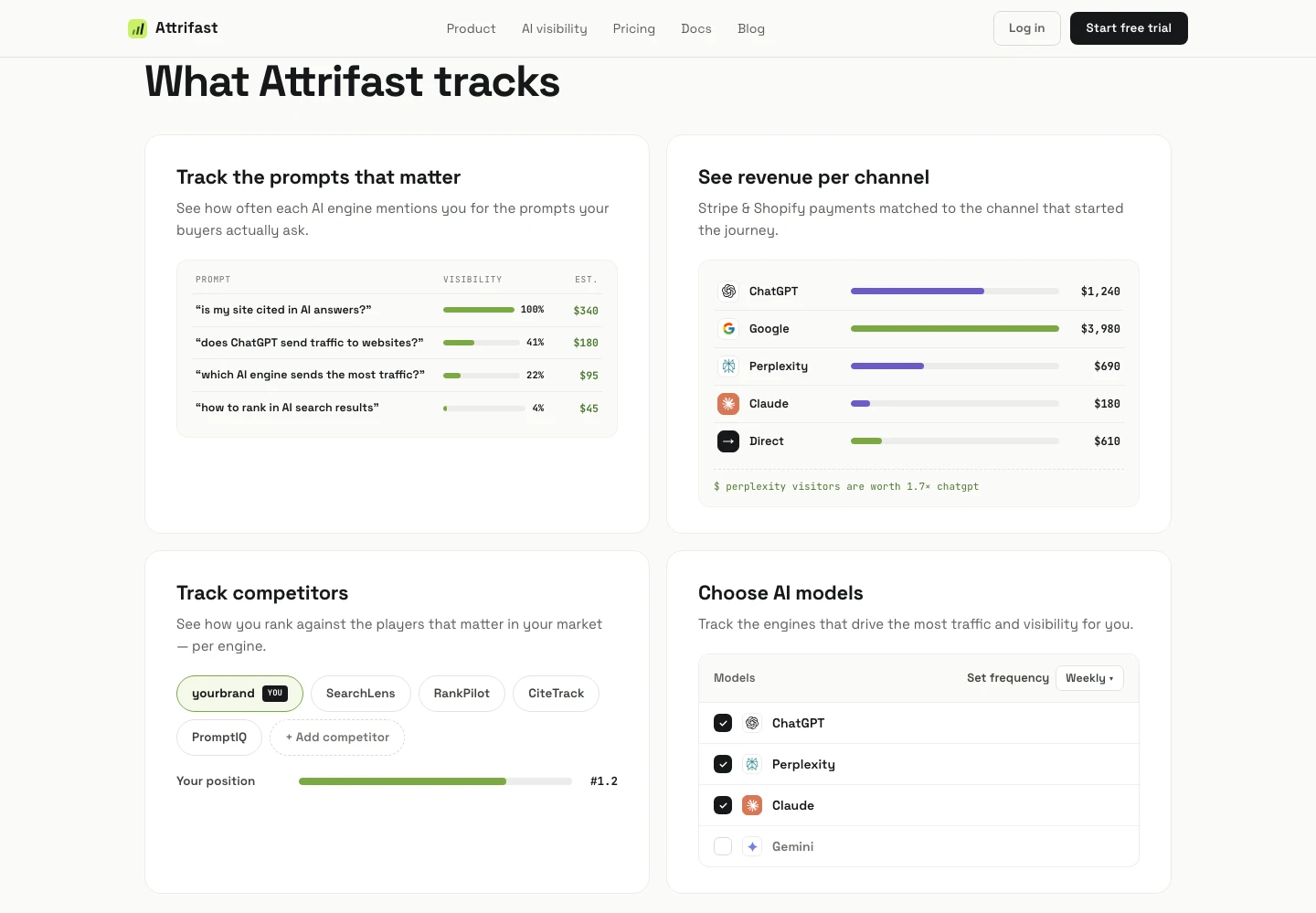
Disclosure: I built Attrifast. It combines AI visibility reporting with first-party website analytics and a Stripe revenue join. Recognized AI referrers and UTMs appear as named source rows; visits without source evidence remain Direct. The product then associates the captured website session with the corresponding completed payment, so the revenue view can be reconciled against Stripe.
| Attrifast capability | Spec |
|---|---|
| Tracking script size | 4 KB gzipped |
| Setup time | ~2 minutes (script tag + Stripe restricted API key) |
| AI source coverage | Supported sources with a recognized referrer or UTM; verify the current source list in product |
| Detection methods | Recognized referrer + UTM; bot UAs reported separately |
| Third-party cookies | Not used for the first-party session model |
| Consent considerations | Uses first-party localStorage; review jurisdiction and configuration |
| Revenue join | Stripe webhook (native) |
| Other PSPs | Paddle, LemonSqueezy on roadmap |
| Entry price | $9.99/mo |
| Free trial | 7 days, $0 due today |
Pricing and the current product workflow are on Attrifast. The advantage over assembling separate visibility, analytics, and payment reports is operational: the observable source, website session, and Stripe outcome can be reviewed in one place. The Attrifast vs Google Analytics comparison covers the differences in detail.
Limitations
Keep these limits in mind when you apply the framework in this guide.
- Voice queries. When a user asks ChatGPT, Gemini, or Siri-via-ChatGPT a question in voice mode and the assistant speaks the answer back without rendering a clickable link, no visit happens to track. The brand mention happens; the traffic doesn't. No reliable measurement story exists for voice-mode answer engines as of mid-2026.
- Enterprise and native-app surfaces. Referrer behavior can differ across web, native-app, and managed-enterprise contexts. Test each surface you care about rather than applying one pass-through rate to all traffic.
- Cross-device sessions. A user reading a Perplexity answer on mobile, screenshotting the URL, then opening it on desktop later looks like a Direct visit from a new visitor unless your stack has identity stitching. No reliable cookieless fix; treat as a known undercount.
- Region and language variance. Engine usage, citation behavior, privacy controls, and buyer intent vary by market. Segment your own data before comparing regions.
- Agent-driven visits. Automated browsers can resemble human sessions. Keep bot and agent classification separate from human revenue attribution unless you have explicit evidence of a customer action.
- Benchmarks drift. Recalculate source share, conversion rate, RPV, and revenue reconciliation on a fixed cadence. Do not turn one quarter's result into a permanent multiplier.
FAQ
What is AI traffic analytics?
AI traffic analytics measures visits carrying a recognized AI referrer, UTM, or other explicit campaign signal and connects those sessions to conversions or revenue. Visibility, traffic, and revenue are distinct layers: a citation does not guarantee a click, and a referrer-less visit cannot be assigned to a specific engine with certainty.
Why doesn't GA4 show AI traffic correctly?
GA4 now includes an AI Assistant default channel for recognized sources such as ChatGPT, Gemini, DeepSeek, Copilot, and Grok [1]. A visit with no referrer or campaign parameter can still become Direct. The built-in channel improves labeling for visible signals, but no analytics setting can recreate a source the browser never sent.
What is the best AI traffic analytics tool in 2026?
It depends on the decision. Citation monitors answer whether sampled AI responses mention your brand. Traffic tools count source-visible visits. Revenue attribution tools join attributable sessions to payments. Attrifast is designed for a lightweight AI-referral-to-Stripe workflow; compare it with alternatives using your own sources, checkout flow, privacy requirements, and verification data.
Can I track AI traffic without cookies or a consent banner?
You can track recognized AI referrals without third-party cookies by preserving the referrer or UTM with a first-party session ID and joining that session to a payment event. "Cookieless" does not automatically remove consent obligations: localStorage and other device storage can still fall within ePrivacy rules, and exemptions vary by jurisdiction and configuration.
How accurate is behavioral fingerprinting for AI traffic detection?
Behavioral classification of a referrer-less visit is an estimate, not attribution ground truth. Accuracy depends on a labeled validation set and may drift as traffic patterns change. Attrifast does not fingerprint visitors or assign an AI engine from behavioral patterns; named engine rows require a recognized referrer or UTM.
Do AI engines pass UTM parameters?
A UTM survives only when the outbound link actually contains it and the redirect chain preserves the query string. Use consistent UTMs on links you control, such as partner placements, social posts, newsletters, and public demos. Do not assume an organic citation will contain your preferred tags or claim a universal recovery percentage.
What is the difference between AI visibility tracking and AI traffic analytics?
Visibility tracking measures whether sampled AI answers mention or cite your brand. Traffic analytics measures visits with an observable source signal. Revenue attribution joins those attributable sessions to conversions or payments. A site can be cited without receiving a click, and a visit can arrive without enough evidence to identify the originating engine.
Which AI engines should I prioritize tracking first?
Start with the engines already visible in your own referrer and UTM data, then add the assistants where your buyers research the category. Prioritize by attributable sessions, revenue per visitor, landing-page fit, and citation coverage — not by a global audience-size headline.
How much AI traffic does the average SMB SaaS get in 2026?
There is no reliable universal percentage for an average SMB SaaS site. Report source-visible AI sessions and revenue for your own property, state whether referrer-less traffic is excluded, and compare the same definition over time. A low reported share can reflect either low AI demand or a measurement gap; the number alone cannot distinguish them.
Does GA4 have a built-in AI traffic channel?
It already has. Google Analytics now documents an AI Assistant default channel for recognized sources including ChatGPT, Gemini, DeepSeek, Copilot, and Grok [1]. The remaining limitation is signal loss: a built-in category cannot identify a referrer-less, untagged visit.
Does Attrifast track all four AI engines?
Attrifast recognizes supported AI engines when a known referrer hostname or UTM reaches the site, preserves that source with a random first-party session ID, and joins the session to Stripe revenue. It does not use device fingerprinting or relabel source-less Direct visits as AI. Review consent requirements for localStorage in your jurisdiction.
How long does it take to set up AI traffic analytics?
A GA4 custom channel can take minutes once you have a tested hostname rule. A first-party revenue join takes longer because the session ID must reach checkout and be reconciled with payment events. Attrifast packages that recognized-source-to-Stripe flow; validate setup time and coverage on your own stack rather than relying on a universal estimate.
What is RPV (revenue per visitor) for AI traffic?
Revenue per visitor is attributable revenue divided by attributable visitors for the same engine, property, and date range. There is no reliable universal AI RPV benchmark: compare each engine with your own organic, paid, and referral baselines, disclose which source-less sessions are excluded, and re-measure on a fixed cadence.
Can AI traffic analytics tools see what prompt the user asked?
Usually not. A receiving site may see a recognized hostname or campaign parameter, but AI engines generally do not send the user's private prompt with the click. Visibility tools replay a prompt set you choose; that is sampled monitoring, not the original prompt for each visitor.
Related reading from the Attrifast research stack
For more on connected topics, see Marketing Attribution for Product-Led Growth (2026), How to Track AI Traffic Sources: The 2026 Operator Playbook, ChatGPT vs Perplexity for Business: Which AI Engine Drives More Revenue?, and Perplexity Shopping Attribution.
References
- Google Analytics Help — Default channel group definitions, including AI Assistant
- Stripe Docs — Checkout Session metadata field
- OpenAI — Overview of OpenAI crawlers and user agents
- Google Search Central — Google crawlers and Google-Extended
- Google Analytics Help — Explorations limits and sampling
For the deep dive on ChatGPT specifically, the ChatGPT referral analytics guide walks the engine in detail. For the visibility-tracking side of the category, the AI visibility tracker multi-LLM comparison covers prompt replay and citation share. For the strategic framing on AEO vs SEO, AEO vs SEO in 2026 is the companion. For practical per-engine setup walk-throughs, see track ChatGPT traffic, track Perplexity traffic, track Claude traffic, track Gemini traffic, and track AI Overviews. For the GEO content tactics that produce the citations these analytics measure, the GEO tactics playbook for 2026 is the implementation reference. If you want the same revenue-attribution architecture for your own stack rather than rolling it yourself, the revenue attribution feature page and the Attrifast vs Google Analytics comparison walk the product side end to end.