Attrifast
ProductAI visibilityPricingDocsBlog
Log inStart free trial
ProductAI visibilityPricingDocsBlogLog in
  1. Home
  2. /Multi Touch Attribution Small Ecommerce
Product
  • Track Website Traffic
  • Attribution Software
  • Website Visitor Tracking
  • SEO Dashboard
  • Analytics for SaaS
  • Revenue by Source
  • Traffic Source Tracking
  • Revenue Channel Attribution
  • Revenue Attribution
  • Privacy-First Analytics
  • Cookieless Analytics
  • UTM to Revenue
  • AI Visibility Score
  • Share of Voice (AI)
  • Prompt Tracking
  • AI Citation Tracking
  • ChatGPT Rank Tracker
  • AI Revenue Attribution
  • Pricing
Track AI Traffic
  • Track ChatGPT Traffic
  • Track Perplexity Traffic
  • Track Claude Traffic
  • Track Gemini Traffic
  • Track AI Overviews
  • Track Copilot Traffic
  • ChatGPT Revenue Attribution
  • Perplexity Revenue Attribution
  • Claude Revenue Attribution
  • Gemini Revenue Attribution
  • AI Visibility to Revenue
Use Cases
  • Stripe Analytics
  • Shopify Analytics
  • Stripe Attribution
  • For Bootstrapped SaaS
  • Affordable Attribution
Compare
  • vs Profound
  • vs Loamly
  • vs Peec AI
  • vs Otterly
  • vs Cometly
  • vs Segment
  • vs Google Analytics
  • vs Plausible
  • vs Fathom
  • vs Simple Analytics
  • vs PostHog
  • vs Matomo
  • vs Umami
  • vs Pirsch
  • vs Mixpanel
  • vs Amplitude
  • vs Heap
  • vs Hyros
  • vs AnyTrack
  • vs DataFast
  • vs Similarweb
  • All comparisons
Resources
  • GEO Hub
  • AEO Hub
  • AI Search Hub
  • Research
  • Best Conversion Tracking Software
  • ChatGPT vs Google Traffic
  • Mixpanel Alternative
  • Track Channel Revenue
  • First vs Last Touch
  • Cookieless Conversion Tracking
  • GA4 Attribution Limits
  • CAC by Channel
  • Stripe Conversion Tracking
  • Stripe Revenue Tracking
  • AEO vs SEO 2026
  • AI Traffic Benchmark
  • How to Rank in ChatGPT
  • Best AEO Tools 2026
  • Measure GEO ROI
  • Schema for AI Search
  • Dark AI Traffic in GA4
  • What Is Referral Traffic?
  • What Is Direct Traffic?
  • What Is Cookieless Analytics?
  • What Is Conversion Attribution?
  • AI Share of Voice
  • Documentation
  • View all posts
  • Multi-Touch Attribution
  • Free Tools
  • UTM Builder
  • UTM Checker
  • ROI Calculator
  • AI Readiness Checker
  • AI Crawler Directory
  • SEO + GEO Workflow
Company
  • About
  • Contact
  • Return Delay Penalty
  • Backlink RPV Scoring
  • AI Instructions
  • Live Demo
  • FAQ
  • Log in
© 2026 Attrifast · built by Vincent Ruan & Jessica Huang
AboutContactTermsPrivacy

Guide

Multi-touch attribution for small ecommerce: do you need it?

Enterprise brands use multi-touch attribution to credit multiple marketing touchpoints. But for small ecommerce stores, multi-touch adds complexity without clarity. Here's when it makes sense — and when a simpler approach works better.

Updated March 2026 · 8 min read
What is multi-touch attribution?

Multi-touch attribution (MTA) distributes revenue credit across every marketing touchpoint in the customer journey. Instead of crediting just the first or last interaction, MTA gives partial credit to each — the ad they clicked, the blog post they read, the email that closed the deal.

Linear:Equal credit to all touchpoints. 4 touchpoints = 25% each.
Time-decay:More credit to recent touchpoints, less to earlier ones.
Position-based (U-shaped):40% first touch, 40% last touch, 20% split across middle.
Data-driven:ML model assigns credit based on statistical analysis.

Why MTA is overkill for small ecommerce

Not enough data

MTA models need thousands of conversions per month to be statistically significant. Most small stores have 50-500 orders. The attribution splits become meaningless noise.

Short customer journeys

Enterprise B2B has 10+ touchpoints over months. Small ecommerce typically has 1-3 touchpoints over days. There's not much to "distribute" credit across.

Expensive tools

Multi-touch attribution platforms (Northbeam, Cometly, Rockerbox) cost $200-500+/month. That's a significant chunk of a small store's profit margin.

Complexity without clarity

When 4 channels each get 25% credit for a $100 order, the insight is "everything works a little." That's not actionable. You need clear signals: this channel drives revenue, this one doesn't.

What to use instead

For small ecommerce stores (under 1,000 orders/month), first-touch attribution is simpler, cheaper, and more actionable.

First-touch revenue attribution

Credit goes to the channel that first brought the customer. This answers the most important question for marketing budget allocation: "Where should I invest to find more customers like this?"

Clear signal: "Instagram drives $3,000/month in orders"
Actionable: double your Instagram budget, cut underperformers
Affordable: tools like Attrifast offer this from $9.99/month
Fast: set up in minutes, not weeks

When multi-touch does make sense

High-volume DTC brands

1,000+ orders/month, spending $50k+ on ads across 5+ channels. Enough data for statistical significance.

Long sales cycles

B2B SaaS with 3-6 month sales cycles and 10+ touchpoints. You need to understand the middle of the funnel.

Complex media mix

TV, radio, out-of-home, digital — multi-channel brands need media mix modeling (a form of MTA) to allocate budgets.

Related reading

First Touch vs Last TouchShopify AttributionAffordable AttributionTrack Channel Revenue

50% OFF · launch promotion

Simple attribution for small stores

First-touch revenue attribution from Stripe. Free to start, setup in 2 minutes.

  • ✓One script tag and a Stripe key — live in minutes
  • ✓Cookieless, so no consent banner for analytics
  • ✓Every AI referral matched to the payment it produced
Try first-touch attribution →

7-day free trial · $0 due today · then $9.99/mo · cancel anytime

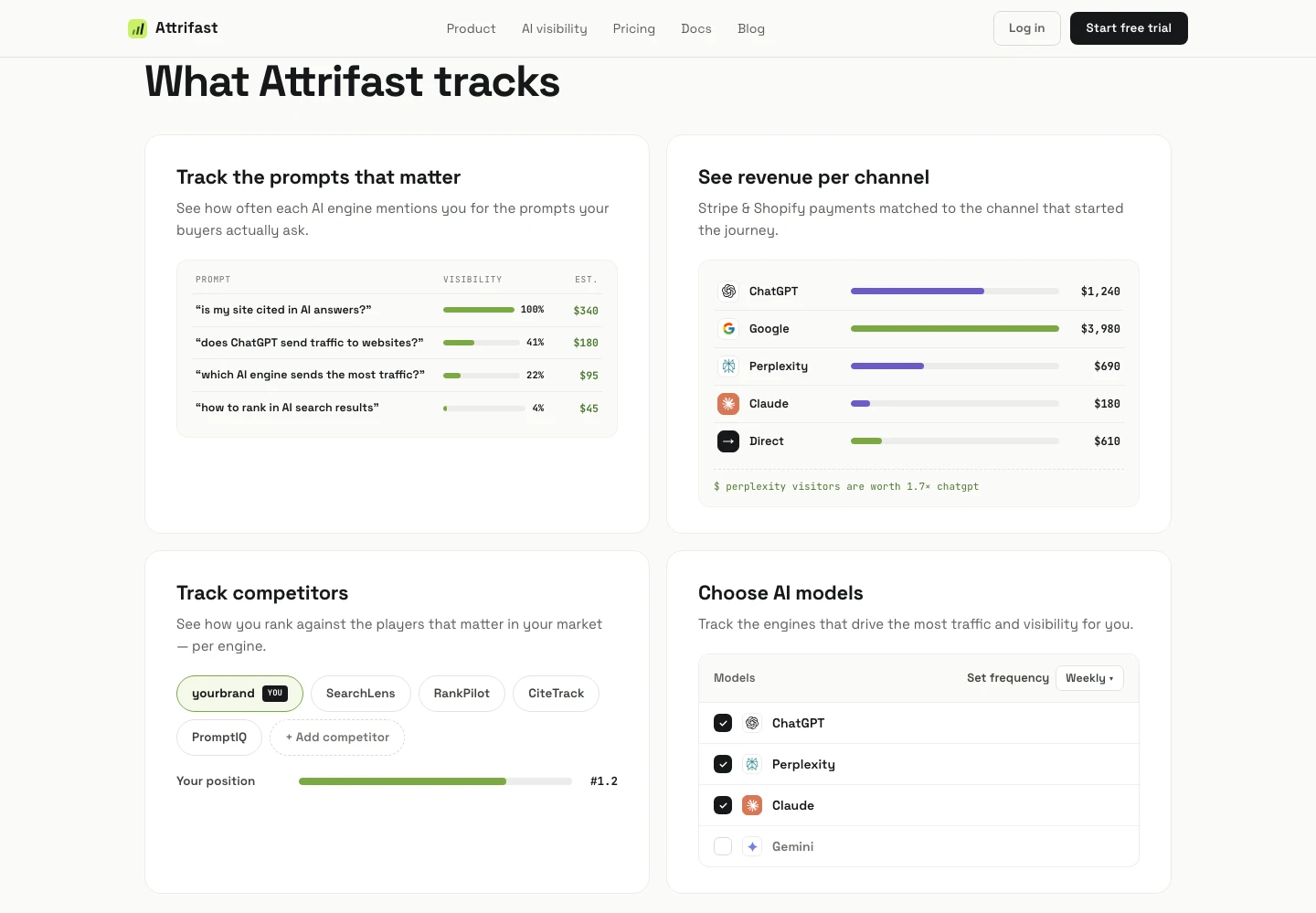
Attrifast dashboard: prompt-level AI visibility with estimated value, revenue split by channel across ChatGPT, Google, Perplexity, Claude and Direct, competitor position tracking, and per-engine scan settings.