Attrifast
ProductAI visibilityPricingDocsBlog
Log inStart free trial
ProductAI visibilityPricingDocsBlogLog in
  1. Home
  2. /Traffic Source Tracking
Product
  • Track Website Traffic
  • Attribution Software
  • Website Visitor Tracking
  • SEO Dashboard
  • Analytics for SaaS
  • Revenue by Source
  • Traffic Source Tracking
  • Revenue Channel Attribution
  • Revenue Attribution
  • Privacy-First Analytics
  • Cookieless Analytics
  • UTM to Revenue
  • AI Visibility Score
  • Share of Voice (AI)
  • Prompt Tracking
  • AI Citation Tracking
  • ChatGPT Rank Tracker
  • AI Revenue Attribution
  • Pricing
Track AI Traffic
  • Track ChatGPT Traffic
  • Track Perplexity Traffic
  • Track Claude Traffic
  • Track Gemini Traffic
  • Track AI Overviews
  • Track Copilot Traffic
  • ChatGPT Revenue Attribution
  • Perplexity Revenue Attribution
  • Claude Revenue Attribution
  • Gemini Revenue Attribution
  • AI Visibility to Revenue
Use Cases
  • Stripe Analytics
  • Shopify Analytics
  • Stripe Attribution
  • For Bootstrapped SaaS
  • Affordable Attribution
Compare
  • vs Profound
  • vs Loamly
  • vs Peec AI
  • vs Otterly
  • vs Cometly
  • vs Segment
  • vs Google Analytics
  • vs Plausible
  • vs Fathom
  • vs Simple Analytics
  • vs PostHog
  • vs Matomo
  • vs Umami
  • vs Pirsch
  • vs Mixpanel
  • vs Amplitude
  • vs Heap
  • vs Hyros
  • vs AnyTrack
  • vs DataFast
  • vs Similarweb
  • All comparisons
Resources
  • GEO Hub
  • AEO Hub
  • AI Search Hub
  • Research
  • Best Conversion Tracking Software
  • ChatGPT vs Google Traffic
  • Mixpanel Alternative
  • Track Channel Revenue
  • First vs Last Touch
  • Cookieless Conversion Tracking
  • GA4 Attribution Limits
  • CAC by Channel
  • Stripe Conversion Tracking
  • Stripe Revenue Tracking
  • AEO vs SEO 2026
  • AI Traffic Benchmark
  • How to Rank in ChatGPT
  • Best AEO Tools 2026
  • Measure GEO ROI
  • Schema for AI Search
  • Dark AI Traffic in GA4
  • What Is Referral Traffic?
  • What Is Direct Traffic?
  • What Is Cookieless Analytics?
  • What Is Conversion Attribution?
  • AI Share of Voice
  • Documentation
  • View all posts
  • Multi-Touch Attribution
  • Free Tools
  • UTM Builder
  • UTM Checker
  • ROI Calculator
  • AI Readiness Checker
  • AI Crawler Directory
  • SEO + GEO Workflow
Company
  • About
  • Contact
  • Return Delay Penalty
  • Backlink RPV Scoring
  • AI Instructions
  • Live Demo
  • FAQ
  • Log in
© 2026 Attrifast · built by Vincent Ruan & Jessica Huang
AboutContactTermsPrivacy

Traffic source tracking

Know where every
visitor really came from.

Multi-signal source detection that catches what cookies cannot. Organic search, paid clicks, social referrals, newsletters — all classified accurately, all without consent banners.

Try traffic source tracking →

7-day free trial. 2-minute setup.

What this page answers

Traffic source tracking is the process of identifying where each visitor came from — direct, organic search, paid ads, social platforms, email campaigns, or referrals — by combining multiple signals: the HTTP referrer, UTM parameters, ad-platform click IDs (gclid, fbclid, ttclid), and known search/social domain matching. Accurate source tracking is the foundation of every honest marketing report.

Key takeaways

  • • Cookie-based trackers misclassify roughly 30–60% of visits as "direct / none" once consent is declined or referrers are stripped.
  • • Multi-signal detection uses 5+ inputs (referrer, UTM, click ID, search match, session continuity) so one missing signal doesn't lose the source.
  • • Click IDs auto-detect paid traffic from Google Ads, Meta, TikTok, Microsoft Ads, and LinkedIn without manual UTM tagging.
  • • Cookieless source tracking uses a random first-party anonymous ID in localStorage — no third-party cookies, no fingerprinting, no cross-site tracking.
  • • Common categories: organic search, paid search, paid social, organic social, email, referral, direct.

Why traffic source tracking is broken in most tools

Cookie consent, app-to-web jumps, and HTTPS referrer policies have quietly broken source attribution everywhere. Most analytics tools just silently bucket the loss into "direct".

Cookie-based tools
  • 30–60% of visits land in "direct"
  • Consent banner drops a chunk before tracking starts
  • One signal breaks → source lost
  • Paid click IDs require manual setup
Attrifast multi-signal
  • Direct shrinks dramatically
  • No banner, GDPR by architecture
  • Multiple signals, fallbacks built in
  • gclid / fbclid / ttclid auto-detected

How Attrifast detects a traffic source

Five independent signals, combined into one accurate source per visit.

SignalWhat it capturesLimits without fallback
document.referrerReferring URL when one is sentStripped on most app-to-web jumps and HTTPS→HTTP
utm_* parametersExplicit campaign taggingOnly as good as your tagging discipline
Click ID parametersgclid, fbclid, ttclid, msclkidNeed normalisation across ad platforms
Search engine matchGoogle, Bing, DuckDuckGo, etc.Search engines hide most query strings
Session continuityReturning visitor stitchingCookieless requires daily-rotating IDs

Every category of traffic source, classified

Organic search

Google, Bing, DuckDuckGo, Yandex, Baidu, Brave, Ecosia.

Paid search & ads

Google Ads, Microsoft Ads, Meta, TikTok, LinkedIn — via click IDs.

Social

X, Reddit, LinkedIn, YouTube, TikTok, Hacker News, Mastodon.

Email

Newsletters, transactional sends, drip campaigns via utm.

Referral

Product Hunt, GitHub, blogs, partner sites, communities.

Direct & internal

Bookmarks, typed URLs, in-app links, email clients.

Go deeper

Track website traffic

Live dashboard, every traffic source in one place.

Revenue by source

Pair each source with Stripe revenue.

UTM setup guide

Tag your campaigns the right way for clean source data.

Traffic source tracking: common questions

What is traffic source tracking?

+

Traffic source tracking is the process of identifying where each visit on your site came from — direct, organic search, paid ads, social, email, referrals — and reporting that breakdown over time. It is the foundation of any honest marketing report.

How does Attrifast detect traffic sources?

+

Attrifast inspects the document referrer, parses utm parameters, normalises ad-platform click IDs (gclid, fbclid, ttclid), matches known search and social domains, and stitches sessions with cookieless daily IDs. The result is a clean source for every visit even when one signal is missing.

Why does GA4 misclassify so many sources as "direct"?

+

GA4 relies heavily on cookies and the referrer header. When users decline consent, switch from app to browser, or arrive via HTTPS-blocked referrers, GA4 falls back to "direct / none". Attrifast uses multiple signals and works without cookies, so direct is much smaller and more accurate.

Can I track paid traffic sources alongside organic?

+

Yes. Click IDs from Google, Meta, TikTok, and Microsoft Ads are auto-detected and grouped with the matching utm_source. You get a single dashboard that compares paid vs organic vs social vs email by visitors and revenue.

Is traffic source tracking GDPR compliant?

+

Attrifast is built cookie-free with no personal identifiers, so traffic source tracking happens without consent banners and is GDPR compliant by design.

50% OFF · launch promotion

See which AI engines actually send you paying customers

Attrifast splits ChatGPT, Perplexity, Claude and Gemini into their own revenue lines — joined to real Stripe payments, not estimates.

  • ✓One script tag and a Stripe key — live in minutes
  • ✓Cookieless, so no consent banner for analytics
  • ✓Every AI referral matched to the payment it produced
Start your free trial →

7-day free trial · $0 due today · then $9.99/mo · cancel anytime
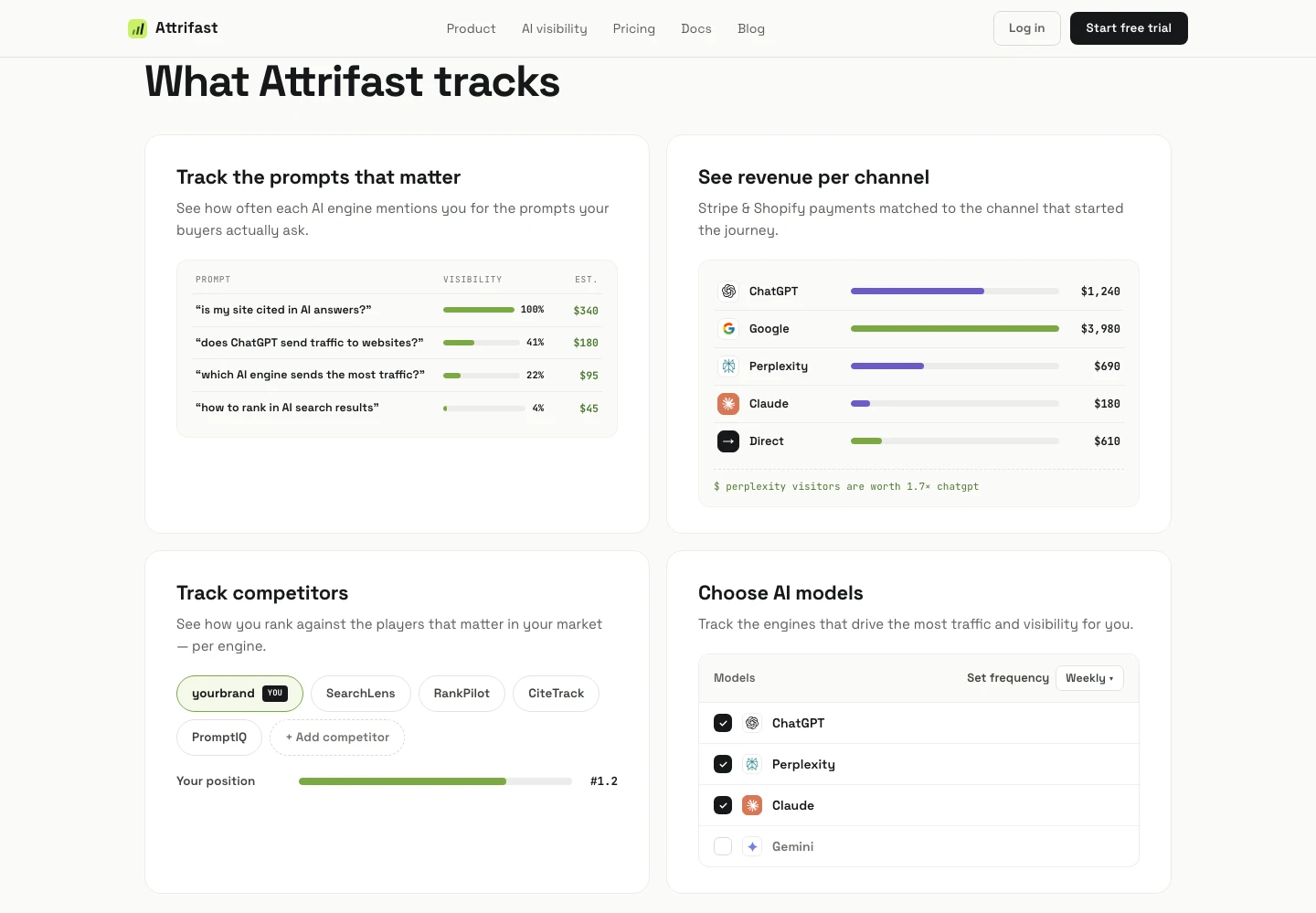
Attrifast dashboard: prompt-level AI visibility with estimated value, revenue split by channel across ChatGPT, Google, Perplexity, Claude and Direct, competitor position tracking, and per-engine scan settings.