Technical Guide

Conversion tracking without cookies in 2026

Vincent Ruan
Vincent RuanFounder, Attrifast ·

Cookie-based conversion tracking has been losing accuracy for almost a decade. Safari started blocking cookies in 2017. Firefox followed. Chrome is now phasing them out. Combined with GDPR consent banners that 30-40% of visitors reject, cookie-based analytics now captures roughly 50-60% of actual traffic. Here's how cookie-free conversion tracking actually works — technically — and why it's more accurate.

Updated March 2026 · 8 min read
TL;DR
  • Cookie-based analytics now captures only 50-60% of actual traffic due to ITP, ad blockers, and GDPR.
  • Cookie-free tracking uses server-side session matching — no cookies, no consent banners, no data gaps.
  • Timeline: Safari started blocking in 2017, Firefox in 2019, Chrome phasing out in 2025-2026.
  • Cookieless attribution is more accurate, more private, and requires zero compliance overhead.

Why cookies are broken for conversion tracking

The failure isn't one thing — it's four compounding problems that each erase a slice of your data.

Consent banner rejections (30-40% data loss)

GDPR and ePrivacy require explicit consent before setting analytics cookies in the EU. Studies consistently show 30-40% of visitors reject or ignore consent banners (source: cookiebot.com). Every one of them becomes invisible. Their conversions are never attributed to a channel.

Browser-level blocking (20-30% additional loss)

Safari ITP kills first-party JS-set cookies in 24 hours. Firefox ETP blocks third-party cookies entirely. Together, Safari and Firefox represent 30%+ of web traffic (source: statcounter.com) — and they've been aggressively restricting cookies since 2017.

Ad blockers (10-40% loss in tech audiences)

uBlock Origin, Brave's built-in blocker, and others strip tracking scripts entirely. If you sell to developers, founders, or technical users, ad blocker penetration can reach 40%+. Your most valuable visitors are the most invisible.

Legal and compliance overhead

Cookie tracking means cookie policies, consent management platforms, data processing agreements, and annual compliance reviews. For small teams, this is a recurring tax — time and money spent on legal, not product.

Browser privacy timeline

Cookie deprecation didn't happen overnight. It's been a nine-year erosion that most analytics tools have quietly ignored. Here's how we got to 50-60% accuracy.

Low impact
Medium impact
High impact
Critical
2017

Safari ITP 1.0

Low impact

First-party cookies capped at 7 days for cross-site tracking.

Minor impact — most conversions still tracked within a week.

2018

Safari ITP 2.0

Medium impact

Third-party cookies blocked entirely in Safari.

Significant for ad platforms. Retargeting pixels lose Safari users (~20% of web traffic).

2019

Firefox Enhanced Tracking Protection

Medium impact

Third-party cookies blocked by default for all Firefox users.

Firefox + Safari together: ~30% of browsers now blocking third-party cookies.

2020

Safari ITP 2.3

High impact

JavaScript-set first-party cookies capped at 24 hours.

Client-side analytics cookies set via JS (e.g. GA) now expire overnight on Safari.

2022

Chrome announces deprecation plans

High impact

Google confirms third-party cookie removal, introduces Privacy Sandbox APIs.

Industry-wide shift begins. Analytics vendors scramble to find alternatives.

2024

Chrome Privacy Sandbox rollout

High impact

Topics API and Protected Audience API begin replacing cookie-based ad targeting.

First-party data becomes the only reliable signal for conversion attribution.

2025

Chrome third-party cookie deprecation (phased)

Critical

Third-party cookies deprecated for a growing share of Chrome users.

Cookie-based attribution now unreliable across all major browsers, not just Safari.

2026

Cumulative accuracy collapse

Critical

GDPR consent rejection (30-40%) + browser blocking + ad blockers compound.

Cookie-based analytics accuracy estimated at 50–60% of actual traffic. Half your data is missing.

The cumulative result in 2026

Each event above removed another slice of visibility. Stacked together — consent rejections, browser blocking, ad blockers — cookie-based analytics now captures an estimated 50-60% of actual conversions. One in two paying customers may be invisible to your current tracking setup.

How cookie-free conversion tracking works

Cookie-free tracking replaces persistent client-side identifiers with techniques that don't require browser storage, don't cross session boundaries, and don't require consent under GDPR or ePrivacy. Three core approaches are in use today.

1. Privacy-safe session hashing

A transient session hash is derived from non-personally-identifying signals: a truncated IP prefix (not the full IP), the user agent string, and a daily rotating salt. The resulting hash is not stored in the browser — it's computed server-side per request and discarded at session end. It cannot be used to track individuals across sessions or sites, which is why it doesn't require consent.

Key property

The hash is deterministic within a session and non-deterministic across sessions. Two visits from the same person on different days produce different hashes — so it's identification without tracking.

2. Server-side event matching

When a conversion happens — a Stripe payment, a Shopify order, a form submission — the server receives a webhook or a direct event. At that moment, it matches the conversion to the active session hash computed from the same request headers. The match is made server-to-server, entirely bypassing the browser. No client-side cookies are needed to connect the visit to the purchase.

Why this matters

Ad blockers block client-side scripts. Browser restrictions block cookies. Neither can block server-to-server communication. Server-side matching reaches 100% of visitors, including Safari users, ad-blocker users, and consent rejectors.

3. First-party data only (no fingerprinting)

Cookie-free doesn't mean fingerprinting. Browser fingerprinting — collecting canvas data, font lists, screen resolution, and dozens of other signals to create a persistent cross-site identifier — is even more privacy-invasive than cookies and is explicitly banned under GDPR. Privacy-safe tracking uses only data that flows naturally with every HTTP request, stays on the site owner's domain, and is never used to build persistent user profiles.

Accuracy comparison: cookie-based vs cookie-free

These figures reflect real-world data loss observed across analytics deployments in 2025-2026, not theoretical maximums.

ScenarioCookie-basedCookie-free
Safari visitor convertsOften missed (24h ITP limit)Tracked
Consent banner rejectedNot trackedTracked
Ad blocker activeScript blocked — not trackedTracked (server-side)
Same-session conversionTrackedTracked
Multi-session conversion (7+ days)Tracked (if cookie survives)First session only
Overall conversion coverage50–60% of actual~100%
Consent banner requiredYes (GDPR/ePrivacy)No
Legal compliance out of the boxRequires DPA + CMPCompliant by default

The one genuine tradeoff: cookie-free tracking is session-scoped. It can't link a visitor's first visit three weeks ago to their purchase today. For most conversion funnels this isn't a problem — the majority of conversions happen within a single session or within hours of the first visit. Long-attribution-window use cases (enterprise SaaS trials, high-consideration purchases) may still benefit from a hybrid approach.

Cookie-free conversion tracking tools

Not all cookie-free tools are equal. The key distinction is whether a tool tracks page views and events only — or whether it connects those events to actual revenue from your payment processor.

Attrifast

Revenue attribution included

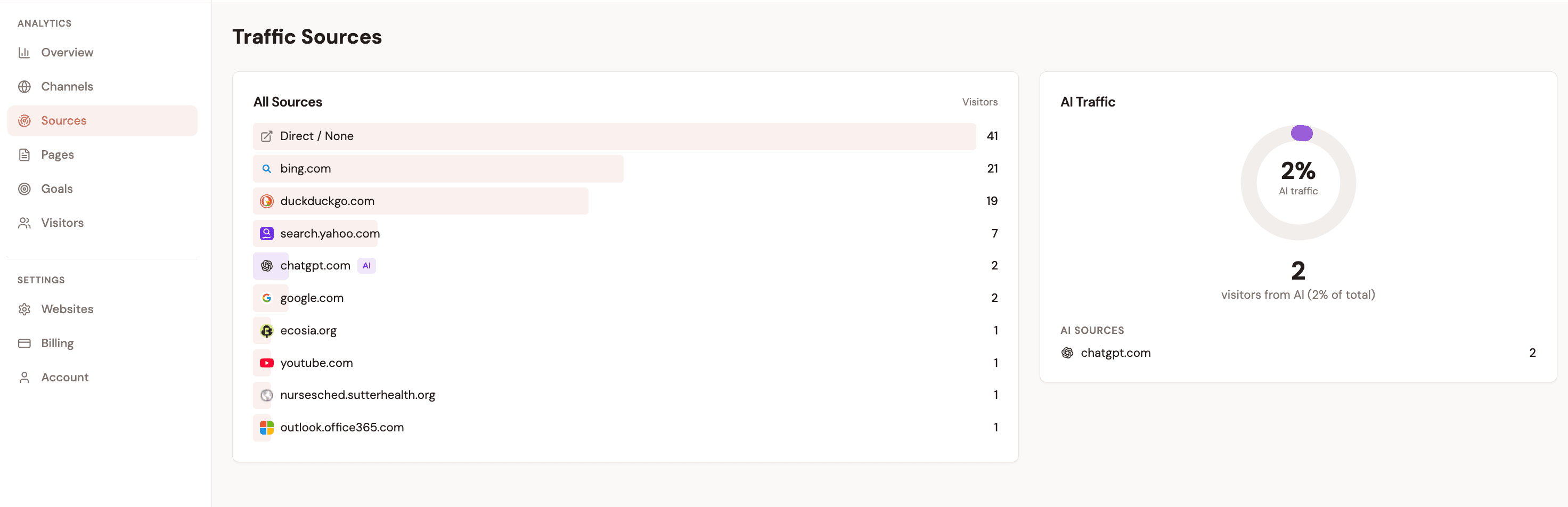
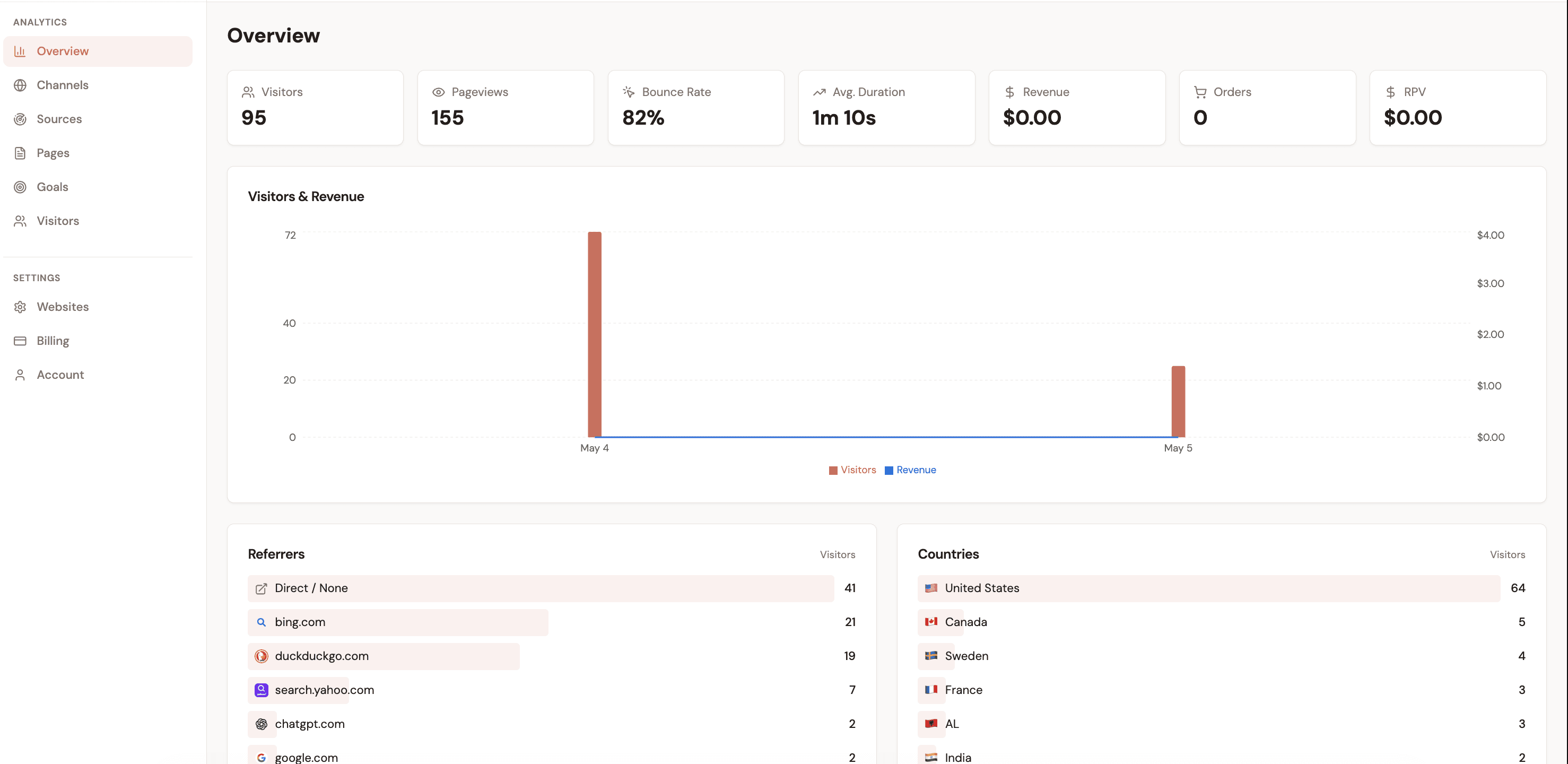
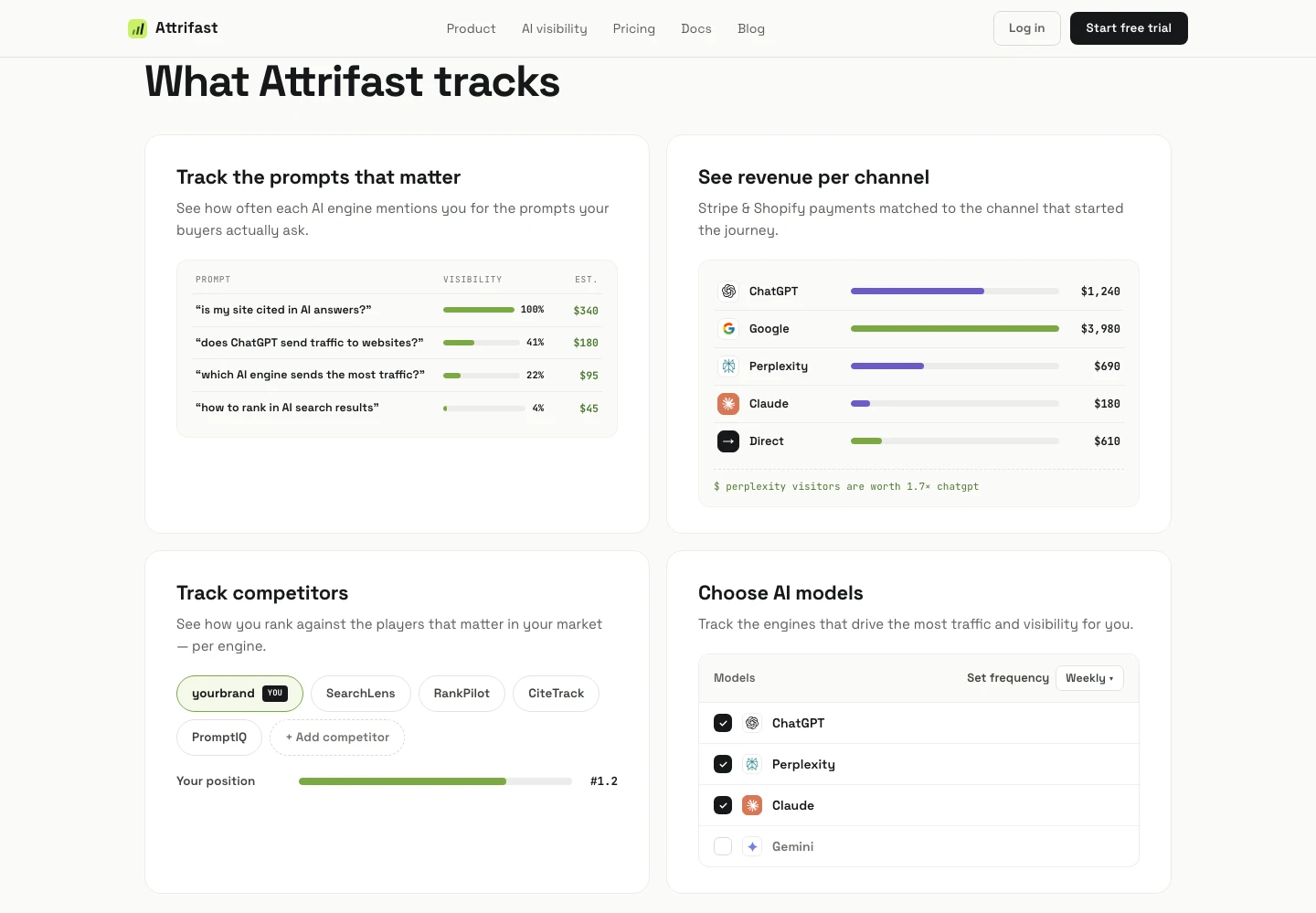
Cookie-free analytics with native Stripe revenue attribution. Tracks which channels bring paying customers — not just visitors — without cookies or consent banners. Free to start.

Plausible Analytics

No revenue attribution

Privacy-first, cookie-free analytics. Tracks page views and custom events. No revenue attribution or payment processor integration. Strong for traffic visibility.

Fathom Analytics

No revenue attribution

Simple, cookie-free analytics with custom event tracking. No built-in revenue connection to Stripe. Good for lightweight event tracking.

Umami

Self-hosted, no revenue attribution

Open-source, self-hosted, cookie-free analytics. Custom events supported. No native payment integrations. Requires server setup and ongoing maintenance.

PostHog (cookieless mode)

Manual Stripe setup required

Product analytics with an optional cookieless mode. Can track custom conversion events. Requires manual setup to connect revenue from Stripe. More complex than purpose-built tools.

Conversion data loss by tracking method (% lost)

Source: Composite of CHI 2025 cookie banner research, Apple WebKit ITP docs, Backlinko ad-blocker stats

Conversion tracking that works in 2026

Cookie-free, consent-free, accurate. Track Stripe conversions without cookies.

Start cookie-free tracking →

Loved by 500+ users