Part of the AI Search Hub — browse all 35 AI Search guides.
A home-goods founder I work with asked Perplexity for "the best non-toxic cast iron skillet under $120" sometime in March, mostly to see whether his own product showed up. It did, second in a tidy comparison with prices, ratings, and a one-line rationale per item. He clicked through to his own product page from inside Perplexity and watched the visit land in his analytics as Direct. Then he checked the month: Perplexity had sent him exactly 38 sessions, which converted at a rate that would have looked unimpressive on a Google Shopping report, but those 38 sessions carried an average order value 30% above his store blend. Thirty-eight visits is not a lot. At his AOV it was still real money, and his GA4 had filed every dollar of it under Direct.
That is the Perplexity Shopping story in one anecdote: fewer shoppers than ChatGPT, higher intent per shopper, and a measurement gap that hides the whole thing. This article is about closing that gap, and about the original point that makes Perplexity worth a separate piece from ChatGPT: because Perplexity sends fewer but higher-intent shoppers, the right metric is dollars per recommended SKU, not appearance count.
This is the Perplexity companion to the ChatGPT Shopping revenue attribution guide, and it deliberately does not repeat that article's full SKU-attribution walkthrough. Where the two surfaces share mechanics, I will point you there and keep moving. What is new here is everything Perplexity-specific: the two buy flows, the research-first buyer profile, the better referer hygiene, the Buy with Pro attribution boundary, and the per-SKU economics of a low-volume high-intent channel. If you want the broader picture of why AI traffic hides in Direct, the ChatGPT referral analytics guide covers that, and the track-Perplexity-traffic playbook covers the detection code.
Quick Facts
| Metric | Value | Source |
|---|---|---|
| Perplexity Shopping launch (Buy with Pro, merchant feed) | Late 2024 | Perplexity / Modern Retail [1][2] |
| Perplexity Shopping stated model | Organic recommendations, merchant program for Buy with Pro | Perplexity blog [1] |
| Perplexity referer pass-through (human clicks) | Higher than ChatGPT; meaningful minority directly attributable | Plausible / Attrifast aggregate [4] |
| GA4 default channel for Perplexity Shopping | Direct/(none) or generic Referral; no built-in AI rule | Google Analytics docs [5] |
| Perplexity-recommended SKU AOV vs blended organic | +24-32% | Attrifast aggregate, Q1-Q2 2026 |
| Perplexity Shopping volume vs ChatGPT Shopping (median store) | Roughly one-quarter to one-third | Attrifast aggregate, Q1-Q2 2026 |
| Perplexity Shopping conversion rate | Lower than Google Shopping; research-led | Attrifast aggregate, Q1-Q2 2026 |
| Perplexity Shopping median time-to-payment | Hours to ~2 days | Attrifast aggregate, Q1-Q2 2026 |
| ChatGPT Shopping launch (for comparison) | April 2025, all users | OpenAI / Search Engine Land [6][7] |
| Schema fields most load-bearing for product recommendation | Product, Offer, AggregateRating | Schema.org / Google merchant docs [8][9] |
| Buy with Pro checkout location | Can complete inside Perplexity | Perplexity / Modern Retail [1][2] |
| Profound Shopping (appearance metrics, ChatGPT-focused) | Share of voice, position, mentions | Profound features page [10] |
Two numbers frame the piece. The +24-32% AOV lift on recommended SKUs is the reason Perplexity is worth instrumenting even at low volume: when these buyers convert, they spend more than any other AI source. The "roughly one-quarter to one-third of ChatGPT volume" number is the reason this is a different article: you cannot manage Perplexity Shopping with the same dashboard logic as ChatGPT, because at that volume an appearance metric will mislead you and only dollars-per-SKU will keep you honest.
What Perplexity Shopping actually does in 2026
Perplexity Shopping is the product-discovery and recommendation surface inside Perplexity. When a user asks a shopping-shaped question, Perplexity does what it does best with any question: it researches, then it answers, and for product queries the answer includes a structured set of product cards with images, prices, ratings, a short rationale, and a way to buy. Perplexity introduced shopping features in late 2024, including a curated merchant feed and the Buy with Pro flow for Pro subscribers, and has positioned the recommendations as organically chosen research output rather than ads [1][2][3].
The defining characteristic, and the one that drives everything in this article, is that Perplexity is a research-first interface. Where a general chat assistant might answer a product query conversationally, Perplexity's whole product is built around assembling sources, comparing options, and citing where it got each claim. That UX selects for a particular kind of shopper: someone in deliberate research mode, comparing a few specific options against stated constraints, closer to a decision than a casual browser. Fewer of them click, but the ones who do are further down the funnel.
The surface, broken into components, because the attribution rules differ by component:
| Component | What the user sees | Attribution relevance |
|---|---|---|
| Product cards | Image, name, price, rating, buy option | The click that lands on your SKU page |
| Comparison table | Side-by-side specs across recommended products | High-consideration; longer time-to-payment |
| Rationale / sources | "Recommended because X" with cited sources | Drives click intent; the citation is a visibility signal |
| Outbound buy link (organic) | Deep link to your product page | The trackable referral event you can attribute |
| Buy with Pro | In-Perplexity checkout for participating merchants | Merchant-program reporting, not a first-party session |
| Follow-up refinement | "Cheaper," "in stock near me," "for sensitive skin" | Re-ranks SKUs; can change the recommended SKU mid-answer |
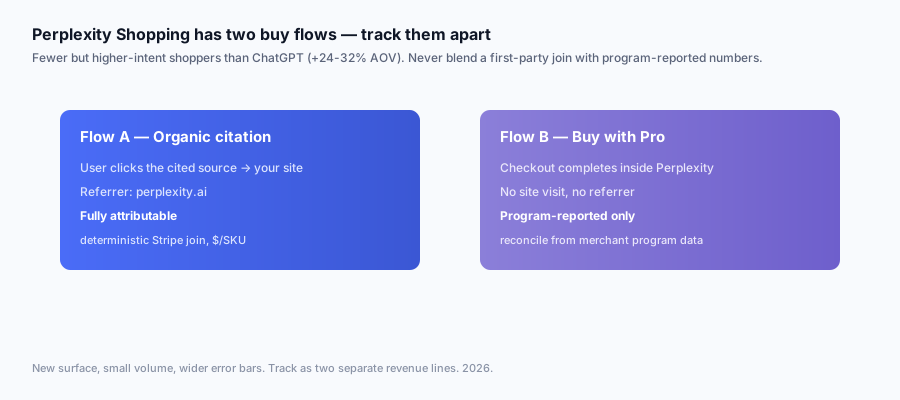
The two rows that matter most are the two buy paths. The organic outbound link deep-links to a product page on your own domain, which is a measurable event you can instrument end to end. The Buy with Pro flow can keep the checkout inside Perplexity, which means the sale may settle without a first-party session on your side. This is the single most important Perplexity-specific fact for attribution, and the rest of the article keeps returning to it.
A few clarifications on what Perplexity Shopping is and is not in 2026:
| Claim | Status |
|---|---|
| Organic recommendations are research output, not ads | Perplexity's stated position [1] |
| Buy with Pro is a merchant program with its own flow | Yes, for participating merchants [1][2] |
| Every Perplexity product click lands on your domain | No; Buy with Pro can complete in-Perplexity |
| Perplexity passes a conversion pixel for organic clicks | No merchant-facing callback for organic citations |
| Recommendations include price and availability | Yes, when feed and Offer schema supply them |
| Perplexity sends more shoppers than ChatGPT | No; volume is lower, intent per shopper is higher |
| Perplexity preserves the referer better than ChatGPT | Generally yes; more clicks are directly attributable |
| It is the same as Perplexity's general answer search | Related surface, product-card-shaped, shopping intent |
The "no merchant-facing callback for organic citations" row is what makes merchant-side instrumentation your job, exactly as with ChatGPT Shopping. You are responsible for detecting the referral and joining it to the payment. The "Buy with Pro can complete in-Perplexity" row is what makes Perplexity attribution genuinely harder in one specific place, and honest measurement means admitting that boundary rather than pretending the whole channel is trackable.
Perplexity vs ChatGPT Shopping: the buyer-profile difference
This is the section that earns Perplexity a separate article. The two surfaces look similar, product cards with prices and a buy link, but they send structurally different traffic, and treating them as interchangeable produces wrong budget decisions.
| Dimension | ChatGPT Shopping | Perplexity Shopping |
|---|---|---|
| Interface posture | Conversational assistant | Research-first answer engine |
| Buyer mode | Mixed: casual to considered | Deliberate research / comparison |
| Relative volume (median store) | Higher (baseline) | Roughly one-quarter to one-third |
| AOV vs blended organic | +12-22% | +24-32% |
| Conversion rate | Research-led, lower than paid shopping | Lower still; deepest research |
| Time-to-payment | Hours to ~3 days | Hours to ~2 days |
| Referer pass-through | Mostly stripped | Preserved more often |
| Dominant buy flow | Deep link to your PDP | Deep link to your PDP + Buy with Pro |
| Attribution difficulty | Behavioral inference for no-referer majority | Easier on referer, harder on Buy with Pro |
Read the table top to bottom and a clear picture emerges. Perplexity is a smaller, deeper, cleaner channel than ChatGPT Shopping. Smaller because fewer people use it for shopping and its research posture filters out impulse browsers. Deeper because the people who do click are working a constraint set and arrive pre-qualified, which is why the AOV is the highest of any AI source. Cleaner because the referer survives more often, so a larger share of the traffic is directly attributable without behavioral guessing.
The strategic implication is the original point of this piece. With ChatGPT Shopping, the volume is high enough that an appearance metric, share of voice across many queries, is a reasonable proxy for opportunity. With Perplexity Shopping, the volume is low enough that appearance is actively misleading. You can hold a strong share of voice on a dozen Perplexity queries and still be talking about a few dozen clicks a month. The only metric that does not lie at that volume is dollars per recommended SKU, because it collapses volume, conversion, AOV, and recommendation accuracy into a single number you can defend in a budget review.
A worked contrast at a real-shaped store, same month, same products:
| Metric | ChatGPT Shopping | Perplexity Shopping |
|---|---|---|
| Sessions | 1,480 | 410 |
| Conversion rate | 0.54% | 0.44% |
| Orders | 8 | ~2 |
| AOV | $96 | $104 |
| Recommended-SKU revenue | ~$580 | ~$190 |
| Revenue per visitor | $0.42 | $0.46 |
Two reads. First, Perplexity produced less than a third of ChatGPT's absolute revenue here, which is typical. Second, its revenue per visitor was actually slightly higher, because the AOV premium more than offset the lower conversion rate. A store that judged Perplexity on session count would underrate it; a store that judged it on RPV or dollars-per-SKU would see a small but efficient channel worth keeping clean.
How Perplexity selects products to recommend
You cannot attribute revenue from a surface you do not understand, so a short detour into selection, with the differences from ChatGPT called out. Perplexity blends several sources into a recommendation, and the merchant's controllable inputs sit in a subset of them, much as with ChatGPT, but Perplexity's research posture weights cited sources and verifiable claims more heavily.
| Signal source | What it contributes | Merchant control |
|---|---|---|
| Merchant product feed (incl. Buy with Pro feed) | Price, availability, image, identifiers | High (you supply the feed) |
| Structured data (Product / Offer schema) | Parseable price, brand, GTIN, rating | High (you author it) |
| Cited third-party reviews and roundups | "Best of" articles, expert reviews, with sources | Medium (earned, weighted by Perplexity) |
| Open-web crawl (PerplexityBot) | Product page content, specs, FAQs | High (your site content) |
| Retailer / platform integrations | Listings via Shopify, merchant programs | Medium (depends on platform) |
| User constraints and refinement | Budget, attributes, prior turns | None (model-side) |
The difference from ChatGPT is one of emphasis. Perplexity's identity is built on citing sources, so verifiable, well-sourced third-party coverage carries unusual weight in what it recommends and how confidently it presents it. A product with strong cited reviews and a clean, crawlable page tends to do well in Perplexity specifically because the engine can show its work. The merchandising lesson: for Perplexity, earned third-party coverage with real sources is not just a nice-to-have, it is closer to the center of the selection logic than it is for a conversational assistant.
A simplified view of how a Perplexity query becomes a recommendation:
Node H is the Perplexity-specific fork that ChatGPT Shopping does not have. The recommendation can branch into a Perplexity-owned checkout (Buy with Pro) or an outbound link to your store. Your attribution has to handle both branches, and it can only fully instrument the outbound one. The refinement loop at node G has the same effect it does on ChatGPT: the recommended SKU is the SKU at the moment of the click, not an assumed earlier recommendation, so you must capture the landing SKU rather than guess.
What you can and cannot influence, summarized:
| Lever | Influence on getting recommended | Notes for Perplexity specifically |
|---|---|---|
| Complete Product schema | High | Table stakes, same as ChatGPT |
| Valid Offer schema (price, availability) | High | Drives whether the price renders on the card |
| Cited third-party reviews | High | Weighted heavily; Perplexity shows its sources |
| Review / AggregateRating schema | High | Supplies the on-card rating |
| Clean, current merchant feed | High | Buy with Pro requires a conforming feed |
| Crawlable PDP (server-rendered) | High | PerplexityBot must read the content |
| Competitive, accurate price | Medium | Mismatch can suppress the price |
| Entity disambiguation (sameAs) | Medium | Helps the engine trust the brand |
Why GA4 fails for Perplexity Shopping
GA4 fails here in the same structural ways it fails for all AI traffic, plus the same shopping-specific failure covered in the ChatGPT Shopping guide. The short version with the Perplexity-specific notes:
| Failure | Mechanism | Effect on Perplexity Shopping attribution |
|---|---|---|
| No default AI channel rule | GA4 has no perplexity.ai channel grouping [5] | Surviving referers land in generic Referral, unlabeled |
| Stripped referer (minority of clicks) | Some clients suppress the Referer header | Those sessions filed as Direct/(none) |
| No UTM on AI links | Perplexity does not append utm_source to buy links | No marketer-set tag to read |
| No recommended-SKU concept | GA4 attributes item revenue to session channel | Cannot tell recommended SKU from browsed SKU |
| Buy with Pro checkout off-domain | Some sales settle inside Perplexity | No on-domain session for GA4 to see at all |
There is one important difference from ChatGPT in this table. Because Perplexity preserves the referer more often, more of its traffic lands in GA4's generic Referral bucket rather than vanishing into Direct, and that is a small mercy: a custom channel group with a perplexity\.ai regex actually recovers a larger fraction of Perplexity traffic than the same trick recovers for ChatGPT. But it still does not solve the recommended-SKU problem, and it does nothing for the Buy with Pro flow, which GA4 cannot see because the session never reaches your domain.
The recommended-SKU failure is the same one that breaks ChatGPT Shopping attribution. GA4 can tell you which items were purchased in a session and attribute that revenue to whatever channel it assigned the session. It has no concept of "the SKU an external AI recommended." So even in the best case where GA4 correctly tagged a session as Perplexity, it still could not tell you whether the recommended product is the one that sold:
| Session | Recommended SKU | What sold | Correct attribution |
|---|---|---|---|
| 1 | Cast iron skillet, $112 | Cast iron skillet, $112 | Full credit to recommended SKU |
| 2 | Cast iron skillet, $112 | Skillet + seasoning oil, $129 | Recommended SKU + halo cart |
| 3 | Cast iron skillet, $112 | Dutch oven, $185 (browsed away) | AI assist, different SKU sold |
GA4 collapses all three into "one session, $X revenue, Direct or Referral." A visibility tool sees none of them because it never touches your cart. Only a stack that captures the landing SKU and joins it to the settled cart line items can produce the third column, and at Perplexity's low volume that third column is where the entire value of measuring the channel lives.
A worked example of how the GA4 view misleads on a real-shaped store:
| Metric | What GA4 reported | What was actually true |
|---|---|---|
| Perplexity Shopping revenue | $0 (Direct) or buried in Referral | ~$1,100/mo settled, SKU-attributable |
| Recommended SKU sell-through | unknown | 58% of recommended-SKU sessions bought that SKU |
| Halo revenue (other SKUs in cart) | counted as Direct/Referral | ~$240/mo from AI sessions buying adjacent SKUs |
| AOV on Perplexity sessions | blended away | $104 vs $79 blended store AOV |
The two Perplexity buy flows, and what each one lets you attribute
This is the section that has no equivalent in the ChatGPT article, because ChatGPT Shopping has effectively one merchant-facing flow (deep link to your PDP) while Perplexity has two. Getting this distinction right is the difference between honest Perplexity attribution and an overstated number.
| Flow | Where checkout happens | First-party session on your domain? | Merchant-side SKU attribution |
|---|---|---|---|
| Organic product citation | Your store (deep link to PDP) | Yes | Full (this article's method) |
| Buy with Pro | Inside Perplexity | No (or minimal) | Partial (program reporting only) |
Flow 1: organic product citations
This is the flow that behaves like ChatGPT Shopping and that you can fully instrument. Perplexity researches a product query, cites your product among the options, and the buy link deep-links to a product-detail page on your domain. The user lands on your PDP, you detect the AI source on entry, you persist a first-party session row with the landing SKU, and you join it to the Stripe payment when it settles. Every data point in the four-pillar method below applies. Because Perplexity preserves the referer more often than ChatGPT, a larger share of these sessions are directly attributable from the perplexity.ai referer without behavioral inference, which makes this flow the cleanest AI-shopping attribution you will get in 2026.
Flow 2: Buy with Pro
Buy with Pro is Perplexity's merchant program that lets eligible Pro users complete a purchase within Perplexity for participating merchants, drawing on a conforming merchant feed [1][2]. For these transactions, part or all of the checkout can happen inside Perplexity rather than on your domain. The consequence for attribution is direct: there may be no first-party session on your site to stitch, and no Stripe Checkout Session you created to write metadata into, because the order was placed through the program flow. Your visibility into Buy with Pro sales is whatever the merchant program reports to you, which is program-level and not the SKU-recommendation-attributed view this article builds for the organic flow.
The honest framing, which I give every store I set up:
| Question | Organic citation flow | Buy with Pro flow |
|---|---|---|
| Can I detect the AI source? | Yes, on landing | N/A; no landing on my domain |
| Can I capture the recommended SKU? | Yes, the landing SKU | Only via program reporting |
| Can I join to my Stripe? | Yes | No (settled in-Perplexity) |
| Can I measure halo (different SKU)? | Yes | No |
| What do I rely on? | First-party + Stripe webhook | Perplexity merchant program reports |
The practical rule is to treat Buy with Pro revenue as a separate line sourced from program reporting, and never to fold it into your first-party recommended-SKU numbers as if it were the same kind of measurement. Mixing a deterministic first-party join with a program-reported figure produces a number you cannot defend when someone asks how it was calculated. Keep them apart, label them honestly, and report both.
The 4 attribution data points (organic flow)
For the organic citation flow, SKU-level Perplexity Shopping attribution rests on the same four data points as the ChatGPT method, captured on a first-party session row and joined to a payment. I cover them briefly here because the ChatGPT Shopping guide walks each in depth; the Perplexity notes are what is new.
| Data point | What it answers | Perplexity-specific note |
|---|---|---|
| 1. Referrer / AI source | Did this session come from Perplexity Shopping? | Referer survives more often; more directly attributable |
| 2. Landing SKU | Which product did the citation deep-link to? | First page-view URL; usually a clean PDP deep link |
| 3. Time-to-cart | Did the recommended SKU enter the cart, and how fast? | Skews slower; research-led consideration |
| 4. Time-to-payment | Which Stripe charge settled, with which line items? | Hours to ~2 days; longer than impulse channels |
Data point 1: the referrer
Detection uses the same multi-layer pattern from the track-Perplexity-traffic playbook: UTM on URLs you control, bot exclusion (PerplexityBot), referer fingerprinting against the AI-domain list, and behavioral inference for the no-referer minority. The Perplexity-specific advantage is that the referer minority is smaller than ChatGPT's, so behavioral inference does less of the work and the confidence is higher.
| Entry shape | Likely source | Confidence |
|---|---|---|
Referer perplexity.ai, lands on /products/<slug> | Perplexity Shopping click | High |
Referer www.perplexity.ai, lands on deep PDP | Perplexity Shopping click | High |
No referer, new visitor, lands on deep /products/<slug> | Suspected AI Shopping | Medium-high |
| No referer, new visitor, lands on homepage | Generic direct | Low |
| UTM-tagged product URL you published | Your own citation | High |
Data point 2: the landing SKU
The first page-view URL on a Perplexity-sourced entry is the recommended SKU. Parse the product identifier from the URL path or the page's Product schema and persist it on the session row. This is the slot GA4 does not have and the one that makes SKU-level attribution possible.
Data point 3: time-to-cart
Capture the add-to-cart event and the SKU added, with a timestamp delta from landing. Perplexity's research-led traffic skews toward the slower patterns:
| Pattern | Time-to-cart | Interpretation |
|---|---|---|
| Recommended SKU added quickly | < 3 min | Rare for Perplexity; high-fit decisive buyer |
| Recommended SKU added after browsing | 3-30 min | The common Perplexity pattern; considered |
| Different SKU added | any | AI assist; recommendation was a doorway |
| No cart event | n/a | Research-only visit; brand exposure |
Data point 4: time-to-payment
The Stripe checkout.session.completed (or charge.succeeded) webhook carries the settled amount and, if you wrote them, the cart line items in metadata. Joining on the session id closes the loop. Time-to-payment for Perplexity skews long because the journey is deeply research-led:
| Source | Median time-to-payment | Profile |
|---|---|---|
| Google Shopping (paid) | Minutes to same-day | Impulse / high-intent |
| ChatGPT Shopping | Hours to ~3 days | Research-led / considered |
| Perplexity Shopping | Hours to ~2 days | Deep research / highest AOV |
The full join for the organic flow, end to end:
Setting up Perplexity Shopping tracking on direct-Stripe stores
The direct-Stripe case (custom storefront, headless commerce, a Next.js store, a SaaS with physical add-ons) is the cleanest for Perplexity because you own the checkout and can write the AI source, recommended SKU, and cart line items straight into the Checkout Session metadata at create time. See the Stripe attribution overview for the broader pattern and the revenue attribution feature page for the product view.
| Step | Direct-Stripe action | Notes |
|---|---|---|
| 1 | Edge middleware detects Perplexity source on landing | Referer + behavioral; writes session row |
| 2 | Persist landing SKU from entry URL / Product schema | First page view on the session |
| 3 | Record add-to-cart with SKU + timestamp | Time-to-cart pillar |
| 4 | Write session id + recommended SKU + cart into Checkout Session metadata | At stripe.checkout.sessions.create |
| 5 | checkout.session.completed webhook reads metadata, attributes | Deterministic join, you own both ends |
The detection layer, with Perplexity in the AI-domain map and a deep-PDP behavioral check:
const AI_DOMAINS = {
  'perplexity.ai': 'perplexity-shopping',
  'www.perplexity.ai': 'perplexity-shopping',
  'chatgpt.com': 'chatgpt-shopping',
  'chat.openai.com': 'chatgpt-shopping',
}

// Returns the AI source for a landing request, or null.
function detectAiShoppingSource(req) {
  // 1. Honour an explicit UTM tag you control.
  const utm = req.query.utm_source
  if (utm && /perplexity/i.test(utm)) return 'perplexity-shopping'

  // 2. Exclude known bots; they are not human shopping clicks.
  const ua = req.headers['user-agent'] || ''
  if (/PerplexityBot|GPTBot|OAI-SearchBot/i.test(ua)) return null

  // 3. Referer fingerprint (Perplexity preserves this more often).
  const referer = req.headers['referer'] || ''
  try {
    const host = new URL(referer).hostname
    if (AI_DOMAINS[host]) return AI_DOMAINS[host]
  } catch (_) {
    // no/invalid referer; fall through to behavioural inference
  }

  // 4. Behavioural inference: no referer, new visitor, deep PDP entry.
  const isDeepProduct = /^\/products\/[^/]+$/.test(req.path)
  if (!referer && isNewVisitor(req) && isDeepProduct) {
    return 'suspected-ai-shopping'
  }
  return null
}
The create-time metadata write that makes the join deterministic for the organic flow:
// Server-side: create the Checkout Session with attribution baked in.
const session = await stripe.checkout.sessions.create({
  mode: 'payment',
  line_items: cart.map(toStripeLineItem),
  metadata: {
    attrifast_session_id: firstPartySessionId,    // the join key
    ai_source: sessionRow.aiSource ?? '',          // 'perplexity-shopping' etc.
    recommended_sku: sessionRow.landingSku ?? '',  // what Perplexity linked to
    cart_skus: cart.map((c) => c.sku).join(','),   // settled line items
  },
})
And the webhook that reads it back on the settled charge, flagging halo purchases:
// Stripe webhook handler.
export async function POST(req) {
  const event = await verifyStripeSignature(req) // never trust unsigned input
  if (event.type !== 'checkout.session.completed') return ok()

  const session = event.data.object
  const sessionId = session.metadata?.attrifast_session_id
  if (!sessionId) return ok() // no first-party join key; skip silently
  if (await alreadyRecorded(session.id)) return ok() // idempotency

  const sessionRow = await getSessionRow(sessionId)
  const aiSource = sessionRow?.aiSource ?? null        // 'perplexity-shopping'
  const recommendedSku = sessionRow?.landingSku ?? null

  const lineItems = await stripe.checkout.sessions.listLineItems(session.id)
  for (const item of lineItems.data) {
    const soldSku = item.price?.metadata?.sku ?? item.description
    await recordAttribution({
      sessionId,
      aiSource,
      recommendedSku,
      soldSku,
      amount: item.amount_total, // cents, settled
      isHalo: recommendedSku != null && soldSku !== recommendedSku,
      stripeSessionId: session.id,
    })
  }
  return ok()
}
Because metadata is written at create time and read back on the settled webhook, the join is deterministic and survives the referer being gone, the session spanning a couple of days (which is the norm for Perplexity), and ad blockers. The only requirement is that the first-party session id persists from landing to checkout, which a first-party identifier scoped to your own domain handles without a third-party cookie or a consent banner under most jurisdictions (verify per your privacy review).
Setting up Perplexity Shopping tracking in Shopify
The Shopify case reuses the stack from the Shopify revenue attribution guide, with the Perplexity-specific addition of detecting perplexity.ai as the AI source and capturing the landing SKU. Shopify Payments runs on Stripe under the hood [11], so the Stripe-webhook join applies to any Shopify store on Shopify Payments.
| Step | What you configure | Time | Cost |
|---|---|---|---|
| 1 | Customer Events Server Pixel (product_viewed, added_to_cart, checkout_completed) | 15 min | Free |
| 2 | First-party tracker captures landing SKU + Perplexity source | 10 min | $9.99/mo tier |
| 3 | Bind session id to order at checkout (checkout extension / cart attribute) | 15 min | Free |
| 4 | Stripe webhook (Shopify Payments) join on settled charge | 10 min | Free |
| 5 | 30-day baseline audit of the recommended-SKU report | 2 hr | one-time |
The Shopify-specific detail worth repeating: use a Server Pixel, not only a Web Pixel, so the product_viewed and added_to_cart events fire server-side and corroborate the landing SKU even when client-side tracking is blocked [12]. In an iOS-heavy storefront mix this is the difference between reliable and unreliable storefront data. The landing SKU on the AI-sourced entry, corroborated by the server-side product_viewed, is what you compare against the settled cart line items to compute recommended-SKU sell-through and halo.
A note on Buy with Pro inside a Shopify context: if you participate in Perplexity's merchant program, those orders may arrive through the program flow rather than as standard storefront sessions. Reconcile them from program reporting and keep them as a separate line from your organic-citation recommended-SKU revenue, for the same honesty reason as the direct-Stripe case.
AOV and economics: Perplexity vs other AI sources
Numbers for sizing your own gap, aggregated across the DTC and Stripe-direct stores I measured in Q1-Q2 2026 (anonymized; apparel, outdoor, beauty, home goods, specialty food, a few physical-goods SaaS add-on stores). Methodology disclosure inline below the tables. These complement, rather than repeat, the ChatGPT-centric tables in the ChatGPT Shopping guide; the focus here is Perplexity's position relative to the rest.
AOV by AI source
| Source | AOV median | AOV 25th-75th pct | vs blended store AOV |
|---|---|---|---|
| Perplexity Shopping (recommended SKU sold) | $104 | $74 - $148 | +28% |
| Perplexity Shopping (halo: different SKU sold) | $97 | $68 - $138 | +18% |
| ChatGPT Shopping (recommended SKU sold) | $96 | $68 - $134 | +18% |
| Google Shopping (paid) | $84 | $61 - $114 | +3% |
| Google organic | $79 | $54 - $108 | reference (blended) |
| Direct (real, after AI split) | $89 | $64 - $124 | +9% |
Volume and conversion by source
| Source | Sessions (median store, /mo) | CVR median | RPV median |
|---|---|---|---|
| Google Shopping (paid) | 6,200 | 1.42% | $1.18 |
| Google organic | 14,400 | 0.86% | $0.62 |
| ChatGPT Shopping | 1,480 | 0.54% | $0.42 |
| Perplexity Shopping | 410 | 0.44% | $0.46 |
The two tables together are the whole argument for treating Perplexity as its own channel. The AOV table puts Perplexity at the top: the highest order value of any AI source, ahead of ChatGPT Shopping and well ahead of paid Google Shopping. The volume table puts it near the bottom: roughly a quarter to a third of ChatGPT's session count, with the lowest conversion rate of the AI sources. Net it out and you get a small, efficient, high-AOV channel whose revenue per visitor is actually competitive with ChatGPT despite far lower volume.
Recommended-SKU sell-through (organic flow)
The Perplexity-specific metric: of the sessions that entered on a Perplexity-recommended SKU, what share bought that exact SKU versus a different one or nothing.
| Outcome | Share of recommended-SKU sessions |
|---|---|
| Bought the recommended SKU | 52-62% |
| Bought a different SKU (halo) | 10-18% |
| Added to cart, did not buy | 12-20% |
| Research only, no cart | 14-22% |
Time-to-payment distribution
| Window | Share of Perplexity purchases |
|---|---|
| Same session | ~22% |
| Same day, later session | ~31% |
| 1-2 days later | ~34% |
| 3+ days later | ~13% |
The time-to-payment distribution is the operational reason Perplexity attribution must be deterministic and not session-bound. Roughly two-thirds of Perplexity purchases settle after the entry session ends, which means a cookie-based or session-window attribution model loses most of the revenue. The first-party-id-into-Stripe-metadata join is what survives a two-day gap; a document.referrer check at purchase time would see nothing.
Methodology disclosure. Aggregated across stores that turned on AI-source plus SKU-level attribution in Attrifast between December 2025 and May 2026, restricted to those with measurable Perplexity volume (a smaller subset than the ChatGPT sample, because Perplexity volume is lower and some stores had too few Perplexity sessions to report). Sessions attributed by the multi-layer pattern (UTM + bot exclusion + referer fingerprinting + behavioral inference) plus landing-SKU capture. Revenue joined via Stripe checkout.session.completed webhook line items (Shopify Payments or direct Stripe). The recommended-vs-halo split depends on the landing-SKU-versus-sold-SKU comparison. Buy with Pro transactions are excluded from these tables because they settle in-Perplexity and are not first-party-joinable; they would need to be sourced from program reporting separately. Individual store rows are not for publication; the aggregate is real, and the Perplexity sample is thinner than the ChatGPT sample, so treat these as directional with wider error bars than the equivalent ChatGPT numbers.
The honest headline: Perplexity Shopping is the highest-AOV, lowest-volume, longest-time-to-payment AI shopping source. It is a precision channel, not a volume channel, and most stores will find the dollars meaningful but small in absolute terms in 2026. The right comparison is to other deep-research discovery channels (cited "best of" roundups, considered organic), not to Google Shopping.
Schema and feed: getting recommended in Perplexity
Because Perplexity weights cited sources and verifiable claims, the structured-data and feed prerequisites matter at least as much as they do for ChatGPT, and the third-party-review dimension matters more. The schema mechanics are the same ones detailed in the ChatGPT Shopping guide; here is the Perplexity-weighted checklist.
| Requirement | Why it matters for Perplexity | Controllable |
|---|---|---|
| Complete Product schema on every PDP | Lets the engine parse name, brand, image, identifier | Yes |
| Valid Offer schema (price, priceCurrency, availability) | Lets the card show a price and in-stock state | Yes |
| GTIN / MPN / brand identifiers | Disambiguates your product from look-alikes | Yes |
| AggregateRating / Review schema | Supplies the on-card rating | Yes (earned reviews, owned markup) |
| Cited third-party "best of" coverage | Weighted heavily; Perplexity shows its sources | Earned |
| Crawlable PDP (server-rendered) | PerplexityBot must read content | Yes |
| Current, conforming merchant feed | Required for Buy with Pro; primary price/availability source | Yes |
| Entity disambiguation (Organization sameAs) | Helps the engine trust the brand | Yes |
A minimal but complete Product + Offer + AggregateRating block, the shape that reliably renders with price and rating across both ChatGPT and Perplexity Shopping:
{
  "@context": "https://schema.org",
  "@type": "Product",
  "name": "Pre-Seasoned Cast Iron Skillet 10 inch",
  "brand": { "@type": "Brand", "name": "ExampleCo" },
  "gtin13": "0123456789012",
  "sku": "CI-SKILLET-10",
  "image": "https://example.com/img/ci-skillet-10.jpg",
  "description": "10-inch pre-seasoned cast iron skillet, no synthetic coatings.",
  "offers": {
    "@type": "Offer",
    "price": "112.00",
    "priceCurrency": "USD",
    "availability": "https://schema.org/InStock",
    "priceValidUntil": "2026-12-31",
    "url": "https://example.com/products/cast-iron-skillet-10"
  },
  "aggregateRating": {
    "@type": "AggregateRating",
    "ratingValue": "4.8",
    "reviewCount": "341"
  }
}
Two notes that prevent the most common failures, both load-bearing for the join. First, the sku in your schema should match the sku you write into Stripe metadata, so the recommended-SKU-to-settled-SKU join is exact rather than fuzzy. Second, keep price and availability in lockstep across schema, feed, and live PDP. A price mismatch is a frequent cause of the product surfacing without a price or not at all, and Perplexity's source-citing posture makes it especially unforgiving of claims it cannot verify against a consistent feed.
Attrifast vs visibility tools for Perplexity Shopping
The category confusion is the same as for ChatGPT Shopping, with one Perplexity wrinkle: most visibility tools have historically been ChatGPT-first, so Perplexity Shopping coverage in the visibility category is thinner and newer. Whatever the tool, the fault line is the same. Visibility tools measure appearance; Attrifast measures settled revenue per recommended SKU. These are different jobs and a serious store eventually runs both.
| Dimension | Visibility tools (Profound and peers) | Attrifast |
|---|---|---|
| Category | AI appearance / share-of-voice monitoring | First-party + Stripe-native revenue attribution |
| Core question | "Are we recommended, where, vs whom?" [10] | "How many dollars did the recommendation produce?" |
| Sees your cart? | No | Yes (session + line items) |
| Sees your Stripe account? | No | Yes (webhook join) |
| Recommended-SKU revenue | No | Yes (organic flow) |
| Halo (different SKU sold) detection | No | Yes (organic flow) |
| AOV per AI source | No | Yes |
| Perplexity vs ChatGPT split | Sometimes (appearance) | Yes (revenue) |
| Buy with Pro coverage | Appearance only | Program reporting only (off-domain) |
| Cookieless / no cross-site tracking | n/a (monitors answers) | Yes |
| Entry price | $499+/mo (enterprise tier) | $9.99/mo |
The maturity-curve framing applies to Perplexity exactly as it does to ChatGPT, and arguably more sharply because Perplexity Shopping is newer. Appearance monitoring matured first because it is the easier problem: you query the model and parse the output, never touching the merchant's revenue system. Revenue attribution matures later because it requires stitching a first-party session to a cart to a settled payment across a multi-day, research-led journey. For Perplexity in 2026 most of the market is at the appearance stage, and the appearance stage is especially misleading for a low-volume channel where citation count and dollar count can diverge wildly.
| Maturity stage | Capability | Perplexity status in 2026 |
|---|---|---|
| Stage 1 | AI appearance monitoring | Emerging (ChatGPT-first tools adding Perplexity) |
| Stage 2 | Share of voice / position | Emerging |
| Stage 3 | Click attribution from AI surfaces | First-party analytics tools |
| Stage 4 | Revenue per AI session | Stripe-native attribution |
| Stage 5 | Revenue per recommended SKU + halo | Few; the gap Attrifast targets |
| Job to be done | Right tool |
|---|---|
| "Are we showing up in Perplexity Shopping?" | A visibility tool |
| "What is our share of voice vs competitors?" | A visibility tool |
| "How many dollars did Perplexity Shopping produce?" | Attrifast |
| "Which recommended SKUs actually sell?" | Attrifast |
| "Is the recommendation a doorway to other SKUs?" | Attrifast (halo flag) |
Use the right tool for the job, and for Perplexity specifically, lean harder on the revenue side than you would for ChatGPT, because appearance at low volume tells you the least.
Retailer comparison: where Perplexity sits among AI shopping surfaces
The AI-shopping landscape is not one surface, and the attribution rules differ by who owns the checkout. Perplexity is unusual in straddling the line, with one flow that lands on your domain and one that does not.
| Surface | Buy flow | Lands on your domain? | Merchant-side attribution feasible? |
|---|---|---|---|
| Perplexity (organic citation) | Comparison + outbound deep link | Yes | Yes (this article) |
| Perplexity (Buy with Pro) | In-Perplexity checkout for participating merchants [1][2] | No (mostly) | Partial (program reporting) |
| ChatGPT Shopping | Organic cards, deep link to your PDP [6][7] | Yes | Yes |
| Amazon Rufus | In-Amazon assistant, stays on Amazon [13] | No (Amazon owns checkout) | No (Amazon reporting only) |
| Walmart (Sparky) | In-Walmart assistant [14] | No (Walmart owns checkout) | No (Walmart reporting only) |
| Google AI Overviews (shopping) | Cites pages, sometimes links out | Sometimes | Partial (low CTR, referer often stripped) |
The structural fault line is the same as in the ChatGPT Shopping guide: surfaces that keep the checkout on their own property (Amazon, Walmart, and Perplexity's Buy with Pro) are attribution dead ends or partial at best for the merchant, while surfaces that deep-link to your own domain (Perplexity organic citations, ChatGPT Shopping, sometimes Google) are where merchant-side SKU-level attribution is feasible. Perplexity's distinction is that it lives on both sides of that line at once, which is why "track the two Perplexity flows separately" is the single most important operational instruction in this article.
| Surface | Who owns the checkout | Attribution owner |
|---|---|---|
| Perplexity organic citation | Merchant | Merchant (instrument it) |
| Perplexity Buy with Pro | Perplexity | Split (program reporting) |
| ChatGPT Shopping | Merchant | Merchant |
| Amazon Rufus | Amazon | Amazon |
| Walmart Sparky | Walmart | Walmart |
A note on Claude for completeness: Claude is a capable shopping-research assistant and shows up in product-comparison journeys, but as of mid-2026 it does not run a dedicated merchant-feed Shopping surface with buy cards the way ChatGPT and Perplexity do [15]. Claude-referred shopping traffic behaves like deep-research organic: low volume, high AOV, usually referer-stripped. Track it as a research-led AI source, not a dedicated Shopping channel. For the per-engine traffic detection across Perplexity, Claude, and Gemini, see the track-Perplexity-traffic playbook and the track-ChatGPT-traffic guide.
Common Perplexity Shopping attribution mistakes
Ten patterns I see often enough to name, with the fix for each. Several overlap with ChatGPT Shopping; the Perplexity-specific ones are flagged.
Mistake 1: Folding Buy with Pro into your first-party numbers (Perplexity-specific). Buy with Pro settles in-Perplexity and is program-reported, not first-party-joined. Mixing it with your deterministic recommended-SKU revenue produces a number you cannot defend. Fix: keep Buy with Pro as a separate, labeled line sourced from program reporting.
Mistake 2: Judging Perplexity by session count (Perplexity-specific). At a quarter to a third of ChatGPT's volume, a session count makes Perplexity look like a rounding error even when its RPV is competitive. Fix: report dollars per recommended SKU and RPV, not raw sessions.
Mistake 3: Treating visibility as revenue. A strong Perplexity share of voice is a leading indicator, not a dollar figure, and the gap between the two is wider at low volume. Fix: pair appearance monitoring with settled-revenue attribution per recommended SKU.
Mistake 4: Trusting GA4's Perplexity number. GA4 buries Perplexity in Direct or generic Referral and has no recommended-SKU concept. Fix: server-side AI detection plus a Stripe webhook join.
Mistake 5: Using a session-window attribution model (Perplexity-specific). Roughly two-thirds of Perplexity purchases settle after the entry session ends. A cookie-or-session-bound model loses most of the revenue. Fix: a deterministic first-party-id-into-Stripe-metadata join that survives multi-day gaps.
Mistake 6: Attributing all session revenue to the recommended SKU. A session that entered on the recommended SKU may have bought something else. Fix: compare landing SKU to settled SKU; flag the halo case separately.
Mistake 7: Ignoring the halo. The opposite error: discounting Perplexity because the recommended SKU did not sell, while ignoring the adjacent SKU it drove. Halo was 10-18% of recommended-SKU sessions in my sample. Fix: report recommended-SKU revenue and halo revenue as separate lines.
Mistake 8: Stale Offer schema causing silent suppression. A schema price that disagrees with the feed or live page can suppress the product, and Perplexity's source-citing posture is especially unforgiving. Fix: keep price and availability in lockstep across schema, feed, and PDP.
Mistake 9: JS-only product pages. If PerplexityBot cannot read the content, the product is hard to recommend, and Perplexity weights readable, citable content heavily. Fix: server-render the PDP content the engine needs.
Mistake 10: Mismatched SKU keys between schema and Stripe metadata. If the schema SKU and the Stripe line-item SKU do not match, the recommended-vs-sold join fails. Fix: standardize one SKU identifier across schema, feed, and Stripe metadata.
What changes when you fix this
The shape of the merchandising and budget conversation changes once recommended-SKU attribution is correct for Perplexity.
| Decision | Before correct attribution | After correct attribution |
|---|---|---|
| Is Perplexity Shopping worth effort? | "We appear in results" (vanity) | "$X/mo settled per recommended SKU, highest AOV of any AI source" |
| Which products to optimize for Perplexity | Guess from share of voice | The SKUs with proven sell-through |
| How to weight vs ChatGPT | Treated as interchangeable | Perplexity = precision/AOV, ChatGPT = volume |
| Buy with Pro participation | Unmeasured guess | Compared against organic-citation attributable revenue |
| Schema / feed investment | "Best practice, unmeasured" | ROI-justified by recommended-SKU revenue |
| Halo products | Invisible | Quantified adjacent revenue |
| Channel comparison | Perplexity vs Google Shopping (wrong frame) | Perplexity vs research-led discovery (right frame) |
| Board update | "We are in AI shopping" (unfundable) | "Perplexity is small but the highest-AOV AI source, growing" |
The "how to weight vs ChatGPT" row is the one with the most leverage and the one this whole article exists to support. Once you can see dollars per recommended SKU on both surfaces, you stop treating them as one AI-shopping bucket and start managing them as what they are: a volume channel and a precision channel, with different content, feed, and merchandising priorities.
Limitations
Five things this article does not cover, and you should not extrapolate past.
- Buy with Pro and other in-Perplexity checkouts. Sales that settle inside Perplexity have no first-party session to stitch and no Stripe Checkout Session you created. You get program reporting, which is coarse and not the SKU-recommendation-attributed view this article builds. Treat it as a separate, partial line.
- The Perplexity sample is thinner than the ChatGPT sample. Because Perplexity volume is lower, fewer stores in my data had enough Perplexity sessions to report reliably. The AOV and sell-through numbers carry wider error bars than the equivalent ChatGPT figures; treat them as directional.
- The surface is new and moving fast. Perplexity Shopping, Buy with Pro, the merchant feed, and referer behavior in mid-2026 may not hold by year end. Verify current Perplexity merchant documentation before relying on any specific mechanic here.
- Behavioral inference is not perfect. The no-referer landing-SKU fingerprint has bounded precision and recall, the same as the general AI-traffic classifier. It is materially better than the GA4 default of zero, not a perfect measurement. Perplexity's better referer hygiene means inference does less of the work here than for ChatGPT, which helps.
- The +24-32% AOV lift is a Q1-Q2 2026 snapshot. As Perplexity's user base broadens, the intent-quality premium will likely compress. Re-measure quarterly and treat the number as a directional estimate, not a constant.
FAQ
How is Perplexity Shopping different from ChatGPT Shopping for attribution?
Both surfaces recommend products and link out to your store, but the buyer profile and the buy flow differ in ways that change how you measure them. Perplexity is a research-first interface, so its shoppers tend to arrive deeper in the funnel, in lower volume, with higher average order value and a longer time-to-payment. The bigger structural difference is the Buy with Pro flow: for participating merchants, part of the Perplexity checkout can complete inside Perplexity rather than on your domain, which means some sessions never land a first-party row you can stitch. Organic Perplexity product citations behave like ChatGPT Shopping, deep-linking to your product page where you can instrument the full join. The practical rule: track the two Perplexity flows separately, because one is a merchant-owned checkout you can attribute end to end and the other is a Perplexity-owned checkout you can only partially see.
Can I track which products Perplexity recommended that led to a sale?
Yes for the organic citation flow, partially for the Buy with Pro flow. For organic product citations that deep-link to your store, you join four data points on a first-party session row: the Perplexity referrer (so you know the session came from an AI surface), the landing SKU (the product the recommendation linked to), the time-to-cart (whether the recommended SKU entered the cart), and the time-to-payment (the Stripe charge that settled, with line items). For the Buy with Pro flow where checkout happens inside Perplexity, you get whatever the merchant program reports rather than a first-party session you can stitch. The honest answer is that organic Perplexity Shopping is fully attributable with a Stripe-native stack and the in-Perplexity checkout is not.
How do Perplexity Shopping referrers look in my server logs?
When a Perplexity product recommendation passes a referer, it arrives as a perplexity.ai or www.perplexity.ai host, and it tends to preserve the referer more often than ChatGPT does, so a higher share of Perplexity clicks are directly attributable from the referer alone. The high-signal pattern for Shopping specifically is a perplexity.ai referer (or a no-referer new-visitor entry) that lands directly on a deep product-detail-page URL rather than your homepage or a collection page. That landing-on-a-specific-SKU shape is the strongest behavioral fingerprint that the visit came from an AI product recommendation. Perplexity's better referer hygiene is a genuine attribution advantage versus ChatGPT, even though its absolute volume is smaller.
Does Perplexity Shopping pass purchase data back to merchants?
It depends on the flow. For organic product citations that link out to your store, Perplexity does not pass a structured conversion callback any more than a normal search engine does; the merchant instruments the attribution. For the Buy with Pro flow, Perplexity operates a merchant program with its own order and reporting model, so participating merchants receive program-level reporting for those in-Perplexity checkouts. Neither path gives you a clean SKU-level merchant pixel for organic traffic, so for the citation flow you own the measurement: detect the AI referral on landing, persist the session, and join to the Stripe payment. Verify the current merchant terms against Perplexity's own documentation, because this surface is changing quickly.
Why does GA4 fail to attribute Perplexity Shopping revenue at the SKU level?
The same compounding failures that break all AI attribution, plus one specific to shopping. GA4 has no default channel rule for perplexity.ai, so even when a referer survives, the session lands in generic Referral or, on stripped-referer clicks, in Direct, with no AI-engine label. On top of that, GA4 enhanced ecommerce attributes item revenue to whatever channel GA4 assigned the session, which is already wrong for AI traffic, and it has no concept of recommended-SKU versus browsed-SKU. So even if GA4 had tagged the session as Perplexity, it could not tell you whether the recommended product is the one that sold or whether the user landed on it and bought something else. You need SKU-level join logic GA4 does not provide.
What is the AOV for Perplexity-recommended products versus other channels?
Across the DTC and Stripe-direct stores I measured in Q1-Q2 2026, Perplexity-recommended SKUs carried the highest median AOV of any AI source, roughly 24-32% above the same store's blended organic AOV, higher than ChatGPT Shopping and well above paid Google Shopping. The driver is Perplexity's research-first interface: its shoppers tend to be in deliberate comparison mode, working a specific constraint set, and they arrive pre-qualified. The catch is volume and conversion rate. Perplexity sends fewer shoppers than ChatGPT, and they convert at a lower rate than impulse-led Google Shopping because the journey is research-led. Highest AOV, lowest volume, lower CVR, longest time-to-payment is the consistent Perplexity Shopping signature.
Should I measure Perplexity Shopping by appearance or by revenue?
Both, in sequence, but do not confuse them. Appearance metrics, whether your product shows up in Perplexity's answers, in what position, against which competitors, are a leading indicator and the right input for the merchandising and content team. Revenue per recommended SKU is the lagging truth and the only number a budget review survives. Because Perplexity sends fewer but higher-intent shoppers, the appearance-only view is especially misleading here: you can be cited often and still need to know which of those citations actually settle to dollars. The metric that matters is dollars per recommended SKU, not share of voice. Measure appearance to know whether you are in the game, measure revenue per SKU to know whether the game is worth playing.
Is Perplexity Shopping worth instrumenting for a small store?
It depends entirely on whether you are getting recommended at all, and Perplexity's lower volume means the honest answer for many small stores is not yet. Perplexity Shopping is a new, low-volume surface; for a store doing under $40k a month, Perplexity-attributed revenue may be a few hundred dollars in the first months, sometimes less. The case for instrumenting it anyway is that the AOV is the highest of any AI source and the referer hygiene is the best, so the dollars you do capture are cleanly attributable and the work doubles as ChatGPT Shopping and broader AI-traffic instrumentation. The honest sequence: confirm you are surfacing in Perplexity at all, ship the schema and feed prerequisites, then turn on revenue attribution. Do not build a Perplexity-specific dashboard for a channel that is sending you ten clicks a month.
What is "halo" revenue and why does it matter for Perplexity Shopping?
Halo revenue is the money from a session that entered on a Perplexity-recommended SKU but settled on a different SKU. Perplexity recommends your $112 skillet; the user lands on it, researches, and buys a $185 Dutch oven instead. The recommendation caused the visit, but the recommended SKU did not sell. If you only measure recommended-SKU sell-through, you undercount the channel; if you attribute all session revenue to the recommended SKU, you overcount it. The honest treatment is to report both as separate lines. Across the stores I measured, halo was 10-18% of recommended-SKU sessions, which is enough to flip a "not worth it" verdict at Perplexity's low volume into a "worth it" one.
Does Perplexity preserve the referer better than ChatGPT?
Generally yes, and it is a real attribution advantage. ChatGPT's clients strip the Referer header on most outbound clicks, which is why behavioral inference does most of the work in ChatGPT attribution. Perplexity passes the referer on a larger share of clicks, so a meaningful minority of Perplexity Shopping sessions are directly attributable from the perplexity.ai referer alone, without any behavioral guessing. This does not mean every Perplexity click carries a referer, and it does nothing for the Buy with Pro flow, which never lands on your domain at all. But for the organic citation flow, Perplexity is the cleanest AI-shopping source to attribute in 2026.
How does Buy with Pro change my attribution?
It carves out a slice of Perplexity revenue that you cannot first-party-attribute. Buy with Pro lets eligible Pro users complete a purchase inside Perplexity for participating merchants, so the checkout settles in-Perplexity rather than on your domain. There is no first-party session to stitch and no Stripe Checkout Session you created to write metadata into. Your visibility is whatever the merchant program reports, which is program-level, not SKU-recommendation-attributed. The right handling is to keep Buy with Pro revenue as a separate, clearly labeled line sourced from program reporting, and never to blend it with your deterministic organic-citation recommended-SKU numbers.
Can I attribute Perplexity Shopping revenue on a non-Shopify store?
Yes, and the direct-Stripe case is the cleanest of all. You own the checkout, so you write the AI source, the recommended SKU, and the cart line items straight into the Stripe Checkout Session metadata at create time, then read them back on the checkout.session.completed webhook. The join is deterministic and survives the multi-day gap that is normal for Perplexity's research-led journeys. The only requirement is a first-party session id that persists from landing to checkout, which a first-party identifier scoped to your own domain handles without a third-party cookie or a consent banner under most jurisdictions (verify per your privacy review). This applies to the organic citation flow; Buy with Pro still settles in-Perplexity and is out of scope for the first-party join.
How long until I see Perplexity Shopping revenue after fixing attribution?
The organic-citation traffic is usually already arriving; you are uncovering it, not creating it. The first 30 days of correct attribution typically resolve a chunk of previously-Direct or previously-Referral revenue to Perplexity-recommended SKUs, with the recommended-vs-halo split stabilizing over 60 days. At Perplexity's lower volume, give the numbers more time to be statistically meaningful than you would for ChatGPT; a single $185 order moves a Perplexity month more than it moves a ChatGPT month. If you are also shipping schema, feed, and cited-review improvements to increase recommendation volume, expect a longer lag (weeks for crawlers to re-read, more weeks for recommendation share to grow) before the supply-side revenue moves. Separate the two effects: attribution fixes reveal existing revenue quickly; visibility improvements add revenue on a multi-week delay.
Do I need a separate tool for Perplexity versus ChatGPT Shopping?
No. The same first-party detection, the same Stripe-webhook join, and the same recommended-SKU logic cover both surfaces; the only difference is the AI-source label and the Buy with Pro carve-out. What you do need is a per-engine split in your reporting so you can see Perplexity and ChatGPT as separate lines rather than one "AI shopping" bucket, because they behave so differently (precision vs volume) that a blended number hides the decision you actually need to make. One tool, two clearly separated channels, is the right setup.
What this looks like inside Attrifast
A short note on the product, because the article should not pretend the author has no interest. Attrifast surfaces AI shopping as a first-class part of the same channel dashboard as paid social, paid search, organic, and email, with a per-engine split (ChatGPT, Perplexity, Claude, Gemini) — the Perplexity revenue attribution page covers the general (non-shopping) version of this join. For Perplexity specifically, the Shopping view captures the landing SKU on organic-citation sessions, compares it to the settled cart line items from the Stripe webhook, and reports recommended-SKU revenue and halo revenue as separate lines, with AOV per AI source so the precision-vs-volume contrast against ChatGPT is legible at a glance.
Two Perplexity-specific design choices follow from this article. First, Buy with Pro is kept as a separate, labeled line, not blended into the first-party recommended-SKU numbers, because it settles off-domain and is only program-reportable. Second, because Perplexity preserves the referer more often, the detection leans on the perplexity.ai referer where present and falls back to the deep-PDP behavioral fingerprint only for the no-referer minority, which gives Perplexity attribution higher confidence than ChatGPT's. The tracking script is the same 4 KB first-party cookieless tracker; it ships without a consent banner under most jurisdictions (verify per your privacy review), and the Stripe connection is a pasted restricted API key. Cost is $9.99/mo flat, no GMV-scaling pricing.
The first-person reason I built the Perplexity view as its own line rather than folding it into a generic AI bucket is the home-goods founder from the opening: 38 visits is easy to ignore until you see they carried a 30% AOV premium and settled cleanly. A blended AI-shopping number would have buried that signal. The per-engine, dollars-per-recommended-SKU view is what makes a small, high-intent channel worth keeping honest.
For the broader AI-traffic picture, the track-Perplexity-traffic playbook walks the detection layer and the ChatGPT referral analytics deep-dive walks why AI traffic hides in Direct. For the ChatGPT equivalent of this piece, the ChatGPT Shopping revenue attribution guide is the companion. For the Shopify stack, the Shopify revenue attribution guide covers it end to end. For the revenue side, see the revenue attribution feature page and the Stripe attribution overview. For how AI shopping fits the wider AI-traffic revenue picture, the AI traffic revenue benchmark rounds out the set.
References
- Perplexity — Shopping with Perplexity (Buy with Pro, merchant program). Late 2024
- Modern Retail — Perplexity rolls out shopping features and a merchant feed. 2024-2025
- The Verge — Perplexity adds shopping to its AI search engine. 2024
- Plausible Analytics — How to track ChatGPT and AI search traffic. 2024
- Google Analytics — Default channel group definitions for GA4
- OpenAI — Shopping in ChatGPT announcement (broad rollout to all users, April 2025)
- Search Engine Land — OpenAI launches shopping features in ChatGPT. April 2025
- Schema.org. Product, Offer, AggregateRating, and Review structured data specifications
- Google Search Central — Product structured data and merchant listing experiences
- Profound — Shopping (AI visibility for product recommendations) features page
- Stripe Documentation — Stripe powers Shopify Payments
- Shopify Help Center — Customer Events: Web Pixels and Server Pixels
- Amazon — Rufus, a generative AI shopping assistant. 2024-2025
- Walmart / Modern Retail — Walmart's Sparky AI shopping assistant rollout — 2024-2025
- Anthropic — Claude features and product capabilities
- Digital Commerce 360 — AI shopping assistants and the changing path to purchase. 2025
- eMarketer — Generative AI in retail and the emerging AI shopping funnel. 2025
- Stripe Docs — Checkout Session object and metadata field
- Shopify — Shopify Catalog and merchant data exposure to AI commerce surfaces. 2025
- Search Engine Land — Google AI Overviews coverage and shopping queries. 2024-2026
- Perplexity — Introducing the Perplexity merchant program. 2024-2025
- eMarketer — How consumers use AI assistants for product research. 2025