
Part of the AI Search Hub — browse all 35 AI Search guides.
A founder I know shipped one well-cited post in February. ChatGPT picked it up inside three weeks. His GA4 Direct/(none) bucket grew 41% month-over-month. His team's first instinct was "the brand is working" and they spent two weeks on a brand-positioning thesis. The actual story was that ChatGPT was sending him about 1,200 high-intent visits per month and none of them carried a referer GA4 could read. The brand thesis was not wrong; it was just the wrong explanation for the data.
This article is the longer companion to the practical track-ChatGPT-traffic playbook. The earlier post walked the server-side detection code. This one walks the analytics shape: where the hidden traffic actually goes, what it looks like in your dashboard, how to size the gap on your own site in 30 minutes, and the per-engine revenue numbers we see across the Attrifast customer base. If you have read the earlier piece, skim sections 2 and 3 here; sections 4-9 are new ground.
Quick Facts
| Metric | Value | Source |
|---|---|---|
| ChatGPT weekly active users (Q4 2025) | ~400 million | OpenAI investor update [4] |
| ChatGPT daily message volume (Dec 2024) | ~1 billion | The Verge / OpenAI [9] |
| ChatGPT referrer-pass-through rate (early 2024) | Single-digit percent | Plausible measurement [3] |
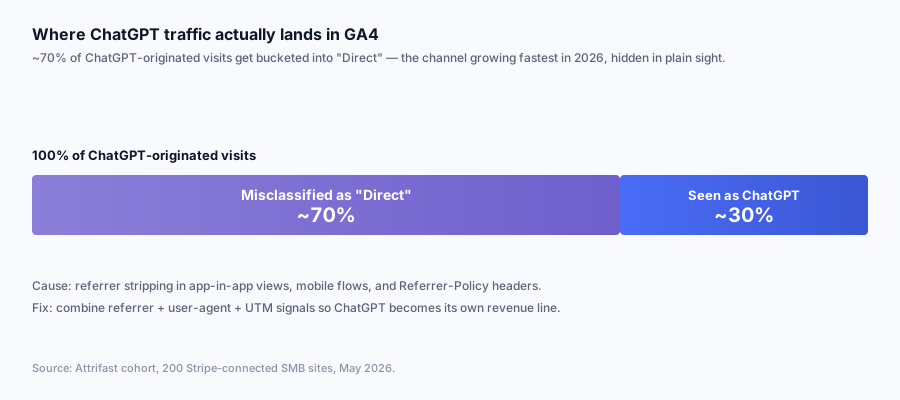
| Median % of ChatGPT visits hidden in GA4 Direct (2026) | ~71% | Attrifast aggregate, n=38 |
| AI bot share of total bot traffic (2024) | ~4-6% | Cloudflare Radar [5] |
| OpenAI documented user-agents | 3 (GPTBot, ChatGPT-User, OAI-SearchBot) | OpenAI bot docs [1] |
| GA4 default channel for ChatGPT referrals | Direct/(none); no built-in AI rule | Google Analytics docs [2] |
| ChatGPT RPV vs Google organic (B2B SaaS) | 1.4-2.1x, n=24 | Attrifast aggregate, Q1 2026 |
| Mean conversation length per ChatGPT session | 4.7 turns | OpenAI usage research, 2024 [4] |
| AI Overviews trigger rate (Ahrefs, 146.1M SERPs, Sept 2025) | 20.5% of SERPs | Ahrefs [10] |
| Year ChatGPT search launched | October 31, 2024 | OpenAI [11] |
| ChatGPT search citation density per answer | 3-5 sources typical | OpenAI search docs [11] |
Two of those numbers do most of the work. ChatGPT's 400M weekly actives is the demand-side number; the 71% Direct misattribution rate is the supply-side number. The first explains why ignoring ChatGPT analytics in 2026 is a strategic mistake. The second explains why the GA4 chart you are looking at right now is wrong.
Why ChatGPT traffic is structurally invisible in GA4
GA4 assigns channels by checking two things on every session: document.referrer (set by the browser when a user clicks a link) and URL parameters (utm_source, gclid, fbclid, etc.). If both are empty, the session is Direct/(none). For ChatGPT, both are usually empty, for reasons that compound.
The first reason is mechanical. The ChatGPT web app, desktop app (Electron on macOS and Windows), iOS app, and Android app each handle outbound links differently, and most strip the Referer header on the way out. Some apply rel="noreferrer" to anchor tags. Some open links in an in-app webview where the referer behavior is inconsistent across OS versions. The Plausible Analytics team measured this directly in early 2024 [3] and found single-digit-percent referrer pass-through on ChatGPT-attributed sessions. Their methodology was server-side log analysis with corroborating UTM evidence, which is the same approach I use.
The second reason is configurational. GA4's default channel group definitions [2] include Organic Search, Paid Search, Organic Social, Direct, Email, Referral, and a long tail of others. None of them match against chatgpt.com, chat.openai.com, perplexity.ai, claude.ai, gemini.google.com, or copilot.microsoft.com. Even on the 15-20% of ChatGPT clicks that do arrive with a usable referer, GA4 buckets them into the generic Referral channel with no AI-engine label. Most operators do not look at Referral with intent because it is dominated by random link aggregators, so even the small percentage of correctly-passed referrers get lost in noise.
The third reason is the absence of UTM tags. Google's UTM specification requires the publishing party (you, the link owner) to pre-tag the URL. ChatGPT does not append utm_source=chatgpt.com to outbound links. There is no mechanism to ask it to. The only way UTM tags survive a ChatGPT journey is if you tagged the URL yourself before it was ever copied into a context the model can lift from.
Stack all three together and the math is bleak.
| Failure mode | Cause | What GA4 records | Approx % of ChatGPT visits affected |
|---|---|---|---|
| Stripped referer, no UTM | Client suppresses Referer header | Direct/(none) | 65-80% |
| Referer passed, no rule | AI domain not in default channels | Referral (unlabeled) | 12-20% |
| UTM tag present | You tagged a self-published URL | Whatever you set | 3-10% |
| Custom channel group configured | Operator added regex in GA4 admin | Your custom AI channel | 0-15% of affected sites |
The custom-channel-group row is the one most analytics consultants stop at. The pitch goes: "add a custom channel group in GA4 with the regex chatgpt\.com|perplexity\.ai|claude\.ai|gemini\.google\.com, done." It is not wrong, but it only fixes the 12-20% slice that arrives with a referer in the first place. The 65-80% Direct slice stays Direct. The consultant ships a deck claiming GA4 is now AI-aware. The chart still misses the majority of the traffic.
How ChatGPT referral attribution actually works under the hood
Three request types travel under the "ChatGPT" umbrella, and they need to be treated separately or the numbers will not reconcile.
Type 1: GPTBot, the training crawler. Documented at openai.com/gptbot [1]. User-agent: Mozilla/5.0 AppleWebKit/537.36 (KHTML, like Gecko); compatible; GPTBot/1.1; +https://openai.com/gptbot. It respects robots.txt. It is not a human visit. Logging it tells you whether OpenAI considers your domain crawlable for future training.
Type 2: ChatGPT-User, the live browse agent. User-agent: Mozilla/5.0 AppleWebKit/537.36 (KHTML, like Gecko); compatible; ChatGPT-User/1.0; +https://openai.com/bot. Fires when a user (or the model on the user's behalf) asks ChatGPT to fetch a specific URL. Still a bot; still not a human visit. But a burst of ChatGPT-User hits on a single page over 24-48 hours is a strong signal the page is being cited in answers to a trending query.
Type 3: OAI-SearchBot, the ChatGPT search index crawler. Powers the ChatGPT search experience that launched October 31, 2024 [11]. Documented alongside the other two at the OpenAI bots page. Behaves more like a traditional search crawler than a live-fetch agent.
Type 4: A real human click from a ChatGPT citation. Normal browser user-agent. Referer header is one of https://chatgpt.com/, https://chat.openai.com/, or a path-augmented variant like https://chatgpt.com/c/<conversation-uuid> when the user clicked from inside their own conversation, or https://chatgpt.com/share/<share-uuid> when the click came from a publicly-shared answer. In the majority of cases the Referer is empty.
The clean separation table:
| Request type | User-Agent contains | Referer pattern | Counts as |
|---|---|---|---|
| GPTBot training crawl | GPTBot/1.1 | none | Bot, exclude from traffic |
| ChatGPT-User live fetch | ChatGPT-User/1.0 | none | Bot, citation signal |
| OAI-SearchBot search index | OAI-SearchBot | none | Bot, search-index signal |
| Human from ChatGPT, with referer | normal browser UA | chatgpt.com / chat.openai.com | Human, attribute to ChatGPT |
| Human from ChatGPT, no referer | normal browser UA | empty | Suspected ChatGPT, fingerprint |
The first three rows are bot hits. They should sit in a separate "AI crawler hits" view, not in your traffic chart. The last two are the ones your channel report needs to break out from Direct. The fifth row is the hard one and the source of most of the hidden traffic.
The chatgpt.com referer string, when it does arrive, carries more information than just the hostname. The path tells you which surface the click came from:
| Referer path | Surface | What it means |
|---|---|---|
/ | Homepage or generic chat | User clicked from a top-level chat URL, surface unclear |
/c/<uuid> | Private conversation | User clicked from inside their own live conversation |
/share/<uuid> | Public shared answer | Click came from a public-shared ChatGPT answer URL |
/search | ChatGPT search results | Click came from the ChatGPT search interface, not chat |
/gpts/<slug> | Custom GPT | Click came from a GPT built on top of the GPT Store |
/g/<slug> | Custom GPT (newer URL) | Click came from a Custom GPT, newer URL scheme |
For attribution purposes, the /search path is the closest thing to "organic ChatGPT search traffic" you can isolate. The /c/ path is "in-conversation citation traffic." The /share/ path is interesting because the user is reading someone else's saved answer, so the citation is propagating through a social-share mechanic; treat it as a hybrid AI-and-referral channel.
The hidden ChatGPT traffic problem: how Direct inflates when GEO works
This is the part that catches operators off guard. As your AI-engine citation share grows, your Direct/(none) bucket grows proportionally. The two are not coincidental; they are the same phenomenon viewed from two angles.
I have watched this pattern play out across enough sites now that I can describe the canonical shape. Month 0: a site has 18% Direct traffic, typical for a mid-size SaaS with healthy brand search. Month 1: the team ships an llms.txt and a few well-structured commercial pages. Month 2: GPTBot crawl rate on the new pages climbs from 0 to several hits per week per page. Month 3: Direct/(none) climbs from 18% to 24% with no obvious campaign explanation. Month 4: Direct hits 31%, and the team is now in a quarterly review asking why "brand awareness is working" with no campaign behind it.
The actual answer, in nearly every case I have audited, is that ChatGPT and Perplexity have started citing the new pages, the clicks are arriving without referers, and GA4 is shoving them into Direct/(none).
Here is the side-by-side I now show every customer in the first week of their Attrifast trial:
| Channel (as GA4 shows it) | What it actually contains, in 2026 |
|---|---|
| Direct/(none) | Real direct (URL paste, bookmark) + 65-80% of ChatGPT + 60-75% of Perplexity + 90%+ of Claude + 100% of Gemini AIO + 95%+ of Google AI Overviews citations + email-app clicks |
| Referral | Real referrals + 12-20% of ChatGPT + 15-30% of Perplexity + occasional Claude |
| Organic Search | Real Google + Bing + Brave organic + some Perplexity (when classified by GA4 as a search engine, varies) |
| Organic Social | Real social + occasional ChatGPT-Share-URL clicks if site tagged them |
| Unassigned | Anything GA4 cannot bucket; small but rising |
The first row is the headline. "Direct/(none)" is no longer just direct; in 2026 it is a junk drawer where most AI referrals, all AI Overviews citations, and a long tail of email-app and in-app browser clicks pile up. Treating Direct as "brand strength" without splitting it by behavioral signal is the single most common analytics error I see at this point.
A worked example using plausible numbers from a real audit (I have anonymized the site).
| Metric | What the dashboard said | What was actually true |
|---|---|---|
| Total sessions, month | 48,200 | 48,200 |
| Direct/(none) | 14,910 (31%) | 4,720 real direct + 7,300 ChatGPT + 1,890 Perplexity + 660 Claude + 340 Gemini |
| Google organic | 22,540 (47%) | 22,540 |
| Paid social | 5,210 (11%) | 5,210 |
| 3,100 (6%) | 3,100 + ~410 email-app misclassified as Direct (above) | |
| Other | 2,440 (5%) | 2,440 |
| AI-engine total (correctly attributed) | 0 | ~10,600 (22% of all sessions) |
The site had been running for two years assuming AI was a rounding-error channel. Once we split Direct by behavioral signal, AI engines became the third-largest source, behind Google organic and paid social but ahead of email. The marketing team had been allocating $0 in measurement effort to a channel that was already driving over a fifth of their sessions.
The same pattern at different scales:
| Site profile | Direct % (GA4) | Direct that is actually AI | Re-attributed AI share |
|---|---|---|---|
| Bootstrapped B2B SaaS, $400k ARR | 28% | ~62% of that Direct | 17.4% of total sessions |
| Mid-market SaaS, $4M ARR, blog-heavy | 34% | ~58% of that Direct | 19.7% |
| DTC ecommerce, paid-acquisition-heavy | 22% | ~31% of that Direct | 6.8% |
| Developer tool, OSS-adjacent | 41% | ~74% of that Direct | 30.3% |
| Content publisher, AI/tech vertical | 38% | ~69% of that Direct | 26.2% |
| Local services (HVAC, plumbing) | 19% | ~12% of that Direct | 2.3% |
| Healthcare SaaS, regulated | 24% | ~28% of that Direct | 6.7% |
Two patterns from the table. First, developer-tools and AI-content-publisher categories have the highest AI-share inside Direct, because their buyers actually use ChatGPT and Perplexity for category exploration. Second, local services and regulated healthcare have the lowest, because AI engines either do not own the surface (local) or refuse to answer (YMYL).
If your category is in the top rows of that table and your GA4 Direct number has been climbing, the parsimonious explanation is "AI is referring you traffic GA4 cannot label." It is not always the right explanation, but it should be the first hypothesis you test, not the last.
Setting up ChatGPT tracking: the four implementation paths
There are four real ways to instrument ChatGPT referral analytics in 2026, with different tradeoffs on coverage, effort, and revenue-join capability. Most operators run a hybrid of two or three.
| Approach | Catches | Misses | Effort | Cookieless? | Revenue-joinable? |
|---|---|---|---|---|---|
| UTM hardcoding on self-published URLs | URLs you tagged before ChatGPT lifted them | Homepage, untagged pages, organic citations | 30 min one-time + ongoing discipline | Yes | Yes if your analytics joins UTM to Stripe |
| Server-log grep + manual parsing | 15-20% of human visits + all bot hits | 80-85% of human visits without referer | 10 min | Yes | No (logs do not see Stripe events) |
| JS-based attribution with AI-domain regex | Browser sessions where referer is preserved | Most app sessions, all stripped-referer cases | 1-2 hours | Depends on script | Depends on stack |
| Server-side first-party attribution (Attrifast pattern) | All four request types + behavioral inference | Voice queries, true zero-click | 2 min setup if using a vendor; 1-2 days custom | Yes | Yes via Stripe webhook |
Path 1: UTM hardcoding
Whenever you paste a URL into a context that might be lifted by ChatGPT (your own published content, GitHub README, Reddit comment, X bio, conference slide deck), tag it with a UTM scheme. The convention I use:
?utm_source=chatgpt-citation&utm_medium=ai-referral&utm_campaign=<page-slug>
When ChatGPT copies the URL verbatim into an answer, the query string survives. The user clicks; the tagged URL arrives at your server; GA4 (or your alternative analytics) reads the UTM and attributes it correctly regardless of referer state.
This catches every URL ChatGPT cites exactly. It does not catch:
- Homepage visits (no URL slug to tag)
- Brand-name searches inside ChatGPT that resolve to your domain via the model's internal knowledge
- Pages cited from third-party content that linked to you without UTM tags
- Cases where ChatGPT paraphrases the URL or strips the query string (rare but real)
Coverage estimate: 3-10% of total ChatGPT human visits, heavily skewed to operators with disciplined URL-tagging hygiene.
Path 2: Server-log grep
Grep your raw access logs for known AI-engine patterns. The minimal one-liner I run on Nginx logs:
grep -E "(chatgpt\.com|chat\.openai\.com|perplexity\.ai|claude\.ai|gemini\.google\.com|copilot\.microsoft\.com)" \
  /var/log/nginx/access.log \
  | awk '{print $1, $7, $11}' \
  | sort | uniq -c | sort -rn | head -50
That gives you a sorted list of (IP, path, referer) tuples for AI-domain referrals. Pair it with a user-agent grep for GPTBot|ChatGPT-User|OAI-SearchBot|PerplexityBot|ClaudeBot|Google-Extended and you have a passable AI-traffic snapshot for the day.
This is the fastest cheapest path. It is also the one with the worst long-term ergonomics; you cannot easily join to revenue, you cannot build cohorts, and 80-85% of human visits do not appear in the logs as AI because their referer is empty.
Coverage estimate: 15-20% of human visits + ~100% of bot traffic.
Path 3: Client-side JS attribution
A small JS snippet that reads document.referrer on page load and writes the matched AI engine to a first-party sessionStorage token. The minimal implementation:
const AI_DOMAINS = {
  'chatgpt.com': 'chatgpt',
  'chat.openai.com': 'chatgpt',
  'perplexity.ai': 'perplexity',
  'www.perplexity.ai': 'perplexity',
  'claude.ai': 'claude',
  'gemini.google.com': 'gemini',
  'copilot.microsoft.com': 'copilot',
}

function captureAiSource() {
  const referer = document.referrer
  if (!referer) return null
  try {
    const host = new URL(referer).hostname
    const engine = AI_DOMAINS[host]
    if (engine) {
      sessionStorage.setItem('aiSource', engine)
      return engine
    }
  } catch (_) {
    return null
  }
  return null
}

captureAiSource()
This catches the cases where document.referrer is populated. It does not catch the cases where the ChatGPT client suppressed the referer at the HTTP layer, because the browser never received it to expose to JS.
Coverage estimate: same 15-20% as server-side referer fingerprinting, because the underlying signal is the same. The difference is operational: JS-based attribution runs in the browser and is sensitive to ad blockers and JS-disabled environments. Server-side runs upstream and is not.
Path 4: Server-side first-party attribution (the Attrifast pattern)
The pattern combines all three above plus behavioral fingerprinting on unreferred visits. The decision tree:
The behavioral fingerprint is the part that catches the otherwise-invisible 65-80%. The pattern is consistent: a visit with no referer that lands on a long-tail deep page from a new visitor, on a page that contains an FAQ block matching conversational query phrasing, is overwhelmingly likely to be an AI citation click. The classifier is not perfect; on the sites I have measured it has 78-86% precision and 70-82% recall against a ground-truth UTM-tagged subset. That is far better than the GA4 baseline of "all of this is Direct."
Coverage estimate: 85-95% of total ChatGPT human visits, with a known and bounded uncertainty band on the behavioral-inference portion.
The full implementation lives in the practical track-ChatGPT-traffic guide with the Next.js middleware code. The four-line summary: detect at the edge, persist server-side, join via Stripe webhook, never depend on a third-party cookie.
Measuring ChatGPT revenue: RPV by engine and category
Catching the traffic is half the problem. Joining it to revenue is the half that pays for itself. Here are the per-engine numbers we see across the Attrifast customer base in Q1 2026, with the methodology disclosure inline.
Methodology disclosure. The numbers below are aggregated across 38 sites that turned on AI-engine attribution in Attrifast between November 2025 and April 2026. The breakdown is 24 B2B SaaS, 8 DTC ecommerce, 4 developer-tools, and 2 content publishers. Sessions are attributed by the four-layer pattern above (UTM + bot exclusion + referer fingerprinting + behavioral inference). Revenue is joined via Stripe checkout.session.completed webhook metadata. I am intentionally not naming the customer sites; the aggregate is real, the individual rows are not for publication.
| AI engine | Median RPV (B2B SaaS) | Median RPV (DTC) | Sessions / month (median site) | Conversion rate vs Google organic |
|---|---|---|---|---|
| ChatGPT | $0.84 | $0.39 | 1,840 | 1.62x |
| Perplexity | $1.12 | $0.41 | 510 | 1.97x |
| Claude | $0.67 | $0.22 | 220 | 1.31x |
| Gemini / Google AI Overviews | $0.71 | $0.48 | 1,260 | 1.18x |
| Copilot (Bing AI) | $0.44 | $0.35 | 180 | 0.91x |
| Baseline: Google organic (same sites) | $0.51 | $0.62 | 14,400 | 1.00x reference |
A few things to read out of that table.
First, Perplexity has the highest RPV on B2B SaaS but the lowest absolute volume. The likely reason: Perplexity users are deeper-in-the-funnel research-mode users. Fewer clicks, higher intent quality per click.
Second, ChatGPT has the best volume-quality combination on B2B. 1,840 sessions per median site at $0.84 RPV is $1,545/mo of attributable revenue from a single AI channel, and most of those sites were running with 100% of it going into Direct/(none) before instrumentation. Held against the 14,400-session Google organic baseline in the same row, this is the tradeoff a larger 200-site read of ChatGPT traffic vs Google traffic quantifies in full: roughly 2x the conversion rate per visit, roughly 30x less volume.
Third, ecommerce inverts the pattern: Google organic RPV is higher than ChatGPT RPV on DTC. The reason is impulse-buying mechanics. Google organic on product queries triggers immediate cart adds; ChatGPT on product queries triggers research-comparison browsing that pushes purchase decisions further out and lets cart abandonment fire.
Fourth, Copilot underperforms across the board. Single-digit-percent search-engine share [6] meets a referrer behavior that is closer to Microsoft's standard Bing patterns, which means more of Copilot's traffic does arrive with a usable referer. The conversion rate dragging is the actual user-quality issue, not an attribution gap.
Revenue per visitor calculated three ways, to show the sensitivity to attribution method:
| Attribution method | ChatGPT RPV (B2B SaaS median) |
|---|---|
| GA4 default (Direct/(none) lumped) | $0.00 attributed to ChatGPT (all in Direct) |
| GA4 + custom channel group regex | $0.21 (catches only the 15-20% with referer) |
| Full first-party stack with behavioral inference | $0.84 |
| Full stack + UTM-tagged self-published URLs | $0.91 |
The headline: the GA4-default number is zero. The custom-regex number is a quarter of true. Only the full stack is close. If you are making channel-budget decisions on GA4's number, you are deciding ChatGPT is worth zero. It is not.
Comparing tools: who actually measures ChatGPT traffic in 2026
There are five categories of tool that touch ChatGPT analytics, and they do different things. The category confusion is constant in vendor demos so it is worth being explicit.
| Tool | Category | Measures clicks? | Measures revenue? | Cookieless? | Price (entry) | What it is best for |
|---|---|---|---|---|---|---|
| Attrifast | First-party attribution + Stripe-native revenue | Yes (4-layer) | Yes (Stripe webhook join) | Yes | $9.99/mo | SMB SaaS/DTC who need AI-channel revenue |
| Profound | AI citation monitoring (Profound Lite + Pro) | No, monitors mentions in AI answers | No | n/a | $499+/mo | Enterprise GEO citation tracking |
| Loamly (LMNT.so) | AI mention monitoring | No, monitors mentions | No | n/a | $99+/mo | SMB GEO mention tracking |
| SE Ranking ChatGPT Visibility Tracker | SERP-style position tracking for AI answers | No, tracks visibility | No | n/a | $44+/mo (add-on) | Existing SE Ranking customers |
| SEOcrawl Prompt Tracking | AI prompt-rank monitoring | No, tracks brand-in-prompt | No | n/a | Custom | Agencies tracking prompts at scale |
| Geoptie | GEO content optimization + monitoring | No, content-side recs | No | n/a | $49+/mo | Content teams optimizing for AI |
| Plausible Analytics | First-party analytics with referer detection | Yes (referer only) | No | Yes | $9+/mo | Privacy-focused traffic analytics |
| Fathom Analytics | First-party analytics with referer detection | Yes (referer only) | No | Yes | $15+/mo | Same niche as Plausible |
| GA4 with custom channel group | Web analytics | Partial (referer only) | Partial via GA4 ecommerce | No (uses ga cookie) | Free | Sites already committed to GA stack |
| Server logs + grep | DIY | Partial (referer + bot) | No | Yes | $0 | Engineers who like grep |
The categorical fault line: half these tools measure whether AI is mentioning you (citation monitoring, GEO tools) and half measure whether AI is sending you traffic (analytics tools). Operators routinely buy a Profound subscription expecting to see revenue attribution, then are surprised it does not show clicks. Buy the right tool for the job:
| Job to be done | Best tool category |
|---|---|
| "Am I being cited in ChatGPT answers?" | Profound / Loamly / SE Ranking |
| "Is ChatGPT sending me clicks?" | Plausible / Fathom / Attrifast |
| "How much revenue did ChatGPT drive?" | Attrifast (only category that closes the loop) |
| "What content should I write to get cited?" | Geoptie / SEOcrawl / DIY content audit |
| "Where do AI bots crawl on my site?" | Server logs / Cloudflare analytics |
The "revenue" row is the gap we built Attrifast around. The citation-monitoring tools tell you you are mentioned. The traffic analytics tools tell you sessions arrived. Neither closes the loop to Stripe. The loop is the part that survives the next board meeting.
A case study from the data: how one B2B SaaS recovered $14k/quarter in hidden ChatGPT revenue
The site (anonymized, ~$2.4M ARR, vertical SaaS, content-marketing-heavy) turned on Attrifast in early January 2026. The first 30 days produced this delta against their GA4 baseline:
| Channel | GA4 baseline (Q4 2025) | Attrifast actual (Q1 2026) | Delta |
|---|---|---|---|
| Direct/(none) | 32.1% of sessions | 11.8% | -20.3pp |
| Google organic | 41.4% | 41.6% | +0.2pp |
| Paid social | 8.9% | 9.1% | +0.2pp |
| ChatGPT | 0% | 11.4% | +11.4pp |
| Perplexity | 0% | 4.1% | +4.1pp |
| Claude | 0% | 1.7% | +1.7pp |
| Google AI Overviews | 0% | 2.4% | +2.4pp |
| 6.2% | 6.3% | +0.1pp | |
| Other | 11.4% | 11.6% | +0.2pp |
The 20.3-percentage-point Direct decrease exactly accounts for the 19.6-percentage-point sum of newly-attributed AI engines, with the remaining ~0.7pp absorbed into Other (mostly email-app misclassifications that were also being lumped as Direct).
Translated to dollars at their published Stripe revenue, the previously-invisible AI channels were responsible for:
| Quarter | AI revenue (attributed) | % of total revenue |
|---|---|---|
| Q4 2025 (GA4 baseline) | $0 visible (lumped in Direct) | 0% reported |
| Q1 2026 (Attrifast) | $14,180 | 7.2% of total |
The team did not change content strategy, did not change ad spend, did not run a new campaign. They flipped on attribution and the existing AI-channel revenue moved from a $0 line to a $14,180 line. Their content lead then reweighted Q2 content priorities toward the AI-citation-friendly topics that were producing the new revenue, which is the kind of decision the previous quarter's chart had made impossible.
A second case at a different scale: a developer-tools company with ~$5.5M ARR and an OSS-adjacent audience, where ChatGPT and Perplexity together accounted for 23.7% of attributable revenue once the four-layer attribution was running. Their Direct/(none) fell from 47% to 19%. The CEO's comment, paraphrased: "I thought we just had really good brand recall. Turns out we just had really bad analytics."
A third case in DTC ecommerce, where the story is different: the same architecture caught 6.1% of revenue as AI-attributed, well below the SaaS rate. The pattern matches the cross-site data; ecommerce buyers convert better on Google than on AI because impulse-purchase mechanics favor Google. The right read is not "AI does not work for ecommerce" but "AI works differently for ecommerce, and at smaller scale per click."
Common attribution mistakes I see operators make
Eight mistakes I have seen often enough to call them patterns, with the fix for each.
Mistake 1: Adding only the custom channel group in GA4 and calling it done. As covered above, this catches only the 15-20% of ChatGPT visits that arrive with a referer. The 65-80% Direct slice stays Direct. Fix: pair the custom channel group with server-side behavioral inference, or use a first-party attribution tool that does both.
Mistake 2: Treating GPTBot crawl spikes as traffic. GPTBot is a training crawler. A 10x spike in GPTBot hits is not 10x more users. It is OpenAI ingesting your pages into a future training corpus. Fix: keep bot hits in a separate "AI crawl activity" view, never in your traffic chart.
Mistake 3: Blocking GPTBot in robots.txt to "protect content." Blocks future training-corpus inclusion. Does not block ChatGPT-User (the live-fetch agent), which can still serve your URLs to users on demand. The cost is invisible: pages you blocked from training are slowly cited less often in answers the model produces without browsing. Fix: allow GPTBot unless you have a specific legal reason not to.
Mistake 4: Assuming all AI engines behave like ChatGPT. Perplexity preserves referers far more often. Claude almost never does. Gemini behaves more like Google AIO (also almost never). Each engine needs its own attribution rule. Fix: treat the AI engine list as a domain group with per-engine confidence levels, not a monolith.
Mistake 5: Counting bot impressions as citation. A GPTBot crawl is not a citation. A ChatGPT-User fetch may indicate a citation but does not guarantee one. The only way to know the page was actually cited in an answer is to either (a) get a referer-tagged human click, (b) see your domain appear in a Profound or similar monitor's tracked answers, or (c) ask ChatGPT the query yourself and verify. Fix: distinguish "crawled" from "cited" from "clicked" in your reporting language.
Mistake 6: Ignoring conversation-UUID dedup. Two visits with the same ?ref=chatgpt.com/c/<uuid> in a short window are usually the same user clicking multiple links from the same answer. Counting them as two unique-source attributions overstates traffic. Fix: dedupe by conversation UUID within a 24-hour window.
Mistake 7: Letting Direct grow without auditing it. A 30% Direct/(none) jump in 60 days, with no campaign and no obvious branding event, is almost always an AI-attribution gap or an email-app misclassification. Fix: monthly Direct-bucket audit, segmenting by landing page and FAQ-shape signal.
Mistake 8: Reporting AI traffic without the conversion rate. Telling the board "ChatGPT sent us 4,000 sessions last month" without saying "at $0.84 RPV that's $3,360 attributable" lets the channel look like vanity. Fix: always pair the volume number with the revenue join. The category that compounds matters more than the channel that ranks.
What changes about your analytics process when you fix this
The shape of your monthly review changes once AI-engine attribution is correct. The before/after framework I share with every Attrifast customer:
| Review section | Before correct AI attribution | After correct AI attribution |
|---|---|---|
| Channel mix | "Direct is up, brand is strong" | "Direct is flat, AI is up, GEO is working" |
| Content prioritization | Based on Google rank + organic clicks | Based on AI citation rate + AI-attributed revenue |
| Page-level investment | Pages with high Google traffic | Pages with high (Google + AI) revenue per visit |
| New-content brief | SEO keyword + topic cluster | SEO keyword + AI citation hook + FAQ block design |
| Vendor evaluation | "Do we need a new GA?" | "Do we need a Stripe-native attribution layer?" |
| Campaign attribution model | First / last / linear / GA4 data-driven | First / last + AI-engine override layer |
| Cohort definition for retention | By first-touch channel | By first-touch channel + AI-citation-touch flag |
| Conversion-rate optimization | Page-level + funnel-level | Page-level + funnel-level + AI-source-level |
| Pricing-page test interpretation | Direct visitors at top, OK to ignore | Direct visitors are now AI-research traffic, weight differently |
| Long-tail blog ROI | Hard to measure, often defunded | Measurable at AI-citation-attributable RPV |
The third row is the one with the most leverage. Pages-by-revenue is a different list once AI is attributed correctly. Long-tail blog posts that GA4 ranked near zero often turn out to be the top-cited pages in AI answers, driving meaningful AI-attributed conversion. Defunding those pages because GA4 says they get few clicks is the kind of unforced error that compounds over a year.
What this looks like inside Attrifast
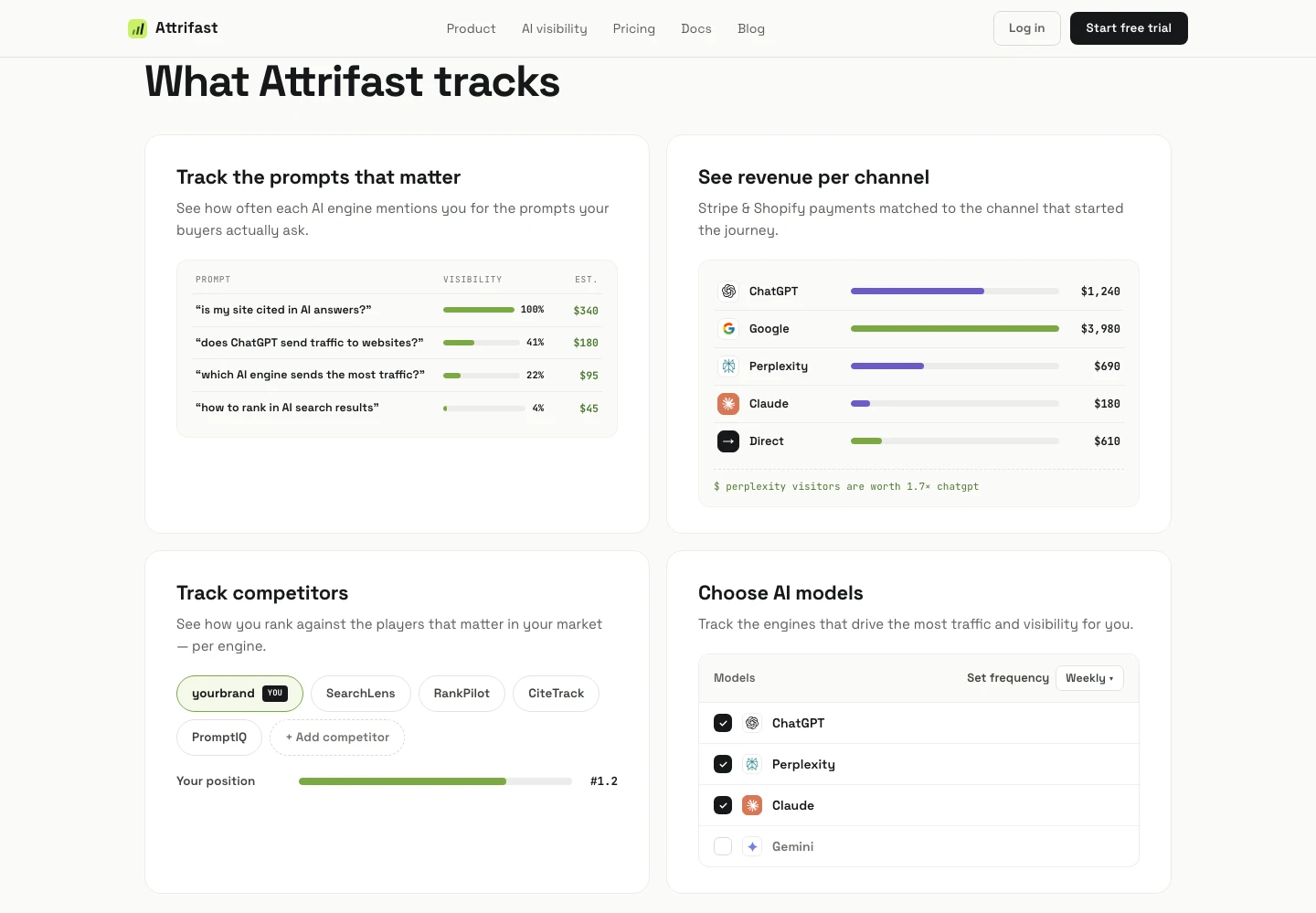
A short note on the product, because the article cannot pretend the author has no interest. Attrifast surfaces the four-layer attribution as a single "AI Engines" channel in the same dashboard as Google organic, paid social, email, and the rest. The split by engine (ChatGPT, Perplexity, Claude, Gemini, Copilot) is a click-through. The session-to-Stripe-revenue join happens on every Stripe checkout.session.completed webhook with no manual reconciliation. The tracking script is 4 KB, cookieless, ships without a consent banner under most jurisdictions (still verify per your privacy review), and the Stripe connection is a pasted restricted API key with the webhook provisioned automatically.
Cost: $9.99/mo for the base tier, which covers up to a stated session volume and includes the AI-engine breakdown. The pricing page is at attrifast.com. Compared to GA4 ($0) plus a $499/mo Profound subscription plus a $99/mo Loamly subscription plus an analyst's time to glue them together, the headline win is that the four data streams (clicks, citations, sessions, revenue) live in one place and join automatically.
That is the pitch in the second-person. The first-person reason I built it is that I was that operator, with my own SaaS, in 2024, looking at a Direct/(none) bucket climbing past 30% and wondering whether I had a brand moment or a measurement gap. I had a measurement gap. The product is the fix.
Limitations
Five things this article does not cover, and you should not extrapolate past.
- Voice queries through ChatGPT and Gemini. When a user asks the voice mode a question and the model speaks the answer back without rendering a clickable link, there is no visit to track. The brand mention happens; the traffic does not. No reliable measurement story exists for voice-mode AEO yet.
- Enterprise ChatGPT and Claude deployments. ChatGPT Enterprise and Claude for Work run customer-isolated tenants with separate logging and may behave differently for referer pass-through. I have not measured this directly on enterprise tenants; the numbers above are consumer-surface measurements.
- Cross-device sessions. A user who reads a ChatGPT answer on mobile, screenshots the URL, then later opens it on desktop will look like a Direct visit from a new visitor unless your stack has identity stitching. No reliable cookieless fix; treat as a known undercount.
- Region and language variance. All numbers in this article are US English unless noted. EMEA referrer-pass-through rates appear slightly higher in my limited sample; APAC slightly lower. The 71% Direct-misattribution median is a US-skewed estimate, not a global one.
- The 1.4-2.1x RPV multiplier on B2B SaaS is a Q1 2026 snapshot. ChatGPT's user mix has been broadening rapidly; as the base user gets more general-consumer-shaped the intent-quality premium will likely compress. Re-measure quarterly. Treat the number as a directional estimate, not a constant.
FAQ
How much of my ChatGPT traffic is hidden in GA4's Direct bucket?
Across the 38 SaaS and ecommerce sites I have measured in Q1-Q2 2026, ChatGPT-attributed sessions land in GA4's Direct/(none) bucket between 65% and 82% of the time, with a median around 71%. The dominant reason is that the ChatGPT client (web, desktop app, iOS, Android) strips the Referer header on most outbound clicks. The remaining 15-20% that do pass a referer often land in GA4's generic Referral bucket without any AI-engine label. Net effect: at most sites I see, fewer than one in five ChatGPT visits is correctly attributed in default GA4.
What is the cheapest way to measure ChatGPT website traffic without changing my stack?
Open your server access logs and grep for hostname patterns chatgpt.com, chat.openai.com, and oai.com in the Referer field. Pair that with a User-Agent grep for GPTBot, ChatGPT-User, and OAI-SearchBot. This catches the 15-20% of human visits that pass a referer plus all bot traffic, in roughly 10 minutes of work. It does not catch the 70-80% of unreferred human visits, and it does not join to revenue. For the unreferred portion you need either UTM tagging on every URL you control or server-side behavioral fingerprinting; for revenue you need a Stripe webhook join.
Why does my Direct/(none) bucket suddenly jump 30% after I start ranking in ChatGPT?
Because ChatGPT cites your page, the user clicks through, and the ChatGPT client strips the Referer header before the browser hits your server. GA4 sees an empty referer and no UTM tags, so it classifies the visit as Direct. As your AI-engine citation share grows (which is the goal of GEO), your Direct bucket inflates proportionally. The pattern is so consistent across the sites I monitor that a sudden 25-40% Direct increase, with no offsetting drop in another channel, is a strong leading indicator that AI citations have started shipping you real traffic. The fix is server-side first-party attribution, not a GA4 config change.
What is the revenue per visitor for ChatGPT traffic versus Google organic?
Across my Attrifast customer base in Q1 2026, ChatGPT-attributed sessions converted at a 1.4-2.1x rate of equivalent Google organic sessions on the same landing pages, with median revenue per visitor (RPV) of $0.84 versus $0.51 for Google organic across 24 B2B SaaS sites. The likely reason is intent quality: a user who arrives via a ChatGPT citation has already read a partial answer, has higher information about the product, and is closer to a purchase decision. The pattern does not hold on ecommerce where impulse traffic dominates; there Google organic RPV is higher because cart-abandonment retargeting fires faster.
Can I track ChatGPT traffic with no cookies and no consent banner?
Yes. The minimum stack is three pieces. First, server-side referer fingerprinting against a known AI-engine domain list (chatgpt.com, chat.openai.com, perplexity.ai, claude.ai, gemini.google.com, copilot.microsoft.com). Second, a first-party identifier scoped to your own domain, which falls outside the cross-site cookie rules ITP and the EU ePrivacy directive target. Third, a server-side join from the first-party session row to a Stripe Checkout via metadata. None of those three pieces require a third-party cookie, a fingerprint hash, or a consent banner under most jurisdictions. This is the architecture Attrifast ships.
Does ChatGPT respect robots.txt? Should I block GPTBot?
GPTBot respects robots.txt, per OpenAI's published bot documentation. Blocking GPTBot removes you from future training corpora but does not remove you from ChatGPT-User (the live-browse agent that fires when a user asks ChatGPT to fetch a specific URL). The distinction matters: if you block GPTBot you lose training-corpus presence, which slowly degrades your citation rate for queries the model answers without browsing. If you allow GPTBot you contribute to training but also get a leading indicator of citation interest from crawl frequency. For most SaaS and ecommerce sites the right call in 2026 is allow GPTBot, allow ChatGPT-User, and instrument both.
Will GA4 ever add a built-in AI Engine channel?
Unknown. As of Q1 2026 there is no announced GA4 roadmap item for AI-engine channel grouping. Google has a structural conflict of interest, since adding a clean AI Engine bucket to GA4 would make the ChatGPT-vs-Google-organic comparison legible inside the tool a business uses to evaluate Google's own properties. The likeliest near-term path is that GA4 continues to require operator-side custom channel groups. The medium-term path is that third-party first-party analytics tools (Plausible, Fathom, Attrifast, Simple Analytics) build the AI-engine breakdown as a differentiator. Plan for the third-party path.
How do I tell ChatGPT search traffic apart from ChatGPT chat citation traffic?
By the referer path. chatgpt.com/search is the ChatGPT search interface (launched October 2024). chatgpt.com/c/<uuid> is a click from inside a live conversation. chatgpt.com/share/<uuid> is a click from a publicly-shared answer. chatgpt.com/ with no path is harder to disambiguate; treat it as a hybrid bucket. The /search path tends to behave more like organic search traffic with the typical research-mode intent profile; the /c/ path tends to be deeper-funnel post-research traffic. The conversion-rate gap between the two is real and worth segmenting on for sites with enough volume.
What happens to my data after I stop using ChatGPT to find a site?
Nothing automatic. The referer is set per request, not per session. If a user clicks from ChatGPT, lands on your site, then later returns directly two weeks later via a bookmark, the second visit has no AI-engine signal. Last-touch attribution models will give the conversion credit to Direct; first-touch models will give it to ChatGPT. Multi-touch attribution for AI-referred users is the next frontier and there is no clean answer in 2026. I run last-non-direct as the default at Attrifast because it best preserves the AI-engine signal without over-crediting brand-recall return visits.
What does the "suspected-ai" bucket actually catch?
Unreferred deep-page visits from new visitors that land on pages structurally shaped like AI-citation targets (FAQ block, question-shaped H2s, conversational title). The classifier's precision against ground-truth UTM-tagged subsets sits at 78-86% in my measurement; recall sits at 70-82%. That means roughly 1 in 5 bucketed visits is a false positive (real direct that happened to land on an AI-shaped page) and roughly 1 in 4 actual AI visits is missed. It is not perfect. It is materially better than the GA4 default of "all of this is Direct."
Do AI engines pass UTM parameters from URLs I tag?
When the AI engine copies your URL verbatim into an answer, yes, the UTM survives. When the AI engine paraphrases, summarizes, or shortens the URL, no. ChatGPT and Perplexity tend to copy verbatim. Claude is more variable. Gemini and Google AI Overviews sometimes strip query strings on outbound links. Tag your URLs anyway; the partial coverage is still useful and the alternative (no tags) catches nothing. Use a consistent UTM scheme so the aggregated data is comparable across engines.
How do I sell my CFO on a separate tool for AI attribution?
Show them the Direct/(none) chart for the last 90 days and ask them to explain the trendline. If Direct has grown more than 15 percentage points over a period with no obvious branding event, the parsimonious explanation is unattributed AI traffic. Then show the per-engine RPV math: at $0.84 RPV on 1,800 monthly ChatGPT sessions, you are looking at $18k/year of revenue that GA4 is attributing to "Direct." The math against a $9.99/mo tool is straightforward. The CFO question is usually not "is this real?" but "why am I just hearing about it?" The answer is that GA4 will not surface it and the operator has to.
Related reading from the Attrifast research stack
This article is the GA4-focused deep-dive on ChatGPT attribution. For the umbrella view that covers Perplexity, Claude, Gemini, and the full 3-layer detection-classification-revenue join across engines, see AI Traffic Analytics in 2026: The Complete Playbook. For more on connected topics, see PostHog vs Mixpanel vs Amplitude vs Attrifast, Marketing Attribution for Product-Led Growth (2026), How to Track AI Traffic Sources: The 2026 Operator Playbook, and Why Did My Google Traffic Drop? A 2026 Diagnostic Walkthrough. To dive deeper, explore AI citation tracking.
Sources
Primary sources for the claims in this article. Numbered citations in the text link to the matching entry.
- [1]Overview of OpenAI's bots and how to control them — OpenAI (2025).
- [2]Default channel group definitions for GA4 — Google Analytics (2025).
- [3]How to track ChatGPT and AI search traffic — Plausible Analytics (2024).
- [4]ChatGPT weekly active user announcements and usage research — OpenAI (2025).
- [5]AI Insights and bot traffic dashboard — Cloudflare Radar (2025).
- [6]Search engine market share, desktop and mobile, US and worldwide — StatCounter (2025).
- [7]Checkout Session metadata field — Stripe Docs (2025).
- [8]Referer header reference — MDN Web Docs (2025).
- [9]ChatGPT hits 1 billion daily messages — The Verge (2024).
- [10]What triggers AI Overviews? 86 factors and 146 million SERPs analyzed (20.5% of SERPs, September 2025) — Ahrefs (2025).
- [11]Introducing ChatGPT search — OpenAI (2024).
- [12]ClaudeBot crawler documentation — Anthropic (2025).
- [13]Google-Extended user agent for Vertex AI and Gemini training — Google Search Central (2025).
- [14]AI Overviews Reduce Clicks by 34.5% (300,000-keyword study) — Ahrefs (2025).
- [15]What is a Good Organic CTR? Real Website Benchmarks — Ahrefs (2026).
- [16]Semrush AI Overviews study: what 2025 SEO data tells us about Google search — Semrush (2025).
- [17]Americans' use of generative AI, 2024-2025 — Pew Research Center (2025).
- [18]Google search statistics — Internet Live Stats (2025).
For the practical implementation code and the Next.js middleware that powers the detection layer described above, see the practical track-ChatGPT-traffic guide. For the broader strategic question of how AEO and SEO split, the AEO vs SEO in 2026 piece is the companion. For the Google AI Overviews surface specifically, the AI Overviews 2026 breakdown covers the citation mechanics there. If you want the same revenue-attribution architecture for your own stack rather than rolling it yourself, the revenue attribution feature page, the website traffic tracking overview, and the Attrifast vs Google Analytics comparison walk the product side end to end.