The "which product analytics tool should I use" question is the wrong question in 2026, and the answer most consultants give ("just use PostHog, it has a free tier") closes the wrong half of the gap. The real choice is not between PostHog, Mixpanel, Amplitude, and Heap; the four are more similar than different at the event-and-funnel layer they all compete in. The real choice is whether you also need a revenue-attribution tool next to them, because all four punt on the marketing-source-to-Stripe-charge join in the same way. I have run this stack on attrifast.com, on two prior SaaS, and audited it on roughly 40 client properties through 2024-2026. The honest read is below.
This piece is the long-form comparison. The per-vendor pages live elsewhere: Attrifast vs PostHog, Attrifast vs Mixpanel, Attrifast vs Amplitude, Attrifast vs Heap, Attrifast vs Segment. The narrower revenue-attribution-feature piece is revenue attribution. The audience-specific guides are Attrifast for bootstrapped SaaS and Attrifast for Stripe.
Quick Facts
| Metric | Value | Source |
|---|---|---|
| PostHog free tier events / mo | 1,000,000 | PostHog pricing [3] |
| PostHog session replay free tier | 5,000 recordings / mo | PostHog pricing [3] |
| Mixpanel Growth plan starting price | $24-28 / mo at base, scales by event volume | Mixpanel pricing [4] |
| Amplitude Plus plan starting price | $49 / mo, scales by event volume | Amplitude pricing [5] |
| Heap Free tier MAU | 10,000 / mo | Heap pricing [6] |
| Segment Team plan starting price | ~$120 / mo, scales by MTU | Segment pricing [7] |
| Stripe Sigma starting price | $0.02 per row queried + base | Stripe Sigma docs [8] |
| Approx % of SMB SaaS using more than one analytics tool (2025) | 68% | OpenView SaaS Benchmarks 2025 [9] |
| Median product analytics tool spend per ARR dollar (SaaS, 2025) | 0.4-0.9% of ARR | ChartMogul SaaS benchmarks 2025 [10] |
| PostHog Github stars (Q2 2026) | 25,000+ | PostHog repo |
| Mixpanel founded | 2009 | Mixpanel about [4] |
| Amplitude founded | 2012 | Amplitude about [5] |
| Heap founded | 2013 | Heap about [6] |
| PostHog founded | 2020 | PostHog about [3] |
| Attrifast flat monthly price | $9.99 / mo at any MRR | Attrifast pricing |
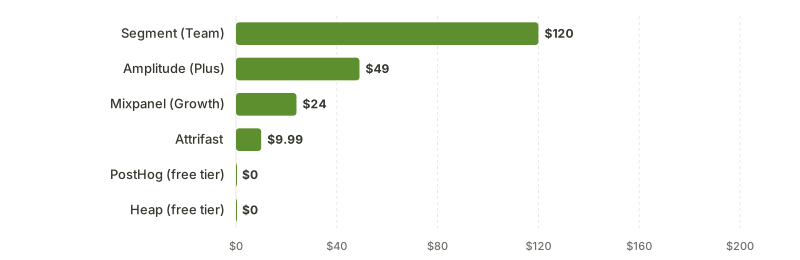
Source: Each vendor's published entry tier. PostHog and Heap start free; Mixpanel, Amplitude and Segment scale with event or user volume above the figure shown
Two of those numbers do most of the work in the comparison. The PostHog free tier (one million events per month) is the floor under the SMB market; almost nothing else in the category gets close. Attrifast's flat $9.99 price is the contrast against metered pricing that compounds with growth. The four product analytics tools are genuinely good at what they do; the question is whether you are buying the right thing.
The three jobs "product analytics" is asked to do
The label "product analytics" got applied to a single category in the mid-2010s, but the category contains three jobs that have different data models, different cost structures, and different correct vendors:
Job 1: Event analytics. Capture what users do inside the product (clicked, signed up, invited, exported, churned-from-feature) and let you query the resulting event stream with reasonable speed. The canonical pattern is track("event_name", { properties }) from a client SDK, with server-side enrichment, identity stitching, and a backing columnar store. PostHog, Mixpanel, Amplitude, Heap, and Segment all do this well; the differences are price, ergonomics, and ecosystem.
Job 2: Funnels and retention. Compose multi-step funnels from events ("signup → activated → invited teammate → upgraded"), show drop-off at each step, and render retention curves over time. This is event analytics with a query layer on top. Mixpanel and Amplitude built their initial reputations on this; PostHog and Heap caught up in 2022-2023; Heap's auto-capture historically gave it an edge for non-technical PMs building funnels without engineering tickets.
Job 3: Revenue attribution by marketing source. Tie each Stripe charge back to the marketing channel, campaign, and content that produced the user, then compute LTV per channel net of refunds, with first-touch and last-touch attribution variants. This is the job product analytics was historically expected to do but never quite delivered, because the data model is fundamentally different. Events are atomic and frequent. Revenue is a small number of large events with subscription state changes, refund tails, and plan-change proration. The join to marketing source happens weeks before the revenue event, often in a separate system, and depends on cookieless first-party attribution surviving ITP, ad blockers, and AI-engine referer stripping.
The three jobs are routinely conflated in marketing materials. The honest 2026 picture:
| Tool | Job 1 (events) | Job 2 (funnels) | Job 3 (revenue attribution) |
|---|---|---|---|
| PostHog | Excellent | Excellent | Partial (Revenue Analytics beta, custom SQL required) [3] |
| Mixpanel | Excellent | Excellent | Partial (custom event schema + Stripe sync) [4] |
| Amplitude | Excellent | Excellent | Partial (Segment + custom transformations) [5] |
| Heap | Excellent | Excellent | Partial (warehouse sync + custom join) [6] |
| Segment | N/A (pipeline only) | N/A | N/A (pipeline only) |
| Plausible / Fathom | Limited (pageviews only) | Limited | No (goals only, no LTV) |
| Stripe Sigma | No | No | Partial (revenue-only, no marketing source) [8] |
| ChartMogul / Baremetrics | No | No | Partial (subscription metrics, no per-channel) [11][12] |
| Attrifast | No | No | Yes (Stripe-native, marketing-source join) |
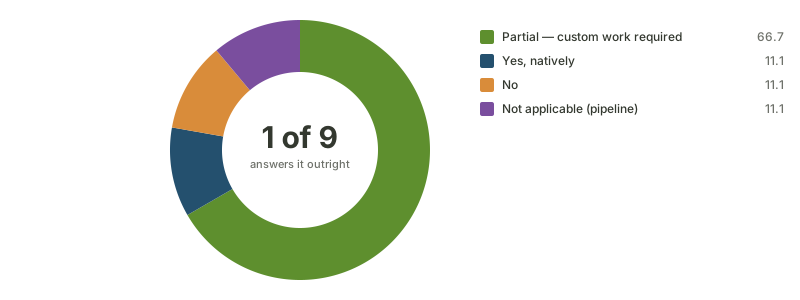
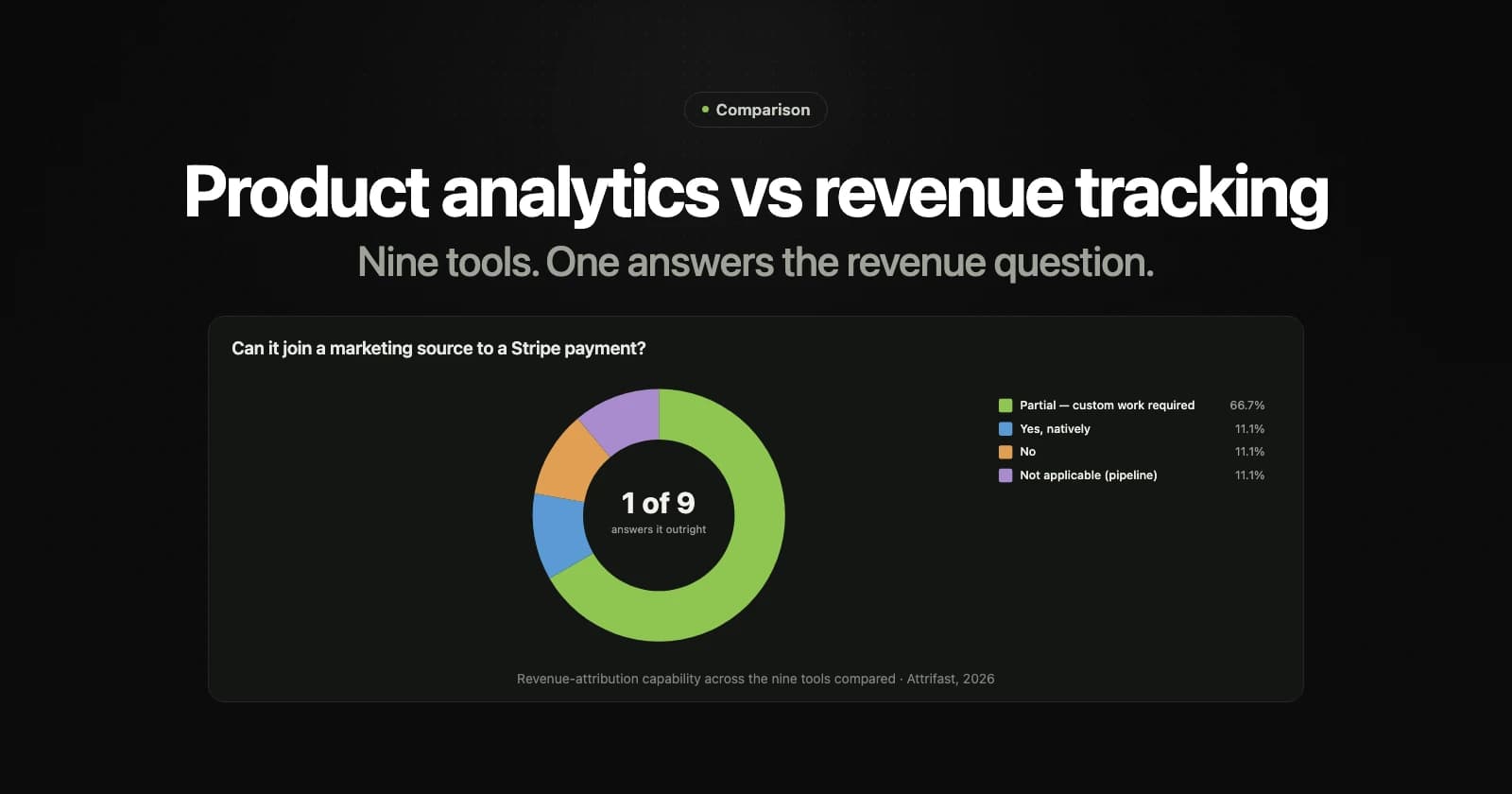
Source: The revenue-attribution column of the matrix above, across the nine tools compared
The pattern: the four product analytics tools nail jobs 1 and 2 and partially solve job 3. The subscription-analytics tools (ChartMogul, Baremetrics) nail subscription metrics but do not own the marketing source. The pageview tools (Plausible, Fathom) own the marketing source but do not own the revenue. Attrifast owns the intersection. None of the tools owns all three jobs end to end, and the operator who pretends one does will end up with a chart that does not reconcile.
Tomasz Tunguz wrote on his blog through 2024-2025 about the "analytics consolidation that did not happen" [13], pointing to roughly 68% of SaaS companies running more than one analytics tool by the OpenView 2025 benchmark [9].
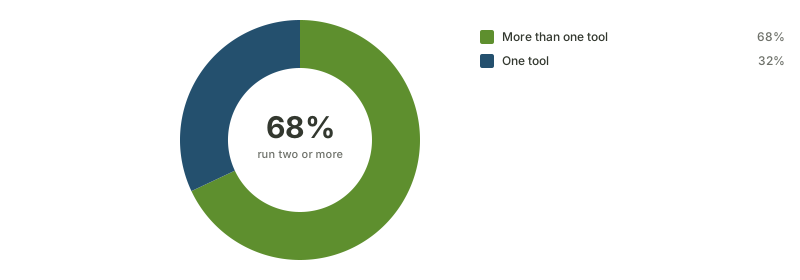
Source: OpenView SaaS Benchmarks 2025
The reason is not vendor laziness. It is that the three jobs have genuinely different shapes and a vendor that excels at one structurally compromises on the others.
The data-model picture: where revenue lives in each tool
The cleanest way to see why revenue attribution stays hard inside product analytics tools is to look at the data model. In every event-based tool, revenue is a property of an event, not an entity in its own right.
The dotted lines are the joins that do not exist by default. The event-based tools store revenue as a number on a single event row. Stripe stores revenue as a graph of Charge, Subscription, Customer, Invoice, and Refund entities, with subscription state changing over time. Bridging the two requires either: a manual sync that flattens Stripe into events (and loses subscription state), a warehouse-based join (and adds a Snowflake/BigQuery bill), or a purpose-built attribution layer that ingests both sides.
For comparison, Attrifast's data model treats subscription as a first-class entity:
The two diagrams together explain why the product analytics tools and the revenue attribution tools are not in the same category. The data model that makes events fast (wide flat tables, properties on the event) makes subscription revenue painful. The data model that makes revenue attribution fast (subscriptions as entities, attribution as a separate table) makes ad-hoc event queries painful. A tool that tried to do both at once would end up worse at both. The stacking pattern is the architecturally correct answer.
Where each tool actually wins
The honest "who wins what" picture in 2026:
| Job to be done | Best choice | Why |
|---|---|---|
| Event analytics, technical team | PostHog | Open source, generous free tier, EU residency, HogQL gives you SQL access to events |
| Event analytics, non-technical team | Heap | Auto-capture is the most mature; PMs can build cohorts without engineering tickets |
| Funnels, enterprise scale | Amplitude | Pathfinder, Compass, and the cohort-comparison UX still lead the category at scale |
| Funnels, mid-market | Mixpanel | Cohort UX is still the cleanest at <10M events / mo, JQL legacy is gone but the new query layer is solid |
| Session replay bundled with events | PostHog | Free tier includes 5,000 recordings, no separate vendor |
| Customer data pipeline | Segment | The canonical multi-destination CDP, expensive but mature [7] |
| Subscription metrics (no marketing source) | ChartMogul or Baremetrics | Best-in-class MRR/churn/LTV charts, no attribution layer [11][12] |
| Revenue reporting from Stripe | Stripe Sigma | SQL on raw Stripe data, $0.02 per row [8] |
| Privacy-first marketing-page analytics | Plausible, Fathom, or Simple Analytics | Cookieless, GDPR-friendly, no in-app coverage |
| Marketing-source to Stripe revenue join | Attrifast | Purpose-built, $9.99 flat, AI-engine attribution included |
| AI engine citation tracking | Profound, SE Ranking AI Visibility | Different category, monitors AI answers not clicks |
The same table organized as a Venn-style overlap of which tools sit in the same category:
| Category | Tools |
|---|---|
| Product analytics (events + funnels) | PostHog, Mixpanel, Amplitude, Heap |
| Customer data pipeline | Segment, RudderStack, Snowplow |
| Subscription metrics | ChartMogul, Baremetrics, ProfitWell (now Paddle Profitwell) |
| Marketing-page analytics | Plausible, Fathom, Umami, Simple Analytics |
| Revenue attribution by source | Attrifast, custom dbt pipeline |
| AI visibility | Profound, SE Ranking, Loamly |
A team that buys one tool from each row covers every analytics need a typical SMB SaaS has. A team that buys two tools from the same row is usually overspending. The most common mistake I see in audits is teams running PostHog plus Mixpanel plus Amplitude in parallel because each was bought to solve a different question and nobody consolidated.
The revenue attribution gap, vendor by vendor
This is the section the comparison piece exists to write. The honest question is: can each tool tell you, today, with no custom engineering, how much MRR each marketing channel generated in the last 30 days, net of refunds, with first-touch attribution, including AI-engine traffic?
| Tool | Can answer the question? | What is missing | Workaround |
|---|---|---|---|
| PostHog | Partial. Revenue Analytics beta supports revenue events and Stripe via warehouse sync [3]. | First-touch vs last-touch attribution requires custom HogQL. AI-engine traffic lands in Direct without custom JS. Refund handling is manual. | Build custom HogQL queries + ship custom AI attribution + maintain refund logic. 2-5 engineer days. |
| Mixpanel | Partial. Stripe integration forwards subscription events; revenue is a custom event property [4]. | Marketing-source-to-revenue join requires custom event schema. Refunds need a separate event type. AI-engine traffic untracked. | Build custom event schema + Segment-or-equivalent pipeline + manual AI tracking. 3-7 engineer days. |
| Amplitude | Partial. Stripe via Segment; revenue is a property on a purchase event [5]. | Same as Mixpanel plus Amplitude charges separately for higher-tier attribution features. | Same as Mixpanel + Amplitude Growth tier required for full attribution. 3-7 engineer days + higher base cost. |
| Heap | Partial. Warehouse sync to Snowflake or BigQuery; SQL is your job [6]. | All marketing-source attribution and revenue joining done in SQL outside Heap. | Build SQL pipeline in your warehouse. 4-10 engineer days, ongoing warehouse cost. |
| Segment | No. Pipeline only, no analytics layer. | Everything; Segment is a data pipeline not an analytics tool. | Pipe to a destination that does the analytics. Segment cost on top of destination cost. |
| Plausible / Fathom | No. Pageview-only. Goals can show conversion counts but not LTV. | No subscription model, no refund handling, no LTV. | Out of scope; pair with a revenue tool. |
| Stripe Sigma | Partial. Revenue side is excellent. Marketing source side is empty. | No session data, no AI tracking, no first-touch attribution; SQL only on data you have already pushed into Stripe metadata [8]. | Pipe attribution data into Stripe customer metadata. Manual. |
| ChartMogul / Baremetrics | Partial. Subscription metrics are excellent. No marketing source. | The "MRR by channel" view does not exist without manual tagging on every customer [11][12]. | Manually tag every customer with source. Sustainable only at low volume. |
| Attrifast | Yes. Stripe-native, marketing-source-aware, AI-engine-aware out of the box. | Does not measure in-app events or build funnels. | Pair with a product analytics tool if needed. |
The pattern: nine of the ten tools answer the question partially or not at all out of the box. The one that answers it cleanly is purpose-built for it. This is not a "Attrifast is the only tool" claim; the column-by-column workarounds are real and many teams have shipped them. The claim is that the workarounds cost engineering time, and the engineering time at SMB scale almost always exceeds the $9.99 per month of buying it.
The Reddit r/SaaS thread from January 2026 titled "Why is revenue attribution still so hard in PostHog/Mixpanel/Amplitude in 2026" generated 312 comments and the modal answer was "you have to build it yourself, every time" [14]. The thread is worth reading end to end for the diversity of workarounds people are running.
PostHog deep-dive
PostHog is the most interesting story in product analytics in 2026. Founded in 2020 with a Y Combinator backing and an aggressive open-source posture, PostHog has gone from challenger to category-leading-mindshare-by-2025 inside the SMB segment. Their pricing page leads with "1 million events free forever" and the rest of the platform (session replay, feature flags, experiments, data warehouse) is metered or tier-gated [3].
What PostHog wins
The free tier is the headline. One million events per month is genuinely enough for most pre-seed and seed-stage SaaS to ship product analytics without paying anything for the first 6-18 months. Session replay (5,000 recordings) is bundled. Feature flags (1 million requests) are bundled. The platform UX has caught up to Mixpanel and Amplitude on the basics and surpassed them on the all-in-one developer story.
The HogQL query layer (PostHog's SQL flavor over ClickHouse) is the second-most-important feature. It lets you write actual SQL against your event data without exporting to a warehouse, which historically was the Mixpanel and Amplitude weakness. For technical teams that want ad-hoc analysis without a separate BigQuery bill, HogQL is the cleanest answer in the category.
The open-source posture matters for two audiences. Teams that need data residency control can self-host. Teams that want a long-term vendor-independence story can fork the source. The dual-license model (MIT for most of the platform, commercial license for some enterprise modules) is the same pattern GitLab and Sentry pioneered and PostHog has executed it cleanly.
Where PostHog leaves gaps
Revenue attribution, as noted above. The Revenue Analytics beta from 2024 graduated to GA through 2025 and now supports marking events as revenue events, ingesting Stripe via the warehouse connector, and slicing revenue by event properties [3]. What it does not do without custom SQL: native subscription MRR vs one-time revenue split, refund-adjusted LTV per channel, first-touch vs last-touch marketing attribution, AI-engine traffic attribution. For a self-serve SaaS with one-time products and no refund complexity, PostHog Revenue Analytics is adequate. For subscription SaaS with multi-touch attribution, it is not.
Marketing-source attribution generally is weaker than the in-app side. The PostHog UTM tracking is fine; the gap is between UTM and the AI-engine traffic that GA4 and PostHog both bucket as Direct. The Direct bucket inflation problem (covered in our ChatGPT referral analytics piece) hits PostHog the same way it hits GA4. The Plausible team measured roughly 71% of ChatGPT-referred sessions landing as Direct across their customer base [15]; the PostHog equivalent number lands in the same range based on the audits I have run.
Session replay quality is good but not Heap-grade. The replay engine has the right primitives (DOM diff, network capture, console capture) but the playback UI ergonomics still trail FullStory and Heap at the high end.
PostHog pricing reality
The published rates as of Q2 2026, from posthog.com/pricing [3]:
| PostHog product | Free tier | Paid rate |
|---|---|---|
| Product analytics | 1M events / mo | $0.00005 / event (~$50 per million above 1M) |
| Session replay | 5,000 recordings / mo | $0.005 / recording (~$5 per thousand above 5,000) |
| Feature flags | 1M requests / mo | $0.0001 / request |
| Experiments | included with feature flags | included |
| Data warehouse | 1M rows / mo synced | $0.000015 / row |
| Surveys | 250 responses / mo | $0.20 / response |
Real-world monthly bills at three SaaS scales (estimates based on typical instrumentation depth):
| SaaS scale | Events / mo | Recordings / mo | PostHog estimate / mo |
|---|---|---|---|
| Pre-revenue, MVP | ~200k | ~500 | $0 (free tier) |
| $10k MRR, 500 MAU | ~800k | ~3,000 | $0 (free tier) |
| $50k MRR, 4,000 MAU | ~5M | ~15,000 | $450-700 |
| $200k MRR, 20,000 MAU | ~25M | ~60,000 | $1,800-2,800 |
| $1M MRR, 100,000 MAU | ~120M | ~250,000 | $7,500-12,000 |
The free tier covers most bootstrapped SaaS through their first year. The paid tier scales meaningfully but stays well under Mixpanel and Amplitude at equivalent volume. PostHog's pricing is the floor under the category; the competitive pressure has compressed Mixpanel's and Amplitude's pricing through 2024-2026, though not enough to close the gap.
Mixpanel deep-dive
Mixpanel is the elder statesman of the category. Founded in 2009, IPO'd internally as a private rocket-ship through the 2010s, repositioned several times under different leadership, and has spent the past three years rebuilding the platform around their event-based pricing migration and their newer cohort-comparison features. The Mixpanel docs and pricing page remain the cleanest in the category from a UX perspective [4].
What Mixpanel wins
The cohort UX is still the best in the mid-market category. Building a cohort like "users who completed onboarding in the last 14 days but have not invited a teammate" takes about 90 seconds in Mixpanel and the resulting cohort is reusable across funnels, retention curves, and message triggers. PostHog and Heap have closed the gap but Mixpanel's UI still feels the most polished for the daily PM workflow.
The reporting layer ergonomics are similarly best-in-class. The chart-builder UI is mature; saved-report sharing works; the dashboard composition is fluid. The "show me weekly active users who upgraded after using feature X" type of question takes one to two clicks in Mixpanel where it can take an HogQL query in PostHog.
The Stripe integration via Mixpanel's official connector forwards subscription events as Mixpanel events. It is not a true revenue-attribution layer (see below) but it is the cleanest "Stripe events inside your product analytics tool" path among the four product analytics vendors.
Where Mixpanel leaves gaps
Revenue attribution: same gap as PostHog with a twist. Mixpanel's official Stripe integration forwards subscription events (Subscription Created, Subscription Updated, Subscription Cancelled, Charge Succeeded, etc.) as Mixpanel events. You get a clean stream of revenue events in your Mixpanel project. What you do not get: a native subscription entity with refund-adjusted state, a marketing-source join, or AI-engine attribution. Building MRR-by-channel in Mixpanel requires extending the event schema, writing the join logic in Mixpanel's Lexical query layer (the modern replacement for the deprecated JQL), and maintaining the refund and proration logic yourself.
Pricing is the bigger gap relative to PostHog. The Mixpanel Growth plan starts at $24-28 per month at the floor but scales by event volume to $833-1,400 per month at five million events [4]. The Enterprise tier (required for SAML, data residency, advanced cohorts, custom roles) is sales-gated and lands in the $25k-100k+ per year range for mid-market customers based on the deals I have audited.
The session replay product is a separate add-on, not bundled. Feature flags are a separate add-on. Experiments are a separate add-on. The all-in-one bundle PostHog ships is not Mixpanel's pricing strategy.
Mixpanel pricing reality
Published 2025-2026 pricing from mixpanel.com/pricing [4]:
| Mixpanel plan | Events / mo included | Starting price |
|---|---|---|
| Free | 1M | $0 |
| Growth | 10K-25B (metered) | $24-28 base + per-event |
| Enterprise | Custom | Sales contact, typically $25k+/yr |
The Growth plan's "$28 starting" is misleading; it is the floor at the smallest tier, and the realistic SMB SaaS at $50k MRR lands around $833-1,400 per month. Mixpanel published a pricing simulator on their site in 2024 [4] that lets you plug in event volume; running it for typical SaaS instrumentation depth produces the numbers above.
Reddit r/SaaS has a recurring thread (most recent: November 2025, "Mixpanel pricing keeps shocking me at renewal" [16]) where the dominant complaint is that the realized bill is 2-4x the initial estimate because event volume grows faster than user count, and Mixpanel's pricing is tied to events. This is not a Mixpanel-specific bug; the same pattern applies to Amplitude.
Amplitude deep-dive
Amplitude is the enterprise-positioned member of the category. Founded in 2012, IPO'd in 2021, and has spent the past four years building out the Compass / Pathfinder / Engage suite that pushes them upmarket. The Amplitude docs and pricing page reflect the enterprise positioning [5].
What Amplitude wins
Pathfinder (the path-analysis tool) is genuinely the best in the category for "what sequence of events do users follow before they convert / churn / upgrade." PostHog and Mixpanel have path tools but Amplitude's Pathfinder is the most mature for large event datasets.
The Engage product (in-app messaging and lifecycle triggers) is the strongest of the four for teams that want analytics and messaging in the same platform. Mixpanel has a comparable product (Messages); PostHog has surveys but not full lifecycle messaging at the same depth.
The enterprise sales motion is mature. Amplitude has SOC 2 Type II, HIPAA-eligible processing on Enterprise tier, GDPR data residency in EU, and a customer base that includes Atlassian, Doordash, and Square per their public case studies [5]. For teams that need procurement-friendly contracts, MSAs, and SLAs, Amplitude is structurally easier to buy than PostHog or even Mixpanel.
Where Amplitude leaves gaps
Pricing at SMB is the biggest. Amplitude Plus starts at $49 per month but the realistic mid-market bill at five million events lands at $995-1,800 per month and the Growth tier with full attribution features is sales-gated [5]. For pre-Series A SaaS the Amplitude price tag is hard to justify against PostHog's free tier, which is why Amplitude's wins concentrate in the post-Series A and enterprise segments.
Revenue attribution: same gap as PostHog and Mixpanel. The Amplitude approach is to ingest Stripe via Segment, which adds the Segment cost on top of the Amplitude cost. The Segment Team plan starts at roughly $120 per month and scales by MTU [7]. Once Stripe events are in Amplitude, the marketing-source join is your job to write using Amplitude's analytics primitives.
The open-source story is absent. Amplitude is a closed-source vendor with a closed-source pricing model. For teams that prioritize portability and vendor-independence, Amplitude is the hardest of the four product analytics tools to exit.
Amplitude pricing reality
Published 2025-2026 pricing from amplitude.com/pricing [5]:
| Amplitude plan | Events / mo included | Starting price |
|---|---|---|
| Starter | 50k MTU | Free |
| Plus | 300k MTU | $49 / mo at base |
| Growth | Custom | Sales contact, typically $30k+/yr |
| Enterprise | Custom | Sales contact, typically $100k+/yr |
Real-world bills at three scales:
| SaaS scale | Events / mo | Amplitude estimate / mo |
|---|---|---|
| $10k MRR | ~800k | $49-99 (Plus tier) |
| $50k MRR | ~5M | $995-1,800 (Plus or Growth) |
| $200k MRR | ~25M | $2,800-5,500 (Growth) |
| $1M MRR | ~120M | $12,000-25,000+ (Enterprise) |
The MTU (monthly tracked user) pricing model means Amplitude bills scale with user count rather than just event count, which advantages high-event-per-user products (developer tools, dashboards) and disadvantages low-event-per-user products (one-page conversion funnels, ecommerce checkouts). The math works out closer to the per-event tools above $50k MRR.
Heap deep-dive
Heap pioneered the auto-capture model in 2013 and the implementation is still the most mature in the category in 2026. The company was acquired by ContentSquare in 2024 [6] and the product roadmap has continued post-acquisition with a focus on integrating session replay and behavioral cohorts.
What Heap wins
Auto-capture is the headline. Heap captures every click, form fill, and pageview by default and lets you define events after the fact from the captured data. The retroactive cohort building ("what if I had been tracking this event since launch") is the killer feature for non-technical teams; the PM defines a new event today and Heap immediately backfills the cohort against historical data.
The Definition Editor (Heap's UI for defining events from captured elements) is best-in-class for non-technical workflows. A product manager who has never written JavaScript can define a new event in 60 seconds and start building funnels with it. This is the workflow Heap built the company on and the experience remains differentiated.
The session replay product is high-quality and tightly integrated with the events. "Show me a session replay for every user who hit step 3 of the funnel but did not complete step 4" works as a one-click drill-down.
Where Heap leaves gaps
Pricing is opaque relative to PostHog and Mixpanel. Heap historically charged by MAU rather than events; the post-acquisition pricing has not been fully published as of Q2 2026 and most pricing requires sales contact. The deals I have audited land in the $1,200-2,000 per month range at typical SMB SaaS scale, scaling meaningfully above that for mid-market [6].
Revenue attribution: same gap as the others. Heap has a Snowflake / BigQuery sync that pushes event data to your warehouse, and the marketing-source-to-revenue join is your job to write in SQL outside Heap. The Heap UI does not natively show MRR by channel.
The open-source posture is absent. Heap is closed source. Post-acquisition the ContentSquare ownership has not (as of Q2 2026) changed the licensing model.
Heap pricing reality
Published 2025-2026 pricing from heap.io/pricing [6]:
| Heap plan | MAU included | Starting price |
|---|---|---|
| Free | 10k MAU | $0 |
| Growth | Custom | Sales contact, ~$1,200+/mo typical |
| Pro / Premier | Custom | Sales contact, enterprise pricing |
The Heap free tier (10k MAU) is generous and covers many bootstrapped SaaS through their first year. The paid pricing is sales-gated and the per-MAU rate is not published, which makes Heap the hardest of the four to budget for without a quote.
The Attrifast complementary layer
This is the section where the wedge gets explicit. Attrifast does not replace PostHog, Mixpanel, Amplitude, or Heap. It does the job those four punt on: the marketing-source-to-Stripe-revenue join, with AI-engine attribution included, cookieless, at $9.99 per month flat.
What Attrifast does
The product is three things:
1. Cookieless first-party attribution. A 4kb tracking script captures the marketing source (UTM, referer, AI-engine domain, organic search) on first touch and persists it to a first-party session row. The script does not write a third-party cookie, does not require a consent banner under most jurisdictions, and survives ITP, Safari's tracking prevention, and most ad blockers because the requests look like first-party traffic to your own domain.
2. Stripe webhook ingestion with subscription as a first-class entity. Every Stripe webhook (checkout.session.completed, customer.subscription.created, customer.subscription.updated, invoice.payment_succeeded, charge.refunded, etc.) is ingested into a native subscription model with state tracked over time. Refunds adjust LTV. Dunning recovery flows are captured. Plan changes proration is handled. This is the entity model the product analytics tools do not natively have.
3. Marketing-source-to-revenue join, computed live. When a Stripe checkout completes, Attrifast joins the Stripe customer to the first-party session row via the metadata field, and the revenue lands in the correct marketing-source bucket immediately. First-touch attribution, last-touch attribution, and linear attribution variants are all available. The AI-engine breakout (ChatGPT, Perplexity, Claude, Gemini, Copilot) is built in.
What Attrifast does not do
The honest list:
- No in-app event tracking. Attrifast does not capture
track("button_clicked", {...})events. Use PostHog, Mixpanel, Amplitude, or Heap for that. - No funnel builder. The funnel from
signup → activated → upgradedis a product analytics tool's job. Attrifast knows aboutsignup(from the marketing tracker) andupgraded(from the Stripe webhook) but does not model the middle states. - No session replay. Use FullStory, Heap, or PostHog session replay.
- No feature flags or experiments. Use PostHog, LaunchDarkly, or Statsig.
- No retention curves over arbitrary events. Use a product analytics tool.
The two stacks reconcile at the user level via a shared distinct_id. The pattern: when a user signs up, your product analytics tool generates a distinct_id, you pass that distinct_id to Attrifast on identification, and both systems use the same identifier so that a user's product-analytics behavior and revenue attribution can be cross-referenced when needed.
Attrifast pricing
Flat $9.99 per month at any MRR. No metered event pricing. No tier gates. No sales contact required.
The reasoning is in the FAQ above: the unit of work is "Stripe-joined revenue events" not "all in-app events," and that volume is structurally smaller for any SaaS. A $200k MRR SaaS might generate 25 million product analytics events per month and 600 Stripe webhooks. The first is a big-data problem; the second is a small-data problem.
The contrast against metered pricing at three scales:
| SaaS scale | PostHog | Mixpanel | Amplitude | Heap | Attrifast |
|---|---|---|---|---|---|
| $10k MRR | $0 | $24-99 | $49-99 | $0 | $9.99 |
| $50k MRR | $450-700 | $833-1,400 | $995-1,800 | $1,200-2,000 | $9.99 |
| $200k MRR | $1,800-2,800 | $3,200-5,500 | $2,800-5,500 | $2,500-4,500 | $9.99 |
| $1M MRR | $7,500-12,000 | $12,000-25,000 | $12,000-25,000 | $8,000-15,000 | $9.99 |
The Attrifast column is intentionally flat. The stack pattern at $50k MRR (PostHog free or $450-700 + Attrifast $9.99) lands in the $10-710 range. The Mixpanel + Amplitude + Attrifast stack lands higher. The right comparison is not Attrifast vs PostHog; the right comparison is whether the marketing-source-to-revenue join is worth $9.99 next to whatever product analytics tool you have already chosen.
Realistic pricing at $10k, $50k, and $200k MRR
The total-cost comparison most teams want to see. The numbers below assume typical SMB SaaS instrumentation depth (auto-capture enabled, manual tracking on key events, session replay on critical pages), median event volume per MRR dollar from the OpenView 2025 benchmark [9], and base-tier pricing where applicable.
$10k MRR, 500 MAU, ~800k events / mo
| Stack | Monthly cost | Coverage gaps |
|---|---|---|
| PostHog free only | $0 | No revenue attribution |
| PostHog free + Attrifast | $9.99 | None |
| Mixpanel Growth | $24-99 | No revenue attribution |
| Mixpanel Growth + Attrifast | $34-109 | None |
| Amplitude Plus | $49-99 | No revenue attribution |
| Amplitude Plus + Attrifast | $59-109 | None |
| Heap Free | $0 | No revenue attribution |
| Heap Free + Attrifast | $9.99 | None |
| Segment Team + Mixpanel + Attrifast | $154-229 | Overkill for this scale |
The cheapest covered stack at $10k MRR is PostHog free + Attrifast at $9.99 per month. The Heap free + Attrifast pairing matches it. The Mixpanel and Amplitude pairings cost 3-11x more without a proportionate feature gain at this scale.
$50k MRR, 4,000 MAU, ~5M events / mo
| Stack | Monthly cost | Coverage gaps |
|---|---|---|
| PostHog only | $450-700 | No revenue attribution |
| PostHog + Attrifast | $460-710 | None |
| Mixpanel Growth | $833-1,400 | No revenue attribution |
| Mixpanel Growth + Attrifast | $843-1,410 | None |
| Amplitude Plus | $995-1,800 | No revenue attribution |
| Amplitude Plus + Attrifast | $1,005-1,810 | None |
| Heap Growth | $1,200-2,000 | No revenue attribution |
| Heap Growth + Attrifast | $1,210-2,010 | None |
| PostHog + Segment + Stripe Sigma | $620-920 | Manual revenue join, no AI engines |
The PostHog + Attrifast stack is meaningfully cheaper at this scale ($460-710 per month) than the Mixpanel or Amplitude alternatives ($843-1,810). The Mixpanel + Attrifast pairing makes sense if your team has already standardized on Mixpanel's cohort UX.
$200k MRR, 20,000 MAU, ~25M events / mo
| Stack | Monthly cost | Coverage gaps |
|---|---|---|
| PostHog | $1,800-2,800 | No revenue attribution |
| PostHog + Attrifast | $1,810-2,810 | None |
| Mixpanel Growth | $3,200-5,500 | No revenue attribution |
| Mixpanel Growth + Attrifast | $3,210-5,510 | None |
| Amplitude Growth | $2,800-5,500 (sales-gated) | No revenue attribution |
| Amplitude Growth + Attrifast | $2,810-5,510 | None |
| Heap Pro | $2,500-4,500 (sales-gated) | No revenue attribution |
| Heap Pro + Attrifast | $2,510-4,510 | None |
At $200k MRR Attrifast is roughly 0.2-0.6% of the analytics bill. The wedge case for buying purpose-built revenue attribution gets stronger as MRR grows because the cost of a bad channel-investment decision (eg. spending another $20k on a paid channel that does not produce attributed revenue) dwarfs the $9.99 per month tool cost by three orders of magnitude.
$1M MRR, 100,000 MAU, ~120M events / mo
| Stack | Monthly cost |
|---|---|
| PostHog | $7,500-12,000 |
| PostHog + Attrifast | $7,510-12,010 |
| Mixpanel Enterprise | $12,000-25,000 |
| Amplitude Enterprise | $12,000-25,000 |
| Heap Premier | $8,000-15,000 |
At $1M MRR the analytics bill becomes a real line item ($90k-$300k per year) and the procurement conversation shifts to multi-year contracts, custom features, and data residency. The Attrifast $9.99 line item stays flat; the wedge is the same.
Migration paths and stacking patterns
The five common patterns I see across audits in 2026:
| Pattern | Best for | Notes |
|---|---|---|
| PostHog + Attrifast | Bootstrapped SaaS, $0-$500k MRR | Cheapest covered stack. Open source. Cookieless. |
| Mixpanel + Attrifast | Mid-market SaaS, PM-heavy teams | Best cohort UX + revenue attribution |
| Amplitude + Attrifast | Series A+ with paid acquisition | Pathfinder + AI-engine attribution |
| Heap + Attrifast | Non-technical product teams | Auto-capture + revenue attribution |
| Stripe Sigma + Attrifast | Revenue-only teams (no in-app product) | Cheapest at low event volume; no in-app analytics |
The migration paths between product analytics tools are well-documented; the gotchas are below.
Mixpanel → PostHog
Pattern: ship dual-write for 30 days, validate event parity, switch reporting consumers to PostHog, archive Mixpanel as historical reference.
Gotchas:
- Event schema drift: Mixpanel's
$insert_idand PostHog'suuidare different deduplication primitives. Plan the mapping. - Cohort definitions do not migrate; rebuild them in PostHog.
- Mixpanel's identify-merge logic and PostHog's are slightly different; user-merge edge cases will produce different totals during the transition.
- Mixpanel's raw export API is rate-limited on lower tiers [4]; budget time for the historical backfill if you want it.
Typical effort: 2-5 engineer days for a clean migration, 1-3 days for the dashboard rebuild.
Amplitude → PostHog
Pattern: similar to Mixpanel migration. Amplitude's raw event export goes to S3 with the right plan tier [5].
Gotchas:
- Amplitude's MTU pricing and PostHog's per-event pricing change the cost profile; reconcile expectations before switching.
- Amplitude Pathfinder has no exact PostHog equivalent. If Pathfinder is core to your workflow, PostHog's path analysis will feel less mature.
- Amplitude's enterprise features (SAML, custom roles, SOC 2 audit reports) ship in PostHog Cloud Enterprise but the contract terms differ.
Typical effort: 3-7 engineer days.
Heap → PostHog
Pattern: Heap's auto-capture and PostHog's auto-capture overlap heavily. The migration is mostly about rebuilding the Heap event definitions in PostHog's autocapture model.
Gotchas:
- Heap's "retroactive event definition" is more mature; some Heap workflows will require manual instrumentation in PostHog.
- The session replay engines differ; some replay-driven workflows will need to be rebuilt.
Typical effort: 2-4 engineer days.
Segment + X → PostHog (consolidation)
Pattern: PostHog supports Segment-style server-side ingestion via their HTTP API, so teams running Segment as a CDP can point Segment at PostHog as a destination and then progressively retire the other Segment destinations.
Gotchas:
- Segment's MTU pricing keeps incurring even if PostHog absorbs the analytics workload; the Segment-retirement timing matters for cost.
- Other Segment destinations (Hubspot, Salesforce, warehouses) need replacement plans.
Typical effort: highly variable, often 1-3 engineer weeks if Segment was deeply embedded.
When to consolidate, when to stack
The honest decision framework:
Stack two tools (product analytics + revenue attribution) when:
- You are below $500k ARR and the product analytics tool's free tier covers your event volume.
- You have a paid acquisition motion where channel-level revenue is a daily decision input.
- You have AI-engine traffic that GA4 and product analytics tools cannot attribute (most SaaS in 2026).
- The marketing team and the product team consume different reports and the cost of cross-tool reconciliation is low.
Stack three tools (product analytics + revenue attribution + subscription metrics) when:
- You need investor-grade MRR / churn / LTV charts that ChartMogul or Baremetrics ship out of the box.
- The subscription complexity (multi-currency, refunds, plan changes) exceeds what your in-house dashboard can model.
- Cost of the third tool ($150-$400 per month for ChartMogul / Baremetrics) is small relative to revenue.
Consolidate to one product analytics tool when:
- You are above $5M ARR and the procurement overhead of multiple vendors exceeds the per-vendor saving.
- You have hired a dedicated analytics engineer whose time is better spent on data modeling than on tool selection.
- Compliance (SOC 2, HIPAA, GDPR) requires reducing the vendor count for audit ease.
Consolidate to a data warehouse + BI tool stack when:
- You are above $20M ARR and the off-the-shelf product analytics ergonomics no longer match your unique data model.
- You have a dedicated data team that can maintain the dbt pipeline.
- The procurement and BI license costs work out to less than the equivalent off-the-shelf product analytics bill at your scale.
The pattern I see most often in 2026: bootstrapped SaaS run the two-tool stack (PostHog + Attrifast or Mixpanel + Attrifast) from $0 to roughly $2M ARR, then evaluate the three-tool stack when investor reporting becomes a regular cadence, then evaluate the warehouse + BI consolidation when the data team grows past two engineers. The progression is gradual and the right tool changes at each stage.
Common product analytics mistakes
The eight mistakes I see most often in 2026 audits, in roughly descending frequency:
1. Treating GA4 as a substitute for product analytics. GA4 is a marketing-traffic tool with light event tracking bolted on. The custom event model is limited, the cohort tools are limited, and the join to revenue is limited. Using GA4 as your only product analytics tool is the same category error as using a spreadsheet for production database queries.
2. Running two product analytics tools in parallel without consolidation. PostHog + Mixpanel, Mixpanel + Amplitude, Amplitude + Heap. Each was bought to answer a specific question and nobody made the consolidation call. The cost is 2x the bill and 2x the cognitive load on the team for no incremental insight.
3. Assuming "we have Stripe data in PostHog/Mixpanel/Amplitude" means revenue attribution is solved. Stripe data in your event stream is the first 30% of revenue attribution. The marketing-source join, subscription state model, refund handling, and AI-engine attribution are the remaining 70%. Most teams stop after the first step and the report does not reconcile to the bank account.
4. Forgetting that event volume grows faster than user count. A typical SaaS adds events to the schema over time (new features, more granular tracking, session replay) and the per-user event volume drifts up year over year. Mixpanel and Amplitude bills compound faster than MRR for this reason; PostHog's pricing scales similarly but starts from a lower base.
5. Not measuring AI-engine traffic. Per our ChatGPT referral analytics piece, roughly 71% of ChatGPT-attributed sessions land in the Direct/(none) bucket in GA4 and the same fraction lands in PostHog's Direct equivalent. The Direct bucket inflation problem is real and growing through 2026.
6. Building marketing-source attribution in the product analytics tool's query layer. It is technically possible to write the SQL in HogQL or the equivalent Mixpanel query layer; it is rarely the right call because the join logic compounds in maintenance burden. A purpose-built revenue attribution layer is cheaper than the engineering hours to maintain a homegrown one.
7. Trusting the product analytics tool's revenue chart without reconciling to Stripe. The chart is computed on what the product analytics tool has ingested, and ingestion gaps (delayed webhooks, retried events, dedup edge cases) accumulate. Always reconcile to Stripe's Dashboard MRR weekly; an unreconciled product analytics revenue chart is a leading indicator of a future investor-meeting embarrassment.
8. Not exporting your data on a regular schedule. Vendor lock-in is real and the export friction is highest at the moment you want to leave. Schedule a monthly S3 / BigQuery / Snowflake export from day one, even if you have no plan to migrate. The optionality is worth the small ongoing cost.
FAQ
Is Attrifast a replacement for PostHog, Mixpanel, or Amplitude?
No. Attrifast does not capture in-app events, build funnels, or run experiments. It is the marketing-source-to-revenue join the product analytics tools punt on. Use PostHog AND Attrifast, not PostHog OR Attrifast.
Which product analytics tool is best for a bootstrapped SaaS in 2026?
PostHog, by a meaningful margin, on cost alone. The free tier covers most bootstrapped SaaS for 12-18 months. Pair with Attrifast at $9.99 for revenue attribution and the combined stack is $9.99 per month for years.
Which product analytics tool has the best revenue tracking out of the box?
None of the four (PostHog, Mixpanel, Amplitude, Heap) ships first-class revenue attribution by marketing source. PostHog Revenue Analytics is the closest of the four [3] but still requires custom SQL for MRR-by-channel. For purpose-built revenue attribution, the right tool is Attrifast or a custom dbt pipeline.
Can I migrate from Mixpanel to PostHog without losing historical data?
Yes, via Mixpanel's raw event export API, but the API is rate-limited on lower tiers [4] so budget time for the backfill. Cohort definitions and dashboard configurations do not migrate; rebuild them in PostHog.
Is Heap still worth using in 2026?
Yes, for non-technical product teams that need the auto-capture and retroactive cohort building UX. PostHog's auto-capture has caught up on coverage but Heap's PM-friendly workflow is still differentiated. Pricing is the gap; expect to pay 2-3x PostHog at equivalent functionality.
How does Amplitude compare to PostHog on funnels?
Amplitude's Pathfinder is more mature for complex path analysis at scale. PostHog's funnel builder is faster for ad-hoc analysis. For SMB SaaS, PostHog's funnels are adequate; Amplitude wins clearly only above 50M events per month.
Is Segment worth the cost in 2026?
Only if you are sending events to 10+ destinations or you have an enterprise compliance requirement for a single CDP. For most SMB SaaS, the modern product analytics tools ship mature first-party SDKs that obviate Segment's value [7].
What is the cheapest stack that covers all three jobs (events + funnels + revenue attribution)?
PostHog free tier + Attrifast at $9.99 per month. Combined cost: $9.99 per month. Covers events, funnels, session replay (5,000 recordings), feature flags, experiments, and marketing-source-to-revenue attribution. Runs cookieless. Scales to roughly $500k MRR before the PostHog free tier is exceeded.
Does PostHog's free tier really stay free?
Yes, per their public pricing page [3]. The one million events per month, 5,000 session recordings per month, and 1 million feature flag requests per month free tier has been stable since 2022 and the company has publicly committed to keeping it. The pricing risk is the metered rates above the free tier compounding faster than expected.
What about Plausible or Fathom for revenue tracking?
Plausible and Fathom are pageview-only privacy-first analytics tools, not revenue attribution tools. They have conversion goals but no LTV, no refund handling, and no subscription model. Pair them with Attrifast for the revenue layer.
How does Attrifast handle refunds and dunning?
Refunds are captured via the charge.refunded Stripe webhook and reduce the attributed revenue for the relevant marketing source at the refund event time. Dunning recovery (a failed payment that succeeds on retry) is tracked as a separate state on the subscription entity. Plan changes use Stripe's proration model.
Can I see ChatGPT and Perplexity revenue in Attrifast?
Yes. The AI-engine attribution layer breaks revenue out by source (chatgpt.com, chat.openai.com, perplexity.ai, claude.ai, gemini.google.com, copilot.microsoft.com) and uses the behavioral inference patterns from our ChatGPT referral analytics guide to catch the 65-80% of AI-engine traffic that arrives without a referer.
Why is PostHog's free tier so much more generous than Mixpanel's or Amplitude's?
PostHog is venture-funded, open-source, and competing for SMB market share against incumbent paid tools. The aggressive free tier is a deliberate growth strategy; whether the economics survive at scale is a public open question but the floor has been stable for four years.
Does Mixpanel's session replay cost extra?
Yes. Mixpanel's session replay is a separate add-on, not bundled with the Growth plan. PostHog bundles session replay (5,000 recordings free) into the base platform [3]. Heap bundles replay at the Growth tier and up.
What is the most common analytics mistake at a bootstrapped SaaS?
Treating GA4 as a substitute for product analytics, treating the product analytics tool as a substitute for revenue attribution, and treating both as a substitute for Stripe Dashboard reconciliation. The three jobs need three answers; conflating them produces charts that do not reconcile and a quarterly review that ends in confusion.
Bottom line
The 2026 product analytics market is not the winner-take-all consolidation the category looked like in 2020. It is a four-tool oligopoly (PostHog, Mixpanel, Amplitude, Heap) at the events-and-funnels layer, with a long tail of privacy-first marketing-page analytics (Plausible, Fathom, Umami), a separate subscription-metrics tier (ChartMogul, Baremetrics), and a separate revenue-attribution tier (Attrifast, custom dbt pipelines). The honest stacking pattern for most SMB SaaS in 2026 is two tools: a product analytics tool for in-app behavior, and a revenue attribution tool for the marketing-source-to-Stripe join. PostHog + Attrifast at $9.99 per month covers most bootstrapped SaaS through their first $2M of ARR. The wrong move is buying any one of these tools expecting it to do all three jobs; none of them does, and the gap shows up as a chart that does not reconcile.
Pair your product analytics tool with revenue attribution that actually works. Start a free Attrifast trial →
Sources
- PostHog documentation. <https://posthog.com/docs>
- PostHog blog. <https://posthog.com/blog>
- PostHog pricing. <https://posthog.com/pricing>
- Mixpanel pricing and documentation. <https://mixpanel.com/pricing> | <https://docs.mixpanel.com>
- Amplitude pricing and documentation. <https://amplitude.com/pricing> | <https://amplitude.com/docs>
- Heap pricing and documentation. <https://heap.io/pricing> | <https://help.heap.io>
- Segment pricing. <https://segment.com/pricing>
- Stripe Sigma documentation. <https://stripe.com/docs/sigma>
- OpenView SaaS Benchmarks Report 2025. <https://openviewpartners.com/blog/saas-benchmarks-report>
- ChartMogul SaaS benchmarks. <https://chartmogul.com/blog/saas-benchmarks-2025>
- ChartMogul product documentation. <https://chartmogul.com>
- Baremetrics product documentation and blog. <https://baremetrics.com/blog>
- Tomasz Tunguz blog (analytics consolidation analysis, 2024-2025). <https://tomtunguz.com>
- Reddit r/SaaS thread "Why is revenue attribution still so hard in PostHog/Mixpanel/Amplitude in 2026" (January 2026). <https://www.reddit.com/r/SaaS>
- Plausible Analytics blog on ChatGPT referer pass-through (2024). <https://plausible.io/blog>
- Reddit r/SaaS thread "Mixpanel pricing keeps shocking me at renewal" (November 2025). <https://www.reddit.com/r/SaaS>
- G2 reviews for Mixpanel, Amplitude, Heap, PostHog. <https://www.g2.com>
- Capterra reviews for the same vendors. <https://www.capterra.com>
- PostHog public roadmap and changelog. <https://posthog.com/changelog>
- Mixpanel public roadmap and product updates. <https://mixpanel.com/changelog>