The "best marketing attribution software" listicle is a category that has been published roughly 800 times since 2022. Most of those articles share three structural problems. They list 8-15 enterprise tools as if a bootstrapped SaaS at $40k MRR and a Series C DTC brand at $4M MRR shop the same shelf. They pretend each tool is good at everything and leave out the specific weaknesses that would make a buyer regret their pick three months in. They confuse categories: product analytics tools get rated next to multi-touch attribution platforms, as if Mixpanel and Northbeam solve the same problem.
I built Attrifast because the existing options did not fit a Stripe-native bootstrapped SaaS under $500k MRR. Writing the honest version of this listicle is partly self-interested (Attrifast is on it) and partly a category service (most of the others on it deserve a more candid review than they usually get). The goal of this piece is to land you on a 2-3 tool shortlist in 20 minutes, with a clear sense of what each tool is bad at, not just what it claims to be good at.
Companion reading: the AI traffic analytics deep dive, ChatGPT referral analytics, GA4 missing traffic explainer, and the Attrifast vs Google Analytics page for the head-to-head detail.
Quick Facts
| Spec | Value |
|---|---|
| Tools compared in this guide | 19 |
| Pricing range, monthly | $0 (free) to $10,000+ (enterprise) |
| Cookieless tools in shortlist | 5 (Plausible, Fathom, Simple Analytics, Usermaven, Attrifast) |
| Tools with native Stripe integration | 7 (Attrifast, Dreamdata, Factors.ai, SegMetrics, Usermaven, Mixpanel via webhook, PostHog via integration) |
| Tools with native Shopify integration | 6 (Triple Whale, Northbeam, Cometly, AnyTrack, GA4, Heap) |
| Tools with built-in AI-engine traffic detection | 4 (Attrifast, Plausible, Fathom, Usermaven) |
| GA4 default channel for AI referrals | Direct/(none), no built-in rule [9] |
| Average iOS 14.5+ Meta Ads underreporting | 22-37% of conversions, per industry surveys [12] |
| Year Triple Whale founded | 2021 [4] |
| Year Northbeam founded | 2020, $25M Series A 2022 [5] |
| Year Dreamdata founded | 2018, Copenhagen, B2B SaaS focus [6] |
| Year Hyros acquired by Caribou | 2024 (per company announcements) [7] |
| Approximate G2 review count, Triple Whale (Q1 2026) | 700+ [4] |
| Approximate G2 review count, Mixpanel | 1,200+ [10] |
| Approximate G2 review count, Amplitude | 2,200+ [11] |
| Open-source attribution tools in shortlist | 2 (PostHog, Matomo as honorable mention) |
| Tools requiring a consent banner in EU | 14 of 19 |
| Tools with native Salesforce integration | 4 (Dreamdata, Factors.ai, Adobe Analytics, HubSpot Marketing Hub) |
| Annual SaaS attribution software market size estimate (2025) | $3.5-4B, per Gartner-adjacent reports [16] |
Three numbers do most of the framing. The 22-37% Meta underreporting is the gap that built the DTC attribution category. The 65-80% AI-engine Direct misattribution in GA4 is the gap that opened the door for cookieless attribution in 2025-2026. The $3.5-4B market size says this is a real category with real budget flowing, not a hobbyist segment.
How to choose attribution software in 2026
Most buyers approach attribution-tool selection backward. They start with a feature checklist (multi-touch! AI-engine detection! Stripe sync!) and try to match it against vendor pages. The feature checklist is a vendor-side artifact; vendors design feature lists to look comparable. The buyer-side question that matters is different.
Five real questions, in priority order.
1. What is the channel mix you actually need to attribute? A bootstrapped SaaS with 80% of acquisition coming from organic and content does not need the same tool as a DTC brand spending $400k/mo on Meta and TikTok. The DTC brand needs multi-pixel server-side attribution that recovers iOS 14.5+ underreporting. The SaaS needs cookieless first-party attribution that catches AI-engine referrals. These are different products. The same listicle will sell both, but the right tool for one is the wrong tool for the other.
2. What is your revenue surface? Stripe-native, Shopify-native, manual invoicing, contract sales, hybrid. Tools with native integrations to your revenue system close the loop in a few hours. Tools without it require a custom webhook handler, a manual CSV import, or a Zapier-style glue, and the maintenance burden adds up.
3. What is your privacy posture? Cookieless and banner-less is now a real differentiator in the EU and increasingly in California. If your legal review has banned third-party cookies or fingerprinting, the eligible-tool list collapses to a handful. If you have a working consent banner and high-conversion path, the constraint is looser.
4. What is the in-house analytics skill level? A tool that requires SQL and event design is wasted on a non-technical marketing team. A tool that requires no setup is too shallow for a data team that wants joins. The buyer's analytics maturity matters as much as the vendor's feature set.
5. What is the budget per year, including hidden costs? The headline subscription is rarely the full cost. Implementation services, ongoing data engineering, the cost of integrating with your CRM, the consent-banner work if the tool requires it, the migration tax if you switch in 18 months. The true 12-month cost of a $219/mo tool can easily be 3-5x the sticker.
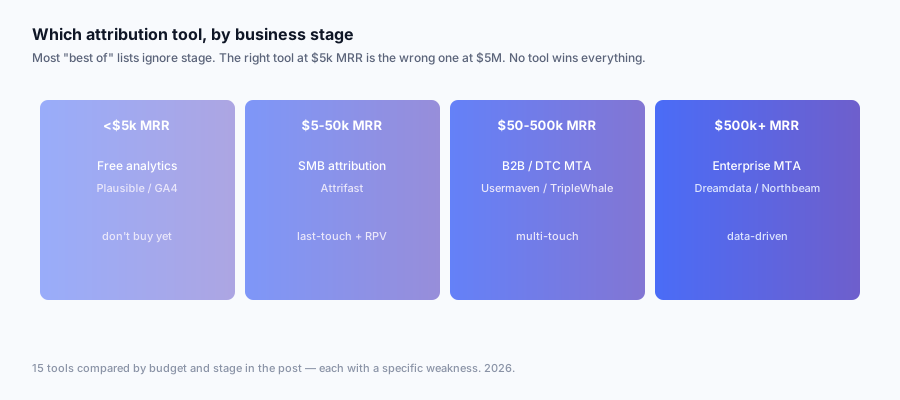
Here is the decision tree I run with most bootstrapped operators:
The tree is opinionated. It will not give you the same answer as the vendor that paid for the G2 placement. It is closer to the answer I would give a friend running the same business as you.
A second decision tree, by privacy posture, because the EU and California privacy landscape now drives more tool selection than the feature checklist does:
The privacy axis collapses the eligible-tool list faster than any other constraint in 2026. If your legal review has already banned third-party cookies, half the tools in this article drop off your shortlist immediately.
The six categories of attribution software
Most listicles list tools without categorizing them, which is how operators end up comparing Mixpanel to Northbeam as if they are alternatives. They are not. They live in different categories, and the categories matter more than the tool names.
Price bands below are the published entry rates I read on each vendor's own pricing page on 1 August 2026, not modelled estimates.
| Category | What it does | Published entry rates (1 Aug 2026) | Best for |
|---|---|---|---|
| Free / commodity analytics | Basic traffic + GA4 channel mix | $0 | Pre-revenue, side projects, first 6 months |
| Privacy-first analytics | Cookieless traffic + simple referrer attribution | $9/mo (Plausible, 10k pageviews) to $15/mo (Fathom, 100k pageviews) | Bootstrapped, GDPR-strict, content-heavy sites |
| SMB attribution (Stripe-native) | Channel mix joined to Stripe revenue | $9.99/mo (Attrifast) to $84/mo (Usermaven Growth) | SaaS and bootstrapped DTC under $500k MRR |
| DTC attribution (paid-spend-heavy) | Multi-pixel server-side, ad-platform native | $100/mo (AnyTrack Starter) to $1,500/mo (Northbeam Starter); Polar and Cometly publish nothing | DTC brands above $50k/mo ad spend |
| B2B SaaS attribution (CRM-native) | Lead-to-revenue join through HubSpot/Salesforce | $199/mo (Factors.ai Lite) upward; Dreamdata is free then quote-only | B2B SaaS with long sales cycles |
| Enterprise multi-touch attribution | Full MTA, MMM, data warehouse pipes | Quote-only across the board | Enterprise marketers, agencies, multi-brand |
A tool can sit in more than one category (Heap does product analytics with some attribution; Adobe Analytics has both web analytics and MTA), but each tool has a dominant category that determines whether it is a fit. If you pick a tool from the wrong category for your stage, the implementation will fight you for a year before you swap it.
Quick decision matrix: budget × business type
This is the single most useful table in the article. Find your row, find your column, look at the cell.
| Stage / Type | SaaS B2B | DTC ecommerce | B2B services | Content / publisher |
|---|---|---|---|---|
| Pre-revenue / <$5k MRR | GA4 + Plausible | GA4 + Shopify | GA4 | Plausible / Fathom |
| $5-50k MRR | Attrifast or Plausible | Shopify + Meta + GA4 | GA4 + HubSpot | Plausible / Fathom |
| $50-500k MRR | Attrifast / SegMetrics / Usermaven | Cometly / AnyTrack | Dreamdata starter / Factors.ai | Fathom + custom dashboards |
| $500k-5M MRR | Dreamdata / Factors.ai | Triple Whale / Northbeam | Dreamdata / Salesforce attribution | Chartbeat + GA4 |
| $5M+ MRR | Dreamdata Enterprise / Adobe | Northbeam / Rockerbox | Adobe / Bizible | Parse.ly / Adobe |
Five caveats on the table.
First, "MRR" is a proxy for traffic scale and ad spend, not a literal billing number. A $200k MRR SaaS with 99% organic acquisition has different attribution needs than a $200k MRR DTC brand spending $300k/mo on Meta. Treat the row as a soft band.
Second, every cell has a defensible alternative; the table is the directional answer, not the only answer. A bootstrapped SaaS at $200k MRR who already knows SQL and runs their own analytics warehouse might be perfectly served by GA4 plus custom dashboards, no separate attribution tool.
Third, the table assumes you can pick once. In practice many operators run two tools in parallel: GA4 for the legacy reports plus a dedicated attribution layer for revenue. The table tells you what the second tool should be.
Fourth, the table does not tell you about tools you should not use. The "do not use this for this stage" answer is implicit. A $30k MRR bootstrapped SaaS should not buy Adobe Analytics. A $5M MRR enterprise marketer should not run their primary attribution off Plausible.
Fifth, internal links because picking a tool is a research-loop: Attrifast vs Google Analytics, Attrifast vs Plausible, Attrifast vs Fathom, Attrifast vs Mixpanel, Attrifast vs Amplitude, Attrifast vs Heap, Attrifast vs PostHog, Attrifast vs Cometly, and the Stripe attribution overview cover the head-to-head detail.
A third decision tree, the explicit "which tool by budget × stage" version most readers come here for:
Every figure in that tree is a published entry rate read on 1 August 2026. Use the tree as a 60-second sanity-check after you have read the per-tool sections below. If the tree's recommendation and your shortlist diverge by more than one tool, re-read the column that disagrees.
Attrifast: Stripe-native cookieless attribution for SMB SaaS and DTC
Positioning. Attrifast sits in the SMB Stripe-native slot. The pitch is one sentence: every paying customer in your Stripe account, with the marketing channel that produced them, in a dashboard you can open in 10 seconds. The tracking script is 4 KB and cookieless. The Stripe connection is a pasted restricted API key. The session-to-revenue join happens on every checkout.session.completed webhook with no manual reconciliation. AI-engine attribution (ChatGPT, Perplexity, Claude, Gemini, Copilot) is built in, with both referrer-based detection and server-side behavioral fingerprinting for the 65-80% of AI clicks that arrive without a referer.
Pricing. $9.99/mo flat for the base tier, covering up to a stated session volume per month with the AI-engine breakdown and the Stripe revenue join included. No per-seat pricing. No add-on for the AI-engine module. Annual plans available with the usual 2-months-free discount.
Strengths. Stripe-native by design rather than retrofitted; the schema models charges, subscriptions, refunds, and trial conversions as first-class entities rather than generic ecommerce events. Cookieless and banner-less under most jurisdictions, which collapses a class of legal-review work. The AI-engine attribution layer is the part of the product I am most opinionated about; it catches what GA4 buries in Direct/(none). Setup is one script tag plus a pasted restricted Stripe API key. The dashboard surfaces revenue per channel, RPV per channel, and channel-to-customer lifecycle in one view.
Weaknesses (call-out, per the brief). Not the right tool above roughly $500k MRR if you have a HubSpot or Salesforce CRM driving most of your pipeline; Dreamdata or Factors.ai do CRM-native multi-touch attribution that Attrifast does not. Not the right tool for DTC brands above $200k/mo ad spend who need server-side conversion APIs piped back to Meta and TikTok in near-real-time; Triple Whale and Northbeam own that workflow. The historical-data import is limited; Attrifast attributes from install date forward, not retroactively against your previous GA4 history. Customizable dashboards are intentionally constrained; if you need a fully bespoke Looker Studio experience, the product will frustrate you.
Best for. Stripe-native SaaS or DTC, $0-500k MRR, who care about AI-engine traffic, want cookieless, and want a single subscription rather than a stack of seven tools. The bootstrapped-SaaS focus page walks the typical customer profile in detail.
| Attrifast spec | Value |
|---|---|
| Founded | 2024 |
| Entry price | $9.99/mo flat |
| Cookieless | Yes |
| Stripe-native | Yes (restricted API key) |
| AI-engine detection | Referrer + behavioral fingerprinting |
| Consent banner required EU | No |
| Best stage | $0-500k MRR |
Sources. Pricing page and feature documentation at Attrifast; the revenue attribution feature page covers the product surface.
Google Analytics 4 (GA4): the default that everyone runs and few love
Positioning. GA4 is the free, ubiquitous web analytics platform from Google that replaced Universal Analytics in July 2023. It is the default. Almost every site in this article also runs GA4. The question is not whether to use GA4 (you probably will) but whether GA4 is also your attribution layer.
Pricing. Free for standard. Google Analytics 360 (the enterprise tier) is sold through sales contact and Google publishes no rate card for it [9], so treat any specific annual figure you see quoted for 360 — including the one this article previously carried — as third-party estimate rather than a Google number.
Strengths. Free. Universally understood; the talent market knows how to use it. Native integration with Google Ads, Google Search Console, Google Tag Manager, and BigQuery export (free in standard since 2023). Looker Studio dashboards are mature. The user-acquisition reports are a reasonable channel-mix baseline if you trust the default channel groupings.
Weaknesses (call-out). Direct/(none) bucket inflation: 65-80% of ChatGPT, 60-75% of Perplexity, and roughly 100% of Google AI Overviews referrals land in Direct/(none) with no built-in rule to break them out [9]. The "data-driven attribution" model is a black box; you cannot inspect the weights. Consent-mode-required data sampling kicks in once you cross thresholds and the numbers stop matching your other sources. The interface in GA4 is widely criticized as a regression from Universal Analytics; basic reports that were one click are now three or four. No native Stripe integration; the ecommerce reports assume retail-style purchases, not SaaS subscriptions with trials and refunds.
Best for. Almost every site, as the baseline. Almost no site, as the only attribution surface.
| GA4 spec | Value |
|---|---|
| Launched | 2020 (GA4 brand); UA sunset July 2023 |
| Entry price | Free |
| Cookieless | No (uses _ga cookies) |
| Stripe-native | No |
| AI-engine detection | Custom channel group only (referer subset) |
| Consent banner required EU | Yes |
| Best stage | All stages, as baseline reporting |
Sources. Channel group documentation [9]; the Attrifast vs GA4 head-to-head walks the gaps in detail.
Plausible Analytics: the privacy-first GA4 alternative that started the cookieless category
Positioning. Plausible is a Tallinn-based privacy-first web analytics company founded in 2018 that helped popularize the cookieless category. The product is intentionally narrow: a single-page dashboard with pageviews, unique visitors, sources, devices, and goals. No cookies, no fingerprinting, no consent banner required under most jurisdictions.
Pricing. Starter is $9/mo for up to 10k monthly pageviews, Growth $14/mo, Business $19/mo, with a 30-day free trial and no credit card required [2]. One navigation note: plausible.io/pricing returns a 404 as of 1 August 2026 — the live pricing lives on the homepage anchor, plausible.io/#pricing. Above the published tiers the page shows "Custom" rather than a figure, so I have removed the "$399/mo at 10M pageviews" this article previously carried; I could not find it on the live page.
Strengths. Genuinely simple; the entire UI fits one screen. Open-source core under AGPL, with a hosted version that is the recommended path. EU-hosted by default. Documented good behavior on referer parsing for AI engines, including a 2024 post on tracking ChatGPT traffic that was one of the first public mentions of the referrer-passthrough issue [3]. Loads in under a second. Tracking script is roughly 1 KB.
Weaknesses (call-out). No revenue join. Plausible reports sessions and goals; it does not connect to Stripe to tell you which channel produced your paying customers. The goal mechanism supports a value field, but it is operator-managed and there is no canonical Stripe sync. No native funnel analysis at the depth product-analytics tools offer. Custom event properties are limited; if you need deep event-level segmentation, this is not the tool. AI-engine attribution is limited to the referrer-passed portion (~15-20% of AI traffic per Plausible's own data) [3]; the unreferred portion still lands in Direct.
Best for. Privacy-strict content sites, blogs, and bootstrapped SaaS that want a clean GA4 alternative for traffic reporting and are willing to handle revenue attribution separately. The Attrifast vs Plausible page covers the head-to-head in detail.
Sources. Pricing page [2]; the ChatGPT-traffic post [3]; G2 reviews consistently rate Plausible 4.7+/5 across the privacy-first analytics category.
Fathom Analytics: the other privacy-first option, with EU isolation and a similar shape
Positioning. Fathom is a Canadian privacy-first analytics company founded in 2018, often shortlisted alongside Plausible. The product is similar in shape: single-page dashboard, cookieless, no consent banner required. The differentiation is EU data isolation and a slightly more polished consumer UI.
Pricing. Fathom prices off a pageview slider, and unusually for this category the entire ladder is published — it ships in the pricing page's own tier data rather than behind a sales call: $15/mo at 100k, $25/mo at 200k, $45/mo at 500k, $60/mo at 1M, $100/mo at 2M, $140/mo at 5M, $200/mo at 10M, and on up to $470/mo at 25M. Only the step above 25M pageviews is contact-only [13]. (The page renders the 500k step by default, so a static scrape reports $45 as if it were the entry rate — it is not; an earlier version of this article also called the 2M and 10M steps quote-only, which the page contradicts.) Yearly billing is ten months for twelve. There is a 7-day free trial, not the 30-day one this article previously claimed. Every plan includes at least 50 sites — 75 on the 1M plan, scaling into the hundreds above that — and extra sites are added in packs of 50 for $10/mo. At comparable volume Fathom sits a few dollars above Plausible rather than in a different bracket.
Strengths. Same cookieless privacy-first stance as Plausible. EU isolation is genuinely useful for EU-only operators; data does not leave EU infrastructure. UI is slightly slicker. Email reports are well-designed. Tracking script is roughly 2 KB. Honest documentation on what the product does and does not do.
Weaknesses (call-out). Same revenue-join gap as Plausible; no native Stripe integration. Custom event properties are limited. AI-engine attribution is referrer-based only, so it misses the 65-80% of AI clicks that arrive unreferred. Pricing at high pageview volumes is slightly above Plausible. No self-hosted option (unlike Plausible's open-source path), which is a constraint if your privacy review insists on on-prem.
Best for. EU-strict content sites and bootstrapped SaaS that want a Plausible-equivalent with EU isolation and a slightly nicer UI. The Attrifast vs Fathom comparison covers the side-by-side.
Sources. Pricing page [13]; G2 reviews; Fathom blog on cookieless attribution.
Mixpanel: the product analytics incumbent that some teams use for attribution
Positioning. Mixpanel is a product analytics platform founded in 2009, with 1,200+ G2 reviews [10] and a long history in B2C and B2B SaaS. The native lens is in-app events and user behavior, not channel-mix attribution. Some teams use it as their attribution layer by tagging acquisition events with UTM properties; this works at moderate scale and breaks at higher scale — the Mixpanel-for-revenue-tracking comparison walks through exactly where.
Pricing. There is a free plan, and the Growth plan "starts at $0" — 1M monthly events free, then $0.28 per 1,000 events, with volume discounts and an on-page calculator; Enterprise is quote-only [10]. Early-stage startups (founded under 5 years ago, under $8M raised) get their first year free. The "$24/mo" this article previously printed is not on the live page and has been removed rather than adjusted.
Strengths. Best-in-class funnel analysis. Strong cohort and retention reports. Native A/B test reporting via experiments. Reasonable Stripe integration via the Mixpanel Stripe connector. Strong React Native, iOS, Android SDKs for in-app analytics. Large talent market; product analysts know Mixpanel.
Weaknesses (call-out). Channel attribution is not the product's first-class lens; UTM-based attribution requires manual event-property design and breaks down when AI-engine traffic arrives unreferred. The pricing scales with event volume in ways that catch teams off guard; at $0.28 per 1,000 events over the free million, a single instrumented feature launch can move you from a $0 bill to a four-figure one inside a month. The free tier's event cap is higher than competitors but the differentiation versus Amplitude shrinks at higher tiers. Cookieless mode exists but the default install uses cookies and a consent banner is required in EU.
Best for. B2B SaaS and consumer apps that need deep product analytics and are willing to add a dedicated attribution layer on top, not in place of Mixpanel. The Attrifast vs Mixpanel page walks the boundary between product analytics and attribution.
Sources. Pricing page and G2 reviews [10]; Mixpanel docs on Stripe integration.
Amplitude: the other product analytics giant, with stronger BI surface
Positioning. Amplitude is the other product-analytics incumbent, founded in 2012, with 2,200+ G2 reviews [11] and a focus on growth and product teams. Public company since 2021. Stronger BI / dashboarding than Mixpanel; weaker session-stitching defaults out of the box.
Pricing. There is a free plan with unlimited seats and no time limit, and the Plus plan "starts at $0" with the first 2M events a month free, scaling with event volume; Growth and Enterprise are quote-only [11]. Startups with under $10M raised and fewer than 20 employees get a free year on Growth. The "$49/mo" and "$50,000/year" figures this article previously carried are not on the live page and have been removed.
Strengths. Best-in-class growth and retention analytics. Strong cohort engine. North Star Framework articulation is opinionated and useful. Native integrations with Snowflake, Redshift, BigQuery for warehouse-native deployments. CDP-adjacent capabilities via Amplitude CDP. Public roadmap and high engineering bar.
Weaknesses (call-out). Channel attribution is even less of a first-class lens than Mixpanel; the product is designed around in-app behavior, not acquisition. The implementation cost is high; meaningful Amplitude deployments need a dedicated analytics engineer for the first 90 days. Default cookieless behavior is limited. Stripe integration exists but is less mature than dedicated attribution tools. The free tier looks generous and then bills surprise you at scale.
Best for. Growth-stage SaaS and consumer companies with a dedicated data team that want the deepest in-app analytics and can pair Amplitude with a separate attribution layer. The Attrifast vs Amplitude page covers the use-case split.
Sources. Pricing page and G2 reviews [11]; Amplitude public earnings reports.
Heap: auto-capture product analytics that some teams stretch into attribution
Positioning. Heap is a product analytics company founded in 2013, acquired by Contentsquare in 2022 [14]. The differentiator was auto-capture: instead of instrumenting events manually, Heap records every click, page view, form interaction and lets you define events retroactively. Some teams use Heap for attribution by retroactively defining acquisition cohorts.
Pricing. Not published. As of 1 August 2026 Heap's pricing page carries no figures at all — every path is "Request a demo" [14]. This article previously printed a "$3,600-12,000+/year" band sourced to "published reports"; I could not substantiate it against anything Heap publishes, so it is deleted rather than hedged. If you shortlist Heap, the price is whatever comes out of the sales call.
Strengths. Auto-capture removes the "did we instrument this event correctly" question for past data; you can answer questions about historical user behavior without having pre-tagged it. Retroactive cohort definition is genuinely useful. Strong session replay since the Contentsquare combination. Reasonable funnel and segmentation tooling.
Weaknesses (call-out). Same fundamental issue as Mixpanel and Amplitude: not designed as an attribution tool. Channel mix and revenue join are not native lenses. Auto-capture is heavier on the page than minimal scripts (10-20 KB typical), which can hurt Core Web Vitals on speed-sensitive landing pages. Pricing is opaque; the published tiers are not on the site, you have to talk to sales. Consent-banner-required by default in EU.
Best for. Product teams that want retroactive event analysis and have already solved attribution separately. The Attrifast vs Heap page walks the comparison.
Sources. Contentsquare acquisition announcement [14]; G2 reviews.
PostHog: the open-source all-in-one product analytics + attribution attempt
Positioning. PostHog is an open-source product analytics platform founded in 2020, designed to be self-hostable and to bundle multiple analytics surfaces (events, session replay, feature flags, experiments, surveys) into one product. It has expanded into attribution-adjacent features over the past two years.
Pricing. Free tier with 1M product-analytics events per month. Beyond that it is pay-per-event with published unit rates that step down with volume: $0.00005 per event for 1-2M, $0.0000343 for 2-15M, $0.0000295 for 15-50M, and down to $0.0000090 above 250M [15]. Self-hosted is free if you run your own infrastructure.
Strengths. Open-source and self-hostable, which solves a class of privacy and data-sovereignty problems. Bundles a lot into one tool: events, replay, flags, experiments, surveys. Strong engineering culture and public roadmap. Cookieless mode is supported. Reasonable Stripe integration via the marketplace.
Weaknesses (call-out). The product surface is sprawling; the "all-in-one" pitch means each individual surface is less polished than the dedicated tools (PostHog session replay is weaker than FullStory, PostHog flags are weaker than LaunchDarkly, PostHog attribution is weaker than dedicated attribution tools). Self-hosting is real work; the "free if you self-host" line hides a meaningful DevOps cost. Pricing at scale can surprise teams; a million-event allowance is small once you start tagging in-app events. UI changes frequently; documentation lags.
Best for. Engineering-led teams that want one open-source-friendly platform across multiple analytics surfaces, and are willing to trade depth in any one surface for breadth. The Attrifast vs PostHog page covers the attribution-specific comparison.
Sources. Pricing page [15]; PostHog blog and changelog.
Triple Whale: the DTC attribution category leader
Positioning. Triple Whale is a DTC-focused attribution platform founded in 2021 by ecommerce operators, with 700+ G2 reviews [4]. It quickly became the default for Shopify brands doing meaningful Meta and TikTok spend, partly because the iOS 14.5+ pixel underreporting created a real and urgent measurement gap. The pitch is "see the truth of your ad spend," with multi-pixel server-side attribution that catches conversions Meta's own pixel misses.
Pricing. Foundation is $219/mo and Automate is $749/mo, both banded by trailing-12-month GMV; Enterprise is custom, and there is a free "Founders Dash" tier [4]. Paying annually gets two months free. Note that no free trial is advertised on the paid tiers — the CTA on both is "Book a walkthrough." Add-ons are priced separately ($19/mo Retention, $79/mo Conversion). The "$129/mo" this article previously carried was stale by 1 August 2026; Foundation is what the page renders now.
Strengths. Native Shopify integration with deep order, refund, and customer data sync. Multi-pixel server-side attribution with conversion API piping back to Meta, TikTok, Google. Recovers iOS 14.5+ underreporting in the 22-37% range typically [12]. Strong native UI for DTC operators. Real-time profit calculator (Sonar) that includes COGS, shipping, ad spend, fees. Active product velocity.
Weaknesses (call-out). DTC-only by design; B2B SaaS attribution is not a use case. Pricing scales with revenue in ways that catch growing brands off guard at the next tier boundary. Requires cookies and a consent banner in the EU. The "Triple Whale Forecaster" and AI-attributed-conversion features have been criticized in some G2 reviews for opacity; you cannot fully audit how a forecasted number was produced [4]. The product breadth (attribution, forecaster, creative analytics, Sonar) means each individual surface is less polished than the best dedicated tool in that lane.
Best for. Shopify brands above $100k/mo ad spend who need multi-pixel attribution and conversion API piping. Below that spend level the math is borderline.
Sources. Pricing page and G2 reviews [4]; Triple Whale blog and product release notes.
Cometly: the SMB-friendly DTC attribution challenger
Positioning. Cometly is a multi-touch attribution and ad-conversion API platform that positioned itself in 2022-2024 as a lower-friction Triple Whale alternative for DTC brands. The pitch is server-side event tracking and conversion API integration with Meta, TikTok, Google, with simpler pricing than the category leader.
Pricing. Not published. On 1 August 2026 Cometly's pricing page showed two plans — Core and Enterprise — with no figures on either, "All plans tailored to fit your existing monthly pageviews," and "Talk to sales" as the only route [17]. Its FAQ also states plainly that it runs no free trial, "because attribution requires CRM and ad-platform setup to be useful." The "$79/mo entry, $349-749 mid-market" band this article previously printed is not on the live page and has been removed.
Strengths. Lower entry price than Triple Whale. Conversion API integrations with Meta, TikTok, Google are first-class. Reasonable Shopify integration. The product is faster to set up than Triple Whale for a non-technical operator. Recent additions for AI ad creative analytics.
Weaknesses (call-out). Smaller team and smaller product surface than Triple Whale or Northbeam; if you need the breadth of the category leader, the gap is real. Some G2 reviews flag onboarding consistency issues; the difference between a well-implemented Cometly install and a partially-implemented one is large. Pricing tiers and feature gating are not always clearly documented; expect a sales conversation for mid-market. Not the right tool for SaaS or B2B; the product is DTC-shaped.
Best for. DTC brands at $20-150k/mo ad spend who want better attribution than Meta Pixel alone but are not ready for Triple Whale or Northbeam pricing. The Attrifast vs Cometly page covers the comparison from the SMB-attribution angle.
Sources. Pricing page [17]; G2 reviews.
Northbeam: the high-end DTC attribution platform for $1M+/mo brands
Positioning. Northbeam is a DTC attribution platform founded in 2020, with a $25M Series A in 2022 [5], positioned at the higher end of the DTC attribution market. The pitch is "data-warehouse-grade attribution for DTC," with stronger cross-channel measurement (Meta, TikTok, YouTube, Pinterest, Snap, podcast, OTT, direct mail) than the SMB tier.
Pricing. Northbeam does publish a floor, which most roundups miss: its Starter tier reads "STARTING AT $1,500 / per month" for brands under $1.5m a year in media spend [5]. Above that, Professional (>$250k/mo media spend) and Enterprise (>$500k/mo) are both "Contact us for a quote." The "$3,000-8,000/mo" mid-market band this article previously carried came from third-party reports rather than Northbeam, so it has been removed; the only Northbeam-published number is the $1,500 Starter floor.
Strengths. Multi-touch attribution with channel-mix modeling that includes incrementality testing. Strong creative analytics layer. Customer Acquisition Cost and Marketing Efficiency Ratio reporting that DTC CFOs use to defend ad budgets. Native integrations with all major DTC ad platforms plus offline channels. Reasonable data-warehouse export.
Weaknesses (call-out). Expensive. The price point puts Northbeam out of reach for sub-$500k/mo revenue brands. Implementation is non-trivial; budget 4-8 weeks to a fully-instrumented deployment, often with vendor-side professional services. The interface is dense; non-DTC-native users find the dashboard intimidating. Like Triple Whale, the AI-attributed-conversion features are partly black-box. Not the right tool for SaaS or B2B.
Best for. DTC brands above $1M/mo revenue with $200k+/mo ad spend across more than three channels, where attribution accuracy at the margin justifies a subscription that starts at $1,500/mo and is quoted individually above that.
Sources. Series A announcement [5]; Northbeam public case studies; G2 reviews.
Dreamdata: B2B SaaS attribution with HubSpot and Salesforce as first-class entities
Positioning. Dreamdata is a B2B SaaS attribution platform founded in 2018 in Copenhagen [6], purpose-built for the long-sales-cycle B2B problem where a lead touches 10+ marketing surfaces over 6 months before a deal closes. CRM-native (HubSpot, Salesforce) with revenue-data warehouse integration as the differentiator.
Pricing. The Starter plan is free — $0/month, with Dreamdata's core B2B web analytics, company identification, audience builder and ad-spend report, capped at 2 months of user history and 5 seats [6]. Everything above it ("Advanced: Activation & Attribution") is listed as "Custom Pricing" with a demo booking, and a guided free trial is offered. The "$999/mo starter" and "$2,500-10,000+/mo" figures this article previously carried are not on Dreamdata's pricing page and have been deleted.
Strengths. B2B-shaped from the ground up: leads, accounts, opportunities, deals, contracts as first-class entities, not retrofitted ecommerce events. Strong HubSpot and Salesforce integration with bidirectional data sync. Reasonable BigQuery, Snowflake, Redshift export. Multi-touch attribution models include first-touch, last-touch, linear, position-based, time-decay, and custom. UTM-management library is genuinely useful.
Weaknesses (call-out). The free Starter tier is genuinely useful, but everything that makes Dreamdata an attribution platform sits behind an unpriced "Custom Pricing" tier, so you cannot budget the real product without a sales call — a hard ask for bootstrapped B2B SaaS under $50k MRR. Implementation requires data-engineering effort; the CRM-sync layer needs careful field mapping and ongoing maintenance. The product is opinionated about B2B; if your business is hybrid B2B/B2C or DTC, the model is awkward. UI can feel heavy. Some G2 reviews flag reporting latency at high data volumes [6].
Best for. B2B SaaS above $500k ARR with HubSpot or Salesforce as the CRM, where the lead-to-revenue join across long sales cycles is the core attribution problem. The Stripe attribution page covers the simpler SaaS use case where Dreamdata is overkill.
Sources. Dreamdata blog and pricing page [6]; G2 reviews.
Factors.ai: AI-native B2B attribution with account-based scoring
Positioning. Factors.ai is a B2B attribution and account intelligence platform that combines marketing attribution with account-based scoring. It positions against Dreamdata on a more AI-and-account-shaped product, with revenue attribution as one module among several (the others include account engagement scoring, intent data, and reverse-IP visitor identification).
Pricing. More public than this article previously suggested. Factors.ai publishes a Lite plan at $199/mo after a free trial with no credit card, then annual-priced tiers: Basic at $6,000 a year, Growth at $20,000 a year, and Enterprise from $30,000 a year [18]. The "$999/mo entry, $1,500-5,000/mo full platform" band this article carried was described as "reportedly" and does not match the published ladder, so it has been replaced with the figures on the page.
Strengths. B2B attribution with stronger account-engagement reporting than most competitors. Reverse-IP visitor identification (useful, controversial, depending on your privacy posture). HubSpot and Salesforce integration. The product roadmap has moved aggressively into AI-driven scoring, which appeals to teams already invested in account-based marketing.
Weaknesses (call-out). Newer product than Dreamdata; the polish gap is real on some workflows. Reverse-IP identification has privacy implications that should be vetted by legal before turning on; in some EU jurisdictions it requires consent. Pricing is opaque; expect a sales process for any meaningful deployment. The "AI" features can be partly marketing-shaped; ask for specifics in the demo.
Best for. B2B SaaS teams running account-based marketing programs who want attribution and account scoring in one tool. The Attrifast positioning is much narrower (no account scoring, no reverse-IP) and the comparison is mostly out of scope; teams shopping Factors.ai are usually shopping Dreamdata or 6sense at the same time.
Sources. Factors.ai blog and pricing summary [18]; G2 reviews.
Hyros: the high-ticket info-product attribution incumbent
Positioning. Hyros is an attribution tool originally built for high-ticket info-product, course, and coaching businesses that run heavy paid traffic to webinars and high-ticket sales funnels. Acquired by Caribou in 2024 per company announcements [7]. The pitch is "attribution that survives long sales cycles for high-ticket coaching and digital products."
Pricing. Effectively unpublished, and the detail matters. As of 1 August 2026 hyros.com/pricing returns a 404, and the Pricing link in the site navigation lands on a "Get A Custom Quote" page with four business-model cards that all route to a booking form. One legacy URL, hyros.com/pricing-ai-tracking-og, still renders a single figure: $230 / per month w/annual plan, covering up to $20,000 in tracked monthly revenue [7]. The tier ladder above it steps at $40,000, $83,000, $250,000, $750,000 and $1,000,000-plus in tracked monthly revenue, and none of those rungs shows a price. The "$499/mo entry, $2,000-5,000+/mo" band this article previously printed is not published anywhere on Hyros's site and has been removed; our Hyros pricing teardown walks the full ladder.
Strengths. Long-window attribution that survives the multi-touch journey typical for high-ticket info products (cold ad to webinar registration to nurture sequence to coaching call to $5k purchase). Strong call-tracking integration for businesses that close on the phone. Reasonable integration with the major ad platforms. Onboarding includes implementation support.
Weaknesses (call-out). Pricing is high relative to the SMB attribution category, and the product is overkill for traditional SaaS subscription businesses. The product is opinionated about high-ticket funnel shapes; SaaS, DTC, and B2B don't fit the model well. Some G2 reviews flag opaque attribution math and difficulty auditing the reported lift [7]. The Caribou acquisition added uncertainty; some longtime customers have raised concerns about roadmap continuity.
Best for. High-ticket coaching, info-product, course, and consulting businesses running paid traffic with multi-touch funnels and call-tracking needs.
Sources. Caribou acquisition announcements [7]; G2 reviews; Hyros public case studies.
SegMetrics: subscription-business attribution with Stripe and InfusionSoft roots
Positioning. SegMetrics is a marketing-attribution and revenue-reporting platform focused on subscription businesses and info-product creators, with strong roots in the InfusionSoft / Keap and ActiveCampaign ecosystems. Has expanded to Stripe and other billing platforms over the past few years.
Pricing. Launch is $57/mo, Grow $197/mo and Scale $397/mo, all quoted at 30,000 active contacts and all with a 14-day free trial; Enterprise is a demo booking for companies over $10M/year in revenue [19]. Paying annually gets two months free. The meter is active contacts, so a larger list lands materially higher than the headline. The "$175/mo entry, $375-825 mid-tier" this article previously carried was stale — SegMetrics is cheaper at the entry than this article claimed, not more expensive.
Strengths. Subscription-business-shaped reporting that handles trials, refunds, churn, and LTV correctly. Reasonable Stripe integration. Strong native integrations with email marketing platforms (InfusionSoft, ActiveCampaign, Drip, ConvertKit). Reasonable UTM-management library.
Weaknesses (call-out). Pricing is higher than Attrifast for a similar SMB-Stripe-native use case. The UI is less modern. AI-engine attribution is not a documented first-class feature; the product assumes traditional UTM-and-referrer attribution. The roots in InfusionSoft/Keap mean the product is best-fit for that ecosystem; standalone Stripe users find some features awkward.
Best for. Info-product and subscription businesses already on InfusionSoft, Keap, ActiveCampaign, or Drip who need attribution that respects subscription LTV math.
Sources. SegMetrics blog and pricing page [19]; G2 reviews.
Wicked Reports: long-window cross-platform attribution for ecommerce and info-product
Positioning. Wicked Reports is a cross-platform marketing attribution platform that focuses on long-window attribution (90-day click-to-purchase windows are typical) for ecommerce and info-product businesses. It positions on accurate first-click and multi-touch attribution across paid social, email, and organic.
Pricing. Measure is $499/mo, Scale $699/mo and Maximize $999/mo, banded by annual revenue, with Enterprise starting at $4,999 for $50M+ brands [20]. Two optional add-ons — Advanced Signal (Meta CAPI) and 5 Forces AI — are $199/mo each on the Measure and Scale tiers and included on Maximize and Enterprise. The "$299-499" entry range this article previously printed had no $299 tier behind it; the published floor is $499.
Strengths. Long-window attribution that respects the reality of 30-90 day buying cycles. Strong email-marketing attribution. Reasonable integration with Shopify, ClickFunnels, and the major ad platforms. Native first-click vs last-click reporting that some operators prefer over the Triple Whale model.
Weaknesses (call-out). Pricing is high relative to SMB tools, and the product is best for the very specific shape of "ecommerce + email + paid traffic with 30-90 day windows." The UI is less modern than newer entrants. AI-engine attribution is not a first-class documented feature. Implementation requires careful event-mapping; expect 2-4 weeks before the data is trustworthy. Some G2 reviews note slow reporting on large data volumes [20].
Best for. Established ecommerce and info-product brands with multi-month buying cycles where long-window attribution is the actual gap, not real-time channel-mix dashboards.
Sources. Wicked Reports pricing page [20]; G2 reviews.
Ruler Analytics: UK-rooted multi-touch attribution with strong call tracking
Positioning. Ruler Analytics is a UK-based marketing attribution platform with native call-tracking integration, positioned for B2B services and lead-gen businesses where phone calls are a meaningful conversion path. Multi-touch attribution with CRM sync.
Pricing. Published, and higher than this article previously said. Ruler's Small plan is "From £299" a month for up to 10,000 monthly visits, which its own currency toggle renders as $400; Medium is "From £499" ($668) for up to 50,000 visits [21]. Paying annually saves 10% (£269 and £449 respectively). The "£199/mo (~$250)" entry figure this article carried was described as "reportedly" and does not match the page.
Strengths. Best-in-class call tracking for the price; dynamic number insertion with channel attribution is a real differentiator. Reasonable CRM integration (HubSpot, Salesforce, Pipedrive). Strong UK and EU presence with reasonable GDPR posture. Multi-touch attribution models include first, last, linear, position-based.
Weaknesses (call-out). Smaller than the US-rooted category leaders, with a smaller talent market and fewer Slack-community-style support resources. Call tracking is a feature; if you do not need it, the product offers less differentiation against the broader attribution category. Pricing is opaque; expect a sales process. The product is best for B2B services and lead-gen, not SaaS or DTC.
Best for. UK and EU B2B services businesses (legal, finance, healthcare, real estate) where call tracking and multi-touch attribution are both required.
Sources. Ruler Analytics pricing summary [21]; G2 reviews.
AnyTrack: lightweight conversion-tracking layer with multi-platform pixel sync
Positioning. AnyTrack is a lightweight conversion-tracking platform that sits between your website and the ad platforms (Meta, Google, TikTok, Microsoft Ads). The pitch is "set up conversion tracking once, sync to every ad platform automatically," with server-side conversion API support.
Pricing. There is a genuine free-forever tier at $0/mo covering 5,000 tracked sessions, one website, one ad-platform integration and one conversion source. Paid plans are Starter $100/mo (100,000 sessions), Personal $150/mo (500,000 sessions, 3 websites) and Advance $300/mo (3M sessions, 10 websites), each with a 14-day free trial; extra websites are $30/mo and session overages run $0.40 down to $0.20 per 1,000 [22]. The "$50/mo lowest tier" this article previously printed does not exist — the ladder goes $0 then $100, with nothing in between. Our AnyTrack review covers the session meter in detail.
Strengths. Genuinely fast to set up; the conversion API piping is the main job, and the product does it well. Reasonable Shopify, WooCommerce, ClickFunnels, and direct-website integration. Supports both DTC and affiliate-marketing use cases. The price point is below Triple Whale and Cometly for the conversion-API-piping job.
Weaknesses (call-out). Not a full attribution platform; the channel-mix and revenue-join surfaces are shallow compared to Triple Whale or Attrifast. Reporting is functional, not best-in-class. The product is best as a conversion-pipe layer alongside another analytics tool, not as a standalone attribution surface. Some G2 reviews note customer support latency [22].
Best for. DTC and affiliate marketers who primarily need the conversion-API-piping job done cheaply and reliably, with another tool handling the dashboard layer. If piping conversions is the actual job rather than modelling channel mix, the narrower category of conversion tracking software is where you should shop — we tested 12 of those tools on accuracy, price, and setup time.
Sources. AnyTrack pricing page [22]; G2 reviews.
Usermaven: cookieless product + marketing analytics challenger
Positioning. Usermaven is a relatively newer (founded 2022-2023) product analytics platform that emphasizes cookieless analytics and attribution. It bundles website analytics, product analytics, and attribution in one tool with a privacy-first stance.
Pricing. At the smallest event tier its slider offers — 250,000 monthly events — Growth is $84/mo and Scale is $199/mo, both with a 14-day free trial; a white-label agency tier starts at $49/mo depending on workspace count, and guided setup is a $499 one-time fee [23]. The "$14/mo" entry and "free tier with limited events" this article previously carried are not on the live pricing page, so both have been removed.
Strengths. Cookieless by default, which collapses a class of legal-review work. Bundles website analytics and product analytics in one product, which is convenient for teams that want both without two tools. Reasonable Stripe integration. AI-engine traffic detection added in 2024-2025. UI is modern.
Weaknesses (call-out). Newer than the incumbents; the product polish gap on some specific workflows is real. Smaller talent market; harder to hire someone who knows the tool. The "all-in-one" pitch is similar to PostHog's, with the same tradeoff of breadth over depth. AI-engine attribution is referrer-based, similar to Plausible and Fathom, without the behavioral fingerprinting layer.
Best for. Bootstrapped SaaS and ecommerce that want cookieless analytics + light attribution in a single tool and are not invested in the GA4 ecosystem.
Sources. Usermaven pricing page [23]; G2 reviews.
The honest pricing breakdown
Most attribution-tool pricing pages are designed to make tools look comparable when they are not. Here is the side-by-side I think buyers actually need. Every entry rate below is what the vendor's own pricing page rendered on 1 August 2026 — I re-read all nineteen that day rather than carrying the previous version of this table forward, and several figures moved by more than 2x. Where a vendor publishes nothing, the cell says so instead of guessing.
| Tool | Published entry rate (1 Aug 2026) | Next published step | Hidden costs to budget for |
|---|---|---|---|
| Attrifast | $9.99/mo ($99.90/yr) | Pro $49/mo ($490/yr) | None material; consent banner not required |
| GA4 | Free | Free | Engineer time for custom channel groups; BigQuery costs at scale |
| Plausible | $9/mo at 10k pageviews | Growth $14/mo, Business $19/mo | Manual revenue reconciliation if needed |
| Fathom | $15/mo at 100k pageviews ($45 at 500k) | $100/mo at 2M, $200/mo at 10M, $470/mo at 25M | 7-day trial only; 50 sites included, +$10/mo per extra pack of 50 |
| Mixpanel | Free; Growth from $0 | $0.28 per 1k events over the free 1M | Event-volume creep; analyst time |
| Amplitude | Free; Plus from $0 | Scales with volume; Growth quote-only | Implementation: 4-8 weeks data-engineer time |
| Heap | Not published — demo only | Not published | Page-weight on speed-sensitive landing pages |
| PostHog | Free to 1M events | $0.00005/event, stepping down with volume | Self-hosting DevOps; event-volume creep |
| Triple Whale | $219/mo (Foundation) | Automate $749/mo | GMV-banded ladder; no trial on paid tiers |
| Cometly | Not published — sales only | Not published | No free trial by policy; sales-mediated upsell |
| Northbeam | $1,500/mo (Starter) | Professional and Enterprise quote-only | 4-8 weeks implementation, often with paid PS |
| Dreamdata | Free (Starter) | Advanced is custom-priced | Data-engineer time; CRM field mapping |
| Factors.ai | $199/mo (Lite) | Basic $6k/yr, Growth $20k/yr, Enterprise $30k+/yr | Reverse-IP legal review in EU |
| Hyros | $230/mo w/annual plan — legacy page only | Five higher tiers, none priced | hyros.com/pricing 404s; Caribou acquisition uncertainty |
| SegMetrics | $57/mo (Launch, 30k contacts) | Grow $197/mo, Scale $397/mo | Meter is active contacts; a bigger list costs more |
| Wicked Reports | $499/mo (Measure) | Scale $699, Maximize $999, Enterprise from $4,999 | 2-4 week implementation; +$199/mo add-ons |
| Ruler Analytics | £299/mo ($400) at 10k visits | Medium £499/mo ($668) at 50k visits | Call-tracking phone-number rental costs |
| AnyTrack | Free (5k sessions); Starter $100/mo | Personal $150/mo, Advance $300/mo | Session overages $0.40-0.20 per 1k |
| Usermaven | $84/mo (Growth, 250k events) | Scale $199/mo | $499 one-time guided setup if you want it |
Four observations.
Sorted, the published paid floors span two orders of magnitude — $9 to $1,500 — and where you land on that curve is the actual buying decision.
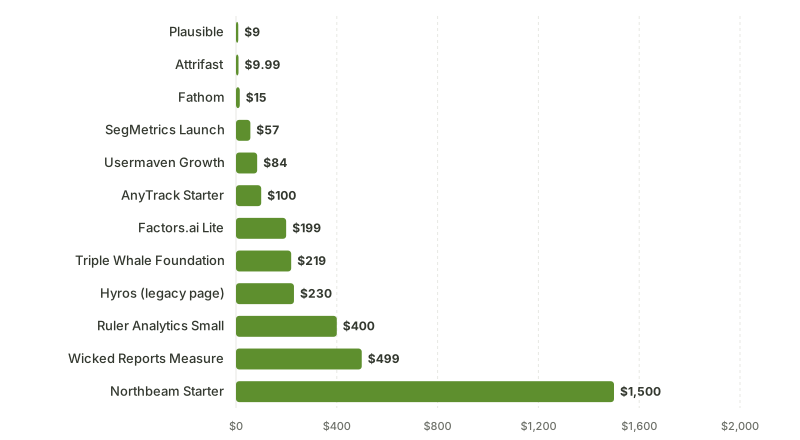
Source: Each vendor's own pricing page as read on 1 August 2026, per the pricing table in this article; Heap, Cometly, Polar Analytics and Dreamdata above its free tier publish no rate and are omitted, as are the tools whose entry is $0
First, four of the nineteen publish no entry price at all — Heap, Cometly, Polar Analytics (covered in the Triple Whale alternatives comparison), and Dreamdata above its free tier. That is itself a buying signal: demo-gated pricing usually means the median deal is large enough to be worth a salesperson's time. It also means any listicle quoting a confident monthly figure for those vendors is repeating something the vendor does not say.
Second, the headline price-per-month is misleading for half the tools. Implementation cost, hidden engineer time, and annual-commitment lock-in routinely double or triple the first-year cost.
Third, the price-per-percentage-of-recovered-attribution is the metric that actually matters. A $9.99/mo tool that recovers 20% of misattributed revenue is more efficient than a $1,500/mo tool that recovers 22%, until the recovered-dollar value crosses the price gap. A $300k MRR DTC brand losing 30% of conversions to iOS 14.5+ underreporting recovers more dollars from Triple Whale at $219-749/mo than from a $9.99/mo tool. The same brand at $30k MRR recovers more dollars per month from a $9.99/mo cookieless tool than from a Triple Whale subscription with implementation services.
Fourth, "free" tools have a real cost. GA4 plus a custom channel group plus an engineer's time per quarter plus a missing Stripe join plus an analyst building Looker Studio dashboards routinely exceeds a paid SMB attribution subscription on a total-cost-of-ownership basis. The headline is "free." The TCO is not.
Here is what the re-read actually cost: eight vendors where the number this article carried and the number the vendor publishes are not the same number, in both directions.
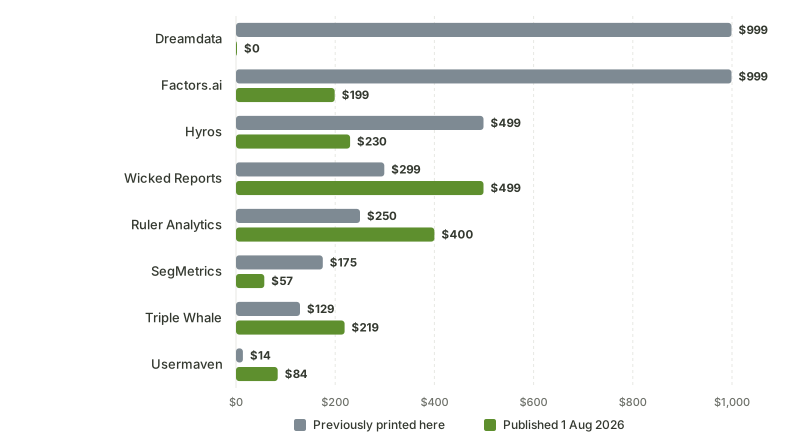
Source: Each per-tool pricing paragraph in this article, which names both the figure this article previously carried and the rate the vendor's own page rendered on 1 August 2026
Integration comparison: Stripe, Shopify, Meta CAPI, Google Ads, HubSpot, Salesforce
A tool's headline features matter less than its native integrations with your actual revenue and ad systems. Here is the integration matrix I keep updated.
| Tool | Stripe | Shopify | Meta CAPI | Google Ads | HubSpot | Salesforce |
|---|---|---|---|---|---|---|
| Attrifast | Native, OAuth | Roadmap | Roadmap | Native | Roadmap | No |
| GA4 | Manual via dataLayer | Native | Via GTM | Native | Manual | Manual |
| Plausible | Goals with revenue | Manual | No | No | No | No |
| Fathom | Goals with revenue | Manual | No | No | No | No |
| Mixpanel | Connector | Connector | Via integration | Via integration | Connector | Connector |
| Amplitude | Connector | Connector | Via integration | Via integration | Connector | Connector |
| Heap | Connector | Native | Via integration | Via integration | Connector | Connector |
| PostHog | Native plugin | Plugin | Plugin | Plugin | Plugin | Plugin |
| Triple Whale | Native | Native | Native | Native | No | No |
| Cometly | Native | Native | Native | Native | No | No |
| Northbeam | Native | Native | Native | Native | No | No |
| Dreamdata | Native | Native | Via Meta connector | Native | Native | Native |
| Factors.ai | Limited | Limited | Native | Native | Native | Native |
| Hyros | Native | Native | Native | Native | Limited | Limited |
| SegMetrics | Native | Native | Native | Native | Limited | Limited |
| Wicked Reports | Native | Native | Native | Native | Limited | Limited |
| Ruler Analytics | Limited | Limited | Native | Native | Native | Native |
| AnyTrack | Limited | Native | Native | Native | No | No |
| Usermaven | Native | Native | Limited | Limited | Limited | No |
A tool with "Native" in the columns that match your stack saves weeks of engineering. A tool with "Roadmap" or "No" in a column you need is a deal-breaker unless you are willing to build the integration yourself.
The Stripe column matters disproportionately for SaaS. The Shopify, Meta CAPI, and Google Ads columns matter disproportionately for DTC. The HubSpot and Salesforce columns matter disproportionately for B2B. If you can ignore three of the six columns based on your business type, the shortlist collapses fast.
Privacy and GDPR comparison: who actually runs cookieless
Privacy is the dimension where vendor marketing diverges most from product reality. Every tool claims to be "privacy-friendly." Few are actually cookieless and banner-less under a strict reading of the EU ePrivacy directive and the California Consumer Privacy Act.
| Tool | Cookies used? | Consent banner required (EU)? | EU data residency option? | GDPR-friendly out of the box? |
|---|---|---|---|---|
| Attrifast | First-party only, no third-party | No | Yes | Yes |
| GA4 | Yes (analytics cookies) | Yes | Limited (consent mode) | With consent mode + DPA |
| Plausible | None | No | Yes (EU-only) | Yes |
| Fathom | None | No | Yes (EU isolation) | Yes |
| Mixpanel | Yes | Yes | Limited | With consent |
| Amplitude | Yes | Yes | Limited | With consent |
| Heap | Yes | Yes | Limited | With consent |
| PostHog | Configurable | Depends on config | Yes (self-hosted) | Configurable |
| Triple Whale | Yes | Yes | No | With consent + DPA |
| Cometly | Yes | Yes | No | With consent |
| Northbeam | Yes | Yes | Limited | With consent + DPA |
| Dreamdata | Yes | Yes | Yes | With consent + DPA |
| Factors.ai | Yes (and reverse-IP) | Yes (strict) | Limited | Legal review recommended |
| Hyros | Yes (fingerprinting) | Yes (strict) | No | Legal review recommended |
| SegMetrics | Yes | Yes | No | With consent |
| Wicked Reports | Yes | Yes | No | With consent |
| Ruler Analytics | Yes | Yes | Yes | With consent |
| AnyTrack | Yes | Yes | Limited | With consent |
| Usermaven | None (cookieless mode) | No (cookieless mode) | Yes | Yes |
The "Cookieless + No consent banner + EU residency + GDPR-friendly out of the box" intersection is short: Plausible, Fathom, Attrifast, Usermaven (with cookieless mode enabled), and self-hosted PostHog with cookieless configuration. Every other tool requires a working consent banner and a Data Processing Agreement for EU operations.
This matters for two reasons. First, consent banners cost conversions; industry surveys put the rejection-tax in the 15-40% range depending on banner UX. Second, a privacy-first stack is a real legal de-risk for EU-focused businesses and is increasingly relevant in California, Colorado, and other US states with active privacy legislation.
AI traffic detection comparison: who actually catches ChatGPT, Perplexity, Claude
A category that did not exist in 2022. By 2026 it is a real differentiator. Here is which tools detect AI-engine referrals and how completely.
| Tool | Referrer detection (15-20% of AI traffic) | Behavioral fingerprinting (additional 50-70%) | AI-engine channel in dashboard | Bot crawl logging |
|---|---|---|---|---|
| Attrifast | Yes | Yes | Yes, native | Yes |
| GA4 | Only via custom channel group | No | Custom config only | No |
| Plausible | Yes | No | Yes, native | Limited |
| Fathom | Yes | No | Yes, native | Limited |
| Mixpanel | UTM only | No | Custom property | No |
| Amplitude | UTM only | No | Custom property | No |
| Heap | UTM only | No | Custom segment | No |
| PostHog | UTM and referer | No | Custom dashboard | Limited |
| Triple Whale | Limited | No | Roadmap | No |
| Cometly | Limited | No | Roadmap | No |
| Northbeam | Limited | No | Roadmap | No |
| Dreamdata | UTM only | No | Custom config | No |
| Factors.ai | UTM only | No | Custom config | No |
| Hyros | UTM only | No | Custom segment | No |
| SegMetrics | UTM only | No | Custom segment | No |
| Wicked Reports | UTM only | No | Custom segment | No |
| Ruler Analytics | UTM only | No | Custom segment | No |
| AnyTrack | Limited | No | No | No |
| Usermaven | Yes | No | Yes, native | Limited |
The intersection of "referrer detection + behavioral fingerprinting + native AI-engine channel + bot crawl logging" is currently small. Most tools catch the 15-20% of AI traffic that arrives with a usable referer and miss the rest. Attrifast's behavioral fingerprinting layer is the part of the product I am most opinionated about because the GA4-baseline alternative is "all of this lands in Direct/(none)." See the ChatGPT referral analytics deep dive for the full methodology.
Bucketed, nine of the nineteen offer nothing past UTM parameters — which for an unreferred AI click is the same as offering nothing.
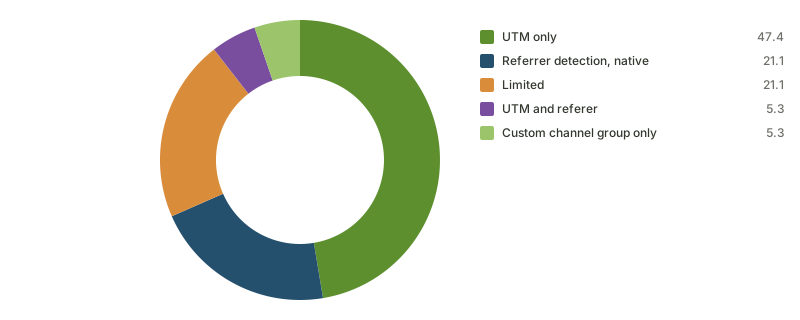
Source: Counted from the AI traffic detection comparison table in this article; each of the 19 tools falls into exactly one referrer-detection value
Migration paths between tools
Most operators end up switching attribution tools at least once. Here is the migration matrix I use when customers come from another vendor.
| From → To | Effort | Data loss | Watch for |
|---|---|---|---|
| GA4 → Attrifast | 1-2 hours setup, no migration | Historical GA4 stays in GA4 | Channel-mix delta on cut-over |
| GA4 → Plausible/Fathom | 1 hour setup, no migration | Historical stays in GA4 | Different session definition; reconcile |
| Mixpanel → Amplitude | 4-12 weeks | Event-schema redesign required | Event-naming conventions diverge |
| Heap → Mixpanel/Amplitude | 8-12 weeks | Auto-capture history not portable | Re-instrument or accept gap |
| Plausible → Attrifast | 1 hour setup, parallel | None | Run parallel 30 days, validate |
| Cometly → Triple Whale | 2-4 weeks | Pixel reconfiguration | Reset Meta Conversion API integration |
| Triple Whale → Northbeam | 4-8 weeks | Significant; data models differ | Run parallel 90 days |
| Hyros → SegMetrics/Attrifast | 2-4 weeks | Funnel-tracking config redesigned | Long-window attribution may not port |
| Mixpanel → PostHog | 4-12 weeks | Event-schema redesign | Self-hosting decision needed |
| Any → Dreamdata | 4-8 weeks | CRM field mapping is the work | HubSpot/Salesforce custom fields |
| Any → Adobe Analytics | 12-26+ weeks | Implementation services often required | Budget six-figure cost |
Two patterns. First, migrating off a cookie-based event-design tool (Mixpanel, Amplitude) is expensive because the event schema is the asset; you cannot easily port it. Second, migrating onto a cookieless first-party tool (Attrifast, Plausible, Fathom) is cheap because the install is a script tag and the data starts accumulating from install date forward. The asymmetric cost favors starting on a cookieless tool early if your business type allows it.
Common buying mistakes
Six mistakes I see often enough to call them patterns.
Mistake 1: Buying for features instead of category-fit. A bootstrapped SaaS buying Northbeam because the demo looked impressive will spend at least $1,500/mo — Northbeam's published Starter floor — for a tool designed for DTC brands, and never recover the value. Decide your category first; then shop within it.
Mistake 2: Underestimating implementation cost. A $1,500/mo tool that requires 6 weeks of data-engineer time to deploy has a first-year cost well past $40,000, not $18,000. Budget the engineer-hours.
Mistake 3: Confusing product analytics for attribution. Mixpanel, Amplitude, Heap, and PostHog are excellent product analytics. They are mediocre attribution layers. Buying one of them as your attribution tool is a common error that produces a year of frustrated dashboards.
Mistake 4: Picking a DTC tool for SaaS or vice versa. Triple Whale is wrong for SaaS. Dreamdata is wrong for DTC. Each tool is shaped for one revenue model and the misfit shows up in week two.
Mistake 5: Assuming GA4 is enough. GA4 is enough for traffic-counting. It is structurally not enough for channel-to-revenue attribution on Stripe, and it is blind to 65-80% of AI-engine traffic. Treating GA4 as the only layer is the most common attribution mistake of 2026.
Mistake 6: Not running tools in parallel during migration. Cutting cold from one attribution tool to another loses the comparison data that lets you defend the change to the board. Run new and old in parallel for 30-90 days, document the deltas, then sunset the old one with the deltas explained.
FAQ
What is the best marketing attribution software in 2026?
There is no single best. The honest answer depends on three variables: monthly recurring revenue, business type, and tech stack. For sub-$50k MRR Stripe-native SaaS or DTC, Attrifast at $9.99/mo is the lowest-friction option that joins sessions to revenue. For DTC ecommerce above $200k/mo ad spend, Triple Whale or Northbeam are the category leaders despite higher prices. For B2B SaaS with a HubSpot or Salesforce CRM and long sales cycles, Dreamdata or Factors.ai close the lead-to-revenue loop better. For high-ticket info-product or coaching, Hyros remains the incumbent. For free analytics with no revenue join, GA4 is still the default, with Plausible or Fathom as the privacy-first alternatives. Any "best of" listicle that names a single winner across all five segments is selling you something, usually their own product.
How much does marketing attribution software cost in 2026?
Every figure here came off the vendor's own pricing page on 1 August 2026. The floor is $0 (GA4, server logs, Matomo self-hosted, and the free tiers at Dreamdata, Mixpanel, Amplitude and PostHog) and the top of the published range is Factors.ai at $30,000-plus a year. The honest middle: privacy-first analytics start at $9/mo (Plausible at 10k pageviews) and $15/mo (Fathom at 100k pageviews); SMB attribution with a revenue join runs $9.99/mo (Attrifast) to $57/mo (SegMetrics Launch at 30k contacts) to $84/mo (Usermaven Growth); DTC attribution runs $100/mo (AnyTrack Starter) to $219/mo (Triple Whale Foundation) to $1,500/mo (Northbeam Starter); high-ticket attribution runs $230/mo (Hyros, and only on a legacy page) to $499/mo (Wicked Reports Measure). Four vendors in this article publish no price at all and require a demo: Polar Analytics, Cometly, Heap, and Dreamdata above its free tier. Treat any roundup that prints a confident number for those four as unsourced.
Do I still need GA4 if I have a dedicated attribution tool?
Yes, for most operators in 2026. GA4 is still the canonical surface for organic-search reporting via Google Search Console linking, for paid-search reporting via Google Ads linking, and for the Looker Studio dashboards your CMO already built. A dedicated attribution tool replaces the channel-mix and revenue-join layer, not the GA4 console. The one exception is if you have committed to a fully cookieless privacy-first stack (Plausible + Stripe + your own pipeline), in which case you can rip GA4 out and document the tradeoff.
Which attribution tools work without cookies and without a consent banner?
The short list in 2026: Plausible, Fathom, Simple Analytics, Usermaven (with cookieless mode enabled), and Attrifast. Each uses first-party-only identifiers scoped to your own domain, no cross-site fingerprinting, and no third-party cookies. Each falls outside the typical scope of the EU ePrivacy directive and most US state laws that require a consent banner for tracking cookies. GA4 with consent mode is borderline and depends on legal interpretation. Triple Whale, Northbeam, Hyros, and most of the DTC and high-ticket category require cookies or fingerprinting and a consent banner under GDPR.
What is the difference between attribution software and product analytics?
Attribution software answers "which channel sent me the paying customer." Product analytics answers "what did the customer do after they signed up." Mixpanel, Amplitude, Heap, and PostHog are product analytics; they instrument in-app events, funnels, cohorts, retention. They can be configured to do some attribution work, but the channel-to-revenue join is not their primary lens. Attribution tools (Attrifast, Dreamdata, Triple Whale) treat the channel-to-revenue join as the core abstraction. Most growth-stage teams need both: product analytics for activation and retention, attribution for acquisition spend allocation.
How do I migrate between attribution tools without losing historical data?
You do not, fully, in 2026. Most attribution tools do not export their channel-mix or session-level data in a portable format, and even if they did, the channel definitions and behavioral-inference models differ enough between vendors that a one-to-one port produces noise. The realistic migration pattern is: run the new tool in parallel for 60 days, validate the channel mix against the old tool on a few known campaigns, document the deltas, then cut over with a clear "before/after methodology change" note on the dashboard. Keep the old tool's account read-only for at least one full year so the historical data is still queryable.
Which attribution tool is best for tracking AI engine traffic?
In 2026 the short list is Attrifast, Plausible, Fathom, and Usermaven. All four detect AI-engine referrers by domain match. Attrifast adds server-side behavioral fingerprinting to catch the 65-80% of AI clicks that arrive without a referer, and joins those sessions to Stripe revenue. Plausible and Fathom expose the referrer-based portion in their dashboards but do not join to revenue. GA4 has no built-in AI-engine channel.
Is Triple Whale worth it for a DTC brand under $100k/mo ad spend?
Usually no. Triple Whale's cheapest paid tier is Foundation at $219/mo as its own pricing page rendered it on 1 August 2026, the next tier up (Automate) is $749/mo, and the ladder is banded by trailing-12-month GMV, so the bill climbs as you grow. The value compounds at higher spend levels where the multi-pixel server-side attribution catches meaningful incremental conversions Meta's pixel misses. Under roughly $50k/mo ad spend the absolute dollar lift from improved attribution is often less than the subscription cost. Below $100k/mo the math is borderline. Note that Triple Whale advertises no free trial on its paid tiers — the CTA is "Book a walkthrough," with a free Founders Dash tier as the only no-commitment entry.
Is Mixpanel or Amplitude better for SaaS?
They are 80% the same product. Mixpanel is slightly stronger on funnel analysis and faster onboarding. Amplitude is slightly stronger on BI, warehouse-native deployments, and dashboarding. Both require a separate attribution layer for channel-to-revenue join. The "better" tool is the one your team already has hiring talent for.
Can I use HubSpot's built-in attribution reports instead of Dreamdata?
For early-stage B2B (<$100k MRR), yes. HubSpot Marketing Hub Professional and Enterprise include multi-touch attribution reports that cover first-touch, last-touch, linear, U-shaped, and W-shaped models out of the box. Before you compare vendors on model count, decide which model you actually need — under 500 conversions a month the first-touch vs last-touch attribution choice moves your numbers more than the tool does. The reports are reasonable for the price. They get strained at scale (large lead volumes, complex multi-product structures, multi-brand portfolios) where Dreamdata or Factors.ai justify the additional spend.
What about Adobe Analytics?
Adobe Analytics is the legacy enterprise category. It is still widely deployed at Fortune 500 marketers with multi-million-dollar Adobe Experience Cloud contracts. Adobe publishes no price for it — every route is a sales conversation, so any figure you see quoted for it, including the "north of $50k/year" this article used to print, is someone's guess rather than Adobe's number. The product is powerful but heavy; implementation is a multi-month consulting engagement. If you are not already in the Adobe stack, you are unlikely to choose Adobe Analytics as your first attribution tool in 2026. If you are, the question is usually whether to layer Dreamdata or Bizible on top, not whether to replace it.
How do I evaluate an attribution tool before buying?
Four-step process. First, run a 30-day trial or proof-of-concept on a single high-volume channel where you already know the truth (your largest paid campaign, your top organic post). Second, reconcile the tool's attribution against your Stripe ledger for the same period and document the variance. Third, ask the vendor for three reference customers in your specific category (not generic "we have a case study" but "we have three SaaS at $200k MRR running Stripe"). Fourth, read the last 90 days of G2 reviews specifically filtered to your business size; ignore the marquee logos in the case studies, focus on operators your size complaining about the same things you would complain about.
What is the most underrated attribution tool in 2026?
Hard question to answer without bias. The honest answer: cookieless first-party attribution as a category is underrated relative to its addressable market. Most bootstrapped SaaS and ecommerce operators are over-paying for GA4 (in implementation and analyst time) and missing 65-80% of their AI-engine traffic in the process. The category is small in vendor count but solves a structurally growing problem. Attrifast is the entry I built and use; Plausible and Fathom are the privacy-first alternatives I respect.
Should I build attribution in-house instead of buying?
Almost never, in 2026. The build path is 4-12 weeks of engineering for a basic version, ongoing maintenance, the cost of staying current with ad-platform API changes, the consent-management work, the Stripe webhook hardening, and the institutional risk that the one engineer who built it leaves. The buy path is a script tag and something between $9.99 and $1,500 a month depending on which category you are in. The break-even crossover is roughly a $5-10M ARR business with a dedicated data engineering team and a specific differentiating attribution requirement that no vendor solves. If you are below that, buy.
References
- Attrifast — Product feature documentation and pricing
- Plausible Analytics — Pricing: Starter $9/mo at 10k pageviews, Growth $14/mo, Business $19/mo, 30-day free trial with no card. Note
/pricingreturns 404; pricing is on the homepage anchor (accessed 1 August 2026) - Plausible Analytics — How to track ChatGPT and AI search traffic. April 2024
- Triple Whale — Pricing: Founders Dash free forever, Foundation $219/mo, Automate $749/mo, banded by trailing-12-month GMV; paid tiers CTA is "Book a walkthrough" (accessed 1 August 2026); G2 reviews
- Northbeam — Pricing: Starter "STARTING AT $1,500 / per month" under $1.5m/yr media spend; Professional (>$250k/mo) and Enterprise (>$500k/mo) both "Contact us for a quote" (accessed 1 August 2026); TechCrunch 2022 Series A coverage.
- Dreamdata — Pricing: Starter free at $0/month; "Advanced: Activation & Attribution" listed as Custom Pricing with a demo booking (accessed 1 August 2026); G2 reviews
- Hyros legacy pricing page — renders
$230 / per month w/annual planat the first tier;hyros.com/pricingreturns 404 and the live Pricing link is a "Get A Custom Quote" booking form (accessed 1 August 2026) - GA4 Channel Group Definitions — Google Analytics support documentation
- Google Analytics 4 — Standard and Analytics 360 product pages
- Mixpanel — Pricing: free plan; Growth "starts at $0" with 1M monthly events free then $0.28 per 1K events; Enterprise quote-only (accessed 1 August 2026); G2 reviews
- Amplitude — Pricing: free plan with unlimited seats; Plus "starts at $0" with first 2M events/month free; Growth and Enterprise quote-only (accessed 1 August 2026); G2 reviews
- iOS 14.5+ Meta Ads underreporting industry surveys. Multiple sources including Meta business blog and third-party measurement studies, 2022-2024.
- Fathom Analytics — Pricing: full pageview ladder published in the page's own tier data, $15/mo at 100k through $470/mo at 25M (200k $25, 500k $45, 1M $60, 2M $100, 5M $140, 10M $200); only the step above 25M is contact-only; yearly is ten months for twelve; 7-day free trial; 50+ sites included, extras $10/mo per pack of 50 (accessed 1 August 2026)
- Heap — Pricing page carries no figures; every path is "Request a demo" (accessed 1 August 2026); Contentsquare acquisition of Heap, 2022 — Company announcements
- PostHog — Pricing: free to 1M product-analytics events/month, then $0.00005/event stepping down to $0.0000090 above 250M (accessed 1 August 2026)
- Gartner-adjacent attribution-software market size estimates, 2024-2025. Various industry analyst reports.
- Cometly — Pricing: no figures published; Core and Enterprise plans "tailored to your existing monthly pageviews" with "Talk to sales" as the only route, and no free trial by stated policy (accessed 1 August 2026); G2 reviews
- Factors.ai — Pricing: Lite $199/mo after a free trial with no card; Basic $6,000/yr; Growth $20,000/yr; Enterprise from $30,000/yr (accessed 1 August 2026); G2 reviews
- SegMetrics — Pricing: Launch $57/mo, Grow $197/mo, Scale $397/mo at 30,000 active contacts, 14-day free trial; Enterprise is a demo (accessed 1 August 2026)
- Wicked Reports — Pricing: Measure $499/mo, Scale $699/mo, Maximize $999/mo, Enterprise from $4,999; add-ons $199/mo each (accessed 1 August 2026); G2 reviews
- Ruler Analytics — Pricing: Small "From £299" ($400) up to 10k monthly visits; Medium "From £499" ($668) up to 50k visits; 10% off annual (accessed 1 August 2026)
- AnyTrack — Pricing: Free $0 at 5,000 sessions; Starter $100/mo; Personal $150/mo; Advance $300/mo; 14-day free trial on paid plans (accessed 1 August 2026)
- Usermaven — Pricing: Growth $84/mo and Scale $199/mo at 250,000 monthly events, 14-day free trial; white-label from $49/mo (accessed 1 August 2026)
For the companion strategic pieces, see the AEO vs SEO 2026 framework, ChatGPT referral analytics deep dive, and the GA4 missing traffic explainer. For the head-to-head detail pages, see Attrifast vs Google Analytics, Attrifast vs Plausible, Attrifast vs Fathom, Attrifast vs Mixpanel, Attrifast vs Amplitude, Attrifast vs Heap, Attrifast vs PostHog, and Attrifast vs Cometly. For the use-case pages, Stripe attribution and bootstrapped SaaS attribution cover the typical customer profile.