
Part of the generative engine optimization guide, AEO Hub, and AI Search Hub.
I have bought, trialed, or been pitched most of the AI visibility tools on the market over the past eighteen months, because I run answer-engine optimization on attrifast.com and a handful of client SaaS properties, and because founders kept DMing me the same question: which AI visibility tool should I buy? The honest answer is that the question is malformed. "AI visibility tool" is not one product. It is at least four products wearing the same label, and the most expensive mistake in the category is buying one job when you needed a different one.
This guide is the explanation I wish someone had handed me before I spent a few thousand dollars learning that distinction the slow way. It covers what these tools actually do under the hood, the four capability tiers, real pricing with the metering traps called out, the revenue blind spot every monitoring-first tool shares, and a buyer's framework you can use to pick the right one for the job you actually have. For the strategic framing of why AI visibility matters at all, start with does GEO actually drive revenue; this piece is the operator's guide that comes after you have decided it does.
What an AI visibility tool actually does
Strip away the marketing and an AI visibility tool does one mechanical thing: it sends a list of prompts to one or more AI engines, repeatedly, and parses the generated answers for your brand. Everything else — the dashboards, the scores, the competitor charts — is computed from that raw stream of answers.
Here is the loop, step by step:
- You define a prompt set. Typically 25–1,000 buyer-stage questions in your category: "best Stripe analytics tool", "how do I track ChatGPT traffic", "alternatives to Google Analytics for SaaS". Good prompt sets mirror how real buyers ask, not how you'd phrase a keyword.
- The tool runs each prompt across the engines — ChatGPT, Perplexity, Gemini, Claude, Google AI Overviews — usually daily, sometimes multiple times per day for statistical stability.
- It parses each answer for three things: whether your brand is mentioned (named in the prose), whether your domain is cited (appears in the linked source list), and where you appear (position, sentiment, surrounding context).
- It aggregates those parsed answers into the metrics you see: mention rate, citation share, share-of-voice versus named competitors, sentiment, and trend lines over time.
The reason step 2 says "repeatedly" matters more than it looks. Unlike a Google SERP, which returns roughly the same ten links to everyone for a given query, an LLM answer is probabilistic. Ask ChatGPT the same question twice and you can get two different answers with two different source lists. A tool that checks a prompt once a week is reading noise; a tool that samples it dozens of times produces a mention rate you can actually trust. Sampling frequency is the single most underrated spec in the category, and it rarely appears on the pricing page.
The core metrics, defined
These terms get thrown around loosely, so here is the working vocabulary. I cover the full metric set in more depth in AI visibility metrics and KPIs, but the short version:
| Metric | What it measures | What it does not tell you |
|---|---|---|
| Mention rate | % of prompt runs where your brand is named | Whether the mention drove a click |
| Citation share | Your share of the cited source links for a prompt | Whether you were cited favorably |
| Share-of-voice | Your mention rate relative to named competitors | Absolute demand for the topic |
| Sentiment | Whether the mention is positive, neutral, negative | Revenue impact of the sentiment |
| Position | Where you appear in the answer (first, middle, buried) | Click-through from that position |
| Revenue per visitor (RPV) | Revenue per AI-referred session, by engine | (Only available with an attribution layer) |
Notice the right-hand column. Every monitoring metric stops one step short of money. That gap is the spine of this entire guide, and I will come back to it.
Why use AI search monitoring tools?
You use AI search monitoring tools to answer one question you cannot eyeball: do ChatGPT, Perplexity, Claude, and Gemini bring up your brand when buyers ask about your category — and is that share rising or falling versus competitors? Buyers now research in AI engines before they ever reach your site, so if you are not mentioned in those answers you lose the deal before it starts, silently, with no SERP to check.
That makes three things worth paying for:
- Measurement you cannot do by hand. Running 50 buyer-stage prompts across five engines, dozens of times each, every week, to get a stable mention rate is mechanical work no human does reliably. The tool exists to turn an invisible, probabilistic channel into a number that trends.
- Competitive early warning. Share-of-voice against named competitors tells you when a rival starts winning the "best tool for X" answer in your category — usually months before it shows up in your pipeline.
- A feedback loop for optimization. When you change your content, schema, or llms.txt, monitoring is how you find out whether AI engines actually started citing you more, instead of guessing.
The honest limit: monitoring tells you whether you appear, not whether appearing paid. Every metric in the table above stops one step short of money. To close that loop you need an attribution layer that joins the AI-referred session to a booked Stripe payment — which is a different job, covered below.
The four jobs an AI visibility tool can do
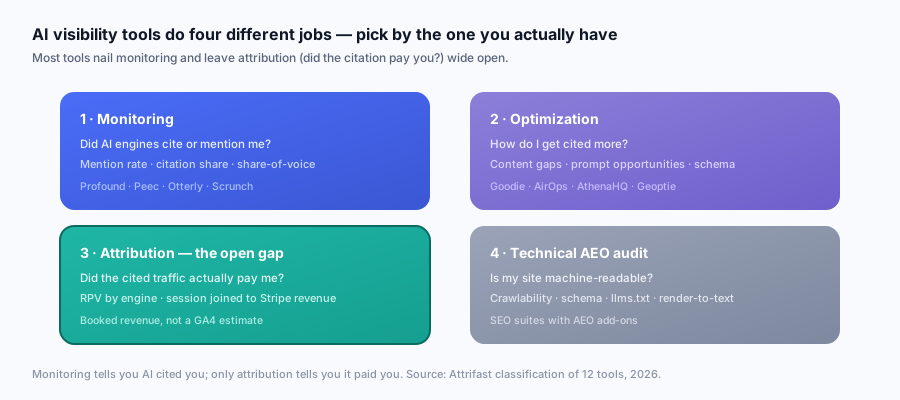
"AI visibility tool" collapses four genuinely different functions. Before you look at a single pricing table, you need this mental model, because the tools that look identical on a homepage are often built for completely different jobs.
| Job | Question it answers | What it measures | Tools that lead here |
|---|---|---|---|
| Monitoring | Did AI engines cite or mention me? | Mention rate, citation share, share-of-voice, sentiment | Profound, Peec, Otterly, Scrunch, Evertune |
| Optimization | How do I get cited more? | Content gaps, prompt opportunities, schema issues | Goodie, AirOps, AthenaHQ, Geoptie |
| Attribution | Did the cited traffic pay me? | Sessions joined to revenue, RPV by engine | Attrifast (booked revenue) |
| Technical AEO audit | Is my site machine-readable? | Crawlability, schema, llms.txt, render-to-text | SEO suites with AEO add-ons |
Almost every vendor claims at least three of these. Almost none deliver three to the same depth. The monitoring tools are genuinely strong at monitoring and weak-to-absent on real revenue attribution. The optimization tools bolt monitoring onto a content workflow. The attribution job — joining the AI-referred session to a paid invoice — is consistently underserved, because doing it properly requires a payment-processor join that a GA4 integration cannot fake. Hold that thought.

Source: Attrifast classification of 12 widely-marketed AI visibility tools by their leading capability, 2026
Why the job split is expensive to get wrong
A concrete example from a client call earlier this year. A bootstrapped B2B SaaS founder had bought a $499/mo enterprise monitoring plan because the homepage said "track your AI revenue." Six weeks in, he had beautiful citation-share charts and zero idea whether any of it made money — the "revenue" figure was a GA4-derived estimate sitting on top of a traffic number that was missing most of his AI visits. He was paying enterprise prices for the monitoring job while believing he had bought the attribution job. He had the right category and the wrong job. The fix cost him less than the monitoring tool: a $9.99/mo Stripe-native attribution layer that showed his actual AI-engine RPV, paired with a cheaper monitoring tool for the visibility half.
That is the pattern. Map your problem to one of the four jobs first, then shop within that job. Buying for the wrong job is how you end up with an expensive dashboard that answers a question you did not ask.
How AI visibility tracking differs from classic rank tracking
If you came from SEO, you will be tempted to treat an AI visibility tool as "rank tracking, but for ChatGPT." That mental model is 70% right and the missing 30% will mislead you. I unpack this fully in prompt tracking vs keyword rank tracking; here is the compressed version.
| Dimension | Classic rank tracking | AI visibility tracking |
|---|---|---|
| Unit of measurement | Position (1–100) in a list | Mention rate / citation share (%) |
| Determinism | Same SERP for everyone | Probabilistic — varies per run and per user [10][12] |
| Sampling needed | One check ≈ accurate | Many checks per prompt for stability |
| Input | Keyword | Natural-language prompt |
| Output surface | Ten blue links | Generated answer + cited sources |
| Personalization | Modest | Heavy (memory, location, account history) |
| Click model | Position-based CTR curve | Often zero-click; the answer is the destination [16] |
The determinism row is the one that breaks naive tools. Because LLM answers vary, a single daily snapshot of "am I mentioned" is statistically meaningless on its own — you can flip from mentioned to not-mentioned between two runs with identical inputs. This is why credible tools report a rate over many samples rather than a binary yes/no, and why you should be suspicious of any tool that shows you a clean position number without disclosing how often it samples.
The zero-click row is the one that breaks naive strategy. In classic search, ranking #1 reliably drives clicks. In AI search, being cited in an answer often means the user got what they needed inside the answer and never clicked through — which is great for brand exposure and terrible for your traffic logs. That decoupling between visibility and traffic, and between traffic and revenue, is exactly why measurement has to extend all the way down to the transaction.
Real pricing: what AI visibility tools actually cost in 2026
Published entry prices, sorted low to high. Treat every number as "verify on the vendor page before you sign" — this category reprices constantly, and several of these tools changed tiers in the last two quarters.
| Tool | Entry price | Primary job | Self-serve trial? |
|---|---|---|---|
| Otterly.ai | $29/mo | Monitoring | Yes, 14-day |
| Attrifast | $9.99/mo | Attribution (revenue) | Yes, free trial |
| Geoptie | $49/mo | Optimization + monitoring | Yes, 14-day |
| Peec AI | $89/mo | Monitoring | Yes, 14-day |
| SE Ranking AI | $119/mo (add-on) | SEO suite + AI tracking | Yes (suite trial) |
| AthenaHQ | ~$95–$270/mo | Optimization + monitoring | No |
| Scrunch AI | $250/mo | Monitoring (enterprise) | No |
| Goodie | $495/mo | Optimization + monitoring | Demo-led |
| Profound | $499/mo (sales-led) | Monitoring (enterprise) | No |
| Evertune | $3,000+/mo | Monitoring (enterprise) | No |

Source: Verified from each vendor's public pricing page, May 2026
The chart compresses two stories. First, the floor of the category is low — $29/mo gets you a real (if prompt-capped) monitoring tool, which means visibility monitoring has commoditized faster than most buyers realize. Second, the ceiling is enterprise-software steep, and the jump is not mostly about software. The four-figure tiers bundle human services — dedicated GEO specialists, white-glove onboarding, SSO/SAML, SOC 2 — that have little to do with the cost of running prompts and everything to do with enterprise procurement [2][5].
The metering trap
The sticker price is the smaller half of the story. Two meters quietly inflate the bill:
- Per-engine add-ons. Several monitoring tools include ChatGPT, Perplexity, and AI Overviews in the base tier, then charge extra to add Gemini, Google AI Mode, Claude, or Copilot. Otterly charges roughly $9–$149/mo extra for additional engines; Peec charges roughly $30–$140/mo per extra model [6][7]. If your audience lives on the engines that are not in the base tier, the real price is the base plus the add-ons.
- Per-prompt metering. Most tools price by how many prompts you track. A 25-prompt plan is cheap and nearly useless for a real category; the prompt count you actually need (100–300 for decent topical coverage) often sits a tier or two up.
When you compare tools, normalize on "price to monitor my engines at my prompt count," not the homepage entry price. Two tools with the same $89 sticker can land $200 apart once you load the engines and prompts you actually need.
The revenue blind spot every monitoring tool shares
This is the section to read if you read only one. Every AI visibility tool tells you whether you were cited. The question that pays your salary is whether the citation converted. Most tools cannot answer it, and the ones that claim to are usually estimating on top of broken data.
Here is the mechanism. When someone clicks from ChatGPT, Perplexity, or another AI client to your site, the client frequently strips the Referer header — especially from native desktop and mobile apps and in-app webviews. GA4 has nothing to attribute the visit to, so it dumps it into Direct/(none). Across our measurement, 65–82% of ChatGPT-referred sessions land in that bucket and are never credited to ChatGPT [1]. I walk through the raw numbers in why ChatGPT referral traffic doesn't show in analytics.

Source: Attrifast measurement of AI referral attribution in GA4, Q1–Q2 2026
The consequence cascades:
- A monitoring tool that derives "AI traffic" from a GA4 integration inherits this blind spot. Its traffic number is a systematic undercount.
- Any "revenue" figure built on that traffic number is an estimate, not a measurement — it is modeling revenue on top of a count it knows is wrong.
- The result is a category-wide false confidence: dashboards full of green citation-share arrows next to a revenue number nobody should bet a budget on.
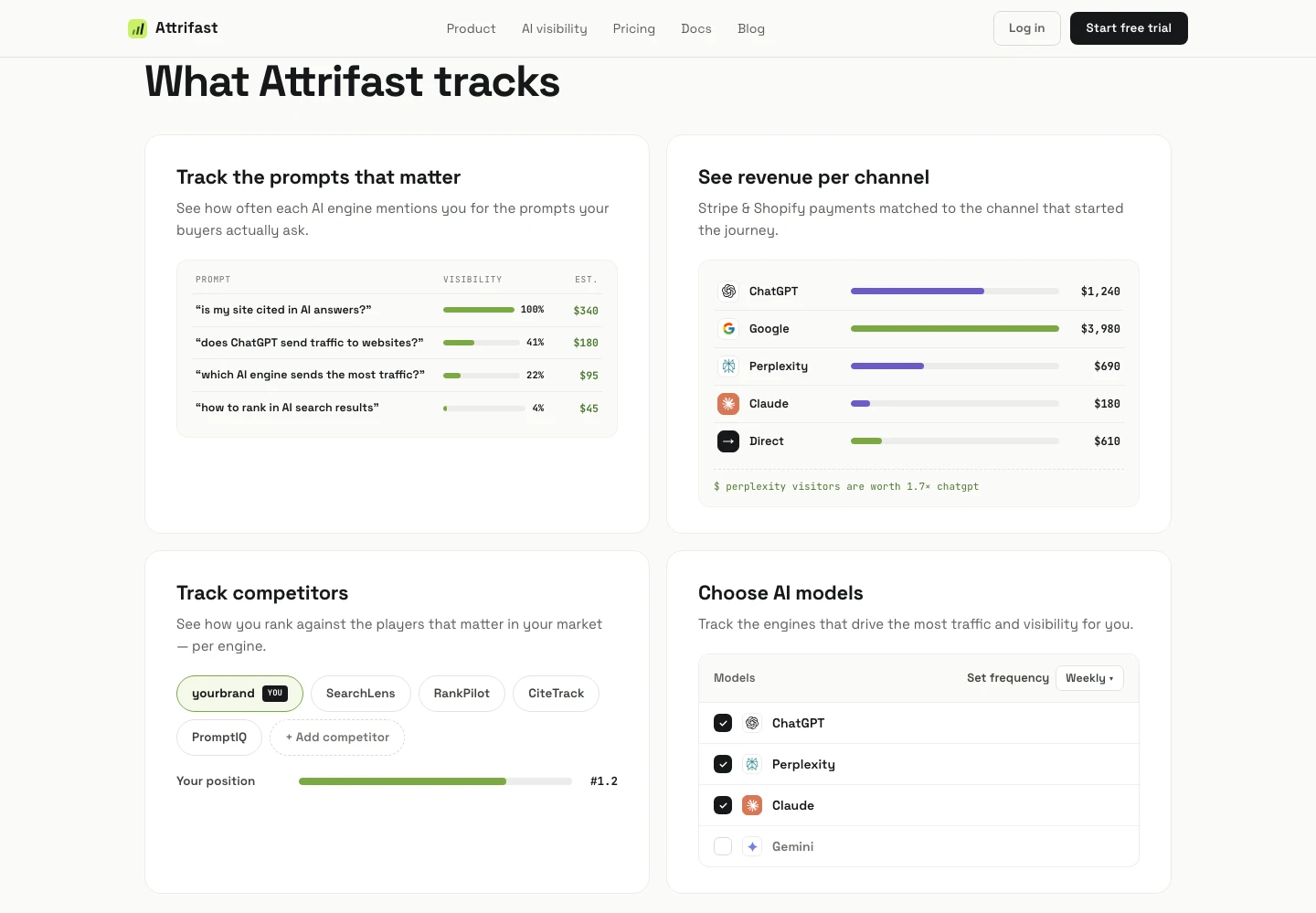
The only number you can fully trust is one tied to a transaction. A session you can trace to a paid Stripe invoice or a Shopify order is booked revenue; everything else is a model. This is the gap Attrifast was built to close — it detects AI-engine referral sessions server-side (before the Referer is lost), writes a first-party session id, and joins that session to the Stripe payment_intent.succeeded webhook when the visitor pays. The output is RPV by engine, by page, by prompt — the metric that actually predicts revenue rather than approximating it. It also runs a deliberately small scan of its own — 10 prompts on a monthly cadence and 3 competitors at $9.99/mo, 30 prompts weekly and 8 competitors at $49/mo — rolled into an AI visibility score that sits in the same row as the revenue those citations produced. That is nowhere near a dedicated monitor's prompt depth, and it is not meant to be; the differentiator is the revenue join, not the coverage. For the full mechanism, see Stripe vs GA4 revenue attribution.
To be clear about scope: this is the attribution job, not the monitoring job. A revenue attribution tool does not replace a citation monitor — it sits underneath it and answers the question the monitor structurally cannot.
A buyer's framework: which AI visibility tool to pick
Forget feature checklists. Pick by the job you actually have, then by budget, then by engine coverage. Run yourself through this in order.
Step 1 — Name your primary job
| If your real problem is… | You need the… | Don't overbuy on… |
|---|---|---|
| "I don't know if AI mentions me" | Monitoring tool | Enterprise tiers, until you've proven the channel |
| "AI mentions competitors, not me" | Optimization tool (or DIY) | A second monitoring tool |
| "I get AI traffic but can't prove ROI" | Attribution tool | Citation depth you won't use |
| "My pages aren't machine-readable" | Technical AEO audit | Prompt-monitoring volume |
Most teams discover they have two jobs — usually monitoring plus attribution — and the correct answer is a small stack, not one mega-tool. The two jobs are genuinely different and the overlap is small.
Step 2 — Match budget to stage
- Pre-revenue / validating the channel: Start with a $29–$49/mo monitoring tool and a $9.99/mo attribution layer. You can run the whole stack for under $65/mo and get both halves of the truth.
- Growth, channel proven: Step up to a $89–$250/mo monitoring tool (Peec, Scrunch) for deeper sampling and competitor sets, keep the attribution layer underneath.
- Enterprise, dedicated GEO team: Profound, Evertune, or Scrunch's higher tiers earn their keep on sampling depth, compliance, and seat scale — but verify there's still a real attribution story, because the four-figure price does not buy you a Stripe join.
Step 3 — Verify the engines and the sampling
Before you sign, confirm two specs that rarely appear on the pricing page:
- Exact engine list in your tier. Not the homepage list — the tier list. Confirm your audience's engines (often ChatGPT + Perplexity for B2B; add Gemini + AI Overviews for consumer) are included, not add-ons.
- Sampling frequency per prompt. Daily minimum; multiple-times-daily is better. A weekly snapshot of a probabilistic answer is noise.
For a deeper, tool-by-tool comparison with the weaknesses called out, see best AEO tools 2026 and best LLM tracking tools 2026. For the metrics layer that tells you which numbers matter once you've picked a tool, see AI visibility metrics and KPIs.
Common mistakes when buying an AI visibility tool
Six I see repeatedly:
- Buying the wrong job. The expensive one. Map your problem to monitoring / optimization / attribution / audit before you shop.
- Trusting GA4-derived traffic numbers. They under-count AI visits because of the Referer-strip problem [1]. Cross-check against server logs and your payment processor.
- Reading a single daily snapshot as truth. LLM answers vary; you need a sampled rate, not a one-off check [12].
- Ignoring per-engine and per-prompt metering. Normalize on your real engine list and prompt count, not the sticker price [6][7].
- Over-indexing on citation share. A high citation share with flat RPV means you're cited for queries that don't convert. Citation share is a leading indicator, not revenue.
- Skipping the attribution layer entirely. Visibility without revenue is a vanity dashboard. The whole point of getting cited is to get paid; measure that.
Frequently asked questions
Is an AI visibility tool the same as a GEO or AEO tool? Largely yes — the labels (AI visibility, GEO, answer engine optimization) describe overlapping practices and most vendors use them interchangeably. The functional distinction that matters is monitoring versus optimization versus attribution, not the three-letter acronym on the homepage. See AEO vs SEO in 2026 for the framing.
Can I track AI visibility for free? Partially. A few tools offer free graders or limited free tiers for a one-off snapshot, and you can manually run a handful of prompts across engines yourself. But serious monitoring — dozens of prompts across multiple engines, sampled repeatedly — costs the vendor real API money per run, so the credible paid floor is around $29/mo.
How often should I check my AI visibility? For monitoring, daily sampling is the floor and the tool should handle it automatically. For reviewing the results, weekly is plenty for most teams; monthly for slow-moving categories. Watch for sudden drops, which usually signal a model retrain or a competitor displacing you in answers.
Does AI visibility actually drive revenue? For some businesses, materially — but only the attribution layer can tell you whether yours does, and by how much. We dug into this with cohort data in does GEO actually drive revenue and is AI traffic worth it.
Related reading from the Attrifast research stack
For the monitoring side, see the multi-LLM AI visibility tracker breakdown and best LLM tracking tools 2026. For the metrics that matter once you've picked a tool, see AI visibility metrics and KPIs. For the revenue half this category leaves open, see revenue attribution and Stripe vs GA4 revenue attribution.
Sources
Primary sources for the claims in this article. Numbered citations in the text link to the matching entry.
- [1]Why ChatGPT referral traffic doesn't show in analytics (65-82% in Direct/none, Q1-Q2 2026) — Attrifast (2026).
- [2]Profound pricing and enterprise positioning — Profound (2026).
- [3]Peec AI pricing — Starter/Pro/Enterprise and model add-ons — Peec AI (2026).
- [4]Otterly.ai pricing — Lite/Standard/Premium and engine add-ons — Otterly.ai (2026).
- [5]Evertune platform and per-prompt pricing analysis — Evertune (2026).
- [6]Otterly.ai engine add-on pricing (Gemini, Google AI Mode) — Otterly.ai (2026).
- [7]Peec AI per-model add-on pricing — Peec AI (2026).
- [8]Scrunch AI pricing and engine coverage — Scrunch AI (2026).
- [9]AthenaHQ plans — 8-engine coverage, GEO score, Shopify/GA4 attribution — AthenaHQ (2026).
- [10]How ChatGPT search works — citations and source selection — OpenAI Help Center (2025).
- [11]Perplexity FAQ — how Perplexity cites sources — Perplexity (2025).
- [12]GEO: Generative Engine Optimization (Aggarwal et al.) — answer variance — Princeton / arXiv (2024).
- [13]AI Search Stats 2026: Market Share, Referral, and Citation Data — SimilarWeb (2026).
- [14]BrightEdge / Search Engine Land — AI Overviews appearance tracking — Search Engine Land (2026).
- [15]TechCrunch — ChatGPT weekly active user milestones — TechCrunch (2026).
- [16]How to Get Cited in Google AI Overviews: Own a Criterion — Backlinko (2026).
- [17]Semrush — AI Overviews and AI search research — Semrush (2025).
- [18]Pew Research Center — share of US adults who have used AI chatbots — Pew Research Center (2025).
- [19]Schema.org — FAQPage and Article structured data for AEO-ready content — Schema.org (2026).
- [20]Search Engine Land — Generative engine optimization and the AEO tooling landscape — Search Engine Land (2026).