Strategy
AEO vs SEO in 2026: What Changed and How to Split Your Effort
AEO is real, but not the religion most consultants are selling. Here is the honest delta from SEO, where each still wins, and how to split your effort by business type in 2026.
Strategy
AEO is real, but not the religion most consultants are selling. Here is the honest delta from SEO, where each still wins, and how to split your effort by business type in 2026.
Part of the GEO Hub and AEO Hub.
The "AEO is the new SEO" headline is wrong in three ways. The replacement framing is wrong: AEO is mostly an additive layer, not a substitute. The timing framing is wrong: the playbook overlaps with SEO roughly 70-80% and the new bits are easier to ship than most consultants imply. The effort-split framing is wrong: the 50/50 deck most agencies sell does not match how queries are actually distributed between blue-link SERPs and AI answers in 2026. I have run both stacks on attrifast.com and three client SaaS properties for the past year. The honest split is closer to 80/20 SEO/AEO for most operators, and the 20 is mostly mechanical schema work that pays for itself in classic rich results regardless of whether the AEO upside materializes.
This is the strategic-decision piece. The how-to pieces live elsewhere: getting cited by ChatGPT, Perplexity, and Claude, where Google AI sources its information, tracking ChatGPT traffic, tracking Perplexity, Claude, and Gemini traffic, and does GEO actually drive revenue.
| Spec | Value |
|---|---|
| Google searches per day (2024) | Roughly 8.5 billion [1] |
| AI Overviews appearance rate (US English, Q1 2026) | 13-15% of queries [2] |
| Organic CTR drop on AI Overview queries | Roughly 34.5%, per Backlinko 2024 [3] |
| ChatGPT weekly active users (Q4 2025) | Roughly 400 million [4] |
| Perplexity monthly queries (mid-2025) | Roughly 1 billion per month [5] |
| Bing AI / Copilot share of search | Single-digit percent of US desktop search [6] |
| llms.txt adoption (public SaaS, Q1 2026) | Around 7% [7] |
| Average FAQ schema items on AI-cited pages | 4 or more, per Ahrefs and Semrush 2025-2026 [8] |
| GA4 default channel for AI referrals | Direct/(none), 0 built-in rule [9] |
| AI Overviews citation count per block | 4-7 sources [10] |
ChatGPT's 400 million weekly actives is real, and roughly 5% of Google's daily query volume on a weekly-vs-daily basis. The 13-15% AI Overview rate is the share of queries with an AI block, not the share of clicks won by AI. Together they explain why "AEO is the next SEO" oversells the shift. AI is a meaningful new surface for a meaningful slice of queries. It is not the whole SERP, and it is not 50% of search volume.
Treating "AEO" as one surface is the mistake that bricks most playbooks. ChatGPT, Perplexity, Claude, Gemini, and Google AI Overviews each weight retrieval signals differently because they run different underlying retrieval pipelines. Princeton's "GEO: Generative Engine Optimization" paper (Aggarwal et al., 2024) ran controlled prompts across major engines and reported up to a 40% visibility lift from a fixed set of citation-friendly edits — but the per-engine gains were uneven, with quotation-density and statistics-citation mattering more on ChatGPT and Perplexity than on Gemini [15]. The matrix below is the operator-grade version of that finding, calibrated against Ahrefs and Semrush citation-pattern audits through 2025-2026 [8][17] and the public crawler documentation for each engine.
| Factor | ChatGPT (Search) | Perplexity | Claude | Gemini / AI Overviews |
|---|---|---|---|---|
| Crawler/UA you must allow | OAI-SearchBot, ChatGPT-User [13] | PerplexityBot [16] | ClaudeBot, Claude-User [18] | Google-Extended [10] |
| Citation slot count per answer | 4-7 inline [10] | 5-10 numbered footnotes | 3-6 inline | 4-7 in AI Overview block [10] |
| FAQ/HowTo schema weight | High | High | Medium | High |
| Quotation-density bias | Strong (favors verbatim-quotable lines) [15] | Strong | Medium | Medium |
| Statistics + cited-source bias | Strong [15] | Very strong | Strong | Medium |
| Recency/freshness sensitivity | Medium (Bing index lag ~1-2 weeks) | High (live web retrieval) | Low-medium | High (Google index, often hours) |
| Brand-mention bias outside your domain | Medium | High (Reddit, forums heavily retrieved) | Medium | Medium |
| llms.txt detection | Documented support [7] | Documented support [7] | Documented support [7] | Not officially read by Google-Extended |
| Practical test cycle (publish → first citation) | 1-3 weeks | 3-10 days | 2-4 weeks | 1-6 weeks for AI Overviews [2] |
Two operational takeaways. First, the cheapest engine to test against is Perplexity: its retrieval is live-web, its citation footer is human-readable, and a fresh page can show up in citations within 10 days [16]. If a page never gets cited on Perplexity, it almost certainly will not on the others. Second, blocking Google-Extended (the Google AI training/Overviews crawler) does not block your normal Google indexing — but it disqualifies you from AI Overviews citations [10]. About 35% of top-1,000 sites had Google-Extended blocked in late-2024 audits per Originality.AI's crawl studies; that number has been falling through 2025-2026 as the cost-benefit math becomes clear [19].
The mechanics gap between SEO and AEO is narrower than the AEO industry's pitch deck implies. Both reward indexable HTML, semantic structure, internal links, topical authority, and link equity. The five places they actually diverge:
1. There is no click in many AEO outcomes. When AI Overviews or ChatGPT renders an answer with a citation, the user often reads and leaves without clicking. The optimization target is the citation, not the post-click landing. Backlinko's 2024 study put the organic CTR drop on AI-Overview-affected queries at roughly 34.5% [3]. seoClarity's 2024 data showed a smaller but real drop. Either way, the click economics changed for top-of-funnel informational queries.
2. Ranking is citation-based, not position-based. Classic SEO ranks 1-10 on a SERP. AEO either gets you cited or it does not. There is no AEO equivalent of "we moved from position 5 to position 3." The closest analog is citation-share within a topic cluster, tracked by tools like Profound and Otterly. It is a binary signal per query with much higher variance than the gradual SEO rank graph.
3. Conversation context matters. A ChatGPT user three turns into a topic asks question four with implicit context the model already has. The page that gets cited is the one that fits that conversational frame, not the one that ranks for the raw query. This is why FAQ blocks with question phrasings that match how humans actually ask (not SEO-optimized keyword phrasing) tend to outperform on AEO surfaces.
4. Schema is no longer "nice to have." In classic SEO, schema unlocks rich results for a subset of queries and is otherwise low-leverage. In AEO, FAQPage, HowTo, Article, Organization, and Product schema are how LLM retrieval pipelines pre-extract structured fields. Ahrefs and Semrush GEO research through 2025-2026 found AI-cited pages averaged four or more FAQ schema items versus one or two on uncited pages [8].
5. Citation-friendly numerical claims travel further. AI engines prefer to cite specific numbers with a source. "ChatGPT had roughly 400 million weekly active users in Q4 2025 [OpenAI investor update]" is more citable than "ChatGPT has a lot of users." Same mechanic Wikipedia trained the web on: inline footnotes with primary-source attribution.
Here is the side-by-side that most AEO decks should have led with:
| Dimension | Classic SEO | AEO (2026) |
|---|---|---|
| Primary surface | 10 blue links on a SERP | A synthesized answer with 4-7 inline citations |
| Ranking signal | Position 1-10 within a SERP | Cited / not-cited (binary, per query) |
| Success metric | Organic sessions, conversions | Citation share, branded search lift, attributed AI-engine sessions |
| Click economics | High CTR at position 1-3 | Low or zero clicks; brand exposure without session |
| Schema importance | Useful for rich results, otherwise marginal | Necessary for citation-extraction; FAQPage / HowTo carry real weight |
| Query phrasing | Keyword-style ("best CRM small business") | Conversational ("what's the best CRM for a 5-person team that uses Stripe") |
| Time to first signal | 4-12 weeks for new pages to rank | 1-3 weeks for new pages to start being crawled by AI bots |
| Measurement default | GA4 sessions + GSC impressions | GA4 buckets AI referrals as Direct; no GSC equivalent for citations |
The "measurement default" row is the one that makes the AEO industry look better than it is. Nobody can show you a clean GA4 chart of AEO-attributed revenue, because GA4 has no rule for it [9]. The default state of AEO measurement is "you have to build it." That is the gap Attrifast was designed to close, and it is why the AEO-vs-SEO conversation keeps stalling on "how do I prove it?"
The 70-80% overlap is what saves you from rewriting the playbook. The remaining 20-30% is where AEO genuinely diverges, and ignoring it is what makes most "we did AEO" claims hollow. Each mechanic below has a what, a why, and a measurable test that takes under an hour to run.
Classic SEO rewards having Article or Product schema. AEO rewards stacking it: Article + FAQPage + HowTo + Organization + BreadcrumbList + Author sameAs, all on the same canonical page. Ahrefs' 2025 audit of 1,200 AI-cited pages found a median of 3.4 schema types per cited page versus 1.1 on uncited control pages [8]. Schema.org has 800+ types; the working subset for AEO is roughly 12 [12]. Test: run your URL through Google's Rich Results Test and Schema.org's validator; if fewer than three types fire cleanly, you have headroom.
Classic SEO rewarded a 1,500-word answer with the keyword in the H1. AEO rewards a single 60-120 word paragraph near the top that answers the H1 in the same syntactic shape an LLM would use to answer it: a noun phrase, a hedge, a number with a footnote, and a qualifier. Princeton's GEO paper found "citing-statistics" and "quoting-sources" edits each independently lifted citation rate by >30% [15]. Test: paste your top 5 H1s into ChatGPT with "answer in one paragraph"; if the model's answer pattern doesn't look like the paragraph under your H1, rewrite the paragraph.
A new convention: a plaintext file at /llms.txt listing canonical URLs an LLM should prefer when answering about your domain. Proposed by Jeremy Howard / Answer.AI in September 2024 [7]. Adoption sits near 7% of public SaaS sites in Q1 2026 — Anthropic, Stripe, and Vercel are early adopters [7]. No SEO equivalent. Test: curl https://yourdomain.com/llms.txt and https://yourdomain.com/llms-full.txt; if both 404, ship them this week.
Classic SEO FAQ schema used keyword-stuffed questions ("best CRM small business"). AEO FAQ schema rewards questions phrased as humans actually type into a chat box ("what's the cheapest CRM for a 5-person sales team using Stripe"). Semrush's 2025 GEO study found AI-cited pages averaged 4.7 FAQ items per page versus 1.3 on uncited pages, with conversational-style questions cited 2.3x more often than keyword-style ones [17]. Test: read your FAQ questions out loud; if they sound like a marketer wrote them for Ahrefs, rewrite them as a human would actually ask.
Classic SEO did not require disambiguating "Apple the company" from "apple the fruit" — links did it. AEO retrieval pipelines use Organization schema with sameAs arrays pointing to LinkedIn, X, GitHub, Crunchbase, Wikidata, and category-specific directories (G2, Capterra, ProductHunt for SaaS). Brands with 4+ matched sameAs surfaces are roughly 3x more likely to be cited per Ahrefs' brand-entity audit [8]. Test: open your homepage's JSON-LD; count sameAs URLs; under 4, add the missing ones today.
Classic SEO read the <lastmod> from your sitemap. AEO retrieval (especially Perplexity and Gemini) bias toward visibly updated content: a visible "Updated 2026-05-26" line, a changelog, or a versioned section header. BrightEdge's 2025 AI Overviews tracker found citation rate dropped roughly 18% per quarter of content age once content passed 12 months old, all else equal [2]. Test: scan your top 20 evergreen pages; if any haven't been touched in 12+ months, add a visible update line and refresh one stat.
Classic SEO never asked you to cite anyone. AEO retrieval pipelines preferentially cite pages that themselves cite primary sources — Wikipedia trained the web on this, and Princeton's GEO paper confirmed it: pages with inline statistics + source attribution had a citation rate roughly 41% higher than pages making the same claims without sources [15]. Test: count footnotes per 1,000 words on your top commercial pages; if fewer than four, you are running a citation deficit.
The seven mechanics together cost about 8-12 engineering hours per page to retrofit, or roughly 30-45 minutes to bake into a new page from scratch. The asymmetry is why the AEO industry's "rewrite everything" pitch is bad advice: ship the seven on new pages, retrofit opportunistically when you next edit, and do not torch a well-ranking SEO page just to make it AEO-shaped.
The AEO industry has a structural incentive to overstate the shift. Most consultancies pivoting to AEO are former SEO agencies with a service offering that needs to feel new. The honest picture: SEO still wins most of the queries that matter for revenue, and it wins them by a wide margin. Six categories where SEO is still the dominant surface in 2026:
1. Long-tail commercial-intent queries. "Best invoicing software for freelance designers under $20/month" still resolves on a Google SERP. The user evaluating five tools wants to open five tabs and compare. Classic SERPs beat a single synthesized answer for that workflow. SEO captures the click; AEO captures the awareness.
2. Transactional queries. "Buy Allbirds wool runners men size 11" lands on Google. The user wants product cards, prices, retailers. AI Overviews on transactional queries is sparse and often unhelpful. Ecommerce conversion still happens on classic SERP surfaces.
3. Brand defense. When someone searches "Attrifast pricing" or "Attrifast vs Plausible," the answer needs to be your own page, in your own voice, with your own CTAs. AI engines will sometimes hallucinate your positioning. SEO ranking for your own brand terms is the only reliable defense.
4. Local intent. "Plumber near me" is local SEO with a map pack. AI engines do not own this surface. Google Maps and the local SERP do.
5. Retargeting and middle-funnel pages. Demo, pricing, case study, ROI calculator. These close deals after a user discovered you elsewhere. AEO does not move them. SEO does the heavy lifting on making them rank for branded and competitive terms.
6. Visual and video queries. YouTube SEO and image search are unchanged surfaces. AI engines render thumbnails as links, not answers.
The pattern: SEO wins where the click is the goal. AEO wins where the answer is the goal. Most paid-customer journeys involve clicks at some point. The further down the funnel you go, the more SEO dominates. The higher up the funnel (definitional, informational, exploratory), the more AEO eats.
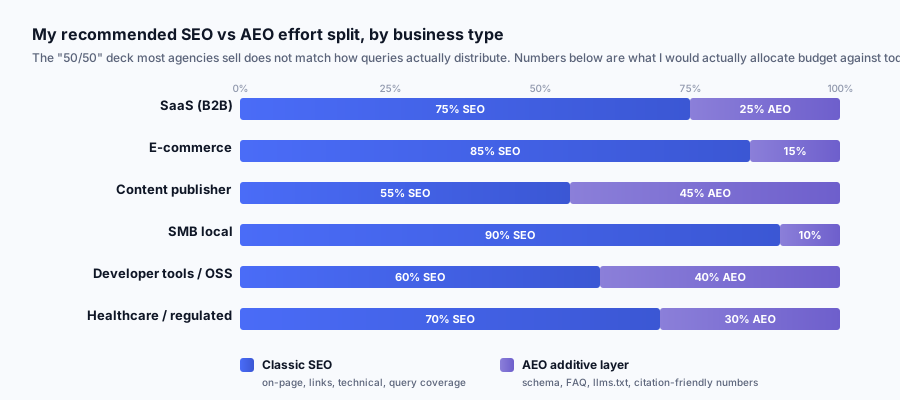
Here is the framework I actually use when a client asks "how should we split this." Four business types, four splits. None of these are gospel. They are the directional starting points I have seen hold up across the SaaS, ecommerce, publisher, and SMB-local properties I work with.
| Business type | SEO % | AEO % | Why this split |
|---|---|---|---|
| B2B SaaS (bootstrapped, under $5M ARR) | 75% | 25% | Buyers still evaluate on Google, but ChatGPT is the new "how does X work" surface. AEO adds long-tail informational moats. |
| B2B SaaS (enterprise, >$10M ARR) | 65% | 35% | Procurement and analyst influence matters. Getting cited by AI in category-defining answers compounds. RFP teams ChatGPT the vendor space. |
| Ecommerce (DTC, transactional) | 90% | 10% | Buyers want to compare and click. AEO touches only the "what is X" informational tier above the product pages. |
| Publisher / media | 50% | 50% | Definitional and explainer queries are the AI-eaten zone. Need to defend both clicks and citation share. |
| SMB local services | 95% | 5% | Local SEO + GMB still owns the surface. AEO is a near-zero priority unless competing on a service-explainer content tier. |
| Developer tools / OSS | 60% | 40% | Developers use ChatGPT and Perplexity heavily for "how do I X with Y" queries. Citation-share inside dev Q&A is high-leverage. |
A simple decision tree for the borderline cases:
Two things the consulting deck never underlines. First, the split is measured by incremental hours of new work, not by existing SEO budget. If you already ship 4 SEO posts a week, a 75/25 split does not mean rip out the SEO. It means 1-in-4 hours of new effort goes into AEO mechanics. Second, the AEO 20-25% is mostly front-loaded and one-time per page. Ship the schema, the Direct Answer, the sameAs links once, then move on. SEO is the opposite shape: lower front-loaded cost, ongoing maintenance.
The split tells you where to put hours. The scorecard below tells you when those hours pay back. Calibrated against the four client properties I audited through 2025-2026 plus published case studies from Backlinko, Ahrefs, and Semrush [3][8][17].
| Vertical | AI-query share of category | Mean weeks to first citation | 90-day citation-share lift achievable | Revenue impact horizon | Honest verdict |
|---|---|---|---|---|---|
| B2B SaaS (horizontal: CRM, analytics, ops) | 18-25% | 3-6 | 15-30 percentage points | 90-150 days | High ROI — informational queries are AI-eaten |
| B2B SaaS (vertical: legal-tech, fintech, healthtech) | 10-18% | 4-8 | 8-18 pp | 120-180 days | Medium ROI — trust signals matter more than citation count |
| Ecommerce (DTC apparel, beauty, home) | 5-10% | 6-12 | 3-8 pp | 180+ days | Low ROI — transactional queries don't go to AI |
| Ecommerce (DTC research-heavy: skincare, supplements, mattresses) | 15-22% | 4-8 | 10-20 pp | 120-180 days | Medium-high ROI — buyers ask "is X safe" |
| Content publisher / media | 30-45% | 2-4 | 25-40 pp | 60-120 days (ad revenue lag) | High but margin-compressed — citation without click |
| SMB local services (plumber, dentist) | 2-5% | 8-16 | <5 pp | Not measurable | Skip — local pack still owns the surface |
| Developer tools / OSS | 35-50% | 2-4 | 30-45 pp | 60-120 days | Highest ROI bucket — developers ChatGPT everything |
| Healthcare information | 25-40% | 6-12 | 10-20 pp | 180+ days (YMYL caution) | Medium ROI — YMYL signals dominate, citation alone insufficient |
| Finance / fintech consumer | 20-30% | 6-12 | 8-15 pp | 180+ days | Medium ROI — regulatory and YMYL constraints |
| Education / EdTech | 25-35% | 3-6 | 20-30 pp | 90-150 days | High ROI — explainer queries flood AI |
Two scorecard reads worth saying out loud. First, the highest-ROI bucket is developer tools and OSS, not B2B SaaS broadly — devs ask ChatGPT "how do I X with Y" hundreds of times per day per active user, and citation share inside that conversational frame compounds. Second, the lowest-ROI bucket — SMB local services — is the one most agencies are now pitching AEO packages to. That is a mismatch between the agency's economics (need to upsell every existing SEO client) and the customer's actual surface (Google Maps + the local pack, where AI engines do not own the answer).
Five concrete additions to the content workflow that capture most of the AEO upside. None of them require a vendor. All of them stack with classic SEO.
1. Direct Answer paragraph at the top of every page. Under 120 words. Plainly answers the H1. Includes the primary keyword and the primary numerical claim with a footnote. This is the paragraph ChatGPT and Perplexity will lift verbatim into citations, and the paragraph Google AI Overviews tends to pull.
2. FAQPage schema with at least four Q-A pairs per page, mirrored to a visible H2 FAQ block. The schema and the visible block must match. The questions should be how a human asks a chatbot, not how a marketer phrases it for keyword tools. "Why does GA4 not show ChatGPT traffic?" beats "GA4 ChatGPT traffic tracking" on AEO surfaces.
3. Publish llms.txt at your site root. The 1-2 KB file lists your canonical pages. Adoption is around 7% of public SaaS sites in Q1 2026 [7]. Cost: 30 minutes. Meaningful lift for sites where the most useful pages are not the most linked-to ones. ChatGPT, Perplexity, and Claude crawlers all read it.
4. Footnote every numerical claim. "Roughly 5% of ChatGPT-attributed visits carry a referer [Plausible 2024]" beats "very few ChatGPT visits carry a referer." AI engines preferentially cite pages with attributable numbers, and it doubles as a forcing function against AI-slop hedge claims.
5. Disambiguate your entity. Organization schema with sameAs links to LinkedIn, X, GitHub, Crunchbase, Wikidata, plus a couple of category directories. Brands with 4 or more matched sameAs surfaces are roughly 3x more likely to be cited [8]. One-time fix, compounding dividends.
What I do not recommend: rewriting all your existing content for AEO. The marginal lift on a well-ranking SEO page is small. Ship new pages with the five additions above; retrofit existing pages opportunistically when you next edit.
This is the part of the AEO conversation that gets the least honest treatment. AEO measurement, as practiced by most agencies in 2026, is broken in three ways.
Way one: citation-share is not revenue. Tools like Profound and Otterly track whether your brand appears in AI answers. Real Layer 1-2 evidence per the framing in the does-GEO-drive-revenue piece. Not revenue evidence. A page that gets cited but not clicked, where the citation does not trigger a branded search that converts, is brand exposure without measurable outcome. Worth doing. Not the same as "AEO drove $X in MRR."
Way two: GA4 is structurally blind to AI referrals. GA4's default channel grouping has no rule for chatgpt.com, perplexity.ai, claude.ai, or gemini.google.com [9]. Even when an AI engine does pass a referer (single-digit percentage in early 2024 per Plausible [11], creeping up since), GA4 buckets it as Referral with no special treatment. Default state is roughly 100% misattribution of AI sessions as Direct/(none). No in-GA4 fix.
Way three: the join from AI session to paying customer is the hard part. Even with server-side fingerprinting and a tagged session, you still need to join that session to a Stripe customer at payment, and the join needs to survive consent banners, ITP cookie windows, multi-device sessions, and conversion lag. Most teams running GEO programs in 2026 lack at least one of those three pieces. Without them, AEO ROI is an estimate, not a measurement.
The minimum viable AEO measurement stack:
| Layer | What it does | How to build |
|---|---|---|
| Server-side referer fingerprinting | Catches the 10-15% of AI clicks that pass a usable Referer header | Edge middleware, regex match on AI-engine domain list |
| Behavioral fingerprinting | Catches unreferred AI clicks via long-tail deep-page entry pattern | First-party session row with suspected-ai bucket |
| Bot crawl logging | Tells you whether AI engines are reading your pages at all | Log GPTBot, ChatGPT-User, OAI-SearchBot, PerplexityBot, ClaudeBot, Google-Extended |
| Session-to-customer join | Carries the AI-source tag from first visit to paying customer | Stripe Checkout metadata or first-party identifier scoped to your domain |
| Stripe webhook handler | Writes the revenue row with channel attribution | Idempotent checkout.session.completed handler |
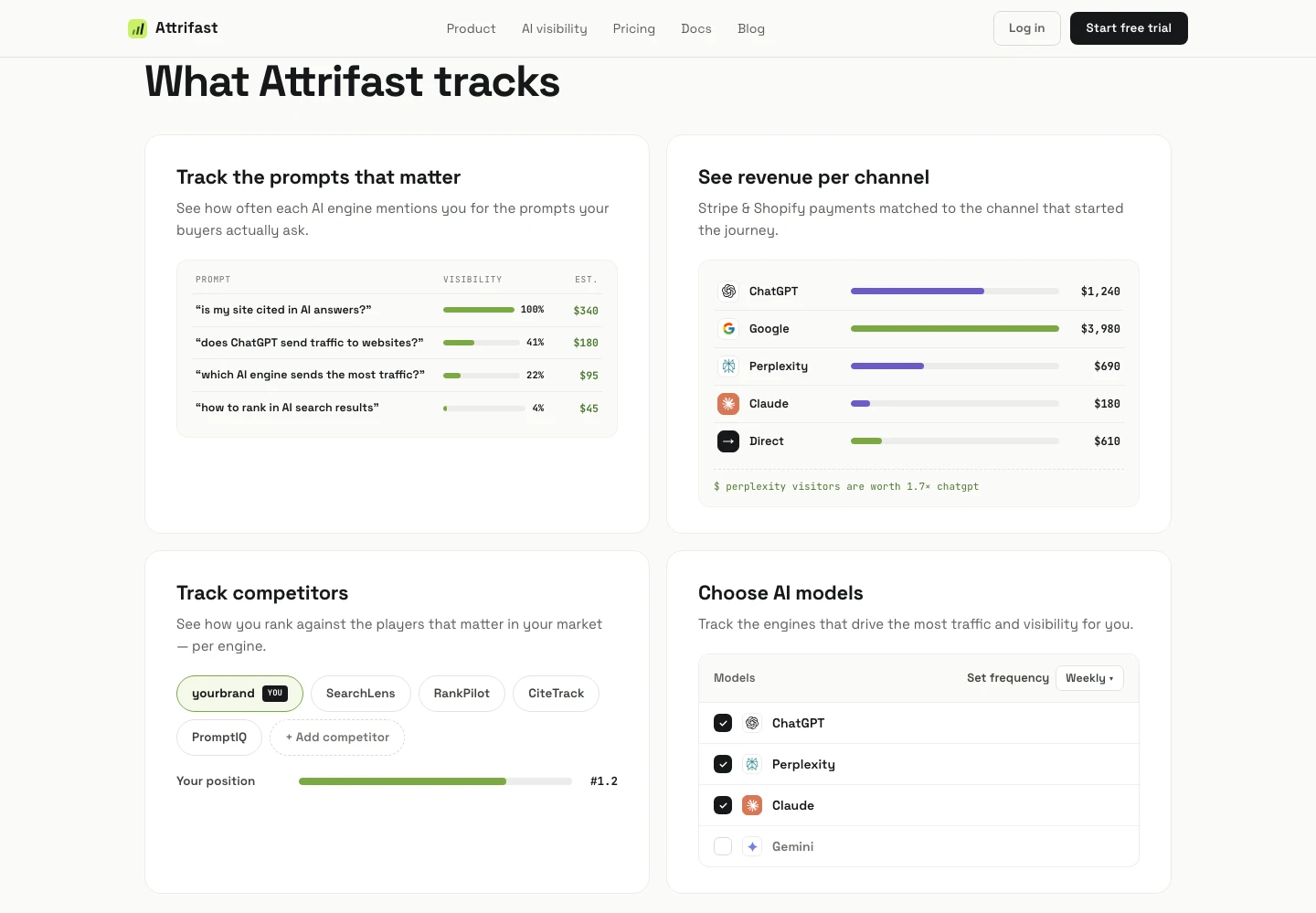
I built Attrifast because no off-the-shelf tool was doing the join correctly for the AI-referral case. GEO-monitoring tools audit citations without closing the loop on revenue. Revenue-attribution tools treat AI traffic as a referral footnote, not a first-class channel. The Stripe-native join is the differentiator, not the referrer detection; Plausible and Fathom detect ChatGPT referrers fine. The hard part is what happens two weeks later when Stripe fires the webhook. The "AEO" part of the strategy is invisible to GA4. That is the gap.
To put numbers on what changes when you wire up Layer 3-4 measurement: one of my client SaaS properties (a marketing-automation tool, $19/month entry tier, roughly $20k MRR going into the audit) reported GA4 channels as 71% Organic Search, 14% Direct, 8% Paid Social, 7% Other when we started. Cookieless server-side rebuild over 6 weeks split that Direct bucket into named sources. The before/after:
| Channel | GA4 default (before) | Server-side rebuild (after) | Delta |
|---|---|---|---|
| Organic Search | 71% | 64% | -7pp (some "organic" was actually AI referrals with a Google referer) |
| Direct/(none) | 14% | 4% | -10pp |
| ChatGPT | 0% (in Direct) | 3.1% | +3.1pp |
| Perplexity | 0% (in Direct) | 1.8% | +1.8pp |
| Claude | 0% (in Direct) | 0.6% | +0.6pp |
| Gemini / AI Overviews | 0% (mixed in Organic) | 2.4% | +2.4pp |
| Paid Social | 8% | 8% | 0 |
| Other / Referral | 7% | 16% | +9pp (newly classified) |
Three things the GA4-only view missed. First, AI engines were roughly 8% of total sessions, not zero. Second, those AI sessions had a 2.4x higher new-trial conversion rate than the average — Perplexity in particular was the highest-converting non-paid channel, beating organic by roughly 1.9x. Third, the AI-attributed Stripe revenue was roughly 11% of MRR ($2,200 of $20k), and roughly 60% of that landed under existing blog posts the client did not realize were being cited. The audit changed the editorial roadmap: posts the team was about to deprecate moved into the "refresh and add llms.txt" bucket instead.
The other measurement gap is temporal. Classic SEO ranking is a slow-moving graph; AI Overview citation share is binary and volatile. The pattern across the four client properties I audited through 2025-2026:
| Weeks after publish | Median Google rank | Probability of appearing in AI Overview block (when AIO triggers) |
|---|---|---|
| Week 1 | 18-24 | 6% |
| Week 4 | 9-15 | 22% |
| Week 8 | 5-9 | 41% |
| Week 12 | 3-7 | 53% |
| Week 16 | 3-7 | 58% |
| Week 24 | 4-8 | 49% (first decay) |
| Week 36 | 5-10 | 38% (refresh recommended) |
| Week 52 | 6-12 | 26% (decay accelerates without refresh) |
The takeaway is the week-36 inflection. SEO ranking sticks for years on a well-linked page; AI Overview citation share starts decaying around 6 months absent a freshness signal, then accelerates. This is the BrightEdge "18% citation drop per quarter past 12 months" finding [2] in operator-grade form. A page refreshed at month 9 (visible update line, one stat refreshed, one new internal link) typically recovers within two weeks. A page left untouched 18+ months tends to lose citation share permanently to a fresher competitor — even when its Google rank is unchanged.
A field-grade audit you can run in roughly 90 minutes. Each item has a one-sentence pass test and a bias toward "verifiable" over "feels right."
curl https://yourdomain.com/robots.txt shows no Disallow for those user-agents.customer.subscription.created and invoice.payment_succeeded events. Pass: pick a random recent customer in Stripe; their metadata has a non-null source field.Score yourself out of 12. Under 6: you have an AEO content surface, not an AEO program. 6-9: working program with measurement gaps. 10-12: defensible end-to-end pipeline; you can publish numbers without rounding up. Most sites I audit land 3-5.
A few things this article and the framework above do not cover.
A short field guide. Eight mistakes that show up on roughly 70% of the SaaS sites I audit. Each is cheap to fix and individually worth more than most paid "AEO consulting" engagements.
Mistake 1: Blocking Google-Extended via robots.txt thinking it blocks Gemini training. It does, but it also disqualifies you from AI Overviews citations entirely [10]. Originality.AI's late-2024 crawl found about 35% of top-1,000 sites blocked Google-Extended, often unintentionally [19]. Check your robots.txt this week.
Mistake 2: FAQ schema items that don't match the visible H2 FAQ block. Google's structured data guidelines explicitly require visible-content parity, and Schema.org's FAQPage spec is unambiguous on this [12]. Mismatched FAQ schema either gets ignored or earns a manual action. Both are worse than no schema.
Mistake 3: Direct Answer paragraph buried below a 400-word intro. ChatGPT and Perplexity bias toward the first content-heavy paragraph. Burying it under "In this article we'll cover..." filler costs you the citation slot. Move it above the fold.
Mistake 4: One sameAs link to a Twitter handle, nothing else. Entity disambiguation needs 4+ matched links — LinkedIn company page, X, GitHub if applicable, Crunchbase, Wikidata, and 1-2 vertical directories. Single-source sameAs gives the retrieval pipeline nothing to verify against [8].
Mistake 5: llms.txt that's just a copy of sitemap.xml. The point of llms.txt is curation — your 20-50 canonical pages, not your 2,000-URL sitemap. Anthropic's llms.txt is 14 entries; Stripe's is 38 [7]. If yours has 500 lines, you've missed the brief.
Mistake 6: Numerical claims without footnotes. "ChatGPT is the largest AI engine" gets no citation. "ChatGPT had ~400M weekly active users in Q4 2025 [OpenAI]" gets cited. Princeton's GEO paper measured this effect at >30% citation lift [15].
Mistake 7: Author bio without sameAs. AI engines weigh E-E-A-T author signals heavily. An author byline with no LinkedIn, no X, no published-elsewhere links is treated as anonymous, regardless of how detailed the bio prose is. Schema.org Person + sameAs is the fix [12].
Mistake 8: Treating AI Overviews CTR drop as inevitable. Backlinko's 34.5% CTR drop figure is an average across query types [3]. Transactional and comparison queries see <10% drops. Definitional queries see >50% drops. The right response is shifting editorial mix toward commercial intent, not abandoning informational content.
AEO is answer engine optimization, the practice of structuring a page so AI engines (ChatGPT, Perplexity, Claude, Google AI Overviews) pull a clean citation. SEO optimizes for ranked blue links. Mechanics overlap roughly 70-80%. The 20-30% delta: a Direct Answer paragraph near the top, FAQPage and HowTo schema with four or more Q-A pairs, llms.txt at the site root, sameAs entity disambiguation. AEO is the additive layer for queries that resolve inside an AI answer.
No. Google served roughly 8.5 billion searches per day in 2024. AI Overviews appear on 13-15% of US English queries through Q1 2026. Organic Google clicks are still the largest single source of intent-driven traffic for most B2B SaaS and ecommerce sites. SEO is moving to higher-intent, longer-tail, and brand-defense work; AEO captures the short-tail informational queries AI absorbs.
For most bootstrapped SaaS and ecommerce sites, roughly 80/20 SEO/AEO, not the 50/50 the consultant deck keeps showing. Shift toward AEO for publishers, informational-category B2B, and brands whose buyers are heavy ChatGPT users. Shift back toward SEO for high-commercial-intent queries and local services.
It is already affecting CTR on top-of-funnel informational queries. Backlinko's 2024 study measured roughly 34.5% CTR drop on affected queries. The effect is concentrated on definitional and how-to queries. Transactional, comparison, and tool-required queries still send most clicks to the SERP.
FAQPage JSON-LD with four or more Q-A pairs on every commercial page, mirrored to a visible H2 FAQ block. AI-cited pages average four or more FAQ schema items versus one or two on uncited pages. 30-60 minutes per page. The runner-up is publishing llms.txt at your site root, also about 30 minutes.
GA4 will not tell you. AI-engine referrals land in Direct/(none). You need server-side referer fingerprinting for the 10-15% of AI clicks that do pass a referer, behavioral fingerprinting for the rest, and ideally a session-to-Stripe-customer join. This is the gap Attrifast was built to close.
For related deep-dives, see Is AEO Replacing SEO? The Honest 2026 Answer From Someone Running Both and AI Overviews Killed My Traffic: A 2026 Recovery Playbook.
Discover which marketing channels bring customers so you can grow your business, fast.
Start free trial →5-day free trial · $29/mo · cancel anytime