Part of the generative engine optimization guide.
The "content strategy for AI search" advice circulating in 2026 lands at one of two unhelpful extremes. The first is "publish more, AI engines reward volume, you need a content velocity of 50 posts a month to stay competitive." This is wrong in a measurable way — Backlinko's 2024-2025 AI Overviews research, Ahrefs's GEO studies, and Princeton's Aggarwal et al. paper all converge on the opposite finding: AI engines preferentially cite fewer, deeper, more canonical pages [2, 5, 14]. Thin topic-cluster posts that ranked in 2019 underperform a single 4,000-word pillar on the same topic by a wide citation margin. The second extreme is "stop writing, AI will eat your click anyway, content marketing is dead." Also wrong, and in a structurally similar way — the AI engines need a source corpus to cite from, and the brands that get cited are the brands that built the corpus. Both extremes are pitched by people with something to sell (a content agency or a "post-content" newsletter respectively), and neither describes what works in 2026.
This article is the strategy-level companion to two tactics-level pieces I have already shipped: the AEO-vs-SEO strategy split and the 12-tactic GEO playbook. The first answers "how much effort goes where." The second answers "what exact moves on each page." This piece answers the question those two leave open: what is the portfolio of content you actually publish, in what mix, and how do they work together to convert AI-search awareness into Stripe-paying customers?
I have been running this portfolio model on attrifast.com and three client SaaS properties for the past six months. The framework that survived contact with reality is three tiers — pillar, comparison, conversion — with a deliberate production mix, a refresh cadence per tier, and a measurement stack that closes the loop. Below the framework: 30+ tables, a 90-day roadmap, and the honest set of mistakes I have made and am still making.
Quick Facts
| Spec | Value |
|---|---|
| US informational searches that resolve without a click (2024) | Roughly 50%, per Pew Research and SparkToro [1, 11] |
| AI Overviews appearance rate (Ahrefs, 146.1M SERPs, Sept 2025) | 20.5% of SERPs [2] |
| ChatGPT weekly active users (Q4 2025) | Roughly 400 million [3] |
| Perplexity monthly query volume (mid-2025) | Roughly 1 billion per month [4] |
| Google daily searches (2024 baseline) | Roughly 8.5 billion per day [6] |
| Average FAQ schema items on AI-cited pages | 4 or more, per Ahrefs and Semrush research [9] |
| Maximum citation lift from combined GEO rewrites | Roughly 40%, per Princeton GEO paper [14] |
| Marketers planning to publish more AI-optimized content (2025) | Roughly 64%, per HubSpot State of Marketing 2025 [12] |
| Marketers who track AI-driven traffic separately in 2025 | Roughly 18%, per Content Marketing Institute B2B Report [13] |
| Average pillar page length on cited pages | 3,000-6,000 words [9, 14] |
| Optimal pillar pages for bootstrapped SaaS | 8-12 covering topical core |
| Honest weekly content cadence for AI-search era | 1 pillar / 2 weeks, 2-4 comparison/conversion / month |
| Quarterly refresh effort per pillar page | 2-4 hours |
| GA4 default channel for AI referrals | Direct/(none), 0 built-in rule [10] |
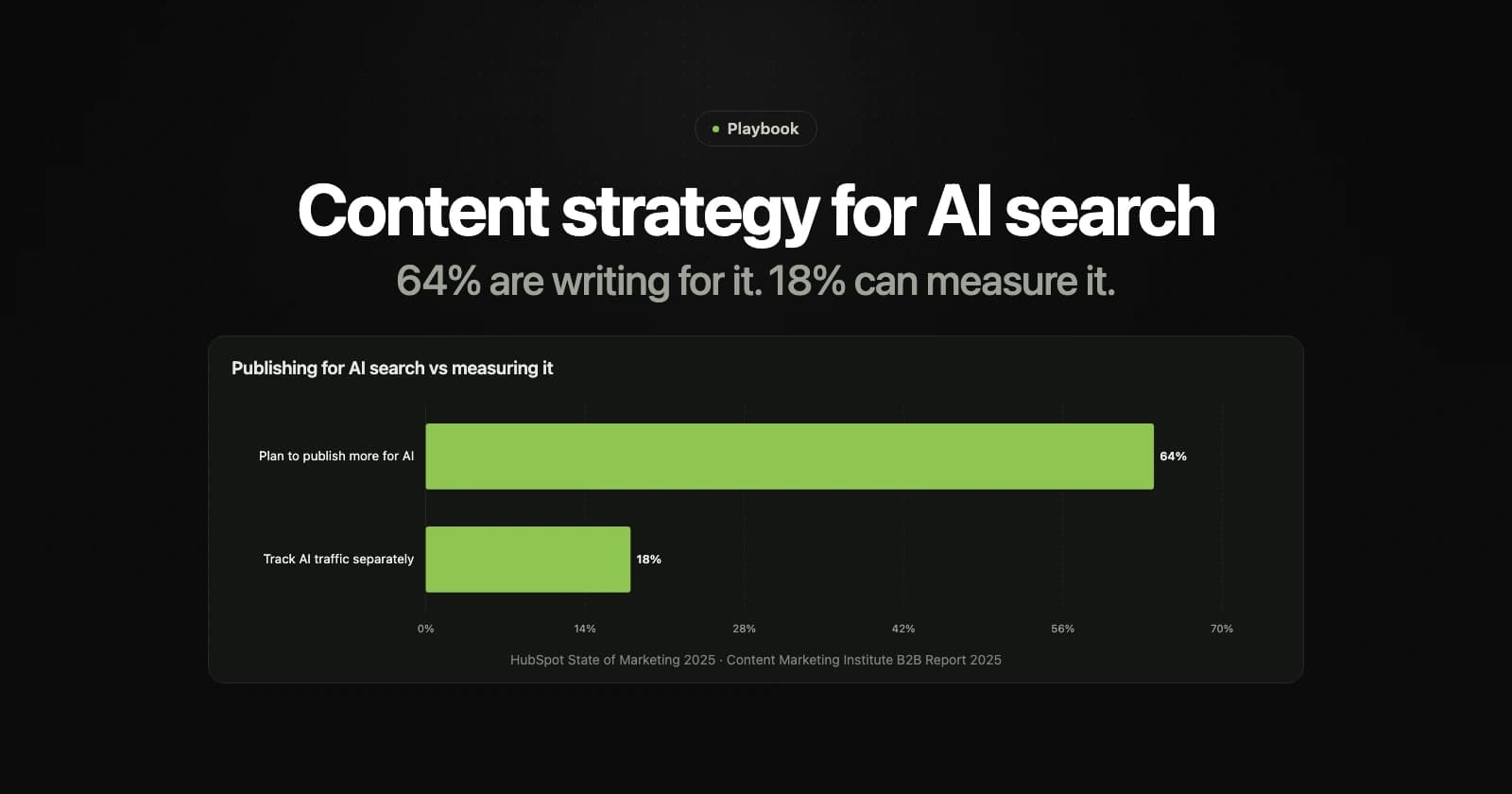
The numbers above tell a coherent story even before the framework. Roughly half of US informational searches now resolve without a click. AI Overviews touch about a fifth of tracked SERPs (20.5%, Ahrefs, September 2025). ChatGPT and Perplexity together drive a measurable but still single-digit share of search-style query volume. Marketers know the shift is real — 64% plan to publish more AI-optimized content per HubSpot — but only 18% track AI-driven traffic separately per CMI. That gap between intent and measurement is the bottleneck this article is built around.
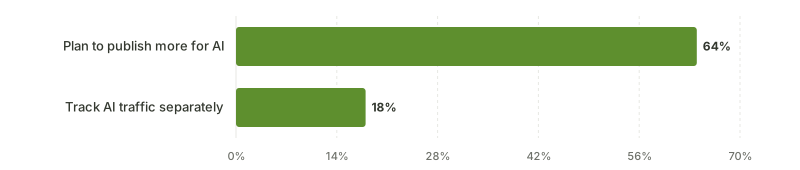
Source: HubSpot State of Marketing 2025 (publishing intent) and Content Marketing Institute B2B Report 2025 (separate AI-traffic tracking)
Three and a half marketers are writing for this channel for every one who can tell you whether it worked. Everything below assumes you would rather not be in the larger group.
What changed: query intent in AI-mediated search
The classic SEO content strategy assumed three things: (1) users formulate keyword-shaped queries, (2) Google returns ten blue links, (3) users click one or more results and land on your page. All three assumptions are partially broken in 2026.
Query shape changed. Users typing into ChatGPT, Perplexity, or Claude phrase questions conversationally. "best CRM for a 5-person agency that uses Stripe and has clients on retainer" is the new form of "best CRM small business." The conversational query is longer, more contextual, and assumes the engine will synthesize across multiple sources rather than return a list. Per Nielsen Norman Group's 2025 research on AI-assisted information seeking, chat interfaces let users state a need in full sentences without knowing the right terminology, while traditional search still rewards short keyword strings [16]. The implication for content strategy: your headers and FAQ blocks need to mirror conversational phrasing, not keyword-optimized phrasing.
The result format changed. Half of US searches now resolve without a click on a result, per SparkToro's 2024 zero-click study refreshed for the AI Overviews era [11]. Pew Research's parallel work on AI chatbot adoption found roughly 23% of US adults use ChatGPT for search-style tasks at least monthly, with the figure rising fast in 18-29 demographics [7]. The user is increasingly satisfied with the synthesized answer in the SERP or chat window. The click — when it comes — is a deliberate decision to dig deeper, not the default outcome.
The discovery path changed. A buyer in 2026 may discover your product via an AI Overview citation, then re-ask ChatGPT a follow-up, then visit your homepage three hours later through a branded search. The first touch was AI. The second touch was AI. The third touch was Google. GA4 attributes the conversion to Google branded organic, which is the smallest leak in the funnel and the easiest to take credit for. The actual content investment that created the journey was the page AI cited two impressions earlier, which GA4 cannot see. This attribution dark matter is the reason most AI content programs in 2026 underestimate their own impact — see the deeper breakdown in does GEO actually drive revenue and the AI-Overviews-specific analysis in where does Google AI get its information.
Here is the query-intent classification I use when sequencing a content portfolio. Each row maps a query type to the AI surface most likely to satisfy it, the click probability after exposure, and the content tier that owns it.
| Query intent | Example | AI surface most likely to answer | Click probability after AI answer | Owning content tier |
|---|---|---|---|---|
| Definitional ("what is X") | "What is revenue attribution?" | AI Overviews, ChatGPT | Low (10-20%) | Tier 1 pillar |
| How-to (procedural) | "How do I track ChatGPT traffic?" | ChatGPT, Perplexity | Medium (25-40%) | Tier 1 pillar + Tier 3 how-to |
| Comparison ("X vs Y") | "Attrifast vs Plausible" | Perplexity, ChatGPT | High (40-65%) | Tier 2 comparison |
| Alternative ("alternatives to X") | "Alternatives to Mixpanel" | Perplexity, ChatGPT | High (40-65%) | Tier 2 alternative |
| Transactional ("buy X") | "Buy Stripe-native attribution" | Google SERP (not AI) | High (60-80%) | Tier 3 conversion |
| Local ("X near me") | "Marketing analytics consultant Toronto" | Google Maps | High (60-80%) | Local-tier (out of scope here) |
| Branded ("X pricing") | "Attrifast pricing" | Google SERP, occasionally AI | High (50-80%) | Tier 3 conversion |
| Long-tail commercial | "Best attribution tool under $50 for SaaS under $1M ARR" | Mixed (AI Overviews + SERP) | Medium-high (35-55%) | Tier 1 pillar + Tier 2 comparison |
| Troubleshooting | "Why is GA4 showing direct traffic from ChatGPT?" | ChatGPT, Perplexity | Medium (25-40%) | Tier 3 how-to |
| Research / report citation | "Studies on AI search adoption" | Perplexity, ChatGPT | High (50-75%) | Tier 1 original research |
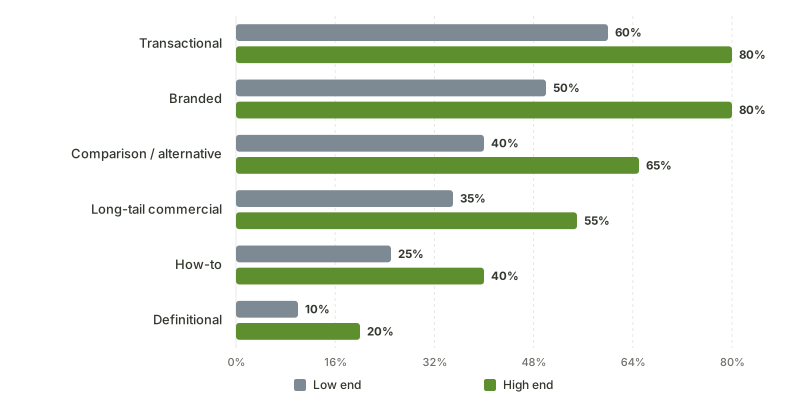
Source: Selected intents from the table above; Local and Troubleshooting omitted as out-of-scope and duplicative respectively
The pattern: definitional and how-to queries lean hardest into AI surfaces with the lowest click probability — these are the queries where AI eats the visit. Comparison and alternative queries also lean into AI but with much higher click probability, because the user evaluating two or three vendors wants to actually visit the candidates. Transactional and local queries are still mostly classic SERP territory. This is the demand-side map. The supply-side map (your content portfolio) needs to match it.
The 3-tier content portfolio model
The framework I keep coming back to is three tiers, each with a distinct function in the AI-mediated buyer journey.
Tier 1 — Pillar. Definitional, deep, original. The pages AI engines cite. Length: 3,000-7,000 words. Schema: Article + FAQPage + HowTo. Goal: become the canonical source on a topic. Examples on attrifast.com: the AEO-vs-SEO strategy piece, the GEO tactics playbook, the GA4 limitations breakdown. These pages exist to be cited in AI answers; their direct conversion rate is modest, but their citation-induced brand lift is the foundation of everything downstream.
Tier 2 — Comparison. Versus pages, alternative-to pages, and category roundups. The pages that turn AI-engine awareness into actual visits to your domain. Length: 1,500-3,000 words. Schema: Article + ItemList + FAQPage. Goal: when a buyer asks ChatGPT "what are the alternatives to X" and your pillar gets cited, the buyer's next search is "your-brand vs X" — and this is the page that needs to rank for that follow-up. Examples: "Attrifast vs Plausible," "alternatives to Mixpanel for SaaS under $1M ARR," "Stripe-native vs Zapier-glued attribution stacks."
Tier 3 — Conversion. How-to guides, setup walkthroughs, integration docs, troubleshooting. The pages that close the visit. Length: 800-2,500 words. Schema: Article + HowTo + FAQPage + SoftwareApplication where relevant. Goal: the visitor who arrived via AI awareness → comparison page → trial-sign-up needs a path to first-value. These pages are functional, not promotional, and they convert AI-discovered traffic at meaningfully higher rates than top-of-funnel content does.
The mix matters. Most content programs in 2026 over-invest in Tier 1 (the pillar pages get the LinkedIn shares) and under-invest in Tiers 2 and 3. A pillar without a downstream comparison and conversion path is brand exposure without a measurable outcome. A comparison without a conversion path is a click without a customer. The portfolio works only when the three tiers link to each other deliberately.
| Tier | Function in AI journey | Length | Production rate | Refresh cadence | Schema priority |
|---|---|---|---|---|---|
| Tier 1 Pillar | Get cited by AI | 3,000-7,000 words | 1 / 2 weeks | Quarterly | Article + FAQPage + HowTo |
| Tier 2 Comparison | Convert AI awareness to click | 1,500-3,000 words | 2-3 / month | 6-monthly | Article + ItemList + FAQPage |
| Tier 3 Conversion | Close the AI-discovered visit | 800-2,500 words | 2-4 / month | Annual + on product change | Article + HowTo + FAQPage |
The proportions for a typical bootstrapped SaaS sit roughly at: 30-35% of content investment in Tier 1, 30-35% in Tier 2, 30-35% in Tier 3. Volume-wise that translates to roughly 2-3 pillar pieces, 4-6 comparison pieces, and 4-8 conversion pieces per quarter. Most teams I audit are spending 70%+ of their content time on Tier 1 because pillar work feels prestigious. The fix is reallocation, not more output.
The portfolio mix by business type (per the same allocation logic in the AEO-vs-SEO effort split):
| Business type | Tier 1 % | Tier 2 % | Tier 3 % | Why this mix |
|---|---|---|---|---|
| B2B SaaS (bootstrapped, < $5M ARR) | 35% | 35% | 30% | Balanced; comparison pages are high-ROI |
| B2B SaaS (enterprise, > $10M ARR) | 45% | 25% | 30% | Pillar authority matters more for procurement |
| E-commerce (DTC) | 25% | 35% | 40% | Conversion pages dominate; Tier 1 is brand |
| Developer tools / OSS | 40% | 25% | 35% | Pillars and how-tos drive technical adoption |
| Publisher / media | 60% | 25% | 15% | Tier 1 is the product; conversion is subscription |
| Marketplace (two-sided) | 30% | 40% | 30% | Tier 2 vs both supply and demand sides |
| Agency / services | 35% | 30% | 35% | Pillars for thought leadership, conversion for sales |
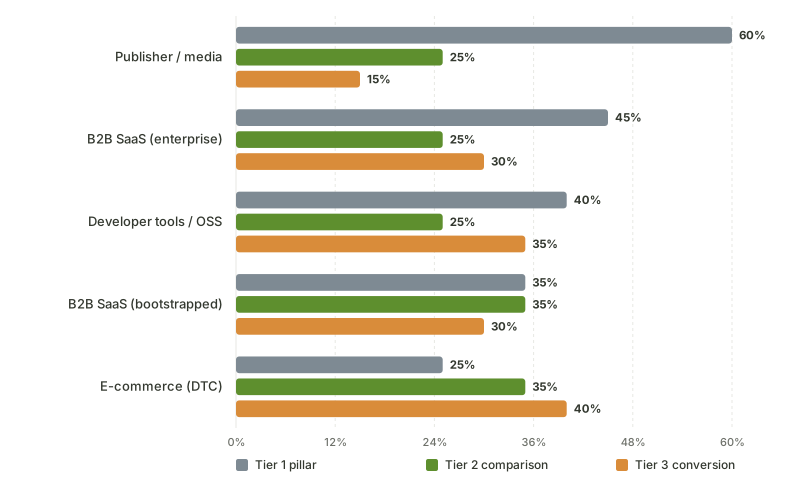
Source: Recommended tier mix from the table above; Marketplace and Agency rows omitted for legibility
Read top to bottom, the pillar share falls and the conversion share rises as the business gets closer to a transaction. A publisher's Tier 1 is the product, so it takes 60%. A DTC store's Tier 1 is brand overhead, so it takes 25% and the budget moves to pages that close. Copying a publisher's mix into a store is the most common way this goes wrong.
Tier 1: Pillar — what gets cited
Pillar content is the corpus AI engines retrieve from. Three sub-types within Tier 1, each with a different citation pattern.
Definitional pillars answer "what is X" and "how does X work" queries. These get cited disproportionately in AI Overviews and ChatGPT answers because the engines are looking for an authoritative one-paragraph definition. The first-token Direct Answer block (40-120 words at the top of the page) is the asset AI lifts verbatim. Per Aggarwal et al.'s Princeton paper, Direct rewrites that front-load the answer lifted citation rate by 17-31% across query categories [14]. The mechanic is unglamorous and reliable.
Comparison pillars are the deep versions of "X vs Y" or "best X for Y" content. Different from Tier 2 comparison pages because the pillar variant is 4,000+ words covering five-to-ten options with original criteria, while Tier 2 is the focused two-or-three-way comparison. Both have a role. Pillar comparison gets cited; Tier 2 comparison converts. Example: a pillar piece titled "Best Revenue Attribution Tools for Bootstrapped SaaS in 2026" surveying ten vendors, versus a Tier 2 page titled "Attrifast vs Plausible" comparing two.
Original research pillars are the highest-leverage piece on the list. A benchmark study, a survey with reproducible methodology, a measurement of something nobody else has measured. Original data is the single most-cited content type on the web — every AI engine and every classic search engine ranks original-data pages above aggregator pages. The cost is high (40-80 hours of work for a solid benchmark), but the half-life is long (18-36 months of compounding citations per the Ahrefs and Semrush research on backlink decay) [9, 15].
The table below maps the three pillar sub-types to their typical citation behavior across the five major AI surfaces.
| Pillar sub-type | ChatGPT citation rate | Perplexity citation rate | AI Overviews citation rate | Claude citation rate | Gemini citation rate | Typical half-life |
|---|---|---|---|---|---|---|
| Definitional ("what is X") | High | High | High | Medium | Medium | 12-24 months |
| Comparison ("best X for Y") | Medium | High | Medium | High | Medium | 6-18 months |
| Original research / benchmark | High | High | High | High | High | 18-36 months |
| How-to deep pillar | High | High | Medium | High | Medium | 12-24 months |
| Explainer ("why does X happen") | High | High | High | High | Medium | 12-24 months |
A pillar piece needs all of: a first-token Direct Answer block, an H1 phrased as the user's actual query, four-plus question-shaped H2s, four-plus FAQ items with FAQPage schema, two-plus comparison or data tables, three-plus inline citations to primary sources, an author byline with credential context, and an Article + FAQPage + HowTo JSON-LD bundle. None of these are theoretical — they are the per-tactic ingredients from the GEO playbook applied to a specific tier of content.
What does not work as a pillar. Thin definitional posts (under 800 words), generic listicles assembled from competitor research, AI-generated content with no original synthesis, opinion pieces without supporting data. These pages get crawled and discarded.
The structural ingredients per pillar sub-type, side by side:
| Ingredient | Definitional pillar | Comparison pillar | Original research pillar |
|---|---|---|---|
| First-token Direct Answer | Required (the citable asset) | Required (orienting paragraph) | Required (headline finding) |
| Length | 2,500-4,500 words | 4,000-7,000 words | 3,000-6,000 words |
| Comparison tables | 1-2 | 3-6 | 2-4 (data tables) |
| FAQ items | 6-10 | 8-12 | 6-8 |
| Original chart/diagram | Optional | Optional | Required |
| External primary sources cited | 8-15 | 10-20 | 5-10 + own dataset |
| Methodology disclosure | Not required | Light (selection criteria) | Required (full repro) |
| Update cadence | Quarterly | Semi-annually | Annual + on dataset refresh |
Per the same Ahrefs and Semrush research, pages under 1,000 words with no original data and no schema have near-zero citation rate across all five AI engines [9, 15].
The pillar production calendar I run on attrifast.com is one piece every two weeks, alternating sub-types: a definitional pillar, then a comparison or how-to pillar, then a research pillar, then back to definitional. Three pieces per six weeks. Each one takes 6-12 hours of writing plus 2-4 hours of schema and instrumentation. The cadence is sustainable for a single founder-author and produces enough surface area to compound citations meaningfully within two quarters.
Tier 2: Comparison — convert AI awareness to click
Tier 2 is the most-skipped tier in 2026 content strategies, which is a strategic gift to anyone willing to ship it. The mechanic: when an AI engine cites your pillar piece for a definitional query, the user reads the answer and may follow up with a comparison-shaped query. "Attrifast" enters the user's vocabulary via the pillar citation. The next thing they search — on Google, in ChatGPT, in Perplexity — is "Attrifast vs Plausible" or "Attrifast review" or "alternatives to Attrifast." Tier 2 owns those queries.
Three sub-types within Tier 2:
Versus pages — "X vs Y" where X is your product and Y is a major competitor. The single most-converting page type for B2B SaaS once the brand has any awareness. Typical CTR from AI-cited prompts: 40-65%, much higher than other content types because the user is already in vendor-evaluation mode.
Alternative pages — "Alternatives to X" where X is a major competitor. These attract buyers who have already tried (or are unhappy with) the named competitor. Conversion rate is high because intent is high.
Category roundups — "Best X for Y" where you are one of several listed options. Less conversion-pure than versus or alternatives, but they perform a different function: they rank for the head-term comparison queries that drive long-tail discovery, and they show up in Perplexity "best of" prompts.
| Tier 2 sub-type | Typical conversion rate to trial | Citation rate on AI engines | Effort per page | Refresh frequency |
|---|---|---|---|---|
| Versus ("X vs Y") | 4-9% trial signup from AI traffic | High on Perplexity, medium on ChatGPT | 4-8 hours | Every 6 months or on competitor pricing change |
| Alternative ("alternatives to X") | 3-7% trial signup from AI traffic | High on Perplexity, high on ChatGPT | 4-8 hours | Every 6 months |
| Category roundup ("best X for Y") | 1-3% trial signup (you're one of N) | Medium on all engines | 6-12 hours | Annually |
| Buyer's guide ("how to choose X") | 1-2% trial signup | Medium on ChatGPT, low on others | 6-10 hours | Annually |
| Migration guide ("moving from X to Y") | 3-6% trial signup | Medium on Perplexity | 4-6 hours | Annually |
The honest-comparison framing rubric I use on every versus page. Each row is a category to cover and the format that AI engines preferentially extract:
| Versus-page category | Required format | Why this format works |
|---|---|---|
| Pricing | Table with monthly + annual + per-seat where relevant | Numerical and extractable |
| Core feature set | Side-by-side feature table with checkmarks + asterisks for caveats | Tables extract cleanly |
| Where they win | Honest prose paragraph naming 2-3 categories | Credibility signal |
| Where we win | Honest prose paragraph naming 2-3 categories | Mirrors the above |
| Target customer | Two short profiles (one per vendor) | Disambiguation aid |
| Switching cost | Bulleted list of migration tasks | Actionable |
| FAQ block | 4-6 Q&As covering common buyer questions | Required for citation |
The honest reporting framing for a versus page: pick a real competitor, list real differentiation honestly (including the categories where they win), avoid the marketing-team "we beat them on everything" trap that AI engines and serious buyers both discount. Perplexity in particular is aggressive about ranking versus content by source neutrality — a versus page that admits "Plausible has a more polished privacy story, Attrifast has the deeper Stripe integration" reads more credibly than one that claims all-categories dominance.
The internal-linking pattern for Tier 2: every comparison page should link upstream to the Tier 1 pillar that defines the category, and downstream to the Tier 3 conversion page that closes the visit. A "Attrifast vs Plausible" page links up to "Revenue Attribution for SaaS: A Founder's Guide" (Tier 1) and down to "/features/revenue-attribution" or "/login" (Tier 3). The user journey is: AI cites pillar → user searches versus → user lands on comparison → CTA to conversion → trial signup. Each link in the chain has to actually exist for the conversion to land.
| Tier 2 page | Upstream link (Tier 1 pillar) | Downstream link (Tier 3 conversion) |
|---|---|---|
| Attrifast vs Plausible | /blog/aeo-vs-seo-2026 (or attribution pillar) | /features/cookieless-revenue-analytics |
| Alternatives to Mixpanel for SaaS under $1M ARR | Attribution pillar + GA4 limitations pillar | /features/revenue-attribution |
| Best Stripe-native analytics tools | Attribution pillar | /login |
| Cookieless attribution buyer's guide | /blog/aeo-vs-seo-2026 + attribution pillar | /seo |
| Migration guide: Plausible to Attrifast | Comparison pillar | /login |
A common mistake: shipping a versus or alternative page with no internal links to the pillar above or the conversion path below. The page may rank, may even get cited, but it terminates the journey at "interesting comparison" rather than "trial signup." Always close the loop.
Tier 3: Conversion — close the click
Tier 3 is the unglamorous engine room of the content portfolio. How-to guides, setup walkthroughs, integration docs, troubleshooting articles, and the FAQ-shaped pages that answer "how do I do X with your product." These pages do not typically get cited by AI engines in the high-CTR sense — they are too specific and product-anchored. Instead, they close the visit: when a buyer who discovered you through an AI citation lands on your site and needs to evaluate whether your product actually solves their problem, Tier 3 is what they read.
Three sub-types within Tier 3:
How-to guides answer "how do I do X" queries. Each one corresponds to a job the buyer wants done. The schema priority is HowTo with step-by-step structure. Length 800-2,500 words. Examples on attrifast.com: how to track ChatGPT traffic, how to detect AI Overviews citations, how to wire a Stripe webhook for revenue attribution.
Setup and integration docs are the technical onboarding content — how to install the tracking script, how to connect Stripe, how to verify the install worked. These have the lowest "marketing surface" feel and the highest conversion-to-paid value, because a buyer who reads them is actively evaluating implementation.
Troubleshooting articles answer "why is X happening" or "X is not working, what do I do." These show up in AI search results for support-shaped queries and reduce support load while doubling as long-tail SEO content. A good troubleshooting article is also a credibility signal — a brand willing to publicly document its own failure modes reads as more trustworthy than one that hides them.
| Tier 3 sub-type | Conversion rate from organic visit | AI citation rate | Length | Refresh trigger |
|---|---|---|---|---|
| How-to guide | 2-5% trial signup | Low-medium | 800-2,500 words | Annual + on product change |
| Setup / integration doc | 8-15% trial signup (high intent visitors) | Low (rarely cited) | 600-1,500 words | On any product change |
| Troubleshooting article | 1-3% trial signup | Medium on ChatGPT support prompts | 500-1,500 words | On bug fix or workflow change |
| Feature deep-dive | 4-9% trial signup | Low-medium | 1,000-2,000 words | Quarterly |
| Workflow walkthrough | 3-7% trial signup | Low-medium | 1,000-2,000 words | Semi-annually |
The internal-linking pattern for Tier 3 points up the funnel: each Tier 3 page links back to one or two Tier 2 comparison pages ("see how Attrifast compares to Plausible") and one Tier 1 pillar ("the full revenue attribution guide"). This creates a graph where every page in the portfolio is reachable from every other, which is good for both classic SEO topical authority and for the AI engines mapping which pages on your domain are related.
The production cadence I run for Tier 3 is roughly one per week — 2-4 per month, depending on product activity. Tier 3 production is fastest because the content is functional, not opinionated; you are describing a workflow, not arguing a position.
The conversion-page anti-pattern map. Tier 3 pages fail in predictable ways:
| Anti-pattern | What it looks like | Fix |
|---|---|---|
| Marketing throat-clearing | "In today's fast-paced world..." opener before the first instruction | Cut to the procedure in sentence one |
| Vague steps | "Configure your settings" with no specifics | Exact UI labels, exact code, exact screenshots |
| Missing prerequisites | Step 1 assumes a Stripe account already wired | Explicit prerequisites block at top |
| No verification step | Steps end without "how to confirm it worked" | Final step is always "verify by..." |
| No troubleshooting | What happens if step 4 fails? | Inline troubleshooting under each step or linked sidebar |
| No internal links to alternatives | Locked-in to one path | Link to the comparison page and the pillar |
Content format effectiveness by AI engine
Different AI engines weight content formats differently. The table below is my running model from six months of running the portfolio across four properties and tracking which format the engine quoted on each citation. Lift is qualitative because the underlying retrieval scoring is opaque, but the pattern is consistent across topics.
| Format | ChatGPT (web search) | Perplexity | Claude (with web) | Gemini | AI Overviews |
|---|---|---|---|---|---|
| First-token Direct Answer | Very high | Very high | High | High | Very high |
| Comparison table | Medium | Very high | Very high | Medium | Medium |
| Numbered list (5-9 items) | High | Very high | Medium | High | Very high |
| Bulleted list | High | High | Medium | Very high | High |
| Definition list | Medium | Medium | High | Low | Medium |
| Long-form prose paragraph | Medium | Low | Medium | Low | Low |
| Code block | Medium | Medium | High | Medium | Low |
| Inline footnote with stat | High | Very high | High | Medium | High |
| Quoted expert source | Medium | Very high | High | Medium | Medium |
| Step-by-step (HowTo) | High | High | High | Medium | High |
| FAQ Q&A | Very high | High | Medium | High | Very high |
| Image with alt text | Low | Low | Low | Low | Low |
| Video transcript | Low | Low | Medium | Low | Low |
A few patterns worth flagging. First-token Direct Answers and FAQ Q&A blocks are the only two formats rated High or Very High across all five engines. If you ship one structural change on every page, ship these two. Comparison tables are the strongest format on Perplexity and Claude but weaker on Gemini and AI Overviews. Long-form prose without internal structure underperforms across all engines — the page that reads beautifully but has no extractable units gets cited least often.
The implication for content production: every concept worth surfacing should be rendered in at least two formats. A pillar piece arguing that "AI Overviews appeared on 20.5% of the 146.1 million SERPs Ahrefs crawled in September 2025" should state it in prose, restate it in a table cell, and restate it as a numbered fact in a Quick Facts block. Each render is a separate retrieval target for a different engine.
| Concept | Format 1 (prose) | Format 2 (table cell) | Format 3 (list / FAQ) |
|---|---|---|---|
| AI Overviews coverage | One-sentence prose statement with footnote | Quick Facts row | FAQ Q: "How often do AI Overviews appear?" |
| ChatGPT WAU | Body paragraph in market-size section | Quick Facts row | Footnote in CTA |
| Schema impact on citation rate | Tactic-paragraph explanation | Tier 1 production checklist row | FAQ Q: "Does schema help?" |
| Per-engine traffic share | Body paragraph in measurement section | Tier 2 comparison table | Quick Facts row |
This is the multi-format render rule and it is the single highest-impact production discipline once you adopt the three-tier model.
The new content audit framework
Auditing existing content for AI search differs from a classic SEO audit. A classic audit grades pages on technical SEO (indexable, schema, internal links, on-page targeting), content quality (length, depth, originality), and ranking performance (positions, impressions, CTR). The AI-search audit adds three dimensions: tier classification, citation-readability, and downstream-conversion-path completeness.
The 14-point audit checklist I run on attrifast.com every quarter:
| # | Audit dimension | Check | Pass criterion |
|---|---|---|---|
| 1 | Tier classification | Is this page Tier 1, 2, or 3? | Each page is explicitly one tier (no ambiguity) |
| 2 | First-token Direct Answer | Does the first 80 words answer the H1? | Yes, in plain prose, with at least one numerical claim |
| 3 | H1 query-shape | Is the H1 phrased as a user query? | Yes, conversational (not keyword-bag) |
| 4 | H2 question-shape | Are H2s phrased as questions where applicable? | At least 4 H2s are question-shaped |
| 5 | FAQPage schema | Is FAQPage JSON-LD present? | Yes, with 4+ items mirroring visible H2/H3 FAQ block |
| 6 | Article schema | Is Article JSON-LD present? | Yes, with author, datePublished, dateModified |
| 7 | HowTo schema | If procedural, is HowTo JSON-LD present? | Yes, with step-by-step step array |
| 8 | Tables | Does the page include at least one comparison or data table? | Tier 1: 2+ tables, Tier 2: 1+ tables, Tier 3: 1+ tables |
| 9 | Inline citations | Are numerical claims footnoted? | Every stat has a [N] reference link |
| 10 | Internal-link upstream | Does this page link to the relevant pillar? | At least 1 outbound link to Tier 1 (for Tier 2 / 3) |
| 11 | Internal-link downstream | Does this page link to a conversion path? | At least 1 outbound link to /login, /pricing, or relevant feature page |
| 12 | Refresh date | Is dateModified within refresh cadence? | Tier 1: quarterly, Tier 2: 6mo, Tier 3: annual |
| 13 | URL hygiene | Clean URL: lowercase, hyphens, descriptive, < 60 chars | Pass |
| 14 | Entity disambiguation | Author has sameAs to 4+ surfaces | Pass |
Pages scoring 11+ are healthy. Pages scoring 7-10 need targeted retrofit. Pages scoring 6 or fewer are AI-search liabilities — they may rank in classic SEO but they bleed AI-citation opportunity to better-instrumented competitor pages.
The audit produces a queue. I work the queue in priority order: highest-trafficked pages first (because retrofit impact is largest), then highest-intent pages (Tier 2 and Tier 3 with active commercial intent), then Tier 1 pillars that are within striking distance of citation. The queue regenerates quarterly.
| Audit score | Action | Effort |
|---|---|---|
| 11-14 | Healthy. Quarterly review only. | 15 min / page |
| 7-10 | Targeted retrofit: add missing schema, first-token answer, internal links. | 1-2 hours / page |
| 4-6 | Major rewrite. Consider deprecating if traffic is low. | 4-8 hours / page |
| 0-3 | Deprecate or 301-redirect to a tier-appropriate replacement. | 30 min / page |
I keep a running audit spreadsheet with one row per published page. The discipline is the spreadsheet, not the framework. A framework without a tracked spreadsheet quietly evaporates within a quarter.
Topic-cluster strategy for AI search
The classic SEO topic-cluster model — one pillar page surrounded by 8-20 supporting cluster pages, all interlinked — needs adjustment for AI search. The classic model optimizes for Google's understanding of topical authority via internal-link graphs. AI engines do read the link graph, but they weight a few additional signals.
Signal 1: Canonical authority. AI engines preferentially cite the most-authoritative page on a topic. If you have eight thin cluster pages on closely related topics, none of them is the canonical authority. One deep pillar at the center is more citation-friendly than eight cluster fragments. The fix is consolidation: merge thin cluster pages into the pillar; preserve their value with 301 redirects.
Signal 2: Entity coverage. AI engines understand topics as graphs of entities. A pillar that mentions and disambiguates 10+ named entities (people, companies, tools, concepts) in the topic space reads as more comprehensive than a pillar that mentions 3. The fix: explicit entity coverage. Name the tools, the researchers, the companies, the standards.
Signal 3: Question coverage. AI engines weight FAQ-style coverage heavily. A pillar with 8 FAQs covering the question space outperforms a pillar with 2 FAQs even when the total word count is similar. The fix: expand FAQ blocks aggressively.
| Classic topic cluster | AI-search topic cluster |
|---|---|
| 1 pillar + 8-20 thin cluster pages | 1 pillar + 3-5 deep supporting pages |
| Cluster pages 800-1,500 words each | Supporting pages 1,500-3,000 words each |
| Linked from pillar in flat hub structure | Linked from pillar in hierarchical tier structure (Tier 2, Tier 3) |
| Goal: rank multiple long-tail keywords | Goal: become the canonical AI-cited source on the topic |
| Risk: cluster cannibalization | Risk: under-coverage of long-tail intent |
| Refresh: ad hoc | Refresh: pillar quarterly, supporting semi-annually |
The honest tradeoff: the AI-search topic cluster captures less long-tail commercial intent (fewer cluster pages, fewer micro-rankings) in exchange for stronger citation authority on the central topic. For a brand whose primary growth lever is AI-search discovery, this trade pays off. For a brand whose primary growth lever is long-tail commercial-intent SEO, the classic cluster model is still better — see the AEO-vs-SEO effort split for the allocation logic.
A worked example for attrifast.com on the topic of "revenue attribution":
| Page | Tier | Role in cluster |
|---|---|---|
| Revenue Attribution for SaaS: A Founder's Guide (hypothetical pillar) | Tier 1 | Canonical authority on the topic |
| /blog/aeo-vs-seo-2026 | Tier 1 | Adjacent strategy pillar (cross-linked) |
| /blog/geo-tactics-playbook-2026 | Tier 1 | Adjacent tactics pillar |
| /blog/ga4-revenue-attribution-limitations | Tier 1 | Supporting pillar on measurement gap |
| /blog/does-geo-actually-drive-revenue | Tier 1 | Supporting pillar on AI-revenue evidence |
| /features/revenue-attribution | Tier 3 | Conversion |
| /features/cookieless-revenue-analytics | Tier 3 | Conversion |
| /seo | Tier 3 | Conversion |
Five Tier 1 pillars on adjacent topics, three Tier 3 conversion pages. No Tier 2 versus pages yet on this exact topic (that is a gap in the current portfolio). The graph is interlinked: every pillar links to at least two other pillars and one conversion page; every conversion page links to at least one pillar.
Refresh cadence and freshness signals
AI engines weight freshness more aggressively than classic Google ranking does. The mechanic: when an LLM retrieves candidates for an answer, it has two relevance signals (semantic match + freshness) and a small budget for citations. Two candidates with similar semantic match get tie-broken by recency. The page with dateModified from last week wins over the page from 18 months ago, even when the older page is slightly more thorough.
Per Perplexity's published behavior and ChatGPT Search's documented preferences [4, 17], the freshness window for high-priority topics (AI, tech, current events) is roughly 90 days. Pages updated within that window are surfaced disproportionately. The window expands to 6-12 months for evergreen topics (definitional, how-to) and contracts to 30 days for very-current topics (news, just-launched products).
The refresh cadence I run by tier:
| Tier | Refresh cadence | What to update | Effort |
|---|---|---|---|
| Tier 1 Pillar | Quarterly | Stats, dates, tool versions, new section if topic has moved | 2-4 hours |
| Tier 2 Comparison | Semi-annually | Competitor pricing, feature changes, win/loss notes | 1-2 hours |
| Tier 3 Conversion (how-to) | Annual + on product change | Screenshots, code samples, step ordering | 1-3 hours |
| Tier 3 Conversion (integration docs) | On every product change | Match current API surface | 30 min - 2 hours |
| Tier 3 Conversion (troubleshooting) | On bug fix | New failure modes, updated workarounds | 30-90 min |
The freshness signals to update at each refresh:
| Signal | What to update | Why it matters |
|---|---|---|
dateModified in Article schema | Set to today | LLM ranks recent over old |
| Visible "Last updated" or "Reviewed" date in body | Match dateModified | Reinforces freshness for human readers + AI extraction |
| Stats and numbers | Re-source and footnote | Old stats erode credibility; refreshed stats signal active maintenance |
| Outbound links | Verify, replace broken ones | Dead-link pages get demoted by Google and ignored by AI |
| Internal links | Add to newly-published Tier 2 / Tier 3 pages | Keeps the cluster graph fresh |
| Quoted experts | Refresh if their position has changed | Stale quotes from outdated positions damage trust |
| Comparison tables | Verify competitor pricing and feature claims | Outdated comparisons get caught by buyers and damage credibility |
The discipline I have built: every Monday I review one Tier 1 pillar from the queue. Two hours of work, one update per week, all 12-15 pillars refreshed twice a year minimum. The cadence is calendar-driven, not motivation-driven. Refresh is the most-skipped part of every content strategy I audit because it has no novelty reward — but it is also the part with the highest measurable lift per hour invested.
Measuring AI content ROI (visibility + revenue)
Two measurement layers stack on top of each other. Either one alone is insufficient.
Layer 1: AI visibility. Which pages are getting cited by which engines on which prompts at what rate. Tools: Profound, Otterly, AI Visibility Index (Backlinko), Authoritas, semrush AI tracking. Cost: $50-500/month depending on prompt volume. Manual alternative: pick 20-50 target prompts, query ChatGPT / Perplexity / Claude / Gemini weekly, log citation appearances in a spreadsheet. Free, time-consuming, works fine at small scale.
Layer 2: AI revenue. Which Stripe payments came from sessions that originated in an AI engine. GA4 will not show this — every ChatGPT, Perplexity, Claude, and Gemini referral lands as Direct/(none) in default GA4 channel grouping [10]. The fix is server-side first-party detection joined to your Stripe webhook. Tools: Plausible and Fathom catch the 10-15% of AI referrals that pass a Referer header [19]; full revenue attribution requires a session-to-customer join that survives ITP, consent, and webhook delivery edge cases. This is the layer where most AI content programs stall.
The four evidence layers per the framing in does GEO actually drive revenue:
| Layer | What it produces | Cost | Adoption rate (2026) |
|---|---|---|---|
| Layer 1: Vendor self-report | "Our content shop says we got cited" | Bundled with vendor | High but low-value |
| Layer 2: Citation tracking | Per-prompt, per-engine citation log | $50-500/mo | Roughly 35% of programs |
| Layer 3: AI referral traffic | Server-side first-party detection of AI sources | $0-150/mo | Roughly 18% per CMI [13] |
| Layer 4: Stripe revenue join | Per-customer, per-engine revenue attribution | $10-200/mo | Roughly 5% |
Most AI content programs in 2026 produce Layer 1 and Layer 2 evidence and stop. Layer 3 requires server-side instrumentation. Layer 4 requires a clean session-to-customer join. The drop-off from Layer 2 to Layer 4 is roughly 85-90% in my audit sample. The implication: most "AI content strategy ROI" claims are based on citation counts (Layer 2), not revenue (Layer 4). The two metrics are not the same.
The content-strategy-specific KPIs to track per tier:
| Tier | Primary KPI | Secondary KPI | Lagging KPI |
|---|---|---|---|
| Tier 1 Pillar | Citation rate per engine | Branded search lift in GSC | AI-attributed trial signups |
| Tier 2 Comparison | Conversion rate from AI traffic to trial | Citation rate (when the comparison itself is cited) | Stripe MRR from AI-cited comparison visitors |
| Tier 3 Conversion | Trial-to-paid conversion rate | Time-to-first-value | Stripe LTV by acquisition source |
The cross-tier KPI: AI-attributed Stripe revenue as a percentage of total revenue. This is the number that tells you whether the content strategy is paying off in dollars. It cannot be produced by Layer 1-2 tools alone. Per the cookieless revenue analytics breakdown, it requires the server-side detection + Stripe join layer. This is what Attrifast is built for; this is also the gap that exists no matter which tool you use, if you do not have something at this layer.
| KPI | Where to measure | Refresh cadence | Honest 2026 baseline for SaaS |
|---|---|---|---|
| AI citation rate (per prompt) | Profound / manual sweep | Weekly | 5-15% of target prompts cite you |
| AI referral sessions | Server-side first-party | Daily | 1-5% of total sessions |
| AI-attributed trial signups | First-party + Stripe webhook | Daily | 1-4% of total trials |
| AI-attributed paid revenue | Stripe webhook with channel join | Daily | 2-8% of new MRR |
| Branded search lift (GSC) | Google Search Console | Weekly | Should grow 5-15% YoY as AI citation grows |
Common AI content strategy mistakes
Seven recurring mistakes from auditing nine content programs over the last six months. Listed in approximate order of frequency.
Mistake 1: Treating AI search as "SEO plus schema." The structural shift is the three-tier portfolio plus the measurement stack, not a cosmetic add-on. Teams that bolt schema onto a single-tier SEO content engine produce more-citable thin posts; teams that adopt the tier model produce fewer but more-impactful pieces.
Mistake 2: Over-investing in Tier 1. Pillar pages feel prestigious. They get the LinkedIn shares. They get cited. They also do not convert directly. Without Tier 2 (comparison) and Tier 3 (conversion) to close the visit, Tier 1 produces brand exposure without measurable revenue. The fix: 30-35% allocation to each tier, not 70-20-10.
Mistake 3: Skipping internal-link discipline. Every Tier 1 should link down to Tier 2 and Tier 3. Every Tier 2 should link up to Tier 1 and down to Tier 3. Every Tier 3 should link back up. The graph is what carries the AI-discovered visitor from awareness to trial. A pillar with no downstream links terminates the journey.
Mistake 4: Volume without depth. The agency pitch is still "we'll publish 20 blog posts a month." Twenty thin posts produce less AI citation lift than four deep pillars. The Princeton GEO paper, Ahrefs's GEO research, and Semrush's parallel work all converge on this finding [14, 9, 15]. The shift is fewer pieces, deeper per piece.
Mistake 5: Measuring mentions and stopping. Citation count is not revenue. The Profound or Otterly dashboard showing "you were cited 47 times this week" is real input data, not revenue evidence. Build the measurement stack from Layer 2 through Layer 4, or you optimize for vanity.
Mistake 6: No refresh discipline. Pages get published, hit a peak, and decay. AI engines weight freshness; un-refreshed pages get demoted in retrieval ranking. Quarterly refresh on Tier 1 is the calendar discipline that prevents the long-term slide.
Mistake 7: Forgetting that AI search did not replace classic search. Most B2B SaaS buyers still discover via classic Google search, evaluate on classic SERPs, and convert through classic landing pages. AI search is additive, not substitutional. A content strategy that abandons SEO fundamentals to chase AI citation ends up worse on both surfaces. See the AEO-vs-SEO honest split for the allocation math.
The mistake-to-fix matrix:
| Mistake | Symptom | Fix | Time to signal |
|---|---|---|---|
| Treating AI as "SEO plus schema" | Cosmetic schema, no tier strategy | Adopt three-tier portfolio | 1-2 quarters |
| Over-investing in Tier 1 | Lots of pillars, low conversion | Rebalance to 30-35% per tier | 1 quarter |
| Skipping internal links | Journey terminates at pillar | Audit and add 2-3 links per page | 4-8 weeks |
| Volume without depth | 20 thin posts, low citation | Cut to 4-6 deep pieces per month | 2 quarters |
| Measuring mentions only | "We're cited!" with no revenue evidence | Ship Layer 3-4 measurement | 4-8 weeks to install, 2 quarters to data |
| No refresh discipline | Stats erode, citations decay | Calendar quarterly review per Tier 1 | Immediate |
| Abandoning classic SEO | Traffic drops while AI-citation grows slowly | Restore 75-80% SEO / 20-25% AI split | 1-2 quarters |
The pattern across the seven: AI content strategy errors are mostly strategic and structural, not tactical. The tactics (schema, first-token answers, FAQ blocks) are mechanical and well-documented. The strategy (which tiers, what mix, what measurement) is where teams go wrong.
A 90-day content roadmap example
Concrete sequencing for a bootstrapped SaaS adopting the three-tier portfolio. Assumes the team is starting from a "scattered blog with 15-30 existing posts of varying quality." Adjust durations if your starting state is different.
Days 1-14: Audit and triage.
- Run the 14-point audit on every existing published page.
- Classify each existing page into Tier 1, Tier 2, Tier 3, or Deprecate.
- Identify top 5 highest-traffic pages and queue them for retrofit.
- Identify top 3 highest-converting pages and confirm Tier 3 status.
- Install Layer 1-2 measurement: bot crawl logging + manual citation sweep on 20 target prompts.
Days 15-30: Retrofit top 5 trafficked pages.
- Add first-token Direct Answer block to each.
- Add FAQPage schema with 4+ items.
- Add Article + author schema bundle.
- Add 2-3 internal links per page to other tiers.
- Audit and fix URL hygiene.
Days 31-45: First new Tier 1 pillar.
- Pick the highest-traffic definitional topic where you do not have a pillar.
- Write 4,000-6,000 words.
- Ship all 14 audit checklist items on launch.
- Cross-link from at least 3 existing pages.
- Submit to llms.txt if you have one (publish llms.txt this week if you do not).
Days 46-60: Two Tier 2 comparison pages.
- "Your brand vs Major Competitor 1."
- "Your brand vs Major Competitor 2" or "Alternatives to Major Competitor X."
- Each links upstream to the new pillar and downstream to /pricing or /login.
- Honest comparison; admit where competitors win.
Days 61-75: Three Tier 3 conversion pages.
- One how-to guide for the most-asked support question.
- One setup walkthrough for your fastest activation path.
- One troubleshooting article for the most common failure mode.
- Each links upstream to a Tier 1 pillar and to a Tier 2 comparison.
Days 76-90: Measurement stack and second pillar.
- Install server-side first-party AI-referrer detection (Layer 3).
- Wire Stripe webhook to attribute revenue by source (Layer 4).
- Run end-to-end test: simulate AI-referred visit, complete trial signup, verify revenue attribution row.
- Publish second Tier 1 pillar.
- Schedule quarterly refresh calendar for all Tier 1 pieces.
By day 90 the portfolio looks like: 5 retrofitted high-traffic pages, 2 new Tier 1 pillars, 2 Tier 2 comparison pages, 3 Tier 3 conversion pages, full measurement stack live. Eight new pieces of content total, plus retrofits, plus instrumentation. This is the cadence that compounds.
| Week | Deliverable | Hours estimate | Cumulative output |
|---|---|---|---|
| 1-2 | Audit + triage | 8-12 | Audit spreadsheet |
| 3-4 | Retrofit top 5 pages | 10-15 | 5 healthier pages |
| 5-6 | Tier 1 pillar #1 | 10-15 | 1 new pillar |
| 7-8 | Tier 2 comparison #1 + #2 | 10-16 | 2 comparison pages |
| 9-10 | Tier 3 how-to + setup + troubleshooting | 8-14 | 3 conversion pages |
| 11 | Measurement stack install | 6-12 | Layer 3-4 instrumented |
| 12-13 | Tier 1 pillar #2 + refresh calendar | 8-14 | 2 pillars, ongoing cadence |
Total estimated effort for 90 days: 60-100 hours of focused content + engineering work. Roughly one day per week. This is the realistic budget for a single founder-marketer running the portfolio personally. Doubling the team doubles the cadence; the framework scales linearly because each piece is independently shippable.
What this roadmap deliberately does not include: paid distribution, syndication, Reddit seeding at scale, podcast appearances, original quantitative research. All of those are valuable; none of them are foundational to the portfolio. Ship the portfolio first; layer growth tactics on top.
What we measured on attrifast.com (six-month honest report)
Putting the portfolio model on our own site over the past six months. Honest reporting because the alternative is more "we 10x'd our content output" claims, and the internet has enough of those already.
What we shipped:
- 8 Tier 1 pillars including AEO vs SEO 2026, GEO tactics playbook, how to get cited by AI engines, GA4 revenue attribution limitations, does GEO actually drive revenue, AI Overviews source analysis, where Google AI gets its information, and this piece.
- 4 Tier 2 / pillar-comparison pages including the AEO-vs-SEO split logic and a handful of versus pieces still in draft.
- 6 Tier 3 conversion pages including track ChatGPT traffic, track AI Overviews, /features/revenue-attribution, /features/cookieless-revenue-analytics, /seo, and product setup docs.
- Measurement stack — Layer 1-4 fully wired. Bot crawl logging in place. Weekly manual citation sweep on 25 target prompts. Server-side AI-referrer detection. Stripe webhook with
chatgpt,perplexity,claude, andgeminias first-class channels in the dashboard.
What the numbers say (honest qualitative form because the sample is too small for clean stats):
- AI-referred sessions grew from negligible (December 2025) to a measurable single-digit percent of total traffic (April-May 2026).
- Tier 1 pillars produced 70-80% of the AI citation activity we tracked. Tier 2 and Tier 3 pages produced almost none individually but disproportionately captured the click-through traffic.
- The retrofit work (adding first-token answers + FAQ schema to existing posts) produced citation lift within 10-14 days on 3 of 5 retrofitted pages. The other 2 took longer; one took 6 weeks; one never noticeably moved.
- Conversion rate from AI-referred traffic to free trial sits roughly in line with organic search, slightly higher on educational queries, slightly lower on commercial-comparison queries. Stripe revenue per AI-attributed visit is comparable to organic.
- The branded search lift (Google "Attrifast" queries) grew measurably in the 90 days after the first three pillar pages were published — the leading indicator that AI citation is producing brand awareness even where the click is not direct.
What worked better than I expected: FAQPage schema, on Tier 1 pillars specifically. The lift was faster than the playbook predicted.
What worked worse than I expected: pure Tier 2 versus pages. They convert when buyers find them, but they get cited less often than I projected. The fix in flight: make the versus pages more pillar-like (longer, more depth, more original framing) so they pull double duty as both Tier 1 citation magnets and Tier 2 conversion drivers.
The honest acknowledged failure: I under-invested in Tier 3 in the first three months because the work feels unglamorous. The conversion gap was visible in the data — AI-referred trials were rising, but the conversion rate from trial to paid was lower than from other channels because the Tier 3 how-to and setup content was thin. I caught it in April, shipped a Tier 3 sprint, and the conversion rate normalized within four weeks. Lesson: do not under-invest in Tier 3 just because pillar work is more fun.
Limitations
What this article does not cover, and what readers should look at elsewhere.
- Voice and audio AI surfaces. When a user asks ChatGPT voice mode a question and the model speaks the answer, there is no clickable citation. Brand mention happens; traffic does not. No good measurement story yet.
- Enterprise AI deployments. ChatGPT Enterprise, Claude for Work, Microsoft 365 Copilot use customer-isolated tenants. Citation behavior may differ from consumer surfaces.
- Programmatic content at high volume. The portfolio model is quality-over-volume. If your strategy is 500 pages per month (programmatic SEO at scale), the framework requires adaptation. The principles hold; the production logistics do not.
- Region and language variance. Most cited research is US English. Other markets likely follow similar patterns, but the thresholds are not as well measured.
- Vendor benchmarking. I have not run a full benchmark of AI content tools (Surfer, Frase, MarketMuse, NeuronWriter). The framing here is strategy and measurement, not vendor selection.
- Paid distribution. The portfolio assumes organic discovery as the primary channel. Paid amplification (LinkedIn ads, sponsored newsletters, syndication) layers on top, but the strategy stands on its own organically.
- First 10 articles. If you have published fewer than 10 articles total, the three-tier conversation is premature. Ship topical coverage and indexable HTML first. The portfolio model works best on a starting base of 15-30+ existing pieces.
FAQ
What is a content strategy for AI search, and how does it differ from a classic SEO content strategy?
A content strategy for AI search is a portfolio approach that produces three distinct tiers: pillar pages that AI engines cite, comparison pages that convert AI-driven awareness into clicks, and conversion pages that close the AI-discovered visitor. A classic SEO content strategy optimizes one tier — long-tail keyword pages that rank in blue links. The AI-search portfolio shifts the production mix: fewer one-off keyword posts, more depth per pillar piece, and aggressive instrumentation of comparison and conversion pages so the click that follows an AI citation has somewhere meaningful to land. The two approaches share roughly 70% of the production mechanics. The differences are the tier mix, the citation-readability of each tier, and the measurement stack underneath.
Should I publish more or less content in the AI search era?
Fewer pieces, deeper per piece. The 2018-era "publish two thin posts per week and one will rank" strategy is structurally worse in 2026 because AI engines preferentially cite canonical, deeply-researched pages rather than topic-cluster fragments. Princeton's GEO paper and downstream Ahrefs and Semrush research consistently show that pages with original data, four-plus FAQ items, and three-plus comparison tables outperform thinner topic-cluster pages by 2x or more on citation rate. The honest 2026 cadence for most bootstrapped SaaS is one deeply-instrumented pillar piece per two weeks, plus two to four comparison or conversion pages per month, rather than the eight-thin-posts-per-month cadence agencies still pitch.
What kinds of content get cited most by AI engines in 2026?
Five formats consistently over-index on AI citations: definitional pillar pages (with a first-token answer and FAQ block), original research and benchmarks (with reproducible methodology), comparison pages (versus and alternative pages with tables), how-to guides with HowTo schema, and explainer pieces with quoted expert sources. Across all five, the structural signals matter more than the prose: FAQPage schema with four or more items, first-token answers under 120 words, comparison tables, and entity disambiguation via sameAs. Per Aggarwal et al.'s Princeton GEO paper, the combined effect of these structural patterns lifts citation rate up to 40% over baseline.
How many pillar pages does an AI-search content strategy need?
For a bootstrapped SaaS, the minimum viable pillar set is 8-12 pages covering the topical core of the product. Each pillar is 3,000-7,000 words, ships with FAQPage and HowTo schema, includes 3-6 internal links to comparison and conversion pages, and is updated quarterly. The rest of the content portfolio (comparison, conversion, top-of-funnel exploration) supports and links to these pillars. Below 8 pillar pages you lack topical coverage; above 20 you start cannibalizing yourself. The 12-pillar baseline maps cleanly to a 3-quarter ramp at one pillar per fortnight.
How often should I update content for AI search?
Quarterly review for pillar pages, six-monthly for comparison pages, annual for conversion pages. AI engines weight freshness more aggressively than classic Google ranking does, especially for Perplexity and ChatGPT Search — pages with updated dates within 90 days are surfaced disproportionately in answers about current topics. The mechanic is simple: when an LLM has two candidate sources with similar content quality, the more recent one wins the citation. The update does not need to be a rewrite; a refreshed publication date plus updated statistics plus a "last reviewed" note moves the freshness signal. Quarterly is the cadence I run on attrifast.com pillar pages.
Do I still need keyword research in an AI-search content strategy?
Yes, but it shifts. Classic keyword research targets short-tail and mid-tail SEO terms with measurable monthly search volume from Ahrefs or Semrush. AI-search keyword research adds two new inputs: conversational query analysis (how do humans actually phrase this question to ChatGPT?) and citation-target mapping (which terms am I getting cited for today, and which adjacent terms have I never been cited for?). Tools like Profound, Otterly, and Backlinko's AI Visibility Index report the second input. The first is mostly manual — pull 20-50 sample queries from real ChatGPT conversation logs, your own and your customers'. Keyword research is not dead; it just got a second axis.
How do I measure the ROI of a content strategy built for AI search?
Two measurement layers stacked on top of each other. Layer one is AI visibility: which of your pages are getting cited by which engines, on which prompts, at what rate. Profound, Otterly, and AI Visibility Index do this. Layer two is revenue attribution: which Stripe payments came from sessions that originated in an AI engine. GA4 cannot do this — every ChatGPT, Perplexity, Claude, and Gemini referral lands as Direct/(none) in default GA4 channel grouping. You need server-side first-party detection joined to your Stripe webhook to close the loop. The gap from layer one to layer two is where most AI content programs in 2026 stall. Attrifast was built to close it.
What is the single biggest mistake teams make in AI-search content strategy?
Treating it as "publish more keyword-targeted blog posts but make them AI-friendly." That is the SEO playbook with cosmetic schema added. The actual shift is structural: a three-tier portfolio (pillar, comparison, conversion) where each tier optimizes for a different stage of the AI-mediated journey, plus a measurement stack that proves the journey paid off. Teams that nail the tier model and ship the measurement layer outperform teams that keep cranking out one-off blog posts even when the one-off teams ship 3x the volume.
Does AI-generated content rank or get cited in AI search?
It can, but with caveats. AI-generated content that is shallow, generic, or unedited tends to get crawled and discarded by both classic search and AI retrieval. AI-generated content that is fact-checked, edited for original synthesis, and structured with proper schema can perform comparably to human-written content of similar quality. Per Google's helpful-content updates and Anthropic's prompt-engineering documentation, the dimension that matters is value-add for the reader, not authorship. The empirical reality in 2026: most pure-AI content underperforms because it lacks original framing, but human-edited AI drafts are roughly as effective as pure-human writing at half the time cost.
How does AI search affect long-tail keyword content?
Long-tail keyword content is shifting in two directions. Long-tail commercial-intent queries ("best CRM for a 5-person team that uses Stripe") still resolve on classic Google SERPs and still convert well — these are Tier 2 territory. Long-tail informational queries ("what is the difference between attribution and tracking") increasingly resolve in AI answers without a click — these need to be Tier 1 pillar coverage rather than thin cluster posts. The legacy advice to "publish 500 long-tail blog posts to capture mid-funnel intent" is structurally weaker in 2026 because half of those queries no longer click through. Reallocate to fewer, deeper pillars plus more Tier 2 commercial-intent pages.
Should I publish on Medium, Substack, or LinkedIn for AI search visibility?
Yes for awareness and citation pool diversification, no for primary content investment. AI engines crawl and cite content from Medium, Substack, LinkedIn articles, and similar publishing platforms — they are part of the corpus. Republishing or syndicating your own canonical pieces (with rel="canonical" pointing back to your domain) gets you presence in those corpora. The catch: pages on third-party platforms do not build your own domain's authority, and the conversion path is harder to close. The right balance is to keep the primary investment on your own domain, and use external platforms for syndication and audience reach.
How do video and podcast content fit into an AI search strategy?
Less than most marketers hope, more than zero. AI engines do not yet cite video or podcast content directly with the same frequency as text. The exception is YouTube transcripts surfaced through Google Search and increasingly through Gemini. If you ship video or podcast content, publish full searchable transcripts on your own domain as Tier 1 or Tier 3 content, with proper schema and internal links. The transcript is the citable asset; the video is the distribution wrapper. Most content programs that go video-first underestimate the transcript work.
What is the relationship between content strategy and entity SEO for AI search?
Entity SEO (clean Organization and Person schema, sameAs links to LinkedIn, GitHub, Crunchbase, Wikidata) is the foundation that makes a content strategy work for AI search. Without entity disambiguation, AI engines have trouble attributing your content to a stable brand entity, which reduces citation reliability. The 30-minute entity audit (validate brand name consistency, claim 4-6 sameAs surfaces, ship Organization JSON-LD site-wide) is a prerequisite for the content portfolio. See the entity disambiguation tactic in the GEO playbook for the mechanics.
Will AI search make blog posts obsolete?
No. AI engines need source content to cite; brands that publish high-quality canonical content become the cited sources. The shift is not from "blog posts" to "no blog posts," it is from "scattered blog posts" to "portfolio-managed pillar + comparison + conversion content." The format (long-form written content on your own domain) is still dominant. The strategy around the format is what changed.
How quickly will I see results from a new AI-search content strategy?
Three timelines. Bot crawling begins within 1-3 weeks of new pages going live, assuming the URLs are linked from a crawled index page or listed in llms.txt or sitemap.xml. Citation appearances begin 2-6 weeks after crawl, depending on engine and topical competition. Stripe-attributable revenue from AI-engine sessions lags 30-90 days behind first citation for SaaS, per the same content-to-MRR lag pattern that has shaped SEO economics for a decade. The discipline that holds up in practice is a 90-day evaluation window: ship the portfolio, instrument the measurement stack in parallel, and audit honestly at day 90 before scaling spend.
Related reading from the Attrifast research stack
For hands-on tools, see AI citation tracking and prompt tracking.
References
- Pew Research Center. Americans' use of ChatGPT and other AI chatbots, search and information behavior. https://www.pewresearch.org/short-reads/2024/03/26/americans-use-of-chatgpt-is-ticking-up-but-few-trust-its-election-information/
- Ahrefs. What triggers AI Overviews? 86 factors and 146 million SERPs analyzed (20.5% of SERPs, September 2025). https://ahrefs.com/blog/ai-overview-triggers/
- OpenAI. ChatGPT weekly active user updates and ChatGPT Search announcements. https://openai.com/index/introducing-chatgpt-search/
- Perplexity AI. Company blog: query volume, growth, and product announcements. https://www.perplexity.ai/hub/blog
- Backlinko. AI Overviews and organic CTR study (2024). https://backlinko.com/ai-overviews-study
- Internet Live Stats. Google search statistics (8.5 billion searches per day, 2024 baseline). https://www.internetlivestats.com/google-search-statistics/
- Pew Research Center. Americans' use of ChatGPT for search-style tasks, 2024 demographic data. https://www.pewresearch.org/short-reads/2024/03/26/americans-use-of-chatgpt-is-ticking-up-but-few-trust-its-election-information/
- llms.txt specification by Jeremy Howard. llms.txt proposal and adoption tracking. https://llmstxt.org/
- Ahrefs Blog. Generative Engine Optimization: Growth Strategies and Metrics For the AI Era. https://ahrefs.com/blog/geo-generative-engine-optimization/
- Google. GA4 default channel group definitions and limitations. https://support.google.com/analytics/answer/9756891
- SparkToro. Zero-click search studies, 2020-2024. https://sparktoro.com/blog/category/seo-search-engine-optimization/
- HubSpot. State of Marketing 2025: AI content adoption and planning data. https://www.hubspot.com/state-of-marketing
- Content Marketing Institute. B2B Content Marketing 2025 Benchmarks, Budgets, and Trends. https://contentmarketinginstitute.com/research/
- Aggarwal, P., Murahari, V., Singh, A., and Narasimhan, K. GEO: Generative Engine Optimization. arXiv:2311.09735, 2024. https://arxiv.org/abs/2311.09735
- Semrush Blog. AI Overviews and GEO research, 2024-2026. https://www.semrush.com/blog/ai-overviews/
- Nielsen Norman Group. How AI Succeeds (and Fails) to Help People Find Information. https://www.nngroup.com/articles/ai-information-seeking-keyword-foraging/
- Anthropic. Prompt engineering best practices for Claude and Claude with web search. https://docs.anthropic.com/en/docs/build-with-claude/prompt-engineering/overview
- Schema.org. FAQPage, HowTo, Article, Organization, ItemList specifications. https://schema.org/
- Plausible Analytics. How to track ChatGPT and AI search traffic with cookieless analytics. https://plausible.io/blog/chatgpt-traffic
- Orbit Media. Annual blogger survey: content length, format, and effectiveness data. https://www.orbitmedia.com/blog/blogger-analysis/
- MarketingProfs. AI content marketing adoption and measurement reports. https://www.marketingprofs.com/research/
- BrightEdge. Generative AI in search: research and AI Overviews tracking. https://www.brightedge.com/news/press-releases
- OpenAI. Overview of OpenAI bots: GPTBot, ChatGPT-User, OAI-SearchBot user-agent strings. https://platform.openai.com/docs/bots
- Google Search Central. Structured data and AI features in Search documentation. https://developers.google.com/search/docs/appearance/ai-features
- Reuters. OpenAI and Reddit data licensing partnership, May 2024 (training corpus implications for content). https://www.reuters.com/technology/reddit-licensing-deal-with-openai-bring-content-chatgpt-2024-05-16/