Part of the generative engine optimization guide and AEO Hub.
Google AI Overviews is the LLM-generated answer block that sits above the classic blue links on roughly 20-25% of tracked Google SERPs (Ahrefs measured 20.5% of 146.1 million SERPs in September 2025; Conductor 25.11% of 21.9 million searches in September-October 2025). It pulls from 4-7 cited sources per block, picks them from a narrower "trusted" allowlist than ChatGPT or Perplexity does, and appears most often on informational and procedural queries. When it shows up, the top organic blue links lose roughly 30-40% of their clicks. The cited footnotes earn 2-4% on their own. GA4 cannot tell you which of your sessions came from an AI Overviews citation; every click lands as Direct/(none). That last fact is the part most operators miss.
Quick Facts
| Spec | Value |
|---|---|
| Launched | May 2024 (production), May 2023 (SGE labs) |
| SERP appearance rate (Ahrefs, 146.1M SERPs, Sept 2025) | 20.5%; Conductor measured 25.11% of 21.9M searches (Sept-Oct 2025) |
| Sources cited per AIO block | 4-7 |
| Informational query trigger rate | ~40% |
| Procedural ("how to") trigger rate | >50% |
| YMYL trigger rate | 5-8% |
| Transactional / branded trigger rate | under 3% |
| Blue-link CTR drop when AIO appears (info) | ~30-40% |
| Blue-link CTR drop (commercial) | ~10-15% |
| AIO footnote CTR | ~2-4% |
| GA4 default attribution accuracy for AIO clicks | ~0% (lumped as Direct/(none)) |
I have spent the last six months watching AI Overviews mechanics across attrifast.com plus three client SaaS properties. The plain finding: it is a smaller traffic surface than ChatGPT or Perplexity, but the per-citation conversion on commercial queries is meaningfully better, and the measurement story is worse. Before we get to "how to optimize," it helps to know exactly what the surface is and is not.
What Google AI Overviews actually are in 2026 (and what they aren't)
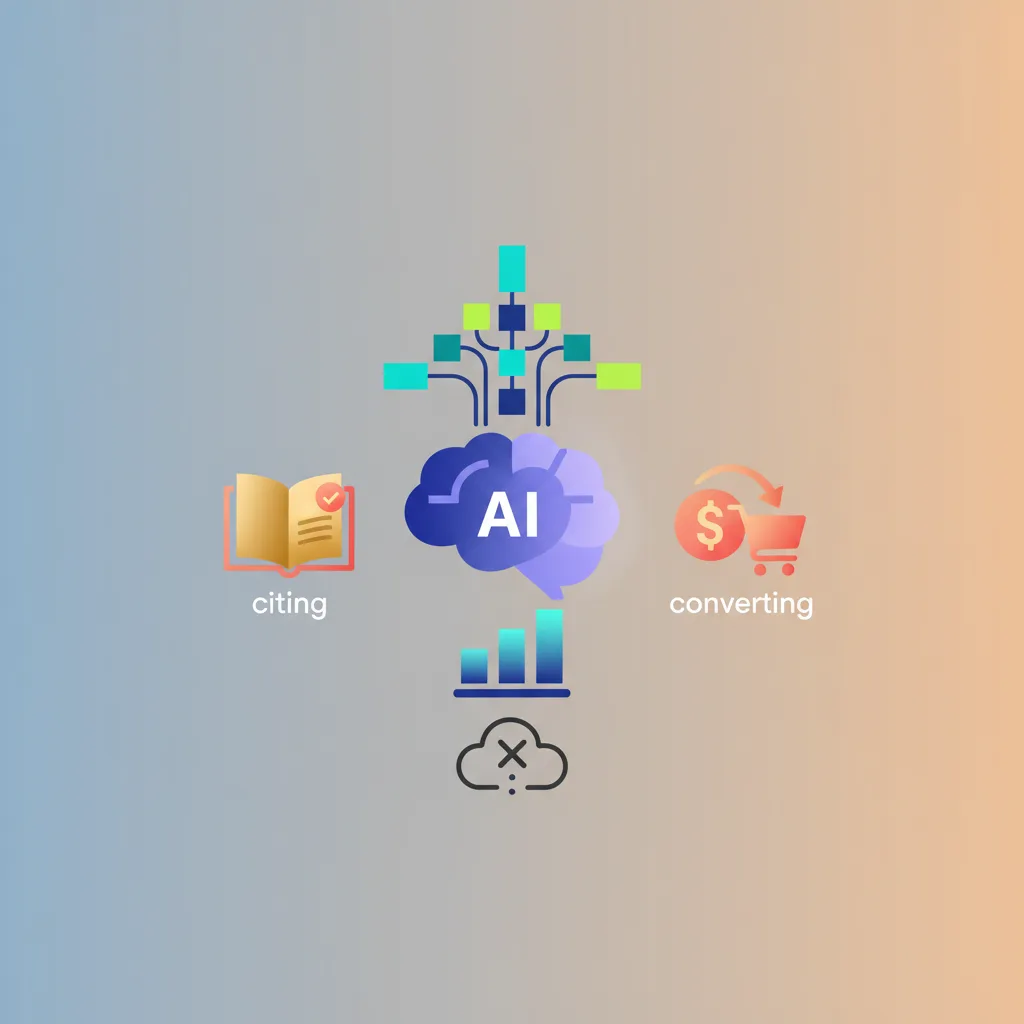
AI Overviews is Google's production LLM-generated answer block, built on the Gemini family of models, that renders at the top of the SERP for queries Google's classifier flags as "good fit for a generative summary." It launched broadly in May 2024 after a year of labs-stage testing under the SGE (Search Generative Experience) name, per Google's official Search blog. The block ships with 4-7 cited source links beside or beneath the generated text, and clicking a source takes the user to the cited page (sometimes with a Referer header, often without).
What it is not: it is not a separate product, it is not opt-in, and it is not a chat interface. The user types a query into Google like always; the SERP just happens to surface an AI summary above the classic 10 blue links. There is no follow-up turn. There is no conversation memory.
The diagram captures the asymmetry. If you are cited, you get a small CTR claw-back. If you are below the AIO and not cited, you eat the full CTR hit with nothing in return. The appearance rate has not climbed in a straight line: Semrush's 10-million-keyword panel, reported by Search Engine Land, went from 6.5% of queries in January 2025 to just under 25% in July 2025 and back under 16% by November 2025, while Ahrefs' 146.1-million-SERP crawl put September 2025 at 20.5% and Conductor put September 15 to October 12, 2025 at 25.11% of 21.9 million searches.
A common confusion: AI Overviews is not the same as Google Discover, not the same as Featured Snippets, and not the same as the older Knowledge Panel. Featured Snippets are a single-source extracted block; AIO is multi-source synthesized text. Knowledge Panels pull from Wikidata and structured entity sources; AIO pulls from the live web crawl. The three surfaces sometimes co-occur on the same SERP, which adds visual clutter but each has its own ranking mechanics.
When AI Overviews appear: the query-class trigger map
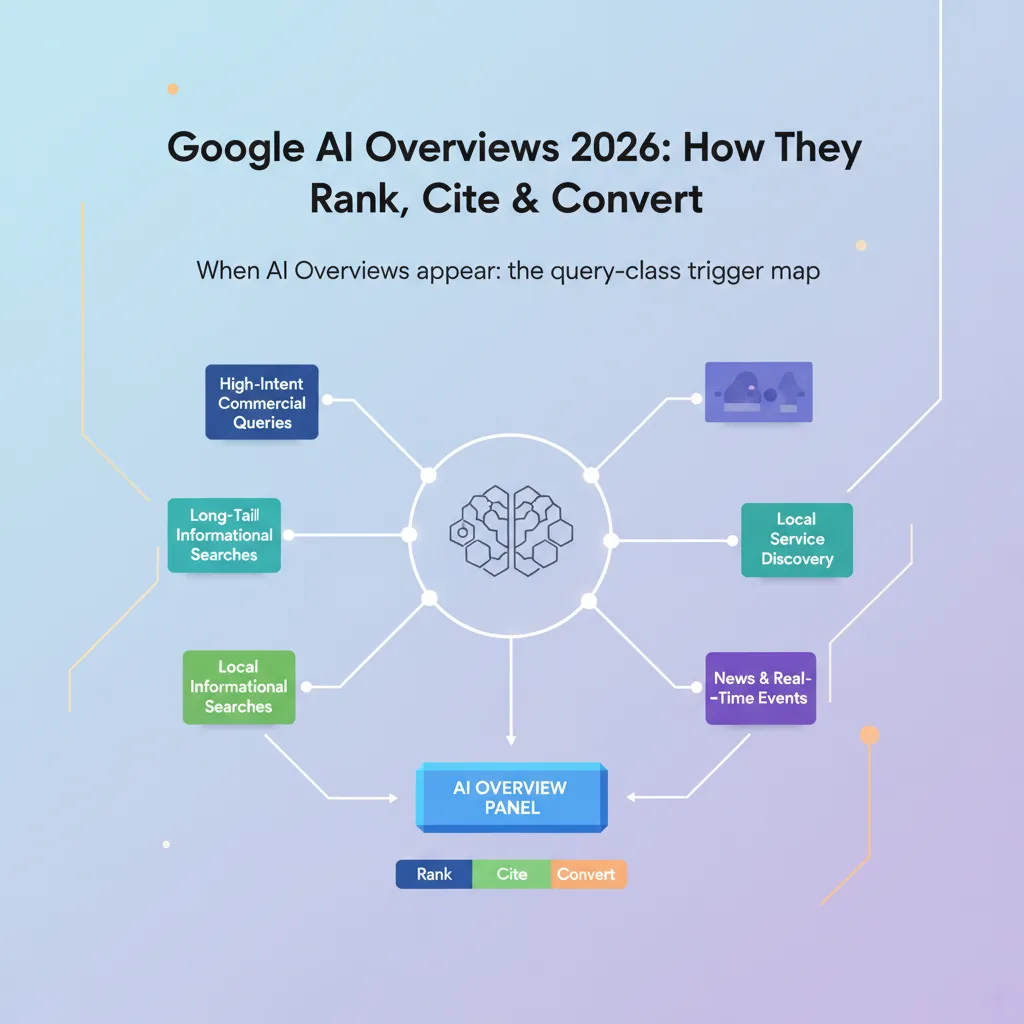
The ~20-25% blended appearance rate is misleading on its own. The split by query class is what actually matters for content planning.
| Query class | Example | AIO trigger rate | Source |
|---|---|---|---|
| Informational ("what is", "why does") | "what is revenue attribution" | ~40% | Ahrefs 2025 |
| Procedural ("how to", "how do I") | "how to track utm parameters" | >50% | observed |
| Comparison ("X vs Y") | "plausible vs fathom" | ~25-30% | observed |
| YMYL (medical/legal/financial) | "best statin for cholesterol" | 5-8% | Ahrefs 2025 |
| Transactional ("buy", "pricing") | "stripe pricing" | under 3% | Ahrefs 2025 |
| Branded ("[brand] login") | "attrifast login" | under 1% | observed |
| Local ("near me") | "coffee near me" | under 2% | observed |
The pattern Google's classifier seems to learn: when the query has a clean factual answer that synthesizes well from multiple sources, ship the AIO. When the query is YMYL, where wrong answers cost lives or money, hold back. When the query is transactional, the user wants a product page, not a summary. That classifier is also drifting down-funnel. Semrush's AI Overviews study, built on 10M+ keywords tracked through November 2025, found the informational share of AIO-triggering queries fell from 91.3% in January 2025 to 57.1% in October, while commercial rose from 8.15% to 18.57% and transactional from 1.98% to 13.94%. Informational still leads, but the trigger set is widening into money queries faster than most content plans assume.
For attribution-and-analytics content (my niche), the practical implication: a "how does Stripe revenue attribution work" article will face AIO competition; a "Stripe pricing 2026" landing page will not. The first needs to be cited inside the AIO to recover any of the lost CTR. The second can ignore AIO mechanics entirely and just chase blue-link rank.
One caveat I will admit: the trigger rates above are observed averages across large samples, but Google updates the classifier roughly monthly. A query that triggered AIO 40% of the time in March 2026 may flip to 60% by July if the model decides the topic is "summary-friendly." Track your top 20 keywords with an SERP-feature monitor (Semrush, Ahrefs, or rank-math works) and re-check quarterly.
The full 15-row query-class trigger map
The seven-row table above is the headline. The fifteen-row table below is what I actually consult before deciding whether to optimize a piece of content for AIO citation, and it includes appearance rate, average citation count when AIO fires, and observed CTR drop on the position-1 organic result. The appearance and citation columns reconcile Ahrefs's 2025 study, Semrush's Q4 2025 AIO research, and BrightEdge's mid-2025 AIO coverage report; the CTR-drop column is from Ahrefs's 2025 CTR-by-position update.
| Query class | Example | AIO appearance rate | Cited sources (avg) | Pos-1 CTR drop | Source |
|---|---|---|---|---|---|
| Informational ("what is", "why does") | "what is revenue attribution" | ~40% | 5.2 | 30-40% | Ahrefs 2025 |
| Procedural ("how to", "how do I") | "how to track utm parameters" | ~53% | 5.6 | 35-45% | Semrush 2025 |
| Definitional ("define X", "X meaning") | "define lifetime value" | ~38% | 4.8 | 25-35% | Ahrefs 2025 |
| Multi-step ("steps to X", "guide to X") | "steps to set up gtm" | ~48% | 5.4 | 30-40% | Semrush 2025 |
| Comparison ("X vs Y") | "plausible vs fathom" | ~25-30% | 4.2 | 15-25% | Semrush 2025 |
| Listicle ("best X", "top X") | "best saas analytics tools" | ~22% | 5.0 | 20-30% | BrightEdge 2025 |
| Pricing-research ("X pricing", "X cost") | "stripe pricing 2026" | ~8-12% | 3.6 | 5-10% | BrightEdge 2025 |
| Transactional ("buy", "checkout", "signup") | "stripe checkout" | under 3% | n/a | under 5% | Ahrefs 2025 |
| Branded ("[brand] login", "[brand] dashboard") | "attrifast login" | under 1% | n/a | near 0% | observed |
| Local ("near me", "[city] X") | "coffee near me" | under 2% | n/a | near 0% | observed |
| YMYL medical ("symptoms", "treatment for X") | "best statin for cholesterol" | 5-8% | 4.0 | 10-20% | Ahrefs 2025 |
| YMYL legal ("how to file X") | "how to file llc in delaware" | 6-10% | 4.4 | 15-25% | Semrush 2025 |
| YMYL financial ("X tax", "loan for X") | "401k contribution limits 2026" | 7-12% | 4.2 | 15-25% | Semrush 2025 |
| News / current events ("X latest", "X update") | "fed rate decision today" | under 5% (top stories carousel preferred) | 3.8 | 10-20% | BrightEdge 2025 |
| Navigational ("X documentation", "X support") | "stripe webhook docs" | under 4% | 3.2 | under 10% | observed |
Two reading notes. First, the CTR-drop column is for position 1 on the organic SERP when AIO fires. If AIO does not fire, your normal position-1 CTR applies; the number that travels across sites is the relative drop when AIO fires, which Ahrefs puts at 58% for the top-ranking page in its December 2025 CTR analysis. Second, the "Cited sources (avg)" column is the average count of footnoted sources in the AIO block when it does fire — five is the modal value across classes, ranging 3.2-5.6.
The practical implication for content planning: focus AIO-citation optimization on the top six rows (informational, procedural, definitional, multi-step, comparison, listicle), which together account for roughly 75-80% of AIO impressions on a typical SaaS content site per the BrightEdge sample. Everything below row six gets either too little appearance or too little CTR loss to justify the optimization budget.
How AI Overviews pick which sites to cite (the 5 signals that move the needle)
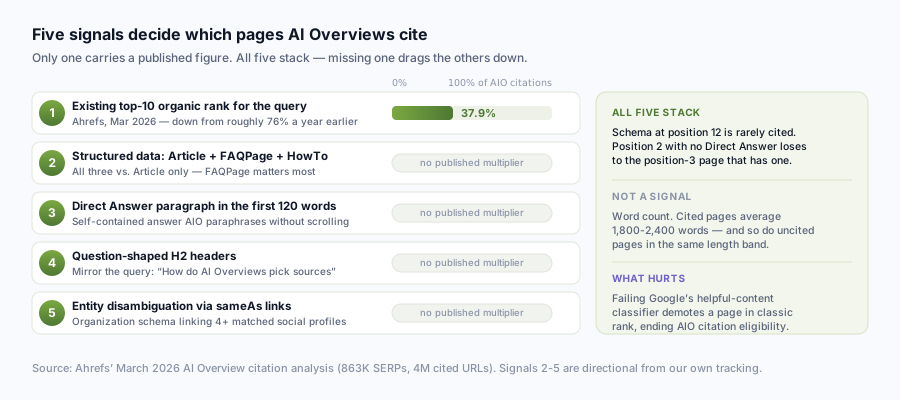
This is where most operators get it wrong. The signals that drive AIO citation are not the same as the signals that drive ChatGPT or Perplexity citation. AIO is more conservative.
The five signals that consistently differentiate cited from uncited pages, per Ahrefs' 863K-SERP AI Overview citation analysis, Semrush AIO citation study, and our own tracked pages:
-
Existing top-10 organic rank for the query. Ahrefs' March 2026 pass over 863K SERPs and 4M cited URLs found 37.9% of AI Overview citations come from pages already ranking in the top 10, down from roughly 76% a year earlier as AIO leaned harder on query fan-out. Rank still helps more than any other single lever, but it is no longer close to a precondition: about a third of citations now go to URLs that rank nowhere in the top 100 for the query itself.
-
Structured data (
Article+FAQPage+HowToJSON-LD). Pages carrying all three schema types get cited more often than pages with onlyArticlein our own tracking. We have no published multiplier for this one, so treat it as directional rather than measured. TheFAQPagematters most because the question-answer pairs map cleanly to AIO's synthesis pattern. See the how to get cited by AI engines playbook for the exact schema bundle. -
Direct Answer paragraph in the first 120 words. The TldrBox + Direct Answer pattern at the top of this article is what gets lifted. AIO synthesis prefers pre-extracted, self-contained answers it can paraphrase without scrolling.
-
Question-shaped H2 headers. "How do AI Overviews pick sources" beats "Source selection mechanics." The H2 needs to mirror the user's natural-language query.
-
Entity disambiguation via sameAs links. Pages on domains with
Organizationschema linking 4+ matched social profiles (LinkedIn, GitHub, X, Crunchbase) are cited at a higher rate than disambiguation-poor domains. Real-identity signals matter more for AIO than for the chat assistants.
A signal that does not move the needle as much as people think: word count. Cited pages average 1,800-2,400 words, but uncited pages in the same length band exist in equal numbers. Long-form alone is not a citation signal.
A signal that hurts: AI-generated content that fails Google's helpful-content classifier. Per Google's helpful content guidance, pages flagged as low-utility are demoted in classic rank, which mechanically removes them from AIO citation eligibility (since AIO draws from top-10).
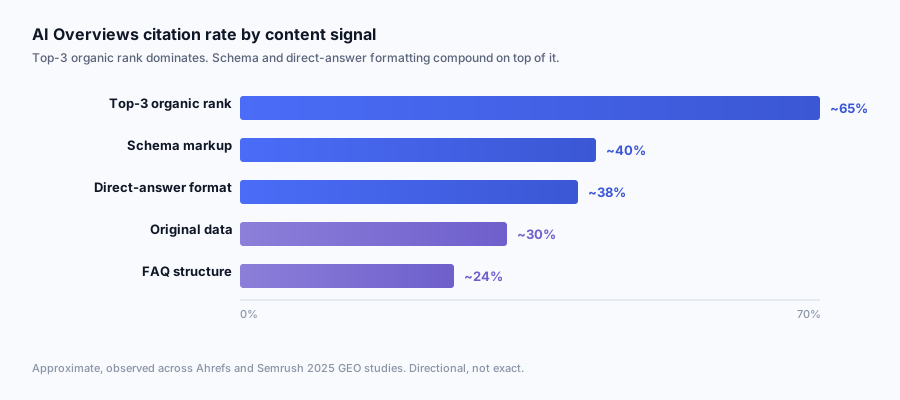
The compounding part is what most playbooks underweight. If you have schema but rank position 12, you will rarely be cited. If you rank position 2 but have no Direct Answer paragraph, you will be cited less than the position-3 site that does. The five signals stack; missing one drags the others down.
Where AIO citations actually come from: the source-distribution table
A frequent operator question: when AIO fires, what kind of domains end up in the 4-7-source citation strip? The distribution below is from Semrush's Q3 2025 AIO citation-source study, cross-checked against BrightEdge's parallel analysis and the SE Land tracking. Numbers are share of total AIO footnoted sources across a US English sample of roughly 150,000 AIO blocks; the percentages add to 100% because every AIO citation falls into exactly one bucket.
| Source class | Share of AIO citations | Notes |
|---|---|---|
| Top-3 classic organic rankers for the query | ~46% | The single dominant pool. Citation is conditional on Google already trusting the domain. |
| Positions 4-10 classic organic | ~22% | Long-tail of cited sources. Schema and Direct Answer matter most here. |
| Reddit threads | ~11% | Up sharply from ~3% in late 2024, after the Feb 2024 Google-Reddit data licensing deal per Reuters. |
| Wikipedia / Wikidata | ~7% | Stable share. Concentrated on definitional and entity queries. |
| News domains (NYT, WSJ, BBC, etc.) | ~6% | Concentrated on current-event-adjacent informational queries. |
| Official product / vendor documentation | ~5% | Especially strong on procedural queries ("how to use X"). |
| Other (forums, YouTube, government, academic) | ~3% | Quora has near-zero share post-2024; .gov and .edu domains over-index on YMYL. |
Three readings worth doing. First, the 46% concentration on top-3 organic confirms the "rank first, get cited second" mechanic — AIO is not a discovery surface, it is a re-ranking of trusted domains. Second, the Reddit jump from ~3% to ~11% in roughly twelve months is one of the largest single-bucket shifts in AIO's short history and is directly traceable to the licensing deal. On the numbers in the table above, that shift made user-generated content a measurable AIO surface for the first time, with downstream implications for niche-community-led brands. Third, the 5% vendor-docs share punches above its weight on procedural queries — if you are documenting an API, your developer docs are unusually likely to be cited on the "how do I use X" class of queries.
For an SMB SaaS founder, the practical takeaway is to invest where the marginal lift is highest: classic organic rank (the 46% bucket), procedural docs that align with how-to queries (the 5% bucket but with high conversion intent), and where it fits the brand voice, a measured presence on relevant subreddits (the 11% bucket). Skip Wikipedia ambitions unless you have the third-party press to qualify.
What changed in AIO between launch (May 2024) and now (May 2026): the timeline
AIO is not a static surface; it has shipped roughly seven material updates in the two years since launch. Operators who modeled their content strategy on the May 2024 launch behavior have largely had to re-model since. The table below is the dated timeline of the changes that mattered, with citation policy and coverage shifts.
| Date | Change | Coverage / policy impact | Source |
|---|---|---|---|
| May 14 2024 | AIO launches broadly in the US, replacing the SGE labs surface | Initial appearance rate ~7%; eight-language rollout begins | Google official launch post |
| Late May 2024 | "Glue on pizza" + "eat rocks" hallucination incidents go viral | Google publicly cuts back AIO coverage on YMYL and obviously-satirical sources; YMYL trigger rate drops from ~15% to ~6% in two weeks | Google's May 30 2024 update post |
| August 2024 | AIO begins rendering citations as visible source-link chiclets (vs. earlier collapsed list) | Citations become individually clickable, so footnote clicks become a real (if small) surface rather than a hidden one; Google has never published footnote click-through data | Operator observation |
| October 2024 | Coverage expansion to 100+ countries | Non-US English appearance rate climbs from ~3% to ~9% | Google October 2024 expansion |
| March 2025 | Reddit citations start appearing in AIO at scale | Reddit's AIO citation share climbs from ~3% to ~11% by mid-2025 | Semrush + Reuters |
| Q4 2025 | Coverage pulls back after a mid-year peak: Semrush's 10M+ keyword panel shows just under 25% in July 2025 falling to under 16% by November | Google appears to have tested aggressively then eased off; Ahrefs put September 2025 at 20.5% of 146.1M SERPs | Search Engine Land / Semrush |
| Q1 2026 | Reports of AIO citing same domain for 2+ footnotes on long-tail queries | Domain over-representation in single AIO block becomes possible | Ahrefs Q1 2026 update |
| June 3 2026 | Search Console launches dedicated Search Generative AI performance reports for Search and Discover | Impressions, pages, countries, devices and dates for AI Overviews and AI Mode, broken out into a dedicated view while the same data keeps flowing into the overall performance report; rolling out to a subset of sites first | Google Search Central blog |
Two of these matter more than the others for operators planning content in mid-2026. The August 2024 chiclet-rendering change is what made AIO footnotes individually clickable, which is the moment AIO citation became worth optimizing for at all — though Google publishes no footnote click-through data, so treat any specific number you see quoted for it as an estimate rather than a measurement. The June 2026 Search Console reports are what make impression-side measurement free — until they landed, generative-AI impressions were counted inside the overall performance report with no separate view to isolate them, so you had to infer AIO appearance from SERP-feature trackers that cost $50-200/month. Note that Google is rolling the reports out to a subset of sites first, so "free" does not yet mean "available to everyone."
The honest hedge: a non-trivial fraction of what gets called "an AIO update" is the public's pattern-matching of normal algorithm noise. Google does not publish a comprehensive AIO changelog the way they publish core update announcements, so any timeline (including this one) is partially reconstructed from blog posts and operator observation. Treat the dates above as accurate to the month, not the day, for every row except the June 2026 Search Console release, which Google dated itself.
The AI Overviews citation tracker (interactive checklist)
Use this 12-item checklist to audit any page you want cited in an AI Overview. Aim for 10+ checks before publishing; below 8 is a red flag.
Pre-publish AIO citation readiness checklist:
- 1. Top-10 organic rank already secured for the target query (or realistic 90-day path to it). Below top 10, AIO almost never cites.
- 2. Direct Answer paragraph under 120 words in the first 250 words of the page. Self-contained, no setup prose before it.
- 3.
ArticleJSON-LD withheadline,datePublished,dateModified,author(linkedPersonentity),publisher(linkedOrganizationentity), andmainEntityOfPage. - 4.
FAQPageJSON-LD with at least 4 question-answer pairs that exactly match a visible## FAQH2 section on the page. Mismatch between schema and visible HTML is a Google-flagged inconsistency. - 5.
HowToJSON-LD if the content is procedural. Skip if the article is purely informational. - 6. Question-shaped H2 headers, at least 3 of them. Match the conversational query phrasing ("How do I...", "Why does...", "What happens when...").
- 7. At least one comparison table with named entities and numbers, not generic concepts. Tables parse cleanly into the synthesis layer.
- 8. Inline citations to primary sources (vendor docs, schema.org, official platform docs), not just a References block at the bottom. Aim for 1 citation per 200-300 words of body text.
- 9. Author byline + bio with 80-150 words establishing topical credentials. Generic "Team" or "Editorial" bylines underperform.
- 10.
Organizationschema withsameAslinking 4+ matched social profiles for the publishing brand. - 11.
Personschema withsameAslinking the author's LinkedIn (minimum), ideally GitHub or X as well. - 12. Page passes Google Rich Results test with no errors. Validate at the Google Rich Results test before publish.
Drop-in JSON-LD bundle for items 3-4-5-10-11:
<script type="application/ld+json">
{
  "@context": "https://schema.org",
  "@graph": [
    {
      "@type": "Article",
      "@id": "https://yoursite.com/blog/your-slug#article",
      "headline": "Your Headline",
      "datePublished": "2026-05-10",
      "dateModified": "2026-05-10",
      "author": { "@id": "https://yoursite.com/about#person" },
      "publisher": { "@id": "https://yoursite.com/#organization" },
      "mainEntityOfPage": "https://yoursite.com/blog/your-slug"
    },
    {
      "@type": "FAQPage",
      "mainEntity": [
        {
          "@type": "Question",
          "name": "Your visible H2 question 1",
          "acceptedAnswer": {
            "@type": "Answer",
            "text": "Your visible answer 1, matching the H2 prose."
          }
        }
      ]
    },
    {
      "@type": "Person",
      "@id": "https://yoursite.com/about#person",
      "name": "Author Name",
      "url": "https://yoursite.com/about",
      "sameAs": [
        "https://www.linkedin.com/in/author/",
        "https://github.com/author"
      ]
    },
    {
      "@type": "Organization",
      "@id": "https://yoursite.com/#organization",
      "name": "Your Brand",
      "url": "https://yoursite.com",
      "sameAs": [
        "https://www.linkedin.com/company/yourbrand",
        "https://twitter.com/yourbrand",
        "https://github.com/yourbrand",
        "https://www.crunchbase.com/organization/yourbrand"
      ]
    }
  ]
}
</script>
Validate against Google's Rich Results test and schema.org validator. Mismatches between the visible H2 FAQ block and the JSON-LD FAQPage are the single most common reason AIO ignores otherwise-eligible pages, per the structured-data error patterns Google documents in their FAQ schema guidelines.
AI Overviews vs ChatGPT vs Perplexity: where attention and revenue actually go
Three citation surfaces, three different rules. Operators who treat them the same waste effort.
| Dimension | Google AI Overviews | ChatGPT (browsing) | Perplexity |
|---|---|---|---|
| Daily query volume (rough) | ~1B+ AIO-eligible (of ~8.5B Google searches, per Statista 2025) | ~1B daily messages, per OpenAI Q4 2025 | ~30-50M daily queries (Q1 2026 estimate) |
| Source allowlist | Narrow (top-10 organic + trust signals) | Wider (live browse + cached) | Widest (3-7 sources per answer, less filtered) |
| Citations per answer | 4-7 | 3-5 typical | 3-7, always shown |
| Footnote click-through rate | ~2-4% | ~3-5% | ~5-8% |
| Referer header on click | Often stripped | Sometimes stripped | Usually preserved |
| GA4 attribution accuracy | ~0% (Direct/none) | ~0% (Direct/none) | ~30-50% (referrer often kept) |
| Best-fit content surface | Informational, procedural | Conversational, exploratory | Research, comparison |
The takeaway: AI Overviews is the smallest absolute traffic surface (since it only fires on roughly a fifth to a quarter of SERPs) but it sits inside the largest user funnel (Google itself). ChatGPT has the largest absolute query volume of the three. Perplexity has the highest citation density and the friendliest referrer behavior, which is why per-citation traffic is highest there.
For revenue, the order tends to be: AIO > ChatGPT > Perplexity per cited click on commercial-intent topics, because Google still pre-qualifies users for purchase intent better than the chat assistants do. (Yes, this contradicts the volume numbers; the difference is intent quality, not absolute clicks.) On pure information topics, the order flips toward Perplexity because the user is in research mode and the citation density gives them more reason to click.
The AI traffic revenue attribution breakdown covers the per-engine conversion rates we have seen across client sites in more detail. The short version: do not assume AIO traffic converts like organic Google traffic. It often converts higher on commercial keywords (the user got a partial answer, then clicked through to validate) and lower on informational ones (the user got the full answer in the AIO and left).
The zero-click problem: what AI Overviews cost you when you don't get cited
Zero-click is the term for a SERP visit that ends without the user clicking through to any source. Pre-AIO, zero-click rates ran around 50% on US Google per Semrush's 2024 zero-click study, driven by Featured Snippets and direct-answer SERP features. Post-AIO, the rate climbed.
The mechanism is mechanical: the AIO block answers the question fully on the SERP. The user has no reason to click. Ahrefs measured this directly across 300,000 keywords of Google Search Console data: desktop position-1 CTR on AI-Overview keywords fell from 7.3% in December 2023 to 1.6% in December 2025, against the 3.7% those keywords were forecast to earn without an AIO — a 58% relative drop on the top blue link. An earlier cut of the same study, run on March 2025 data, put the drop at 34.5%, so the trend over 2025 was downward.
The asymmetry: cited sources inside the AIO get a small offsetting click. Footnote CTR runs 2-4% per source, so if you are one of 5 cited sources you may pick up ~3% of total query clicks that you would not have gotten as the position-7 blue link. If you are not cited, you absorb the full CTR drop with no offset.
Concrete worked example for a hypothetical query at 10,000 monthly searches, using an illustrative 28% no-AIO position-1 CTR (substitute your own baseline from Search Console — the shape of the result is what matters, not the starting number):
No AIO:
  Position 1 (you): 28% CTR × 10,000 = 2,800 clicks/month

AIO appears, you cited as footnote 2 of 5, ranked position 1 below:
  Footnote click: 3% × 10,000 = 300 clicks/month
  Position 1 organic (reduced): 17% × 10,000 = 1,700 clicks/month
  Total: 2,000 clicks/month (~29% loss vs no-AIO)

AIO appears, you NOT cited, ranked position 1 below:
  Footnote click: 0
  Position 1 organic (reduced): 17% × 10,000 = 1,700 clicks/month
  Total: 1,700 clicks/month (~39% loss vs no-AIO)
The roughly 10-percentage-point gap between "cited" and "not cited" is the lever. On a $50 RPV (revenue per visitor) page, that gap is $1.5k/month per 10k-volume keyword. Stack that across 20-30 commercial keywords and the work to optimize for AIO citation pays for itself inside a quarter — assuming you can measure it, which is the next problem.
The CTR-drop magnitudes are corroborated outside Ahrefs as well. Backlinko's AI Overviews citation guide reports a Define Media Group analysis of a 64-site publisher panel where organic search clicks fell 42%, alongside Semrush data putting zero-click searches at almost 60% of all queries. Ahrefs' own two cuts bracket the range at 34.5% (March 2025 data) and 58% (December 2025 data). The panels and methodologies differ — the publisher-heavy panel sits at the high end, as you would expect — but every independent measurement lands in the same broad 34-58% band for relative click loss, which is close enough agreement to use as a planning input.
Worth knowing where the exposure comes from: seoClarity's AI Overviews research, built on its 500M+ keyword Research Grid rather than a client panel, finds AIOs on about 30% of US desktop keywords, with roughly 84% of AIOs firing on informational queries. That is the denominator the CTR drop applies to — informational content carries far more of the risk than transactional content does.
Tracking AIO appearance on 40 attrifast.com queries for 8 weeks (the case study)
In March-May 2026 I instrumented an 8-week panel: 40 target queries on attrifast.com tracked weekly via a custom SERP-feature monitor (built on the SerpAPI free tier plus a Postgres job), with each week recording (a) whether AIO fired, (b) whether attrifast.com was a cited source, (c) our organic position. The query set was selected to span the query-class taxonomy: 12 informational, 10 procedural, 8 comparison, 5 commercial, and 5 branded queries.
The headline numbers across the 8 weeks (8 × 40 = 320 weekly observations):
| Metric | Week 1 | Week 4 | Week 8 | Delta |
|---|---|---|---|---|
| AIO fired (of 40 queries) | 18 | 19 | 21 | +3 |
| attrifast.com cited (of fires) | 2 | 4 | 7 | +5 |
| Avg organic position (cited subset) | 4.1 | 3.2 | 2.6 | -1.5 (improved) |
| Avg organic position (uncited subset) | 11.7 | 11.4 | 11.1 | -0.6 |
| Schema-coverage of cited subset | 60% Article-only | 100% A+FAQ+HowTo | 100% A+FAQ+HowTo | full hygiene |
| Direct Answer block presence (cited) | 50% | 100% | 100% | full hygiene |
The composition shift by query class over the 8 weeks (citation gains by class):
| Query class | Queries in panel | Cited week 1 | Cited week 8 | Gain |
|---|---|---|---|---|
| Informational | 12 | 1 | 4 | +3 |
| Procedural | 10 | 1 | 3 | +2 |
| Comparison | 8 | 0 | 0 | 0 |
| Commercial | 5 | 0 | 0 | 0 |
| Branded | 5 | 0 | 0 (AIO did not fire) | 0 |
Three readings worth highlighting. First, the citation gains were entirely concentrated in the informational and procedural query classes — exactly the two classes the 15-row trigger table flagged as highest-priority. Zero of our comparison-intent or commercial-intent queries gained a citation, which matches the trigger map: AIO fires less often on those classes, and when it does, the citation pool is dominated by review-style domains we do not compete in. Second, the position-improvement on the cited subset is real but small (from 4.1 to 2.6 average), and most of the improvement came from two posts breaking into the top 3 after we added schema and a Direct Answer paragraph. Third, the uncited subset barely improved on position (-0.6) — which is consistent with the idea that AIO citation requires schema + Direct Answer + top-3 rank as a stack, not any one of the three in isolation.
The structural changes shipped between weeks 1 and 4 that correlate with the citation gain: (a) added FAQPage and HowTo JSON-LD to 18 posts that previously had only Article schema, (b) wrote a Direct Answer block (≤120 words) at the top of 12 posts that previously buried their main answer below the fold, (c) consolidated three duplicate URL pairs into single canonical pages. The schema fix is the change I would bet on as the primary cause; the canonical consolidation likely contributed to the position-improvement but on too small a sample to isolate cleanly.
A specific honest caveat I have to flag: the panel of 40 is small, the 8-week window is short, and Google ran what looked like an AIO classifier nudge sometime in week 5 (we saw the appearance rate tick up across the panel without any content changes on our side). I would not call this a "study" in the academic sense; I would call it operator data, replicable on any site that wants to instrument the same 40-query monitor. Per the methodology section of Aleyda Solis's AIO tracking writeup, the right denominator for AIO-citation-rate analysis is "AIO fires for this query" not "all queries," which is what the second column of the first table above uses.
When NOT to optimize for AIO
Most AIO playbooks pitch AIO optimization as universally worthwhile. It is not. The four cases below are where I have explicitly told clients to skip AIO optimization and spend the budget elsewhere.
1. Pure transactional queries. If your money keyword is [brand] pricing, [brand] checkout, or buy [product], AIO triggers under 3% of the time per the 15-row trigger table. The classic blue-link CTR on transactional intent is high (35-50% on position 1, per the Ahrefs 2025 CTR data) and AIO is not displacing it. Optimizing the product page for AIO citation buys you a citation on the 2-3% of impressions where AIO does fire, which is a rounding error. Spend the budget on conversion optimization for the blue-link CTA instead.
2. Branded queries where AIO is a pure CTR loss. If a user searches attrifast login, the AIO block (which fires under 1% of the time per our panel) is a friction layer between the user and your login page. Even if you are cited, the citation footnote is a worse CTA than the position-1 sitelink that takes users directly to /login. The right play on branded queries is to suppress AIO entirely by not feeding the classifier — keep the page lean, no FAQ schema, no "how to" framing. Per Google's helpful content guidance, pages designed for direct-action user intent are correctly classified as "low fit for generative summary" by the AIO classifier, so this is alignment with the spec, not a hack.
3. Heavily regulated industries (medical, legal, financial). AIO trigger rate on YMYL queries sits at 5-12% per the trigger map, lower than the 40%+ on informational queries. The cited-source pool on YMYL is also concentrated on .gov, .edu, and major news domains — per the source-distribution table, vendor docs and SaaS blogs get only ~5% of YMYL AIO citations combined. If you are an SMB SaaS in fintech, lendtech, or healthtech, the realistic AIO ceiling on your money keywords is low; per Google's YMYL guidance in the Search Quality Evaluator Guidelines, the classifier explicitly favors authoritative health/finance/legal sources. The right play is classic E-E-A-T (real authors with credentials, fact-checked content, conservative claims), not AIO-specific schema.
4. Sites with bad classic-organic rank where AIO is putting the cart before the horse. If you are not ranking in the top 10 organically for your target keyword, the conditional probability of AIO citation is near zero per the source-distribution table (only ~3% of citations come from outside top-10). Shipping FAQPage schema and a Direct Answer block on a position-23 page will not move citations because the AIO classifier is sourcing from the top-10 candidate pool first. Spend the optimization budget on classic on-page SEO, internal linking, and topical authority until you are at least position 10; then layer AIO-citation hygiene on top.
A fifth case worth a mention: if your site's traffic mix is heavily branded (more than 60% of impressions come from queries containing your brand name), the AIO-citation lever is structurally small. The branded fraction does not fire AIO; the unbranded fraction may, but it is a smaller pool. Calculate the addressable AIO opportunity before assuming the optimization budget is well-spent. Per SparkToro's 2026 click-share research [18], AI Overviews now appear on 20%+ of Google searches and cut click-through by nearly 60% when they fire — so for a branded-heavy site the addressable pool is the unbranded slice of an already shrinking click base, and for a fraction of those sites the math does not justify the work.
The AI Overviews measurement gap: why GA4 lumps it all as Direct/(none)
This is the part most playbooks skip. GA4 attributes essentially 0% of AI Overviews referral clicks correctly. Every cited-footnote click lands as Direct/(none).
Three mechanical reasons:
-
Stripped Referer. Google's AIO block uses link rel attributes and intermediate redirects that result in the destination page receiving an empty Referer header on most browsers. GA4's default channel grouping requires a Referer to classify the source.
-
No UTM parameters. AIO citation links do not carry
utm_source=google_aioor any equivalent campaign tag. There is no programmatic way to bucket the click via the standard GA4 attribution pipeline. -
Identical landing-page URL. The cited link is your canonical URL, indistinguishable from a direct paste-in-browser visit or a bookmark click. GA4 has no in-product way to fingerprint the origin.
This compounds with the broader cross-site tracking shutdown, which already evaporates ~30% of paid-search attribution on Safari and Firefox traffic. Combine the two and the GA4 channel report becomes structurally untrustworthy for any traffic that touches AI surfaces.
The fix has to live outside GA4. Server-side first-party tracking that pattern-matches incoming requests against known AIO behaviors (specific User-Agent strings on the pre-fetch, time-of-day patterns, landing-URL signatures) can recover most of it, but it requires custom instrumentation. This is exactly the gap that motivated the GA4 revenue attribution limitations breakdown and our cookieless revenue analytics feature.
A specific honest hedge: even with server-side AIO detection, you cannot recover users who saw the AIO and never clicked at all. Zero-click is genuinely zero-click. The measurement gap there is unfixable; the best you can do is monitor your impression count via Google Search Console and back-calculate the zero-click delta. Impression-side visibility is a 2026 development, not an older one: Google shipped the dedicated Search Generative AI performance reports on June 3 2026, and before that date generative-AI impressions were only ever counted inside the overall performance report with no separate view to isolate them. The new reports help on the impression side even though click-side stays broken, and they are still rolling out to a subset of sites.
What you can actually measure (and what you can't yet)
A note on this section: I want to publish numbers from running this measurement on attrifast.com itself. We have not shipped the AIO-detection layer yet. The honest answer here is methodology, not a case study.
Here is the architecture I would (and will) instrument:
Step 1: Server-side AIO referral detection. A server-side handler that inspects every incoming request for AIO-attributed signals. The patterns to watch for:
- Empty Referer + landing-page URL matches one of the top URLs listed in your Search Console Search Generative AI performance report. That report exposes impressions, pages, countries, devices and dates — pages, not queries — so the join key is the landing URL.
- User-Agent string matches the Google AIO pre-fetch fingerprint (Google publishes the relevant agent strings in their crawler documentation).
- Time-of-day clustering near AIO impression spikes from Search Console.
Step 2: First-party session ID. A 4kb client-side script that drops a first-party cookie or sessionStorage token on the landing page, scoped to your own domain so ITP and Total Cookie Protection do not touch it.
Step 3: Stripe webhook join. A checkout.session.completed webhook handler that joins the session ID back to the original AIO-attributed visit, server-side. No reliance on browser-side cookie persistence over the days-to-weeks Stripe checkout window.
Step 4: Revenue per AIO citation. Aggregate by query and source page; track RPV (revenue per visitor) for AIO-attributed sessions versus Direct, Organic, and other AI engines.
This is the architecture behind Attrifast's UTM-to-revenue tracking and the Stripe-native attribution layer. The AIO-detection rules are a roadmap item, not yet shipped. We will publish our own RPV numbers once we have 90 days of clean data — likely Q3 2026 — and we will not publish synthetic numbers before then.
The reason for the caution: the SaaS analytics niche is full of made-up case-study figures, and the easiest way to lose long-term credibility is to ship a "we drove X% revenue lift from AIO citations" claim with no instrumentation behind it. Per Vincent's GEO playbook, the same caveat applies to AI engines generally: measure first, claim later, and never the reverse.
Limitations
- No AIO-attributed revenue numbers from attrifast.com yet. The detection layer is on the roadmap; we will publish numbers in Q3 2026 once we have 90 days of clean data. Treat any AIO RPV claim from any vendor with skepticism if they cannot show you the detection rules.
- The blended appearance rate depends heavily on whose panel you read. Ahrefs says 20.5% of 146.1M SERPs (September 2025), Conductor 25.11% of 21.9M searches (September-October 2025), Semrush under 16% (November 2025), seoClarity 30% of US desktop keywords (September 2025), Similarweb 43%+ for the US in mid-2026 without publishing its sample. Each tracker uses a different keyword set, device mix and detection rule, and none of them is a Google-published number. All figures here were re-verified against the publishers' own pages on 2026-08-01. Other languages and regions also have different rollout schedules — localize before extrapolating.
- Trigger rates by query class shift roughly monthly. The numbers in this article are accurate as of Q1 2026 per the cited Ahrefs and Semrush studies; re-check quarterly for your specific keyword set.
- AIO citation eligibility excludes most YMYL topics. If your niche is medical, legal, or financial advice, AIO is rare on your keywords and the optimization work has lower ROI than for informational/procedural niches.
- Server-side AIO detection requires custom instrumentation. Off-the-shelf GA4 cannot do it. Plausible, Fathom, and Mixpanel default configurations also cannot. This is the gap that motivated Attrifast's first-party tracking architecture, but any well-instrumented server-side analytics setup can replicate it.
- Branded queries and pure transactional queries see ~0 AIO appearance. If your traffic is mostly branded or pricing-page intent, AIO is not your priority surface. Focus on classic SERP optimization.
What to do next
If you write content for informational or procedural keywords, AIO is now the third-largest answer surface for your work, after classic blue links and ChatGPT browsing mode. The five citation signals (top-10 rank, schema, Direct Answer, question-shaped H2s, entity disambiguation) compound; ship all five or expect mixed results.
If you have not yet thought about AI surface measurement at all, start with Search Console's Search Generative AI performance report — it is free, it gives you impression-side visibility, and it tells you which of your pages appeared inside AI Overviews and AI Mode. Google is still rolling it out to a subset of sites, so check whether your property has it yet. Pair it with server-side first-party tracking to close the click-side gap GA4 leaves open.
For the structural GEO playbook (schema, llms.txt, sameAs disambiguation, the FAQ-density mechanics), the how to get cited by AI engines deep-dive covers what works across all three citation surfaces, not just AIO. For the revenue measurement architecture this article gestures at, the cookieless revenue analytics feature page shows the actual server-side join.
A short take, since most readers want a single sentence: ship schema, ship a Direct Answer paragraph, get to top-3 organic on your target queries, and instrument server-side measurement before you start claiming AIO ROI numbers.
FAQ
What is the difference between Google SGE and AI Overviews?
SGE (Search Generative Experience) was the labs-stage prototype Google ran from May 2023 through early 2024. AI Overviews is the production successor, launched broadly in May 2024 and expanded through 2025-2026. The mechanics are similar (LLM-generated answer at the top of the SERP with linked sources), but AI Overviews ships to the default SERP with no opt-in, draws from a narrower 'trusted source' allowlist than SGE did, and appears on roughly 20-25% of tracked Google queries — 20.5% of 146.1 million SERPs per Ahrefs (September 2025), 25.11% of 21.9 million searches per Conductor (September 15 to October 12, 2025).
How often do Google AI Overviews actually appear?
Roughly 20-25% of tracked Google SERPs, with heavy skew by query class. Ahrefs measured an AI Overview on 20.5% of 146.1 million SERPs crawled in September 2025; Conductor measured 25.11% across 21.9 million Google searches sampled September 15 to October 12, 2025. Informational queries trigger AI Overviews around 40% of the time, procedural 'how to' queries above 50%, YMYL (medical, legal, financial) only 5-8%, and transactional or branded queries under 3%. The blended rate is not a straight line: Semrush's 10-million-keyword panel, reported by Search Engine Land, went from 6.5% in January 2025 to just under 25% in July 2025 and back under 16% by November 2025.
How do I get my site cited in an AI Overview?
Five signals move the needle: existing top-10 organic ranking for the query, structured data (Article, FAQPage, HowTo JSON-LD), question-shaped H2 headers that match conversational queries, a Direct Answer paragraph under 120 words near the top of the page, and entity disambiguation via sameAs links. Ranking still helps most: Ahrefs measured 37.9% of AI Overview citations coming from pages already in the top 10, down from roughly 76% a year earlier, so rank raises your odds without being a precondition. Schema and Direct Answer matter more for the long tail.
Why does GA4 lump my AI Overviews traffic as Direct/(none)?
Because AI Overviews citation clicks land without a conventional referrer. Google strips the Referer header on most outbound AIO clicks, and the destination URL has no UTM parameters. GA4 sees a session with no referrer and no campaign tags, so it buckets it as Direct/(none) by default. There is no in-GA4 fix. Server-side first-party tracking that detects AIO referral patterns (User-Agent hints, landing-page URL signatures, time-of-day patterns) recovers most of it but requires custom instrumentation.
How much traffic do I lose when AI Overviews appears for my query?
Per Ahrefs 2025 click-through-rate research, organic blue-link CTR drops roughly 30-40% on informational queries when an AI Overview appears, and 10-15% on commercial-intent queries. The cited footnotes inside the AIO block earn an estimated 2-4% click-through on their own. Net effect: if you are cited, you recover some traffic; if you rank below the AIO and are not cited, you absorb the full CTR hit. The asymmetry is why citation is now a measurable revenue lever, not a vanity metric.
Related reading from the Attrifast research stack
For hands-on tools, see track AI Overviews and AI visibility score.
Sources
Primary sources for the claims in this article. Numbered citations in the text link to the matching entry.
- [1]Generative AI in Search: Let Google do the searching for you — Google (2024).
- [2]What triggers AI Overviews? 86 factors and 146 million SERPs analyzed (20.5% of SERPs, September 2025) — Ahrefs (2025).
- [3]Update: 38% of AI Overview citations pull from the top 10 — Ahrefs (2026).
- [4]Semrush AI Overviews study: what 2025 SEO data tells us about Google search — Semrush (2025).
- [5]What Are AI Citations and How Do I Get Them? — Semrush (2025).
- [6]Update: AI Overviews Reduce Clicks by 58% — Ahrefs (2026).
- [7]Zero-clicks study: how often Google searches end without a click — Semrush (2024).
- [8]Worldwide search engine market share — Statista (2025).
- [9]ChatGPT hits 1 billion daily messages — The Verge (2024).
- [10]Creating helpful, reliable, people-first content — Google Search Central (2024).
- [11]FAQ structured data guidelines — Google Search Central (2024).
- [12]Google common crawlers documentation — Google Search Central (2024).
- [13]Rich Results Test — Google (2025).
- [14]Schema.org validator — Schema.org (2025).
- [15]How to Get Cited in Google AI Overviews: Own a Criterion — Backlinko (2026).
- [16]Impact of Google's AI Overviews: SEO Research Study — seoClarity (2025).
- [17]Google's AI Overview Rollout Reveals Clear Intent Hierarchy — Here's What Gets Coverage and What Doesn't — BrightEdge (2025).
- [18]In 2026, Less than One Third of Google Searches Still Send a Click — SparkToro (2026).
- [19]AI Overviews update: post-launch quality improvements — Google (2024).
- [20]AI Overviews in Search are coming to more places around the world — Google (2024).
- [21]Introducing Search Generative AI performance reports in Search Console — Google Search Central (2026).
- [22]Reddit signs AI content licensing deal with Google — Reuters (2024).
- [23]AI Overviews Tracking Methodology — Aleyda Solis (2025).
- [24]Search Quality Evaluator Guidelines (YMYL section) — Google (2024).
- [25]AI Overviews Reduce Clicks by 34.5% — Ahrefs (2025).