To get cited by AI engines, create the page an answer system can defend: it should answer a specific question, contribute information that is not available everywhere else, show where its claims come from, and remain accessible to the platform's search or retrieval crawler. Then measure whether the citation generated a visit and a customer.
That definition is stricter than “write an SEO article.” It also avoids the most common GEO failure: optimizing formatting while the page contains no original evidence worth citing.
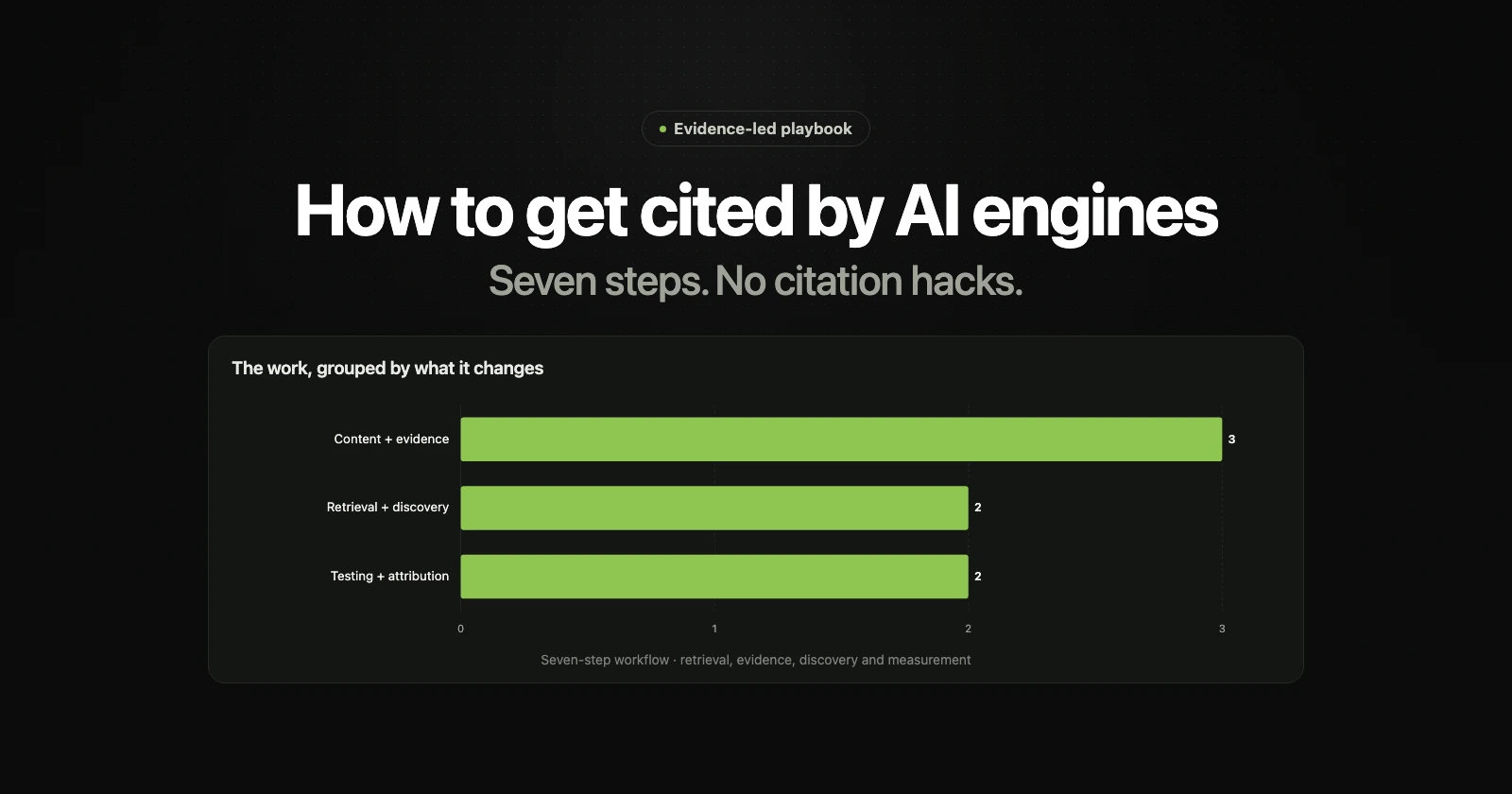
The seven-step playbook
| Step | Deliverable | Evidence level | Failure it prevents |
|---|---|---|---|
| 1 | One citable question and search intent | Platform mechanics | A page trying to answer ten unrelated queries |
| 2 | A differentiated answer asset | Vendor guidance + research | Commodity prose that adds no source value |
| 3 | Primary sources, numbers, and boundaries | Controlled GEO research | Claims an answer engine cannot verify safely |
| 4 | Crawl, index, and bot-access audit | Platform-confirmed | A strong page that never enters retrieval |
| 5 | Contextual topic-cluster links | Confirmed for Google Search | An orphan page with weak discovery and context |
| 6 | Stable prompt-set testing | Measurement practice | Mistaking one personalized answer for a trend |
| 7 | Citation → session → conversion → revenue join | Attribution practice | Treating visibility as business value |
Step 1: choose one question worth citing
Start with a question whose answer can change a decision. “What is AI search?” is broad and easily summarized from thousands of pages. “Does Google Search use llms.txt?” has a precise, documented answer and a clear primary source.
Write down four fields before drafting:
| Field | Example for this article |
|---|---|
| Primary question | How do I get cited by AI engines? |
| Reader decision | Which work should we prioritize this month? |
| Original contribution | Seven-step workflow plus an evidence-grade matrix |
| Proof required | Vendor bot docs, Google AI Search guidance, KDD GEO research |
This creates a tighter page and makes metadata easier to align. The title, H1, first paragraph, table, and FAQs can all serve the same intent without repeating an exact keyword unnaturally.
Step 2: create an answer asset, not another summary
An answer asset gives the engine a reason to cite your URL rather than another explanation. Good forms include:
- a dataset with sample size, date range, definitions, and limitations;
- a first-hand test with a reproducible method;
- a decision table that reconciles conflicting vendor guidance;
- a calculator, checklist, template, or code example;
- an expert correction of a widely repeated but unsupported claim;
- a maintained specification or source map.
For example, our companion article does not merely list AI search ranking factors. It grades 12 popular claims into five platform-confirmed mechanisms, three research-supported patterns, and four unproven shortcuts. That classification is the citable contribution.
Avoid invented “original data.” A percentage without a denominator, cohort definition, collection window, or method makes the page look less authoritative, not more.
Step 3: support claims with primary evidence
The KDD 2024 Generative Engines and Search paper created GEO-bench with 10,000 queries. In that benchmark, adding citations, quotations, and statistics improved source visibility, with reported gains of up to 40% across queries and up to 37% on Perplexity in the evaluated setup.
Use that result as a design principle, not a guaranteed lift. A strong evidence block contains:
- Claim: the exact statement the evidence supports.
- Source: preferably the vendor document, paper, or first-party dataset.
- Date: when the source or observation applies.
- Scope: product mode, geography, sample, or query type.
- Boundary: what the evidence cannot establish.
Compare the two versions:
Weak: “Schema increases AI citations by 3×.”
Strong: “Google says structured data should match visible content and can support eligible Search features; it does not document a special AI citation boost.”
The second sentence is less sensational and more useful because it can survive verification.
Step 4: make the page retrievable by each engine
Search inclusion and model training are different controls. Audit the tokens the platform actually documents.
| Platform | Search / retrieval access | Separate control | What to verify |
|---|---|---|---|
| Google AI in Search | Googlebot and normal Search directives | Google-Extended controls certain Gemini uses, not Search | Index status, snippet eligibility, robots.txt, canonical |
| ChatGPT search | OAI-SearchBot | GPTBot controls training; ChatGPT-User is user-triggered | robots.txt plus CDN/WAF logs |
| Claude search | Claude-SearchBot | ClaudeBot controls training; Claude-User is user-triggered | token-specific rules and request logs |
| Perplexity | PerplexityBot; Perplexity-User for user requests | Official IP ranges support verification | robots.txt and WAF/IP allow rules |
The official OpenAI, Anthropic, and Perplexity pages should override copied bot lists from third-party blogs.
Also check the ordinary web layer:
- return a successful status code;
- render the answer in HTML;
- use one canonical URL;
- avoid accidental
noindexor restrictive snippet controls; - include the page in crawlable navigation or a relevant hub;
- keep a current XML sitemap;
- do not hide the only useful content behind client interaction.
Step 5: build a small, coherent topic graph
Internal linking should describe the reader's next question. Google confirms that crawlable links and descriptive anchor text help it discover and understand pages. There is no reason to turn the footer into a list of every URL.
For this topic, the relationship is:
Where Google AI gets information
        ↓
AI search ranking factors, graded by evidence
        ↓
How to get cited by AI engines
        ↓
AI citation tracking and AI referral revenue
Use anchors that state the destination's job:
- where Google AI gets its information
- AI search ranking factors
- AI citation tracking
- AI referral traffic analytics
- track website traffic
This is more useful than dozens of repeated exact-match links. It creates topical continuity and gives a reader a reason to continue.
Step 6: test citations without fooling yourself
AI answers vary. A single screenshot is evidence that an answer appeared once—not a stable rank.
Create a repeatable test:
| Element | Minimum useful practice |
|---|---|
| Prompt set | 20–50 questions mapped to awareness, comparison, and purchase intent |
| Engines | Test each supported engine separately |
| Baseline | Capture citation status before the content change |
| Frequency | Use a consistent schedule; avoid interpreting daily noise as a trend |
| Annotation | Record publication, major edits, link additions, and technical changes |
| Competitors | Track the small set of domains repeatedly cited for the same prompts |
| Outcome | Separate mention, citation/link, click, conversion, and revenue |
Do not rewrite the prompts after the result arrives. Changing the evaluation set makes before-and-after comparisons meaningless.
Step 7: connect citation visibility to business value
The complete funnel has four separate observations:
- Citation: an engine names or links to the brand or URL.
- Session: a person reaches the site with a recognized referrer or campaign signal.
- Conversion: that website session completes a defined action.
- Revenue: Stripe or Shopify records a verified payment that can be joined to the journey.
| Result | Correct interpretation | Next action |
|---|---|---|
| Citations up, visits flat | Visibility improved; click-through did not | Review prompt intent, citation placement, and destination promise |
| Visits up, conversions flat | The channel sends traffic but the page or offer does not convert | Improve message match and CTA |
| Conversions up, revenue flat | Lead quality or payment completion is weak | Inspect customer and checkout quality |
| Revenue up | The AI search work is producing measurable commercial value | Scale the prompt and content cluster carefully |
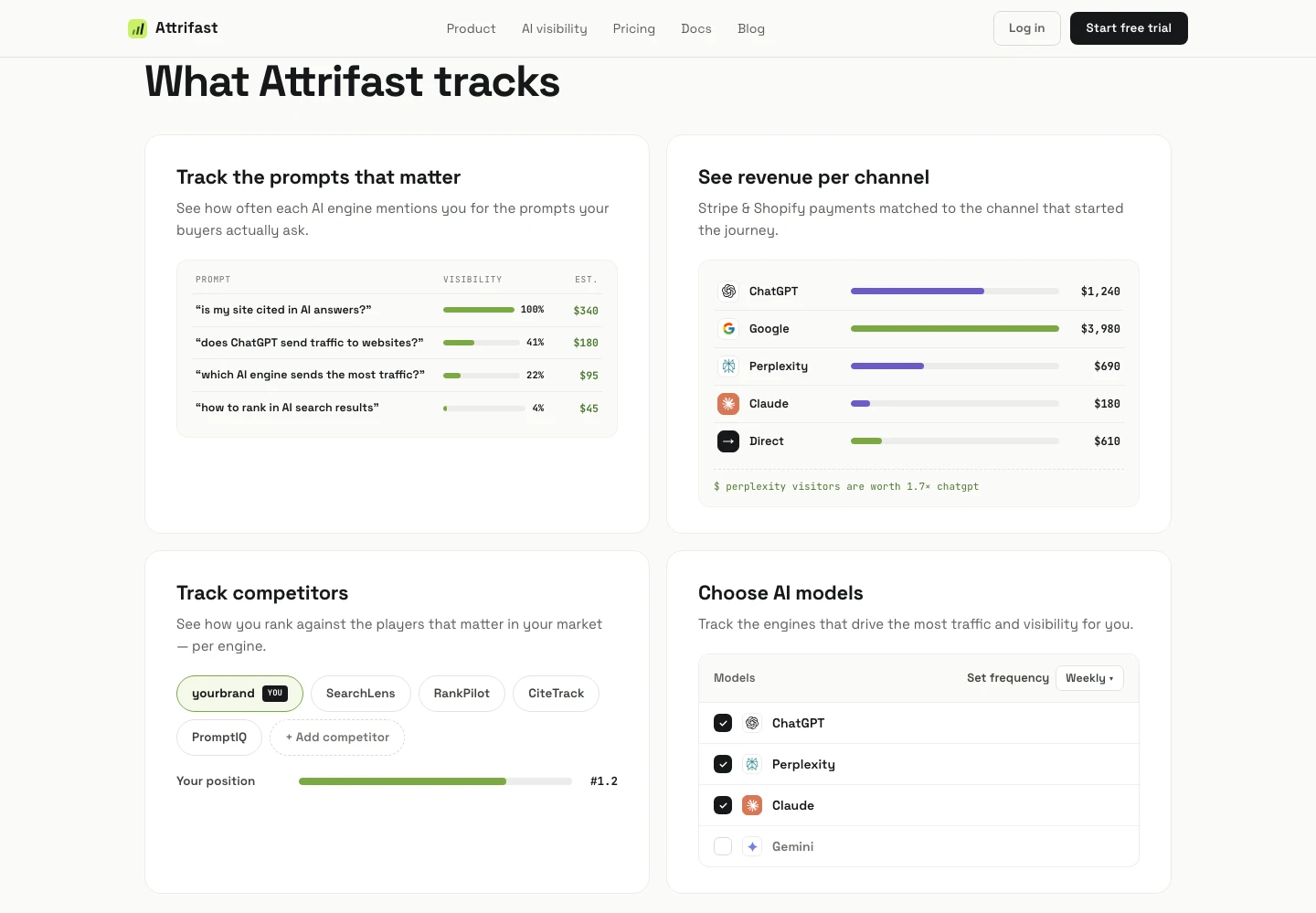
Attrifast is built for this connection. The AI citation tracker records prompt-level visibility; first-party analytics classifies recognized AI referral traffic and website sessions; Stripe and Shopify joins show which visits paid. The homepage shows the whole workflow without requiring signup.
A citation-ready article blueprint
Use this outline when the topic supports it:
| Section | Purpose | Target length |
|---|---|---|
| Title and description | State the exact question and differentiated value | One line each |
| Direct answer | Give a bounded answer before the history lesson | 40–80 words |
| Evidence table | Make claims, sources, and confidence scannable | 4–12 rows |
| Method | Explain how data or conclusions were produced | As long as reproducibility requires |
| Main analysis | Resolve the reader's real decisions | Topic-dependent |
| Limitations | Prevent the conclusion from being over-applied | 3–8 explicit points |
| FAQ | Answer remaining high-intent questions | Only genuine questions |
| Sources | Prefer first-party and primary references | Complete, current list |
| CTA | Connect the research problem to a relevant product outcome | One focused action |
The target lengths are editorial ranges, not ranking thresholds.
What not to treat as a proven citation hack
| Popular claim | Evidence-based position |
|---|---|
“Add llms.txt and ChatGPT will cite you” | Optional experiment; no documented ranking effect. Google Search explicitly ignores it. |
| “FAQ schema is the biggest AI citation lever” | Visible FAQs may help readers. No vendor documents FAQ markup as a citation boost. |
“Use four sameAs links” | Identity consistency is useful; the number four has no published threshold. |
| “Write exactly 2,000 words” | Length follows the information need. Retrieval systems can use short or long pages. |
| “Get a Wikidata page” | Do not create notability or identity pages solely for ranking. |
| “Refresh the date every week” | Update the page only when the content materially changes. |
| “More citations are always better” | Relevant primary sources improve trust; link padding does not. |
A 30-day execution plan
| Week | Action | Deliverable |
|---|---|---|
| 1 | Select 20–50 prompts and audit crawler access | Baseline citation matrix and technical checklist |
| 2 | Upgrade three high-intent pages with original answer assets | Methods, tables, primary sources, limitations |
| 3 | Add contextual links from the hub, product pages, and related research | A coherent topic graph, not a footer dump |
| 4 | Re-scan prompts and review sessions, conversions, and payments | Annotated citation-to-revenue report |
One month may be enough to observe retrieval changes on some engines and insufficient on others. Report what happened in your own test; do not convert the schedule into a guarantee.
Research standard and limitations
This guide was re-reviewed on August 22, 2026 against public documentation from Google, OpenAI, Anthropic, and Perplexity, plus the KDD 2024 GEO paper. We distinguish:
- Platform-confirmed: documented controls or mechanisms.
- Research-supported: measured in a published experimental setting.
- Operational practice: necessary for valid measurement, but not a ranking factor.
- Unproven: plausible or popular, without public evidence as a direct citation signal.
AI outputs vary with prompt wording, product mode, account state, geography, and time. No public tool can recover the engines' private factor weights. Citation monitoring is therefore a repeated observation, not a deterministic rank check.
FAQ
How do I get my website cited by AI engines?
Publish a crawlable page that gives a direct, differentiated answer and supports material claims with primary evidence. Allow each platform's search crawler, connect the page through descriptive internal links, and keep facts current. Then monitor a fixed set of prompts. No vendor guarantees that schema, llms.txt, or a specific word count will produce citations.
How long does it take to get cited by ChatGPT or Perplexity?
There is no published or reliable universal timeline. A page must first be discovered by the relevant search system, and citation selection varies by prompt, freshness, location, and product version. Measure from the date the canonical page is accessible, but report the observed time for your own test rather than promising a 24- or 72-hour result.
Do I need schema markup to get cited by AI?
No major AI engine documents schema as a requirement for citation. Accurate Article, Organization, Product, or FAQ markup can help supported search features and reduce ambiguity when it matches visible content, but it is not a citation guarantee. Prioritize crawlable HTML, original evidence, and clear sourcing first.
Should I create an llms.txt file?
Treat llms.txt as an optional experiment, not a core ranking tactic. Google says Search ignores it, and other major engines do not publicly document it as a ranking factor. If you maintain one, keep it accurate and do not let it replace robots.txt, sitemaps, canonical tags, crawlable navigation, or substantive HTML content.
How do I know whether an AI citation created revenue?
Track four separate events: the citation or mention, the click or recognized AI referral session, the conversion, and the verified payment. Attrifast monitors prompt-level citation visibility and first-party website sessions, then joins recognized AI referrals to Stripe or Shopify revenue so you can distinguish visibility from commercial impact.
Continue the research path
- Where Google AI gets its information
- AI search ranking factors: 12 signals graded by evidence
- AI Search Hub: 36 guides
- AI citation tracking connected to revenue
- AI referral traffic analytics and revenue attribution
- Track website traffic from first click to revenue
Sources
Primary sources for the claims in this article. Numbered citations in the text link to the matching entry.
- [1]AI features and your website — Google Search Central.
- [2]Top ways to ensure your content performs well in Google's AI experiences on Search — Google Search Central.
- [3]OpenAI crawlers and user agents — OpenAI.
- [4]Anthropic web crawler controls — Anthropic.
- [5]Perplexity crawlers — Perplexity.
- [6]Generative Engines and Search — KDD 2024 / arXiv.
- [7]Link best practices for Google — Google Search Central.
- [8]General structured data guidelines — Google Search Central.