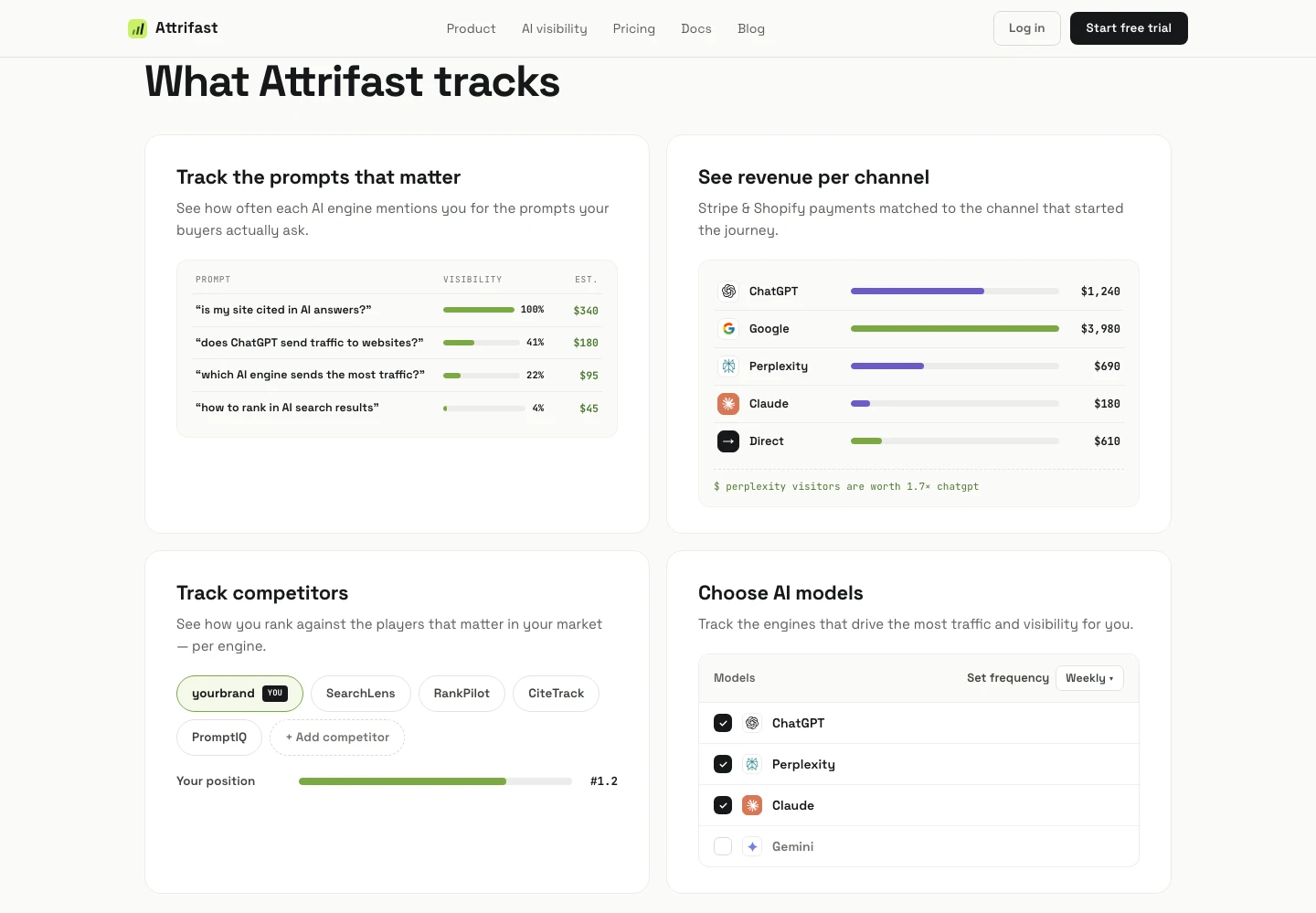
- AI referrers are inconsistent: web clicks may expose a hostname, while native-app and redirect flows can lose it.
- GA4 now has an AI Assistant default channel for recognized sources[11]; missing referrers still become Direct.
- Use UTMs on links you control and never infer an exact engine for a session with no source signal.
- Revenue attribution requires preserving the source at session start and joining it to the payment event.
- Attrifast automates that join for recognized AI sources without fingerprinting.
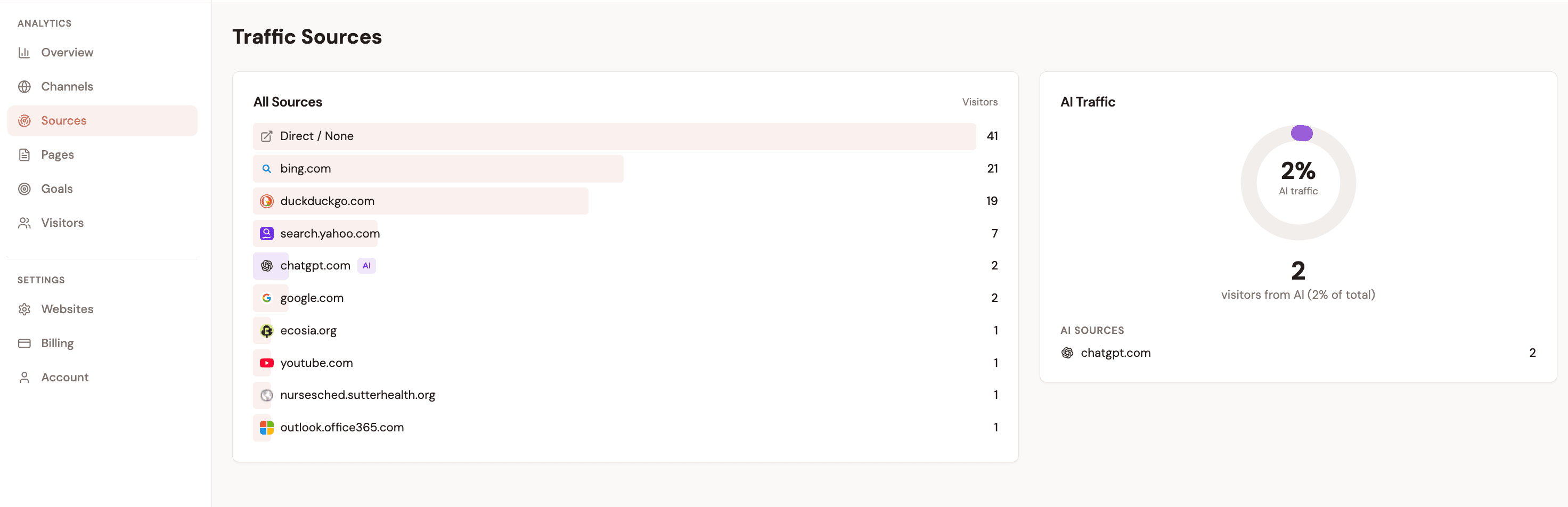
AI engines are sending traffic. The source signal is not always preserved.
ChatGPT, Perplexity, Claude, and Gemini all surface external sources, but the click path varies. A normal browser navigation may preserve the referring hostname; an app handoff, redirect, or privacy policy may not. That difference determines whether any analytics product can name the engine with confidence.
For SaaS founders and ecommerce operators, this creates a specific problem: a new traffic channel with potentially high purchase intent is arriving at your site, but part of it may appear as generic Referral or Direct. You can optimize the attributable portion and improve future measurement with controlled UTMs; you cannot turn missing evidence into ground truth.
Start with your own baseline: count sessions with a recognized AI hostname or UTM, compare their landing pages and conversion rate with other channels, and reconcile the attributed payments with Stripe. That produces a decision-ready number without borrowing a traffic-share benchmark from a different industry or site mix.
Why AI-referred visitors convert differently
A user arriving from a Google search result may be researching broadly. A user arriving from a ChatGPT citation arrived because an AI explicitly recommended your product in response to a question like "what is the best analytics tool for Stripe businesses?" That recommendation can narrow intent, but conversion performance varies by query, landing page, price point, and brand. Treat "AI converts better" as a hypothesis; compare revenue per visitor on your own attributable sessions.
Example source mix: who is sending attributable AI traffic
Illustrative composition of source-visible AI referrals. This is not global market share and should not be applied to your site; use the chart format with your own recognized sessions.
Interpret only recognized sources. The chart excludes visits that arrived without a referrer or campaign signal because their engine cannot be known deterministically.
| AI engine | Referrer behavior | GA4 default classification | Capture method |
|---|---|---|---|
| ChatGPT (web) | chatgpt.com Referer header[4] | AI Assistant when the source is recognized | Capture hostname at session start |
| ChatGPT (mobile app) | No Referer header sent[2] | Direct when no campaign signal survives | UTM where you control the link[9] |
| Perplexity | May preserve perplexity.ai | Referral/custom AI, or Direct if absent | Referrer or UTM |
| Claude (web) | May preserve claude.ai | Referral/custom AI, or Direct if absent | Referrer or UTM |
| Gemini | gemini.google.com Referer | Sometimes "google"[6] | Domain pattern match needed |
Referrer behavior can change by app, browser, and release. Validate these patterns on your own requests and use the table as a measurement checklist, not a permanent guarantee.
Skip the manual setup
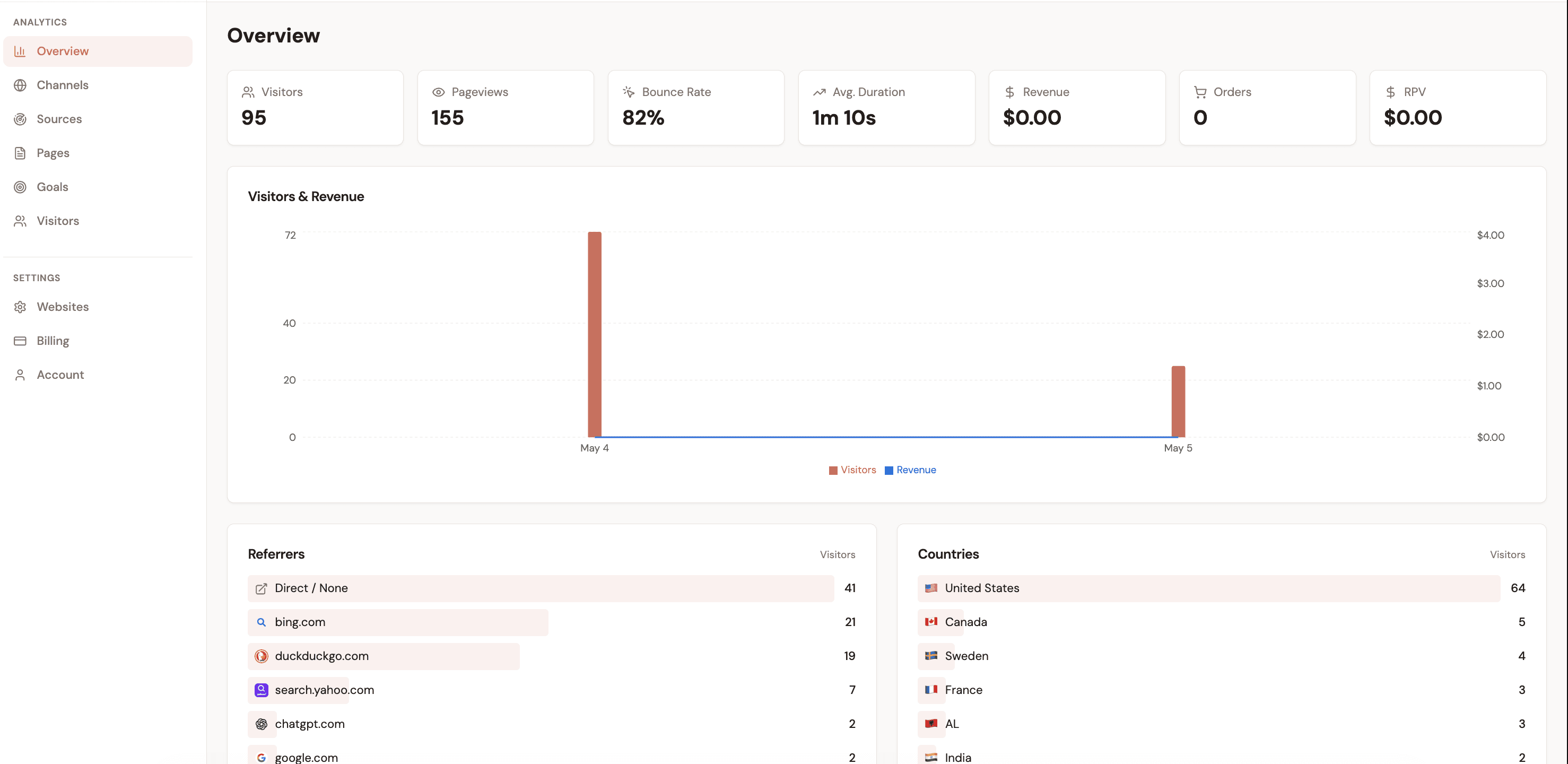
GA4 now supplies an AI Assistant channel for recognized sources, and it can receive ecommerce events with the right implementation. Attrifast packages the source list and Stripe-oriented session join so source-visible ChatGPT, Perplexity, Claude, Gemini, and Copilot traffic appears in one revenue view.
How AI traffic referrers actually work: the technical reality
When a user clicks a link inside an AI chat interface, the browser may send an HTTP Referer header to the destination server — the same mechanism that has powered web analytics since the mid-1990s. On the client side, your JavaScript can read this as document.referrer.
https://chatgpt.com/when the web flow preserves ithttps://perplexity.ai/surface-dependenthttps://claude.ai/surface-dependenthttps://gemini.google.com/when distinct from Google SearchWhy referrers get lost: three common failure modes
1. Referrer-Policy headers set to same-origin
If an AI surface applies same-origin or no-referrer, the destination will not receive the AI hostname. Policies and navigation paths can change, so verify behavior from real requests instead of assuming one permanent setting.
2. HTTPS → HTTPS with meta refresh redirects
Some AI engines route clicks through intermediate pages. Depending on the redirect and referrer policy, the destination may receive the intermediate origin or no referrer. Treat this as one testable failure mode rather than a universal engine behavior.
3. GA4's referral exclusion and session stitching logic
GA4 uses campaign and referring-source information to classify a session. Its AI Assistant channel names supported sources when the signal survives. Direct is the appropriate fallback when the session has no source signal; default or custom channels change labels, not missing evidence.
What you see in GA4 vs what is actually happening
An illustrative set of 100 visits. GA4 can group supported, source-visible assistant traffic; a revenue-oriented view can then split the recognized engines and join payments. Neither view reassigns source-less Direct traffic.
Supported visible AI sources are grouped as AI Assistant; source-less sessions remain Direct.
Recognized AI referrers become named rows; Direct is not guessed away.
How analytics tools handle AI traffic: comparison
GA4, Plausible, Fathom, and Attrifast — how each handles AI engine referrers and revenue attribution. For the broader market, see our conversion tracking software comparison.
Yes
Yes
AI Assistant channel available; purchase-event implementation still required
Yes
No
Shows referrer domain but no revenue data
Yes
No
Shows referrer domain but no revenue data
Yes
Yes
AI source → session → Stripe payment linked
How to track AI traffic revenue with Attrifast: step by step
Attrifast captures document.referrer at the start of every session and stores it server-side with a privacy-safe session token. When a Stripe payment completes, it joins the payment record back to that original session — including its AI engine referrer. Here is the full setup flow.
Add the Attrifast script tag
Paste a single 4 KB script tag into your site's <head>. No configuration needed — the tracker automatically reads document.referrer on every page load.
Connect Stripe with a restricted API key
Paste a read-only restricted API key from your Stripe dashboard. Attrifast matches browser sessions to server-side payment events using a random first-party ID stored in localStorage — no third-party cookies, no PII stored.
See AI traffic in your dashboard immediately
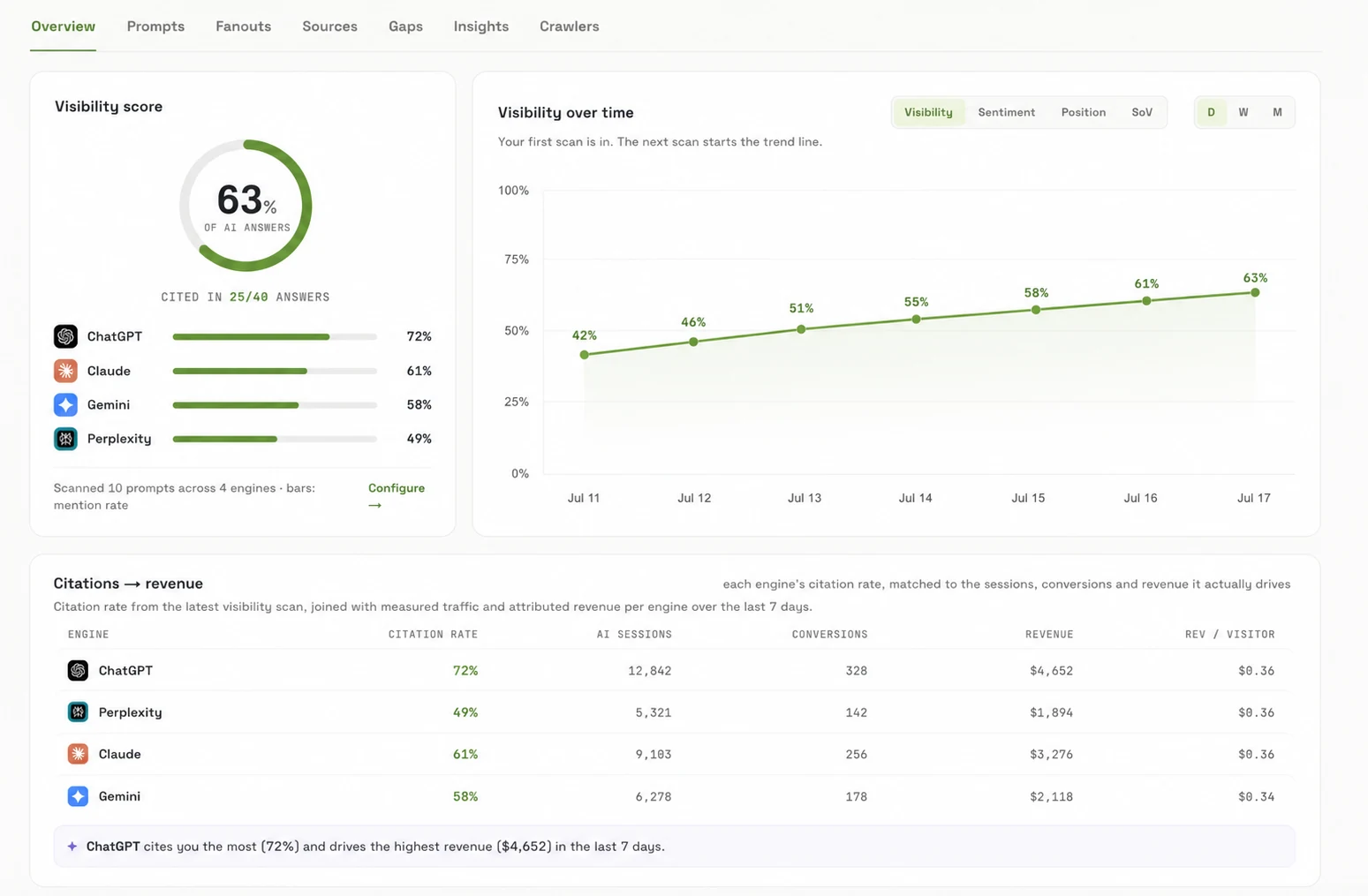
ChatGPT, Perplexity, Claude, and Gemini referrals appear as distinct channels. Each row shows visitors, conversion rate, and revenue generated.
Filter revenue by AI source
Click any AI source to see the exact pages visitors landed on, their conversion rate versus your organic average, and total revenue attributed.
What you will see in your dashboard
Within 24 hours of installation, AI traffic sources appear as named channels: ChatGPT, Perplexity AI, Claude AI, Gemini. Each row shows sessions, conversion rate, revenue generated, and revenue per visitor. You can sort by revenue to immediately see which AI engine produces the highest-value customers for your business.
Attrifast sets no third-party cookies and does no fingerprinting — it identifies sessions with a random first-party ID in localStorage. This reduces cross-site tracking, but storage and consent obligations still depend on jurisdiction and configuration; "cookieless" is not a blanket legal exemption.
Why tracking AI referrals now is a first-mover opportunity
SEO took years to become a mature discipline. Social media analytics tooling lagged platform growth by two to three years. The pattern repeats: new traffic channels emerge, attribution tooling follows slowly, and early adopters who build measurement infrastructure first gain durable advantages in understanding and optimizing their traffic mix.
AI-generated content optimization — sometimes called GEO (Generative Engine Optimization) — is emerging as a discipline precisely because traffic from AI engines behaves differently from traditional search. Knowing your current AI traffic baseline and which AI engines send the highest-value visitors gives you the data foundation to run structured experiments: which content formats get cited, which product pages earn AI recommendations, and which AI engines reward which types of businesses.
You cannot optimize what you do not measure. Starting now gives you a comparable baseline for source-visible AI sessions, landing pages, conversion rate, and revenue — without pretending the unattributed remainder is known.
Signals to preserve: referrer, UTM, click ID, payment-session ID
Guessed engine labels for referrer-less, untagged sessions
Named AI visits, conversions, and Stripe revenue
Key takeaways
Frequently asked questions
Does ChatGPT send referrer data when it links to my website?
Sometimes. Referrer behavior varies by web app, native app, browser handoff, redirect, and referrer policy. When a hostname survives, it can be read from the request or document.referrer. When it does not, use a UTM on links you control; otherwise the session should remain Direct or Unknown.
Why does GA4 show AI traffic as Direct?
GA4 records Direct when no campaign or referring-source information is available. Its current default channel group includes an AI Assistant category for recognized sources such as ChatGPT, Gemini, DeepSeek, Copilot, and Grok. That improves labeling, but no channel rule can recreate a referrer the browser never sent.
How much revenue is coming from AI engines in 2026?
There is no defensible universal percentage. Measure your own source-visible AI sessions and revenue, report referrer-less traffic separately, and avoid applying a market-wide benchmark to an individual site.
Is Perplexity AI traffic trackable?
Perplexity traffic is trackable when a perplexity.ai referrer or campaign parameter reaches your site. App and browser behavior can remove that signal, so it is not correct to call every Perplexity click fully trackable.
How do I track which AI sources drive paying customers, not just visitors?
Capture the referrer, UTM, and click IDs at session start, preserve them with a first-party session ID, and pass that ID into the checkout or payment workflow. When Stripe confirms payment, join the event back to the originating session. GA4 can receive purchase events with custom implementation; Attrifast provides the Stripe-oriented join and channel view out of the box.
Does Claude AI send referrer data?
Claude web clicks may expose claude.ai, while native-app or browser-handoff flows may not. Capture the hostname when present, use UTMs where you control the link, and leave source-less visits unattributed.
Related reading

Source: Digiday — 'In Graphic Detail: The state of AI referral traffic in 2025', based on Conductor data
Sources
Primary sources for the claims in this article. Numbered citations in the text link to the matching entry.
- [1]In Graphic Detail: The state of AI referral traffic in 2025 — ChatGPT +52% YoY, Gemini +388% — Digiday (2025).
- [2]How GA4 records traffic from Perplexity Comet and ChatGPT Atlas — referer is stripped from native AI apps — MarTech (2025).
- [3]How to Track AI Referral Traffic from ChatGPT, Perplexity & Gemini — AI Advantage Agency (2025).
- [4]Referrer-Policy: HTTP — strict-origin-when-cross-origin behaviour and HTTPS→HTTP downgrade — MDN Web Docs (Mozilla) (2025).
- [5]A new default Referrer-Policy for Chrome — strict-origin-when-cross-origin since v85 — Chrome for Developers blog (2020).
- [6][GA4] Attribution models — data-driven, last-click, first-click, linear, position-based, time-decay — Google Analytics Help (2025).
- [7]Why "Direct Traffic" in GA4 Is More Confusing Than You Think — only 10–15% is genuinely direct — AdFixus (2024).
- [8]A Guide to GA4 Direct Traffic and How to Reduce It — OWOX (2024).
- [9][GA4] URL builders: Collect campaign data with custom URLs — utm_source / utm_medium / utm_campaign — Google Analytics Help (2025).
- [10]Mastering multi-touch attribution models — first-touch, last-touch, linear, U-shape, time-decay, data-driven — Matomo Analytics (2025).
- [11][GA4] Default channel group — includes AI Assistant for recognized AI sources — Google Analytics Help (2026).