AI Citation Tracking
AI citation tracking that connects
every citation to revenue
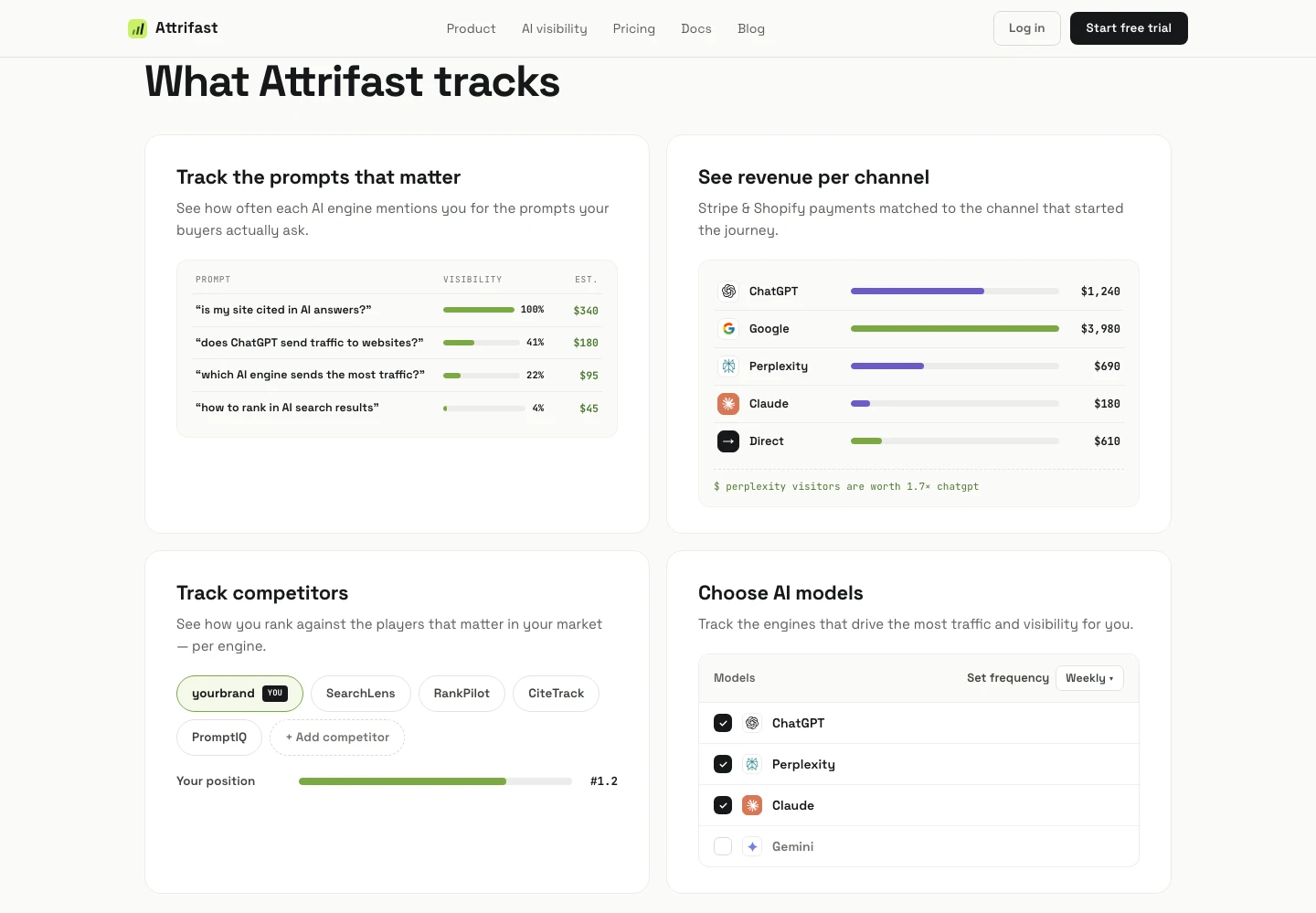
Knowing ChatGPT cited you matters only if you can tell which citations drove paying customers. Attrifast logs every AI citation, captures the click, and joins it back to your Stripe revenue — in one dashboard.
7-day free trial · $49/mo Pro · 30 monitored prompts
What citation tracking does, and what it leaves on the table
Citation tracking is a real and useful job. It is also one step removed from the decision it is supposed to inform.
Citation tracker alone
- ✓Logs every citation event per engine and prompt
- ✓Trends appearance rate over time
- ✓Compares your share against competitors
- ✕Cannot tell which citations sent visitors
- ✕Cannot tell which sent visitors paid
Citation tracker + revenue join
- ✓Every citation event captured (same scan)
- ✓First-party session captured server-side on the click
- ✓Stripe payment joined back via webhook
- ✓Revenue per AI engine, alongside per-prompt citations
- ✓Cut the prompts that never earn a citation
What the citation-to-revenue table actually looks like
Sample row set from a SaaS site after 30 days of tracking. Every row is one engine across the tracked prompt set — cited-or-not per prompt, with sessions and revenue joined per engine.
EngineCited promptsCitationsSessionsTrials / Revenue
ChatGPT (web search)14 of 30 tracked prompts181426/$348
Claude9 of 30 tracked prompts1100/$0
Gemini6 of 30 tracked prompts8281/$58
Claude cited the brand 11 times but produced zero trackable sessions — bare brand mentions without a clickable link. Same data shows where to chase (ChatGPT) and where to deprioritize (Claude for performance).
Why citation-to-revenue measurement is harder than it looks
Three structural problems break the chain if you do not solve them on purpose. First, AI engines strip the HTTP referer in many flows — particularly mobile-app, in-app browsers, and sandboxed share previews — so the click from chatgpt.com or perplexity.ai often arrives at your site with no referrer header at all. GA4 dutifully buckets these as Direct, which is exactly the cohort everyone undercounts[5].
Second, GA4's default channel grouping does not maintain a ChatGPT or Perplexity source/medium mapping out of the box. Even when the referer is preserved, the visit often lands in Referral or Direct rather than in a properly named AI engine channel, and the daily traffic report bundles it invisibly with affiliate clicks and direct type-ins. Fixing this requires custom channel definitions, which most teams do not configure — see our walkthrough at GA4 AI traffic tracking setup.
Third, the citation event and the click event live in separate systems by default. The citation tracker scans engines on its own clock; your analytics tool captures clicks on its clock; your Stripe webhook fires on a third clock. Joining the three requires a shared identifier — a first-party session id captured server-side on the click — that survives both referer stripping and cookie loss. That join is the specific job Attrifast was built to do, and it is the reason the citation table on the previous section has revenue values at all.
For the wider treatment of how AI-citation traffic disappears in standard analytics, the ChatGPT referral analytics guide walks the referer-stripping problem in detail, and the revenue attribution feature page covers the Stripe-join half of the pipeline.
Attrifast vs Profound vs SEOcrawl vs Geoptie
Four real citation trackers. One does the revenue join.
CapabilityAttrifastProfoundSEOcrawlGeoptie
Citation logging per engine
Competitor share leaderboard
First-party click capture
Stripe payment join
Revenue per engine
Open pricing under $50/mo
No demo gate
Vendor claims based on each product's public pages[3][4][6].
AI citation tracking FAQ
How citation tracking works, what it costs, and why the Stripe join changes the decision.
›What is AI citation tracking?
AI citation tracking is the process of monitoring whether large language models — ChatGPT, Claude, Gemini, Perplexity, and their peers — name your domain or brand inside the answers they generate. A citation is the AI-search equivalent of a SERP position: it is the visible inclusion of your site as a source. Citation tracking logs the event each time it happens, attributes it to a specific prompt and engine, and trends it over time. The honest version of citation tracking ends one step further than the count: it joins the citation to the click that follows and then to the Stripe payment that the click eventually produces. Without that join the citation is a presence metric, not a performance metric.
›How does citation tracking differ from citation analysis?
Citation tracking is the longitudinal log: prompt P was scanned on engine E at time T and your domain was either cited or not, alongside the full list of sources the engine cited. Citation analysis is the cross-sectional interpretation: across your scan history, your domain shares citation real estate with the competitors you track, you over-index on ChatGPT, you under-index on Gemini, and 22% of all your citations are concentrated on three prompts. Tracking gives you the event stream; analysis gives you the patterns and the budget implications. Attrifast does both in the same dashboard, but the value of analysis is fully realized only when revenue is layered on top — which is the part most analysis-only tools omit.
›Why is knowing you were cited not enough?
Because not every citation produces a click, and not every click produces a paying customer. Claude in particular often references your brand in a summary without a clickable link at all, which is a brand asset but not a revenue line. ChatGPT and Perplexity link out far more reliably, but the click rate from an AI answer is materially different from the click rate of a top-three Google organic result. Then the visitors that do click vary wildly in conversion behavior based on the prompt intent (buying vs research) and the engine. In our own measurement across instrumented sites, the dispersion between "got cited" and "got paid" is wider than most teams expect. The fix is to report both numbers side by side and let revenue decide which citations to chase.
›How does the join from citation to revenue actually work?
Mechanically: (1) The citation scan logs which engine cited your domain on which prompt at which time. (2) The Attrifast tracking script on your site captures the referrer server-side on every visit — chatgpt.com, perplexity.ai, gemini.google.com, etc. — and stores a first-party session id. (3) When that session later completes a Stripe checkout, the payment_intent.succeeded webhook fires and Attrifast joins the payment to the originating session and back through the session to the engine. (4) Reporting aggregates the joined revenue per AI engine, shown alongside the per-prompt cited/uncited matrix and the top cited sources list. The chain depends on capturing the referrer before GA4 strips it into Direct, which is why server-side first-party capture matters — see dark AI traffic in GA4 for the deeper walkthrough.
›Which AI engines does the citation tracker support?
ChatGPT (with web search), Claude, and Google Gemini — with more engines, including Perplexity, rolling out. Each engine has different citation density and link-out behavior, so each is scored separately. ChatGPT with web search returns structured results, which makes it the engine where citation parsing is cleanest. Claude is the hardest to attribute because it most often summarizes without a link. Gemini sits in the middle.
›How is this different from Profound's citation tracking and Geoptie's rank trackers?
Profound's Answer Engine Insights is the deepest enterprise citation tracker in the market, with strong source-share analysis and a public Index leaderboard. Geoptie ships free per-LLM rank trackers — useful as a top-of-funnel signal but not joined to your site analytics. Attrifast is not trying to out-build Profound on the citation side. We pair a competent citation tracker with the part both products leave open: the Stripe webhook join that tells you which AI engines' citations produced paid trials. If you need the deepest citation analytics, Profound. If you need to defend a marketing budget at SMB scale, Attrifast.
›Can I track competitor citations in addition to my own?
Yes. Every scan parses the full cited-source list each engine returns, not just your own domain. You declare your competitor set during onboarding — up to eight competitor domains on Pro, three on Starter (we suggest a starting set based on your category) — and the dashboard then shows competitor citation share alongside yours across your tracked prompts. We cannot report competitor revenue — only your own Stripe webhook joins back — but the citation-share leaderboard is fully visible in the dashboard.
›What does an AI citation tracker cost?
Attrifast starts at $9.99/mo on Starter — 10 prompts monitored, rescanned every 30 days — and the Pro plan is $49/mo for up to 30 prompts monitored, rescanned every 10 days across ChatGPT, Claude, Gemini, and Perplexity. Both include a 7-day free trial, full first-party tracking on your site, and Stripe webhook attribution. For comparison, enterprise citation tracking platforms are typically sold via demo with annual contracts in the four-to-five-figure-per-month range; the open-priced AI-visibility tools sit in the $50-$200/mo entry band. We are deliberately the cheapest tool in the category that also does the revenue join — that is the wedge.
Sources
Primary sources for the claims in this article. Numbered citations in the text link to the matching entry.
- [1]Anthropic Claude — web search and citations behavior — Anthropic (2025).
- [2]Google AI Overviews study (citation patterns) — Backlinko (2025).
- [3]Answer Engine Insights — citation tracking — Profound (2026).
- [4]Free GEO Rank Tracker — Geoptie (2026).
- [5]Default channel groups and attribution windows — Google Analytics Help (2025).
- [6]AI SEO Visibility Tracker product page — SEOcrawl (2026).
- [7]GEO: Generative Engine Optimization — Princeton University / KDD (Aggarwal et al.) (2024).
Track every citation. Match every payment.
See which AI engines' citations actually drove paid trials, joined to your Stripe data — alongside the per-prompt citation log.
- One script tag and a Stripe key — live in minutes
- First-party measurement without third-party cookies
- Recognized AI referrals joined to Stripe payments
7-day free trial · $0 due today · then $9.99/mo · cancel anytime