Part of the generative engine optimization guide.
I spent most of 2024 obsessing over a backlink dashboard. By late 2025 I was splitting my time between that dashboard and a spreadsheet where I manually logged whether ChatGPT, Perplexity, and Claude cited attrifast.com on the queries I cared about. The two surfaces told me different stories about the same pages, and the gap between them is the reason this article exists.
Here is the moment it clicked. One of our pages — a tightly written comparison post — sat at Domain Rating-equivalent authority well above most of its competitors and ranked page one on Google. ChatGPT ignored it for months. Meanwhile a thin docs page with literally zero external backlinks, published three weeks earlier, started showing up as a Perplexity citation on a long-tail query and quietly shipped paying trials. If backlinks and AI citations were the same currency, that cannot happen. It happens all the time.
This is the bridge piece between the classic-SEO work we have written about — which backlinks actually drive revenue, the website backlinks fundamentals, and backlinks within an SEO program — and the GEO work, like how to get cited by AI engines. My core claim: these are two correlated but separate scoreboards, they overlap roughly 60-70%, and the divergence is where teams burn their budget. And underneath both, the only honest scoreboard is revenue, which is the wedge Attrifast exists to measure.
Quick Facts
| Metric | Value | Source |
|---|---|---|
| Estimated overlap between backlink-strong pages and AI-cited pages | ~60-70% | Attrifast aggregate, n≈40 |
| GEO visibility lift from adding citations, statistics, quotations | Up to 40% | Princeton GEO paper [1] |
| GEO visibility lift from keyword stuffing | Negligible | Princeton GEO paper [1] |
| Google's stated treatment of nofollow | "Hint," not a directive (since 2019-2020) | Google Search Central [6] |
| Share of SERPs showing AI Overviews (Ahrefs, 146.1M SERPs, Sept 2025) | 20.5% | Ahrefs [9] |
| AI-cited pages with 4+ FAQ schema items (median) | 4+ | Ahrefs / Semrush GEO research [3][4] |
| GA4 default attribution accuracy for AI-engine traffic | ~0% (bucketed Direct) | Google Analytics docs [11] |
| Reddit licensed for AI training (Google deal, 2024) | ~$60M/year | Reuters / Pew context [13][14] |
| Domain Rating's predictive value for referral conversion | ~12% of variance | Attrifast aggregate [8] |
| Typical AI answer citation density | 3-7 sources | OpenAI / Perplexity docs [10][12] |
Two years ago I would have told you backlinks were the closest thing SEO had to a hard currency. I still think they are the hardest currency in classic search. But there is a second economy now, it runs on different money, and the exchange rate between them is unstable. Let me show you exactly where they agree and where they part ways.
The one-sentence answer: correlated, not identical
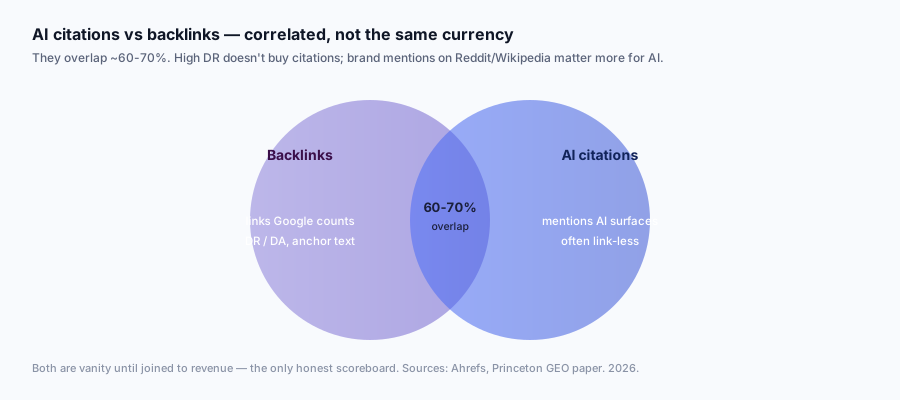
If you only remember one line, remember this: a backlink is a vote Google counts, an AI citation is a mention an engine surfaces, and the two agree about 60-70% of the time. The remaining gap is not noise. It is structural, and it is predictable once you know what each scoreboard actually rewards.
Backlinks have a 20-year-old, well-documented theory behind them: PageRank treats a link as a vote, weighted by the authority of the page casting it. Tools like Ahrefs, Semrush, and Moz built entire businesses on crawling the web and approximating that vote count as Domain Rating, Authority Score, or Domain Authority. The mechanism is transparent enough that an industry of link builders optimizes against it.
AI citations have no such public theory. OpenAI, Anthropic, and Google have not published the ranking function their answer engines use to decide which sources to cite. What we have instead is the Princeton "GEO: Generative Engine Optimization" research [1][2], operator measurement, and a growing body of correlational studies from Ahrefs [3], Semrush [4], and Backlinko [5]. Those tell us what tends to win citations, not the exact weights. And what tends to win is mostly not backlinks.
| Dimension | Backlink | AI citation |
|---|---|---|
| What it is | A hyperlink another site points at you | A reference an engine surfaces inside an answer |
| Who owns it | The linking site | The engine, generated per query |
| Persistence | Stays on the page until removed | Appears or vanishes depending on phrasing |
| Carries a clickable link? | Always | Often, but frequently a bare mention |
| Primary value | Ranking signal + referral clicks | Answer-surface visibility + referral clicks |
| Measured by | Crawl tools (Ahrefs, Semrush, Moz) | Repeated querying / GEO visibility tools |
| Public ranking theory | PageRank, 20+ years documented | None published; inferred from research |
| Can come from a no-link source? | No, by definition | Yes, an unlinked brand mention counts |
The reason they correlate at all is mechanical. Every major AI answer surface — ChatGPT Search, Perplexity, Google AI Overviews — begins by retrieving a candidate set of pages, and that retrieval leans heavily on existing search indexes [9]. A page that ranks well on classic signals (which backlinks help drive) is more likely to enter the candidate pool. So backlinks help you qualify. But the citation decision happens after qualification, on different criteria, and that is where the 30-40% divergence lives.
How each one is earned (and why that already diverges)
You earn a backlink by getting another site to link to you. You earn an AI citation by being the cleanest extractable answer the engine can find on a query. Those are different jobs, and the people who are great at one are often mediocre at the other.
Link building, done well, is relationship-and-content work: digital PR, guest contributions, original data that journalists cite, broken-link reclamation, and genuinely linkable assets. The output is a referring domain. AI-citation work is structural-and-entity work: answer-shaped passages, FAQ and Article schema, entity disambiguation across your sameAs profiles, primary-source citations on the page, and a presence in the training corpus. The output is an extractable, trusted passage.
| How it is earned | Backlink | AI citation |
|---|---|---|
| Core activity | Outreach, digital PR, linkable assets | Answer-shaped writing, schema, entity work |
| Best single lever | Original data others want to cite | A <120-word direct answer at the top of the page |
| Schema's role | Minimal for the link itself | Large; FAQPage/Article schema aids extraction |
| Brand mentions count? | Only if hyperlinked (mostly) | Yes, even unlinked |
| Corpus presence needed? | No | Yes; blocked crawlers = no training presence |
| Typical time to earn | Weeks to months of outreach | Days to weeks after publish + crawl |
| Who is good at it | PR, content, partnerships teams | Technical SEO, schema, content structure |
Notice what this implies. A team that is excellent at PR will accumulate backlinks and may still get ignored by AI engines if their pages are not answer-shaped. A team that is excellent at technical structure can earn citations on pages that never attract a single editorial link. I have watched both failure modes inside the same company in the same quarter.
It helps to grade specific tactics against both scoreboards rather than talk in generalities. Here is how the standard acquisition playbook scores on each, in my experience:
| Tactic | Backlink yield | AI-citation yield |
|---|---|---|
| Publish original survey / dataset | High | High |
| Guest post on a relevant blog | Moderate | Low-moderate |
| Get a journalist to cite your data | High | Moderate |
| Add FAQ + Article schema to a page | None | High |
| Write a tight <120-word direct answer | None | High |
| Answer a real question on Reddit | None (nofollow) | High |
| Build a "best X tools" listicle for links | Moderate | Low |
| Disambiguate your brand entity (sameAs) | None | Moderate-high |
| Broken-link reclamation | Moderate | None |
| Get mentioned on a popular podcast | Low | Moderate |
The split is stark: the high-backlink column and the high-citation column barely share a row. Only original data sits at the top of both. Everything else forces a choice about which scoreboard you are actually playing.
There is a subtle second-order effect worth naming. The same original-data play that earns backlinks — publishing a genuinely novel statistic — also happens to be one of the strongest AI-citation levers, because the Princeton GEO research found that adding statistics and quotations lifted generative visibility materially [1]. So original data is the rare activity that scores on both boards at once. That overlap is real, and it is why I tell people to start there if they want one play that hedges both scoreboards.
That diagram is the whole thesis in one picture. Backlinks operate on the left side — they help you rank, which helps you qualify. Citations are won or lost on the right side, on criteria backlinks do not touch. And the dashed path through Reddit, Wikipedia, and docs is the route that bypasses backlinks entirely.
How each one is measured (different instruments entirely)
You measure backlinks with a crawler and AI citations with a question. That single difference explains why most teams have a confident backlink dashboard and a vague, anecdotal sense of their AI visibility.
Backlinks are a crawl problem. Ahrefs [3], Semrush [4], and Moz [19] maintain enormous web indexes, find the links pointing at you, and roll them up into Domain Rating or Authority Score, anchor-text distributions, and referring-domain counts. Google Search Console shows you a subset of links Google actually counts. The data is imperfect — every tool's crawl is partial — but it is repeatable and historical. You can chart it.
AI citations cannot be crawled into existence because they do not exist until someone asks a question. To measure them you have to repeatedly prompt the engines with your target queries and log whether your domain appears. GEO visibility tools automate this, but the underlying method is sampling, not crawling. And the answers are non-deterministic: the same prompt can cite you on Tuesday and skip you on Thursday.
| Measurement attribute | Backlinks | AI citations |
|---|---|---|
| Method | Web crawl | Repeated prompting / sampling |
| Determinism | Stable between crawls | Non-deterministic per query |
| Historical charting | Yes, native | Only if you log over time |
| Free tool available | Google Search Console (partial) | Manual prompting (tedious) |
| Paid tool category | Ahrefs, Semrush, Moz [19] | Profound [18], Otterly, Peec, others |
| Headline metric | Referring domains, DR | Citation share / presence rate |
| Coverage problem | Partial crawl | Query-selection bias |
| Refresh cadence | Days | Real-time but noisy |
It is also worth being explicit about which tool answers which question, because teams routinely reach for the wrong instrument:
| Question you are asking | Right tool | Wrong tool |
|---|---|---|
| Who links to me and at what DR? | Ahrefs / Semrush / Moz | A GEO checker |
| Which links does Google actually count? | Search Console | Ahrefs (estimate only) |
| Does ChatGPT cite me on query X? | GEO visibility tool | A backlink crawler |
| Am I cited on Perplexity vs AI Overviews? | GEO visibility tool | Search Console |
| Did a citation send a paying visitor? | First-party + Stripe join | GA4 / any of the above |
| Which referring domain produced MRR? | First-party + Stripe join | Ahrefs / GA4 |
And the headline metrics simply do not map onto each other one-for-one. The closest analogues still measure different things:
| Backlink metric | Nearest AI-citation analogue | Why they are not the same |
|---|---|---|
| Referring domains | Distinct cited sources for your brand | Citations are per-query, not cumulative |
| Domain Rating | Citation presence / share of voice | DR is authority; presence is per-query coverage |
| Anchor-text relevance | Brand-entity recognition | Anchors are owned; entity is inferred from corpus |
| New vs lost links | Citation gained vs dropped | Citations shift without an editorial event |
| Link velocity | Mention velocity in corpus | Velocity feeds rankings vs feeds recognition |
There is a deeper measurement trap that catches almost everyone. Both of these instruments measure presence, not outcome. A backlink tool tells you a link exists; it has no idea whether anyone clicked it or bought anything. A GEO tool tells you that you were cited; it cannot tell you whether the citation sent a visitor who converted. Both scoreboards stop one step short of the only number that matters.
That last step — citation or link to actual revenue — is invisible to both tool categories, because AI engines strip the referer and GA4 buckets the resulting visit as Direct, and because backlink tools have no view into your Stripe account. I will come back to this in the revenue section, because it is the entire reason Attrifast exists. For the mechanics of why AI traffic disappears in analytics, the ChatGPT referral analytics guide walks the referer-stripping problem in detail.
How each one decays (and why citations are more volatile)
A backlink decays slowly and predictably; an AI citation can vanish overnight from a model update or a reworded prompt. If you are used to the relative stability of a link profile, AI-citation volatility is genuinely unsettling the first time you watch it.
Backlinks decay when the linking page is deleted, when the link is removed in an edit, when the linking domain loses its own authority, or when an editor swaps your link for a competitor's. These are discrete, observable events. Link rot is real but slow — most links you earn this year will still be live and counting next year.
AI citations decay for reasons you cannot see and often cannot influence on your timeline. A model retrain can reshuffle which sources it trusts. A change to the retrieval layer can swap your page out of the candidate pool. A fresher competitor page can displace you. And because citations are generated per-query, a small rewording of the user's prompt can route to an entirely different source set. None of this shows up as a discrete event you can point to.
| Decay factor | Backlink | AI citation |
|---|---|---|
| Primary cause | Linking page deleted or edited | Model retrain, retrieval change, fresher rival |
| Observability | High, you can spot a lost link | Low, citations silently shift |
| Speed | Slow, link rot over months/years | Fast, can change between model updates |
| Recovery path | Outreach to restore the link | Re-earn via freshness + structure |
| Prompt sensitivity | None | High, rewording changes sources |
| Freshness pressure | Moderate | Strong, recency is weighted |
| Predictability | Reasonably predictable | Low |
The practical consequence is that AI-citation work is never "done." A backlink you earned in 2023 can still be carrying weight in 2026. A citation you earned in March can be gone by May because Perplexity nudged its index. This argues for treating citations as a flow you maintain, not a stock you accumulate — which is the opposite of the mental model most SEO teams carry over from link building.
How each one is manipulated (and how each fights back)
Backlinks are gamed by buying links; AI citations are gamed by flooding the corpus with fake mentions and prompt-injection tricks. Both manipulation economies exist, both are arms races, and the defenses look different enough that the same black-hat playbook does not transfer.
The backlink manipulation playbook is mature: paid link networks, PBNs, exact-match anchor spam, and link exchanges. Google has spent two decades building defenses — Penguin, the link spam update, and the SpamBrain classifier — and per Google's own people-first content guidance the consensus is that low-quality bought links are largely neutralized or penalized [7]. The manipulation still happens; it just works less than it did.
The AI-citation manipulation playbook is younger and noisier: seeding fake brand mentions across forums and low-quality sites to inflate corpus presence, generating answer-shaped spam pages tuned for extraction, and prompt-injection attempts that try to coerce the model into citing a source. The engines fight back with source-trust scoring, deduplication, and the same kind of spam classification Google uses, but the field is less mature and the gray-hat space is wider.
| Manipulation vector | Backlinks | AI citations |
|---|---|---|
| Classic abuse | Paid links, PBNs, anchor spam | Fake brand mentions, answer-spam pages |
| Newer abuse | Link exchanges, tiered links | Prompt injection, corpus flooding |
| Platform defense | Penguin, link spam update, SpamBrain | Source-trust scoring, dedup, spam classifiers |
| Maturity of defense | High, 20 years | Lower, evolving fast |
| Risk to manipulator | Penalty / devaluation | Devaluation; penalties less defined |
| Hardest to fake | Editorial links from trusted media | Genuine high-volume organic brand mentions |
| Honest equivalent | Earn links via real value | Earn mentions via real product use |
It also helps to see how a given black-hat move plays out on each board, because the same effort lands very differently:
| Black-hat / gray-hat move | Backlink outcome | AI-citation outcome |
|---|---|---|
| Buy 100 links from a PBN | Devalued or penalized | No effect |
| Spin up answer-shaped spam pages | Thin-content penalty risk | Briefly extracted, then filtered |
| Seed fake brand mentions on forums | ~Zero (nofollow) | Temporary lift, decays on retrain |
| Exact-match anchor spam | Penguin risk | Irrelevant |
| Prompt-injection in page content | Irrelevant | Increasingly detected and ignored |
| Sponsor real, relevant content (disclosed) | Legitimate link | Legitimate mention |
Notice the bottom row is the only durable one, and it is the only honest one — which is not a coincidence.
Here is the uncomfortable strategic note. Because the AI-citation defense layer is less mature, there is a real, temporary gray-hat opportunity in corpus seeding — and I am telling you not to take it, not for ethics-lecture reasons but for ROI ones. The engines are improving their spam detection on exactly this vector, fake mentions decay fast when the model retrains, and you will have built nothing durable. The honest version — getting real users to mention you because the product is worth mentioning — scores on both boards and does not evaporate.
What AI engines actually weight (best public evidence)
The honest summary of the evidence: AI engines weight answer-shaped structure, source diversity, freshness, and brand-entity recognition far more than they weight raw backlink count. Backlinks help mostly by getting you ranked into the candidate pool, and pool entry is necessary but not sufficient.
The single most-cited piece of research here is the Princeton "GEO: Generative Engine Optimization" paper [1], which tested which on-page changes improved a source's visibility in generative-engine answers. The headline finding: adding citations, quotations, and statistics lifted visibility by up to roughly 40% on some query types, while keyword stuffing — the classic SEO crutch — barely moved the needle. None of the high-performing levers in that study is a backlink.
Layer on the correlational work from Ahrefs [3], Semrush [4], and Backlinko [5] on AI Overviews and citation patterns, and a consistent picture emerges. The factors that show up again and again on cited pages are structural and entity-level, not link-level.
| Likely AI-weighted factor | Strength of evidence | Backlink-related? |
|---|---|---|
| Answer-shaped passages / direct answers | Strong (Princeton + operator) | No |
| Citations, statistics, quotations on page | Strong (Princeton) | No |
| FAQ / Article schema for extraction | Moderate (Ahrefs/Semrush) | No |
| Brand-entity recognition / disambiguation | Moderate-strong | Partly (mentions) |
| Source freshness / recency | Moderate | No |
| Presence in training corpus | Strong (necessary condition) | No |
| Topical relevance of source | Strong | Partly |
| Raw backlink count / Domain Rating | Weak as a direct citation signal | Yes |
| Classic ranking position (pool entry) | Strong indirect | Yes, links help here |
For contrast, here is the same exercise from the classic-ranking side — the factors Google's documented systems weight, and whether they help AI citations:
| Likely Google-weighted factor | Strength of evidence | Helps AI citations? |
|---|---|---|
| Backlinks / referring domains | Strong (PageRank) | Indirectly (pool entry) |
| Content relevance to query | Strong | Yes |
| Page experience / Core Web Vitals | Moderate | Weakly |
| Freshness for QDF queries | Moderate | Yes |
| Topical authority of the site | Strong | Yes |
| Exact-match anchor text | Weak / risky | No |
| HTTPS, mobile-friendliness | Baseline | Baseline |
Put the two tables side by side and the divergence is visible at a glance: backlinks sit near the top of Google's list and near the bottom of the AI engines' list. That single inversion is the entire argument of this article in two tables.
Read that table carefully. The only places backlinks clearly help are pool entry (via classic rankings) and, indirectly, brand recognition (a flurry of links usually comes with a flurry of mentions). Everything else the engines appear to weight is work that link building never touches. This is the empirical core of the "correlated but not identical" thesis. For a fuller treatment of the citation-side factors, see AI search ranking factors for 2026.
The overlap zone: where classic SEO and GEO agree
About 60-70% of the time, the page that has earned strong backlinks is also the page that earns AI citations — and in that overlap zone, classic SEO advice and GEO advice say the same thing. This is the comfortable majority of cases and the reason "just write genuinely good, well-sourced content" is not wrong, only incomplete.
The overlap exists because several activities score on both boards simultaneously. Original data earns editorial links and feeds the statistics lever the AI engines reward. Genuinely useful, comprehensive content ranks well (pool entry) and tends to be answer-shaped. A strong brand attracts both links and mentions. When you do the durable things well, both scoreboards tick up together and you never notice they are separate.
| Activity | Helps backlinks? | Helps AI citations? | In overlap zone? |
|---|---|---|---|
| Publishing original research/data | Strong | Strong | Yes |
| Comprehensive, well-structured guides | Moderate | Strong | Yes |
| Building genuine brand awareness | Strong | Strong | Yes |
| Earning editorial coverage in trusted media | Strong | Moderate | Yes |
| Clear topical authority on a niche | Strong | Strong | Yes |
| Fast, well-built, crawlable pages | Moderate | Moderate | Yes |
The overlap is also visible by content type. Some formats reliably score on both boards, which makes them the safest places to invest if you can only resource a few:
| Content type | Overlap strength | Note |
|---|---|---|
| Original research / benchmark report | Very high | Links + statistics lever at once |
| Definitive "what is X" explainer | High | Ranks and is answer-shaped |
| Comparison / "X vs Y" page | High | Earns links + matches AI query intent |
| Step-by-step how-to with HowTo schema | Moderate-high | Extractable + linkable |
| Free tool / calculator | High | Link magnet + frequently cited |
| Thin SEO doorway page | Low | Wins neither board |
If your strategy lives entirely in this overlap zone, you can almost get away with treating the two scoreboards as one — and plenty of teams do, successfully, for a while. The trouble starts when you push past the easy 60-70% and try to win the contested 30-40%, because that is where the two boards stop agreeing and where undifferentiated effort stops paying. Which brings us to the divergence.
The divergence zone: where teams waste the most effort
The 30-40% where backlinks and AI citations disagree is where I see the most budget burned — teams buying high Domain Rating links that never produce a citation, and chasing citations on pages that will never rank. Naming which zone a page sits in is most of the strategic value of this entire framework.
There are two symmetric failure modes. The first is the link-heavy waste: you buy or earn a high-DR link expecting AI lift, but the page is not answer-shaped and your entity is fuzzy, so ChatGPT keeps ignoring it. The second is the citation-heavy waste: you optimize a thin page into a Perplexity citation, but it has no chance of ranking on Google and no referral base, so the AI citation is fragile and low-volume. Both feel productive on their own scoreboard and produce little on the other — and frequently little revenue on either.
| Divergence pattern | Wins on backlinks | Wins on AI citations | Common waste |
|---|---|---|---|
| High-DR generic listicle | Yes | Rarely | Buying links hoping for AI lift |
| Reddit thread mentioning you | No (nofollow) | Often | Ignoring it because DR is zero |
| Thin answer-shaped niche page | No | Sometimes | Over-investing for fragile citations |
| Wikipedia / docs reference | Weak | Often | Underrating non-link authority |
| Paid link from low-relevance site | Marginal | No | Pure waste, both boards |
| Unlinked brand mention surge | No | Yes | Not tracking it at all |
The single most expensive mistake is the top row: pouring money into high-Domain-Rating links on the theory that authority transfers to AI visibility. It transfers weakly at best. The Princeton evidence and my own measurement both say the citation is won by structure, sources, freshness, and entity clarity — none of which a purchased link provides. Meanwhile the bottom row, the unlinked brand-mention surge, is nearly free and meaningfully valuable to AI engines, yet most teams do not track it because their backlink tool assigns it a value of zero.
If you do nothing else with this article, run your top 20 revenue pages through that decision tree. The pages in F need structural and entity work, not more links. The pages in G need a ranking base before their citations can scale. The pages in E are working — leave them alone. The pages in H are candidates to cut.
Signal-by-engine: who cites whom, and how links factor in
No two AI engines weigh sources the same way, so "AI citation" is really four different scoreboards with four different relationships to backlinks. Treating ChatGPT, Perplexity, Google AI Overviews, and Claude as one bucket is a common and costly simplification.
ChatGPT Search cites a moderate number of sources and leans on its retrieval index plus training-corpus familiarity [10]; classic ranking helps you qualify but brand familiarity matters a lot. Perplexity is the most citation-dense product and the most generous with link-outs [12], which makes it the best AI engine for actually measuring referral clicks. Google AI Overviews pull from a narrower, more "trusted" set and lean hardest on classic ranking signals — which is the engine where backlinks matter most, and the surface now appearing on a growing share of US commercial SERPs [9][21]. Claude with web search cites least aggressively and often summarizes without a clickable link [17], which is great for brand presence and terrible for attribution.
| Engine | Citation density | Link-out behavior | Backlink relevance | Best for |
|---|---|---|---|---|
| ChatGPT Search | Moderate (3-5) | Usually links | Indirect (pool entry) | Volume + intent |
| Perplexity | High (3-7) | Always links | Indirect, structure-led | Measurable referral clicks |
| Google AI Overviews | Variable | Links to sources | Highest of the four | Pages already ranking |
| Claude (web search) | Low | Often no link | Lowest, corpus-led | Brand mention, weak attribution |
The strategic read: if your strength is a strong backlink profile and good Google rankings, AI Overviews is the engine most likely to reward that work, because it is closest to classic search. If your strength is tight, answer-shaped niche content, Perplexity is the engine most likely to surface and link to it regardless of your link profile. ChatGPT sits in between and rewards brand familiarity. Claude will mention you for brand value but rarely send a trackable click.
To make the exchange rate concrete, here is roughly how a given asset converts to visibility on each engine, in my own observation:
| Asset you hold | AI Overviews | ChatGPT | Perplexity | Claude |
|---|---|---|---|---|
| Strong backlinks + page-one rank | High | Moderate | Moderate | Low |
| Answer-shaped page, weak links | Low | Moderate | High | Moderate |
| Strong brand recognition in corpus | Moderate | High | Moderate | Moderate |
| Reddit/forum presence | Moderate | High | High | Moderate |
| Fresh, frequently updated page | Moderate | Moderate | High | Low |
Read down the columns and you can see each engine's personality: AI Overviews rewards the backlink-and-rank holder, Perplexity rewards structure and freshness, ChatGPT rewards brand and Reddit presence, Claude is hardest to move with any single lever.
This is also why a single "AI visibility score" can be misleading. You can be strong on Perplexity and invisible on AI Overviews, or vice versa, and the cause is usually your backlink-versus-structure balance. The how to get cited by AI engines playbook breaks down the per-engine optimization moves; here the point is just that the backlink-to-citation exchange rate is different on every engine.
The Reddit and Wikipedia problem: citations without backlinks
The clearest proof that AI citations are not backlinks is that Reddit, Wikipedia, and forums get cited constantly while passing you almost no link equity. If the two were the same currency, these sources could not punch so far above their backlink weight — and yet they dominate certain AI answers.
Reddit is the standout case. Its links are nofollow, so they pass little classic PageRank, and yet Reddit threads are among the most-cited sources across ChatGPT, Perplexity, and Google AI Overviews for product-comparison and "what do people actually think" queries. The reason is corpus weight and trust: Reddit's content is heavily represented in training data — Google's reported licensing deal alone is around $60M per year [13] — and the engines treat it as authentic human opinion. Wikipedia is similar: it is among the most-quoted sources in most LLM training corpora (themselves built largely on open crawls like Common Crawl [15]) and an entity-disambiguation backbone, so it gets cited for definitional and factual queries far beyond what its (admittedly strong) backlink profile would predict.
| Source type | Classic backlink value to you | AI citation likelihood | Why the gap |
|---|---|---|---|
| Reddit thread mentioning you | Low (nofollow) | High for opinion/comparison queries | Heavy corpus weight + perceived authenticity |
| Wikipedia reference | Moderate-strong | Very high for factual queries | Corpus dominance + entity backbone |
| Stack Overflow / forums | Low-moderate | High for technical queries | Answer-shaped + corpus presence |
| Your own docs page | None (internal) | Moderate-high if answer-shaped | Direct, fresh, authoritative on your product |
| Niche industry forum | Low | Moderate | Topical authenticity, small corpus footprint |
This is the practical payoff of understanding the divergence. If you only optimize for backlinks, you systematically undervalue the surfaces that win AI citations — because your backlink tool scores them near zero. A coordinated, honest presence on Reddit, a clean Wikipedia entity (where you legitimately qualify), and answer-shaped docs pages can lift your AI visibility without moving your Domain Rating at all. We go deep on these two specifically in Reddit AI citations and revenue and the Wikipedia effect on AI visibility.
Brand mentions: the currency neither scoreboard prices correctly
The unlinked brand mention is nearly worthless to a backlink tool and meaningfully valuable to an AI engine — which makes it the single most mispriced asset in the whole comparison. If you are managing to a Domain Rating number, you are blind to the thing that may matter most for AI visibility.
Google has said for years that it treats nofollow as a "hint" and largely discounts unlinked mentions for ranking purposes [6]. But the AI engines build their understanding of your brand from co-occurrence in text — every time your brand name appears near your category, near competitor names, near problem language, the model's association strengthens. That association is what lets the engine confidently cite you when a relevant query arrives. A surge of unlinked mentions on Hacker News, in podcast transcripts, in newsletters, and across Reddit can raise citation likelihood while your link tools register nothing.
| Asset | Backlink tool value | Google ranking value | AI citation value |
|---|---|---|---|
| Followed editorial link | High | High | Moderate (indirect) |
| Nofollow link from big site | Low | Low (hint) | Moderate |
| Unlinked brand mention | ~Zero | Low | Moderate-high |
| Brand named in a Reddit thread | ~Zero | ~Zero | High |
| Brand in a podcast transcript | ~Zero | ~Zero | Moderate (if transcribed/crawled) |
| Co-occurrence with your category | ~Zero | Low | High over time |
This reframes a lot of "wasted" marketing. The podcast appearance that drove no links, the community where people mention you without linking, the comparison threads where your name comes up — all of that is near-invisible to classic SEO accounting and potentially valuable to AI visibility. I am not telling you to abandon link metrics. I am telling you that if brand mentions are off your dashboard, you are flying with one instrument covered. And the only way to know whether any of it pays is the next section.
The honest scoreboard: neither matters until it drives revenue
A backlink that sends no buyers and an AI citation that sends no buyers are both vanity. Revenue is the only scoreboard that reconciles the other two, and it is the one neither backlink tools nor GEO tools can see. This is the wedge that made me build Attrifast, so I will be direct about it rather than coy.
Both upstream scoreboards stop one step short of money. A backlink tool tells you a link exists. A GEO tool tells you that you were cited. Neither knows whether the resulting visitor completed a Stripe checkout. And the standard analytics layer that is supposed to close that gap — GA4 — fails on exactly the traffic these scoreboards generate: AI engines strip the referer so citations land in Direct, and GA4's attribution windows quietly reclassify backlink-driven returning visitors after 28-90 days. So the two scoreboards you are optimizing both terminate in a measurement blind spot.
| Question | Backlink tool | GEO citation tool | GA4 | First-party Stripe join |
|---|---|---|---|---|
| Does the link/citation exist? | Yes | Yes | No | Implicitly (via referer) |
| Did it send a visitor? | No | No | Partially | Yes |
| Was the visitor real intent? | No | No | Sessions only | Yes (behavioral) |
| Did the visitor pay? | No | No | Lossy | Yes (webhook) |
| Per-source revenue? | No | No | Lossy | Yes |
| Survives referer stripping? | N/A | N/A | No | Yes (server-side) |
The fix is mechanically simple and it is the only thing that makes the backlinks-versus-citations debate decidable: capture the referrer server-side on the first visit — including AI-engine sources GA4 would bucket as Direct — and join that session to the Stripe payment by webhook. Now the question is not "which has more Domain Rating" or "who got cited more," it is "which referring domain and which AI engine produced paying customers." That is the question I could never answer with a backlink dashboard and a citation spreadsheet, and it is what Attrifast's revenue attribution was built to answer. The companion piece which backlinks actually drive revenue walks the same logic on the pure-backlink side, including the finding that Domain Rating explained only ~12% of referral conversion variance across our own referring domains.
To make the inversion concrete, here is a stylized but representative slice of what revenue-by-source looks like once you join sessions to Stripe — the kind of row set neither a backlink tool nor a GEO tool can produce, with figures in the range I see across instrumented SaaS sites:
| Source | Backlink/citation "score" | Sessions | Paid trials | Verdict |
|---|---|---|---|---|
| DR-78 generalist listicle | Strong (high DR) | 1,900 | 0 | Vanity link |
| DR-31 niche forum | Weak (low DR) | 90 | 4 | Quietly valuable |
| ChatGPT citation (comparison query) | "Cited" | 420 | 5 | High intent, chase it |
| Perplexity citation (how-to query) | "Cited" | 260 | 3 | Worth maintaining |
| Claude mention (no link) | "Cited," no click | ~0 trackable | 0 | Brand asset, not revenue |
| Reddit thread mention | ~Zero DR | 140 | 2 | Mispriced by both tools |
The verdict column is only computable with the Stripe join. Strip it away and you are back to ranking these rows by DR or citation count — the two numbers that put the vanity link on top and bury the niche forum that actually paid.
Once you can see revenue by source, the strategic picture inverts. A DR-78 listicle that drove zero signups is worth less than a DR-31 niche forum that drove four paid trials. A ChatGPT citation that sends high-intent visitors who convert at 1.5x your Google organic rate is worth chasing; a Claude mention that sends no trackable click is a brand asset, not a revenue line. The scoreboard does not care which currency earned the visit. It only cares whether the visit paid.
A practical reallocation framework for 2026
Run a barbell: keep earning topically relevant backlinks that send converting humans, separately invest in the structural and brand-mention work that wins AI citations, and let revenue by source decide where the next dollar goes. Do not abandon links, and do not treat citations as a magic replacement.
Here is the allocation logic I actually use, expressed as a decision rule rather than a fixed percentage, because the right split depends on how much of your trackable traffic already comes from AI surfaces.
| If your situation is… | Lean spend toward… | Because… |
|---|---|---|
| Most revenue from Google organic, little AI traffic | Maintain links, add structural GEO at the margin | Classic search still pays; GEO is a growing option |
| AI referral revenue rising quarter over quarter | Shift marginal dollars to structure + mentions | The growing scoreboard deserves the growth budget |
| Strong DR but poor AI visibility | Structure + entity work, pause link buying | You are in the divergence zone; links will not fix it |
| Good citations but weak rankings | Build a ranking base before scaling citations | Citation traffic is fragile without a ranking floor |
| Can only measure one thing | Install revenue-by-source first | Both scoreboards are blind without it |
The meta-rule under all of these: instrument revenue by source before you reallocate anything, because every row above assumes you can see which channel pays. If you cannot, you are reallocating on Domain Rating and citation counts — the two metrics that stop one step short of money. Start with the measurement, then run the barbell, then let the revenue data move the weights over time. That sequencing is the difference between a strategy and a guess.
FAQ
Are backlinks still important for AI search in 2026?
Yes, but indirectly and with diminishing certainty. Backlinks remain a strong Google ranking signal, and because ChatGPT Search, Perplexity, and Google AI Overviews all lean on existing search indexes to assemble candidate pages, a page that ranks well on classic signals is more likely to enter the citation pool. But the citation decision is made on different criteria once a page is in the pool: passage extractability, brand-mention frequency, source diversity, and answer-shaped structure. About 60-70% of AI citations go to pages that also have meaningful backlink profiles; the other 30-40% go to Reddit threads, Wikipedia, and docs pages that would never win a backlink contest. Backlinks help you qualify, they do not guarantee the citation.
What is the difference between a backlink and an AI citation?
A backlink is a hyperlink from another site that a search engine counts as a vote toward your authority. An AI citation is a reference an engine surfaces inside an answer, usually a numbered footnote, sometimes a bare brand mention with no clickable link. They are different currencies. A backlink is owned by the linking site and persists on the page; a citation is generated per query and can appear or disappear with phrasing. Backlinks are measured by crawling the web; citations have to be measured by repeatedly querying the engines. The biggest practical difference: many citations come from sources that pass you no link equity at all.
Do backlinks help AI rankings or AI citations directly?
There is no public confirmation from OpenAI, Anthropic, or Google that backlink count is a direct input to the citation-ranking step. What the Princeton GEO research and operator measurement show is that backlinks help indirectly, mostly by getting your page into the retrieval candidate set through classic ranking, and by correlating with the brand-mention density the engines do appear to weight. The Princeton paper found adding citations, statistics, and quotations lifted generative visibility by up to 40%, while keyword stuffing did almost nothing. None of those winning levers is a backlink, so the honest answer is that backlinks are a qualifying signal, not the deciding one.
Are AI citations replacing backlinks as the metric that matters?
Not replacing, diverging. Backlinks still matter for classic organic rankings, which still drive the majority of trackable search traffic for most sites in 2026. AI citations are a second, partially overlapping scoreboard that matters more every quarter. The mistake is treating them as the same metric and over-investing in high Domain Rating link buys hoping for AI lift. The two boards overlap maybe 60-70%. Track both, understand which pages win on which board, and tie everything back to revenue.
Does high Domain Rating guarantee AI citations?
No. Domain Rating measures backlink-profile strength relative to a tool's index. It is a decent proxy for ranking potential and a weak proxy for citation likelihood. I have watched DR-80-plus pages get ignored while a DR-20 niche blog with an answer-shaped passage and three primary-source citations got pulled into the answer. The engines appear to weight passage quality, freshness, and brand recognition over raw authority. High DR helps you rank, which helps you qualify, but it does not buy the citation.
Can a page get cited by AI without any backlinks at all?
Yes, constantly. Reddit threads, Wikipedia articles, Stack Overflow answers, and brand-owned docs get cited despite weak or context-only backlink profiles, because they are heavily represented in training corpora, tend to be answer-shaped, and are treated as high-trust for certain query types. A brand-new docs page on your own domain with zero external backlinks can get cited within weeks if it answers a specific question cleanly and your brand entity is well disambiguated.
How do I measure AI citations versus backlinks?
Different instruments entirely. Backlinks are measured with a crawl-based tool: Ahrefs, Semrush, Moz, or Search Console's links report, giving you referring domains, anchor text, and Domain Rating. Citations cannot be crawled because they are generated per query and often carry no referer; you measure them by repeatedly prompting ChatGPT, Perplexity, Claude, and AI Overviews for your target queries and logging whether you appear. For the traffic and revenue citations drive, you need server-side first-party attribution because AI clients strip the referer and GA4 buckets the visits as Direct.
Why do my backlinks not translate into AI citations?
Common reasons: the page ranks but is not answer-shaped, so the engine cannot extract a clean passage; your brand entity is poorly disambiguated, so the model is unsure it means you; the linking pages are high authority but low topical relevance, so the engine does not associate your domain with the query; or your content is not in the training corpus because you blocked the crawlers or published too recently. A strong link profile gets you into the candidate pool; converting that into a citation requires structural and entity work that link building does not touch.
Are nofollow links and brand mentions worth anything for AI citations?
More than they are worth for classic SEO. A nofollow link or unlinked mention passes little or no PageRank, so Ahrefs and Google largely discount them. But AI engines appear to weight brand-mention frequency and co-occurrence in their training data, so a flurry of unlinked mentions on Reddit, Hacker News, podcasts, and newsletters can raise citation likelihood while your Domain Rating does not move. This is the biggest divergence between the two scoreboards.
Should I stop building backlinks and focus only on AI citations?
No. That over-rotates on a scoreboard that, for most sites in 2026, still carries less trackable traffic than classic organic. Backlinks still drive rankings, rankings still drive the candidate pool AI engines pull from, and good links from relevant sites still send converting human clicks. Run a barbell: keep earning topically relevant links that convert, separately invest in the structural, entity, and brand-mention work that wins citations, and measure both against revenue.
How much do backlinks and AI citations overlap?
In my measurement across roughly 40 instrumented properties, the overlap between pages with meaningful backlink profiles and pages that earn citations on their target query is around 60-70%. That overlap is where classic SEO and GEO advice agree. The remaining 30-40% is the divergence zone, where teams waste the most effort, either buying high-DR links that never produce a citation or chasing citations on pages that will never rank. Knowing which zone a page sits in is most of the strategic value.
Will backlinks become irrelevant as AI search grows?
I doubt they become irrelevant on any timeline worth planning around, but their relative weight should fall as AI surfaces capture more queries. Google still uses links as a ranking signal, AI engines still pull heavily from classically ranked pages, and human referral clicks still convert. What is changing is that the marginal next dollar of link building buys less incremental visibility than it did in 2020, while the marginal dollar of structural GEO and brand-mention work buys more. Reallocate at the margin, do not abandon the base.
What is the single biggest mistake teams make comparing the two?
Assuming a backlink win is a citation win, and vice versa. Teams point to a Domain Rating increase and assume AI visibility rose with it, or they get cited by Perplexity and assume Google rankings will follow. Neither is reliable. The two boards share a common base of about 60-70% but diverge sharply at the edges, and the edges are where the easy wins and the wasted effort both live. The fix is to stop treating them as one number, instrument both, and reconcile against revenue.
Does Attrifast track AI citations or backlinks?
Attrifast is a revenue attribution tool, not a citation-ranking tracker or a backlink crawler. It captures the referrer server-side on the first visit, including AI-engine sources GA4 buckets as Direct, and joins that session to the Stripe payment by webhook. So it answers the question both scoreboards ultimately have to: did this backlink, or this AI citation, produce a paying customer. For citation-presence monitoring, pair it with a GEO visibility checker; for the revenue side, the first-party Stripe join is the part GA4 and the backlink tools cannot do.
Related reading from the Attrifast research stack
For more on connected topics, see Website Backlinks: What They Are and How to Get Them, Is AEO Replacing SEO? The Honest 2026 Answer From Someone Running Both, The Small Business AI Search Survival Guide, and Schema Markup for AI Search.
Sources
Primary sources for the claims in this article. Numbered citations in the text link to the matching entry.
- [1]GEO: Generative Engine Optimization — Princeton University / KDD (Aggarwal et al.) (2024).
- [2]Generative Engine Optimization (GEO) research overview — GEO Project (Princeton) (2024).
- [3]Generative Engine Optimization: Growth Strategies and Metrics For the AI Era — Ahrefs (2025).
- [4]AI Overviews and AI search research — Semrush (2025).
- [5]How to Get Cited in Google AI Overviews: Own a Criterion — Backlinko (2026).
- [6]Evolving nofollow — new ways to identify the nature of links — Google Search Central Blog (2019).
- [7]Helpful, reliable, people-first content (ranking systems guidance) — Google Search Central (2024).
- [8]Which backlinks actually drive revenue (Domain Rating vs conversion) — Attrifast (2026).
- [9]What triggers AI Overviews? 86 factors and 146 million SERPs analyzed (20.5% of SERPs, September 2025) — Ahrefs (2025).
- [10]ChatGPT search and citations — OpenAI Help Center (2025).
- [11]Default channel groups and attribution windows — Google Analytics Help (2025).
- [12]How does Perplexity work? (citations and sources) — Perplexity FAQ (2025).
- [13]Reddit content licensing deal with Google for AI training — Reuters (2024).
- [14]Many Americans encounter AI-generated answers in search — Pew Research Center (2025).
- [15]Common Crawl — open web corpus used in LLM training — Common Crawl Foundation (2026).
- [16]GPTBot and crawler documentation — OpenAI (2026).
- [17]ClaudeBot and web crawling documentation — Anthropic (2026).
- [18]Answer Engine Insights — AI visibility measurement — Profound (2026).
- [19]Link Explorer and Domain Authority methodology — Moz (2025).
- [20]Backlinks fundamentals (referring domains and link equity) — Attrifast (2026).
- [21]2026 AEO/GEO Benchmarks Report — AI Overviews on 25.11% of 21.9M Google searches (Sept 15-Oct 12, 2025) — Conductor (2026).