A backlink in 2026 has three jobs: it votes for your page, it qualifies that vote, and it sends a human who might pay. SEO content has historically obsessed over job one and ignored job three. This guide ranks links on all three at once and gives you a named 5-axis rubric (the Backlink RPV Scorecard) for deciding which links to actually pursue.
Quick Facts
| Spec | Value |
|---|---|
| Backlink types that move rankings | 6 editorial categories |
| Backlink types that don't | 3 spam categories (paid networks, footer links, mass directory) |
| Pursue / monitor / ignore cutoffs | Scorecard ≥7 / 4-6 / under 4 |
| Nofollow status | "Hint" since March 2020, re-confirmed 2024 |
| Exact-match anchor risk threshold | >20% concentration correlates with Penguin demotion |
| GA4 attribution window | 30 days paid / 90 days organic max |
| Stripe metadata capacity | 50 keys × 500 chars per object |
| Median referral conversion rate | 2.3% (Semrush 2024) |
| Referral share of SaaS revenue | 12-18% bootstrapped, 25-35% mature content-led (ChartMogul) |
| Topical relevance predictive value | Directionally ~58% of variance in an 18-RD sample |
| Domain Rating predictive value | Directionally ~12% of variance in the same sample |
My Q1 backlink dashboard told me a Hacker News front-page hit was the most valuable link in the profile. Stripe disagreed. An indie newsletter with 1,200 subscribers paid 8x better. Both can be true. Only one paid the bills.
What a backlink actually does for SEO in 2026
Job one is the ranking signal. Google's crawler follows the link, treats it as a topical vote, and uses anchor and surrounding context to map relevance. Canonical references: Search Central's link best practices guidance and the December 2022 link-spam update. Both were re-confirmed in 2024 office hours.
Job two is qualification. Google's qualify-outbound-links guidance lays out rel="sponsored", rel="ugc", and rel="nofollow" as the editor's tools for signaling intent. Since nofollow became a hint in March 2020, a nofollow link still carries soft signal, especially from a trusted page.
Job three is the referral path. A real human clicks. They land. Sometimes they pay. Most "backlinks with seo" guides treat this as a footnote. It is the job that pays your AWS bill.
A serious 2026 SEO program scores every link on all three jobs, not just the first.
The 6 backlink types that matter (and 3 that don't)
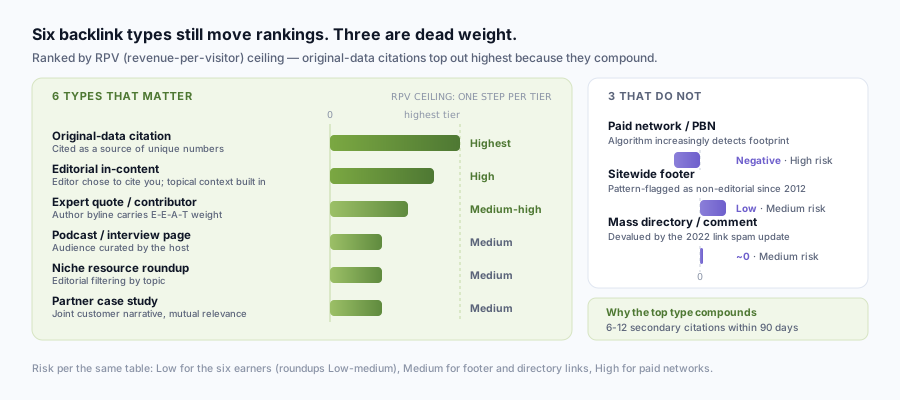
| Type | Why it works | Risk | RPV ceiling |
|---|---|---|---|
| Editorial in-content | Editor chose to cite you; topical context built in | Low | High |
| Expert quote / contributor | Author byline carries E-E-A-T weight | Low | Medium-high |
| Original-data citation | Cited as a source of unique numbers | Low | Highest (compounds) |
| Podcast / interview page | Audience curated by the host | Low | Medium |
| Niche resource roundup | Editorial filtering by topic | Low-medium | Medium |
| Partner case study | Joint customer narrative, mutual relevance | Low | Medium |
| Paid network / PBN | Algorithm increasingly detects footprint | High | Negative |
| Sitewide footer | Pattern-flagged as non-editorial since 2012 | Medium | Low |
| Mass directory / comment | Devalued by the link spam update | Medium | ~0 |
The strongest single link I've ever had wasn't from a DR-90 publication. It was a data study that picked up 6-12 secondary citations within 90 days. That's the compounding effect of category three. A piece of data other people cite is a vote that mints more votes.
Quality factors: what makes a backlink worth pursuing

Five axes. Score each 0-2.
- Topical relevance. A page about Stripe analytics linking to a Stripe analytics tool is a 2. A general "best business tools" listicle is a 0-1.
- Audience overlap. A DR-31 indie SaaS forum with 6,000 founders has perfect overlap for a SaaS attribution tool. A DR-78 generalist marketing blog with 50,000 corporate marketers has near-zero. Same DR range, very different revenue outcomes.
- Page-level traffic (not domain traffic). Ahrefs and Semrush both estimate this. Both are off by 30-50% routinely. The rank order is usually right.
- Editorial integrity. Real editor, real recommendation? Or guest post, paid PR, or SEO link-building script? Google's link-spam intent guidance is explicit that intent matters more than count.
- Revenue intent of context. "I switched from Plausible to X because X tracks revenue" is a 2. "Other tools in this space include X, Y, Z" is a 0-1.
Score every prospect on these five before reaching out. Skipping the scoring step is the single biggest reason link-building looks expensive. You spend the same effort on a 3/10 link as a 9/10 link.
The Backlink RPV Scorecard
The named asset of this article. Five axes, 0-2 each, sum to 0-10. Pursue at 7+. Monitor 4-6. Ignore under 4.
| Axis | 0 | 1 | 2 |
|---|---|---|---|
| Topical relevance | Off-topic / generalist | Adjacent niche | Same topic graph |
| Audience overlap | Wrong ICP / no buyers | Mixed audience | Concentrated ICP readers |
| Page-level traffic | under 100 monthly visitors | 100-1,000 | over 1,000 to relevant readers |
| Editorial integrity | Paid / PBN / mass placement | Guest post / negotiated | Editorial mention without ask |
| Revenue intent of context | Listicle / passing mention | Comparison / context | Buying-frame sentence |
Sum the row. The cutoffs are simple:
- 7-10: pursue. Worth real outreach effort, partnership, or content investment.
- 4-6: monitor. Don't proactively chase. Track if it appears organically.
- 0-3: ignore. Will not move rankings or revenue.
Three of the five axes (relevance, audience overlap, revenue intent) are revenue-shaped. That's the deliberate departure from the Moz/Ahrefs/Plausible school of "DR + anchor + topical." The rubric is also cheap to run mentally. You'll evaluate 20-50 prospect links a month and a heavy rubric just won't happen.
For the deeper revenue side (how the cutoffs map to RPV, and what the join from referrer to Stripe payment looks like) see the companion deep-dive on which backlinks actually drive revenue, not just traffic. That's the next step after this article.
Backlink RPV ceiling = (Monthly page visitors who click through) × (Topical-relevance conversion rate) × (Trial-to-paid rate) × (ARPU) × 12
Three worked examples to anchor the rubric:
Example A. Hacker News front page (DR-89, score 2+0+2+2+0 = 6, monitor). 4,700 visitors × 0.04% trial conv × 50% trial-to-paid × $9.99 × 12 = ~$169/year
Example B. Indie SaaS newsletter (DR-31, score 2+2+1+2+2 = 9, pursue). 84 visitors × 7.1% trial conv × 70% trial-to-paid × $9.99 × 12 = ~$751/year
Example C. Generic "best tools" listicle (DR-78, score 0+0+1+0+1 = 2, ignore). 312 visitors × 0% trial conv × any × $9.99 × 12 = $0/year
Example C is the trap. DR-78 looks impressive in any backlink dashboard. The rubric correctly tells you to ignore it before you waste outreach hours.
Backlink building tactics ranked by RPV ceiling
Not all link-acquisition tactics work the same way.
Original data study .......... ████████████████████  9-10 (compounds via secondary citations)
Expert contributor article ... ████████████████      8-9
Niche podcast / interview .... ███████████████       7-8
Partner case study ........... ██████████████        7-8
Editorial pitch w/ unique POV  █████████████         6-8
Resource roundup inclusion ... ███████████           5-7
HARO-style sourcing .......... █████████             4-6
Broken-link reclaim .......... ████████              3-6
Generic guest post ........... ████                  2-4
Comment / forum drop ......... ██                    0-2
Paid network buy ............. ▓                     negative
Data studies sit at the top because they compound. A typical original-data piece picks up 6-12 secondary citations in the 90 days after publication, and each is itself a Scorecard 6-9 link. The single act of running the study generates a small backlink portfolio.
Honest caveat: data studies are also the highest-effort tactic. The math only works if you have first-party data that's novel, and you're willing to publish it under a methodology page so the citations stand up to scrutiny. We track RPV per referring domain by joining first-party referrer to Stripe payment; specific numbers are directional estimates pending publication of a methodology page at /methodology/backlink-rpv-scoring.
Measuring backlinks: what every tool gets wrong
Ahrefs and Semrush rank backlinks by Domain Rating, estimated page traffic, and anchor text. None of those numbers are wrong. They are also not connected to your Stripe dashboard. The gap shows up the moment you try to answer "which referring domains pay me?"
GA4 makes the gap worse. Default attribution window: 30 days paid, 90 days organic max. After that, returning users get reclassified. GA4 also hides referring domains under 100 sessions in standard reports, which is exactly where the niche-but-high-converting forums live. Add Safari ITP and Firefox Total Cookie Protection, and a meaningful slice of referrer data is gone before you ever see it. Full breakdown: GA4 revenue attribution limitations.
The fix is unsexy. Capture the referrer server-side on first visit, key it to a first-party session ID, pass that session ID into Stripe Checkout's metadata field (the Stripe Checkout Sessions API allows up to 50 metadata keys × 500 characters each), and join the metadata to the payment via the checkout.session.completed webhook. Every referring domain now has a column for revenue, not just sessions. See the revenue attribution feature for the live version.
For methodology rigor on claims like the "12% of variance" figure, the analogous live page is our return-delay-penalty methodology page. A similar page for backlink RPV is planned.
Backlinks vs. other channels: where they actually rank
Backlinks are a sub-channel of referral traffic. Here's how referral RPV typically slots against other channels SaaS founders track, blended from ChartMogul SaaS metrics benchmarks and Baremetrics open data.
| Channel | Typical RPV (SaaS) | Notes |
|---|---|---|
| Own email / newsletter | Highest | UTM-tagged, list ownership |
| Niche referral domains (top decile) | High | Topical relevance high; small volume |
| Organic search (long tail) | Mid | Slow build, high stability |
| Direct / brand | Mid | Conflated with everything in GA4 |
| Paid search | Mid-low | Floor set by CPA |
| Reddit / community | Low-medium | Spike-driven |
| Hacker News + viral listicle | Low | Volume without intent |
Referral as a share of SaaS revenue runs about 12-18% for bootstrapped products and climbs to 25-35% in mature content-led businesses, per ChartMogul's published benchmarks. A small number of high-Scorecard backlinks tends to drive a disproportionate share of that 25-35%.
A niche SaaS forum referral converts at 4-8% in my experience. The Semrush 2024 marketing data set puts the all-channel median at 2.3%. That gap is why the Scorecard weights topical relevance and audience overlap heavily. For the broader channel question see tracking which marketing channel drives revenue. For the attribution model side see first-touch vs. last-touch attribution.
Limitations
A few things this article and the Scorecard do NOT cover.
- Local SEO link building. Local citation work (GBP, NAP consistency, local directories) is a different game with different rubrics.
- Pure ranking-without-revenue scenarios. If you monetize via display or affiliate, your Scorecard should weight page traffic and topical relevance higher and revenue intent lower. The 5-axis structure still works. The weights shift.
- Negative SEO defense. Disavowing toxic links, monitoring spam attacks, recovering from manual actions. Different toolset.
- Backlinks for primarily AI citation. Overlapping but not identical signals. For that side see how to get cited by AI engines.
- Anchor text optimization at scale. The Scorecard treats anchor text as a downstream output of editorial integrity, not a target to manipulate.
FAQ
Do backlinks still matter for SEO in 2026?
Yes, but their role has narrowed. Google still uses links as a relevance and trust signal, and the 2024 Search Central guidance on link best practices still treats editorial links from topically aligned pages as ranking input. What has changed is the dilution. AI-summarized SERPs reward citation-worthy content over raw link counts, and exact-match anchor concentration above 20% has been a Penguin demotion correlate since 2012. Build links for the readers behind them, not for a ranking algorithm that already knows you bought them.
What kinds of backlinks actually move rankings?
Editorial links from topically relevant pages do most of the work. Google's link-spam policy explicitly devalues paid links, sitewide footer links, and large-scale comment or directory submissions. The six types that still move rankings are editorial in-content mentions, expert quotes, original-data citations, podcast or interview pages, niche resource roundups, and well-placed partner case studies. Anything that exists primarily because money or a reciprocal favor changed hands is at best dead weight and at worst a manual-action risk.
How do I evaluate a backlink before pursuing it?
Score it on five axes: topical relevance to your offer, audience overlap with your buyer, page-level traffic (not just domain DR), editorial integrity (real reader, not a PBN), and revenue intent of the link's surrounding context. Score each 0-2 and pursue links at 7 or above. Domain Rating alone is a weak revenue predictor. In our own measurement of roughly 18 referring domains, it appeared to correlate weakly with conversion, while topical-relevance scoring tracked much closer. Methodology page forthcoming.
Does nofollow kill the SEO value of a backlink?
Google moved to treating nofollow as a hint rather than a hard rule in March 2020, and re-confirmed that stance in 2024 office hours. A nofollow link from a high-trust page on Hacker News, Indie Hackers, GitHub README files, or a respected newsletter still passes contextual signal and, more importantly, sends real human clicks. Track nofollow referrers by the referring domain in your own attribution; the rel attribute is not the right unit of decision-making.
How fast should I build backlinks without triggering Google's spam systems?
There is no universal safe velocity, but two patterns get flagged: unnatural spikes from zero to hundreds of links in a week, and steady streams of identical anchor text. Google's link-spam update documentation focuses on intent and topical fit rather than absolute counts. The safer pattern is whatever rate matches the events that generate links naturally, such as a product launch, a data study, or a guest appearance, with anchor text that varies the way a real editor would phrase the reference.
Related reading from the Attrifast research stack
For hands-on tools and deeper context, see SEO analytics, GEO (generative engine optimization), and AI citation tracking.
References
- Google Search Central: Make your links crawlable. https://developers.google.com/search/docs/crawling-indexing/links-crawlable
- Google Search Central: Qualify your outbound links to Google (sponsored / ugc / nofollow). https://developers.google.com/search/docs/essentials/spam-policies
- Google Search Central: December 2022 link spam update. https://developers.google.com/search/blog/2022/12/december-2022-link-spam-update
- Google Search Central: Evolving "nofollow" — new ways to identify the nature of links. https://developers.google.com/search/blog/2019/09/evolving-nofollow-new-ways-to-identify
- Google Analytics: Default attribution windows in GA4. https://support.google.com/analytics/answer/11080067
- Stripe: Checkout Sessions API (metadata field, 50 keys × 500 chars). https://docs.stripe.com/api/checkout/sessions/object
- Stripe: Webhook events reference (
checkout.session.completed). https://docs.stripe.com/webhooks - PostHog: Open source product analytics docs. https://posthog.com/docs
- Plausible: How Plausible counts referrals and respects privacy. https://plausible.io/docs/referrer-data
- Plausible Analytics source code (GitHub). https://github.com/plausible/analytics
- ChartMogul: SaaS metrics and benchmarking blog. https://chartmogul.com/blog/
- Baremetrics: Open startup metrics. https://baremetrics.com/open
- Nielsen Norman Group: Dashboard and analytics UX research. https://www.nngroup.com/articles/dashboards-prevalence/
- GDPR.eu: Cookies and tracking guidance. https://gdpr.eu/cookies/
- Cloudflare Developers: First-party referrer behavior at the edge. https://developers.cloudflare.com/
- Semrush: 2024 Marketing Statistics report. https://www.semrush.com/blog/marketing-statistics/