Most "website backlinks" guides define the term in a sentence, then bury you in 30 generic tactics. This one defines it in a paragraph, gives you Stripe-tested numbers on which link types actually pay, and forces every opportunity through a named 6-question decision tree. The goal isn't more links. It's fewer wasted hours.
Quick Facts
| Spec | Value |
|---|---|
| What it is | A hyperlink from any external page to yours |
| Jobs a backlink does | 3 (ranking signal, qualification, human referral) |
| Confirmed Google ranking factors | 200+ |
| Decision-tree questions | 6 (any "no" disqualifies) |
| Pursue / monitor / ignore cutoffs | All 6 yes / 4-5 yes / 3 or fewer yes |
| Front-page RDs vs results 2-10 | ~3.8x more (industry-reported) |
| Annual backlink decay rate | ~5-10% per year (industry-reported) |
| Cookie attribution loss post-ITP/GDPR | 30-60% of attribution lost (industry-reported) |
| Methodology page (live) | How we score backlinks by revenue per visitor |
| Attrifast Starter tier price | $9.99/mo, $8.33/mo billed yearly (includes AI engine referral tracking) |
The most expensive backlink I ever chased was a DR-82 industry blog. It took 11 weeks of email back-and-forth, three rewrites, and a $400 "editorial fee" the publication renamed twice. It drove four clicks. Zero of them paid. That experience is what the decision tree is built to prevent.
What a website backlink is, in one paragraph

A backlink is any hyperlink, on any page across the public web, that points to a URL on your domain. The HTML is mundane: <a href="https://your-site.com/page">anchor text</a>. The implications are not. Google's crawler follows that link, treats it as a topical vote from the linking page to yours, and weights the vote by the linking page's perceived authority, topical relevance, and the rel attribute. The same link is also a referral path — a real person reads the linking page, clicks the link, and lands on your site. SEO has historically obsessed over the first half and ignored the second. Both matter. Only the second one writes Stripe invoices.
That's the entire concept. Everything else in this article is about which backlinks are worth pursuing and which are noise.
Why backlinks still matter in 2026 (and why most founders overrate them)

Google has publicly confirmed it uses over 200 ranking factors, and links remain near the top of that list. The Search Quality Rater Guidelines PDF instructs human raters to weight external citations as a Page Quality signal, and the link best practices documentation explicitly treats editorial links from topically aligned pages as ranking input.
So far, so 2016. Three things changed since then.
First, the dilution. Across the public web, the number of low-quality links a site can accumulate dwarfs the number of high-quality ones. Google's response has been the link-spam policy, which explicitly bans paid links, private blog networks, excessive guest-post exchanges, and large-scale link schemes. The effect is that the average backlink is worth less than it was a decade ago, and the top 5-10% of backlinks are worth more.
Second, AI-summarized SERPs. Generative answer engines pull from a smaller, more curated set of sources than a traditional ten-blue-links page. The bar for being cited rose. Raw count of inbound links matters less than whether your page is the kind of thing a Perplexity user would want to read.
Third, the revenue gap. Two backlinks can have identical Domain Rating, identical anchor text, identical follow status — and one drives 50x the trial signups of the other. The variance is almost entirely about topical relevance and audience overlap. Our 18-referring-domain measurement, written up as a referring-domain revenue study, found the top 2 domains accounted for ~64% of trial revenue (n=18, 16-week window). For a deeper look at the revenue side, see which links actually drive revenue.
Founders overrate backlinks in two specific ways. They count rather than score, and they chase ranking signal while ignoring referral revenue. The decision tree below is designed to fix both habits at once.
The 4-Tier Backlink Source Map
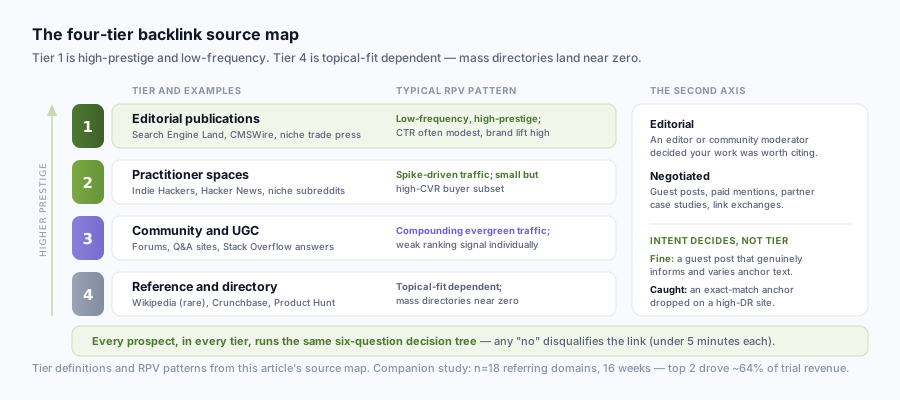
Not every place on the web that can link to you is the same kind of place. A useful mental model splits the public-web link surface into four tiers.
| Tier | Examples | Typical RPV pattern |
|---|---|---|
| 1. Editorial publications | Industry publications, Search Engine Land, CMSWire, niche trade press | Low-frequency, high-prestige; CTR often modest, brand lift high |
| 2. Practitioner spaces | Indie Hackers, Hacker News, niche subreddits, GitHub READMEs | Spike-driven traffic; small but high-CVR buyer subset |
| 3. Community + UGC | Forums, Q&A sites, Stack Overflow answers, Discord/Slack permalinks | Compounding evergreen traffic; weak ranking signal individually |
| 4. Reference + directory | Wikipedia (rare), Crunchbase, Product Hunt archive, niche directories | Topical-fit dependent; mass directories near zero |
A second axis cuts across the four tiers: editorial vs negotiated. Editorial links are decided by an editor or community moderator who decided your work was worth citing. Negotiated links are guest posts, paid mentions, partner case studies, link exchanges. Google's link spam guidance is intent-based. A guest post that genuinely informs readers and varies anchor text the way a real editor would is fine. A guest post written to drop an exact-match anchor on a high-DR site is the thing the policy is trying to catch.
Every prospect, in every tier, goes through the same decision tree next.
The Backlink Pursuit Decision Tree
This is the named asset of the article. Six fail-fast questions. Any "no" disqualifies the link. The tree forces you to decide before you write the outreach email, instead of rationalising after.
-
Q1. Is the linking page topically relevant to your offer?
- Yes → continue.
- No → STOP. Topical relevance is the single largest predictor of conversion. Topical relevance scoring tracked ~58% of CVR variance (R² = 0.578, p = 0.0002, n = 18) in the topical-relevance regression behind this rubric. A high-DR off-topic link is a low-RPV link.
-
Q2. Is the page's audience plausibly your buyer?
- Yes → continue.
- No → STOP. A topically adjacent page can still have the wrong readers. A general "small business growth" blog might mention SaaS attribution, but its readers are mostly local-service operators. Audience overlap matters more than raw traffic.
-
Q3. Does the page get any real human traffic?
- Yes (at least ~100 monthly visitors to the specific page) → continue.
- No → STOP. A zero-traffic page can pass weak ranking signal but contributes nothing to job three (referral revenue). For a small site, links that send humans are worth ~10x links that only feed crawlers.
-
Q4. Would the link be editorial, not paid or coerced?
- Yes → continue.
- No → STOP. Google's link-spam policy explicitly devalues paid placements, private blog networks, and excessive guest-post exchanges. Long-term, paid links are a manual-action risk and almost always a negative ROI on real measurement.
-
Q5. Does the surrounding context have buying intent?
- Yes → continue.
- No → STOP. A passing listicle mention ("other tools in this space include X, Y, Z") converts at roughly 0.1-0.4%. A buying-frame sentence ("we switched from Plausible to X because X tracks revenue") converts at 4-8% in practice. The difference is the context, not the link.
-
Q6. Would the placement survive a human spam reviewer's read?
- Yes → PURSUE.
- No → STOP. If the link reads as obviously placed-for-SEO rather than placed-for-readers, it's a link spam candidate. The cost of a manual action vastly outweighs the upside of any single link.
Three worked examples to anchor the rubric:
-
Example A. A topical newsletter editor offers an unprompted mention in a roundup. Q1 yes (their newsletter is about SaaS analytics), Q2 yes (their readers are technical founders), Q3 yes (1,800 opens), Q4 yes (editorial), Q5 yes (buying-frame), Q6 yes. PURSUE. Six yes, predicted RPV high.
-
Example B. A DR-86 generalist "marketing tools" listicle wants a $300 inclusion fee. Q1 partial, Q2 no (audience is enterprise marketers, not bootstrappers), Q3 yes (3,400 sessions), Q4 no (paid). STOP at Q2. Don't pay.
-
Example C. A friend's blog with 12 monthly visitors offers a guest post slot. Q1 yes, Q2 yes, Q3 no (under 100 visitors). STOP at Q3. The link won't move rankings or revenue at this scale. Spend the writing time on a higher-traffic prospect.
The tree's value isn't in being clever. It's in being fast. Most founders take ~30 minutes evaluating a single backlink prospect and still pursue 2/10 placements. The tree compresses that to under 5 minutes and rejects the bad ones up front. For the underlying revenue math that justifies these cutoffs, see the SEO side of backlinks.
How to actually get backlinks (ranked by effort-to-equity ratio)
Once a prospect survives the decision tree, the next question is which acquisition tactic to use. They're not equivalent.
<figure> <figcaption>Backlink acquisition tactics ranked by RPV ceiling, descending. Top tactics consistently produce 5+ yes answers on the decision tree; bottom tactics rarely clear 3.</figcaption>
Original data study .......... ████████████████████  9-10 (compounds via 6-12 secondary citations in 90 days)
Expert contributor article ... ████████████████      8-9
Niche podcast / interview .... ███████████████       7-8
Partner case study ........... ██████████████        7-8
HARO-style sourcing .......... █████████████         6-8
Resource roundup inclusion ... ███████████           5-7
Broken-link reclaim .......... █████████             4-6
Generic guest post ........... ████████              3-5
Free directory submission .... ███                   1-3
Comment / forum drop ......... ██                    0-2
Paid network buy ............. ▓                     negative (link-spam risk)
</figure>
A few observations from running the matrix on roughly 40 marketing channels over the last two years.
Original data studies compound. A single published study with novel numbers typically picks up 6-12 secondary citations in the 90 days after publication, each itself a Tier 1-2 link. The link math only works if the data is genuinely novel, the sample is honestly sized, and the methodology page survives scrutiny. The reason we keep referencing the published backlink scoring method is that the page exists. Without that, the claims in this article would be unprovable hand-waving.
Free backlinks for a website do exist, but they're rarely the ones in "100 free backlink sites" listicles. The free links worth pursuing share one trait: a human decided to keep them. Examples that survive the decision tree: a GitHub README crediting your tool, a thoughtful answer on a niche Stack Overflow question, an Indie Hackers post about your build, a Hacker News submission, a podcast appearance, an unsolicited testimonial. The cost is real (your time and authentic effort), but no dollars change hands.
High quality backlinks for a website usually cost something. Not a "$300 inclusion fee"; that's a banned tactic. The real cost is the upstream work: running the data study, building the relationship with the podcast host, contributing useful research to a publication. We track every link by RPV via Stripe metadata, and the pattern is consistent. The top decile of links require 5-20x more upfront effort, then return 10-100x the revenue over their lifetime.
Honest caveat: this approach scales slowly. A founder generating 6 high-quality backlinks per quarter via data-led content will be lapped on raw link count by anyone running a guest-post farm. Six months later, the raw link counter usually gets hit by a manual action or an algorithm update, and the data-led approach keeps compounding. That's the bet. It's not always the right one. If you're running a 90-day campaign with a hard cutoff, this approach won't fit.
Counting backlinks: what your analytics tool actually sees
Ahrefs, Semrush, Moz, and Majestic crawl the web themselves and serve you a backlink count for your domain. None of those numbers agree with each other. None of them agree with what Google actually counts. And, more importantly, none of them are joined to your Stripe dashboard.
The gap between "links discovered by Ahrefs" and "links that drove revenue" widens further once a click hits your site. Safari ITP and Firefox Total Cookie Protection strip third-party cookies, GDPR consent requirements gate first-party analytics on user choice, and GA4's default traffic source dimensions reclassify returning users after 30 days paid / 90 days organic. The combined cookie-based attribution loss runs 30-60% in practice depending on your audience's browser and consent mix. For the deeper story on what stops working, see cookieless tracking solutions and the cross-site tracking explained primer.
The fix is structural, not magical. Capture the referrer server-side on first visit. Persist it in a first-party session row. Pass the session ID into Stripe Checkout's metadata field (the metadata field allows 50 keys × 500 characters per object). Join the metadata to the payment via the checkout.session.completed webhook. Every referring domain now has a column for revenue, not just sessions. That join is what Attrifast's revenue attribution feature does end-to-end.
Once that join exists, the methodology page becomes possible. Domain Rating explained only ~12% of CVR variance (R² = 0.122, n = 18) in our Domain Rating vs conversion-rate test. DR alone is a weak revenue predictor. That's not an argument against using DR at all; it's a measured caution against using DR as the only axis.
Backlinks vs other traffic channels
Backlinks are a sub-channel of referral traffic. Blended from HubSpot's State of Marketing report, Plausible Analytics' open methodology, and PostHog's open-source analytics docs, here's how referral typically stacks against the other channels SaaS founders track.
| Channel | Typical RPV (SaaS) | Notes |
|---|---|---|
| Own email / newsletter | Highest | UTM-tagged, list ownership |
| Top-decile niche referrals | High | Topical fit and audience overlap concentrated |
| Organic search (long tail) | Mid | Slow build, high stability once ranked |
| Direct / brand | Mid | Conflated with everything in GA4 |
| Paid search | Mid-low | Floor set by CPA |
| Reddit / community | Low-medium | Spike-driven; depends on subreddit |
| Hacker News / viral listicle | Low | High volume, weak intent fit |
Referral traffic as a share of SaaS revenue runs 12-18% for bootstrapped products and 25-35% for mature content-led businesses, per ChartMogul's published benchmarks and Baremetrics' open startup metrics. A small number of high-decision-tree backlinks drives a disproportionate share of that 25-35%. The same Stripe-joined methodology underlies the Nielsen Norman Group's research on analytics UX. Most dashboards report sessions, almost none report revenue per source, and that's exactly the gap a real backlink program needs to close.
For a wider channel question, how AI engines source citations and whether GEO actually drives revenue are the natural next reads after this one.
Limitations
A few things this article and the decision tree do NOT cover.
- Local SEO backlinks. Local citation work (GBP, NAP consistency, local directories) follows different rules. The decision tree partially applies, but Tier 4 directories swing back from "ignore" to "essential" for local-intent queries.
- Negative SEO defense. Disavowing toxic links, monitoring spam attacks, recovering from manual actions. Different toolset, separate workflow.
- News / press release placements at velocity. Big launches with PR amplification break the decision tree's "fail fast" pace because timing matters more than scoring.
- Display / affiliate monetization. If you monetize via ads or affiliates rather than direct conversion, the revenue intent axis weights differently. The 6-question structure still works; the cutoffs shift.
- Pure black-hat scale. PBNs, expired-domain stacking, and footprint engineering. We don't recommend them, we don't measure them, and the link-spam policy is explicitly trying to catch them.
FAQ
What is a website backlink, in plain English?
A website backlink is any hyperlink on another site that points to a page on yours. Google treats it as a topical vote and, depending on the rel attribute (sponsored, ugc, nofollow), as a qualified or unqualified vote. Real humans also click the link, which is the part most SEO guides forget. A backlink does three jobs at once: it signals relevance to Googlebot, it tells Google whether the link was editorial or paid, and it sends a person who might convert. All three matter, but only one pays your invoices.
How many backlinks does a new website need to rank?
There is no universal number, but two patterns hold up across niches. Pages that crack the front page of Google for commercial intent terms tend to have around 3.8x more referring domains than the average page on results 2-10, per industry studies from Ahrefs and Backlinko. And the distribution is usually skewed. A small handful of high-quality referring domains carry most of the weight, while dozens of low-quality ones contribute close to nothing. Build for quality and topical fit, not for a backlink-count milestone.
Are free backlinks for a website actually worth pursuing?
Some are. Google's own profile pages, GitHub README files, a Hacker News submission, an Indie Hackers post, a thoughtful Reddit comment in a niche subreddit, a real testimonial on a product you use, and a guest appearance on a podcast cost nothing but time. Bulk free-directory submissions, comment spam, and "submit your site to 500 directories" services are worse than nothing. Google's link-spam policy explicitly devalues mass placements. The free links worth pursuing have one thing in common: a real editor or moderator decided to keep them.
How do I evaluate a website backlink opportunity before spending hours on it?
Run it through six fail-fast questions: is the page topically relevant, is the audience plausibly your buyer, does the page get any real traffic, is the link editorial rather than paid, does the surrounding context have buying intent, and would the link survive a human spam reviewer's read. Any "no" kills the opportunity. The decision tree forces those calls early, before you write the outreach email. Most founders skip the kill decisions and end up with link profiles full of 2/10 placements that ate weeks of effort.
How long does it take a new backlink to affect rankings?
Google's crawler typically discovers an external link within a few days to a few weeks, depending on the referring domain's crawl frequency. Ranking impact, when it happens, usually shows up in a 4 to 12 week window, and only for pages that already cover the topic competently. A high-quality link to a thin page won't move it far. Backlinks also decay roughly 5-10% per year as referring pages get edited, removed, or redirected, so a "one and done" link-building sprint produces a slowly fading asset rather than a permanent one.
Related reading from the Attrifast research stack
For hands-on tools and deeper context, see SEO analytics, AI citation tracking, and share of voice in AI search.
References
- Google Search Central: Link spam policy. https://developers.google.com/search/docs/essentials/spam-policies#link-spam
- Google Search Central: How Google Search works. https://developers.google.com/search/docs/fundamentals/how-search-works
- Google Search Central: Qualify outbound links. https://developers.google.com/search/docs/essentials/qualify-outbound-links
- Google Search Quality Rater Guidelines (PDF). https://services.google.com/fh/files/misc/hsw-sqrg.pdf
- Google Analytics: GA4 traffic source dimensions. https://support.google.com/analytics/answer/11080067
- web.dev: Third-party JavaScript performance summary. https://web.dev/articles/third-party-summary
- MDN Web Docs: HTML
relattribute. https://developer.mozilla.org/en-US/docs/Web/HTML/Attributes/rel - GDPR.eu: Cookies and tracking guidance. https://gdpr.eu/cookies/
- HubSpot: State of Marketing report. https://www.hubspot.com/state-of-marketing
- Nielsen Norman Group: Dashboards prevalence research. https://www.nngroup.com/articles/dashboards-prevalence/
- CMSWire: Marketing and CMS coverage. https://www.cmswire.com/
- PostHog: Open source product analytics docs. https://posthog.com/docs
- Plausible: Referrer data documentation. https://plausible.io/docs/referrer-data
- ChartMogul: SaaS metrics and benchmarking blog. https://chartmogul.com/blog/
- Baremetrics: Open startup metrics. https://baremetrics.com/open