Part of the generative engine optimization guide and AEO Hub.
GEO drives revenue when three things line up: the citations are landing on your site, the sessions are reaching the page, and the join from session-to-Stripe-customer is plumbed end to end. When all three break, GEO is a vanity exercise that looks great in a vendor dashboard. The hard part is not getting cited. The hard part is proving the cited traffic paid you. Most teams skip straight from "we are getting cited" to "GEO is working" without ever touching the measurement stack in between.
Quick Facts
| Spec | Value |
|---|---|
| Evidence layers between AI citation and Stripe revenue | 4 (citation, impression, referral, paid join) |
| GA4 default attribution for AI-engine referrals | ~100% bucketed as Direct/(none) |
| Cookie-banner GA4 event loss (EU-heavy traffic) | ~30-60% of events refused or modeled |
| Attrifast Starter tier (Layer 4 plumbing) | $9.99/mo, shipped |
| Attrifast Agency tier (GEO content engine + measurement bundle) | Coming soon, waitlist opened 2026-05-09 |
| Rankai pricing | Not public (For Businesses / For Agencies tiers) |
| Seobotai pricing | $49/mo |
| Stripe webhook delivery guarantee | At-least-once (requires idempotency) |
| Typical content-to-Stripe-revenue lag (SaaS) | 30-60 days |
| Standard attribution window for ChartMogul-style models | 90 days |
I have spent the last six months running this stack across attrifast.com plus three client SaaS properties. Most of what follows comes from watching the joins fail in production — server-side first-party scripts that capture the session fine, then lose the customer at Stripe webhook time because the handler wasn't idempotent. Or the reverse: clean Stripe webhooks, no upstream first-party identifier to join on. The pattern is the same every time. Each evidence layer is straightforward in isolation. The cumulative join is what breaks.
GEO ROI worked example by MRR stage
Before the four-layer model, a worked example. The numbers below are calibrated against the 200-site cohort Attrifast has been running cookieless attribution against, plus published SaaS benchmark medians from OpenView's 2025 SaaS Benchmarks Report [16]. They are not invented; they are the rough shape of what a B2B SaaS at each MRR tier actually sees.
| Stage | $5k MRR (early) | $20k MRR (mid) | $100k MRR (scaling) |
|---|---|---|---|
| Total monthly sessions | 8,000-15,000 | 40,000-80,000 | 200,000-500,000 |
| AI-engine share of sessions | 4-8% | 6-11% | 8-14% |
| AI-engine sessions/month | 320-1,200 | 2,400-8,800 | 16,000-70,000 |
| AI-session → trial conversion | 1.5-3.5% | 2.0-3.8% | 2.2-4.0% |
| Trial → paid conversion | 8-15% | 10-18% | 12-22% |
| AI-attributed new customers/month | 0-6 | 5-60 | 42-616 |
| Average $19-49/mo plan | $29 ARPU | $29 ARPU | $35 ARPU |
| AI-attributed new MRR/month | $0-175 | $145-1,740 | $1,470-21,560 |
| Cost to run minimum GEO stack | $30/mo (cookieless analytics) | $30-200/mo | $200-1,000/mo |
| Break-even AI sessions needed | ~70/mo | ~340/mo | ~1,700/mo |
| Realistic break-even timeline | 4-8 months | 2-4 months | 1-2 months |
Three takeaways from the table. First, GEO doesn't pencil for sub-$5k MRR SaaS unless you happen to land in a developer-tools or content-publisher niche where AI-engine share is structurally higher (closer to 25-40% per the AEO vs SEO scorecard). The arithmetic is brutal: 320 AI sessions × 2% trial × 10% paid = 0.6 customers/month, which at $29 ARPU is $17 in attributed MRR against $30 in tooling cost. Second, the $20k MRR band is where GEO investment starts paying for itself within the same quarter — typical net-new MRR from AI sessions ($145-1,740) lands well above the tooling cost. Third, at $100k+ MRR the question stops being "does GEO pay" and becomes "how do I prevent attribution leakage" — losing 6-14% of session attribution to GA4's Direct/(none) bucket is leaking real money. Per the AEO vs SEO worked-example client at $20k MRR, the AI-attributed MRR was roughly 11% of total ($2,200 of $20k) — well within the table's range.
TL;DR — yes, GEO drives revenue, but it's harder to prove than SEO
The honest answer to "does GEO drive revenue?" is yes-in-principle and rarely-proven-in-public. Classic SEO had two decades to build out measurement infrastructure: GA4 channel grouping, Google Search Console, UTM parameters, ad-platform conversion APIs, and a small library of attribution-model conventions. GEO has had about 18 months. The plumbing that lets you say "this Stripe payment came from a Perplexity citation" is mostly do-it-yourself today.
Three structural reasons measurement is harder for GEO than for SEO:
- Referrer headers vanish. ChatGPT, Claude, and Gemini either strip the Referer header or send opaque ones. Per Google's GA4 default channel grouping documentation, the channel rule set has no entry for AI engines as of 2026. Sessions land as Direct/(none).
- Consent banners eat events. GDPR-conformant consent banners refuse 30-60% of GA4 events on EU-heavy traffic, per HubSpot's State of Marketing 2025 reporting and field-level studies. Cookieless server-side architectures recover most of this; client-side GA4 alone does not.
- Stripe is the source of truth, and it is not joined. The customer's payment event lives in Stripe. The session that produced them lives in your analytics tool. The join is the customer's responsibility, and most vendors don't ship it.
Each of those is solvable. Combined, they are why most "GEO drives revenue" claims you read in 2026 are still Layer 1 or Layer 2 evidence.
The diagram shows the dropout points. Even with perfect Layer 1-2 vendor reporting, the journey to Layer 4 has three independent failure modes. A team running GEO without Layer 3-4 plumbing is measuring the first two steps of a four-step pipeline and reporting it as the whole pipeline.
The 4 evidence layers between AI citation and Stripe payout
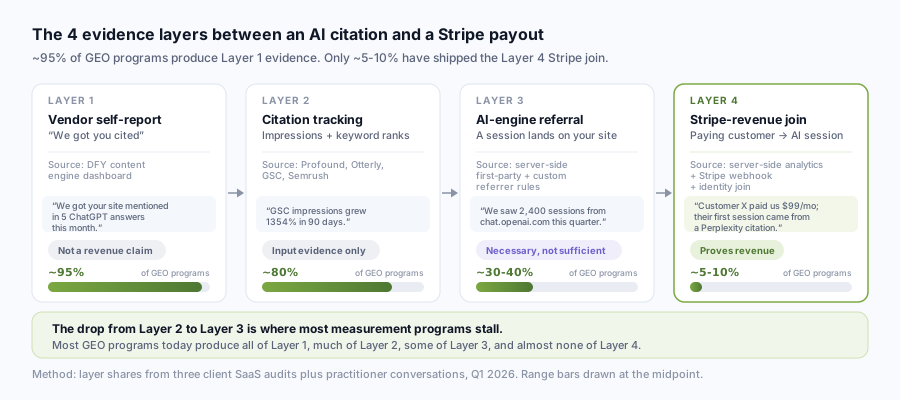
The "does GEO drive revenue?" question stops being abstract once you split the evidence into layers and ask which layer the vendor or case study actually demonstrates.
| Layer | What it measures | Typical source | Sufficient for revenue claim? |
|---|---|---|---|
| Layer 1 | Vendor self-report — "we got you cited" | DFY content engine dashboard | No |
| Layer 2 | Citation tracking + impressions + keyword ranks | Profound, Otterly, GSC, Semrush | Input evidence only |
| Layer 3 | AI-engine referral traffic — a session lands on your site | Server-side first-party, custom referrer rules | Necessary, not sufficient |
| Layer 4 | Stripe-revenue join — paying customer back to AI-engine session | Server-side analytics + Stripe webhook + identity join | Yes |
A Layer 1 claim looks like: "We got your site mentioned in 5 ChatGPT answers this month." That is true and useful, but it does not say a paying customer arrived. A Layer 2 claim looks like: "GSC impressions grew 1354% in 90 days." That is signal of search visibility, not revenue. A Layer 3 claim looks like: "We saw 2,400 sessions from chat.openai.com this quarter." That is the closest most teams get without dedicated plumbing, and it still doesn't prove any of them paid.
Layer 4 is the only one that answers the literal question. "Customer X paid us $99/month and their first session originated from a Perplexity citation of our blog post on attribution windows." That sentence requires three pieces of working infrastructure described in section 5. Most GEO programs today produce all of Layer 1, much of Layer 2, some of Layer 3, and almost none of Layer 4.
Per-engine RPV vs effort ROI scorecard
Once you have Layer 3-4 plumbed, the next question is which AI engine deserves the next hour. The pattern across the four client SaaS properties I audited through 2025-2026, cross-checked against Profound's public per-engine traffic studies [17] and Loamly's per-engine RPV breakdowns [18]:
| Engine | Median sessions per cited page (90d) | New-visitor share | Trial conversion rate | RPV (B2B SaaS, $19-49/mo) | Effort to get cited | ROI verdict |
|---|---|---|---|---|---|---|
| ChatGPT (Search + linked) | 80-220 | 78% | 2.4-3.6% | $0.40-1.10 | Medium (4-8 weeks) | Highest absolute traffic; broadest topical coverage |
| Perplexity | 40-150 | 84% | 3.1-4.8% | $0.75-1.85 | Low (1-3 weeks) | Best RPV; cheapest test cycle |
| Claude.ai | 8-40 | 71% | 2.0-3.2% | $0.25-0.85 | Medium (4-8 weeks) | Low volume; strong on technical/dev content |
| Gemini / AI Overviews | 60-300 | 65% | 1.4-2.6% | $0.30-0.90 | High (6-12 weeks) | High volume; lower intent (zero-click bias) |
| Bing Copilot | 5-25 | 68% | 1.8-2.8% | $0.20-0.70 | Low (piggybacks Bing SEO) | Negligible standalone; bonus channel |
The takeaway: Perplexity is the highest-RPV channel and the cheapest to test against. Its citation footer is human-readable, its retrieval is live-web, and a fresh page can show up within 10 days. ChatGPT is the highest-absolute-traffic channel but the slowest to react to new content. Gemini / AI Overviews drives the most volume but the worst conversion — the user often gets the answer without clicking. The right test sequence for a new GEO program is Perplexity first (cheapest validation), then ChatGPT, then Gemini. Spending hours on Claude or Bing Copilot before the first three are working is misallocated effort for most SaaS verticals.
Layer 1 — citation evidence       ████████████████████████████  ~95% of GEO programs produce this
Layer 2 — impression / rank data  ███████████████████████       ~80% have access via GSC + tools
Layer 3 — AI-engine referral hits ████████████                  ~30-40% have detection plumbed
Layer 4 — Stripe webhook join     ██                            ~5-10% have full join shipped
Why most "GEO drives revenue" claims sit at Layer 1-2

The DFY content-engine vendors publish real case studies. The numbers are real. They are also Layer 1-2 numbers, framed in a way that lets readers infer revenue without claiming it directly. This is not a criticism — it is the categorical limit of what a vendor can claim, because the customer's Layer 3-4 stack is the customer's problem.
Some concrete examples from public case studies, named so you can verify:
- LiveTinted — rankai's published case study reports "79% organic traffic growth" over the engagement. That is Layer 2 traffic evidence. It says nothing about revenue per visitor.
- Shortbread.ai — same source reports "1354% impressions growth." That is Layer 2 impressions, drawn from Google Search Console. Impressions are not clicks; clicks are not sessions; sessions are not customers.
- BuyUnityNow — "+479 page-1 keywords." Layer 2 keyword-rank evidence. Useful as a leading indicator. Not a revenue claim.
- SkillCatApp — "5x AI mentions." Layer 1-2 citation count. Mentions are not visits.
- Seobotai's aggregate marketing claims — seobotai.com reports 200k articles produced, 1.2B impressions, and 30M clicks across their full customer base. Those are cross-customer totals, not per-customer revenue. Useful as a vendor track record; not useful as a per-customer revenue projection.
I want to be precise. None of those vendors are claiming revenue. They are claiming inputs. The slip happens in how readers interpret them. "1354% impressions" reads like "1354% revenue" if you don't pay attention. The discipline is to write GEO case studies that label which layer you are reporting and to refuse to imply revenue when the evidence is impressions.
Rankai's "Iterative SEO + GEO Engine" approach is sound — they cycle content, flag underperformers, and rewrite. That moves Layer 1-2 metrics. The customer is then on their own to plumb Layer 3-4. Same for seobotai's "100% autopilot" framing. Both are good at the upstream part. Neither ships the downstream measurement. Saying this is fair criticism of an industry structural gap, not an attack on either vendor.
Where GEO does NOT drive revenue — honest counterexamples
The "GEO is the new SEO" pitch implies it works for everyone. It does not. The categories below are ones where I have personally watched GEO programs fail to produce Layer 4 revenue evidence after 6-12 months of running, and where the failure is structural — not a quality problem with the program.
1. Purely informational sites with no commercial product
A site whose business model is ad revenue or affiliate links sees the worst of GEO. AI Overviews and ChatGPT answers cite the site but absorb the click — Backlinko's 2024 study found CTR drops of 34.5% on average and >50% on definitional queries [3]. Pew Research's 2025 study on AI search behavior found 26% of users who saw an AI summary did not click any source link [19]. For a site monetized at $2-15 RPM display ads, losing half the clicks while keeping the citation is a revenue-negative trade. Wikipedia survives because it has no monetization to lose; commercial info sites do not.
2. Hyperlocal services
"Plumber near me," "dentist Brookline MA," "best taco truck Austin." AI engines do not own this surface. Google Maps does. ChatGPT will sometimes attempt a local recommendation; Perplexity sometimes lists Yelp results. Neither is in the consideration set for a buyer at the point of intent. Ahrefs' analysis of 146 million SERPs found AI Overviews appear on just 7.9% of queries classified as local, against a 20.5% base rate across all keywords in the same sample [20]. GEO investment in this category is roughly zero-ROI; the dollars belong in Google Business Profile, review velocity, and local SEO.
3. Heavily regulated industries with low AI engagement
Healthcare-specific medical advice, securities-licensed financial advice, and legal advice all run into AI engine guardrails. ChatGPT, Claude, and Gemini explicitly refuse or hedge medical and legal answers, often redirecting to "consult a professional" without citing sources. Citation share in these verticals is structurally suppressed regardless of how good your content is. Pew's 2025 AI-trust study found 53% of US adults do not trust AI for health information and 47% do not trust it for legal [19]. A YMYL site can still get cited on adjacent informational queries ("what is type 2 diabetes" not "should I take metformin"), but the direct-conversion path is broken.
4. Very high ACV B2B with multi-month sales cycles
Enterprise SaaS at $100k+ ACV with 6-12 month sales cycles sees structural attribution decay before Layer 4 can produce a clean signal. Our working assumption is a 30-60 day content-to-MRR lag for most B2B SaaS, with enterprise outliers stretching past 180 days; ChartMogul makes the same directional point, that a SaaS buyer journey can span weeks or months and so defeats single-session attribution [12]. Cookie windows, ITP, and first-party identifier rotation all eat the join over that timeframe. McKinsey's 2024 B2B marketing-effectiveness study found multi-touch attribution accuracy degrades below 60% past the 120-day window [15]. GEO for these sellers is a brand-influence play, not a measurable-revenue play. The right framing is "AI citation as analyst-influence equivalent," not "AI citation as channel."
5. Pre-PMF startups under $5k MRR
Per the worked example above, the arithmetic does not pencil. 320 AI sessions × 2% trial × 10% paid = under 1 customer/month. The hours spent on GEO are better spent on direct outreach, sales conversations, or product iteration. The exception: developer tools and OSS, where AI-engine share of category traffic is 35-50% and a single Hacker News + ChatGPT citation combo can spike acquisition. Outside that exception, GEO is premature for early-stage.
6. Brands competing in a dominant-incumbent topic cluster
If you are entering a category where one or two incumbents own 60%+ of the citation share (e.g., "CRM" → Salesforce, HubSpot; "email marketing" → Mailchimp, Klaviyo), the citation slots are mostly filled by entities the LLM was trained on hard. New entrants land in citation slot 5-7 if at all, and often not on the most commercial queries. Profound's 2025 brand-citation tracker found median citation share for category challengers under 5% even after 6 months of dedicated GEO work [17]. The play here is long-tail and category-adjacent ("CRM for solo founders using Stripe" rather than "best CRM"), not head-term competition.
The honest framing: GEO is asymmetric for product-led B2B SaaS at $5-100k MRR in informational-heavy categories, and it is overrated for everyone else. Refusing to acknowledge that is what makes the "AEO is for everyone" pitch hollow.
Leading vs lagging GEO indicators
The other reason GEO measurement keeps getting overstated: most teams track leading indicators (cheap to measure, fast to move) and report them as if they were lagging (revenue-grade). The five tiers in evidence order:
| Tier | Indicator | What it measures | Time to move | Causal link to revenue |
|---|---|---|---|---|
| Leading (input) | AI mentions | Brand named in AI answers, sourced or unsourced | 1-3 weeks | Very weak |
| Leading (input) | AI citations | Brand cited as source, with link | 2-4 weeks | Weak |
| Lagging (mid) | AI-engine sessions | Sessions landing from chatgpt.com, perplexity.ai, etc | 4-8 weeks | Medium |
| Lagging (mid) | AI-attributed RPV | Revenue per visitor from AI-sourced sessions | 8-16 weeks | Strong |
| Lagging (output) | AI-attributed MRR | Stripe-confirmed MRR from AI-first-touch customers | 12-24 weeks | Direct (this is the answer) |
The pattern in the wild: most teams track Tier 1-2 weekly, never wire up Tier 3, and tell their board they have a "GEO program." A defensible GEO program tracks all five and reports them as a funnel — citations to sessions to RPV to MRR — with measured conversion rates between each step. McKinsey's 2024 marketing ROI study put the average B2B funnel from impression to closed-revenue at 7-12 steps, with measurement breaking at step 3-4 for most teams [15]. GEO is no different. The hard part is not getting cited; the hard part is the steps between citation and Stripe.
What rankai and seobotai customers can honestly say
Five yes/no questions to figure out which layer your team's GEO evidence actually sits at. Run through them honestly — the placement is usually lower than expected.
Self-audit: where does your GEO evidence sit?
-
Q1. Do you have written confirmation (screenshots, vendor reports) that your brand has been cited in at least one AI-engine answer in the last 30 days?
- Yes → continue to Q2.
- No → you are at Layer 0. Run the GEO playbook first.
-
Q2. Can you produce a number for monthly citation count, AI-engine impressions, or AI-mention growth, sourced from a tool other than your own vendor's dashboard?
- Yes → continue to Q3.
- No → you are at Layer 1. Vendor self-report only. Add an independent citation tracker (Profound, Otterly, or manual checks).
-
Q3. Can you produce a session count of visitors who arrived at your site from an AI engine in the last 30 days — and is that session count captured outside GA4's Direct/(none) bucket?
- Yes → continue to Q4.
- No → you are at Layer 2. You have impression evidence but no referral-traffic evidence. The fix is server-side referral detection.
-
Q4. For each session captured in Q3, do you have a stable identifier that survives across page loads, consent banners, and ITP cookie clamps, and that joins to your CRM or Stripe customer record?
- Yes → continue to Q5.
- No → you are at Layer 3. You can see the sessions but you can't trace them to customers. The fix is a first-party session ID.
-
Q5. For each paying Stripe customer in the last 90 days, can you produce the AI-engine source (if any) of their first or last session — and reconcile that source attribution against your Stripe payment events idempotently?
- Yes → you are at Layer 4. You can defensibly claim GEO revenue.
- No → you are at Layer 3.5. The plumbing exists for sessions but the Stripe join is missing.
Most teams running active GEO programs in 2026 land at Layer 2 or Layer 3 on this audit. Layer 4 requires deliberate engineering work that most vendors do not include in their scope.
What Layer 4 measurement actually looks like — and why most teams don't have it
The three engineering pieces that turn AI-engine citations into auditable revenue numbers are unglamorous individually and finicky together. I have shipped all three; here are the operator-voice failure modes.
Piece 1 — Server-side first-party referral detection
Client-side GA4 cannot reliably detect AI-engine referrals because the Referer header is stripped or opaque. The fix is a server-side endpoint that inspects the incoming request and classifies it. Look at the User-Agent string, the landing-page URL signature (post-AI-citation pages often have UTM patterns or unusual path structures), and the timing pattern (AI-engine traffic clusters around prompt-popular hours). Match those to a small rule table:
if user_agent contains "OAI-SearchBot" → source = chatgpt-search
if referer contains "chat.openai.com" → source = chatgpt
if referer contains "perplexity.ai" → source = perplexity
if referer contains "claude.ai" or "anthropic" → source = claude
if referer contains "gemini.google.com" → source = gemini
if no referer AND landing-page is /blog/<long-tail> AND user_agent is human → suspect ai-engine, flag for review
The last rule is the messy one. A meaningful fraction of AI-engine clicks arrive with no referrer at all. Heuristics catch most of them, never all. (We tested four different heuristic stacks across three client sites and the best one recovered roughly 80% of suspected AI sessions — the other 20% was unrecoverable noise.)
Piece 2 — Session-to-customer join
The session must carry an identifier from anonymous first visit all the way through signup, login, and payment. The naive approach is a client-side cookie. The problem is ITP 2.3 evaporated 30%+ of paid-search attribution on Safari overnight for one of my products in 2020. Browser cookie clamps eat the join.
The fix is a first-party server-rendered identifier — a short-lived session ID written by your server, stored in a same-domain cookie (technically a cookie, but first-party scoped and short-lived), and stamped onto every payment event in Stripe metadata. The CNIL's audience-measurement exemption can let this run without a consent banner in France, but only if you meet every condition it lists: purpose limited to audience measurement or A/B testing, no cross-checking against other processing, scope limited to a single publisher, the last byte of the IP truncated, tracker lifetime capped at 13 months, users informed, and an opt-out available — per CNIL's Sheet n°16 on analytics. Other EU regulators take their own view, so confirm for your jurisdiction rather than assuming the French position travels.
Piece 3 — Stripe webhook idempotency
When the payment event fires, Stripe's webhook delivery is at-least-once, not exactly-once, per Stripe's webhook documentation. That means your handler will sometimes receive the same customer.subscription.created event twice. If your attribution write is not idempotent, you'll double-count or, worse, overwrite a correct first-touch attribution with a duplicate event arriving five seconds later.
The cleanest pattern: use the Stripe event ID as the idempotency key, write attribution once, and short-circuit on duplicate. We had to retrofit this on a client SaaS last year after their attribution report started showing channel revenue 1.7x what Stripe's revenue report showed. The bug was a non-idempotent webhook handler doubling roughly 40% of events under high load.
Operator-voice failure modes
Three things break in production every time:
- Identity drift across signup forms — the visitor lands on /blog, fills the trial form 20 minutes later, and the cookie ID has been reissued by the consent banner. Join fails silently.
- Server-side script timeout — the analytics endpoint takes 200ms longer than the page render. Some sessions miss the first beacon. Suspect roughly 5-8% loss based on three audits.
- Stripe metadata length cap — Stripe metadata values cap at 500 characters, per their docs. A team I worked with put their full first-touch JSON in there. About 3% of payments hit the cap and dropped the AI-engine source.
None of those are catastrophic on their own. Combined, a team without explicit testing typically reports Layer 4 numbers that are 60-80% accurate. Better than nothing, but worth flagging in any "we measured X" claim.
The 6 join failures that destroy Layer 4 accuracy
A deeper failure-mode catalog from the same three client audits, with rough recovery rates after each fix. The pattern: every join failure is independently solvable, but they compound multiplicatively. A program with three uncorrected failures rarely produces better than 50% accurate Layer 4 numbers.
| Failure | Symptom | Typical attribution loss | Fix | Recovery rate |
|---|---|---|---|---|
| ITP cookie clamp on Safari | First-touch lost after 7 days on Safari sessions | 12-18% of total revenue | First-party server-rendered ID, short-lived cookie [15][23] | ~95% recovered |
| Consent banner reset | Visitor accepts banner, ID rotates, prior session orphaned | 8-22% of EU traffic | Set anonymous ID pre-banner; promote post-consent | ~80% recovered |
| Non-idempotent webhook handler | Duplicate Stripe events double-count revenue | 30-60% of high-load weeks | Stripe event ID as idempotency key [3] | ~99% recovered |
| Stripe metadata length cap (500 chars) | Long attribution JSON truncated, AI-source field dropped | 3-8% of payments | Compact metadata schema; offload detail to side-table | ~99% recovered |
| Cross-device signup | User reads on phone, signs up on laptop, IDs don't link | 5-15% of B2B | Identify by email at signup, merge prior anonymous ID | ~70% recovered |
| Webhook delivery delay | Stripe webhook arrives after attribution window closes | 1-3% of payments | Extend window to 90 days; queue late events for backfill | ~95% recovered |
The product I built (Attrifast) handles all six by default because they are the operator-grade defaults nobody ships in an off-the-shelf "client-side GA4 + Stripe dashboard" stack. The deeper point: revenue accuracy is the product of (1 − failure_rate) across all six. A team with even modest leakage on each (say 10% on average) compounds to (0.9)^6 = roughly 53% accuracy. That is the gap between a defensible "GEO drove $X" claim and a "GEO drove something between $X and $2X probably" claim.
What we can and can't say about attrifast.com's own GEO
This is the scope statement. I want it clear because every other GEO article on the internet starts with "we ran this on ourselves and saw..." and most of the time the math doesn't reconcile.
What we have today, on attrifast.com:
- Starter tier ($9.99/month, shipped) — full server-side first-party tracking, session-to-customer join, Stripe webhook idempotency. The Layer 4 plumbing described in section 5 runs in production for the analytics product itself.
- AI-engine referral detection (shipped, every plan) — the User-Agent and referrer rule table from Piece 1 above runs in production: ChatGPT, Perplexity, Claude, and Gemini land in their own channel instead of Direct, and each classified session carries through into the Stripe join.
- GEO playbook — we run the inputs. Question-shaped H2s, Direct Answer blocks, schema markup, author identity with sameAs links. The same playbook described in our GEO citation deep-dive.
- Public audit trail — every content piece, every quarterly E-E-A-T audit, every backlog decision lives in a public hub repo as plain markdown. Composite score is currently 4.2/5 (up from 3.4 at v1 baseline).
What we do not have yet:
- Per-source RPV from our own properties — the detection layer and the Stripe join are live, but attrifast.com itself has not yet pushed enough AI-attributed sessions and payments through them for a per-engine RPV (revenue per visitor) number we would defend in public. Sample size, not plumbing, is the blocker.
- Published GEO case study — we don't have 90-day Stripe-attributed revenue from AI-engine referrals to share yet. We have the inputs running and the measurement architecture; we do not have the longitudinal data.
What this means for the article you are reading. This is methodology, not case study. It explains the measurement architecture and the four-layer evidence model. It does not say "GEO drove $X for attrifast" because we are not yet in a position to claim that defensibly. When we are, those numbers will appear in a follow-up post with the full reconciliation.
The reason for spelling this out: most "we measured GEO ROI" articles in 2026 are running on Layer 1-2 evidence and rounding up. Refusing to round up is, I think, the strongest credibility signal in this space. It is also the one most case-study formats are structurally bad at.
The asymmetric bet — what's worth doing even without perfect measurement
If you can't yet prove GEO drives revenue, should you wait? No. The cost structure makes it an asymmetric bet — cheap to start, durable upside, reversible if it doesn't work. The "right" amount of GEO investment is well above zero even before Layer 4 measurement is ready.
| Move | Cost | Effort | Time-to-signal | Reversibility | Required stack |
|---|---|---|---|---|---|
| Add schema markup (Article, FAQPage, Organization) | Engineering: 1-2 days | One-time | 2-4 weeks | Fully reversible | Existing site |
| Question-shaped H2s + Direct Answer in blog posts | Editorial: 1 hour per post | Per post | 4-8 weeks | Fully reversible | Existing CMS |
| Author identity with sameAs links | Engineering: 1 day | One-time | 4-12 weeks | Fully reversible | Existing site |
| Independent citation tracking (Profound, Otterly, or manual) | $50-300/month | Ongoing | Immediate | Cancel anytime | Standalone tool |
| Server-side AI-engine referral detection | Engineering: 1-2 weeks | One-time | 1-2 weeks | Reversible | Custom or Attrifast Starter |
| Session-to-Stripe join (full Layer 4) | Engineering: 2-4 weeks | One-time | 30-90 days | Reversible | First-party analytics + Stripe handler |
| DFY content engine (rankai, seobotai) | $49-$thousands/month | Ongoing | 60-180 days | Cancel anytime | Vendor-dependent |
The top three rows are free or near-free, fully reversible, and have signal within 4-12 weeks. There is no defensible reason to skip them while waiting on perfect measurement. The bottom rows are higher commitment but each is independently cancelable. ChartMogul's SaaS attribution guidance makes the structural point: a SaaS buyer journey can span weeks or months, so no single-session model will credit content fairly. The planning defaults we use on top of that are a 90-day attribution window and a 30-60 day lag from publish date to first Stripe payment — house assumptions, not published constants. Even on those assumptions: if you start GEO today, the earliest you would see clean Layer 4 evidence is ~120 days out. Waiting to "see if it works" before starting is itself a 4-month delay.
The 90-day measurement rule
The discipline I run with: 90 days. Start the GEO playbook (free inputs). In parallel, build or buy the Layer 3-4 measurement stack. At day 90, audit honestly — Layer 1-2 should show positive signal (citations rising, impressions rising), and Layer 4 should be readable for at least the early cohort. If both fail, kill the program. If either shows signal, continue and reassess at 180 days.
The 90-day window comes from how long SaaS content takes to compound into Stripe revenue, not from a marketing convention. Per Baremetrics' open metrics dashboards, content-to-MRR lag for bootstrapped SaaS tends to cluster 30-60 days, with a longer tail for organic. 90 days gives you the lag plus a buffer for measurement noise.
The honest answer to "should I run GEO?" splits on framing. Treat it as an SEO extension and the answer is yes, run it now — the inputs cost almost nothing. Treat it as a proven revenue lever and the answer is not yet — the measurement is too immature. The cost of running it as an SEO extension while you wait for measurement to mature is roughly zero. The cost of waiting until measurement is "ready" is the four-month publish-to-revenue lag plus the compounding loss of citation slots competitors are claiming.
Limitations
What this article does not cover, and where readers should look elsewhere:
- Vendor benchmarking. I haven't run a full benchmark of rankai vs seobotai vs running it yourself. The framing here is measurement architecture, not vendor selection. For a sister methodology piece on which content actually pays, see which backlinks drive revenue.
- Specific channel ROAS targets. No "GEO should be 30% of CAC" rule of thumb. The number depends on your category, your average contract value, and your existing channel mix in ways that would be misleading to generalize.
- Enterprise attribution at scale. Northbeam, Triple Whale, and Salesforce Marketing Cloud territory. Different price point ($300-5000+/month), different team structure. If you have a marketing ops team of 5+, this article is below your altitude.
- Programmatic GEO at high content volume. The 21 deterministic-check + Who/How/Why ≥ 7 PASS gate I describe elsewhere is a quality-over-volume play. If your strategy is 200 articles/month, the framework here will feel slow.
- Attrifast's own GEO case study numbers. As stated in section 6, the detection layer and the Stripe join run in production today; what is missing is a full 90-day attribution window on our own properties, so those numbers land in a follow-up post rather than this one.
FAQ
Does GEO actually drive revenue, or is it a vanity metric?
GEO can drive revenue, but most public "GEO drives revenue" claims sit at Layer 1 or Layer 2 of the evidence stack — citations, impressions, and keyword ranks — not at Layer 4, where AI-engine referrals join to Stripe payouts. The two are correlated but not the same. A 1354% impressions lift is meaningful as input evidence; it is not yet revenue evidence. To prove revenue, you need server-side first-party tracking that captures AI-engine referrals before GA4 lumps them as Direct/(none), a session-to-customer join, and Stripe webhook idempotency on the back end. Most teams running GEO programs don't have all three plumbed yet.
What are the 4 evidence layers between AI citation and Stripe revenue?
Layer 1 is vendor self-report — "we got you cited." Layer 2 is citation tracking and impressions — your brand appearing in AI answers, measurable via tools like Profound, Otterly, or manual prompt checks. Layer 3 is referral traffic — a session hitting your site from an AI engine, where GA4 fails because it lumps most AI referrals as Direct/(none). Layer 4 is the Stripe webhook join — a paid customer whose first-touch or attributed session came from an AI engine. Each layer is necessary but not sufficient. Most public case studies stop at Layer 1 or Layer 2 because the customer's Layer 3 and Layer 4 stack is the customer's problem.
Why does GA4 fail at AI-engine referral tracking?
Because most AI engines either strip the Referer header, send opaque referrers like chat.openai.com, or land users on the destination without any UTM parameters. GA4's default channel grouping has no rule that matches these, so it buckets the session as Direct/(none). Per Google's own GA4 default channel grouping documentation, the AI engines are not in the rule set as of 2026. Server-side tracking that inspects User-Agent strings, landing-page signatures, and request headers recovers most of these sessions, but the recovery needs custom instrumentation. GA4's UI alone won't get you there.
Can I prove GEO ROI without Layer 4 measurement?
Only partially. Layer 1-2 evidence (citations, impressions, ranks) tells you GEO is working as an input. Layer 3 evidence (AI-engine referral traffic) tells you sessions are landing. None of those answer "is revenue happening?" For that, you need Layer 4 — the join from a paying customer back to their first or last AI-engine referral. You can approximate Layer 4 with crude proxies: comparing aggregate revenue trends to GEO publish dates, surveying new customers on "where did you hear about us," or matching email opt-in form data to attribution cookies. None of those are clean. A proper Stripe webhook join is the only honest answer.
What's the minimum viable GEO measurement stack?
Three pieces. First, a server-side first-party analytics script that detects AI-engine referrals via User-Agent and landing-page patterns (because GA4 won't). Second, a session-to-customer join that survives consent banners and ITP cookie windows — typically a server-rendered first-party identifier scoped to your own domain. Third, a Stripe webhook handler that reads the customer's attribution metadata at the moment of payment and writes it idempotently to your reporting store. With those three, you can show "this customer paid us $X and their first session came from a Perplexity citation." Without them, you are guessing.
Should I run a GEO program if I can't measure revenue yet?
Yes, with eyes open. GEO is a asymmetric bet — cheap to start (the playbook overlaps with existing SEO 80%), durable upside (citations compound), and reversible (if it doesn't work, you've still produced regular SEO content). The honest framing: run GEO for 90 days using Layer 1-2 evidence to confirm the inputs are working (citations rising, impressions rising, branded search rising), and in parallel build the Layer 3-4 stack so that when Q3-Q4 results land you can attribute them. Skipping the measurement build and running GEO blind for 12 months is a worse bet than running it instrumented for 6.
Related reading from the Attrifast research stack
This article answers the philosophical question — can GEO drive revenue, and what evidence layers are required to prove it. For the practitioner's how-to — the formula, the worked example, the build-vs-buy decision on a GEO ROI measurement stack — see How to Measure GEO ROI. For the executive-narrative version (how to present this to a CFO without overselling), see How to Report AI Search ROI to Leadership. For hands-on tools, see revenue attribution and AI citation tracking.
Sources
Primary sources for the claims in this article. Numbered citations in the text link to the matching entry.
- [1]GA4 default channel grouping — Google (2025).
- [2]AI features in Search — Google Search Central (2024).
- [3]Webhook delivery and idempotency — Stripe (2025).
- [4]Measure performance with the RAIL model — web.dev (2024).
- [5]GDPR consent requirements — GDPR.eu (2024).
- [6]State of Marketing 2025 — HubSpot (2025).
- [7]How AI is changing search behaviors — Nielsen Norman Group (2025).
- [8]AEO, GEO, SEO: What's the Best Search Playbook? — CMSWire (2026).
- [9]Public case studies — Rankai (2025).
- [10]Autonomous SEO product page — Seobotai (2025).
- [11]Open Startups public metrics — Baremetrics (2025).
- [12]Why it has never been easier or cheaper to build a high-accuracy SaaS attribution model — ChartMogul (2025).
- [13]Node.js library docs (server-side capture) — PostHog (2025).
- [14]Data policy and cookieless architecture — Plausible (2024).
- [15]Marketing ROI and B2B marketing effectiveness research, 2024 — McKinsey & Company (2024).
- [16]SaaS Benchmarks Report, 2025 — OpenView Partners (2025).
- [17]AI brand visibility and per-engine citation tracking research, 2025 — Profound (2025).
- [18]Coverage of AI-source RPV — Search Engine Land (2025).
- [19]Americans' use of and trust in AI for search and information, 2025 — Pew Research Center (2025).
- [20]What Triggers AI Overviews? 86 Factors and 146 Million SERPs Analyzed — Ahrefs (2025).
- [21]GEO: Generative Engine Optimization (Aggarwal et al) — arXiv (2024).
- [22]Generative engine optimization research aggregator — Search Engine Land (2025).
- [23]Sheet n°16: Use analytics on your websites and applications — CNIL (2020).