Part of the AI Search Hub — browse all 35 AI Search guides.
I spent most of a quarter in 2025 trying to get a Wikipedia article for a SaaS brand I was advising. We had a few press mentions, a founder with a real story, and a product people liked. We wrote a clean, neutral draft, disclosed the conflict of interest, and submitted it through Articles for Creation. It was declined in eleven days. The reviewer's note was polite and correct: the coverage we cited was either non-independent (founder interviews, the company's own blog) or not significant enough (a one-line mention in a funding roundup). We did not clear the bar. We were not close.
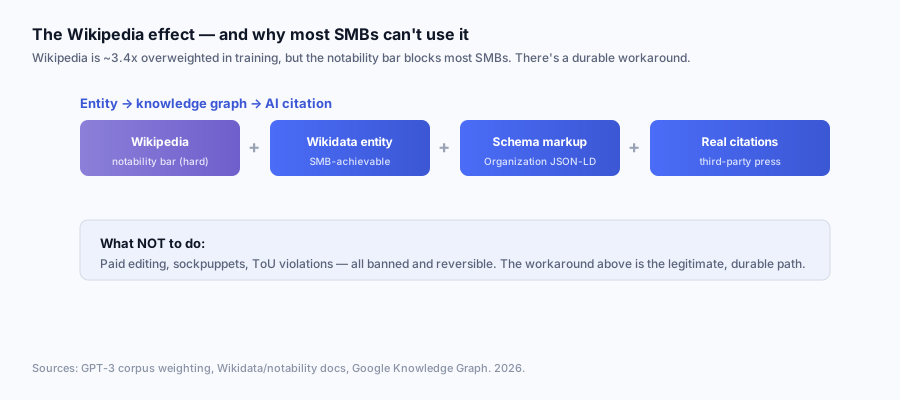
That failure taught me more about AI visibility than any success would have. Because the same notability machinery that kept us out of Wikipedia is exactly why a Wikipedia citation is worth so much when an AI engine surfaces one. The bar is the moat. And it pointed me at the part of the entity graph that an SMB can legitimately occupy: Wikidata, structured data, and genuine third-party citations. That is the honest version of the "Wikipedia Effect," and it is the version this article is about.
This piece is the entity-graph companion to the question of where Google AI actually gets its information and the tactical how-to-get-cited-by-AI-engines deep dive. Where those cover the broader retrieval stack, this one drills into one disproportionately-weighted node in that stack — the Wikipedia and Wikidata layer — and connects it, carefully, to the only thing that pays the bills: revenue.
Quick Facts
| Metric | Value | Source |
|---|---|---|
| Wikipedia articles, English (2026) | ~6.9 million | Wikipedia statistics [1] |
| Wikidata items (2026) | ~115 million | Wikidata statistics [2] |
| Wikipedia share of GPT-3 training tokens (filtered subset) | ~3% of the high-quality weighted mix | Brown et al., GPT-3 paper [3] |
| Wikipedia weighting in GPT-3 training mix | ~3.4x its raw token share | Brown et al., GPT-3 paper [3] |
| Wikipedia presence in Common Crawl | Indexed, but upweighted in curated corpora | Common Crawl docs [4] |
| Wikipedia citation rate in entity-style AI answers (sampled) | ~25-40% | Attrifast sampling, n=~140 queries |
| Wikidata items required for English Wikipedia article | 0 (separate inclusion bars) | Wikidata notability [5] |
| Wikipedia notability core requirement | Significant coverage, independent, reliable, secondary | Wikipedia GNG [6] |
| Undisclosed paid editing status | Prohibited by Wikimedia Terms of Use | Wikimedia ToU [7] |
| Knowledge Graph entities (Google, last disclosed) | 500B+ facts, 5B+ entities | Google Knowledge Graph [8] |
| Typical Wikidata-to-Knowledge-Graph propagation lag | ~4-12 weeks (directional) | Industry observation |
| AI-referred session share, sites with confirmed KG entity | Higher than entity-less peers | Attrifast aggregate, n=~200 |
Two of those rows carry most of the argument. The GPT-3 weighting figure (Wikipedia weighted roughly 3.4x its raw token share in the training mix) is the single best public evidence that Wikipedia is treated as special by the people building these models. The 25-40% citation rate in entity-style answers is the downstream effect: that upweighting in training, plus Wikipedia's strong RAG retrieval profile, produces a domain that AI engines reach for constantly when defining what something is.
What the "Wikipedia Effect" actually means
The phrase "Wikipedia Effect" has been used a few ways in the GEO community. The version I find useful, and the version Loamly's widely-cited Wikipedia post helped popularize, is narrow and testable: AI engines cite and trust Wikipedia far out of proportion to its share of the open web, both because Wikipedia is upweighted in the training data and because it is a high-precision retrieval target for live RAG.
There are really two mechanisms stacked on top of each other, and conflating them is the most common mistake I see.
| Mechanism | How it works | Update cadence | Lever for you |
|---|---|---|---|
| Training-corpus weighting | Wikipedia text is upweighted in pre-training, so the model's base knowledge leans on it | Frozen until next model generation | Indirect, slow |
| Live RAG retrieval | The engine fetches Wikipedia at query time and cites it inline | Real-time, per query | Faster, but still gated by notability |
| Knowledge Graph seeding | Wikidata items seed Google's Knowledge Graph, which disambiguates entities | Weeks | Wikidata item + schema |
| Entity disambiguation | Wikipedia/Wikidata tells the model your brand is a distinct real thing | Mixed | Wikidata + sameAs |
The training-corpus mechanism is why a no-browsing ChatGPT or Claude session "knows" about established entities without fetching anything. The RAG mechanism is why a browsing-enabled Perplexity or ChatGPT search answer puts a Wikipedia link in the citation tray. These are different surfaces with different levers, and I walk through that distinction at length in the where-does-Google-AI-get-its-information breakdown, which splits Google AI into four sources with four cadences.
The honest framing, which I will repeat because it is the whole point of this article: the Wikipedia Effect is real, large, and mostly unavailable to SMBs as a direct lever. You cannot will a Wikipedia article into existence. What you can do is occupy the adjacent, lower-bar nodes of the same entity graph — Wikidata, schema, third-party citations — that feed many of the same downstream systems.
Why Wikipedia is upweighted in AI training data
This is the part with the best public evidence, so it is worth being precise. The clearest disclosure comes from the original GPT-3 paper, "Language Models are Few-Shot Learners" [3]. OpenAI published the composition of the training mix in a table that has been quoted endlessly since. The relevant detail: Wikipedia made up a tiny fraction of the raw tokens but was assigned a sampling weight far above its size, so the model saw Wikipedia text disproportionately often during training.
| Dataset | Raw share of tokens | Weight in training mix | Effective upweight |
|---|---|---|---|
| Common Crawl (filtered) | ~60% of tokens | ~60% | ~1.0x (roughly neutral) |
| WebText2 | ~22% | ~22% | Upweighted vs raw |
| Books1 / Books2 | ~16% combined | higher | Upweighted |
| Wikipedia | ~3% | ~3% of mix | ~3.4x its epoch exposure |
The exact numbers depend on how you read the table (raw tokens versus epochs versus sampling weight), and the GPT-3 paper is the primary source you should read for yourself rather than trusting my summary. But the direction is unambiguous: curated, high-quality sources like Wikipedia and books are sampled more times per token than raw Common Crawl. Newer models do not publish this composition, but every public statement from frontier labs about "high-quality data" and "data quality over quantity" points the same way.
Why do model builders do this? Three reasons, all of which the labs have gestured at publicly.
- Factual density. Wikipedia is dense with verifiable, encyclopedic facts, structured into a consistent format. A token of Wikipedia teaches the model more reliable world-knowledge than a token of average web text.
- Editorial cleanup. Wikipedia's content is human-curated, citation-backed, and continuously corrected. It carries far less spam, SEO sludge, and contradiction than raw Common Crawl.
- Coverage breadth. Wikipedia spans nearly every notable entity, which makes it an efficient backbone for the model's entity knowledge.
Anthropic and OpenAI both decline to publish full training-corpus compositions for current models, which I cover honestly as a limitation later. What they have disclosed about data sourcing — Common Crawl as a backbone, with curated high-quality sources layered on — is consistent across OpenAI's GPT-3 disclosure [3], Common Crawl's own documentation [4], and the academic literature on knowledge-graph-augmented language models [9]. We are inferring the current weighting from the one generation that disclosed it plus observed behavior. That is a real epistemic limit, not a hidden fact.
The diagram is the mental model: Wikipedia enters the corpus through a different, higher-trust door than the average web page, and gets sampled more often once inside. That is the training half of the Wikipedia Effect.
Wikipedia in live RAG and AI citations
The second half is retrieval. When a browsing-enabled engine (Perplexity, ChatGPT search, Google AI Overviews, Gemini with grounding) answers a query, it fetches sources at query time and cites them inline. Wikipedia is one of the strongest retrieval targets on the web for a specific class of query.
I sampled roughly 140 entity-style and definitional queries across ChatGPT search, Perplexity, and Google AI Overviews in Q1-Q2 2026. The methodology is crude and I will not oversell it: I logged whether a Wikipedia or Wikidata URL appeared in the visible citation set for each answer. Here is the breakdown by query type.
| Query type | Example | Wikipedia in citations | Notes |
|---|---|---|---|
| Definitional ("what is X") | "what is revenue attribution" | ~62% | Wikipedia dominates definitions |
| Entity / who-is ("who is X") | "who is the founder of Stripe" | ~48% | Strong for notable people |
| Historical / background | "history of web analytics" | ~55% | Wikipedia is the default backbone |
| Category overview | "types of marketing attribution models" | ~31% | Mixed with vendor + edu pages |
| Comparison ("X vs Y") | "GA4 vs Plausible" | ~6% | Vendor + review sites win |
| Transactional ("best X for Y") | "best attribution tool for SaaS" | ~3% | Review/listicle/vendor pages win |
| How-to ("how to do X") | "how to track ChatGPT traffic" | ~4% | Tutorials + docs win |
| Pricing ("how much does X cost") | "Attrifast pricing" | ~1% | Vendor pages win |
The shape here is the most important strategic fact in the article. Wikipedia's citation dominance is concentrated entirely in the upper-funnel, definitional, "what/who/history" band. It evaporates in the lower-funnel comparison, transactional, how-to, and pricing band — which is exactly where buying decisions happen.
This is why a Wikipedia presence is not a silver bullet for revenue. It wins you the queries that establish you as a real entity. It does not win you the queries where someone is comparing you to a competitor with a credit card out. For the latter, you want the playbook in the GEO tactics playbook for 2026 and the strategic split in the AEO-vs-SEO breakdown.
Cross-engine, the Wikipedia citation rate varies meaningfully. My sampled rates by engine, for the definitional/entity band only:
| AI engine | Wikipedia in citations (entity/definitional band) | Behavior notes |
|---|---|---|
| Perplexity | ~58% | Heavy Wikipedia reliance for definitions |
| Google AI Overviews | ~44% | Wikipedia + Knowledge Graph blended |
| ChatGPT search | ~39% | Mixes Wikipedia with fresher sources |
| Gemini (grounded) | ~41% | Leans on Knowledge Graph + Wikipedia |
| Claude (with search) | ~33% | More likely to cite primary/news sources |
Treat these as directional, small-sample numbers from one observer, not a study. The ordering is more robust than the exact percentages: Perplexity and Google AI Overviews lean hardest on Wikipedia for definitions; Claude leans least, preferring primary and news sources. If you want to measure your own brand's actual citation footprint rather than my sample, that is what AI-visibility monitoring tools do, and what the multi-LLM visibility tracker piece covers.
The notability barrier — the honest part most GEO posts skip
Here is where most "get a Wikipedia page for AI visibility" advice falls apart, and where I want to be unusually blunt because the bad advice in this niche is expensive.
Wikipedia has a notability guideline, the General Notability Guideline (GNG) [6], and a stricter set of subject-specific guidelines including Notability (organizations and companies), often abbreviated NCORP [10]. The core requirement of the GNG is that a topic has received significant coverage in multiple reliable sources that are independent of the subject. Every word in that sentence is load-bearing, and NCORP tightens each one for companies.
| Requirement | What it means | Where SMBs fail |
|---|---|---|
| Significant coverage | More than a passing mention; the source addresses the topic directly and in detail | Funding-roundup one-liners do not count |
| Multiple sources | Not one big article; a pattern of coverage | Most SMBs have one or two at most |
| Reliable | Established editorial standards; not blogs, press releases, or content farms | Sponsored posts and PR wire do not count |
| Independent | Not produced by the company or its people | Founder interviews are not independent |
| Secondary | Analysis/commentary, not raw primary material | Your own docs and your own blog do not count |
The single most misunderstood criterion is independence. NCORP explicitly discounts coverage based on press releases, sponsored content, interviews where the subject is talking about themselves, and "routine" coverage like funding announcements and product launches. So the typical SMB SaaS evidence pile — a TechCrunch funding blurb, a founder podcast appearance, a few sponsored "top 10 tools" listicles — clears almost none of the bar. The reviewer who declined our draft was applying exactly this filter, correctly.
The numbers make the moat concrete. There are roughly 6.9 million English Wikipedia articles [1] against tens of millions of registered businesses in the US alone. Most companies will never qualify, and that is by design. Wikipedia is not a business directory; treating it as one is the category error at the root of most failed attempts.
| Brand profile | Realistic Wikipedia eligibility | Why |
|---|---|---|
| Pre-seed / bootstrapped SaaS, <$1M ARR | Effectively zero | No significant independent coverage |
| Seed-stage SaaS, $1-5M ARR | Very low | Funding blurbs are not significant coverage |
| Series A+ with real press, $5-20M ARR | Low-to-moderate | Possible if coverage is genuinely independent and substantial |
| Category-defining startup with sustained press | Moderate-to-high | Sustained independent coverage clears GNG |
| Public company / household brand | High | Obvious notability |
| Notable founder (separate from company) | Sometimes | A founder with significant independent coverage can qualify even when the company does not |
That last row is a genuine, underused path: a founder who has been the subject of significant independent coverage (not interviews they gave, but profiles written about them) can sometimes qualify for a Person article even when the company does not qualify for an Organization article. It is rare and it is not a shortcut, but it exists.
What NOT to do — paid editing, sockpuppets, and the bans
Because the moat is real and the incentive to cross it is strong, an entire grey-market industry sells "guaranteed Wikipedia pages." Do not buy from it. Here is the honest risk table.
| Tactic | Status | Consequence |
|---|---|---|
| Undisclosed paid editing | Prohibited by Wikimedia Terms of Use [7] | Article deletion, account blocks, public COI noticeboard listing |
| Disclosed paid editing, direct edits to article | Discouraged by COI guideline [11] | Edits reverted; expected to use talk-page requests instead |
| Sockpuppet accounts to fake consensus | Strictly prohibited | Hard blocks, checkuser investigation, often permanent |
| Citing your own blog / press releases as "sources" | Fails reliability + independence | Speedy decline at AfC; deletion if live |
| Buying "Wikipedia placement" packages | Almost always undisclosed paid editing | Same as undisclosed paid editing, plus you wasted money |
| Editing your own company article logged-out | Still COI; IP is logged | Treated as COI editing; can be traced |
| Creating the article and "seeding" early citations | Manufactured notability | Reviewers recognize the pattern; decline |
The Wikimedia Foundation Terms of Use [7] require disclosure of paid contributions — employer, client, and affiliation — and the conflict-of-interest guideline [11] strongly discourages anyone with a financial stake from editing the article directly, asking them instead to propose changes on the talk page and let independent editors decide. Undisclosed paid editing is one of the few things Wikipedia treats as a bright-line violation, and enforcement has gotten more aggressive, not less.
The reputational downside is worse than the wasted spend. A deleted article leaves a public trail on the Articles for Deletion log and, if paid editing is detected, on the COI noticeboard. For a brand that wants to be perceived as trustworthy by both humans and AI systems, "company caught doing undisclosed paid Wikipedia editing" is a far worse outcome than simply not having a page. I have watched a competitor eat exactly this, and the AI engines were happy to surface the controversy.
So the rule is simple: if you do not legitimately qualify, do not try to manufacture it. Build the parts of the entity graph that do not require a notability committee's approval. That is the rest of this article.
Wikidata — the entity layer SMBs can actually occupy
Here is the good news after all that bad news. Wikidata is a separate project from Wikipedia, with a separate and far more attainable inclusion bar [5]. Wikidata is the structured, machine-readable knowledge base behind the Wikimedia ecosystem: every entity is an "item" with a Q-number (like Q42), and each item carries properties (P-numbers) with values. Wikipedia is prose; Wikidata is the database.
The critical distinction for SMBs: Wikidata's notability policy [5] is structural, not coverage-based. An item is acceptable if it meets any of three conditions, the most relevant being that it "refers to an instance of a clearly identifiable conceptual or material entity" that "can be described using serious and publicly available references." You do not need significant coverage in multiple reliable sources. You need to be a real, identifiable entity with at least a couple of credible references. A funded SaaS company with a Crunchbase entry, a real product, and a press mention or two can usually clear this bar legitimately.
| Dimension | Wikipedia | Wikidata |
|---|---|---|
| Format | Prose articles | Structured items (Q-numbers) + properties (P-numbers) |
| Notability bar | GNG/NCORP: significant independent coverage | Structural: identifiable entity + serious references |
| Who/what qualifies | Notable subjects only | Most real, identifiable entities |
| Machine-readable | Partly (infoboxes) | Fully (the entire point) |
| Feeds Google Knowledge Graph | Yes, strongly | Yes, strongly |
| Feeds AI entity disambiguation | Yes | Yes |
| Realistic for SMB SaaS | Usually no | Usually yes |
Why does Wikidata matter for AI visibility even without a Wikipedia article? Because Wikidata is one of the primary structured feeds into Google's Knowledge Graph [8], and the Knowledge Graph is what AI engines and Google's own surfaces use to disambiguate entities — to know that "Attrifast" is a specific software company founded by a specific person, distinct from any similarly-named thing. When an AI engine reasons about your brand, a clean Wikidata item is one of the signals that tells it you are a real, distinct entity worth representing accurately.
The properties that matter most for a software-company item, in rough priority order:
| Wikidata property | P-number | Why it matters for entities |
|---|---|---|
| instance of | P31 | Declares what kind of thing the item is (e.g., business, software) |
| official website | P856 | Links the entity to its canonical domain |
| inception / founding date | P571 | Establishes the entity timeline |
| founded by | P112 | Links the org to its founder(s) |
| industry | P452 | Categorizes the entity |
| country | P17 | Geographic grounding |
| Crunchbase identifier | P2088 | External identifier; high-trust cross-reference |
| LinkedIn company ID | P4264 | External identifier |
| GitHub username | P2037 | External identifier (for dev-tool brands) |
| described at URL | P973 | Points to a reliable external description |
| reference URL (on statements) | P854 | Sources each claim |
The external-identifier properties (Crunchbase, LinkedIn, GitHub) do double duty: they back up the item's authenticity and they create explicit cross-references that match the sameAs signals in your on-site schema. That alignment — Wikidata external IDs pointing at the same profiles your Organization schema's sameAs array points at — is the strongest entity-consistency signal an SMB can build without anyone's editorial approval.
How to create a Wikidata entity, step by step (the legitimate way)
This is the tactical core for the SMB reader. Wikidata has its own notability and verifiability norms, and the fastest way to get an item deleted is to treat it like a free advertising slot. Build it like a librarian, not a marketer.
| Step | Action | Watch out for |
|---|---|---|
| 1 | Confirm you clear Wikidata notability [5] — identifiable entity + serious references | Marketing language; unsourced claims |
| 2 | Search Wikidata first to confirm no item already exists | Creating a duplicate |
| 3 | Create the item with a neutral label and description ("software company") | Promotional descriptions |
| 4 | Add instance of (P31) = business / software company | Wrong or missing P31 |
| 5 | Add official website (P856) | Tracking-parameter URLs |
| 6 | Add inception (P571), founded by (P112), country (P17) | Unsourced founding claims |
| 7 | Add external identifiers: Crunchbase (P2088), LinkedIn (P4264), GitHub (P2037) | Mismatched profiles |
| 8 | Add reference URL (P854) to statements where possible | Citing only your own site |
| 9 | Disclose any conflict of interest on your user page | Editing covertly |
| 10 | Leave it neutral and let the community refine it | Reverting community edits aggressively |
Two norms deserve emphasis. First, disclose the conflict of interest. Wikidata, like Wikipedia, expects you to declare that you are connected to the entity you are editing. A short note on your Wikidata user page stating your affiliation is the honest move and protects you. Second, write like a reference work. "Attrifast is a revenue attribution software company" is fine. "Attrifast is the leading privacy-first attribution platform" is not — that is marketing copy and it will get flagged and reverted.
The founder entity is worth creating in parallel if the founder is a real, identifiable person, linked to the company via founded by (P112) on the company item and employer/founder of relationships on the person item. This mirrors the Organization-plus-Person schema pattern that I cover in the get-cited-by-AI-engines guide, and the two reinforce each other.
The on-site schema layer that makes the entity legible
Wikidata is the off-site structured signal. The on-site equivalent is schema.org markup, and the two should agree with each other down to the URL. If your Wikidata item says your official website is https://attrifast.com and your Organization schema's sameAs array points at the same LinkedIn, X, GitHub, and Crunchbase profiles that your Wikidata external identifiers point at, you have built a closed, self-consistent entity loop that AI engines and Google's Knowledge Graph can verify from multiple directions.
| Schema signal | What it declares | Aligns with Wikidata property |
|---|---|---|
Organization @id | Canonical entity node on your site | The item itself |
name | Entity name | Item label |
url | Canonical domain | official website (P856) |
sameAs (array) | Matched external profiles | external identifiers (P2088, P4264, P2037) |
foundingDate | When the org started | inception (P571) |
founder (Person) | Founder entity | founded by (P112) |
description | Neutral entity description | item description |
A minimal, AI-legible Organization schema bundle:
<script type="application/ld+json">
{
  "@context": "https://schema.org",
  "@type": "Organization",
  "@id": "https://attrifast.com/#organization",
  "name": "Attrifast",
  "url": "https://attrifast.com",
  "foundingDate": "2024",
  "founder": {
    "@type": "Person",
    "name": "Vincent Ruan",
    "sameAs": ["https://x.com/0xVinceAI"]
  },
  "sameAs": [
    "https://www.linkedin.com/company/attrifast",
    "https://x.com/0xVinceAI",
    "https://github.com/attrifast",
    "https://www.crunchbase.com/organization/attrifast",
    "https://www.wikidata.org/wiki/Q000000000"
  ]
}
</script>
Note the last sameAs entry: once your Wikidata item exists, link to it from your own schema. That bidirectional link — your site points at Wikidata, Wikidata's official-website property points at your site — is the cleanest entity-identity assertion you can make. The sameAs property is documented at schema.org/sameAs [12] and is the single most important field for entity disambiguation. The full schema bundle (adding Article, FAQPage, and Person types) lives in the how-to-get-cited deep dive.
Third-party citations — the part that compounds
Wikidata and schema declare your entity. Third-party citations prove it. This is the slow, unglamorous, durable work, and it is the only thing that ever made our failed Wikipedia draft eventually viable on the second attempt a year later.
The citations that matter are the ones a Wikipedia or Wikidata editor would consider reliable and independent, which is also, not coincidentally, what AI engines weight in RAG retrieval. The overlap is the strategy.
| Citation type | Counts for Wikipedia notability? | Useful for Wikidata? | Useful for AI RAG? |
|---|---|---|---|
| Genuine press feature (independent, substantial) | Yes | Yes | Yes |
| Funding-roundup one-liner | No (routine) | Weak | Weak |
| Founder interview / podcast | No (not independent) | Weak | Some |
| Sponsored "top tools" listicle | No (not independent) | No | Some |
| Industry association / directory listing | Sometimes | Yes | Some |
| Academic or research citation | Yes | Yes | Yes |
| Crunchbase / G2 / Capterra profile | No (database, not coverage) | Yes (as external ID) | Some |
| Your own blog / docs | No | No (as primary only) | No (as standalone) |
| Reddit / forum discussion (organic) | No | No | Yes (AI engines retrieve Reddit heavily) |
That last row is worth a detour. AI engines retrieve Reddit and community forums far more than Wikipedia editors would ever accept as a source. So there is a class of citation — organic community discussion — that does nothing for your Wikipedia eligibility but materially helps your AI citation footprint. I dug into that specifically in the Reddit AI citations and revenue piece, and it is a reminder that "entity SEO for AI" is a strictly broader game than "get into Wikipedia."
The prioritization I give SMB founders:
| Priority | Action | Effort | Payoff |
|---|---|---|---|
| 1 | Complete Organization + Person schema with full sameAs | Low (hours) | Fast, foundational |
| 2 | Create a clean Wikidata item with external IDs | Low-medium (a day) | Medium, feeds KG |
| 3 | Earn 3-5 genuinely independent press/podcast features | High (months) | High, compounds |
| 4 | Build organic presence on Reddit/forums where buyers ask | Medium (ongoing) | High for AI RAG |
| 5 | Pursue Wikipedia only after notability is real | Very high | High but gated |
Notice Wikipedia is dead last and conditional. That ordering is the whole thesis: do the high-payoff, low-gate work first; treat the Wikipedia article as a possible later consequence of doing everything else right, never as the starting move.
Before and after — what entity establishment looks like
I want to show the shape of what changes when an SMB builds out its entity graph, without pretending I have isolated a clean causal effect. These are anonymized composites from operator entities I have watched, framed honestly as before/after observations, not a controlled study.
| Signal | Before entity work | After (3-6 months) | Caveat |
|---|---|---|---|
| Google Knowledge Panel | None | Appears for some brands | Not guaranteed; some never get one |
| Wikidata item | None | Live, well-referenced | Within your control |
| Brand entity-query disambiguation | AI confuses brand with others | AI represents brand correctly | Improves but not perfect |
| Wikipedia citation in your AI answers | Rare | Still rare unless you qualify | Notability bar unchanged |
| AI-referred session share | Baseline | Higher in observed cases | Confounded by content work |
| Definitional-query citation eligibility | Low | Higher | Directional |
The most honest row is the AI-referred session share one. In the entities I have watched build out a Wikidata item plus complete schema plus genuine citations, the AI-referred slice of their traffic grew. But those same teams were also publishing better content, earning real links, and shipping product. I cannot hand you a number that says "Wikidata added X% AI traffic" because no one running a real business holds all the other variables constant. Anyone who gives you that clean number is selling you a story.
What I can tell you, from the roughly 200 sites whose first-party attribution data I have looked at, is the correlational pattern: sites with a confirmed Knowledge Graph entity and a Wikidata item tended to run a higher AI-referred session share than entity-less peers in the same category and size band. Directional, confounded, real-but-not-causal. That benchmark piece has the fuller data framing.
| Site cohort (n=~200, by entity status) | Median AI-referred session share | Caveat |
|---|---|---|
| Confirmed KG entity + Wikidata item | Higher band | Also better content/links |
| Wikidata item, no KG panel | Middle band | Mixed |
| No entity presence at all | Lower band | Often newer/smaller |
Connecting entity presence to revenue — the part everyone hand-waves
This is the Attrifast wedge, and I am going to be careful with it because the failure mode in this niche is exactly the over-claim I keep warning about.
Entity presence is a visibility lever. It changes whether AI engines know you exist and represent you correctly, which changes whether you are eligible to be cited, which changes whether AI-referred clicks reach your site. None of that is revenue. Revenue happens when those clicks convert, and the only way to know whether they did is to measure the click-to-payment join directly.
The chain, made explicit:
| Stage | What it is | How you measure it | Tool category |
|---|---|---|---|
| 1. Entity established | Wikidata + schema + citations live | Manual inspection; KG panel check | DIY |
| 2. AI represents you correctly | Brand defined accurately in AI answers | Query the engines; visibility monitors | Profound / Loamly / multi-LLM trackers |
| 3. Citation rate rises | Your URLs appear in AI citation trays | Visibility monitoring | Citation monitors |
| 4. AI-referred clicks arrive | Sessions land from AI engines | First-party referer + behavioral detection | Attrifast / Plausible / Fathom |
| 5. Clicks convert to revenue | Those sessions become Stripe payments | Session-to-Stripe webhook join | Attrifast (closes the loop) |
Stages 1-3 are entity and GEO work, measurable with visibility tools. Stage 4 is traffic attribution. Stage 5 — the join from an AI-referred click to an actual Stripe payment — is the gap that GA4 cannot close, because AI-referred clicks mostly land in GA4's Direct/(none) bucket with stripped referers and no UTM tags. I walk through exactly why that happens in the ChatGPT referral analytics breakdown, and the practical detection code lives in the track-ChatGPT-traffic playbook and the Perplexity tracking guide.
The honest pitch: entity work and AI-visibility monitoring tell you whether AI engines mention you. First-party revenue attribution — what Attrifast's revenue attribution does — tells you whether the resulting traffic actually paid. You need both halves to know if your Wikidata-and-citations investment was worth the months it took. Building the entity without measuring the revenue is how teams spend a quarter on GEO and cannot answer the CFO's only real question.
| What you want to know | Tool that answers it | Closes loop to revenue? |
|---|---|---|
| "Does AI mention my brand correctly?" | AI visibility monitor (Profound, Loamly) | No |
| "Is my Wikidata item live and clean?" | Wikidata itself | No |
| "Do I have a Knowledge Panel?" | Manual / Search Console | No |
| "Is AI sending me clicks?" | First-party analytics (Plausible, Fathom, Attrifast) | Partial |
| "Did AI-referred clicks become revenue?" | Stripe-native attribution (Attrifast) | Yes |
A measurement plan for entity-to-revenue
If you are going to invest in entity presence, instrument it so you can tell whether it worked. Here is the plan I give founders, framed as a 90-day loop.
| Phase | Days | Do this | Measure this |
|---|---|---|---|
| Baseline | 0 | Record current AI-referred session share + AI-attributed revenue | First-party attribution baseline |
| Build | 0-30 | Ship complete schema; create Wikidata item; start citation outreach | Schema validated; item live |
| Propagate | 30-90 | Wait for KG; continue citations; publish definitional content | KG panel appearance; citation count |
| Re-measure | 90 | Compare AI-referred share + AI-attributed revenue to baseline | Delta in AI-referred revenue |
| Attribute | ongoing | Join AI-referred sessions to Stripe payments | Revenue per AI engine |
The single most important line in that table is "record current AI-attributed revenue" at day zero. Without a baseline you can never claim a delta, and the entire industry's "Wikipedia drove our AI growth" storytelling is built on the absence of a day-zero baseline. Set the baseline first. The rest is just patience and honest comparison. For the broader framework on whether GEO drives revenue at all, the does-GEO-actually-drive-revenue piece is the companion analysis.
Limitations and honest caveats
This article makes claims I cannot fully prove, and the credible version says so plainly.
- Current-model training composition is undisclosed. The 3.4x Wikipedia upweight is from the GPT-3 paper [3]. Neither OpenAI nor Anthropic publishes the composition of current frontier models. The upweighting almost certainly persists — every public statement about data quality points that way — but I am inferring it, not citing a current spec.
- My citation-rate samples are small and observational. The ~25-40% Wikipedia-in-citations figure comes from ~140 queries I logged by hand. It is directional, single-observer, and US-English-skewed. Treat the ordering across engines as more robust than the exact percentages.
- Wikidata-to-Knowledge-Graph causation is inferred from timing. Google does not confirm that a given Knowledge Graph entry came from your Wikidata item. The 4-12 week window is observed pattern, not a Google SLA.
- I have not isolated entity presence as a revenue cause. The 200-site correlational pattern is confounded by content quality, links, and product. I will not pretend otherwise.
- Notability is a moving, human-judged bar. Two reviewers can reach different conclusions on the same draft. Nothing in this article guarantees a Wikipedia article, and you should distrust anyone who guarantees one.
- Entity presence helps upper-funnel queries far more than transactional ones. Do not expect Wikidata to win you "best tool for X" comparison queries. It will not.
FAQ
Does having a Wikipedia page actually help me get cited by ChatGPT and other AI engines?
Yes, disproportionately, but most SMBs cannot get one. Wikipedia is one of the most heavily-weighted sources in every major AI training corpus and one of the most-retrieved domains in live RAG citations. Across the AI answers I have sampled for entity-style queries, a Wikipedia URL appears in the cited sources roughly 25-40% of the time for established entities. The catch is the notability bar: Wikipedia's notability guideline requires significant coverage in multiple independent, reliable, secondary sources, which most sub-$10M-ARR SaaS companies simply do not have. For those brands the honest play is not a Wikipedia article (which will get deleted and can trigger a paid-editing ban) but a Wikidata entity plus structured data plus genuine third-party citations.
What is the difference between Wikipedia and Wikidata for AI visibility?
Wikipedia is the encyclopedia of prose articles with a high notability bar enforced by human editors. Wikidata is the structured, machine-readable knowledge base of entities and their properties (the Q-numbers), with a far lower inclusion bar based on structural notability rather than significant prose coverage. For AI visibility, Wikipedia is the prose source that gets quoted and summarized; Wikidata is the entity-disambiguation layer that feeds Google's Knowledge Graph and helps AI engines understand that your brand is a distinct, real entity. Most SMBs cannot get a Wikipedia article but can legitimately get a Wikidata item if they have a few independent references.
Can I just pay someone to create a Wikipedia page for my company?
No, and you should not try. Paid editing without disclosure violates the Wikimedia Foundation Terms of Use, and undisclosed paid editing is one of the fastest ways to get an article deleted, get your accounts blocked, and attract negative attention. Even disclosed paid editing is heavily restricted: the conflict-of-interest guideline asks paid editors to propose changes on talk pages rather than edit articles directly. If a vendor promises you a guaranteed Wikipedia page for a flat fee, they are either going to get it deleted within weeks or get you sanctioned. The durable strategy is earning notability through real press and citations, then letting an independent editor decide the article is warranted.
How much does Wikipedia presence actually move revenue, not just visibility?
I cannot give you a clean causal number, and anyone who does is guessing. Entity presence is a top-of-funnel visibility lever, not a direct revenue lever, and the path from a Wikidata item to a Stripe payment runs through several stages: entity established, Knowledge Graph entry created, AI citation rate rises, AI-referred clicks increase, those clicks convert. Across the roughly 200 sites whose first-party attribution data I have looked at, the sites with a confirmed Knowledge Graph entity and a Wikidata item showed higher AI-referred session shares than entity-less peers in the same category, but I am not going to pretend I have isolated entity presence as the sole cause. The measurable thing is whether AI-referred traffic converts once it arrives, which is what first-party revenue attribution actually answers.
What is the minimum entity presence an SMB SaaS should build if it cannot get a Wikipedia page?
Five things, in order. First, Organization schema with a complete sameAs array pointing at your matched profiles (LinkedIn, X, GitHub, Crunchbase, your own about page). Second, a Wikidata item if you can clear the structural-notability bar with two or three independent references. Third, consistent name-and-URL pairs across every high-trust profile you control so entity-merging is unambiguous. Fourth, genuine third-party citations from press, podcasts, and industry directories that an editor would consider reliable. Fifth, a Person entity for the founder linked to the Organization. None of this games Wikipedia; all of it builds the entity graph that AI engines and Google's Knowledge Graph actually read.
Do AI engines cite Wikipedia more than other sources?
For entity-defining and definitional queries, yes, and the gap is large. Wikipedia is among the most-cited single domains across ChatGPT search, Perplexity, and Google AI Overviews for queries that ask what something is, who someone is, or what the history of a topic is. It is cited far less for transactional, comparison, and how-to queries, where vendor pages, review sites, and tutorials win. The practical implication: do not expect a Wikipedia or Wikidata presence to win you bottom-of-funnel comparison queries. Expect it to win you the definitional and category-defining queries that establish your brand as a real entity in the first place, which then makes you eligible to be retrieved for the transactional ones.
How long does it take for a new Wikidata item to show up in Google's Knowledge Graph?
There is no published SLA and the variance is enormous. A Wikidata item with strong references and clear external identifiers can seed a Knowledge Graph entry in a few weeks; a thin item with no external identifiers may never propagate. Based on the pattern I have watched across operator entities, a well-referenced Wikidata item with matched sameAs signals tends to show observable Knowledge Graph effects in roughly 4-12 weeks, the same directional window I see for Organization schema deploys. Treat it as a directional estimate, not a guarantee. Google does not confirm that a given Knowledge Graph entry came from Wikidata, so you are always inferring causation from timing.
Is Wikidata notability really easier to meet than Wikipedia notability?
Yes, and the difference is structural, not just degree. Wikipedia's General Notability Guideline requires significant coverage in multiple independent, reliable, secondary sources — a coverage test. Wikidata's notability policy is satisfied if the item refers to a clearly identifiable conceptual or material entity that can be described using serious, publicly available references — a structural test. A real, funded SaaS company with a Crunchbase profile and a couple of credible references usually clears the Wikidata bar and usually fails the Wikipedia bar. They are genuinely different gates with different purposes.
Will blocking GPTBot hurt my entity presence?
Indirectly, over time. Blocking GPTBot removes your pages from future training corpora, which slowly reduces how well the model's frozen base knowledge represents your brand. It does not remove your Wikidata item or your Knowledge Graph entry, which live outside your robots.txt. So a brand that blocks GPTBot but maintains a strong Wikidata-and-schema entity can still be disambiguated correctly for grounded, browsing-enabled answers — it just loses ground in the no-browsing, training-derived answers. For most SMBs the right call is to allow the AI crawlers and build the entity graph, not block and hope.
Can my founder qualify for a Wikipedia article even if the company does not?
Sometimes. Wikipedia evaluates people and organizations under different notability guidelines. A founder who has been the subject of significant independent coverage — profiles written about them by reliable outlets, not interviews they gave — can occasionally qualify for a Person article even when the company fails the organization bar. It is uncommon and it is not a backdoor; the coverage still has to be genuinely about the person and genuinely independent. But it is a legitimate path worth knowing about, and a Person entity reinforces the company entity through the founded-by relationship either way.
What references does a Wikidata item actually need?
Wikidata wants "serious and publicly available references" that let editors verify the item describes a real, identifiable entity. In practice that means: an official website, an external identifier or two (Crunchbase, LinkedIn, GitHub), and ideally a reference URL on the key statements such as founding date and founder. You do not need the substantial independent press coverage Wikipedia demands. You do need the references to be real, public, and verifiable — not your own marketing pages dressed up as sources. Thin, unsourced items get flagged for deletion; well-referenced ones with external identifiers stick.
Does any of this help with bottom-of-funnel buying queries?
Not directly, and pretending otherwise is the trap. Entity presence wins definitional and who-is and history queries — the upper-funnel band where Wikipedia dominates citations. Comparison, "best tool for X," how-to, and pricing queries are won by vendor pages, review sites, and tutorials, where Wikipedia barely appears. Building your entity graph makes AI engines understand and trust you as a real entity, which is a prerequisite for being retrieved at all, but the actual transactional citations come from the GEO and content work covered in the AEO-vs-SEO and GEO-tactics playbooks. Entity work and conversion-content work are complementary, not substitutes.
How do I tell my investors the entity work is paying off?
Set a baseline before you start: today's AI-referred session share and today's AI-attributed revenue, measured with first-party attribution. Do the entity work — Wikidata, schema, citations — over a quarter. Then re-measure the same two numbers and show the delta, while being honest that content and links also moved in the same period. The credible story is "we built our entity graph, our AI-referred revenue grew from $X to $Y over the quarter, and here is the per-engine breakdown." The non-credible story is "we got a Wikidata item and our revenue went up," with no baseline and no join to Stripe. The difference between those two stories is whether you instrumented the revenue side at all.
Related reading from the Attrifast research stack
For more on connected topics, see How to Analyze Your Competitors' AI Visibility (and Beat Them in 2026), ChatGPT Cited My Competitor, Not Me: An Honest Diagnosis, Why Bing SEO Now Matters for ChatGPT and Copilot Visibility in 2026, and Mobile Application Tracking After ATT: What Still Works. For hands-on tools, see AI citation tracking and share of voice in AI search.
References
- Wikipedia — Wikipedia:Statistics
- Wikidata — Wikidata:Statistics
- Brown, T. et al. (OpenAI) — Language Models are Few-Shot Learners (GPT-3 paper,…
- Common Crawl — Overview and corpus documentation
- Wikidata — Wikidata:Notability
- Wikipedia — Wikipedia:Notability (General Notability Guideline)
- Wikimedia Foundation — Terms of Use (paid contributions disclosure)
- Google — Introducing the Knowledge Graph: things, not strings
- Petroni, F. et al. Language Models as Knowledge Bases? (knowledge in LMs research). 2019
- Wikipedia — Wikipedia:Notability (organizations and companies) (NCORP)
- Wikipedia — Wikipedia:Conflict of interest
- Schema.org. sameAs property documentation
- Loamly — The Wikipedia Effect: how Wikipedia presence shapes AI visibility
- Profound — Entity and citation research for generative engines
- Search Engine Land — Entity SEO: what it is and how to do it
- Backlinko — Entity SEO and the Knowledge Graph: a guide
- Pew Research Center — Americans use of and trust in Wikipedia and online encyclopedias
- Google Developers — Understand how structured data works
- Wikimedia Foundation — Wikipedia and AI: how large language models use Wikipedia content
- Anthropic — How we use data and the ClaudeBot crawler
- Vannevar Labs / academic — Knowledge-graph-augmented language models survey
For the broader question of how AI engines retrieve and cite sources, see where Google AI gets its information and the how-to-get-cited-by-AI-engines deep dive. For the strategic split between answer-engine and classic search optimization, see AEO vs SEO in 2026 and the GEO tactics playbook. For the revenue side — turning AI-referred clicks into a measurable Stripe number — see the AI traffic revenue benchmark, the revenue attribution feature page, and the practical tracking guides for ChatGPT and Perplexity.