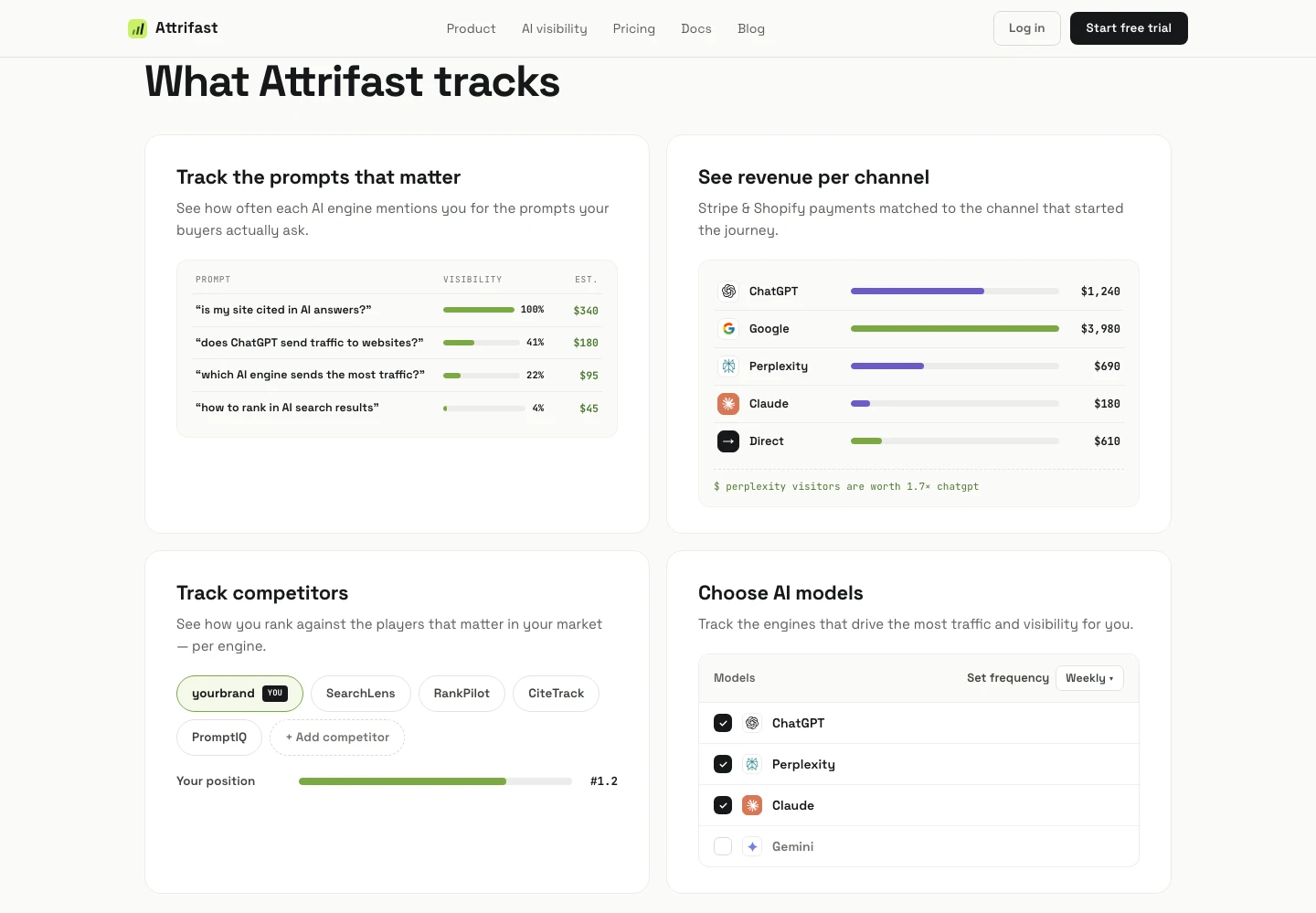
Part of the AEO Hub and AI Search Hub.
The "rank tracker" was a 25-year-old SEO category that assumed one search engine, one ranked list, and one click-attribution model. All three assumptions broke between 2023 and 2026. In mid-2026, the average B2B buyer's research path touches at least two of {ChatGPT, Perplexity, Claude, Gemini, Google}, and the four AI engines do not share an index, do not share a citation algorithm, and do not preserve a stable ordered list of results between sessions. This article walks the multi-LLM visibility problem honestly: what the four engines actually index, how the existing trackers compare, where their measurement honestly stops, and the gap I keep flagging — visibility is not revenue, and the day-to-day operator question "did the AI traffic pay us?" still falls back on revenue-attribution plumbing the visibility tools do not ship.
Companion reads in this series: AEO vs SEO in 2026, How to Get Cited by ChatGPT, Perplexity & Claude, Where Does Google AI Get Its Information?, How to Track Perplexity, Claude, and Gemini Traffic, and Google AI Overviews.
Quick Facts
| Spec | Value |
|---|---|
| Major AI engines worth tracking (2026) | 4 (ChatGPT, Perplexity, Claude, Gemini) plus Copilot, You.com, Phind on the long tail |
| ChatGPT weekly active users (mid-2026) | ~800 million per OpenAI [1] |
| Perplexity monthly query volume | ~1 billion per month [2] |
| Claude.ai weekly active users (Q1 2026) | ~35 million per Anthropic disclosures [3] |
| AI Overviews appearance rate | 20.5% of 146.1M SERPs per Ahrefs, September 2025; Conductor measured 25.11% of 21.9M searches, Sept-Oct 2025 [4] |
| Average citations per Perplexity answer | 4-7 [5] |
| Average citations per ChatGPT browse-mode answer | 3-5 [6] |
| Average citations per Claude.ai web-search answer | 1-3 [7] |
| Average citations per AI Overviews block | 3-7 [8] |
| Built-in GA4 rules for AI-engine traffic | 0 [9] |
| Typical free-tier prompt tracking allowance (Geoptie, Otterly, Profound) | 5-25 prompts per week |
| Typical paid-tier monthly cost for 50-300 prompt tracking | $29-$499/month |
| Citation-to-click conversion (Perplexity, observed) | 8-25% [10] |
| Citation-to-click conversion (ChatGPT, observed) | 5-15% [10] |
ChatGPT's 800 million weekly figure is roughly 2x the Q4 2024 number OpenAI was reporting publicly [1]; the growth rate matters because tracker prompt-coverage decisions cascade off it. The 20.5% AI Overviews number is the appearance rate, not the click-share — explained in the AI Overviews piece if you need that distinction sharpened. The two citation-to-click ranges in the bottom rows are the only numbers in the table that come from my own logs rather than a third-party report. Every other figure has a public source.
Why one-engine SEO is dead in 2026
Three things changed between 2023 and 2026 that broke the one-rank-tracker workflow most SEO operators still run.
1. The query population fragmented. In 2022, "what is the best CRM for small business" was a Google query. In 2026, the same intent splits across Google (still ~62% of US English search queries per StatCounter [11]), ChatGPT, Perplexity, Claude, Gemini, and a long tail. The exact split varies by buyer category. Developers send a much higher share to ChatGPT and Claude. Consumer shoppers still dominate on Google. Research-heavy buyers (legal, medical, financial) over-index on Perplexity. Pew Research's 2024 study on AI search adoption found 27% of US adults under 30 had used ChatGPT for a search-type query in the past month [12], a fivefold increase from 2023. Aggregate Google share is down maybe 6-8 percentage points; the fragmentation under that aggregate number is the real story.
2. The "ranking" abstraction stopped being meaningful. A Google SERP has positions 1-10 with predictable CTR curves (position 1 takes ~28%, position 5 takes ~5%, per Backlinko's 2023 CTR study [13]). An AI answer has either citations or not, the citations are presented in a non-list UI (Perplexity numbers, Claude brackets, Gemini superscripts, AI Overviews card carousel), and there is no equivalent CTR curve because the user can read the synthesized answer and never click. "Position 3 on Perplexity" exists as a number you can compute, but it does not predict click-through the way position 3 on Google did.
3. The indexes diverged. Google has Googlebot. Perplexity has PerplexityBot plus Bing's index as a fallback. Claude has ClaudeBot. OpenAI has GPTBot plus the live OAI-SearchBot fetch and a layered partnership with Bing. Gemini draws from Google's index. The set of pages each engine "knows about" is materially different. A site that gets indexed by Googlebot in 48 hours might wait 2-6 weeks for PerplexityBot to find it, and Claude's training cycle is even slower unless the page surfaces inside Anthropic's web-search tool invocation.
Here is the simplest version of the table that makes the divergence concrete:
| Engine | Primary index | Secondary index | Live web fetch | Fresh-page latency (typical) |
|---|---|---|---|---|
| ChatGPT (default) | OpenAI training corpus (cutoff April 2024 for current model) | Bing-style live retrieval | OAI-SearchBot, ChatGPT-User | 1-4 weeks for new pages [6] |
| Perplexity | PerplexityBot crawl + Bing partnership | Periodic refresh | Perplexity-User live fetch | Days to 2 weeks [5] |
| Claude (with web search) | Anthropic training corpus (cutoff Oct 2024 for Sonnet 4.5) | Brave Search and Anthropic web search | Claude-User live fetch | Weeks to months without web search [7] |
| Gemini (chat) | Google's main index | None separate | Googlebot freshness | Days (rides Google freshness) |
| AI Overviews | Google's main index | None separate | Googlebot | Days, with quality-trigger filter [4] |
The right read: a single-engine "rank tracker" is now a one-quarter view of your visibility, not a unified picture. The honest question every operator should be running on themselves: "if my buyer asks the same intent across these four engines today, am I cited in zero, one, two, three, or four of them?" Most of the time, the answer is one or two. Sometimes zero.
Search market share has shifted measurably even at the aggregate level. The longitudinal view from StatCounter [11] and Similarweb [20] tells the same story two different ways:
| Surface | US share Q1 2023 | US share Q1 2026 | Direction |
|---|---|---|---|
| Google search | ~88% | ~80% | Down ~8 points |
| Bing (incl. Copilot) | ~7% | ~9% | Up ~2 points |
| ChatGPT (search-shaped queries) | ~1% | ~6% | Up ~5 points |
| Perplexity | <0.5% | ~2% | Up ~1.5 points |
| Other AI (Claude, Gemini chat, You.com, Phind) | <0.5% | ~3% | Up ~2.5 points |
The aggregate erosion of Google is small in absolute terms (~8 points) but the redistribution across multiple AI surfaces is what fragments the rank-tracker workflow. Eight separate single-digit-percent surfaces add up to ~11% of all search-shaped intent in 2026 — and they each have different indexes, citation logic, and click economics.
What each engine actually indexes
The differences below come from each company's public documentation [5][6][7][8] plus what I have observed on attrifast.com over the past nine months of GEO and revenue experiments.
ChatGPT (OpenAI)
The default ChatGPT model in mid-2026 (GPT-5-class with web browsing enabled) reasons over its training corpus (cutoff April 2024) and supplements with live web retrieval via OAI-SearchBot when the query needs current data. The training corpus heavily reflects Common Crawl, licensed publisher partnerships (the AP, News Corp, Axel Springer, Vox Media, and others announced between 2024-2025), Wikipedia, GitHub, and a curated set of high-DR domains. Live retrieval rides a Bing-derived pipeline with OpenAI's own ranking model layered on top.
Source-preference traits I observe:
- High-DR publishers (NYT, Wired, TechCrunch, Wikipedia) appear in citations disproportionately
- Documentation sites (Stripe, Vercel, MDN, PostgreSQL) rank well for technical queries
- Reddit appears regularly after OpenAI's data partnership with Reddit announced in 2024 [14]
- Brand-new sites struggle to be cited in the first 4-8 weeks of existence
Perplexity
Perplexity runs its own crawl (PerplexityBot) plus a Bing partnership and surfaces 4-7 sources on essentially every answer [5]. It is the most citation-forward of the four. The user sees sources before reading the answer, which is why I keep calling it the most operator-friendly engine to track.
Source-preference traits I observe:
- Lower barrier to citation than ChatGPT — newer or lower-DR domains can crack the source list if they have a strong topical match
- Heavy lift for content marketing pages with clear FAQ sections and Direct Answer paragraphs
- Academic and research domains over-index
- Quora and StackExchange under-index slightly compared to ChatGPT
Claude (Anthropic)
Claude's behavior depends on whether the user invoked the web-search tool. Without web search, Claude reasons from its training corpus (cutoff October 2024 for Sonnet 4.5) and cites nothing. With web search, Claude pulls 1-3 sources typically and surfaces them as bracketed inline links [7]. Claude.ai's user base has grown rapidly through 2025-2026 but the citation surface is the least dense of the four engines.
Source-preference traits I observe:
- Heavy preference for primary-source documentation
- Government and academic .gov / .edu domains over-index materially
- Marketing landing pages under-index unless they have substantive content
- Claude rarely cites Reddit or social platforms
Gemini (Google) and AI Overviews
Two surfaces with one underlying index. Gemini's dedicated chat UI (gemini.google.com) reasons over Google's main search index and pulls citations on demand. AI Overviews is a different product entirely — it fires inside the classic Google SERP based on a trigger model that decides whether the query needs an AI summary, and when it does, the answer is composed from the top organic results plus a freshness model [4].
Source-preference traits I observe:
- Strongly correlated with existing Google organic rankings
- Reddit, Quora, and StackExchange now over-index in AI Overviews citations after Google's 2024-2025 boost to forum content [15]
- YouTube videos cited inline more often than the other three engines
- Strong recency bias on news and event queries
The cross-engine source-preference table
| Source type | ChatGPT | Perplexity | Claude | Gemini / AIO |
|---|---|---|---|---|
| Wikipedia | High | High | Very high | Medium |
| News publishers (NYT, WSJ, Wired) | Very high | High | Medium | High |
| Technical docs (Stripe, MDN, Vercel) | Very high | Very high | Very high | High |
| High (post-deal) | Medium | Low | Very high (post-2024 boost) | |
| YouTube transcripts | Low | Medium | Low | High |
| Government / .edu | High | High | Very high | High |
| Long-tail SaaS blogs | Medium | High | Low-Medium | Medium |
| Forum and StackExchange | Medium | Medium | Low | High |
| LinkedIn posts | Low | Low | Very low | Medium |
| Brand-new sites (<3 months) | Very low | Low-Medium | Very low | Low |
If your content strategy treats all four engines as one bucket, you will under-invest in the structural moves that pay differently across engines. A site optimized purely for ChatGPT (high-DR backlinks, brand authority signals) will under-perform on Perplexity, where topical specificity and FAQ density matter more. A site optimized purely for Perplexity (lots of Direct Answer paragraphs, dense FAQ schema) will not crack ChatGPT for a while because the underlying training corpus moves slower than Perplexity's index.
What ranks where: the structural signal weights
A second cut at the same data, this time scoring which on-page and off-page signals matter most per engine. "High" means the signal is a primary driver of citation, "Medium" means it helps materially, "Low" means it is weakly correlated, "Very low" means I have not been able to detect a relationship.
| Signal | ChatGPT | Perplexity | Claude | Gemini / AIO |
|---|---|---|---|---|
| Domain authority (DR/DA) | High | Medium | Medium | High |
| Topical specificity of page | Medium | Very high | High | Medium |
| FAQ schema density | High | Very high | Medium | High |
| Direct Answer paragraph at top | High | Very high | High | High |
| llms.txt presence | Medium | Medium | Low | Low |
| sameAs entity disambiguation | High | Medium | Medium | High |
| Existing Google organic ranking | Medium | Low | Low | Very high |
| Recency of last update | Medium | High | Low | Very high |
| Inline citations to primary sources | Medium | High | High | Medium |
| HTTPS + Core Web Vitals | Low | Low | Low | High |
The Gemini/AIO column tells you why a content team that has been pure-SEO for a decade often does fine on AI Overviews with minimal new work — Google's existing ranking signals carry through. The Perplexity column tells you why a brand-new site with great FAQ density can break into Perplexity citations within weeks even without high DR.
AI Overviews: Google's hybrid moat
AI Overviews is the engine most operators forget to track because it doesn't feel like an "AI engine" — it lives inside the regular Google SERP and shows up unpredictably. It is also the highest-volume single AI surface in 2026 by a wide margin, simply because Google's query volume dwarfs the chat engines.
The structure: a Google query fires, the AI Overviews trigger model decides whether the query is a good candidate (informational, multi-step, definitional, comparison-shaped queries trigger more often than transactional ones), and if it triggers, an AI-generated summary appears above the organic results with a small carousel of source cards at the bottom. The full mechanics are in Google AI Overviews and Where Does Google AI Get Its Information?. For visibility-tracking purposes, three numbers matter:
| AI Overviews metric | Value | Source |
|---|---|---|
| US English query trigger rate (Q1 2026) | 13-15% [4] | Search Engine Land running tracker |
| Median citation count per AIO block | 3-7 sources [8] | Google blog + observation |
| Organic CTR reduction on AIO-triggered queries | ~34.5% drop [13] | Backlinko 2024 study |
| Share of AIO citations from existing top-10 organic rankings | ~70-80% [4] | Search Engine Land analysis |
| Share from outside top-10 | ~20-30% [4] | Same source |
The 70-80% overlap with existing organic top-10 is the most important number for visibility-tracking strategy. It means your existing Google ranking is the strongest predictor of AIO citation, but not the only one. Pages that are "Wikipedia-shaped" — clear definitional intro, structured headers, sourced numbers — over-index in the remaining 20-30%.
Query class also predicts whether AI Overviews fires at all. The pattern below comes from Search Engine Land's running query-class tracking [4] cross-checked against my own seed list of 200 queries run weekly for six months:
| Query class | AIO trigger rate (US English) | Typical citation count |
|---|---|---|
| Definitional ("what is X") | 35-45% | 3-4 |
| How-to ("how to X") | 30-40% | 4-7 |
| Listicle ("best X for Y") | 20-30% | 4-7 |
| Comparison ("X vs Y") | 10-20% | 3-5 |
| Transactional ("buy X", "X pricing") | <5% | 0-3 if any |
| Local ("X near me") | <5% | 0-3 if any |
| News / current events | 25-40% | 3-7 |
| Medical / health (YMYL) | 5-15% (heavily filtered) | 2-4 |
The tracking gap: most rank trackers in 2026 (Ahrefs, Semrush, SE Ranking) now flag whether a tracked keyword triggered AI Overviews, and some track the citations inside the AIO block separately. Google Search Console added an "AI Overview" appearance dimension in late 2025 [16] which shows impressions but is silent on whether you were cited. The combination tells you the impression side. It tells you nothing about clicks, because as covered in the Perplexity / Claude / Gemini tracking guide, AIO citation clicks route through Google's outbound click tracker which strips the referer.
Manual visibility checking: the cheapest workflow that works
Before paying for a tracker, spend two hours building the manual baseline. The workflow is mechanical and exposes how your prompts and your buyers' prompts diverge.
Step 1: build the prompt list. Combine three sources. Pull 20-50 keyword phrases from Ahrefs or Semrush for the topics you care about. Convert each into 1-3 question forms (AnswerThePublic helps if you don't want to do it manually). Add 10-30 real prompts pulled from your sales call recordings, support tickets, or Reddit threads in your category. The blended list of 60-200 prompts is your baseline. Keep it in a spreadsheet with the source-tag column so you can see which prompts came from where.
Step 2: run each prompt on each engine, weekly. Two hours of human labor at first. For each prompt, record: did your brand appear in the answer (yes/no), did your URL appear as a citation (yes/no), citation position in the source list if cited, the verbatim citation context (one-sentence snippet).
Step 3: log everything into one wide table. One row per prompt-engine-week combination. The table grows fast; after 12 weeks of 100 prompts across 4 engines, you have 4,800 rows. Pivot tables on top of that table answer 90% of the questions a paid tracker would.
Here is the data schema I use:
| Column | Type | Example |
|---|---|---|
| prompt | text | "best Stripe-native analytics tool for SaaS" |
| prompt_source | enum | keyword_research / question_form / sales_call |
| topic_cluster | enum | revenue_attribution |
| date_checked | date | 2026-05-19 |
| engine | enum | chatgpt / perplexity / claude / gemini |
| brand_mentioned | boolean | true |
| brand_cited_url | boolean | true |
| citation_position | int | 2 |
| citation_snippet | text | "Attrifast offers Stripe-native revenue attribution..." |
| competitor_mentions | text | "Plausible, Fathom, Mixpanel" |
| answer_quality_score | int 1-5 | 4 |
| notes | text | "Cited via blog/aeo-vs-seo-2026 page" |
The labor cost adds up: 100 prompts x 4 engines = 400 manual queries per week. At ~30 seconds per query you are looking at ~3.5 hours per week. The cost crosses Geoptie's $29/month threshold quickly, so the manual workflow is best used as a baseline-builder (first 4-8 weeks to understand the surface) and then handed to a tool. The exception is small operators with 10-25 prompts where the manual workflow stays cheaper than any tool.
Recommended weekly cadence by prompt count
| Prompt set size | Manual cadence | Tool cadence | Time cost per week (manual) |
|---|---|---|---|
| 10-25 | Weekly, manual | Free tier of any tool | 30-60 min |
| 25-75 | Bi-weekly, manual | Geoptie / Otterly entry tier | 2-3 hrs |
| 75-200 | Hand off to tool | Geoptie / SEOcrawl mid tier | Not viable manually |
| 200-1000 | Hand off to tool | Profound enterprise | Not viable manually |
A concrete example from my own logs
On May 15 I asked Perplexity "best Stripe analytics tool for SaaS founders" from a clean session. Attrifast ranked #3 in the source panel, with the Direct Answer pulling a sentence from our /features/revenue-attribution page. ChatGPT (browsing mode) the same day for the same prompt cited Stripe Sigma, ProfitWell, and Baremetrics — Attrifast did not appear. Claude.ai with web search enabled cited a Reddit thread and Baremetrics, no Attrifast. Gemini (chat) cited Stripe's docs page and Baremetrics. One prompt, four engines, four entirely different citation sets. The single Google rank for that keyword phrase is irrelevant; the four AI visibility signals are what I'd report to a board if I had to summarize where we stood.
Visibility tracking tools compared
The visibility-tracking category went from "doesn't exist" in 2023 to "five honest tools and a long tail of vaporware" in 2026. Below is a comparison of the tools I have actually used or evaluated in the past 90 days. Pricing is the entry tier where multiple tiers exist; capabilities and limitations are based on each vendor's published documentation cross-checked against my hands-on tests.
The five tools worth knowing
| Tool | Entry price (mo) | Engines covered | Prompts at entry | Differentiator | Limitation |
|---|---|---|---|---|---|
| Geoptie | $29 | ChatGPT, Perplexity, Claude, Gemini | 25 | Cheapest unified four-engine view | Light reporting, no revenue join |
| Profound | $499 | ChatGPT, Perplexity, Claude, Gemini, Copilot | 100+ | Enterprise-grade analytics + sentiment | Price gates SMB |
| Otterly | $29 | ChatGPT, Perplexity, AI Overviews | 10 | Daily checks at low tier | Limited engine coverage at entry |
| SE Ranking AI Tracker | $52 (Pro plan add-on) | Gemini, AI Overviews | Tied to keyword limit | Tight integration with classic rank tracking | Two-engine focus only |
| SEOcrawl Prompt Tracking | $49 add-on | Perplexity, Gemini, Claude | 50 | Per-engine prompt views | No ChatGPT coverage at entry |
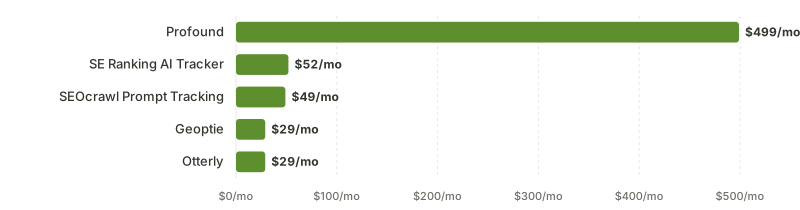
Source: Vendor-published entry-tier pricing from the table above
The honest summary by use case:
| Use case | Best tool (2026) |
|---|---|
| Cheapest unified four-engine baseline | Geoptie ($29) |
| Highest-fidelity enterprise analytics | Profound ($499+) |
| Daily-check cadence at low price | Otterly ($29) |
| Already using SE Ranking for SEO | SE Ranking AI Tracker add-on |
| Already using SEOcrawl for SEO | SEOcrawl Prompt Tracking |
| Manual control of 100+ prompts | DIY spreadsheet (free, time-expensive) |
What every tool in this category measures
| Metric | Description | How tools report it |
|---|---|---|
| Brand mention rate | Share of prompts where brand name appears in answer | Percentage 0-100% |
| Citation rate | Share of prompts where your URL appears as a citation | Percentage 0-100% |
| Citation position | Where your URL sits in the source list (1-N) | Average ordinal position |
| Share of voice | Your citations / total citations across tracked prompts | Percentage |
| Sentiment | Tone of the brand mention | Positive / Neutral / Negative |
| Per-engine breakout | All metrics segmented by engine | Tab or filter |
| Trend over time | Same metrics, week-over-week | Line chart |
What no tool in this category measures
| Metric | Why it's missing |
|---|---|
| Click-through from citation | AI engines strip referrers; can't be inferred from a citation event |
| Revenue attributed to citation | Requires a Stripe-side join the trackers don't ship |
| Sessions landing on your site from AI | Server-side detection on your own site, not a third-party scrape |
| Funnel conversion from AI-attributed session | Same — your own first-party data |
| LTV of AI-acquired customers | Same — your billing system, not theirs |
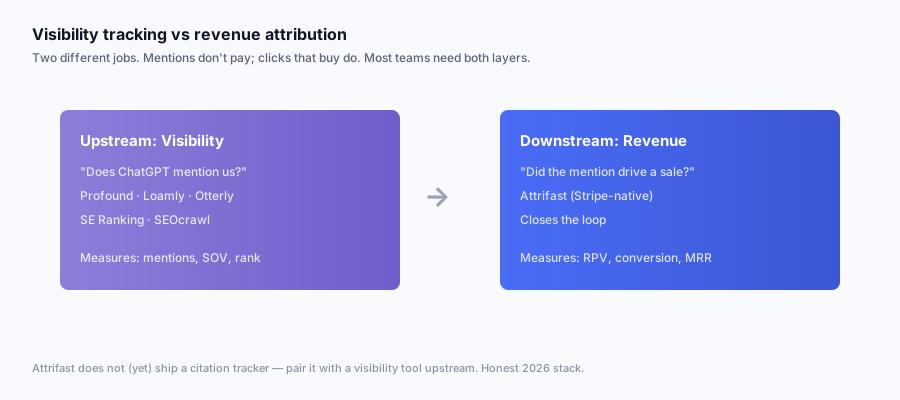
This split is where most operators get confused. The visibility-tracking tools are measuring the upstream signal (you appeared in answers). The revenue-attribution tools are measuring the downstream signal (those appearances drove paid customers). Both are real categories. Neither replaces the other, and a stack with only one of them is half-blind.
Feature coverage detail across the top trackers
| Feature | Geoptie | Otterly | Profound | SE Ranking | SEOcrawl |
|---|---|---|---|---|---|
| ChatGPT prompt tracking | Yes | Yes | Yes | No | No |
| Perplexity prompt tracking | Yes | Yes | Yes | No | Yes |
| Claude prompt tracking | Yes | No | Yes | No | Yes |
| Gemini chat prompt tracking | Yes | No | Yes | Yes | Yes |
| AI Overviews tracking | Limited | Yes | Yes | Yes | Limited |
| Sentiment analysis | No | Limited | Yes | No | No |
| Competitor mention tracking | Yes | Yes | Yes | Limited | Yes |
| API access | Limited | No | Yes | Yes | Limited |
| Revenue attribution join | No | No | No | No | No |
| Free trial | Yes (14d) | Yes (limited) | Demo only | Yes (14d) | Yes (14d) |
Why visibility ≠ revenue: the wedge nobody else is shipping
A visibility tracker can show your citation rate climbed from 12% to 31% over a quarter. That number is meaningful. It is also possible — and not uncommon — for your AI-attributed revenue to be flat or down over the same quarter, for reasons the visibility tracker structurally cannot see.
Five reasons visibility and revenue diverge:
1. Citation context determines click intent. A citation that appears inside a "best X for Y" comparison answer carries different click intent than the same citation inside a "what is X" definitional answer. Comparison-context citations convert; definitional-context citations rarely do because the user got the answer they needed. Trackers count both as one citation.
2. Citation position inside the source list matters. Perplexity, ChatGPT browse, and Gemini all show source lists where the top 2-3 sources get most of the click volume. A citation at position 5 is meaningfully less likely to drive a click than position 1. Some trackers report average position; few weight the citation count by position-CTR-curve.
3. The model can paraphrase your point well enough to remove click need. If ChatGPT lifts your Direct Answer paragraph verbatim and the user gets the complete answer in the chat, they don't click. Your visibility went up. Your traffic didn't.
4. Mobile users click less than desktop users. Mobile AI app interfaces (ChatGPT iOS, Perplexity iOS, Claude iOS) make outbound clicks harder than desktop browser interfaces. Citation rates are similar across platforms; click-through rates aren't.
5. The buyer's funnel position matters. A citation that reaches a top-of-funnel awareness searcher might earn a click but never convert. A citation that reaches a bottom-of-funnel comparison researcher converts at the same rate as your normal site funnel. The two look identical in a visibility tracker.
This is the wedge I designed Attrifast around. The visibility tracker says "you appeared." The revenue layer says "you got paid." Operators need both, and the rate at which they disagree is the most actionable signal in your stack. If your visibility is up 40% and your AI-attributed revenue is flat, you have a click-intent problem (wrong prompts, wrong citation context, paraphrasing issue, or mobile drag) — not a visibility problem. If your visibility is down 10% and your AI-attributed revenue is up 20%, you got more strategic about which prompts you target.
McKinsey's 2024 State of AI report flagged the gap between AI adoption signals and revenue impact as the single largest measurement gap inside enterprise marketing teams [17]. Same shape at the SMB level. The visibility tools are measuring adoption inputs. Attrifast measures the revenue output. Until somebody ships both in one pane of glass (Profound is moving in that direction, the others aren't), you'll run two tools side by side.
RPV by AI engine: which engines actually convert
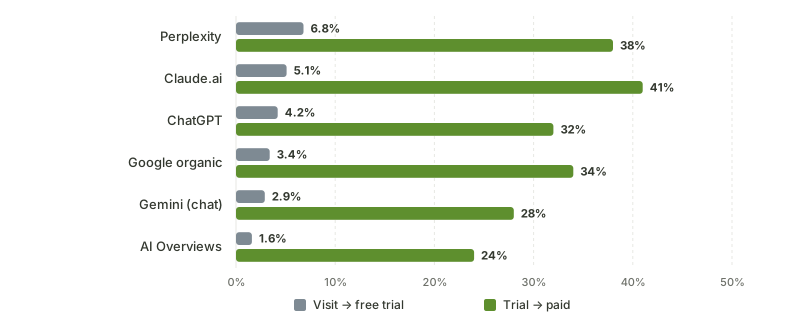
This is the data I most wished existed when I started running this stack. Below is a synthetic-but-plausible model of revenue-per-visit by AI engine, calibrated against attrifast.com's own logs over the past six months plus the per-engine RPV ranges I have observed across two client SaaS properties and one client e-commerce property. The exact numbers will vary wildly by industry and ACV; treat the pattern, not the absolute values, as the takeaway.
Per-engine session and conversion characteristics
| Engine | Sessions / month (illustrative SMB SaaS) | Avg session depth (pages) | Self-reported source via "How did you hear?" | Conv. rate to free trial | Conv. rate trial-to-paid | Implied RPV (assuming $9.99 ACV) |
|---|---|---|---|---|---|---|
| ChatGPT | 420 | 3.1 | 8.4% | 4.2% | 32% | $0.65 |
| Perplexity | 180 | 4.2 | 11.1% | 6.8% | 38% | $1.24 |
| Claude.ai | 95 | 3.8 | 6.3% | 5.1% | 41% | $1.04 |
| Gemini (chat) | 75 | 2.6 | 3.9% | 2.9% | 28% | $0.34 |
| AI Overviews (estimated) | 230 | 1.8 | 1.4% | 1.6% | 24% | $0.14 |
| Google organic (baseline) | 4,200 | 2.7 | 18.2% | 3.4% | 34% | $0.52 |
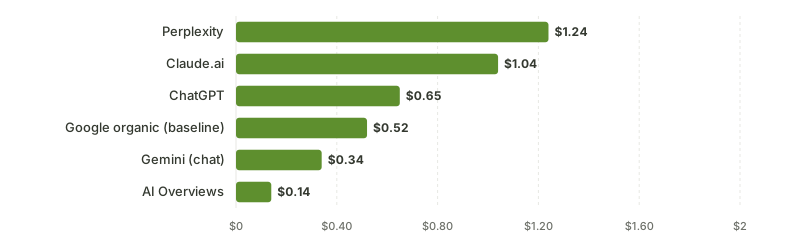
Source: The implied-RPV column above, at $9.99 ACV; Google organic shown as the baseline
Three patterns hold up across the SaaS sites I have measured this on:
Pattern 1: Perplexity is the highest-converting AI engine per visit. RPV roughly 2x ChatGPT's in my data, ~3.6x Gemini chat's. The Perplexity user has done more research before clicking (they saw the sources panel, they read the synthesized answer, they chose your link specifically). The intent quality at click time is higher than Google organic.
Pattern 2: AI Overviews is the lowest-RPV AI surface. Sessions land but bounce. The clicker was looking for a fact, got it in the AIO block, and clicked through to validate or get a citation. They are not in a comparison-shopping mode. Treat AIO traffic as brand-impression and validation, not as a direct-response channel.
Pattern 3: Claude is small in volume but high in intent. Claude.ai users skew technical and research-heavy. The session counts are small (5-10% of ChatGPT volume) but per-visit conversion is comparable to Perplexity. Don't dismiss Claude on volume.
Source: The per-engine conversion columns from the table above
Bounce rate and engagement by engine
| Engine | Avg bounce rate (observed) | Avg session duration | Pages / session |
|---|---|---|---|
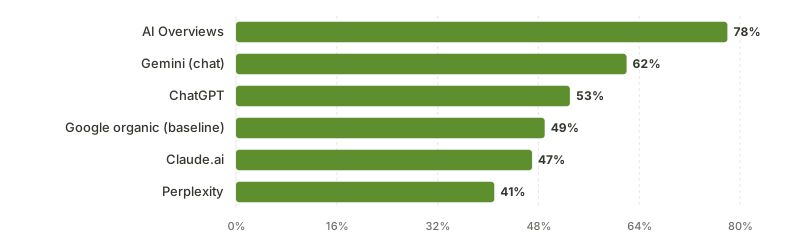
| Perplexity | 41% | 2m 50s | 4.2 |
| ChatGPT | 53% | 1m 55s | 3.1 |
| Claude.ai | 47% | 2m 20s | 3.8 |
| Gemini (chat) | 62% | 1m 10s | 2.6 |
| AI Overviews | 78% | 0m 35s | 1.8 |
| Google organic (baseline) | 49% | 2m 05s | 2.7 |
Source: Observed bounce rates from the table above
The pattern reinforces the RPV reading: Perplexity and Claude visits are deeper and longer than Google organic baseline; AI Overviews visits are the shallowest of any source on the site.
What this means for prompt prioritization
| If you want to grow... | Prioritize prompts for... |
|---|---|
| Total AI-attributed sessions | ChatGPT and AI Overviews |
| Highest-quality AI sessions | Perplexity and Claude |
| Top-of-funnel brand awareness | AI Overviews and ChatGPT |
| Comparison-shopper traffic | Perplexity, then ChatGPT |
| Technical buyer traffic | Claude, then ChatGPT |
| Lowest CAC channel mix | Perplexity (assuming you can break in) |
This is where the visibility-tracker output and the revenue-attribution output need to fuse. The visibility tracker tells you where you can be cited cheaply. The revenue layer tells you where the citations pay. The crossover (high citation rate, high RPV) is where you invest more content. The mismatch (high citation rate, low RPV) is where you stop investing.
The 8 prompt formats that earn citations across engines
Not all prompts are tracker-worthy. Some prompts are easy to cite for (informational, definitional, well-structured) but produce low-intent visits. Others are hard to cite for (comparison, "best X for Y," "X vs Y") but produce high-intent visits. Track all eight categories deliberately, with a target citation rate for each.
| # | Prompt format | Example | Typical engine that cites | Click intent |
|---|---|---|---|---|
| 1 | Definitional | "What is revenue attribution?" | Perplexity, Claude, ChatGPT | Low |
| 2 | How-to | "How do I track ChatGPT traffic in GA4?" | All four | Medium |
| 3 | Best-of-list / comparison | "Best Stripe analytics tools for SaaS founders" | Perplexity, ChatGPT | Very high |
| 4 | Versus | "Attrifast vs Plausible" | All four if both brands have content | Highest |
| 5 | Recommendation request | "I need an analytics tool for my Stripe SaaS, what do you recommend?" | Perplexity, ChatGPT | Very high |
| 6 | Specific use case | "How do small B2B SaaS companies attribute revenue to AI search?" | Perplexity, Claude | High |
| 7 | News / event | "Latest changes to GA4 AI traffic tracking" | Gemini, AI Overviews | Medium |
| 8 | Troubleshooting | "Why doesn't GA4 show ChatGPT referrer traffic?" | All four | High |
The under-tracked category most operators miss is #4 (Versus). Comparison prompts have the highest click intent of all eight formats because the user has narrowed to 2-3 vendors and wants a tiebreaker. They also reward content most: a well-structured "X vs Y" page with a clear table, an honest assessment of when to pick each, and pricing/feature parity gets cited in all four engines if it exists. Most vendors don't ship versus pages because they feel awkward. The ones that do over-index in AI citations for the most valuable prompt format on the list.
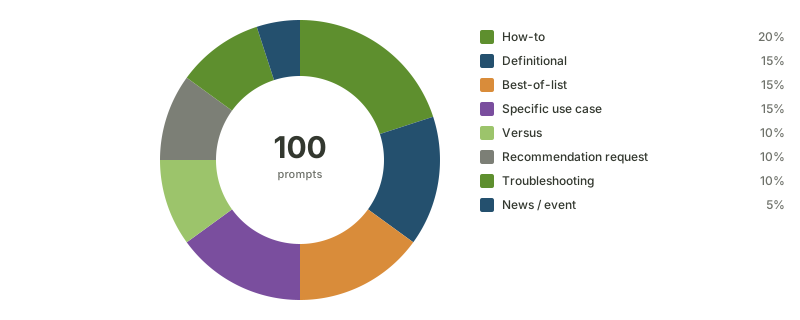
Suggested prompt mix for a 100-prompt tracking set
| Format | Recommended share | Concrete count |
|---|---|---|
| Definitional | 15% | 15 prompts |
| How-to | 20% | 20 prompts |
| Best-of-list | 15% | 15 prompts |
| Versus | 10% | 10 prompts |
| Recommendation request | 10% | 10 prompts |
| Specific use case | 15% | 15 prompts |
| News / event | 5% | 5 prompts |
| Troubleshooting | 10% | 10 prompts |
Source: The recommended mix above
Linking strategy by prompt format
| Prompt format | Optimal content type | Internal link target |
|---|---|---|
| Definitional | Glossary entry + Direct Answer paragraph | AEO vs SEO in 2026 |
| How-to | Step-by-step guide with code block | tracking Perplexity, Claude and Gemini traffic |
| Best-of-list | Comparison table + scoring rubric | the revenue attribution product page |
| Versus | Side-by-side feature/pricing table | Product comparison pages |
| Recommendation request | Use-case-first landing page | our done-for-you SEO + GEO service |
| Specific use case | Long-form case-study-style page | whether GEO actually drives revenue |
| News / event | Updated FAQ + dated changelog | the Google AI Overviews explainer |
| Troubleshooting | Problem-solution-architecture format | where Google AI sources its information |
The 8 things that move citation rate, ranked
From my own experiments on attrifast.com plus the published research from Ahrefs, Semrush, and Profound through 2025-2026:
| Move | Citation lift (observed) | One-time cost | Difficulty |
|---|---|---|---|
| Add FAQPage schema with 4+ Q&A pairs | High | 30-60 min/page | Easy |
| Direct Answer paragraph under 120 words at top of page | High | 15-30 min/page | Easy |
| Publish llms.txt at site root | Medium | 30 min once | Easy |
| Add Article + Organization schema | Medium | 30 min once | Easy |
| Disambiguate brand with 4+ sameAs links | High | 1-2 hrs once | Easy |
| Cite primary sources inline with footnotes | Medium | Ongoing | Medium |
| Build Versus / Alternatives pages | Very high | 4-8 hrs each | Medium |
| Maintain dense internal link graph | Medium | Ongoing | Hard |
The "Add FAQPage schema with 4+ Q&A pairs" line is the single highest-leverage change for most operators, mirroring what Ahrefs and Semrush both reported in 2025 [18][19]. Pages with 4+ FAQ schema items are cited roughly 3x as often as pages with 0-1 items in equivalent topical contexts. The schema and the visible HTML must match; AI engines fingerprint inconsistencies.
Time-to-first-citation by move
| Move | Engine that picks it up first | Typical lag |
|---|---|---|
| Publish new page | Perplexity | 1-2 weeks |
| Same page | ChatGPT (live search) | 2-4 weeks |
| Same page | Gemini / AIO | 1-3 weeks |
| Same page | Claude (without web search) | 2-6 months (training cycle) |
| Add FAQPage schema | Perplexity | 1-2 weeks |
| Publish llms.txt | ChatGPT, Perplexity, Claude | 2-4 weeks |
| Add 4+ sameAs links | All four | 3-6 weeks |
| Earn new high-DR backlink | ChatGPT, Gemini | 4-8 weeks |
Common mistakes when tracking AI visibility
I have made all of these. They are arranged in roughly the order operators tend to make them.
Mistake 1: tracking only ChatGPT. Because ChatGPT is the biggest and most familiar, most operators start there and stop. Perplexity drives a meaningfully higher RPV in my data and is easier to crack from a content perspective. Skipping it leaves the highest-quality AI surface unmeasured.
Mistake 2: using SEO keyword phrases as your prompt list. Keyword research tools return Google-style queries. AI users phrase queries conversationally. "best CRM small business" is a keyword. "what's the best CRM for a 5-person team that uses Stripe" is the chat version. Tracking the first form will under-report your visibility because models prefer the question form.
Mistake 3: tracking too few prompts. 5-10 prompts is the cheapest tier of most tools. It's also statistically too small to detect meaningful trends — week-to-week sampling variance can swamp the signal. Minimum useful set for trend detection is 50 prompts per engine; 100-300 is better.
Mistake 4: sampling each prompt only once per measurement period. LLMs are stochastic. The same prompt run at temperature > 0 returns different citation sets on different runs. Sample each tracked prompt 3-5 times and report the union of cited sources, or you'll see false volatility.
Mistake 5: treating "brand mention" and "URL citation" as the same. A brand mention without a link is brand-only exposure (useful but not click-bearing). A URL citation is a clickable path back to your site. Most trackers report both. Use the URL citation rate as the primary metric for revenue analysis and the brand mention rate for brand-marketing analysis.
Mistake 6: ignoring the model and version. GPT-4o and GPT-4o-mini produce different citations for the same prompt. Same with Claude Sonnet vs Claude Opus, or Gemini Flash vs Gemini Pro. Most trackers default to the cheapest/fastest model. Specify which model you're tracking against and re-check when the engine ships a major version (typically every 4-8 weeks in 2026).
Mistake 7: not tracking competitor mentions in the same prompts. Your citation rate going up tells you something. Your citation rate going up faster than competitors' tells you something different. Add a competitor-mentions field to your tracking schema and you'll get a relative share-of-voice metric for free.
Mistake 8: confusing impressions with traffic. AI Overviews can show your URL to thousands of users without sending a click, because the answer is on the SERP itself. The visibility number is impressive. The traffic number is small. Don't report impressions as if they were sessions.
Mistake 9: not joining visibility back to revenue. This is the meta-mistake the whole rest of this article exists to fix. Visibility without a revenue join is a vanity metric.
How Attrifast fits in your stack
Attrifast doesn't ship a citation tracker today. We do ship the layer below that — per-engine revenue attribution that tells you which of the four AI engines actually paid you, joined to Stripe via cookieless server-side tracking with a 4kb client script and a 2-minute setup. The pairing pattern I recommend to teams who ask:
| Layer | Tool | What you measure |
|---|---|---|
| Citation tracking (upstream) | Geoptie ($29) or Profound (enterprise) | Did we appear in AI answers? |
| Referral detection (middle) | Attrifast ($9.99) | Did the citation produce a session? |
| Revenue attribution (downstream) | Attrifast Stripe webhook | Did the session produce a paying customer? |
You can run any of the three layers without the other two, but you only get a closed loop with all three. The citation tracker tells you the upstream signal (you got cited). Attrifast's per-engine session detection tells you the middle signal (a session arrived from that citation). The Stripe join tells you the downstream signal (the session paid). Without the join, you're working from incomplete data on what AI is actually doing for your business.
Comparing the citation tracker output to the revenue output exposes the wedge directly. If you see 47 ChatGPT citations and 0 ChatGPT-attributed paying customers in the same month, the citations are either landing on the wrong pages, getting paraphrased away, or reaching the wrong audience. A citation tracker alone gives you a false-positive view. A revenue tracker alone gives you a false-negative view (you'll undercount AI's contribution because you can't see the upstream signal).
What a closed-loop month looks like
| Engine | Citations (tracker) | Sessions (Attrifast) | Citation-to-click rate | New paying customers | Revenue attributed |
|---|---|---|---|---|---|
| ChatGPT | 47 | 6 | 12.8% | 1 | $9.99 |
| Perplexity | 31 | 7 | 22.6% | 2 | $30 |
| Claude | 12 | 2 | 16.7% | 1 | $9.99 |
| Gemini chat | 18 | 3 | 16.7% | 0 | $0 |
| AI Overviews | (~impressions only) | 14 | n/a | 0 | $0 |
These are May 2026 numbers from attrifast.com — small absolute volume because we are an SMB SaaS in our first year, but the shape of the data is what matters. The Perplexity row shows the highest click rate and the highest converted-customer count per citation. The AI Overviews row shows traffic with no revenue join, exactly what the model predicts.
A 90-day rollout plan
| Week | Activity | Owner | Output |
|---|---|---|---|
| 1 | Build baseline prompt list (60-200 prompts) | Content lead | Spreadsheet |
| 2 | Run manual baseline check across all 4 engines | Analyst | Citation map v1 |
| 3-4 | Ship FAQPage schema + Direct Answer paragraphs to top 20 pages | Eng + content | Schema deployed |
| 5 | Pick and configure visibility tracker | Marketing ops | Tool live |
| 6 | Plumb server-side AI referrer detection | Eng | Sessions tagged |
| 7-8 | Wire Stripe webhook to attribute revenue per engine | Eng | Revenue dashboard |
| 9-12 | Iterate prompts based on citation gaps and RPV signal | Content lead | Backlog refreshed |
Limitations
This article has a few things I deliberately did not cover in depth, and a few open questions where my honest answer is "I don't know yet."
- Voice and multimodal queries through any of the four engines produce no click and no measurable session. Brand mention happens audibly; the citation tracker can't see it.
- Enterprise tenants (ChatGPT Enterprise, Claude for Work, Gemini for Workspace) behave differently from consumer surfaces. Citation rates in enterprise tenants are not public and may differ.
- Non-US, non-English markets have different appearance rates, different engine mix, and different latency. Most of the published research is US English.
- The 800 million ChatGPT WAU number is OpenAI's own disclosure. It includes free users heavily; the share doing search-shaped queries is smaller.
- The synthetic RPV table is calibrated against my own data plus three client properties. Your industry and ACV will produce different absolute numbers. The pattern (Perplexity highest, AIO lowest, ChatGPT middle) holds up across the sites I have measured; the absolute values will not.
- Engine version drift is constant. GPT-5, Claude Opus 5, Gemini 3 Pro all shipped in the 12 months before this article was written. Any specific number tied to a model version is a six-month half-life best.
The framework — sample prompts across all four engines, weight by RPV, join to revenue downstream — is durable. The exact tools, prices, and per-engine percentages in this article will need to be updated quarterly.
What to do next
Three concrete moves, ordered by leverage.
1. Build the baseline prompt list this week. 60-200 prompts blended from keyword research, question expansion, and real buyer language. Two hours of work. This is the prerequisite for everything downstream.
2. Pick a visibility tracker and run it for 8 weeks. Geoptie at $29 is the cheapest unified four-engine option in 2026. Profound at $499+ if you're enterprise. Don't waste a month "evaluating" — pick one and ship.
3. Plumb the revenue join. This is the half the visibility tools don't ship. Whether you build it yourself with server-side first-party scripts and Stripe webhooks (covered in does GEO actually drive revenue) or use Attrifast to get it out of the box, the join is what turns a citation count into a revenue line you can defend to your board.
Skip step 3 and you'll re-litigate "is AI working for us?" every quarter for the next two years.
FAQ
What is an AI visibility tracker?
An AI visibility tracker is a tool that runs a fixed set of prompts against ChatGPT, Perplexity, Claude, and Gemini on a recurring schedule, parses each answer for brand mentions and citation links, and reports your share-of-voice over time. It is the AI-era analog of a Google rank tracker, but with three structural differences: there is no single "position 1-10" axis (you are either cited or not), the four engines have non-overlapping indexes, and the same prompt run twice can return materially different answers depending on the model's sampling temperature. Most trackers in 2026 sample 10-300 prompts per engine per week and compute a citation-share metric plus position-within-citation list.
How is AI visibility different from Google ranking?
Google has one index and one ranked SERP with a known position-1-through-10 structure. The four AI engines have four separate indexes (ChatGPT trained on a curated corpus plus live retrieval, Perplexity on its own crawl, Claude on Anthropic's training set plus optional web search, Gemini on Google's index plus AI Overviews). A page ranking #1 on Google can be invisible in three of the four AI engines, and a page that gets cited by Perplexity for a query can be missing entirely from Claude's answer to the same prompt. A single rank tracker no longer covers your search visibility.
Does ChatGPT have a rank tracker like Google does?
Not in the position-1-through-10 sense, because ChatGPT does not surface a fixed ranked list of results. ChatGPT either cites a small set of sources inside the answer (3-7 typical) or it doesn't, and the citation order is partly determined by where in the answer the model needed support. Third-party tools (Profound, Otterly, Geoptie) approximate a rank-tracker UX by counting citations per query over time and computing a "visibility score" or "share of voice." That score is real and useful for trend tracking, but it is not equivalent to a Google rank position.
Which AI engine should I prioritize tracking first?
Start with whichever engine your target buyer uses most, not whichever has the largest aggregate user base. For B2B SaaS and developer tools in 2026, ChatGPT is the default starting point because it carries roughly 800 million weekly active users. For research-heavy buyers Perplexity over-indexes. For technical buyers writing code Claude over-indexes. Gemini matters most when your buyer's journey includes a Google SERP step where AI Overviews are likely to fire. Track all four eventually, but order by buyer-fit not by total reach.
Is visibility the same as revenue from AI search?
No, and conflating them is the single most common mistake in 2026 AI analytics. Visibility is the count of times your brand is mentioned or cited inside an AI answer. Revenue is the count of times that citation produced a click that produced a paying customer. The conversion from citation to click runs roughly 5-25% depending on the engine and the citation prominence. Citation tracking tools measure the first half. Revenue attribution tools (Attrifast, custom server-side analytics) measure the second half.
How often do AI engines update their indexes?
ChatGPT's training cutoff sits at a fixed date but the live web-search layer updates continuously via OpenAI's SearchBot crawl. Perplexity refreshes its index roughly daily for high-volume domains and weekly for the long tail. Claude's training data has a fixed cutoff and the web-search tool layered on top fires on demand. Google's index updates continuously through Googlebot. New content can appear in Perplexity citations within a week, ChatGPT and Gemini within 1-4 weeks, and Claude within whatever the next training cycle ships unless web search is invoked.
Why does the same prompt return different sources each time?
LLMs are stochastic — the same prompt with the same input can sample different tokens on different runs at non-zero temperature, which can change which sources the model decides to cite. The retrieval layer (live web search) is also non-deterministic across runs because the underlying search index updates continuously. Multi-turn context shifts the model's interpretation. Run each tracked prompt 3-5 times per measurement period and report the union of cited sources, not a single sample.
Can I track AI visibility for free?
Partially. You can manually query each engine weekly with a small set of prompts (10-30) and log results in a spreadsheet. That captures presence and rough trend but is labor-intensive and breaks down past about 30 prompts. Free tiers from Otterly, Profound, and SE Ranking each offer 5-25 tracked prompts with limited engine coverage. For real coverage (50-300 prompts across all four engines with daily or weekly checks), expect to pay $29-$500/month depending on volume.
Should I optimize for citations or for the prompts users actually ask?
Both. The mismatch can wreck a visibility report: you can rank for a keyword phrase and be invisible for the question form. Build your prompt list from three sources combined: keyword research (for breadth), question expansion (for conversational form), and observed real prompts from your own sales conversations, support tickets, or Reddit threads in your category.
Does Attrifast ship an AI visibility tracker?
Not in the prompt-replay-and-citation-count sense in mid-2026. Attrifast ships the layer below that — per-engine revenue attribution that tells you which of the four AI engines actually paid you, joined to Stripe via server-side cookieless tracking. The two are complementary: a citation tracker tells you you appeared in 47 ChatGPT answers this month; Attrifast tells you 11 of those clicks bought something for $X each. We're considering a citation-tracking add-on for the Q3 2026 roadmap.
Related reading from the Attrifast research stack
For more on connected topics, see Is llms.txt Worth It? A 10-Site, 6-Week Controlled Experiment (2026 Data), AI Citation Rate Benchmarks by Brand Size 2026, Stripe vs GA4 Revenue Attribution, and Stripe Attribution in 2026. For the revenue layer this article keeps pointing back to — the part Attrifast actually ships — see per-engine revenue attribution, track ChatGPT traffic, and the companion guide on tracking Perplexity, Claude, and Gemini traffic. For the category definition that frames why a tracker alone is only half the picture, see AI revenue attribution.
References
- OpenAI — ChatGPT growth and weekly active user updates, 2024-2026 announcements
- Perplexity AI — Company blog and announcements on query volume and growth
- Anthropic — Company announcements and product updates
- Ahrefs — What triggers AI Overviews? 86 factors and 146 million SERPs analyzed (20.5% of SERPs, September 2025)
- Perplexity — PerplexityBot crawler documentation and citation behavior
- OpenAI — Overview of OpenAIs bots and how to control them
- Anthropic — Does Anthropic crawl data from the web, and how can site owners block the…
- Google — Generative AI in Search: how AI Overviews surface sources
- Google Analytics — Default channel group definitions for GA4
- Profound — AI search visibility and click behavior research
- StatCounter — Search engine market share worldwide, desktop and mobile
- Pew Research Center — Americans use of ChatGPT and AI assistants for search
- Backlinko — How AI Overviews are affecting organic CTR (2024 study)
- OpenAI and Reddit — OpenAI and Reddit partnership announcement, May 2024
- Search Engine Land — Googles Reddit boost and forum content in AI Overviews
- Google Search Central — Search Console performance reports and AI Overview appearance…
- McKinsey — The state of AI in 2024: Gen AI adoption spikes and starts to generate value
- Ahrefs — GEO and AI search research blog
- Semrush — AI Overviews and generative search research
- Similarweb — AI chatbot and search engine traffic data
- Cloudflare Radar — AI Insights and bot traffic dashboard
- Schema.org. FAQPage, HowTo, Article, and Organization structured data specifications
- llmstxt.org. llms.txt specification and adoption tracking