The AEO Hub
Answer Engine Optimization, in 27 guides.
AEO is what happens when search starts answering the question instead of sending you to a page. Google AI Overviews, ChatGPT search, Perplexity summaries, Claude research mode — every one of those surfaces decides which sources to cite, and being the cited source is increasingly worth more than being “page one.” The 27 guides on this page cover the AEO foundations, the structural moves that earn citations, and the measurement architecture you need to prove any of it pays.
The AEO mental model, in three points
1. The win condition changed. Classic SEO wins when you rank #1; AEO wins when the model cites you, recommends you, or quotes you in an answer-shaped response. Those are different states, and a page can win one without winning the other.
2. Structure beats prose. LLMs parse structured signals — JSON-LD, FAQ blocks, direct-answer 40-80-word paragraphs, tables — far more cleanly than rambling content. The cheapest AEO move is making existing content more structurally legible to a model.
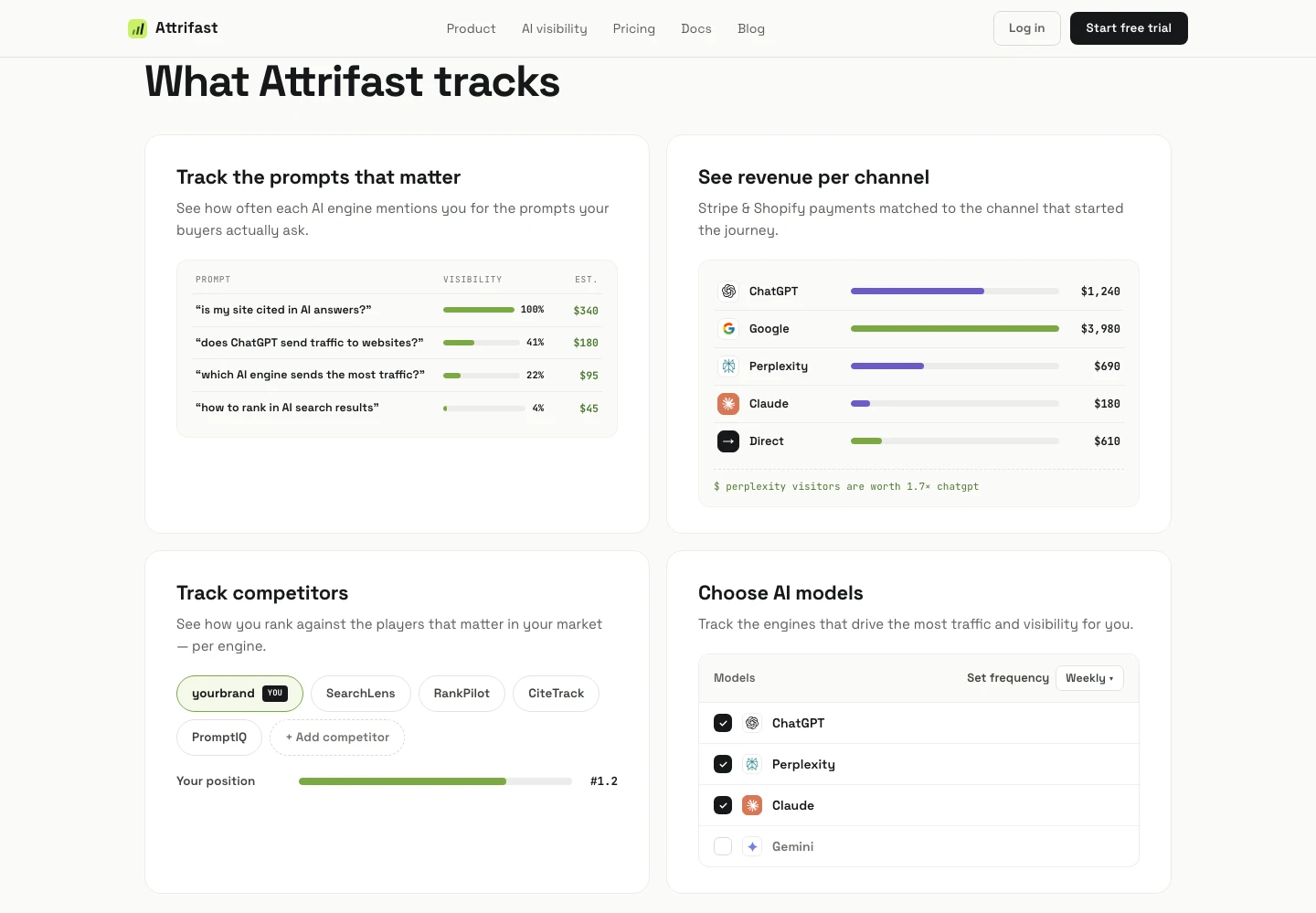
3. Measurement is the gap nobody fills.Most AEO tools tell you whether you appeared. Almost none tell you whether the appearance produced revenue. Closing that loop is where most teams get stuck — and why we built Attrifast.
Foundations — what AEO is and is not
AEO is the practice of optimizing for the answer-shaped surfaces that AI engines now ship in front of the classic blue links. The distinction between AEO and the broader GEO term is fuzzy, but AEO leans toward direct-answer formatting and the specific shape AI Overviews / ChatGPT answers / Perplexity summaries lift cleanly. These three pieces set the framing.
- AEO vs SEO in 2026: what changedThe framework split between answer-engine and search-engine optimization. Where SEO still wins, where AEO is taking over, and how to allocate effort.
- Is AEO replacing SEO? An honest 2026 answerTwo years of running both on the same property — what the data actually says about which one moved revenue.
- AI search ranking factors 2026The 12 factors that decide whether AI engines cite your page in answer-shaped responses — labeled documented, inferred, or speculative.
AEO tools and the category landscape
The "AEO platform" category did not exist in 2024 and now has 12+ vendors. Most are prompt trackers (Profound, Peec, Otterly, Loamly) measuring whether you appear in AI answers; almost none measure whether that visibility produces revenue. The piece below is the honest category breakdown.
- Best AEO tools 2026: 14 platforms comparedHonest pros, cons, and gaps across the category — including the tools that lock you into enterprise procurement and the ones that fit indie budgets.
- AI visibility tracker: rank in ChatGPT, Perplexity, Claude & GeminiHow multi-engine visibility tracking works in practice, including the data integrity gaps every tool has and how to read around them.
- AI visibility metrics & KPIs: the 10 that matter in 2026Which AEO metrics correlate with revenue and which ones are vanity. Cite share, mention share, position share, share of voice, and the one most tools omit.
AEO playbooks — how to get cited in answers
The structural moves that earn citations in answer-shaped surfaces, ordered by lift. The 7-step "get cited by AI engines" playbook is the most-read piece on the blog for this topic; if you only read one of these, read that.
- How to get cited by ChatGPT, Perplexity & ClaudeThe 7-step mechanical playbook, plus six months of A/B-style experimentation disclosed in the body.
- How to rank in ChatGPT (2026 playbook)The two ranking mechanics, the 10-step playbook, and a ranking-factor effectiveness table by tested impact.
- How to get recommended by ChatGPTThe harder "recommended" surface — earning a product mention in a ChatGPT answer, not just a citation footnote.
- How to get cited by Google AI OverviewsThe specific structural pattern AIO favors, with citation-rate data from 1,200 prompts.
- 30-step AI search optimization checklistThe whole AEO surface in one ordered list, ranked by impact and effort.
Schema and structure: the AEO layer that pays fastest
Schema markup correlates with citation in every test I have run. It is the single cheapest, fastest-moving AEO lever. These pieces cover the exact JSON-LD blocks that earn answer-shaped citations, plus the auxiliary structural files (llms.txt, robots.txt) that influence how AI crawlers see your site.
- Schema markup for AI searchThe structured data patterns that actually earn citations in 2026 — Article + FAQPage + Breadcrumb, with the field-level details.
- llms.txt: does it actually improve AI visibility and revenue?A deep dive on what llms.txt is, what it is not, and the honest revenue impact across early adopters.
- Is llms.txt worth it? A 10-site 6-week controlled test10 sites, 6 weeks, controlled before/after — what changed and what did not.
- llms.txt vs robots.txt vs sitemap.xmlWhat each one actually does in 2026, where they overlap, and where they conflict.
AI Overviews — the AEO surface most likely to move your traffic first
For most SEO-driven sites, Google AI Overviews is the AEO surface that will move your numbers first — positively or negatively — before any other engine does. These three pieces map the mechanics, the recovery playbook for AIO-induced traffic loss, and the difference between AIO and the newer AI Mode that ships behind the same UI label.
- Google AI Overviews 2026: how they rank, cite & convertFull mechanical breakdown of AIO ranking, 24 citations, and an 8-week founder case study.
- Google AI Mode vs AI OverviewsThe real differences between the two surfaces Google ships behind similar UI, and what each means for your pages.
- AI Overviews killed my traffic: 2026 recovery playbookStep-by-step recovery — what specifically to change, in what order, and how long each fix takes to show.
Measurement — proving AEO actually pays
The honest gap in the AEO category: most platforms measure whether you appear in answers, almost none measure whether that appearance generates revenue. These pieces walk through the measurement architecture — detect AI traffic, join to Stripe, separate AI-influenced revenue from AI-direct revenue.
- How to measure GEO / AEO ROIThe practitioner methodology — baseline, detect AI traffic, join to Stripe, compute (revenue − cost) / cost with honest confidence intervals.
- Does GEO / AEO actually drive revenue?The 4 evidence layers between AI citation and Stripe payout, and which ones most teams skip.
- 2026 AI search revenue benchmarkReal data from 200 Stripe-connected sites — per-engine RPV, conversion rate, and ROI vs paid search.
- AI-influenced conversions: the hidden 30-40% of your revenueMost AI revenue does not show up as last-click. How to measure it without overclaiming the channel.
AEO for B2B SaaS — the buying-committee angle
B2B SaaS sells to buying committees that increasingly research vendors in ChatGPT and Perplexity before any sales call. This piece is the AEO playbook specifically for that motion — getting recommended in 'best X tool for Y' answer-shaped queries.
- AI visibility for B2B SaaSGetting ChatGPT and Perplexity to recommend your tool — buying-committee framework, per-role query table, 5-engine benchmark.
- ChatGPT isn't recommending your product? Here's whyThe 5 reasons this happens, ordered by frequency, with the fix for each one.
- ChatGPT cited my competitor, not me: an honest diagnosisWhy this happens and what to actually do about it — diagnostic playbook with the fix per scenario.
Share of voice in AI answers
AEO share of voice is the AEO-native version of the classic ad-measurement metric — what fraction of AI answer mentions in your category go to you vs competitors. The classic mention-count version is a vanity metric without revenue weighting; the Revenue SOV variant is what actually matters.
- AI share of voice in 2026The formula, a worked 3-brand × 30-prompt example, the common reporting pitfalls, and why Revenue SOV fixes the vanity-metric problem.
- AI brand sentiment: how ChatGPT, Perplexity, and Claude describe your brandSentiment is the AEO layer most operators skip. How to measure it and the revenue link.
Frequently asked questions
What is Answer Engine Optimization (AEO)?
AEO is the practice of optimizing your content so it gets cited in the answer-shaped surfaces AI engines now ship in front of the classic search results — Google AI Overviews, ChatGPT's recommended answers, Perplexity's source citations, Claude's research mode, Gemini's AI Mode. The job is no longer just 'rank #1 in blue links'; it is also 'be the source the model summarizes when it answers the question directly'. That requires a different structural approach (schema markup, direct-answer formatting, FAQ blocks) than classic SEO.
Is AEO the same as GEO?
In practice, ~80% of the technical advice overlaps. "AEO" (Answer Engine Optimization) leans toward the answer-shaped UI surfaces — AIO, ChatGPT answers, Perplexity. "GEO" (Generative Engine Optimization) is the broader umbrella that also covers the no-browse training-corpus side. Some practitioners use them interchangeably; we tend to use AEO when we mean answer-shaped surfaces specifically and GEO when we mean the whole optimization problem. The aeo-vs-seo-2026 article walks through where the terms diverge.
How is AEO different from traditional SEO?
Three structural differences. (1) The win condition changes — AEO wins on citation and recommendation, not just ranking. A page can be cited prominently by ChatGPT and rank #15 in Google for the same query. (2) Structural signals (FAQ schema, direct-answer blocks, primary-source citations in the body) are weighted more heavily because LLMs parse them cleanly. (3) The CTR layer changes — answer-shaped surfaces increasingly answer queries without sending a click, which means "ranking" without traffic is a real failure mode that classic SEO did not have. The zero-click search revenue impact piece in the measurement section covers this.
What is the single highest-leverage AEO move?
Ship a 40-80 word direct-answer block at the top of the page, then mirror your visible H2 questions exactly in FAQPage JSON-LD schema. That combination is the most consistently citation-positive move in every test I have run. The Princeton GEO research paper (Aggarwal et al., 2024) showed adding statistics and primary citations lifts visibility 30-40%, which I have replicated on a smaller sample. Schema + direct-answer + primary citations is the AEO equivalent of the on-page SEO basics: not glamorous, but the foundation that everything else compounds on.
Do I need a dedicated AEO tool?
You can do the structural and content work manually without buying anything. What you cannot do manually is monitor whether your changes actually moved citation rates across 100+ prompts on 5+ engines weekly. That is where dedicated AEO tools earn their keep — they answer "did this work?". The best-aeo-tools-2026 piece walks through 14 platforms with honest pros and gaps. Attrifast covers both layers: it tracks which of your monitored prompts cite you across ChatGPT, Claude, and Gemini, and joins the AI traffic those engines send to Stripe revenue — visibility-only tools stop at the first layer.
How long does AEO take to show results?
Faster than classic SEO, because the answer-shaped surfaces re-crawl on a much shorter cycle than Google indexing. A well-structured page can show up in ChatGPT search citations within days of being crawled by OAI-SearchBot. AI Overviews citation usually follows existing Google rankings — pages already in the top 10 for a query are the candidate set AIO selects from — so AEO + classic SEO compound rather than competing. The training-corpus side (no-browse model answers) lags by months because it only updates with model releases.
Does AEO replace SEO?
No, but the allocation between them should shift. SEO still drives the majority of organic traffic for most sites in 2026. AEO captures the increasing share of queries that get answered in-surface instead of producing a click. The honest answer is in the is-aeo-replacing-seo article in the foundations section above — running both on the same property for two years, I found the right split was roughly 60-70% effort still going to traditional SEO with the remaining 30-40% going to AEO-specific structural work. That ratio will shift toward AEO as zero-click query share grows.
See whether your AEO work actually produces revenue.
Most AEO tools tell you whether you appeared in an answer. Attrifast tells you whether the appearance paid — Stripe-joined revenue split by AI engine (ChatGPT, Perplexity, Claude, Gemini), server-side.
- One script tag and a Stripe key — live in minutes
- First-party measurement without third-party cookies
- Recognized AI referrals joined to Stripe payments
7-day free trial · $0 due today · then $9.99/mo · cancel anytime