AI Visibility Score
One score for AI visibility,
tied to your revenue.
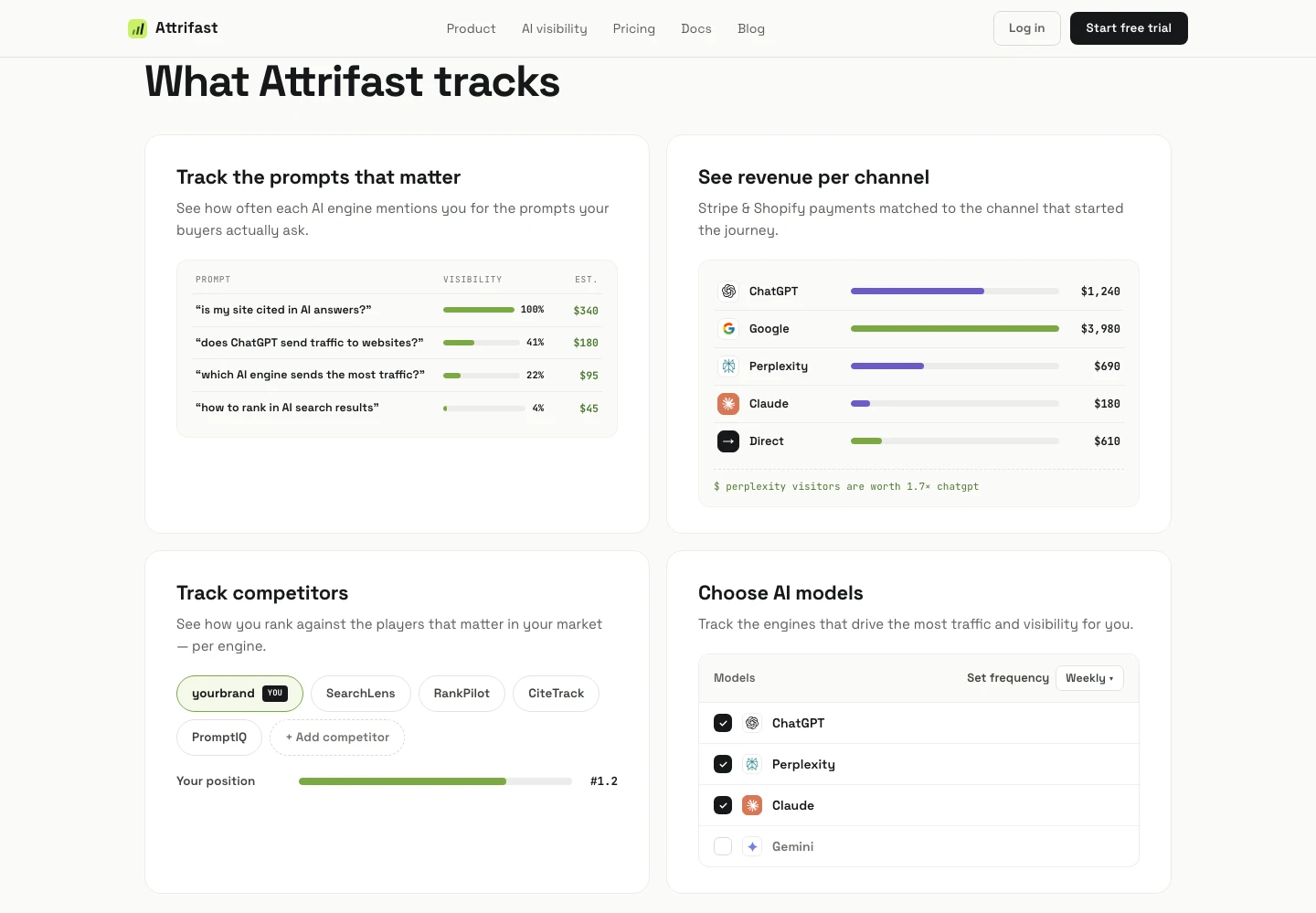
Most AI visibility trackers stop at the citation count. Attrifast scans ChatGPT, Claude, Gemini and Perplexity on your real buyer prompts, rolls the appearance rate into one score, and joins the AI traffic each engine sends to the Stripe revenue it produced.
7-day free trial · from $9.99/mo · cancel anytime
A citation count is not a visibility score
Every AI visibility tracker I tried before building this one reported the same shape of number: "you appeared in N of M answers." That number ignores where the answer surfaced, which prompt drove it, whether the prompt was buying-stage or research-stage, and most importantly whether the resulting click bought anything.
Citation count only
- ✕Treats research prompts and buying prompts the same
- ✕Cannot tell a Claude bare-mention from a Perplexity link-out
- ✕Stops one step short of the Stripe payment
- ✕Optimizes for vanity, not budget reallocation
Attrifast visibility score
- ✓Weighted by prompt intent (buying vs research)
- ✓Engine-level sub-scores (ChatGPT, Claude, Gemini, Perplexity)
- ✓Each citation joined to its Stripe revenue line
- ✓Drives the next budget decision, not the next slide
How the visibility score is computed
One number, four engines, transparent weights. The full methodology is documented; you can audit every prompt and every parsed citation.
Score=Σ engine weight×appearance rate×intent weight
A 30-prompt scan that finds your domain in 12 answers, weighted by how commercial each prompt is and which engine surfaced it, yields a single 0-100 score. Move the prompts and the weights are recomputed transparently.
Engine weight
Each engine gets a weight proportional to how much traffic and revenue it sent your site in the last 30 days. Sites with heavy Gemini referral traffic weight it higher; product-led SaaS often weights ChatGPT higher.
Intent weight
Prompts tagged as buying-stage ("best X tool", "X vs Y", "alternative to X") count more than research-stage ("what is X"). You tag the prompts during setup; the weights are exposed and editable.
Closing the loop: citation → click → revenue
The score is the headline number. The loop underneath it is what makes the score worth tracking in the first place.
StageWhat Attrifast capturesGA4 captures?Profound captures?
Citation eventAI engine names your domain
Referral clickVisitor lands from chatgpt.com / perplexity.ai
SessionAnonymous first-party session, server-side
Stripe paymentWebhook fires payment_intent.succeeded
Revenue joinPayment matched back to citing engine
The last row — payment matched back to citing engine — is the join that makes the visibility score worth optimizing. No other tool in the AI-analytics category does it for $9.99/mo[1].
What you get beyond the score
The score is one tab of seven. Everything below is in the product today — anything marked Pro, whether a whole tab or a single field inside a Starter tab, is on the $49/mo plan, and the 7-day trial unlocks it on either plan.
Overview
The 0-100 score with per-engine sub-scores, a trend chart you can switch between visibility and share of voice — sentiment and position are on Pro — the citations-to-revenue panel, and a brand leaderboard ranking you against the competitors you track.
Prompts
Every tracked prompt with its per-engine result, whether the answer was branded, and the intent it was classified as. On Pro, sentiment and position deltas sit next to each row so you can see the week a model dropped you.
Fanouts
The background searches each engine actually ran to answer your prompt — the query behind the answer, not just the answer. ChatGPT, Claude and Gemini expose theirs; Perplexity reports none, and the page says so rather than showing a silent zero.
Sources
Which pages and domains each engine cited, grouped by source type, so you can see whether you are losing to a competitor, a review site, or a forum thread. On Pro, your own cited pages also carry the revenue they produced.
GapsPro
The prompts where competitors get cited and you do not, ranked by a gap score with absolute counts beside every rate and a previous-window comparison. Exports to CSV.
InsightsPro
Structured findings across models and topics: an intent-by-topic matrix, the movers since the last scan, prompt value, cited-page revenue, and the crawl-coverage gap between what AI crawlers read and what they cite.
Crawlers
Which AI crawlers — GPTBot, ClaudeBot, PerplexityBot and the rest — hit your site, which pages they read, and whether each hit verifies against the vendor’s published IP ranges.
Why AI visibility matters in 2026
ChatGPT crossed 800 million weekly active users in late 2025 and OpenAI has continued to publish growth numbers into 2026[2]. Ahrefs measured AI Overviews on 20.5% of 146.1 million SERPs crawled in September 2025, and Conductor on 25.11% of 21.9 million Google searches sampled September 15 to October 12, 2025[3]. Across the sites I have instrumented, AI engines now send 3-15% of total traffic for SMB SaaS — a slice that grew from effectively zero in 24 months.
The visibility score exists because that slice grew faster than the analytics layer that was supposed to measure it. GA4's default channel grouping does not maintain a ChatGPT source/medium mapping, so chatgpt.com referrals get bucketed as Direct or Referral depending on cookie state and session context[4]. The result: the channel growing fastest is the channel your dashboard cannot see, and the citation event that drove the visit is invisible to every classic SEO tool you own.
The Princeton GEO research found that adding citations, statistics, and quotations to a page lifted generative-engine visibility by up to 40%, while keyword stuffing barely moved the needle[5]. Translation: the levers that lift an AI visibility score are not the same as the ones that lift a classic SEO rank. Knowing which lever moved your score by how much — and whether it paid — is the entire job. Our deeper treatment of the AI-citation scoreboard versus the classic backlink scoreboard lives in AI citations vs backlinks.
Attrifast vs Profound vs Loamly vs SEOcrawl
All four track AI visibility. Only one ties each citation to revenue.
CapabilityAttrifastProfoundLoamlySEOcrawl
AI visibility score
Per-engine sub-scores
Stripe revenue join per AI engine
Intent-weighted prompt scoring
Scheduled rescans
Sub-$50/mo entry tier
CSV export
JSON API export
Profound and Loamly publish their methodology pages publicly; SEOcrawl bundles AI tracking into its broader SEO suite[6][7].
From $9.99/mo for the only score that includes revenue
The enterprise AI-visibility tools are priced for Fortune 500 marketing budgets. Attrifast is priced for the founder who needs the number this week.
ToolEntry priceRevenue join included
Attrifast$9.99/mo ($49 Pro)
ProfoundDemo / enterprise
Loamly$79+/mo
SE Ranking AI Suite$65+/mo
SEOcrawl$59+/mo
AI visibility score FAQ
How the score is computed, what engines it covers, and how the Stripe join actually works.
›What is an AI visibility score?
An AI visibility score measures how often large language models like ChatGPT, Claude, Gemini, and Perplexity reference your domain when users ask buying-stage questions in your category. Attrifast rescans your seed prompts every 10 days on Pro (every 30 days on Starter), parses every answer for your domain plus competitor domains, and rolls the appearance rate into a single 0-100 number. A score of 38 means your domain showed up in 38 of every 100 sampled answers. Unlike a typical AI visibility tracker, the score is reported alongside the revenue those citation-driven sessions actually produced, so you can see whether the score correlates with paying customers.
›How is your AI visibility tracker different from Profound or Loamly?
Profound and Loamly stop at the citation count: they tell you that you appeared in N answers across M prompts. Attrifast takes the same scan output and joins it back to Stripe via the same session-stitching pipeline that powers our revenue attribution product. The result is a single dashboard row per AI engine showing citation share, referral sessions, paid trials, and revenue. That join is the part GA4 cannot do because chatgpt.com referrers get bucketed as Direct, and the part Profound and Loamly do not do because they have no read into your Stripe account.
›Which AI engines does the visibility score cover?
ChatGPT (with web search), Claude, Google Gemini and Perplexity — all four are scanned on every run. Each gets its own sub-score because, as the Princeton GEO research shows, the levers that win a citation are not identical across engines: what wins a citation on one does not always work on another. Treating them as one bucket hides the signal you actually need to act on. One caveat specific to Perplexity — it is scanned and scored like the rest, but it is the one engine that does not report the background searches it ran, so it stays blank on the Fanouts tab.
›How many prompts do you scan and how often?
On the $49/mo Pro plan you get up to 30 prompts monitored, rescanned every 10 days across ChatGPT, Claude, Gemini and Perplexity — Attrifast runs the scheduled scan and you can trigger a rescan from the dashboard at most once every 7 days. The $9.99/mo Starter plan covers up to 10 prompts, rescanned every 30 days. You bring the seed prompt list (we suggest a starter set based on your category) and Attrifast handles the scan, parsing, deduplication, and longitudinal storage. Every prompt comes with a presence trend chart so you can see when a model retrain dropped you from an answer or when a competitor displaced you. The scan output feeds the score, the share of voice number, and the revenue join.
›Why does AI visibility need to be tied to revenue?
Because a citation that sends no buyers is vanity. I have watched DR-80 sites get cited heavily by ChatGPT on competitive prompts and produce zero trials, because the visitors that did click were research-stage. I have watched DR-20 niche pages get cited rarely but convert at 2-3x because the citation arrived inside a buying-shaped query. The only way to tell those apart is to join the citation event to the eventual Stripe payment, which is the thing Attrifast was built to do. Without that join you optimize a score that does not pay the bills.
›Will this work for a small SaaS without a big marketing team?
Yes — it is built for that case. The setup is one tracking script (4 kb) plus a restricted Stripe API key you paste into the dashboard, then you add the prompts you want monitored. There is no consultant onboarding, no annual contract, and no per-seat upsell. Pricing starts at $9.99/mo, and the Pro plan — 30 prompts rescanned every 10 days — is $49/mo, both with a 7-day free trial. Compared to Profound, which is sold via demo into Fortune 500 marketing teams, Attrifast is sized for the founder or growth lead who needs the data to make a budget decision this week, not next quarter.
›How accurate is the AI visibility score?
Accuracy depends on two things: prompt coverage and parse fidelity. Prompt coverage is on you — if your seed list misses the queries your buyers actually ask, the score reflects the wrong universe. We help with that by suggesting starter prompts from your category and from your existing GSC and keyword data. Parse fidelity is on us: we extract every cited URL and bare brand mention from each engine's structured response (where available) and fall back to regex on the rendered answer. For engines that return structured source lists (ChatGPT with web search, Perplexity), parsing is effectively 100%; for Claude and Gemini answers, we hit 90%+ in our own validation.
›Can I export the AI visibility data to a spreadsheet or BI tool?
Partly. The Gaps tab exports to CSV — every source, its citation and competitor-presence rates with the absolute counts behind them, the gap score, and the change against the previous window, so the numbers can be recomputed outside the dashboard. The other tabs are read-in-app for now, and there is no JSON API yet. Both are on the roadmap; if a specific export blocks your workflow, tell us, because roadmap order follows user demand.
Sources
Primary sources for the claims in this article. Numbered citations in the text link to the matching entry.
- [1]Answer Engine Insights — methodology and pricing — Profound (2026).
- [2]ChatGPT usage and product updates — OpenAI (2026).
- [3]What triggers AI Overviews? 86 factors and 146 million SERPs analyzed (20.5% of SERPs, September 2025) — Ahrefs (2025).
- [4]Default channel groups and attribution windows — Google Analytics Help (2025).
- [5]GEO: Generative Engine Optimization — Princeton University / KDD (Aggarwal et al.) (2024).
- [6]AI Visibility methodology and audit samples — Loamly (2026).
- [7]AI SEO Visibility Tracker product page — SEOcrawl (2026).
Stop tracking citations in a spreadsheet
See your AI visibility score and the revenue each engine drove — same dashboard, one Stripe connect away.
- One script tag and a Stripe key — live in minutes
- First-party measurement without third-party cookies
- Recognized AI referrals joined to Stripe payments
7-day free trial · $0 due today · then $9.99/mo · cancel anytime