Free Tool
Does AI recommend
your brand?
We ask ChatGPT, Claude, Gemini and Perplexity the questions your buyers ask — then show you whether your name comes up, and who gets recommended instead.
An AI visibility checker tests whether AI assistants name your brand when someone asks a buying question. It is not a rank tracker: there is no ranked list to scrape, so the check has to send real questions to each assistant and read the answers. This free checker sends three buyer-intent questions to ChatGPT, Claude, Gemini and Perplexity with web search on, then reports how many of the twelve answers mentioned you.
No signup to start. One scan asks four assistants three real questions.
How the scan works
1.We work out what your buyers ask
The scanner reads your homepage, identifies your category, and writes three buyer-intent questions — the "best tool for X" and "what should I use" phrasing that makes an assistant search the web and name real vendors, rather than answer from memory.
2.We ask four assistants, for real
Each question goes to ChatGPT, Claude, Gemini and Perplexity with web search enabled. Twelve live answers, not a cached index and not a simulation.
3.We check every answer for you
Each answer is checked for your brand — cited as a link or named in the text — and every domain the assistant pointed at is counted, so you can see who got recommended in your place.
Not mentioned? Check you are readable first.
An assistant can only recommend a site its crawler is allowed to fetch. If this scan came back empty, the first thing worth ruling out is a robots.txt rule blocking GPTBot, ClaudeBot or PerplexityBot — which is a five-minute fix that nothing else can compensate for.
Run the AI Readiness Checker
Free, instant, and it tests the three things that decide whether AI engines can read you at all: robots.txt AI-crawler rules, llms.txt, and structured data.
Check if AI can read your site →Questions about the scan
Is the AI visibility checker really free?
Yes. Three questions across four AI assistants, no account and no card. Each visitor can run three scans a day, which is enough to check a site and a couple of competitors.
How is this different from the AI Readiness Checker?
The AI Readiness Checker tests whether AI crawlers can read your site — robots.txt rules, llms.txt and schema markup. This one tests whether the assistants actually recommend you when someone asks a buying question. Readable is the prerequisite; recommended is the result.
Why does the scan take a minute or two?
Because the queries are real. Each of the three questions is sent to four assistants with web search turned on, and a web-searched answer takes roughly half a minute to come back. The three rounds run one after another to stay inside rate limits, so a typical scan lands between one and two minutes. A result that appeared instantly would be a lookup in a stale index, not a live check.
What does "appeared in 2 of 9 answers" mean?
Nine is the number of engine answers that came back successfully, and two is how many of them mentioned your brand. Calls that failed are left out of both numbers, so an engine outage is never counted as the assistant declining to mention you.
Does being mentioned by ChatGPT actually drive revenue?
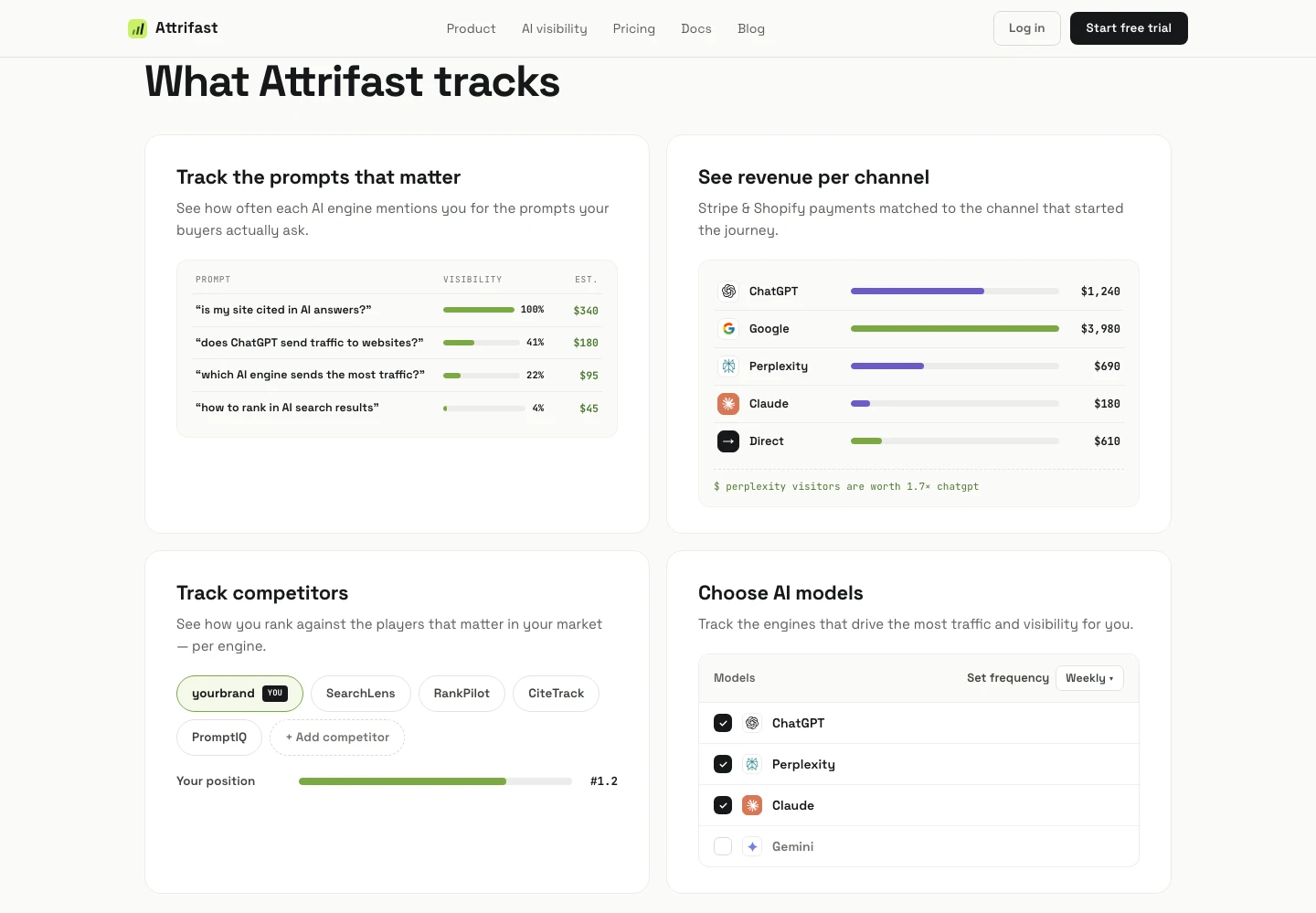
Sometimes, and the only way to know is to measure it. A citation is a leading indicator: it tells you an assistant knows about you, not that anyone clicked through or paid. Attrifast tracks the visitors AI answers send you and joins them to the Stripe or Shopify payment they produced.
Being mentioned is step one. Getting paid is the point.
Attrifast tracks the visitors AI answers send you and joins each one to the Stripe or Shopify payment it produced.
- One script tag and a Stripe key — live in minutes
- First-party measurement without third-party cookies
- Recognized AI referrals joined to Stripe payments
7-day free trial · $0 due today · then $9.99/mo · cancel anytime