Free Tool
Can AI engines
read your site?
ChatGPT, Claude, and Perplexity can only cite sites their crawlers can read. Check your robots.txt, llms.txt, and schema markup in 10 seconds. No signup required.
Three requests to your site: robots.txt, llms.txt, homepage. Nothing stored beyond a 1-hour cache.
What we check, and why it matters
robots.txt AI-crawler rules
GPTBot (OpenAI), ClaudeBot (Anthropic), PerplexityBot, Google-Extended and 10 more — we parse your robots.txt the way the bots do and flag any that are blocked from your whole site. A blocked crawler can never cite you.
llms.txt
The emerging standard for AI engines: a markdown index at /llms.txt that tells assistants what your site is about and which pages matter. Cheap to add, increasingly read by AI search.
Structured data (JSON-LD)
Schema markup on your homepage helps engines identify your brand, product, and content — and cite you accurately instead of guessing.
Readable is step one. Revenue is the point.
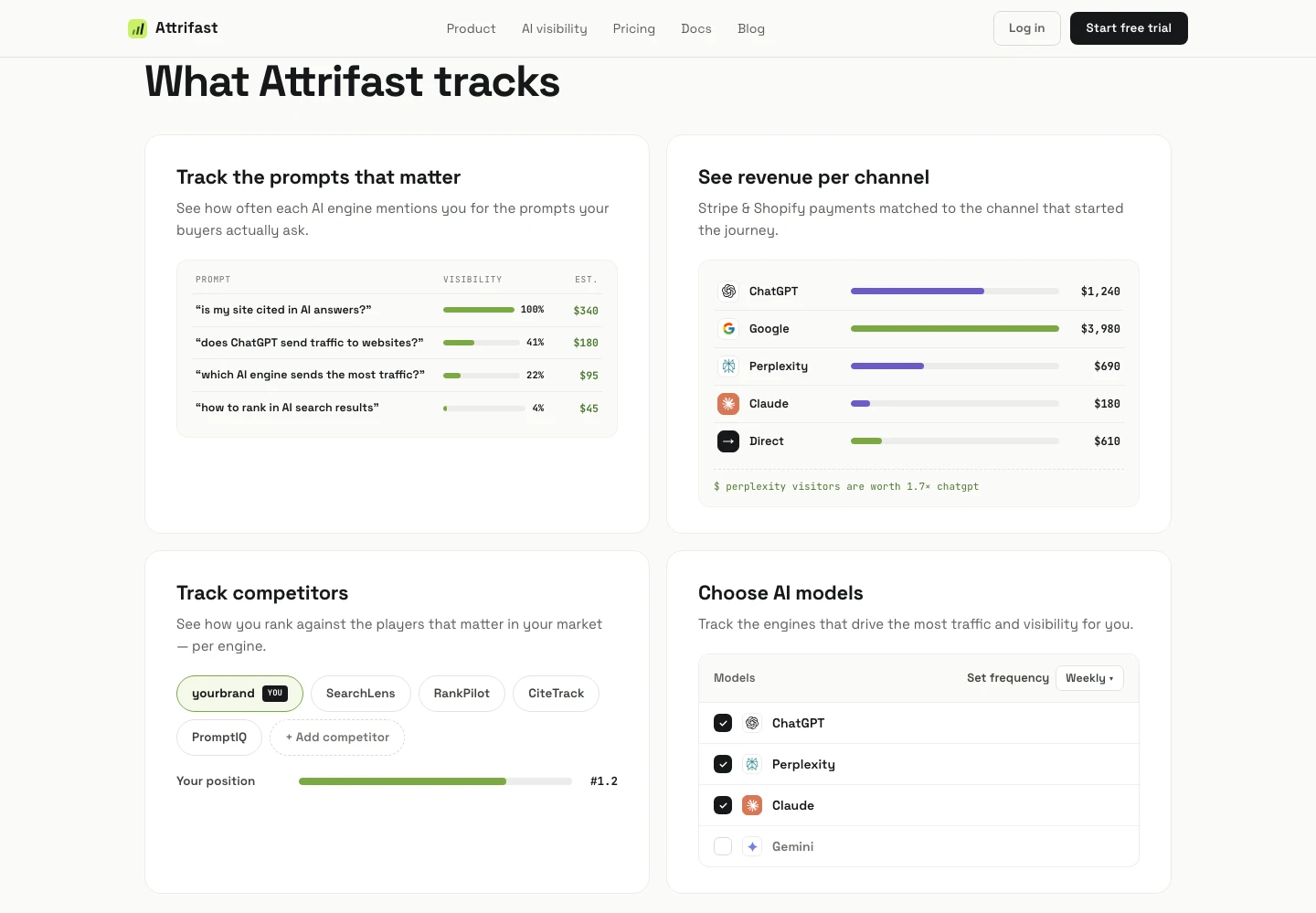
Passing these checks means AI assistants can read and cite your site. It doesn't tell you whether they actually send you visitors — or what those visitors are worth. Visibility tools stop at citations; AttriFast puts a first-party tracker on your site and attributes real sessions, conversions, and revenue to ChatGPT, Claude, Perplexity, and Gemini individually.
Next: are you actually recommended?
Passing these checks means the crawlers can reach you. The AI Visibility Checker asks ChatGPT, Claude, Gemini and Perplexity real buying questions and tells you whether your brand comes up — or who gets named instead. Also free.
Check if AI recommends you →Measure your AI revenue with AttriFast
One script tag. See which AI engines send traffic, which pages they land on, and how much revenue each engine drives — plus weekly citation scans across the engines themselves.
Try it free →Know what AI traffic is worth
AttriFast attributes real revenue to ChatGPT, Claude, Perplexity, and Gemini — not just citations.
- One script tag and a Stripe key — live in minutes
- First-party measurement without third-party cookies
- Recognized AI referrals joined to Stripe payments
7-day free trial · $0 due today · then $9.99/mo · cancel anytime