Part of the generative engine optimization guide and AEO Hub.
Here is the uncomfortable truth most "how to rank in AI Overviews" posts skip: there is no formatting trick that pulls a page ranking on position 30 into a Google AI Overview. I have watched citation patterns across attrifast.com and a handful of client SaaS and e-commerce sites for about a year, and the single strongest predictor of getting cited is the most boring one. The page already ranks top-3 for the query. Everything else, schema, direct-answer paragraphs, question-shaped headers, is the second-order layer that converts a strong ranking into a citation. It is real, it is worth doing, and it is useless on a page that does not rank.
This article is the how-to-get-cited companion to Google AI Overviews 2026: how they rank, cite and convert, which explains what AI Overviews is, when it triggers, and why GA4 cannot see the traffic it sends. If you have not read that one, skim it first for the mechanics. This piece is the playbook: the source-selection model, a 9-factor citeability checklist you can run on any page, the schema and direct-answer formatting that actually moves the needle, the honest CTR-loss-versus-citation tradeoff, and the part nobody owns, measuring the revenue an AI Overview citation actually drives.
I am going to be blunt about the tradeoffs throughout, because the field is full of confident claims that fall apart in production. Getting cited is not free traffic. It is a way to recover some of the click you would otherwise lose entirely when AI Overviews eats your query. That framing matters for how you prioritize, and it matters even more for how you measure.
Quick Facts
| Spec | Value | Source |
|---|---|---|
| SERP AIO appearance rate (Ahrefs, 146.1M SERPs, Sept 2025) | 20.5% | Ahrefs [5] |
| Sources cited per AIO block | 4-7 | Google Search blog [2] |
| Citation rate, positions 1-3 vs 4-10 | ~4x higher | Semrush AIO research [8] |
| Blue-link CTR drop on position 1 when AIO appears | ~34.5% | Ahrefs AIO click study [4] |
| AIO footnote click-through | Not published by Google; low single digits by industry estimate | No primary source |
| Share of AIO citations from top-10 organic | ~38% (was ~76% in July 2025) | Ahrefs [7], Semrush [8] |
| Is structured data a direct ranking factor? | No (per Google) | Google Search Central [1] |
| Does Google-Extended gate AIO citation? | No | Google Search Central [1] |
| GA4 default attribution for AIO clicks | google.com referrer or Direct | Google Analytics Help [11] |
| Index AIO draws from | Standard Google Search index | Google Search blog [2] |
How AI Overviews picks which sources to cite
Google AI Overviews selects its 4-7 cited sources from the standard organic Search index, then weights heavily toward pages already ranking in the top 10, with a strong skew to positions 1-3. There is no separate "AIO allowlist" you apply to. The eligibility gate is the same gate as classic Search: you have to be in the index and ranking well for the query before the generative layer will consider quoting you.
That single sentence reframes the entire problem. People treat AI Overviews as a new surface with its own rules, and then go hunting for the secret formatting that unlocks it. The reality, confirmed in Google's Search blog and corroborated by the major SEO tool studies, is that AIO is built on top of the organic index. The model reads the top-ranking pages for a query, synthesizes an answer, and footnotes the sources it leaned on. If your page is not in the top results, the model never reads it.
There are two layers in that diagram, and the order is non-negotiable.
| Layer | What it controls | Lever | Hard requirement? |
|---|---|---|---|
| Layer 1: Ranking | Whether the model ever reads your page | Classic SEO: links, content depth, topical authority, technical health | Yes, top-10 is the entry gate |
| Layer 2: Citeability | Whether the model picks your page over the others it read | Direct-answer formatting, schema, entity clarity, freshness | No, but it decides ties |
The mistake I see most often is teams spending all their effort on Layer 2 because it feels new and actionable, while the page sits on page 3 of the results. You can have the cleanest FAQPage schema on the internet and a 60-word direct answer crafted by a copywriter, and if you rank #28, you will not be cited. The formatting layer only operates on pages the model already reads.
The ranking dependency, in numbers
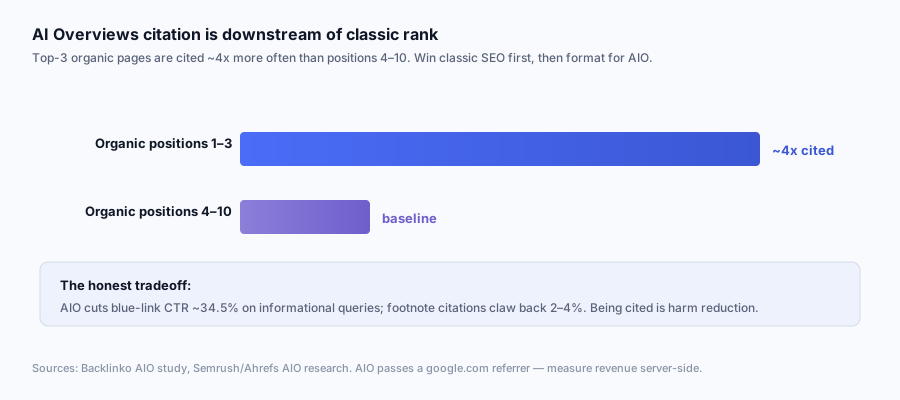
Semrush's AI Overviews research found that pages ranking in positions 1-3 are cited roughly four times more often than pages in positions 4-10 [8]. Ahrefs' March 2026 update, covering 863,000 SERPs and 4 million AIO URLs, found 37.9% of cited URLs also rank in the top 10 for the query — down from roughly 76% in July 2025 as Google leaned harder on query fan-out [7]. The two studies use different samples and methods and land in the same place: rank still raises your odds materially, but on Ahrefs' latest data it is no longer close to a precondition.
| Organic position band | Relative AIO citation likelihood | Practical read |
|---|---|---|
| 1-3 | Highest (~4x positions 4-10) | Strong-favorite tier; format aggressively |
| 4-10 | Moderate | Eligible; formatting can win ties |
| 11-20 | Low | Rarely cited; fix ranking first |
| 21+ | Near zero | Not a citation problem, a ranking problem |
So the playbook writes itself. Win classic top-3 organic ranking for the queries you care about. Then, on those pages, add the AIO-specific formatting that converts a ranking into a citation. Doing it in the other order is the most common way teams waste a quarter.
The minority of off-rank citations
To be honest about the exceptions: a minority of AIO citations do pull from pages ranking lower than the top 10, or from a page that ranks for a closely related query rather than the exact one the user typed. This happens most on long-tail queries where the top-10 is weak and your page is genuinely the best direct answer available, and on queries where the model stitches an answer from several related sub-queries. It is a real wedge for new and small sites, covered in the FAQ, but it is the exception. Do not build a strategy on the 10% case.
The 9-factor citeability checklist
Once a page is ranking top-10, nine factors decide whether AI Overviews cites it over the other pages the model read. Run this checklist on any page you want cited. The first factor is the gate; the other eight are the tiebreakers that operate only after the gate is passed. None of them substitute for ranking.
| # | Factor | What "good" looks like | Why it moves citation | Effort |
|---|---|---|---|---|
| 1 | Top-3 organic ranking | Page ranks 1-3 for the target query | The entry gate; ~4x citation rate vs 4-10 [8] | High |
| 2 | Direct-answer paragraph | Sub-80-word answer to the query near the top | Gives the model a clean, liftable, attributable snippet | Low |
| 3 | Question-shaped H2 headers | H2s phrased as the conversational query | Matches the query the model is answering | Low |
| 4 | FAQPage + Article schema | Valid JSON-LD, passes Rich Results test | Machine-parseable facts; disambiguates Q&A | Medium |
| 5 | Entity disambiguation | sameAs links, clear author + org identity | The model trusts attributable, identifiable sources | Medium |
| 6 | Freshness signal | Genuine updatedAt, current data points | AIO favors current answers on time-sensitive queries | Low |
| 7 | Extractable structure | Tables, lists, definition blocks | Easier to lift and footnote than dense prose | Low |
| 8 | Source-of-truth depth | Original data, first-hand experience, named figures | E-E-A-T; the model prefers primary over derivative | High |
| 9 | Technical crawlability | Googlebot allowed, fast, indexable, no JS-only content | If Googlebot cannot read it cleanly, AIO cannot cite it | Medium |
Let me walk the factors that need explanation. Factors 1, 8, and 9 are the classic-SEO layer; if those are weak, fix them before touching the rest.
Factor 1: top-3 ranking is the gate, not a nice-to-have
I keep repeating this because it is the factor people most want to skip. There is no row in this table that compensates for not ranking. If you are honest with yourself that the page ranks #19, close this checklist and go read the AI search ranking factors playbook, because your problem is ranking, not citeability. The other eight factors are the difference between getting cited and getting passed over among pages that all already rank.
Factor 2: the direct-answer paragraph
The single highest-leverage, lowest-effort thing you can do on a ranking page is put a tight, self-contained answer to the query in the first screen of content. The model is looking for a clean snippet it can lift and attribute. A 70-word paragraph that fully answers "how to get cited by Google AI Overviews" is far more liftable than the same information spread across three paragraphs of throat-clearing. I cover the exact formatting in the direct-answer section below.
Factor 5: entity disambiguation
AI Overviews, like the rest of Google, is trying to map your content to entities it understands. A page by a named author with a real bio, an organization with a clear identity, and sameAs links to authoritative profiles is more trustworthy to the model than an anonymous content-mill page. This is why every Attrifast article carries a real author byline, a detailed bio, and a sameAs link. It is not vanity; it is entity signal. Per Schema.org, sameAs is the canonical way to say "this entity is the same as that one over there."
Factor 8: source-of-truth depth
The model prefers primary sources over derivative ones. Original data, first-hand experience, named figures with provenance, and specifics it cannot get from a hundred other pages all raise your odds of being the cited source rather than one of the uncited pages it also read. This is the part that takes real work and is the hardest to fake. It is also the part that compounds: a page with genuine original data tends to both rank better and get cited more, because it is the kind of page other sites link to.
Here is how I score a page before deciding whether it is worth the formatting effort.
| Score band | Factors 1, 8, 9 status | Action |
|---|---|---|
| Strong | Ranks top-3, real depth, clean tech | Apply factors 2-7 aggressively; track citation |
| Workable | Ranks 4-10, decent depth | Apply factors 2-7; build links to push to top-3 |
| Not yet | Ranks 11+ or thin content | Stop. Fix ranking and depth first |
Schema markup for AI Overviews
Structured data does not trigger an AI Overview citation, and it is not a ranking factor; Google has stated both repeatedly. What schema does is make your facts machine-parseable and your entities unambiguous, which raises the odds that the model lifts a clean, attributable snippet from your page instead of a competitor's. Treat schema as a tiebreaker that amplifies a page already ranking well, never as a trigger that manufactures authority.
I want to be precise here because this is where bad advice does the most damage. Per Google Search Central's structured data documentation, structured data helps Google understand your content and can enable rich results, but Google is explicit that it is not a direct ranking signal. AI Overviews draws from the same organic index, so schema does not buy you a ranking and therefore does not buy you the eligibility gate. What it buys you is clarity once you are already in the room.
The schema types that matter for AIO
| Schema type | What it clarifies | AIO benefit | Where to use |
|---|---|---|---|
| Article / BlogPosting | Author, publish/update dates, headline | Entity + freshness signal | Every blog post |
| FAQPage | Discrete Q&A pairs | Liftable question-answer snippets | Articles with a real FAQ |
| HowTo | Ordered steps | Procedural query answers | Step-by-step guides |
| Organization | Brand identity, logo, sameAs | Publisher entity disambiguation | Site-wide |
| Person | Author identity, sameAs | Author E-E-A-T signal | Author bylines |
| Product | Price, availability, reviews | E-commerce answer eligibility | Product pages |
| BreadcrumbList | Site hierarchy | Context for the page's place | Most pages |
A caveat that trips people up: do not stuff FAQPage schema onto a page that does not have a genuine, visible FAQ. Google's guidelines require the marked-up content to match what users see, and there have been enforcement waves against fake FAQ markup. Mark up the FAQ you actually show. This article's frontmatter carries a real faqs array that renders both as visible Q&A and as FAQPage JSON-LD, which is the pattern you want.
A minimal, correct schema stack
Here is the JSON-LD I ship on a citeable article. Note that the comparison operators inside the code fence are fine; the rule about escaping applies only to prose.
{
  "@context": "https://schema.org",
  "@type": "Article",
  "headline": "How to Get Cited by Google AI Overviews in 2026",
  "datePublished": "2026-05-26",
  "dateModified": "2026-05-26",
  "author": {
    "@type": "Person",
    "name": "Vincent Ruan",
    "url": "https://attrifast.com/about",
    "sameAs": ["https://x.com/0xVinceAI"]
  },
  "publisher": {
    "@type": "Organization",
    "name": "Attrifast",
    "logo": {
      "@type": "ImageObject",
      "url": "https://attrifast.com/favicon.svg"
    }
  },
  "mainEntityOfPage": {
    "@type": "WebPage",
    "@id": "https://attrifast.com/blog/get-cited-by-google-ai-overviews"
  }
}
Schema mistakes that cost you
| Mistake | Consequence | Fix |
|---|---|---|
| FAQPage markup with no visible FAQ | Manual action risk; ignored | Mark up only visible Q&A |
dateModified that never changes | Freshness signal is fake | Update genuinely or omit |
Author with no sameAs or bio | Weak entity signal | Add real author identity |
| Invalid JSON-LD (syntax errors) | Silently dropped by Google | Validate in Rich Results test |
| Schema on JS-only content | Googlebot may not render it | Server-render the markup |
The honest summary on schema: it is table stakes, not a growth lever. Get it valid, get it matching your visible content, and move on. The hours you might spend over-engineering schema are better spent on factor 8, original depth, which actually compounds.
Direct-answer formatting that gets lifted
The format AI Overviews lifts most reliably is a self-contained, sub-80-word answer to the exact query, placed in the first screen of the page, written so it makes sense quoted out of context. The model is scanning the pages it already ranked for a clean snippet to synthesize and footnote. Give it one. Bury the answer under 400 words of preamble and the model either skips you or paraphrases without attribution.
This is the lowest-effort, highest-leverage move on a page that already ranks, and it is the thing the most articles get wrong, because writers are trained to build to a point rather than lead with it. For AI discovery, you invert that instinct: lead with the answer, then earn the read.
The lead-with-the-answer pattern
Look at how each H2 in this article opens. The first paragraph under the heading is a tight, standalone answer to the question the heading implies, written so it survives being quoted alone. Then the supporting detail follows. That is deliberate. It serves the human skimmer and the model simultaneously.
| Element | Bad (buries the answer) | Good (leads with it) |
|---|---|---|
| Opening paragraph | "There are many factors to consider when..." | "Win top-3 ranking first, then add schema and a direct-answer paragraph." |
| Length | 200-word wind-up | 40-80 words, self-contained |
| Position | Below the fold | First screen, under the H2 |
| Quotability | Needs surrounding context | Makes sense lifted alone |
| Specificity | Vague generalities | Named figures, concrete numbers |
Formatting elements the model lifts easily
| Element | Why it lifts well | Example |
|---|---|---|
| Definition sentence | Clean, attributable fact | "AI Overviews is Google's LLM-generated answer block..." |
| Comparison table | Structured, scannable | The tables throughout this article |
| Numbered list | Procedural answers | A step-by-step how-to |
| Bolded key figure | Stands out to extractor | "34.5% lower CTR on position 1" |
| Question-shaped H2 | Matches the query | "How do AI Overviews pick sources?" |
Word count: tighter than you think
The instinct is to write more. For the liftable answer specifically, write less. A 70-word paragraph that fully answers the query is more citeable than a 250-word one that answers it better but cannot be lifted whole. Save the depth for the body; keep the lead tight.
| Content block | Target length | Rationale |
|---|---|---|
| Direct-answer lead under each H2 | 40-80 words | Liftable as a unit |
| Definition sentence | 1 sentence | Maximally quotable |
| FAQ answer | 40-90 words | Matches AIO answer length |
| Body paragraph | No hard limit | Depth lives here |
One caution: do not turn the whole page into a stack of 70-word snippets with no connective depth. That reads as thin to both humans and Google, and thin pages do not rank, which means they never reach the citation layer. The structure is liftable lead plus genuine depth, not liftable lead instead of depth.
Crawlability and eligibility prerequisites
Before any of the citeability factors matter, Googlebot has to be able to crawl, render, and index the page cleanly, because AI Overviews draws from the standard Google Search index. If your answer lives in client-side-only JavaScript, sits behind a robots block, or loads too slowly to render, the model never sees a clean version of it, and no amount of schema or direct-answer formatting fixes that. Eligibility is a technical prerequisite that sits underneath the entire checklist.
I treat this as the floor below factor 9. It is unglamorous, but it is the most common silent reason a page that should be citeable is not: the content the model reads is not the content the human reads, because the page renders the answer in JavaScript that Googlebot did not execute, or the page is technically indexed but the key answer is injected late.
| Prerequisite | Failure mode | How to check | Fix |
|---|---|---|---|
| Googlebot allowed | robots.txt or meta blocks the page | Search Console URL Inspection | Remove the block |
| Server-rendered answer | Answer only in client JS | View rendered HTML in URL Inspection | Server-render the answer + schema |
| Indexable | noindex or canonical to another URL | URL Inspection coverage status | Fix the directive |
| Fast enough to render | Slow LCP delays content | PageSpeed / Search Console | Improve Core Web Vitals |
| Clean canonical | Duplicate or conflicting canonicals | URL Inspection | Single self-canonical |
| Valid structured data | JSON-LD syntax errors | Rich Results Test [18] | Validate and redeploy |
A specific gotcha for SMB SaaS sites built on heavy front-end frameworks: the marketing site is often server-rendered, but the answer content sometimes is not, especially if it is loaded from a CMS via a client-side fetch. Open Search Console's URL Inspection, look at the rendered HTML Google actually sees, and confirm your direct-answer paragraph and your JSON-LD are both present in that rendered output. If they are not there, the model is reading a skeleton, and your formatting work is invisible to it.
| What you author | What you must verify Google renders |
|---|---|
| Direct-answer paragraph | Present in rendered HTML, not injected post-load |
| FAQ Q&A | Visible and in the DOM Googlebot sees |
| JSON-LD schema | In the server response or rendered output |
| Internal links | Crawlable anchor tags (a href), not JS click handlers |
None of this is exotic. It is the same crawlability hygiene classic SEO has always required. The reason it earns its own section is that AI Overviews raises the stakes: a rendering gap that merely dampened your ranking before now also silently excludes you from the citation layer, because the model only ever reads what Google rendered.
The CTR-loss versus citation tradeoff
Here is the part the optimistic posts skip. Getting cited by AI Overviews does not give you more traffic than you had before AIO existed. It recovers a fraction of the traffic AIO takes away. When an AI Overview appears on your query and you are not cited, you absorb the full blue-link CTR hit; Ahrefs measured roughly a 34.5% drop in click-through on position-1 results when an AI Overview is present [4]. When you are cited, the footnote claws back an estimated 2-4% click-through plus a brand impression inside the answer. Citation is harm reduction, not a windfall.
I want to model this honestly because the framing changes how you prioritize. Consider a query that gets 10,000 monthly impressions and used to send your position-1 page a clean click-through.
| Scenario | Effective CTR | Monthly clicks | vs pre-AIO baseline |
|---|---|---|---|
| Pre-AIO, position 1 | ~35% (illustrative) | ~3,500 | Baseline |
| AIO appears, you are NOT cited | ~23% (35% minus ~34.5%) | ~2,300 | -1,200 clicks |
| AIO appears, you ARE cited | ~23% blue link + ~3% footnote (assumed) | ~2,600 | -900 clicks |
| AIO appears, cited + still rank #1 blue link | Both surfaces | ~2,600+ | -900, plus brand impression |
The numbers above are illustrative: they combine the Ahrefs CTR-drop figure [4] with a 3% footnote click-through assumption. Google publishes no AIO footnote click-through data, so that second input is a modelling assumption, not a measured benchmark, and your real numbers depend on query class and intent. But the shape is the point. Getting cited does not get you back to 3,500 clicks. It gets you from 2,300 to roughly 2,600 and buys a brand impression. That is worth real effort, but only if you frame it correctly internally. If your CEO expects citation to restore pre-AIO traffic, you will look like you failed at a thing that actually went well.
Where the tradeoff favors citation most
The recovered slice is worth more on some queries than others.
| Query class | AIO trigger rate | CTR loss when uncited | Value of citation |
|---|---|---|---|
| Informational ("what is X") | High (~40%) | Severe (~34.5%+) | Mostly brand impression |
| Procedural ("how to X") | Very high (>50%) | Severe | Brand + some high-intent clicks |
| Commercial ("best X tool") | Moderate | Moderate | High; recovered clicks convert |
| Transactional / branded | Low (under 3%) | Low | Low; AIO rarely appears |
The strategic read: prioritize AIO citation effort on commercial-intent queries where the searcher still needs to buy something. An uncited informational query mostly costs you a brand impression. An uncited commercial query costs you a click that would have converted. That is where the recovered 2-4% earns its keep.
The zero-sum reality
There is a deeper honesty here, covered in depth in the zero-click search revenue impact piece. AI Overviews shifts a chunk of search from "click and read" to "read the answer and leave." For some informational queries, the user gets what they need from the AI Overview and never clicks anyone. You cannot format your way out of that; if the query is fully answerable in three sentences, the AIO will answer it and most users will not click any source, cited or not. The queries where citation still drives clicks are the ones where the AIO answer is a starting point, not an ending point: comparisons, tools, anything where the user has to do something after reading.
Measuring AI Overviews-attributed traffic and revenue
This is the hard part, and there is no clean built-in answer in 2026. AI Overviews citation clicks pass a google.com referrer or no referrer at all, so GA4 cannot distinguish an AIO footnote click from a normal Google organic click, and it buckets the no-referrer cases as Direct. There is no GA4 setting that fixes this. The practical stack is a Search Console correlation to detect the pattern, plus a server-side first-party join to connect those sessions to revenue.
I have written at length about why GA4 cannot see AI traffic in the dark AI traffic in GA4 piece and about the broader AI-Mode referrer problem in the Gemini AI Mode tracking guide. The short version specific to AI Overviews: because the click originates inside google.com, the referrer is either google.com or stripped, and neither tells you it was an AIO footnote rather than a blue link.
What you can and cannot measure
| You want to know | Can GA4 tell you? | Can Search Console? | Can a server-side join? |
|---|---|---|---|
| Did AIO appear for my query | No | Partially (impressions/CTR shifts) | No |
| Was I cited in the AIO | No | No (manual SERP checks) | No |
| Did a session come from an AIO footnote | No | No (cannot isolate) | Inferred, not certain |
| Total Google organic clicks | Yes (roughly) | Yes | Yes |
| Revenue from Google organic sessions | Only via goals | No | Yes, precisely |
| Revenue from a specific landing page | Partially | No | Yes, precisely |
The brutal cell in that table is "Did a session come from an AIO footnote." No tool can tell you that with certainty in 2026, because the click looks identical to a normal organic click at the wire level. What you can do is triangulate.
The triangulation method
Step by step:
| Step | Tool | What it gives you | Confidence |
|---|---|---|---|
| 1. Spot AIO-affected queries | Search Console | Queries with flat/up impressions but dropping CTR | Medium |
| 2. Verify AIO + citation | Manual SERP check or rank tracker | Confirm the AIO appears and whether you are cited | High (point-in-time) |
| 3. Capture sessions server-side | First-party tracker | Sessions landing on AIO-affected pages, cookieless | High |
| 4. Join to revenue | Stripe webhook | Revenue per session, per landing page | High |
| 5. Compare cited vs uncited pages | Your analytics | Revenue trend on cited vs uncited query clusters | Medium |
The Search Console signal in step 1 is the closest thing to a leading indicator you get. When AI Overviews starts appearing on a query, you typically see impressions hold steady or rise while click-through-rate falls, because the SERP is showing your listing but fewer people click past the AIO. That CTR-down/impressions-flat divergence is the fingerprint. It does not prove citation, but it tells you which queries to go verify by hand.
Why the revenue join has to be server-side
GA4's session attribution falls apart the moment the referrer is missing or generic, which is exactly the AIO case. To know whether the traffic on your AIO-affected pages actually drives revenue, you need to capture the session with a first-party identifier scoped to your own domain (cookieless, no consent banner needed in most jurisdictions), then join that session to a Stripe Checkout via metadata on the server. That join does not depend on the referrer surviving, which is the whole point. This is the architecture Attrifast ships, and it is the same first-party join described in the revenue attribution feature.
To be honest about the limits: even with a perfect server-side join, you are measuring revenue per landing page for AIO-affected query clusters, not revenue per AIO footnote click. The last mile of certainty, "this exact dollar came from an AIO citation specifically," is not available to anyone in 2026, because the click is indistinguishable from a normal organic click at the network level. Anyone claiming per-citation revenue attribution for AI Overviews is overstating what the data supports. What you can defensibly claim is the trend: are cited query clusters holding revenue better than uncited ones over time? That is the measurable, honest version of the question.
A practical measurement cadence
| Cadence | What to check | Tool |
|---|---|---|
| Weekly | Search Console CTR/impressions on target queries | Search Console |
| Monthly | Manual AIO + citation audit on top 20 queries | Rank tracker or by hand |
| Monthly | Revenue per landing page, cited vs uncited clusters | Server-side join (Attrifast) |
| Quarterly | AIO trigger rate shifts in your category | Search Engine Land tracking + your data |
If you want a deeper treatment of how to recover and label the AI traffic GA4 hides before you can even attribute revenue to it, the track AI Overviews guide walks the detection layer, and the broader GEO tactics playbook covers the strategy across all AI surfaces, not just Google's.
Common mistakes that keep you uncited
The most common reason a page does not get cited by AI Overviews is not a formatting flaw; it is that the page does not rank well enough to be read in the first place. After that, the recurring mistakes are over-investing in schema while ignoring ranking, burying the answer below the fold, faking freshness, and measuring citation as if it were a traffic windfall instead of harm reduction. Here are the ones I see most, with the fix.
| Mistake | Why it fails | Fix |
|---|---|---|
| Optimizing citeability on a page that does not rank | Layer 2 only works on pages the model reads | Fix ranking first; top-10 is the gate |
| Treating schema as a citation trigger | Schema is a tiebreaker, not a ranking factor | Get it valid and move on to depth |
| Burying the answer below 400 words of preamble | Nothing clean to lift | Lead with a sub-80-word answer |
Faking dateModified to look fresh | Google detects stale-but-restamped content | Update genuinely or leave the date |
| Marking up an FAQ that is not on the page | Manual action risk; ignored | Mark up only visible content |
| Expecting citation to restore pre-AIO traffic | It recovers a fraction, not the whole | Frame as harm reduction internally |
| Chasing AIO on informational queries with no commercial value | Recovered clicks do not convert | Prioritize commercial-intent queries |
| Measuring AIO in GA4 alone | GA4 cannot isolate AIO clicks | Triangulate Search Console + server-side join |
| Blocking Googlebot or rendering content JS-only | The model cannot read what it cannot crawl | Server-render; allow Googlebot |
| Claiming per-citation revenue attribution | The click is indistinguishable from organic | Measure cited-cluster revenue trends instead |
The biggest strategic error
If I had to name the one error that wastes the most time, it is inverting the playbook: pouring effort into the formatting layer on pages that have not earned a top-10 ranking. It feels productive because schema and direct-answer paragraphs are concrete, checkable tasks. But you are polishing a page the model never reads. The discipline is to gate the formatting work behind a ranking check. If the page is not top-10, the work item is "improve ranking," full stop, and the AIO formatting is queued behind it.
The second-biggest error
The second is measuring this badly and drawing the wrong conclusion. Because GA4 buckets AIO clicks as Direct or generic organic, teams either miss the traffic entirely or misattribute it. Then they either conclude "AI Overviews sends no traffic" (false; they just cannot see it) or "our Direct/branded traffic is growing" (also a misread). The fix is the triangulation method above. You will not get per-click certainty, but you will get a defensible read on whether your cited query clusters are holding revenue, which is the question that actually matters for budget.
How AIO optimization differs from ChatGPT and Perplexity
AI Overviews rewards your Google organic ranking specifically, because it draws from Google's index. ChatGPT and Perplexity draw from their own retrieval and training corpora, so they cite a wider, less ranking-correlated set of sources and weight freshness and broad web presence more heavily. The shared layer, direct-answer formatting, clean schema, clear entities, helps everywhere. The divergence is that AIO is a Google-rank game while the chat engines are a be-everywhere-and-quotable game.
| Dimension | Google AI Overviews | ChatGPT search | Perplexity |
|---|---|---|---|
| Source index | Google organic index | Own retrieval + training corpus | Own retrieval + web |
| Ranking dependency | Very high (top-3 ~4x) | Lower; broader source set | Lower; freshness-weighted |
| Dominant lever | Classic Google SEO | Broad crawlability + citations across web | Freshness + direct quotability |
| Schema benefit | Tiebreaker | Helps parsing | Helps parsing |
| Sources cited per answer | 4-7 | 3-5 typical | Often more |
| Referrer on click | google.com or none | Usually stripped | Sometimes passes |
The practical takeaway: do the shared layer once, because it pays off across every engine, then tune the index-specific layer per surface. For AIO, that means investing in Google rank. For the chat engines, it means being broadly referenced and freshly updated across the web. I cover the cross-engine strategy in detail in the GEO tactics playbook, and the engine-by-engine ranking factors in the AI search ranking factors guide.
A 30-day AIO citation plan
If you want a concrete sequence, here is the 30-day plan I would run on a real site. It front-loads the ranking and measurement work because those gate everything else, and it leaves the formatting polish for the back half once you know which pages are worth polishing.
| Days | Task | Why first |
|---|---|---|
| 1-3 | Pull Search Console; flag queries with flat impressions, dropping CTR | Find AIO-affected queries |
| 4-7 | Manually verify AIO + citation on top 20 affected queries | Confirm the pattern, not assume it |
| 8-10 | Score each affected page on factors 1, 8, 9 (the gate) | Separate ranking problems from citeability problems |
| 11-14 | Stand up server-side first-party tracking + Stripe join | You cannot measure outcomes without it |
| 15-21 | For top-10 ranking pages: add direct-answer leads, question H2s, schema | Layer 2, only on pages that pass the gate |
| 22-25 | For sub-top-10 pages: queue ranking work (links, depth) | Fix the gate, not the formatting |
| 26-30 | Set the weekly/monthly measurement cadence; baseline revenue per cluster | Make it ongoing, not a one-off |
Notice that formatting (days 15-21) comes after the gate check (days 8-10) and the measurement setup (days 11-14). That ordering is the entire thesis of this article in a calendar.
FAQ
How do you actually get cited by Google AI Overviews in 2026?
Win classic top-3 organic ranking for the query first, then add AIO-specific formatting on top. Across the pages I have watched get cited, the single strongest predictor is existing position 1-3 ranking: those pages are cited roughly 4x more often than pages in positions 4-10, per Semrush AIO research. Once you are ranking, layer on a sub-80-word direct-answer paragraph near the top, question-shaped H2 headers, FAQPage and Article JSON-LD, and entity disambiguation via sameAs. There is no formatting trick that pulls a page ranking on position 30 into an AI Overview. Citation is downstream of ranking, not a substitute for it.
Does schema markup help you get cited by AI Overviews?
It helps, but it is a tiebreaker, not a trigger. Google has stated repeatedly that structured data is not a direct ranking factor, and AI Overviews draws from the same organic index. What schema does is make your facts machine-parseable and disambiguate entities, which raises the odds that the model can lift a clean, attributable snippet from your page rather than a competitor's. In my testing, adding FAQPage and Article JSON-LD to pages already ranking top-5 nudged citation frequency up modestly over 8-12 weeks. Adding it to pages ranking on page 3 did nothing. Schema amplifies a page that already deserves to rank; it does not manufacture authority.
If AI Overviews answers the question, why bother getting cited at all?
Because the alternative is worse. When an AI Overview appears and you are not cited, you absorb the full blue-link CTR hit, which Backlinko measured at roughly 34.5% lower click-through on position-1 results. When you are cited, the footnote claws back an estimated 2-4% click-through plus a brand impression inside the answer. Citation does not recover all the click you would have gotten pre-AIO; it recovers some of the click you would otherwise lose entirely. The honest framing is harm reduction plus brand presence, not a traffic windfall. On commercial-intent queries where the searcher still needs to buy something, that recovered slice converts well.
How do I measure traffic and revenue that came from an AI Overview citation?
This is the hard part, and there is no clean built-in answer in 2026. AIO citation clicks pass a google.com referrer (or none at all), so GA4 cannot distinguish an AIO footnote click from a normal organic click, and often buckets the no-referrer cases as Direct. The practical stack is: tag the URLs you control, watch for the signature of AIO-driven entries (deep-page landings on question-shaped URLs with a google.com or empty referrer and a CTR-down/impressions-flat pattern in Search Console), and join those sessions to revenue server-side via a first-party identifier and a Stripe webhook. Attrifast does the server-side join; the Search Console correlation you do by hand.
Do AI Overviews only cite pages that already rank on page one?
Less than it used to be, and the trend is moving fast. Semrush finds a heavy skew to positions 1-3, and Ahrefs' March 2026 update found 37.9% of AIO-cited URLs also rank in the top 10 for the query — down from roughly 76% in July 2025, because Google increasingly cites pages surfaced by fan-out sub-queries rather than the original SERP. The takeaway for planning: treat top-10 organic as the strongest single lever you control rather than a hard entry requirement, and top-3 as the strong-favorite tier. Spend your effort getting the page to rank, then format it for citation.
Does getting cited by AI Overviews send any meaningful traffic?
Less than ranking #1 used to, more than zero, and highly query-dependent. The cited footnote earns an estimated 2-4% click-through inside the AIO block, versus the roughly 30-40% a clean position-1 blue link used to earn before AIO appeared on the query. So on a query that triggers an AI Overview, being cited is worth a fraction of the old #1 click but materially more than being uncited. The volume only matters if the query has volume and commercial intent. A cited footnote on a high-intent comparison query can outperform an uncited #1 on a vague informational one.
Will blocking GPTBot or Google-Extended affect AI Overviews citations?
Google-Extended controls Gemini and Vertex AI training, not AI Overviews indexing. Per Google's documentation, AI Overviews draws from the standard Google Search index, governed by Googlebot, not by Google-Extended. So blocking Google-Extended does not remove you from AI Overviews eligibility. Blocking Googlebot, on the other hand, removes you from Search entirely and therefore from AIO. The practical answer for almost every SMB SaaS or e-commerce site: do not block Googlebot, and decide on Google-Extended based on your training-data stance, knowing it does not gate AIO citation.
How long does it take to start getting cited after optimizing a page?
In my own testing, weeks to a couple of months once the page is already ranking, because AIO citation tracks ranking and Google has to recrawl, re-rank, and then re-select sources. On pages that were not yet ranking top-10, the honest timeline is the same as classic SEO: months of link-building and content depth before the page enters the top 10, and only then does AIO formatting start to pay off. Anyone promising AIO citations in days is selling the formatting layer as if it were the ranking layer. It is not.
Is there a difference between optimizing for AI Overviews and optimizing for ChatGPT or Perplexity?
Yes, and the difference is the index. AI Overviews draws from Google's organic ranking, so classic top-3 SEO is the dominant lever. ChatGPT and Perplexity draw from their own retrieval and training corpora, so they cite a wider, less ranking-correlated set of sources and weight freshness and direct quotability more heavily. The overlap is direct-answer formatting, clean schema, and clear entity signals, which help everywhere. The divergence is that AIO rewards your Google rank specifically, while the chat engines reward being broadly crawlable and frequently referenced across the web. Optimize the shared layer once; tune the index-specific layer per engine.
Can a brand-new site get cited by AI Overviews?
Realistically, not for competitive queries, and not quickly. AI Overviews citation depends on top-10 organic ranking, and new sites rarely rank top-10 for competitive terms without time, links, and topical depth. Where a new site can get cited early is on low-competition long-tail queries where the top-10 is weak and your page is genuinely the best direct answer. That is the same wedge classic SEO has always offered new sites: win the long tail first. The AIO formatting layer simply lets you convert a long-tail top-3 ranking into a citation faster than you otherwise would.
Should I create separate pages just to target AI Overviews?
No. AI Overviews draws from your existing organic index, so a thin page built only for AIO has to first rank organically, which thin pages do not. You are better off making your already-ranking pages more citeable than spinning up dedicated AIO pages. If a query is important enough to chase, the right move is a genuinely strong page that ranks top-3 and is formatted to be lifted, not a stripped-down answer page that ranks nowhere. The exception is filling a real content gap where you have no ranking page at all; in that case, build a real page, not an AIO-bait page.
Does the direct-answer paragraph hurt my dwell time or conversions?
In practice, no, when done right. Leading with a tight answer serves skimmers and the model without preventing the rest of the page from earning the read; the depth still lives below. The risk is only if you make the whole page a stack of snippets with no substance, which reads as thin and tends not to rank or convert. Lead with the answer, then deliver the depth that makes the visitor trust you enough to buy. That structure tends to improve both citation odds and on-page conversion, because the visitor who arrives mid-question gets oriented immediately.
How do I know if an AI Overview is appearing for my query at all?
Two signals. First, check Search Console for queries where impressions are flat or rising while click-through-rate falls; that divergence is the fingerprint of an AIO eating clicks above your listing. Second, manually run the query in a logged-out, incognito Google search and look for the AI Overview block and its cited footnotes. Rank trackers increasingly flag AIO presence too. The Search Console signal scales but is indirect; the manual check is direct but does not scale, so use Search Console to find candidates and manual checks to confirm the top ones.
Sources
Primary sources for the claims in this article. Numbered citations in the text link to the matching entry.
- [1]Structured data markup that Google Search supports — Intro to structured data — Google Search Central (2026).
- [2]Generative AI in Search: Let Google do the searching for you — Google Search Blog (2024).
- [3]AI features and your website — Search Central documentation — Google Search Central (2026).
- [4]AI Overviews Reduce Clicks by 34.5% — Ahrefs (2025).
- [5]What triggers AI Overviews? 86 factors and 146 million SERPs analyzed (20.5% of SERPs, September 2025) — Ahrefs (2025).
- [6]How AI Overviews and AI Mode are reshaping search — Search Engine Land (2026).
- [7]Update: 38% of AI Overview Citations Pull From The Top 10 — Ahrefs (2026).
- [8]How AI Overviews choose sources — AIO ranking research — Semrush (2025).
- [9]AI Overviews at the One-Year Mark: Presence, Size, and What They Are Citing — BrightEdge (2026).
- [10]sameAs property — entity disambiguation vocabulary — Schema.org (2026).
- [11]Default channel group — Direct traffic definition — Google Analytics Help (2026).
- [12]FAQPage structured data guidelines — Google Search Central (2026).
- [13]Article (Article, NewsArticle, BlogPosting) structured data — Google Search Central (2026).
- [14]Winning in AI Search: Framework for SEO Success — seoClarity (2024).
- [15]Americans' use of and views on AI search and chatbots — Pew Research Center (2025).
- [16]Google-Extended and AI crawler controls — Google Search Central (2026).
- [17]Referrer-Policy header — how referrers are passed or stripped — MDN Web Docs (2026).
- [18]Rich Results Test — validate structured data eligibility — Google Search Central (2026).
Related reading from the Attrifast research stack
To dive deeper, explore AI citation tracking.