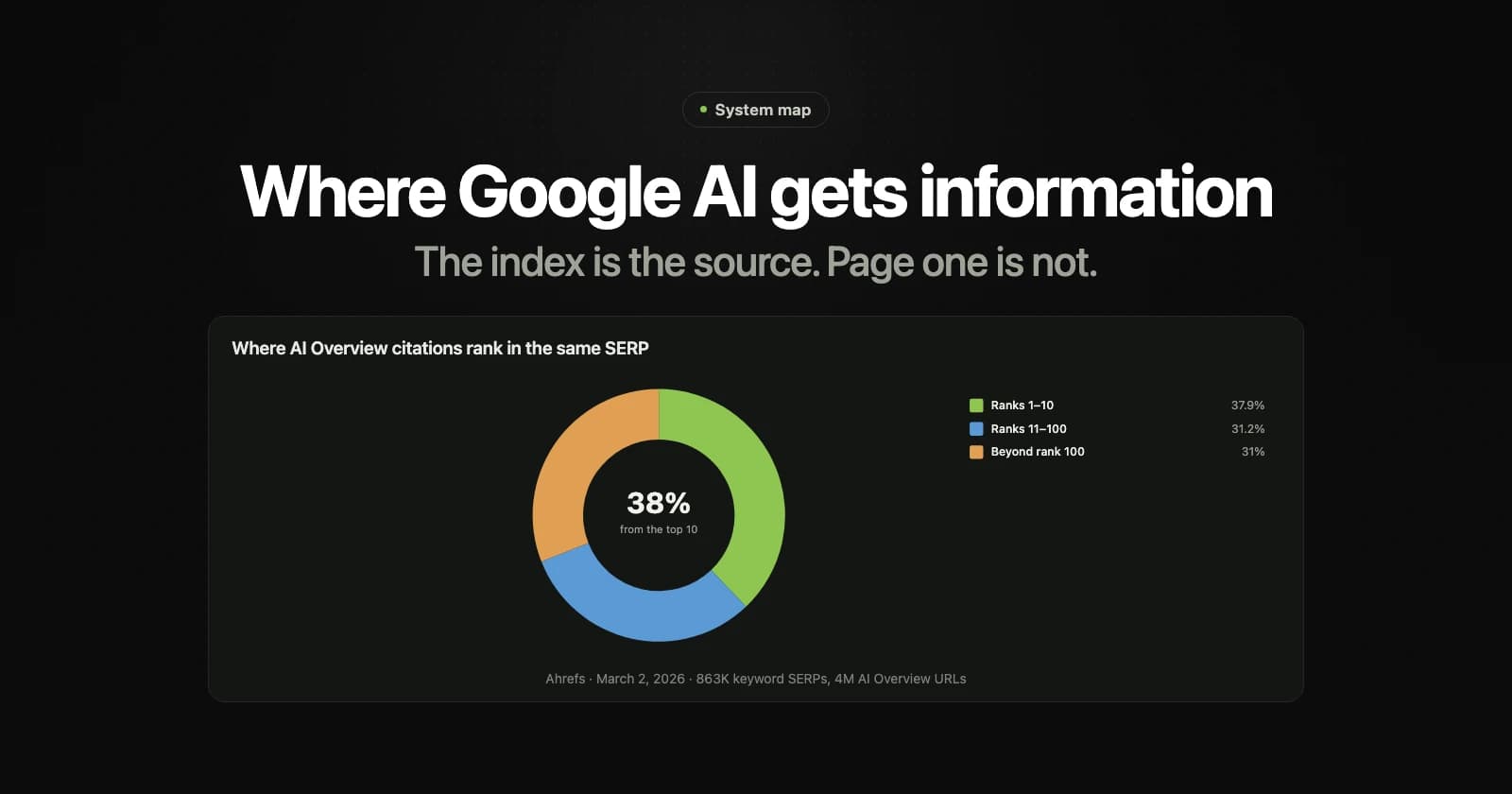
Google AI does not pull every answer from one database or one Gemini training snapshot. In Google Search, the best-supported model is Search index retrieval first: the system expands the question, retrieves relevant pages, and uses a generative model to assemble an answer with links. Other Google systems can add entity, product, local, or background context, but Google does not publish a stable percentage split.
That distinction matters. If the answer is grounded in Search, you can influence eligibility through crawlability, indexing, useful content, and internal links. If a claim comes from a model's background knowledge, there is no equivalent “request indexing” lever. Treating both as the same system leads to bad optimization advice.
The answer in one table
| Information layer | What Google publicly confirms | Typical examples | What a publisher can control | Evidence level |
|---|---|---|---|---|
| Search index retrieval | AI Overviews and AI Mode use Search infrastructure, retrieval-augmented generation, and query fan-out | Web pages, documentation, articles, forums | Crawlability, indexing, snippet eligibility, content quality, internal links | Confirmed |
| Knowledge and entity systems | Google maintains a Knowledge Graph assembled from public sources and licensed data | People, companies, places, relationships | Accurate entity information and corrections; no guaranteed inclusion | Confirmed system; answer-level use undisclosed |
| Product, local, and first-party Google data | Google recommends keeping Merchant Center and Business Profile information current for AI Search experiences | Prices, availability, business details, local facts | Product feeds, profiles, visible page content | Confirmed guidance |
| Model background context | Gemini models contain learned knowledge and can also be grounded with Search | General concepts, language, reasoning | Limited; training mix and answer-level contribution are not disclosed | Confirmed capability; exact mix unknown |
This is a system map, not a traffic-share estimate. Google has not published the percentage of an AI answer that comes from each layer, and the mix can change by query, surface, country, and product mode.
What does Google officially say about AI Overviews and AI Mode?
Google's AI features documentation says that AI Overviews and AI Mode can use query fan-out: the system issues multiple related searches across subtopics and data sources, then brings the results together[1]. The same page sets the entry requirement plainly — a page "must be indexed and eligible to be shown in Google Search with a snippet." Its 2026 AI optimization guide describes the architecture as retrieval-augmented generation grounded in Google's Search index[2].
The important sequence is:
- A user asks a question.
- Google may decompose it into related subqueries.
- Search retrieves candidate pages and passages.
- The model synthesizes a response from retrieved evidence and its reasoning context.
- The interface presents links that support or extend the answer.
Solid arrows are the path Google documents for AI features in Search. The dotted arrows are systems Google confirms exist and can contribute context, without publishing how much any one of them contributes to a given answer.
Google does not publish a fixed number of subqueries, sources, or citations. Any article that promises “Google AI always uses four to seven sources” is turning an observation into a platform rule.
Is the Search index the same thing as Gemini training data?
No. They solve different jobs.
| Search grounding | Model training |
|---|---|
| Retrieves documents at answer time | Produces learned model parameters before deployment |
| Can surface recently indexed information | Does not update simply because a page was recrawled |
| Can expose supporting links | Usually cannot identify a clean source for every learned fact |
| Controlled for Search through Googlebot and Search directives | Certain future Gemini uses can be controlled with Google-Extended |
A grounded answer can still use model reasoning, and a Gemini product can invoke Search. The boundary is therefore not “Search versus Gemini”; it is retrieved evidence versus background model knowledge.
This is also why a recrawl does not guarantee that every Gemini response immediately changes. A current Search-grounded answer may update while a non-grounded answer continues to repeat older background knowledge.
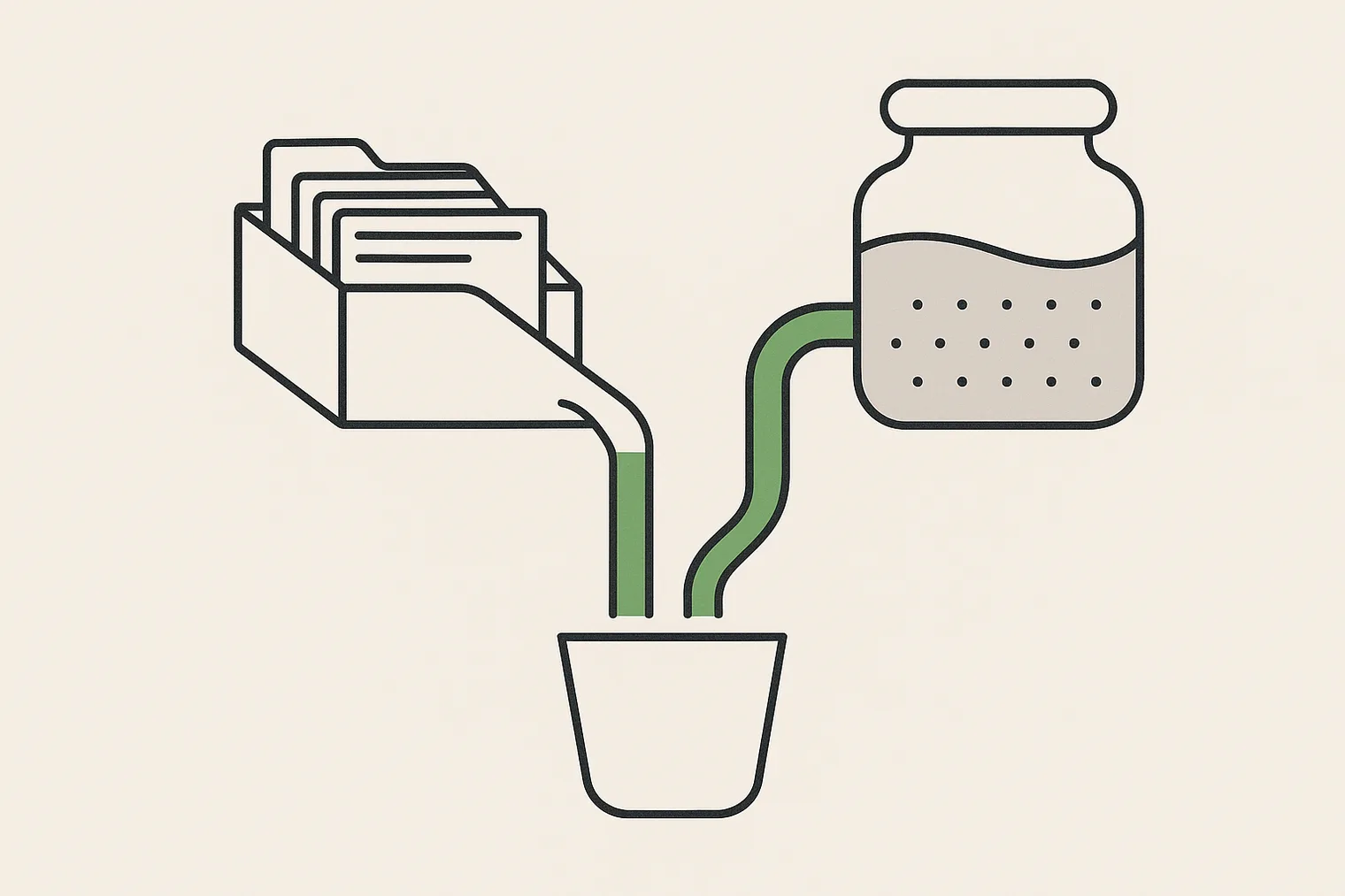
The practical consequence is a difference in latency, not a difference in prestige. Publishing changes what can be retrieved on the next crawl. It does not reach back into a model's parameters.
Which pages does Google AI actually cite?
Documentation describes the mechanism. Third-party measurement describes the outcome, and the two answer different halves of the question.
In March 2026 Ahrefs analysed 863,000 keyword SERPs and 4 million AI Overview URLs, then checked where each cited page ranked for the same query[9]. Being in the index is the entry requirement. Ranking on page one is not.
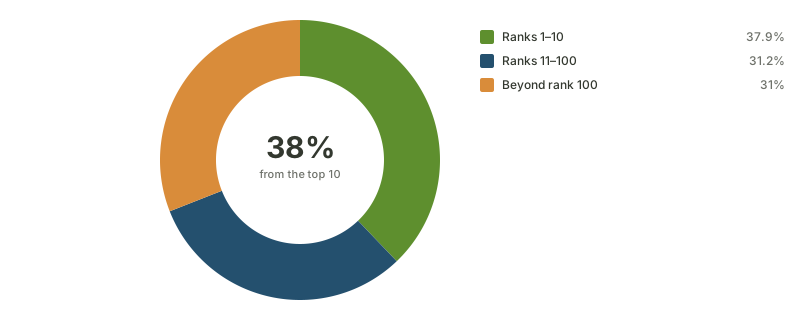
Source: Ahrefs, March 2, 2026 — 863K keyword SERPs, 4M AI Overview URLs
Read that carefully before acting on it. Ahrefs states its citation parsing improved after the July 2025 study that reported roughly 76% top-10 overlap, so an unknown share of the fall to 37.9% is better detection rather than a change in how Google selects sources[9]. The safe reading is directional: retrieval reaches well past the visible top 10, and a page that ranks 40th for a query is not disqualified from being cited for it.
The second measured pattern is which kinds of sites accumulate the citations. Ahrefs' July 2026 Brand Radar sweeps of US queries rank domains by mention share — a domain's citations as a percentage of the citations earned by the most-cited sources, not of every citation Google makes[10][11].
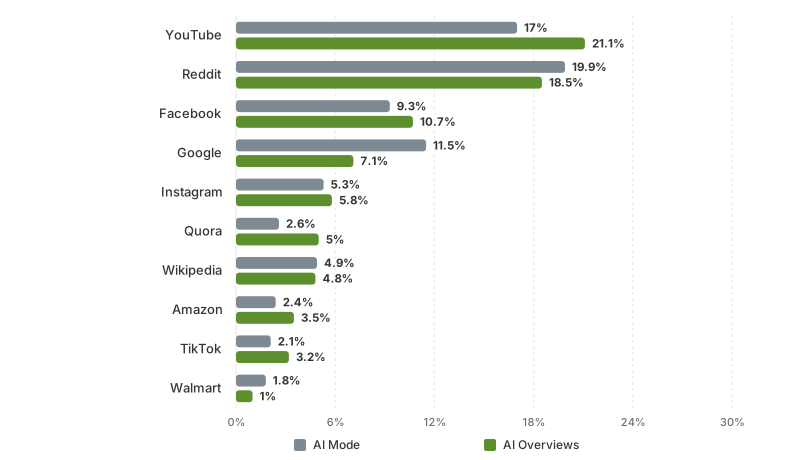
Source: Ahrefs Brand Radar, July 2026 — US queries, 3M+ analysed
Three things follow, and one does not:
- The head of the distribution is user-generated and platform content — YouTube, Reddit, Facebook, Instagram, Quora — not classic publisher authority.
- The two surfaces do not agree. Reddit leads AI Mode at 19.9% while YouTube leads AI Overviews at 21.1%, and Google's own properties take 11.5% of AI Mode mention share against 7.1% in AI Overviews. Optimising for "Google AI" as one destination assumes a uniformity the data does not show.
- Mention share is concentrated at the head by construction, so a top-50 leaderboard says very little about a narrow B2B or local query where none of those domains is relevant.
What does not follow is that you should go post on Reddit to get cited. This is an aggregate over every US query including entertainment, shopping and how-to; it measures where citation volume pools, not what wins a specific commercial query. Treat it as a description of the corpus, not a channel strategy.
Where does the Knowledge Graph fit?
Google describes its Knowledge Graph as a system that understands entities and their relationships from public sources and licensed data[7]. It can support Knowledge Panels and other search features. It is reasonable to treat entity clarity as useful context, but it is not reasonable to claim that a Wikidata page, four sameAs links, or Organization schema guarantees inclusion.
Use entity markup for consistency, not as a citation hack:
- Keep the organization name, URL, logo, and public profiles consistent.
- Use Organization or Person structured data only when it matches the visible page.
- Link to authoritative first-party profiles where they help users verify identity.
- Claim and correct a Knowledge Panel when Google makes that workflow available.
- Avoid manufacturing directory listings or Wikipedia pages solely to create “entity signals.”
Google's structured-data guidelines are explicit that valid markup does not guarantee a search feature[6]. Schema describes content; it does not replace the content or prove authority.
What role do product and business data play?
For ecommerce and local questions, the open web is only part of the picture. Google's AI Search guidance tells site owners to keep Merchant Center and Business Profile data current. This matters for queries involving price, stock, location, hours, and service availability.
The E-E-A-T lesson is straightforward: publish the fact on the canonical page, keep the relevant Google feed or profile consistent with it, and show when the information was last verified. Conflicting price or business details reduce confidence for both people and retrieval systems.
What can Google-Extended actually control?
Google-Extended is often misdescribed as a crawler. Google's crawler documentation says it is a standalone robots.txt product token with no separate HTTP user-agent string[3]. It controls certain uses for future Gemini model training and grounding in Gemini Apps and Vertex AI.
It does not control inclusion or ranking in Google Search.
User-agent: Google-Extended
Disallow: /

User-agent: Googlebot
Allow: /
That configuration can restrict the Google-Extended uses while leaving Googlebot access unchanged. Whether to opt out is a publisher policy decision; it is not an SEO ranking tactic.
What should you do if you want Google AI to use your page?
Google's own advice is less exotic than most GEO checklists:
| Priority | Action | Why it matters |
|---|---|---|
| 1 | Make the page crawlable and indexable | A page must be in the Search index and eligible for a snippet to appear as a supporting link |
| 2 | Put the key answer in visible text | Retrieval systems need the fact in the HTML, not only inside an image, video, or interaction |
| 3 | Add first-hand evidence | Original tests, definitions, examples, and data make the page less interchangeable[4] |
| 4 | Cite primary sources | Readers and systems can audit the claim rather than trust an unsupported summary |
| 5 | Use descriptive internal links | Google says anchor text helps people and Google understand the destination page[5] |
| 6 | Keep feeds and profiles current | Product and local answers can depend on Merchant Center and Business Profile data |
| 7 | Match structured data to visible content | Consistency helps interpretation and search-feature eligibility; it is not a special AI signal |
The AI search ranking factors evidence audit grades each commonly recommended tactic. The AI citation playbook turns that evidence into an implementation sequence.
How should you measure the result?
A citation and a business outcome are different measurements. Use a five-stage funnel:
| Stage | Question | Best evidence |
|---|---|---|
| Indexed | Can Google retrieve the page? | URL Inspection and index coverage |
| Cited | Did an AI answer link to or name the page? | Prompt-level citation monitoring |
| Visited | Did a person click through? | First-party session and referrer or campaign signal |
| Converted | Did that session complete the desired action? | Conversion event joined to the session |
| Paid | Did the customer produce verified revenue? | Stripe or Shopify payment joined to the original journey |
Google Search Console reports clicks from AI features inside the Web search type; Google does not provide a separate universal AI Overview filter. That makes first-party landing-page and session analysis useful when you need to separate the business outcome from overall Search performance. Attrifast's AI revenue attribution and website traffic tracking pages explain that measurement layer.
Research standard and limitations
This article was re-reviewed on August 24, 2026 against public documentation from Google and two independent 2026 citation datasets. We use three labels:
- Confirmed: Google publicly documents the mechanism or requirement.
- Supported: independent research observes an effect, but the vendor does not publish the production weight.
- Unknown: plausible, but neither official documentation nor controlled research establishes the claim.
Google does not reveal source weights, ranking models, prompt instructions, or the exact mix of retrieved versus learned information for individual answers. The interface and retrieval system can also change without a public changelog. For those reasons, this page describes observable architecture and eligibility—not a guaranteed ranking formula.
The KDD 2024 Generative Engine Optimization study evaluated 10,000 benchmark queries and found that adding citations, quotations, and statistics improved visibility in its experimental setting[8]. Its own summary is that the top three methods produced "a relative improvement of 30-40% on the Position-Adjusted Word Count metric and 15-30% on the Subjective Impression metric."
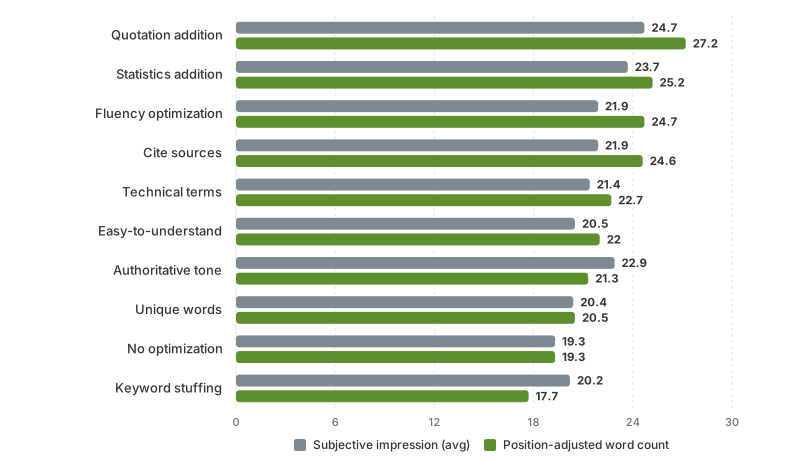
Source: GEO: Generative Engine Optimization, KDD 2024 (arXiv:2311.09735), Table 1 — 10,000 queries
Two details matter more than the headline. Keyword stuffing was the only method that scored below the unoptimised baseline on position-adjusted word count — 17.7 against 19.3. And the ordering is not stable across the two metrics: an authoritative tone ranked seventh on word count but third on subjective impression. That is useful evidence for content design, not proof that Google gives any of these elements a fixed ranking weight in production. The benchmark ran against the paper's own experimental generative engine, not against Google.
FAQ
Where does Google AI get its information?
For AI Overviews and AI Mode in Google Search, the clearest documented source is Google's Search index. Google says these features use retrieval-augmented generation and query fan-out to retrieve supporting web pages. Knowledge systems, product or business data, and the model's background context may also contribute, but Google does not publish a fixed source recipe or weighting for every answer.
Does Google AI use Gemini training data or live web results?
It can use both, depending on the product and mode. AI features inside Google Search are grounded through the Search index and can retrieve current pages. A Gemini response without Search grounding can rely more heavily on model knowledge. Google does not disclose the exact contribution of training data versus retrieved evidence for each answer.
How can I become a source in Google AI Overviews or AI Mode?
Make the page crawlable, indexable, eligible to show a snippet, and useful for the query. Google specifically recommends strong technical SEO, helpful original content, descriptive internal links, important information in text, and structured data that matches visible content. Google says no special AI file or schema is required.
Does Google-Extended control visibility in Google Search?
No. Google documents Google-Extended as a robots.txt token that controls certain Gemini training and grounding uses. It has no separate crawler user-agent string, and opting out does not affect inclusion or ranking in Google Search. Googlebot remains the relevant crawler for Search visibility.
Do AI Overviews only cite pages that rank on page one?
No. Ahrefs analysed 863,000 keyword SERPs and 4 million AI Overview URLs in March 2026 and found 37.9% of cited pages also ranked in the top 10 for that query, 31.2% ranked between 11 and 100, and 31.0% did not rank in the top 100 at all. Ahrefs notes its citation parsing improved after its July 2025 study, which found roughly 76%, so part of the change is better detection rather than a change at Google. Indexing remains the entry requirement; a top-10 position is not.
Can schema markup or llms.txt make Google AI cite my page?
Neither guarantees a citation. Structured data can help Google understand a page and qualify it for supported search features when it matches visible content, but Google says there is no special schema for AI features. Google's 2026 guidance also states that Google Search ignores llms.txt.
Continue the research path
- Where does ChatGPT get its information? — the same question for ChatGPT, with 287 answers traced to their sources
- AI Search Hub: 36 research guides
- AI search ranking factors: 12 signals graded by evidence
- How to get cited by AI engines: the 7-step playbook
- AI citation tracking connected to revenue
- Track website traffic from first click to revenue
Sources
Primary sources for the claims in this article. Numbered citations in the text link to the matching entry.
- [1]AI features and your website — Google Search Central.
- [2]Top ways to ensure your content performs well in Google's AI experiences on Search — Google Search Central.
- [3]Google common crawlers — Google Search Central.
- [4]Creating helpful, reliable, people-first content — Google Search Central.
- [5]Link best practices for Google — Google Search Central.
- [6]General structured data guidelines — Google Search Central.
- [7]How Google's Knowledge Graph works — Google.
- [8]Generative Engines and Search — KDD 2024 / arXiv.
- [9]Update: 38% of AI Overview citations pull from the top 10 — Ahrefs (2026).
- [10]The 50 most-cited websites in Google AI Overviews — Ahrefs (2026).
- [11]100 most-cited domains in Google's AI Mode — Ahrefs (2026).