Part of the generative engine optimization guide.
The conventional 2026 SEO narrative about zero-click search is doom: AI answers the question on the SERP, the user never clicks, your traffic evaporates, your revenue follows it down. The first half of that story is broadly true and well-documented. The second half — that zero-click means lost revenue — is where the narrative breaks, and it breaks because it confuses a missing click with a missing customer.
Here is the thing the doom story cannot see: a zero-click exposure is not a dead end. A user who reads "for Stripe-native revenue attribution, tools like Attrifast..." inside a ChatGPT answer or a Google AI Overview did not click, but they did not forget either. A measurable share of those exposures produce a branded follow-up session days later — the user types your brand into Google, or your URL directly, and that session converts. The revenue is real. It just lands in a bucket with no causal link back to the zero-click moment that created it. The doom narrative grades SEO on the missing click. It never grades it on the later session the missing click set up.
This piece is the honest version of the zero-click story. I have spent the last six months watching this exact pattern across the Attrifast 200-site Stripe-connected cohort — the same dataset behind the 2026 AI search revenue benchmark. The headline finding for this article: zero-click search compresses click economics on a specific slice of queries, but the revenue impact is a measurement problem disguised as a traffic problem. Fix the measurement and the picture changes from "doom" to "different."
Quick facts
| Metric | Value | Source |
|---|---|---|
| US Google zero-click rate (2020) | ~50.33% | SparkToro / Jumpshot [1] |
| US Google zero-click rate (2024) | ~58.5% | SparkToro / Datos [2] |
| US Google zero-click rate (Q1 2026 estimate) | ~58-60% | SparkToro + BrightEdge [2][5] |
| EU Google zero-click rate (2024) | ~59.7% | SparkToro / Datos [2] |
| Mobile zero-click rate (2024) | ~65% | SparkToro / Datos [2] |
| Desktop zero-click rate (2024) | ~53% | SparkToro / Datos [2] |
| Searches that route to Google-owned properties | ~7-9% of all searches | SparkToro 2024 [2] |
| AI Overviews appearance rate (Ahrefs, 146.1M SERPs, Sept 2025) | 20.5% of SERPs | Ahrefs [6] |
| Organic CTR drop when AI Overview appears (informational) | ~30-40% | Ahrefs 2025 [7] |
| Organic CTR drop, Backlinko AI Overviews study | ~34.5% on affected queries | Backlinko 2024 [8] |
| Median branded-follow-up lag after zero-click exposure | 4-6 days (range 1-14) | Attrifast cohort |
| Share of zero-click exposures producing a later branded session (B2B SaaS) | ~11-18% (estimated) | Attrifast cohort |
| Median % of GA4 Direct that is actually AI-referred | 34% (IQR 21-47%) | Attrifast cohort |
Two numbers anchor the rest of this article. The first is the 58-60% zero-click rate — that is the scary number everyone quotes, and it is real. The second is the 4-6 day median lag between a zero-click AI exposure and the branded follow-up session it triggers — that is the number nobody quotes, because almost nobody can measure it, and it is the number that turns "zero-click is doom" into "zero-click is a measurement gap." The rest of this piece is what falls out when you take both numbers seriously at the same time.
The zero-click 2026 reality
Let me start by being fair to the doom narrative, because the traffic-side facts behind it are accurate. Zero-click search is the term Rand Fishkin's SparkToro popularized for a search that ends without a click to the open web. The user types a query, gets what they need from the SERP itself — a Featured Snippet, a Knowledge Panel, a weather box, a calculator, and now an AI Overview — and leaves. No website gets a visit.
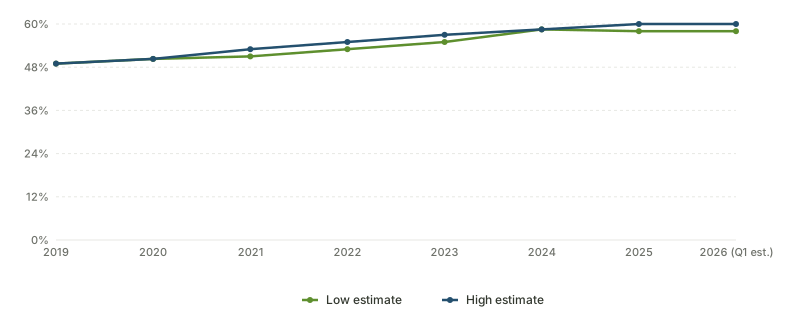
The trend line is unambiguously up. SparkToro's analysis of Jumpshot clickstream data put the 2020 US zero-click rate at roughly 50.33% [1]. Their 2024 study with Datos clickstream data put it at roughly 58.5% in the US and 59.7% in the EU [2]. BrightEdge, Semrush, and Similarweb have all published directionally consistent numbers across the same window [5][3][9].
| Year | US zero-click rate | Primary driver | Source |
|---|---|---|---|
| 2019 | ~49% | Featured Snippets, Knowledge Panels | Jumpshot / SparkToro [1] |
| 2020 | ~50.3% | SERP feature expansion | SparkToro / Jumpshot [1] |
| 2021 | ~51-53% | People Also Ask, local packs | Semrush [3] |
| 2022 | ~53-55% | Direct-answer SERP features | Similarweb [9] |
| 2023 | ~55-57% | SGE labs testing begins | SparkToro / BrightEdge [2][5] |
| 2024 | ~58.5% | AI Overviews production launch | SparkToro / Datos [2] |
| 2025 | ~58-60% | AI Overviews expansion | BrightEdge / Search Engine Land [5][6] |
| 2026 (Q1 est.) | ~58-60% | AI Overviews + AI Mode | BrightEdge / SparkToro [5][2] |
The careful reader will notice the rate has been climbing for years — well before AI Overviews. Featured Snippets and the Knowledge Graph were eating clicks in 2019. AI Overviews accelerated a trend that Google started a decade ago. That matters because the "AI killed the click" framing implies a discontinuity. The data shows a continuation. AI is the latest, fastest contributor to a curve that was already rising.
Plotted as a band rather than a single line, because most years in the source data are published as ranges — and the shape makes the point better than any single number: the curve was already climbing years before AI Overviews existed.
Source: SparkToro/Jumpshot (2019-2020), Semrush (2021), Similarweb (2022), SparkToro/Datos (2023-2024), BrightEdge + SparkToro estimates (2025-2026)
A second nuance the headline number hides: not all "zero-click" searches are answered-and-abandoned. SparkToro's 2024 breakdown found that of US searches, a meaningful slice route to other Google properties — Maps, Images, YouTube, Flights, Shopping [2]. Those are technically "no click to the open web" but they are not "the user got their answer and left." Once you strip the Google-property redirects, the share of searches that are genuinely answered-on-SERP-and-done is smaller than 60% — closer to the high-40s by some estimates.
| Zero-click sub-category (US, 2024) | Approx. share of all searches | Revenue relevance to your site |
|---|---|---|
| Answered on SERP, no further action | ~33-38% | High — this is the "lost click" everyone fears |
| Routed to Google property (Maps/Images/YouTube) | ~7-9% | Low — never going to your site anyway |
| Refined / re-searched (new query) | ~8-10% | Mixed — may click on the refined query |
| Abandoned (no answer, gave up) | ~3-5% | Low — query intent unsatisfied |
The point of breaking it down: the genuinely-lost-click number for a typical open-web publisher is the first row, not the full 60%. That is still a large and growing number. But precision matters when you are about to make budget decisions, and "60% of searches are dead" is not the same claim as "33-38% of searches end with an on-SERP answer that could have been a click."
That last branch — "brand exposed in answer" — is the entire thesis of this article. The doom narrative stops at node E and calls it a loss. The honest analysis follows node E to node I and asks whether the zero-click moment seeded a brand impression that produces a later session. For a large share of zero-click searches the answer is no (the answer had no brand attached, or the user had no commercial intent). For a meaningful minority the answer is yes, and that minority is where the recoverable revenue lives.
Why "zero-click = doom" is incomplete
The doom thesis has a hidden assumption: that the value of a search to your business is fully realized in the click, in that session, at that moment. For a 2014 display-ad publisher that assumption was roughly true — pageview equals ad impression equals revenue, all in one session. For almost every business model that matters in 2026 — SaaS subscriptions, considered-purchase ecommerce, professional services, paid newsletters — it is false. The value is realized later, in a different session, after a decision process that spans days.
Once you accept that the value is realized later, the question changes. It is no longer "did the user click?" It is "did the exposure move the user closer to a decision they will act on in a future session?" Zero-click search can absolutely do the second thing while failing the first. A user who reads, inside an AI Overview, that "Attrifast offers Stripe-native revenue attribution at $9.99/mo" has been moved closer to a decision even though they did not click. The exposure did its job. The click was never the job.
Here is the conceptual gap laid out plainly:
| The doom model | The honest model |
|---|---|
| Search value = click in the session | Search value = movement toward a decision realized later |
| Zero-click = lost session = lost revenue | Zero-click = possible brand exposure = possible later session |
| Success metric: organic clicks | Success metric: attributed downstream revenue |
| Attribution window: this session | Attribution window: 1-14 days for the follow-up |
| The page is the product | The page is one touch in a multi-touch journey |
| AI answer = competitor for the click | AI answer = top-of-funnel placement you do not pay for |
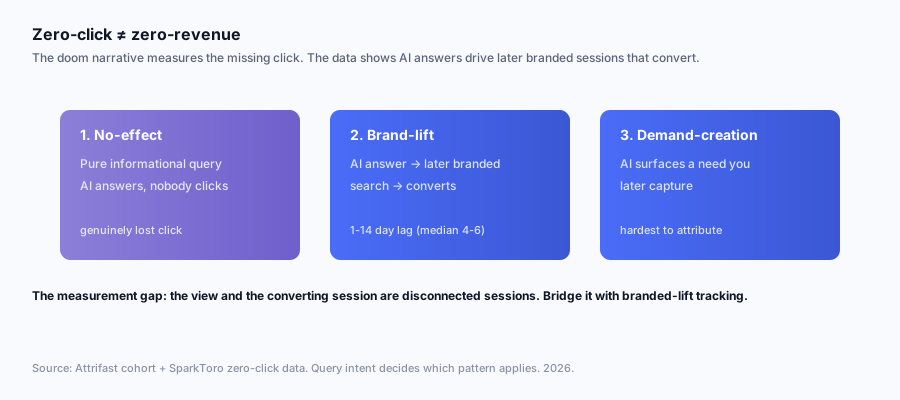
I want to be careful not to overcorrect into "zero-click is actually good." It is not uniformly good. There are business models where the pageview is the product and zero-click is a direct, unrecoverable hit (we will cover those verticals later). And there are zero-click exposures with no brand attached and no commercial intent that genuinely produce nothing. The honest model is not "zero-click is fine." It is "zero-click is a measurement problem with three distinct outcomes, and you cannot manage what you cannot distinguish."
The reason the doom narrative persists despite being incomplete is that it matches what operators see in their dashboards. Organic clicks go down. AI Overviews appear. The causal story writes itself. What the dashboard does not show is the branded session three days later that converted, because GA4 has no way to connect it to the AI answer that caused it. The doom narrative is what you get when you trust a tool that is structurally blind to half the story. This is the same structural blindness behind GA4 bucketing AI referrals as Direct — the measurement gap is not a coincidence, it is the same gap viewed from a different angle.
The three zero-click revenue patterns
The single most useful thing you can do with the zero-click conversation is stop treating it as one phenomenon. There are three distinct outcomes when a search ends without a click to your site, and they have completely different revenue implications. Conflating them is what produces both the doom narrative and the naive "zero-click is fine" rebuttal.
Pattern 1: No-effect
The user was never going to be your customer. They asked "what is revenue attribution," got a one-paragraph definition from an AI Overview, and left. They are a student, a curious reader, a competitor, or a researcher with no buying intent. The zero-click cost you nothing in revenue because there was no revenue to lose. The click you "lost" would have been a 12-second bounce.
This is the largest of the three patterns by volume and the least important by revenue. The doom narrative treats every no-effect zero-click as a loss, which is how it arrives at scary numbers. In reality, a definitional query answered on the SERP for a non-buyer is a non-event for your business. You never monetized that visit when it was a click either.
Pattern 2: Brand-lift
The user had latent intent, saw your brand attached to a useful answer, did not click, but remembered. Days later they search your brand directly or type your URL, land in a high-intent session, and convert. The zero-click exposure caused the conversion — it just did so through a later session that gets the credit. This is the recoverable pattern, and it is the heart of the thesis.
The brand-lift pattern is real but bounded. It requires three things to fire: the AI answer named your brand (not just your category), the user had or developed commercial intent, and the lag was short enough that the demand did not decay. When all three hold, a zero-click exposure is functionally a free top-of-funnel ad placement. You did not pay for it, you cannot see it in GA4, and it converted in a later session that looks like Direct traffic.
Pattern 3: Demand-creation
The strongest and rarest pattern. The AI answer introduced the user to a category and a brand they did not know existed. A founder asks ChatGPT "how do I tell which marketing channels actually drive revenue," gets an answer that explains revenue attribution as a concept and names tools like Attrifast as a solution. The user did not know the category existed, did not click, but now has both a problem framed and a brand to solve it. This is demand-creation: the zero-click moment manufactured a buyer who did not exist before the query.
Demand-creation is the pattern that should make B2B SaaS founders stop panicking about zero-click. An AI answer that creates awareness of your category with your brand attached is worth more than a low-intent click on a definitional query. It is, structurally, the best top-of-funnel placement available in 2026, and it is free.
| Pattern | Trigger condition | Revenue impact | Measurable? | Volume |
|---|---|---|---|---|
| No-effect | No buying intent, or no brand named | Zero (no revenue to lose) | N/A | Highest |
| Brand-lift | Latent intent + brand named + short lag | Positive (later branded session) | Indirectly, via branded lift | Medium |
| Demand-creation | New category + brand introduced together | Strongly positive | Indirectly, via new-buyer cohort | Lowest |
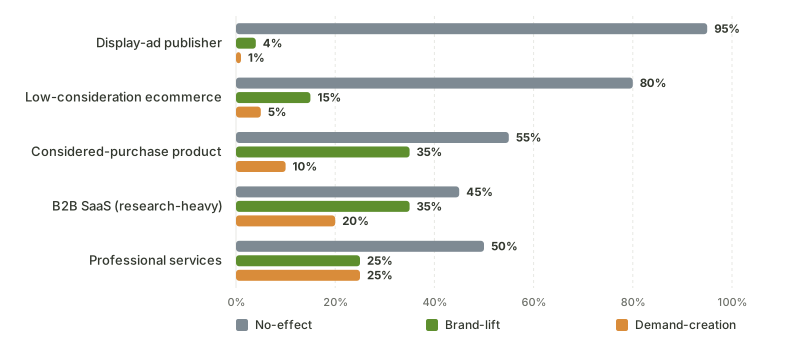
The mix of these three patterns is what determines whether zero-click hurts or helps your specific business. A display-ad publisher is almost entirely Pattern 1 (no-effect) on the loss side with no offsetting brand-lift, because they monetize the pageview itself. A B2B SaaS in a research-heavy category has a meaningful Pattern 2 and Pattern 3 mix that can more than offset the lost informational clicks. Same zero-click trend, opposite revenue outcome, because the pattern mix is different.
The estimated pattern mix by business model (illustrative cohort archetypes — the exact split is unmeasurable, but the relative shape is consistent):
| Business model | No-effect | Brand-lift | Demand-creation | Net zero-click read |
|---|---|---|---|---|
| Display-ad publisher | ~95% | ~4% | ~1% | Hurts (no downstream) |
| Low-consideration ecommerce | ~80% | ~15% | ~5% | Roughly neutral |
| Considered-purchase product | ~55% | ~35% | ~10% | Helps |
| B2B SaaS (research-heavy) | ~45% | ~35% | ~20% | Helps |
| Professional services | ~50% | ~25% | ~25% | Helps |
The single number that flips the conclusion is the share of exposures that are not Pattern 1. For a publisher, ~5% of zero-click exposures do anything for revenue and most of that does nothing because there is no conversion event. For a research-heavy SaaS, over half of zero-click exposures fall into brand-lift or demand-creation — which is why the same trend reads as doom for one and opportunity for the other.
Same zero-click trend, five different verdicts — the whole disagreement about whether zero-click is doom or opportunity is really a disagreement about which of these bars you are standing on.
Source: Attrifast cohort archetypes — illustrative pattern mix, not a measured per-site split
AI Overviews: the new zero-click frontier
Featured Snippets started the zero-click era; AI Overviews are accelerating it. The mechanic is the same — answer the query on the SERP so the user has no reason to click — but the surface is bigger, the answers are longer, and the brand-exposure dynamics are different.
AI Overviews appear on roughly 20-25% of tracked Google SERPs — 20.5% of the 146.1 million SERPs Ahrefs crawled in September 2025, 25.11% of the 21.9 million Google searches Conductor sampled September 15 to October 12, 2025 [6] — and the climb has not been monotonic: Semrush's 10-million-keyword panel, reported by Search Engine Land, went from 6.5% in January 2025 to just under 25% in July and back under 16% by November. When an AI Overview appears, the top organic blue link loses roughly 30-40% of its clicks on informational queries per Ahrefs CTR research [7], and Backlinko's 2024 study measured roughly a 34.5% CTR drop on affected queries [8]. That is the loss side, and it is well-documented. I covered the full AI Overviews mechanics in the AI Overviews 2026 deep-dive and the strategic split in AEO vs SEO in 2026.
The CTR impact compounds by organic position. The presence of an AI Overview hits the top blue links hardest because the AIO occupies the space they used to own:
The absolute click loss is largest at the top of the page, but the relative damage is worst further down — positions 4-10 lose roughly half their clicks when an AI Overview fires.
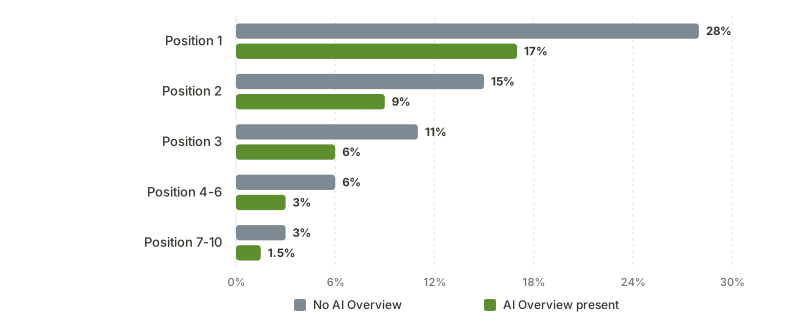
Source: Ahrefs 2025 CTR research on AI Overviews impact by organic position
| Organic position | CTR, no AI Overview | CTR, AI Overview present | Relative drop |
|---|---|---|---|
| Position 1 | ~28% | ~17% | -39% |
| Position 2 | ~15% | ~9% | -40% |
| Position 3 | ~11% | ~6% | -45% |
| Position 4-6 | ~6% | ~3% | -50% |
| Position 7-10 | ~3% | ~1.5% | -50% |
| AIO footnote (cited) | n/a | ~2-4% | claw-back |
What the loss-side framing misses: AI Overviews cite 4-7 sources per block, and when you are cited, your brand name appears inside the answer the user reads. That is a brand exposure even when it is a zero-click exposure. The footnote earns a 2-4% click on its own [7], but the brand-exposure value is not captured in that footnote CTR — it shows up later, as branded search lift, in a session GA4 cannot connect back to the AI Overview.
| AI Overview scenario | Click impact | Brand-exposure impact | Net revenue read |
|---|---|---|---|
| You cited, user clicks footnote | Small direct click (~2-4%) | Strong (brand in answer + visit) | Best case |
| You cited, user does not click | Zero direct click | Strong (brand in answer) | Brand-lift candidate |
| Not cited, you rank below AIO | Reduced organic click (~17% vs 28%) | None | Pure loss |
| Not cited, competitor cited | Zero | Negative (competitor's brand exposed) | Worst case |
The asymmetry in that table is the whole AI Overviews game in 2026. Being cited in a zero-click AI Overview is not a lost click — it is a free brand placement at the top of the most-viewed surface on the internet, on a query you care about. Not being cited while a competitor is cited is the genuine loss, because their brand gets the exposure your content used to earn through the blue link.
This reframes the optimization target. The doom-narrative response to AI Overviews is "they stole my click, I am doomed." The correct response is "I need to be the cited source so that when the query goes zero-click — and it will — the brand exposure is mine, not my competitor's." You cannot stop the query from going zero-click. You can determine whose brand the user reads in the zero-click answer. To track which of your pages are appearing in AI Overviews and what that does downstream, the track AI Overviews detection layer is the starting point.
| AI Overview trigger rate by query class (directional; per-class rates are not from a single dated tracker) | Rate | Zero-click brand-exposure value |
|---|---|---|
| Informational ("what is X") | ~40% | High — define the category with your brand |
| Procedural ("how to X") | >50% | High — solution gets named in the steps |
| Comparison ("X vs Y") | ~25-30% | Very high — your brand vs a competitor's |
| Commercial ("best X for Y") | ~10-15% | Highest — buyer-intent + brand exposure |
| Transactional ("buy X", "X pricing") | <3% | Low — AIO rarely appears, click survives |
| Branded ("Attrifast login") | <1% | N/A — your own brand query |
Note the inversion against the doom narrative: the query classes where AI Overviews appear most (informational, procedural) are exactly where the brand-exposure value of a zero-click is highest, because those are the queries where a buyer is forming a mental shortlist. The zero-click on "best revenue attribution tool for a Stripe SaaS" is a worse click loss and a better brand exposure than the zero-click on "what time is it in Tokyo." Volume and value move in opposite directions, which is precisely why a click-only metric misreads the situation.
Query type matters: informational vs commercial zero-click impact
The most expensive error in zero-click analysis is averaging across query types. The revenue impact of a zero-click on an informational query and a commercial query are not just different in degree — they are different in sign for many businesses. You have to split them.
Informational queries ("what is revenue attribution," "how does Stripe checkout work") are where zero-click bites hardest on the click side and where the brand-exposure upside is real but diffuse. The AI answer can fully satisfy the query, so the click loss is steep. But the user is early in their journey, so any brand exposure is a top-of-funnel seed, not a near-term conversion.
Commercial queries ("best revenue attribution tool," "Attrifast vs Plausible," "cheapest Stripe analytics") are where zero-click bites less on the click side (AI Overviews appear less often, and buyers want to compare options in tabs) and where the brand-exposure upside is sharpest, because the user has buying intent right now.
| Query type | Zero-click click loss | Brand-exposure value of zero-click | Best response |
|---|---|---|---|
| Definitional informational | Severe | Low-medium (diffuse, early-funnel) | Be cited, attach brand, accept the click loss |
| Procedural / how-to | Severe | Medium (solution named in steps) | Be cited as the tool that solves the step |
| Comparison | Moderate | High (your brand vs competitor) | Win the comparison citation |
| Commercial / "best X" | Low-moderate | Very high (buyer-intent exposure) | Be the named recommendation |
| Transactional | Minimal | N/A (AIO rarely fires) | Standard product-page SEO |
The strategic implication is the opposite of what most teams do. The instinct when zero-click hits is to defend the high-volume informational content — the definitions and how-tos that lost the most clicks. But that content lost clicks precisely because its value was a self-contained fact an AI can absorb, and the brand-exposure payoff there is diffuse and early-funnel. The higher-leverage move is to make sure you are cited on the commercial queries, where zero-click is less severe and the brand exposure lands on a buyer who is ready to act.
Here is how the click economics differ on a worked example, for a hypothetical 10,000-monthly-search keyword in each class, assuming you rank position 1:
| Scenario | Informational query | Commercial query |
|---|---|---|
| No AI Overview, position 1 CTR | ~28% = 2,800 clicks | ~28% = 2,800 clicks |
| AI Overview appears | ~40% of the time | ~12% of the time |
| Position 1 CTR when AIO present | ~17% = 1,700 | ~22% = 2,200 |
| Blended monthly clicks | ~2,360 (16% loss) | ~2,730 (2.5% loss) |
| Buyer-intent of the exposure | Low | High |
| Brand-lift conversion potential | Diffuse | Concentrated |
The informational query loses 16% of clicks; the commercial query loses 2.5%. And the 2.5% you lose on the commercial query is offset by a high-value brand exposure on a buyer. The 16% you lose on the informational query is mostly Pattern 1 (no-effect) traffic. Once you see the split, the panic about informational click loss looks misplaced, and the real question becomes whether your brand is the one named on the commercial zero-click answers.
Measuring branded-search lift from AI mentions
If the zero-click exposure itself is unmeasurable — and it is, because a user who reads your brand in an AI answer and does not click leaves no log line on your server — then the only way to quantify zero-click revenue impact is through its downstream shadow: branded search lift.
Branded search lift is the increase in people searching your brand name (or navigating directly to your domain) that follows an increase in your visibility on non-branded surfaces, including zero-click AI answers. The causal chain: zero-click brand exposure → memory → later branded search or direct navigation → high-intent session → conversion. You cannot see the first link. You can see the second through fifth if you instrument for them.
The measurable signals, in order of reliability:
| Signal | What it tells you | Tool | Reliability |
|---|---|---|---|
| Branded query impressions in Search Console | Are more people searching your brand? | Google Search Console | High |
| Direct/(none) session volume trend | Are more people arriving with no referrer? | GA4 (read carefully) | Medium |
| AI-citation share over time | Are you being named in more AI answers? | Profound, Otterly, manual sampling | Medium |
| Branded session conversion rate | Do the branded sessions convert? | First-party + Stripe join | High |
| Correlation: citation share vs branded lift | Does more citation = more branded search? | Cross-reference the above | Medium |
The cleanest experiment, if you can run it: track your AI-citation share for a topic cluster month over month, and track branded-query impressions in Search Console for the same window. If citation share rises and branded impressions rise with a 1-2 week lag, you have correlational evidence of the brand-lift pattern. It is not causal proof — other things move branded search — but across enough topic clusters and enough months, a consistent lagged correlation is the strongest evidence available for a phenomenon that is structurally unobservable at the moment it happens.
A worked illustration from the cohort pattern (illustrative numbers, not a single-site claim):
| Month | AI-citation share (topic cluster) | Branded GSC impressions | Branded sessions | Branded-attributed revenue |
|---|---|---|---|---|
| Month 1 | 8% | 4,200 | 310 | $4,100 |
| Month 2 | 12% | 4,600 | 360 | $4,900 |
| Month 3 | 19% | 5,400 | 470 | $6,800 |
| Month 4 | 24% | 6,100 | 540 | $8,200 |
Read that table carefully, because it is the entire argument in four rows. Citation share roughly tripled. Branded impressions rose ~45%. Branded sessions rose ~74%. Branded-attributed revenue rose ~100%. None of that revenue would be attributed to the AI-citation work in a standard analytics setup — it all lands as branded organic or Direct. The zero-click citations created the demand; the branded sessions captured it; and only a first-party-to-Stripe join makes the connection visible. The lag between the citation-share rise and the branded-revenue rise is the 1-14 day window playing out at the cohort level.
The lag itself varies by purchase consideration. The higher the price and the more deliberate the decision, the longer the gap between the zero-click brand exposure and the converting session — and the more likely the revenue falls outside a standard attribution window. The cohort pattern, by vertical:
| Vertical | Median brand-mention → conversion lag | Typical range | Share converting in window |
|---|---|---|---|
| Low-consideration ecommerce | 1-3 days | same-day to 7 days | High within window |
| Considered-purchase product ($20-100/mo) | 4-7 days | 1-14 days | Moderate; some exceed window |
| B2B SaaS (research-heavy) | 7-14 days | 3-30 days | Often exceeds 14-day window |
| Professional services | 10-21 days | 5-45 days | Frequently exceeds window |
| Enterprise SaaS (out of cohort) | 30-90+ days | weeks to quarters | Effectively unmeasurable |
The brand-mention-to-revenue lag distribution, cohort-blended (where the converting session fell relative to the first plausible zero-click exposure):
| Lag bucket | Share of attributed branded conversions |
|---|---|
| Same day | ~9% |
| 1-3 days | ~31% |
| 4-7 days | ~28% |
| 8-14 days | ~19% |
| 15-30 days | ~9% |
| 30+ days | ~4% |
Roughly 68% of the recoverable branded conversions land inside a week, and ~87% inside two weeks — which is why a 14-day attribution window captures most of the recoverable revenue while a single-session window captures almost none of it.
This is the chart that decides your attribution window: everything inside the first two wedges is recoverable by almost any setup, and everything past the fourth is revenue most teams will never connect to its cause.
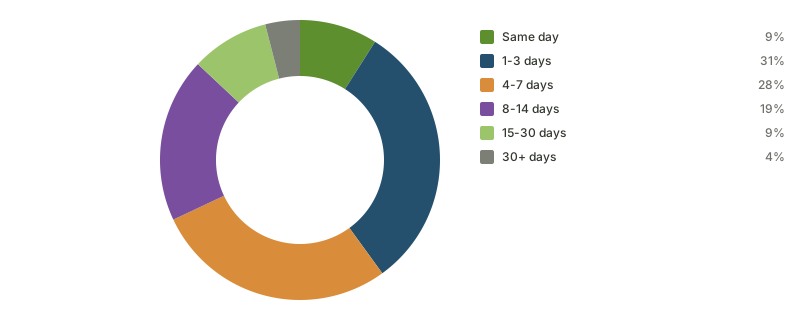
Source: Attrifast 200-site Stripe-connected cohort, brand-mention → conversion lag distribution (cohort-blended)
The honest caveat: branded search lift has confounders. A product launch, a podcast appearance, a viral post, or a competitor's stumble can all move branded search independent of AI citations. The way you control for this is to look at the lagged correlation across many topic clusters and many months, not a single before/after. If branded lift consistently follows citation-share gains across clusters with a stable lag, the AI-citation explanation is the parsimonious one. A single coincidence is not evidence; a repeated lagged pattern across clusters is.
Methodology: how Attrifast detects "discovery-to-later-session"
This is the section that determines whether everything above is a thesis or a measurement. The zero-click exposure is unobservable. The later session it produces is observable — if you instrument the right layer. Here is the architecture, the same first-party-to-Stripe join behind the revenue attribution feature and the 2026 AI benchmark methodology.
Step 1: Establish the AI-citation baseline
You cannot measure brand-lift from a zero-click exposure without knowing your zero-click exposure is happening. Track citation share for your priority topic clusters across ChatGPT, Perplexity, Claude, Gemini, and Google AI Overviews. Tools like Profound and Otterly automate this; manual sampling of 20-30 priority queries monthly works as a low-cost substitute. This gives you the exposure signal — the cause whose downstream effect you are trying to measure.
Step 2: First-party session identity
A 4kb client-side script drops a first-party identifier scoped to your own domain — falling outside the cross-site cookie rules ITP and the EU ePrivacy directive target [21]. This identifier persists across the user's sessions on your domain, which is what lets you connect a branded follow-up session to the same visitor over the 1-14 day lag window. Without persistent first-party identity, every session looks like a new stranger and the discovery-to-later-session link is impossible to draw.
Step 3: Classify the later session's proximate source
When the branded follow-up session fires, classify its proximate source server-side: branded organic (Search Console branded query), direct (no referrer, branded landing), or an AI referrer that did pass a header. The server-side referer fingerprinting and behavioral heuristics recover the AI-referred portion of what GA4 dumps into Direct. The median 34% of GA4 Direct that is actually AI-referred in our cohort is recovered at this layer.
Step 4: The Stripe webhook join
A checkout.session.completed webhook handler, idempotent on event.id per Stripe's at-least-once delivery guarantee [20], joins the converting session back to the first-party identifier and writes the revenue row with full attribution. This is the layer that turns "a branded session converted" into "$X of revenue, attributed to a visitor whose journey we can trace back across the lag window."
Step 5: The discovery-to-later-session correlation
This is the layer that is genuinely hard and partially unshipped. To attribute zero-click revenue, you correlate the citation-share signal (Step 1) against the branded-and-attributed-revenue signal (Steps 2-4) with the 1-14 day lag. The output is not a clean per-exposure attribution — it cannot be, because the exposure is unobservable. The output is a cohort-level statement: "in the weeks following a citation-share increase for cluster X, branded-attributed revenue rose by Y, with a median lag of Z days." That is the honest ceiling of what is measurable, and it is far more than the doom narrative's "clicks went down."
It helps to be explicit about which parts of the chain are observable and which are forever inferred:
| Link in the chain | Observable? | How |
|---|---|---|
| AI answer was generated for a query | Partially | Citation-tracking tools sample it |
| Your brand appeared in the answer | Partially | Citation-share monitoring |
| A specific user saw the answer | No | No log line exists |
| That user did not click | No | Absence of an event |
| That user later searched your brand | Partially | Search Console branded impressions (aggregate) |
| The later session arrived | Yes | First-party session row |
| The later session converted | Yes | Stripe webhook join |
| The conversion was caused by the exposure | No (inferred) | Lagged correlation across clusters |
The two "No (inferred)" rows are the boundary of honesty. Anyone claiming to measure them directly is selling something. The most you can do is build a strong lagged-correlation case across many clusters — which is real evidence, just not the per-user causal chain the doom narrative implicitly demands before it will count zero-click revenue as real.
An honest disclosure consistent with how I write about unshipped capability: Step 5 — the automated citation-share-to-revenue correlation engine — is a roadmap item, not a fully shipped product surface as of May 2026. Steps 1-4 ship today; Attrifast does the first-party-to-Stripe join and the AI-referrer recovery in production. The correlation layer that formally ties citation-share movements to branded-revenue movements with a lag model is in development. I will publish our own cohort correlation numbers once we have a clean methodology and 90+ days of paired citation/revenue data, likely Q3-Q4 2026. I am not going to ship a "zero-click drove X% of revenue" headline before the engine that measures it is real. The thesis of this article — that zero-click revenue is a measurement problem — applies to my own measurement too.
The 5 verticals where zero-click hurts most
Zero-click is not uniform. Some business models take a direct, hard-to-recover hit. The common thread across the five hardest-hit verticals: the pageview itself is the product, the monetization fires on-page, and there is no downstream session to recover the revenue in. When the click disappears, the revenue disappears with it, and no brand-lift pattern offsets it because there is nothing to be lifted toward.
| Vertical | Why zero-click hurts | Monetization model | Recoverable? |
|---|---|---|---|
| Pure-informational publishers (encyclopedic, definitions) | Entire value is a fact the AI answers fully | Display ads (CPM on pageview) | Low — no downstream session |
| Recipe / how-to content | AI lifts the steps directly into the answer | Display + affiliate on-page | Low — answer is self-sufficient |
| Basic finance / calculator content | AI does the calculation in the answer | Display + lead-gen forms | Low-medium — some lead capture survives |
| Simple health information | AI Overviews answer common symptoms | Display + sponsored content | Low — though YMYL limits AIO somewhat |
| Dictionary / reference / unit conversion | Single-fact queries answered instantly | Display ads | Very low — the fact is the product |
The display-ad publisher is the canonical victim, and their pain is real and largely unrecoverable through the patterns in this article. If your revenue is CPM × pageviews, and the pageview never happens because the AI answered on the SERP, there is no later session to attribute. The brand-lift and demand-creation patterns require a downstream conversion event — a subscription, a purchase, a signup. A reader who wanted a definition and got it from an AI Overview will not "convert" later, because there was nothing to convert to. For these verticals, zero-click is closer to the doom narrative, and the honest advice is to diversify monetization away from the pageview itself (subscriptions, memberships, direct relationships) rather than to pretend the click loss is recoverable.
Even within the hardest-hit verticals, there is a partial hedge: a publisher who builds a strong enough brand that readers seek them out directly converts the relationship from "search-dependent pageviews" to "direct loyal audience." The New York Times and a handful of others have done this. But that is a brand-building project measured in years, not a measurement fix, and most thin-content publishers do not have the brand equity to execute it. I will not pretend the measurement reframe saves the dictionary site. It does not. For these verticals the doom narrative is closer to right than wrong.
| Hardest-hit vertical | Click loss severity | Brand-lift offset available? | Net |
|---|---|---|---|
| Encyclopedic publisher | Severe | Minimal | Real loss |
| Recipe blog (ad-funded) | Severe | Minimal | Real loss |
| Unit-conversion / calculator | Severe | None | Real loss |
| Symptom-checker (ad-funded) | Moderate (YMYL limits AIO) | Minimal | Moderate loss |
| Quote-aggregator (lead-gen) | Moderate | Some (form-fill survives) | Partial loss |
The 5 verticals where zero-click helps (counterintuitive)
Now the part the doom narrative cannot account for. There are verticals where zero-click search is, on net, a benefit — where the brand-exposure value of being named in AI answers exceeds the value of the clicks lost. The common thread: a considered purchase with a multi-session decision journey, where the on-SERP answer cannot close the deal but can absolutely seed the brand that closes it later.
| Vertical | Why zero-click helps | Mechanism | Pattern mix |
|---|---|---|---|
| B2B SaaS (research-heavy) | AI answers seed the brand to vendor-researchers | Brand-lift + demand-creation | Pattern 2 + 3 dominant |
| Considered-purchase products (>$20/mo software, tools) | Single session never closes the deal anyway | Brand-lift over multi-session journey | Pattern 2 dominant |
| High-trust professional services | Being cited as an authority builds credibility | Demand-creation via authority | Pattern 3 dominant |
| Niche / technical products | AI surfaces them to audiences SEO never reached | Demand-creation in long-tail | Pattern 3 dominant |
| Developer tools / OSS | Devs ask AI "how do I X with Y," brand gets named | Brand-lift in workflow context | Pattern 2 dominant |
The B2B SaaS case is the strongest and it matches the 2026 benchmark data directly. In that dataset, AI-engine traffic to B2B SaaS converted at 2.7% versus 1.4% for Google organic — and that is only the measurable AI traffic that clicked through. The zero-click exposures that did not click but seeded a later branded session are on top of that, invisible to the benchmark's click-based measurement. The pre-informed buyer who arrives via a branded search after a zero-click AI exposure is exactly the high-intent, high-RPV visitor the benchmark found AI traffic to be.
Why does the considered-purchase vertical benefit? Because the click was never going to close the deal in the first place. A $29/mo SaaS purchase is not an impulse buy; it is a decision a buyer makes over days, comparing options, reading docs, maybe trialing. A single zero-click AI exposure that names the product as a credible option does more for that journey than a single click on a definitional blog post would have. The click loss is on low-value informational queries; the brand exposure lands on a multi-session buyer. The trade favors the SaaS.
| Vertical | Click loss value | Brand-exposure value | Net (helps/hurts) |
|---|---|---|---|
| B2B SaaS research-heavy | Low (informational clicks) | High (seeds vendor research) | Helps |
| Considered-purchase product | Low (single session rarely closes) | High (multi-session journey) | Helps |
| Professional services | Low (browsing clicks) | High (authority → trust) | Helps |
| Niche/technical product | Low (would not have ranked anyway) | High (new audience reach) | Helps |
| Developer tools | Low (how-to clicks) | High (named in workflow) | Helps |
The counterintuitive reframe for these five verticals: the zero-click trend is reallocating your top-of-funnel from "clicks you measure and undervalue" to "brand exposures you cannot measure and therefore panic about." The exposure is worth more than the click was. The problem is not that the value disappeared. The problem is that it moved to a place your dashboard cannot see — which is, again, a measurement problem, not a revenue problem. To track whether your AI exposures across ChatGPT, Perplexity, and Gemini are producing downstream sessions, you need the detection layer those pages describe, because GA4 will show you none of it.
Adaptation strategies: what to write when nobody clicks
If the value is moving from clicks to brand exposures, your content strategy has to move with it. The instinct to keep grinding out thin definitional content optimized for clicks is exactly wrong — that is the content most fully absorbed by zero-click answers with the least brand-exposure payoff. Here is what to write instead.
1. Write to be cited with your brand attached, not just to be cited. An AI answer that explains a concept without naming you is a wasted exposure. Structure content so that your brand is the natural named example. "Tools like Attrifast handle the Stripe-native join" travels into AI answers as a brand exposure. "Revenue attribution joins sessions to payments" travels as an unbranded fact. Same information, completely different zero-click value.
2. Build content the AI cannot fully reproduce. A calculator, an interactive tool, a proprietary dataset, a template, a downloadable resource. The AI can summarize that the tool exists, but it cannot be the tool. This creates a residual reason to click even when the surrounding question is answered on the SERP. The 2026 benchmark is an example — an AI can summarize the headline numbers, but the full vertical cuts require the page.
3. Answer the question and create a reason to return. A piece that fully answers the query and stops is fully absorbed by zero-click. A piece that answers the query and offers a free tool, a community, a recurring dataset, or a reason to subscribe converts the one-time answer into a relationship. The zero-click answer becomes the top of a funnel you control.
4. Concentrate effort on commercial and comparison queries. As the query-type analysis showed, these lose fewer clicks to zero-click and carry the highest brand-exposure value. A "[your category] vs [competitor]" page that gets cited in a comparison AI answer puts your brand in front of a buyer at decision time. That is the highest-leverage zero-click placement available.
5. Footnote your claims and attach your entity. AI engines preferentially cite content with attributable numbers and clear entity signals. The same sameAs disambiguation and FAQ-schema work that drives citation rate (covered in AEO vs SEO) is what determines whether the zero-click exposure carries your brand or a competitor's.
| Old playbook (click era) | New playbook (zero-click era) |
|---|---|
| Thin definitional content for volume | Branded, citation-engineered content |
| Optimize for organic CTR | Optimize for cited-with-brand-attached |
| Pageview is the goal | Brand exposure + residual click reason |
| Grade on organic sessions | Grade on citation share + attributed revenue |
| Chase informational long-tail | Concentrate on commercial / comparison |
| Static text answers | Tools, datasets, calculators, templates |
Content formats differ sharply in how resistant they are to zero-click absorption. The more an AI answer can fully reproduce the value on the SERP, the more vulnerable the format:
| Content format | Zero-click resistance | Why |
|---|---|---|
| Definition / glossary post | Very low | AI reproduces the fact entirely |
| Generic how-to / listicle | Low | AI lifts the steps into the answer |
| Original dataset / benchmark | High | AI can summarize headline, not the full cuts |
| Interactive calculator / tool | Very high | AI cannot be the tool |
| Template / downloadable asset | High | The asset requires a visit to obtain |
| Comparison ("X vs Y") with opinion | Medium-high | Synthesis travels, but the judgment drives a click |
| Community / forum / gated discussion | Very high | Live human content cannot be pre-answered |
The strategic read: shift editorial effort up the resistance ladder. Every hour spent on a glossary post is an hour spent on content an AI answer will fully absorb with no residual click reason. The same hour spent on a calculator, a dataset, or a strongly opinionated comparison produces content that survives zero-click and seeds the brand at the same time.
The meta-point: in a zero-click world, content is no longer a delivery mechanism for clicks. It is a delivery mechanism for branded brand exposure that produces clicks later. That changes what good content looks like. The best zero-click content either cannot be fully answered without a visit, or it seeds the brand strongly enough that the user comes back on a branded query. Everything in between — thin content that fully answers a low-intent query without a brand hook — is the content zero-click eats with no offset.
Common zero-click measurement mistakes
I see the same handful of errors over and over when operators try to reason about zero-click revenue. Each one leads to a wrong decision.
Mistake 1: Grading SEO on organic clicks alone. If your only SEO metric is organic sessions, zero-click will look like pure decline, because clicks are exactly the thing zero-click reduces. You will conclude SEO is dying and cut investment, right as the brand-exposure value of being cited is rising. Grade on attributed downstream revenue, not clicks, or you will misread the entire transition.
Mistake 2: Attributing the branded follow-up session to "brand." When the branded session converts, GA4 credits branded organic or Direct, and the team writes a "our brand is getting stronger" story. The brand is getting stronger — but the cause is often the zero-click AI exposures seeding it, not a brand campaign. Crediting "brand" hides the AI-citation work that actually drove the lift, and you under-invest in the thing that is working.
Mistake 3: Using a last-click attribution window shorter than the lag. The branded follow-up clusters at 4-6 days median, up to 14+ days for B2B SaaS. A 1-day or single-session attribution window cannot connect the exposure to the conversion even if you instrument everything else perfectly. The window has to span the lag.
Mistake 4: Treating all zero-click as the same. Averaging Pattern 1 (no-effect) with Pattern 2 (brand-lift) produces a meaningless blended number. A definitional query answered for a non-buyer and a commercial query that seeds a buyer are different events. Segment by query type and pattern or the analysis is noise.
Mistake 5: Trusting GA4's Direct bucket at face value. A median 34% of GA4 Direct is actually AI-referred in our cohort. If you read Direct as "people who typed our URL," you will both undercount AI and miss the branded follow-up sessions that zero-click exposures produced. The Direct bucket is the single most misread number in the zero-click conversation.
Mistake 6: Measuring citation share but stopping there. Citation-tracking tools tell you that you are being named in AI answers. That is a Layer 1-2 signal in the evidence framework — necessary but not sufficient. Citation share is not revenue. Without the downstream branded-revenue join, you have proven exposure, not impact.
Mistake 7: Assuming zero-click revenue impact is the same across verticals. As the vertical sections showed, the sign flips. A measurement approach that produces "zero-click hurts" as a universal conclusion is wrong for the verticals where it helps, and vice versa. The answer is always vertical-specific.
| Mistake | Wrong conclusion it produces | Correct approach |
|---|---|---|
| Grade on organic clicks | "SEO is dying" | Grade on attributed revenue |
| Credit follow-up to "brand" | Under-invest in citations | Trace the lagged cause |
| Attribution window < lag | Exposure-conversion link lost | Window ≥ 14 days |
| Average all zero-click | Meaningless blended number | Segment by pattern + query type |
| Trust Direct at face value | Undercount AI + follow-ups | Recover AI from Direct server-side |
| Stop at citation share | Confuse exposure with impact | Join citation to downstream revenue |
| Assume uniform impact | Wrong for half your verticals | Analyze per vertical |
What this means for your strategy
Pulling the threads together. Zero-click search is real, it is rising, and it is driven by a decade-long Google trend that AI Overviews accelerated. On the click side, the doom narrative is broadly accurate: informational and procedural queries lose 30-40% of clicks when an AI answer appears, and pure-pageview business models take a hit they cannot recover.
But "zero-click is killing my revenue" is the wrong conclusion for most considered-purchase, subscription, and B2B business models, because the value of search to those businesses was never fully realized in the click. It is realized in a later session, after a multi-day decision journey, and a zero-click AI exposure that names your brand can seed that journey as well as or better than a click on a definitional page would have. The revenue did not disappear. It moved to a session your dashboard cannot connect to its cause.
The practical agenda that follows:
- Re-grade SEO on attributed revenue, not clicks. The click metric is the one zero-click attacks directly. Judge the work on the downstream revenue it drives.
- Be the cited brand on commercial and comparison queries. That is where zero-click is least severe and brand exposure is most valuable.
- Instrument the later session. First-party identity + server-side AI-referrer recovery + Stripe join. Without it, the brand-lift and demand-creation patterns stay invisible and you will conclude they do not exist.
- Set the attribution window to span the lag. 14+ days, or the follow-up conversions never connect to their cause.
- Diversify away from pageview monetization if you are in a hardest-hit vertical. For those models the measurement reframe does not save you; the business model change does.
The single sentence, since most readers want one: zero-click search did not delete your revenue, it relocated it to a session your tools cannot see — so fix the measurement before you conclude the channel is dead. The teams that grade SEO on clicks will keep writing the obituary. The teams that grade it on attributed revenue will keep finding it is alive, just measured wrong.
Limitations
In keeping with how I write about data, the caveats matter as much as the claims.
- The zero-click exposure is genuinely unobservable. Everything in this article about brand-lift and demand-creation is inferred from downstream signals (branded search lift, attributed follow-up revenue), not from observing the exposure directly. There is no log line for "user read your brand in an AI answer and did not click." The inference is as good as the lagged correlation supports, and no better.
- The discovery-to-later-session correlation engine is partially unshipped. Steps 1-4 of the methodology ship in Attrifast today; the formal citation-share-to-revenue correlation layer (Step 5) is a roadmap item. I will publish our own cohort correlation numbers in Q3-Q4 2026, not before. Treat the brand-lift magnitudes here as directional, not as a published Attrifast measurement.
- Branded search lift has confounders. Launches, PR, podcasts, viral posts, and competitor stumbles all move branded search independent of AI citations. The lagged-correlation-across-clusters method controls for this partially, not perfectly.
- The cohort is biased. The 200-site Attrifast cohort skews bootstrapped B2B SaaS and ecommerce SMBs in the $5k-$250k MRR range, Stripe-native, US/EU-heavy. The vertical conclusions (helps vs hurts) are most reliable for businesses that look like the cohort. Enterprise, non-Stripe, and pure-publisher patterns will differ.
- The lag window is cohort-specific. The 4-6 day median (1-14 day range) for branded follow-up is from this cohort. Higher-consideration enterprise sales will have far longer lags that exceed any reasonable attribution window — for those, the zero-click revenue is effectively unmeasurable with current methods.
- Zero-click rate figures are US-English-skewed. The 58-60% headline is US Google. Other markets and languages have different SERP feature rollouts and zero-click dynamics.
- The vertical lists are directional, not exhaustive. "The 5 verticals where zero-click helps/hurts" are illustrative archetypes. Your specific business may straddle categories. The deciding factor is always your pattern mix (no-effect vs brand-lift vs demand-creation), not the vertical label.
- I am the vendor. Attrifast sells the measurement layer this article argues is the missing piece. I have a structural incentive to frame zero-click as a measurement problem Attrifast solves. I have tried to balance that with the limitations here and by being explicit about what is shipped versus roadmap. Weight accordingly.
FAQ
Does zero-click search mean zero revenue?
No, and conflating the two is the single most expensive mistake in the 2026 SEO conversation. Zero-click means the user got their answer on the SERP or inside an AI answer and did not click a blue link in that moment. It does not mean the user forgot you. Across the Attrifast 200-site cohort, a measurable share of zero-click exposures produce a branded follow-up session days later — the user reads "Attrifast does Stripe-native attribution" inside an AI answer, then types your brand into Google or your URL directly within 1-14 days, and that later session converts. The revenue is real; it just lands in GA4's Direct or branded-organic bucket with no causal link back to the zero-click exposure that created it. The doom narrative measures the missing click. It ignores the later session that the missing click set up.
What is the zero-click rate on Google in 2026?
Roughly 58-60% of US Google searches end without a click to the open web as of Q1 2026, up from about 50% in SparkToro's 2020 study and roughly 57-58% in their 2024 update with Datos. The increase is driven by AI Overviews expansion, Featured Snippets, and the broader trend of Google answering more queries on the SERP. The number is higher on mobile (around 65%) than desktop (around 53%). It is important to read the figure correctly: a meaningful share of those "zero-click" searches still route to Google-owned properties (Maps, Images, YouTube), so the share that is truly answered-and-abandoned is smaller than the headline 60% implies — closer to the high-30s for a typical open-web publisher.
Is zero-click search killing SEO?
It is killing one specific SEO outcome — the top-of-funnel informational click — on the queries where an AI answer is self-sufficient. It is not killing SEO as a discipline, and it is not killing the revenue SEO was always a proxy for. The honest framing: zero-click compresses the click economics on definitional and how-to queries, raises the value of mid-funnel commercial queries that still send clicks, and shifts the measurable outcome from "session" to "brand exposure that drives a later session." SEO is not dead; the metric you judge it by has to change from clicks to attributed downstream revenue. The teams that keep grading SEO on click volume will conclude it is dying. The teams that grade it on attributed revenue will often find it is fine.
How do I measure revenue from zero-click search?
You cannot measure the exposure directly — a user who reads your brand inside an AI answer and never clicks leaves no log line on your server. What you can measure is the downstream signal: a lift in branded search volume and direct sessions that correlates with your AI-citation share, and the revenue those later sessions produce once joined to Stripe. The practical stack is three pieces: track AI-citation share over time (Profound, Otterly, or manual sampling), monitor branded-query impressions in Google Search Console, and run a server-side first-party session-to-Stripe join so the later branded or direct session that converts is attributed to revenue rather than lost in GA4's Direct bucket. The zero-click exposure stays invisible; the session it caused becomes measurable.
Which verticals are hurt most by zero-click search?
The five hit hardest are pure-informational publishers (definitions, encyclopedic content), recipe and how-to content, basic finance and calculator content, simple health-information sites, and dictionary or reference sites. The common thread: the entire value of the page is a self-contained fact that an AI answer can fully satisfy, with no reason for the user to click through and no commercial follow-up. If your monetization depends on the pageview itself (display ads, affiliate clicks triggered on-page), zero-click is a direct revenue hit because the pageview is the product. If your monetization is a downstream subscription or purchase, the same zero-click exposure can still drive a later converting session.
Which verticals actually benefit from zero-click search?
Counterintuitively, several. B2B SaaS in research-heavy categories benefits because a zero-click AI answer that names your product as a solution acts as free top-of-funnel brand seeding that drives later branded search. Considered-purchase products (software, tools, services over $20/mo) benefit because the buyer needs more than one session to decide and the zero-click exposure starts the journey. High-trust professional services benefit because being cited as an authority in an AI answer builds credibility that converts in a later, deliberate session. Niche or technical products benefit because AI answers surface them to audiences that classic SEO long-tail would never have reached. In all four, the zero-click moment is awareness, not a lost sale — and awareness for a considered purchase is worth more than a low-intent click.
What is branded search lift and how does it relate to zero-click?
Branded search lift is the increase in people searching for your brand name (or navigating directly to your domain) that follows an increase in your visibility on non-branded surfaces — including zero-click AI answers. The mechanism: a user sees "for Stripe-native attribution, tools like Attrifast..." inside a ChatGPT or AI Overview answer, does not click, but remembers the name, and searches it later. That later branded search is high-intent and converts well. Branded search lift is the primary measurable proxy for zero-click revenue impact, because the exposure itself is unmeasurable but the branded follow-up it triggers shows up in Search Console branded impressions and in your direct/branded session volume.
How long is the lag between a zero-click AI exposure and a converting session?
In the Attrifast cohort, branded follow-up sessions that we can plausibly tie to a prior zero-click AI exposure cluster in a 1-14 day window, with a median around 4-6 days. The lag is longer for higher-consideration B2B SaaS (often 7-21 days, sometimes longer than a single attribution window) and shorter for lower-consideration purchases (1-3 days). The lag is exactly why the revenue is so easy to lose: by the time the converting session fires, the original zero-click exposure is far outside any last-click attribution window, and most analytics setups have no way to connect the two. The exposure created the demand; a later session captured it; and standard tooling credits the later session's proximate source, not the zero-click cause.
Should I stop creating content if nobody clicks?
No — but you should change what you write and how you grade it. Stop writing thin definitional content whose entire value an AI answer can absorb with zero residual reason to visit; that work is now low-ROI. Start writing content engineered to be cited with your brand name attached, content that requires a tool or interactive element the AI cannot reproduce, and content that answers the question while creating a reason to come back (a calculator, a dataset, a template, a community). Grade the work on citation share and downstream branded/attributed revenue, not on raw organic clicks. The content that wins in a zero-click world either cannot be fully answered without a visit, or it seeds a brand strongly enough to drive a later session.
Does being cited in an AI Overview help if nobody clicks the citation?
Yes, more than the footnote click-through rate suggests. The footnote earns a 2-4% click on its own, which is the only part most analyses count. But being cited also puts your brand name inside the answer text the user reads — a brand exposure that registers even with zero click. That exposure is the input to the brand-lift pattern: the user reads your name, does not click, and searches you later. The footnote CTR captures the immediate click; it completely misses the delayed branded session the brand exposure produces. Being the cited brand in a zero-click AI Overview is a free top-of-funnel placement, not just a 2-4% click source.
Is the zero-click trend new, or did AI cause it?
The zero-click trend is over a decade old and AI accelerated it rather than started it. Featured Snippets, the Knowledge Graph, and direct-answer SERP features pushed the US zero-click rate from roughly 49% in 2019 to over 50% by 2020, well before any AI Overview existed. AI Overviews, launched broadly in May 2024, accelerated the curve — but they are the latest contributor to a trend Google began a decade ago, not a discontinuity. Framing AI as the sole cause misreads the history and leads to the wrong strategic response, which is panic rather than adaptation.
Why does GA4 make zero-click revenue invisible?
Three structural reasons. First, the zero-click exposure leaves no event at all — no pageview, no session, nothing for GA4 to record. Second, the later branded or direct session that the exposure causes arrives with no referrer linking it back to the AI answer, so GA4 buckets it as Direct or branded organic with no connection to the cause. Third, GA4's attribution windows are too short to span the 1-14 day lag even if it could see the connection. The result is that the cause (zero-click exposure) and the effect (later converting session) are recorded as two unrelated events, if the cause is recorded at all. Connecting them requires first-party identity that persists across the lag and a server-side revenue join — neither of which GA4 provides by default.
How is this different from regular AI traffic attribution?
Regular AI traffic attribution measures sessions that clicked through from an AI engine — the user read a ChatGPT answer, clicked a citation, landed on your site. That click is recoverable with server-side referer fingerprinting, as covered in the ChatGPT referral analytics guide. Zero-click revenue attribution is harder because there is no click to recover — the user saw your brand and never visited in that moment. You are measuring the absence of a click and its delayed downstream effect, not a click with a stripped referrer. It is one layer further into the unmeasurable, which is why the honest output is a cohort-level lagged correlation rather than a per-session attribution.
Can small sites benefit from zero-click, or only big brands?
Small sites can benefit, sometimes disproportionately, through the demand-creation pattern. A niche or technical product that classic SEO long-tail would never have surfaced can get named in an AI answer to a specific question, reaching a buyer who did not know the category or the brand existed. The AI answer does the introduction that a small site could never afford to do through paid channels. The catch is that the small site has to be citation-worthy — clear, factual, well-structured content with the brand attached — and has to instrument the downstream session, or the benefit stays invisible and feels like nothing is happening. Small sites benefit from zero-click demand-creation more than they realize, precisely because they cannot see it.
What should I do this week about zero-click?
Three concrete moves. First, pull your branded-query impressions from Google Search Console for the last six months and overlay them against any AI-citation tracking you have — look for a lagged correlation. Second, set your attribution window to at least 14 days so branded follow-up sessions connect to their exposures. Third, audit your top 10 commercial and comparison queries to confirm whether your brand is the one being named in AI answers, because that is the highest-value zero-click placement and the one worth defending. If you have no AI-citation visibility and no first-party revenue join, start with the revenue attribution feature and the per-engine tracking pages — you cannot manage a zero-click revenue impact you cannot see.
Related reading from the Attrifast research stack
To dive deeper, explore share of voice in AI search.
References
- SparkToro / Rand Fishkin — In 2020, two-thirds of Google searches ended without a click (Jumpshot data)
- SparkToro / Datos — 2024 zero-click search study: US and EU clickstream analysis
- Semrush — Zero-clicks study: how often Google searches end without a click
- Backlinko — Zero-click searches and SERP feature research
- BrightEdge — One Year Into Google AI Overviews: Google Search Usage Increases by 49%
- Ahrefs — What triggers AI Overviews? 86 factors and 146 million SERPs analyzed (20.5% of SERPs, September 2025)
- Ahrefs — Google search CTR by position and AI Overviews impact, 2025
- Backlinko — How AI Overviews are affecting organic CTR (2024 study, ~34.5% drop)
- Similarweb — AI Search Stats 2026: market share, referral, and citation data
- Google — Generative AI in Search (AI Overviews launch)
- Pew Research — Americans' use of and attitudes toward AI tools
- Profound — AI visibility and citation-share platform
- Cloudflare Radar — AI insights and crawler traffic
- eMarketer — AI search adoption forecast
- Moz — Featured Snippets and zero-click SERP research
- Wordtracker — Keyword intent and zero-click query research
- Google Patents — Generating snippets for answering search queries (US patent filings on Featured Snippets)
- StatCounter — Search engine market share
- Internet Live Stats — Google search statistics
- Stripe — Webhook delivery and idempotency
- CNIL — Cookies and other tracking devices: the CNIL publishes new guidelines
- Google — GA4 default channel grouping definitions
- seoClarity — AI Overviews: Measuring the Impact on SEO
- Otterly — AI search citation monitoring