Part of the AEO Hub — browse all 28 AEO guides.
A founder I advise ran his own brand name through ChatGPT in March, expecting a soft-focus brochure paragraph. Instead the model told him, in a calm and authoritative voice, that his product "had reliability issues and frequent downtime according to user reports." The downtime it was describing was a single incident from eighteen months earlier, fully resolved, on infrastructure he had since replaced. The model stated it as present-tense fact. He had been losing comparison-query buyers for over a year and had attributed it to pricing. The pricing was fine. The problem was that a stale negative had calcified into ChatGPT's description of his company, and every buyer who asked "is X reliable" before signing up read a confident lie at the exact moment they were deciding.
That is the shape of the AI brand sentiment problem in 2026. The monitoring tools that surface this, Profound, SEOcrawl, Loamly, and a growing field, do genuinely useful work. But monitoring is where most operators stop, and monitoring alone leaves the most important question unanswered: when AI describes your brand badly, does it actually cost you money, and how much?
This piece is my attempt to answer that honestly using the one thing I have that the sentiment-monitoring vendors do not: a Stripe-native revenue join across roughly 200 sites that lets me line up the sentiment of an AI answer against the conversion rate of the traffic that came from it. The short version is that sentiment costs revenue in some places and is nearly free in others, and the difference is predictable. The longer version is below.
This is the strategy-and-evidence piece. The how-to companions live elsewhere: tracking ChatGPT traffic, tracking Perplexity traffic, tracking Claude traffic, getting cited by AI engines in the first place, how AEO and SEO split, the AI traffic revenue benchmark, and where Google AI sources its information.
Quick Facts
| Metric | Value | Source |
|---|---|---|
| ChatGPT weekly active users (Q4 2025) | ~400 million | OpenAI investor update [1] |
| Share of US adults who have used generative AI (2025) | ~34% and rising | Pew Research [2] |
| Consumers who say trust drives purchase decisions | 81% must trust a brand to buy | Edelman Trust Barometer [3] |
| Buyers who research before purchase | Most B2B buyers complete majority of research pre-contact | Gartner buyer research [4] |
| Perplexity monthly queries (mid-2025) | ~1 billion per month | Perplexity blog [5] |
| Engines in a typical sentiment monitor's panel | 4-6 (ChatGPT, Perplexity, Claude, Gemini, Copilot, Grok) | Profound / Loamly product docs [6][7] |
| Median AI-attributed share of sessions (Attrifast SaaS) | ~17-30% of sessions, depending on category | Attrifast aggregate, n≈200 |
| GA4 default channel for AI referrals | Direct/(none); no built-in AI rule | Google Analytics docs [8] |
| Sentiment classifier run-to-run variance | Material; LLM-as-judge has known instability | Academic sentiment / LLM-eval literature [9][10] |
| Typical AI answer citation density | 3-7 sources per answer block | Search Engine Land tracking [11] |
Two of those numbers frame the whole article. The 81% trust-to-buy figure from Edelman [3] is why sentiment is not a vanity concept in principle. The "no built-in AI rule" GA4 fact [8] is why almost nobody can actually measure whether it matters in practice. The space between those two is where this piece lives.
What "AI brand sentiment" actually means in 2026
Sentiment, in the classic social-listening sense, measures the tone of what real humans say about you across public conversation. AI brand sentiment measures something subtly different and, for a buyer at the decision point, more consequential: the tone of how a generative engine synthesizes and presents your brand when a single user asks about you directly.
The distinction is not pedantic. It changes what you are measuring and what you can do about it.
| Dimension | Classic social listening | AI brand sentiment |
|---|---|---|
| Source of the signal | Real humans posting publicly | A model synthesizing its corpus plus live-browsed sources |
| Who reads the output | A feed, many people, passively | One buyer, at the moment of decision, actively asking |
| Volume | High, thousands of mentions | Low, one answer per query, but each is high-stakes |
| Conditionality | Mention is what it is | Highly query-conditional; same brand reads differently per prompt |
| Mutability | You cannot edit a tweet | You can move it by changing the sources the model cites |
| Failure mode | Misinterpreting tone | The model confidently stating false or stale things as fact |
The most important row is the last one. Social listening's worst case is that you misread the tone of a real opinion. AI sentiment's worst case is that the model invents a confident falsehood and presents it to a buyer in an authoritative voice with no human author to argue with. That is a categorically different and, in my experience, more expensive risk.
Sentiment is query-conditional, and that is the whole game
A brand does not have one AI sentiment. It has a distribution of sentiments across the queries people actually ask. Collapsing that distribution into a single score is where most monitoring dashboards lose the signal that matters.
| Query | Typical sentiment shape | Why |
|---|---|---|
| "What is [brand]?" | Neutral-positive | Definitional, the model recites your own positioning |
| "Is [brand] any good?" | Mixed, source-dependent | Pulls reviews; one viral complaint skews it |
| "Why is [brand] so expensive?" | Negative on price, often neutral on value | The premise of the query is already negative |
| "[brand] vs [competitor]" | Comparative, can be either | Whoever the model frames as the safer choice wins |
| "Alternatives to [brand]" | Implicitly negative for you | You are the thing being replaced |
| "Is [brand] safe / legit?" | Neutral-positive unless a real incident exists | Trust query; hallucinated incidents are devastating here |
The "alternatives to [brand]" row is the one operators consistently fail to monitor, because they only check their own brand name. If a buyer asks an engine "alternatives to [your product]" and the model returns a clean list of three competitors with reasons, that is negative sentiment doing maximum damage at the bottom of the funnel, and you will never see it if your monitoring only watches "is [your product] good."
How often to read each engine
Monitoring cadence should track how fast each engine can change its mind, not a fixed weekly cron for everyone:
| Situation | Cadence | Why |
|---|---|---|
| Active reputation event (incident, viral thread) | Daily | Live-browse engines shift within days |
| Recent pricing or positioning change | Weekly | Sources are still propagating |
| Steady state, healthy brand | Monthly | Corpus layer moves slowly; weekly is noise |
| Post-remediation verification | Weekly for 4 weeks | Confirm the fix landed before declaring victory |
| Competitor launch in your category | Weekly | "X vs new competitor" queries spike |
Why AI sentiment matters more than its traffic share suggests
The skeptic's objection is fair: AI engines still drive a minority of total sessions for most brands, so why obsess over how they describe you? The answer is that the sessions they do drive arrive at a uniquely high-stakes moment, and the sentiment of the answer is woven into the buyer's decision in a way a blue-link SERP never was.
A Google search result is a list of options the buyer evaluates. An AI answer is a recommendation the buyer has already partially accepted by the time they click. The trust transfer is different. When ChatGPT says "X is the most reliable option in this category," the user clicking through to X arrives pre-sold. When ChatGPT says "X has had reliability issues," the user who clicks through anyway arrives pre-skeptical, and the user who does not click through is invisible, a conversion you never even got the chance to lose in your funnel.
The structural difference between the two surfaces, and why sentiment travels with the click on one but not the other:
| Property | Blue-link SERP | AI answer |
|---|---|---|
| What the buyer receives | A menu of options to evaluate | A recommendation already partly accepted |
| Brand framing | Neutral; the buyer judges | The engine has already judged for them |
| Sentiment exposure | Implicit, in titles and snippets | Explicit, woven into the prose |
| Trust state at click | Skeptical, comparison-mode | Pre-sold or pre-skeptical, per the answer |
| Lost buyers | Visible as low CTR | Invisible; they never enter your funnel |
| Where you can intervene | Title tag, snippet, rank | The sources the engine cites |
The "lost buyers" row is the expensive one. On a SERP, a buyer who skips you still leaves a measurable impression-without-click. In an AI answer, a buyer the engine talked out of clicking leaves no trace at all in your analytics. That is reputation damage you cannot even see, which is why monitoring the answer text is the only way to catch it.
That invisibility is the crux. Classic reputation damage shows up as bad reviews you can read. AI sentiment damage shows up as buyers who silently never arrive, plus arriving buyers who convert worse. Edelman's Trust Barometer has consistently found that a large majority of consumers will not buy from a brand they do not trust [3], and the AI answer is now a primary trust-formation surface for the slice of buyers who research through these engines. Gartner's buyer research has long shown that B2B buyers complete the majority of their evaluation before ever contacting a vendor [4]; increasingly that pre-contact research runs through an AI engine, and the engine's sentiment is the buyer's first impression.
The trust-to-conversion chain
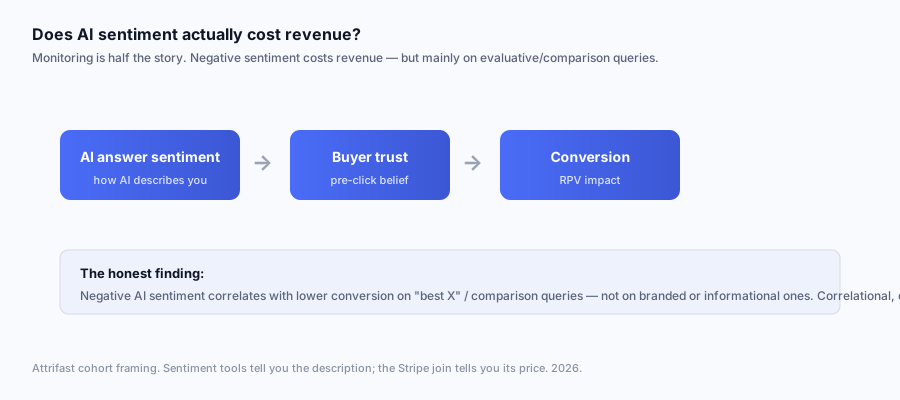
Here is the causal chain as I understand it, with the honest caveat that the middle links are hard to measure cleanly:
The diagram is a hypothesis, not a proof. The link I can actually measure is the bottom one, from arriving session to revenue, because that is what a Stripe-native attribution join captures. The links above it, from sentiment to click-through, I can only infer by correlating the sentiment of the likely-preceding answer with the conversion behavior of the traffic. That inference is the original contribution of this piece, and I will be explicit about its limits when I get to the data.
The honest core thesis: monitoring is half the story
Every sentiment-monitoring vendor will sell you the same loop: we tell you how AI describes your brand, you see a score, the score goes up or down, you react. It is a clean product story. It is also incomplete in a way that matters for anyone spending real money on it.
Monitoring answers "what is the AI saying about me?" It does not answer "is what the AI is saying costing me anything?" Those are different questions with different answers, and conflating them leads to expensive misallocation. I have watched teams spend a quarter chasing a negative-sentiment reading on a query that drove almost no decision-relevant traffic, while ignoring a quietly negative comparison query that was bleeding real revenue.
The two questions, side by side:
| Question | Tool that answers it | What you do with the answer |
|---|---|---|
| How does AI describe my brand? | Profound, Loamly, SEOcrawl | Audit the description, find false claims |
| Per engine, how does the description differ? | Same monitoring tools | Prioritize the worst engine |
| Per query, where is sentiment worst? | Same monitoring tools | Prioritize the most decision-adjacent query |
| Does that worst sentiment correlate with worse conversion? | Revenue attribution (Attrifast) | Decide if it is worth fixing |
| What is the dollar cost of the negative sentiment? | Revenue attribution join | Build the business case to fix it |
The first three rows are well served by existing tools. The last two are the gap. A monitoring tool can tell you your Perplexity sentiment is negative; it cannot tell you that Perplexity traffic converts 30% worse than ChatGPT traffic on your pricing page, because it never sees a session, let alone a Stripe charge. That is not a knock on the monitoring tools, they are good at their job, it is a statement about where their job ends.
Why nobody closes the loop
The reason the loop stays open is structural, and it is the same reason ChatGPT traffic hides in GA4's Direct bucket. The sentiment-monitoring vendors are query-side: they ask the engines questions and score the answers. They have no visibility into your site's sessions or your Stripe account. The web-analytics vendors are session-side: they see traffic but bucket AI referrals as Direct and have no sentiment data. The revenue lives in Stripe, a third place. Closing the loop requires joining all three, and the join is the hard engineering, which is the entire reason Attrifast exists.
The three data planes and who owns each:
| Data plane | What it knows | What it cannot see | Tool category |
|---|---|---|---|
| Query plane | How AI describes you, per engine, per prompt | Whether anyone clicked or paid | Profound, Loamly, Otterly |
| Session plane | That traffic arrived (if attributed) | The sentiment of the answer that drove it | Attrifast, Plausible, GA4 |
| Revenue plane | That money changed hands | Which channel and sentiment caused it | Stripe |
The complete loop only exists when something joins all three planes. The diagram of the full measurement stack:
Building a sentiment scoring rubric you can actually act on
Before connecting sentiment to revenue, you need a sentiment score that means something. Most blended scores do not. Here is the rubric I use when auditing a brand's AI presence, designed so that the output is a prioritized action list, not a single vanity number.
| Score | Label | What the answer reads like | Action priority |
|---|---|---|---|
| +2 | Strongly positive | Recommends you as the best or safest choice, specific praise | Protect; understand why |
| +1 | Positive | Favorable framing, minor caveats | Maintain |
| 0 | Neutral | Lists facts, pros and cons evenly, no lean | Opportunity to win |
| -1 | Negative | Real caveat or criticism foregrounded | Investigate truth and decision-adjacency |
| -2 | Strongly negative or false | Confident criticism, or a hallucinated/stale negative | Fix immediately if false |
The single most important refinement: split the -1 and -2 buckets by whether the negative is true or false.
| Negative type | Example | Fixable? | Revenue urgency |
|---|---|---|---|
| True, fixed-fit | "Premium-priced, built for larger teams" | Not by you; it is correct | Low; may be qualifying |
| True, current | "Limited integrations compared to competitor" | Yes, ship the integration | Medium |
| Stale | "Has had downtime" (fixed 18 months ago) | Yes, fast, publish a correction | High |
| Hallucinated | A breach that never happened, attributed to you | Yes, urgent, publish on-record | Critical |
| Conflated | Confused with a same-name company | Yes, entity disambiguation | High |
A monitoring tool will lump all five into "negative." The action you take is completely different per row. A true, fixed-fit negative ("expensive, for big teams") may be doing useful qualifying work and is not worth one minute of effort. A hallucinated breach is a five-alarm fire. The blended score treats them identically, which is precisely why the blended score is not actionable.
Weighting sentiment by query value
The final piece of an actionable rubric is weighting each query's sentiment by how much decision-relevant traffic it represents. A negative reading on a query nobody asks is noise. A negative reading on your top comparison query is a budget line.
| Query intent tier | Decision weight | Example | Sentiment impact on revenue |
|---|---|---|---|
| Bottom-funnel evaluative | High (3x) | "is X worth it," "X vs Y" | Direct; sentiment is doing persuasion |
| Mid-funnel comparison | Medium-high (2x) | "best [category] for [ICP]" | Strong; you are in or out of the set |
| Trust / safety | Variable, spike risk | "is X safe / legit" | Low unless a negative exists, then severe |
| Top-funnel informational | Low (1x) | "what is X," "how does X work" | Minimal; user not yet deciding |
| Navigational | Near zero | "X login," "X pricing page" | Negligible; user already chose |
Multiply each query's sentiment score by its decision weight and its monthly AI-attributed session volume, and you get a prioritized list of which negative sentiments to fix first. That weighted list is what a sentiment program should produce. A single number is what it usually produces instead.
Per-engine sentiment divergence: the engines do not agree
One of the most consistent and underappreciated findings from running brand prompts across engines repeatedly is that the engines disagree, often sharply, about the same brand. Treating "AI sentiment" as monolithic erases this, and the divergence is frequently where the actionable insight lives.
The rough behavioral profile I have observed, with the heavy caveat that these are directional tendencies, not laws, and they drift:
| Engine | Browsing behavior | Sentiment tendency | Staleness risk | Notes |
|---|---|---|---|---|
| Perplexity | Live-browses aggressively, cites sources | Most critical; surfaces recent negatives and Reddit | Low (most current) | Will quote a bad review verbatim with a citation |
| ChatGPT (no search) | Leans on training corpus | Middle; can be stale | High | A fixed problem can persist for a year+ |
| ChatGPT (with search) | Browses when triggered | More current than corpus mode | Medium | Behavior depends on whether search fires |
| Claude | Cautious, browses when asked | Most hedged; even pros/cons | Medium | Often refuses a strong opinion, reads neutral [12] |
| Gemini | Weights Google's index and aggregators | Close to Google's surface | Medium | Trusts established review sites heavily |
| Copilot | Bing-index-backed | Variable | Medium | Tracks Bing's source weighting |
The practical consequence: your brand can be positive in ChatGPT and negative in Perplexity simultaneously, because ChatGPT is reciting an older, friendlier corpus while Perplexity is live-quoting a critical Reddit thread from last month. A blended score averages these into a meaningless middle. The right move is to find the divergence, identify the source driving the negative engine (almost always a specific citable page), and fix that source.
A worked divergence example, anonymized from a real audit:
| Query | ChatGPT | Perplexity | Claude | Gemini | Driver of divergence |
|---|---|---|---|---|---|
| "Is [brand] reliable?" | +1 | -1 | 0 | +1 | Perplexity surfacing a 2024 status-page incident |
| "[brand] vs [competitor]" | 0 | -1 | 0 | -1 | A comparison blog post ranking that favors competitor |
| "Is [brand] worth the price?" | +1 | 0 | +1 | +1 | Perplexity quoting a "too expensive" Reddit comment |
| "Alternatives to [brand]" | -1 | -2 | -1 | -1 | The brand is framed as the thing being replaced everywhere |
Reading that table top to bottom tells a clear story: Perplexity is the problem engine, the drivers are two specific external sources, and "alternatives to" is uniformly bad and needs a content response. That is an action plan. A blended "your sentiment is 0.2, down from 0.4" tells you nothing you can do.
Which source each engine weights most heavily, so you know where to spend remediation effort per engine:
| Engine | Heaviest-weighted sources | Lever to pull |
|---|---|---|
| Perplexity | Live web, Reddit, recent reviews, news | Fix recent cited pages; engage Reddit honestly |
| ChatGPT (corpus) | Training data, established sites | Publish durable content; wait for retraining |
| ChatGPT (search) | Live web when search fires | Same as Perplexity when browsing is active |
| Claude | Trusted reference sites, your own pages | Clear on-record answers it can cite cleanly |
| Gemini | Google index, review aggregators | G2/Capterra freshness, Google-visible content |
| Copilot | Bing index | Bing-visible content and Bing-weighted sources |
The data: does negative sentiment actually cost revenue?
This is the section the rest of the article exists to set up, and the one where I have to be most careful about what I can and cannot claim.
Methodology and its limits
The Attrifast dataset is roughly 200 sites that turned on AI-engine attribution between late 2025 and Q2 2026: a mix of B2B SaaS, DTC ecommerce, developer tools, and a few content publishers. For each site, AI-attributed sessions are detected with the four-layer server-side method described in the ChatGPT referral analytics guide (UTM, bot exclusion, referer fingerprinting, behavioral inference), and revenue is joined via the Stripe checkout.session.completed webhook.
To connect that to sentiment, on a subset of sites I overlaid a sentiment read: for each site's top decision-adjacent queries, I scored the per-engine answer sentiment, then compared the conversion behavior of traffic attributed to each engine against the sentiment of that engine's answers. This is a correlational, observational design with several honest weaknesses I want on the record before any numbers:
- I am correlating session-level conversion with the sentiment of the answer that likely preceded the click, not the exact answer the specific user saw. The click does not carry the answer text.
- Engine, query, and sentiment are confounded. Perplexity users differ from ChatGPT users in ways beyond the sentiment of the answer they saw.
- Sentiment scoring has run-to-run variance and LLM-as-judge bias [9][10]. I averaged multiple passes but the scores are noisy.
- This is not a randomized experiment. I cannot claim sentiment causes the conversion gap, only that they move together in a consistent and plausible direction.
The confounders I cannot fully separate, stated plainly so the numbers are not over-read:
| Confounder | Why it muddies the sentiment-revenue link |
|---|---|
| Engine-user mix | Perplexity users are research-mode; ChatGPT users are broader. Different baseline intent. |
| Query selection | Buyers who ask "is X worth it" already differ from those who ask "what is X." |
| Landing page | Different queries route to different pages with different baseline conversion. |
| Answer drift | The exact answer the user saw is unknown and changes between my scoring and their click. |
| Time | Sentiment, traffic, and pricing all move over the measurement window. |
With all of that flagged, here is what the data shows.
The headline correlation
Segmenting AI-attributed sessions by the sentiment of the likely-preceding answer, on evaluative and comparison queries, on the same landing pages:
| Sentiment of likely-preceding answer | Relative conversion rate (vs positive = 1.00) | RPV index (positive = 1.00) |
|---|---|---|
| Strongly positive (+2) | 1.00 (reference) | 1.00 |
| Positive (+1) | 0.94 | 0.95 |
| Neutral (0) | 0.78 | 0.81 |
| Negative (-1) | 0.61 | 0.64 |
| Strongly negative / false (-2) | 0.49 | 0.52 |
Read carefully, this says that on evaluative queries, traffic arriving in the wake of a strongly-negative or false AI answer converts at roughly half the rate of traffic arriving after a strongly-positive answer, on the same pages. The neutral row matters too: neutral sentiment is not neutral for revenue, it costs roughly a fifth of conversion versus positive, because an undecided buyer is a coin flip and a pre-sold buyer is not.
The critical qualifier is "on evaluative queries." When I run the same segmentation on top-funnel informational queries, the gap collapses:
| Query intent | Conversion gap, positive vs negative answer | Interpretation |
|---|---|---|
| Bottom-funnel evaluative ("is X worth it") | Large (~2x) | Sentiment is doing persuasion |
| Comparison ("X vs Y") | Large (~1.8x) | Sentiment decides if you make the cut |
| Trust ("is X safe") | Very large when a negative exists | Hallucinated negatives are catastrophic |
| Top-funnel informational ("what is X") | Small (~1.1x) | User not deciding yet; sentiment barely moves it |
| Navigational ("X login") | Negligible | User already chose |
This is the core finding, and it is more nuanced than either the sentiment vendors or the skeptics want. The vendors imply all negative sentiment is bad. The skeptics imply none of it is measurable. The data says: negative AI sentiment costs real, measurable revenue, but concentrated almost entirely on the queries where the AI answer is part of the buying decision, and it is close to free where the answer is not.
Per-engine: where the sentiment-revenue gap is widest
Overlaying per-engine sentiment with per-engine conversion across the dataset:
| Engine | Median sentiment (eval queries) | Conversion vs Google organic | Where sentiment hurts most |
|---|---|---|---|
| ChatGPT | +0.4 (mildly positive, stale) | ~1.5-1.6x | When stale negatives persist on trust queries |
| Perplexity | -0.2 (most critical) | ~1.7-2.0x when positive, drops sharply when negative | Comparison queries with cited competitors |
| Claude | +0.1 (hedged neutral) | ~1.3x | Neutral framing leaves revenue on the table |
| Gemini | +0.2 | ~1.1-1.2x | Tracks Google review-aggregator sentiment |
The interesting tension: Perplexity has the most critical sentiment and the highest conversion rate when the sentiment is positive. That is not a contradiction. Perplexity users are deep-research-mode buyers; when Perplexity endorses you to that buyer the conversion is excellent, and when Perplexity surfaces a damning competitor comparison to that same high-intent buyer, the loss is correspondingly steep. Perplexity is high-variance, which makes its sentiment the highest-leverage to fix.
The dollar framing
For a concrete (anonymized, plausible) example: a B2B SaaS site getting ~1,800 monthly AI-attributed sessions on evaluative queries, with a baseline positive-answer RPV of $0.84. If a stale negative on its top trust query drags a quarter of that evaluative traffic from positive-answer conversion down to negative-answer conversion (roughly a 0.52 RPV index), the implied monthly cost is the difference applied to that segment:
| Scenario | Evaluative sessions/mo | Blended RPV | Monthly AI-evaluative revenue |
|---|---|---|---|
| All positive-answer sentiment | 1,800 | $0.84 | $1,512 |
| 25% dragged to negative by a stale claim | 1,800 | ~$0.74 | ~$1,332 |
| Implied monthly cost of the stale negative | — | — | ~$180/mo, ~$2,160/yr |
That is one stale claim, on one query, at a small site. The number scales with traffic and is, crucially, recoverable: fixing a stale or false negative is among the highest-ROI work available because the live-browsing engines update fast once the source changes. I show this calculation to be honest about magnitude: it is real money, it is not usually company-ending, and it is fixable. The vendors who imply AI sentiment is an existential threat oversell it; the skeptics who call it a vanity metric undersell it. The truth is a recoverable few-percent revenue line, larger the more your buyers research through AI.
Monitoring tool comparison: who measures what
The category confusion here is as bad as it is in AI traffic analytics, so it is worth being explicit. Sentiment monitoring tools, traffic analytics tools, and revenue attribution tools do three different jobs and operators routinely buy one expecting another.
| Tool | Category | Scores sentiment? | Measures clicks? | Measures revenue? | Entry price | Best for |
|---|---|---|---|---|---|---|
| Profound | AI answer / citation + sentiment monitoring | Yes | No | No | $499+/mo | Enterprise GEO and sentiment tracking [6] |
| Loamly | AI mention + sentiment monitoring | Yes | No | No | $99+/mo | SMB sentiment monitoring [7] |
| SEOcrawl Prompt Tracking | Prompt-rank + brand presence monitoring | Partial | No | No | Custom | Agencies tracking prompts at scale |
| Otterly | AI search visibility + sentiment | Yes | No | No | $29+/mo | SMB AI visibility on a budget |
| Attrifast | First-party attribution + Stripe revenue | No (by design) | Yes (4-layer) | Yes (Stripe join) | $9.99/mo | Connecting AI traffic to revenue |
| Brandwatch / Brand24 | Classic social listening | Yes (social) | No | No | $$$ | Social conversation, not AI answers |
| GA4 | Web analytics | No | Partial (referer) | Partial | Free | General analytics, blind to AI referrals [8] |
The honest positioning: Attrifast is not a sentiment tool and should not pretend to be. Profound and Loamly score sentiment better than I ever will. What Attrifast does is the complementary half, the revenue join, which makes the sentiment data actionable rather than informational. The ideal 2026 stack for a brand that cares about this is a sentiment monitor for the description plus a revenue attribution layer for the cost, read together.
| Job to be done | Right tool category |
|---|---|
| "How does ChatGPT describe my brand?" | Profound / Loamly / Otterly |
| "Which engine is hardest on me?" | Same sentiment monitors (per-engine view) |
| "Is the negative-sentiment engine converting worse?" | Attrifast (per-engine revenue) |
| "What does the bad sentiment cost in dollars?" | Attrifast (Stripe join) |
| "What humans say about me on social" | Brandwatch / Brand24 (different category) |
The remediation playbook: changing how AI describes you
You cannot edit a model's weights, but you can move what it says, because the live-browsing layer of these engines reads the open web and the engines preferentially cite a small set of trusted sources. The remediation work is source work, not model work.
Step 1: Audit and triage
The triage decision is the whole game, because the action you take depends entirely on whether the negative is true, stale, false, or qualifying:
Run the eight-prompt baseline (see the FAQ) across all four engines, score with the rubric above, and produce the triage list:
| Triage bucket | What to do | Timeline |
|---|---|---|
| Hallucinated / false negatives | Publish an on-record, citable correction; fix the cited source | Days |
| Stale negatives | Publish updated facts; the live-browse engines overwrite fast | Days to weeks |
| Conflation (same-name confusion) | Entity disambiguation: Organization schema, sameAs, Wikidata | Weeks |
| True current negatives | Fix the product issue, then the content | Weeks to months |
| True fixed-fit negatives | Leave alone; may be qualifying | n/a |
Step 2: Fix the sources the engines actually cite
The engines do not invent their sources; they cite a knowable set. Find which pages drive your negative sentiment (the monitoring tools show cited URLs; so does manually reading the answers) and prioritize fixing them by authority and decision-adjacency.
| Source type | Influence on AI sentiment | How to improve | Speed of effect |
|---|---|---|---|
| Your own site | High; first source for "what is X" | Publish honest, footnoted answers to negative queries | Fast (you control it) |
| G2 / Capterra / Trustpilot | High; heavily weighted by Gemini and ChatGPT | Respond to reviews, drive recent positive ones | Medium |
| Reddit threads | High for Perplexity; cited constantly | Engage honestly; cannot edit others' posts | Slow, indirect [13] |
| Wikipedia | Very high; trusted by all engines | Ensure accuracy via proper editorial process | Slow [14] |
| Comparison blog posts | High on "X vs Y" queries | Earn or write balanced comparisons | Medium |
| News / press | Spike influence on trust queries | PR, on-record statements | Variable |
The Reddit and Wikipedia rows deserve a caution. Both are heavily cited by AI engines, and both have strict community norms; attempting to manipulate either directly will backfire and can produce worse coverage. The honest play is participation and accuracy, not manipulation. Studies of AI citation patterns consistently find Reddit and Wikipedia among the most-cited domains [13][14], which is exactly why they cannot be gamed without consequence.
Step 3: Publish the on-record answer
The single highest-leverage content move for sentiment is to publish a clear, honest, footnoted answer to the negative-leaning query directly on your own site. Models prefer to cite an on-record answer over inferring one. If buyers ask "why is X so expensive," a page titled honestly that breaks down the value gives the engine something better to cite than a Reddit complaint.
| Negative query | Defensive content to publish | Effect |
|---|---|---|
| "Why is X expensive?" | Honest pricing/value breakdown page | Engine cites your framing, not a complaint |
| "Is X reliable?" | Public status page + uptime history | Overwrites stale incident references |
| "X vs [competitor]" | Fair, footnoted comparison you author | You enter the comparison on your terms |
| "Alternatives to X" | "When X is and isn't the right fit" page | Reframes you as a considered choice |
| "Is X safe?" | Security/trust page with specifics | Pre-empts hallucinated incident claims |
Step 4: Measure whether it worked, in revenue
This is the step the monitoring tools cannot do and the reason the whole loop matters. After remediation, the monitoring tool will show the sentiment score recovering. That is necessary but not sufficient. The question that justifies the work to a CFO is whether the conversion rate of that engine's traffic recovered too. With per-engine revenue attribution you can answer it; without it you are reporting a vanity score that went up.
| Before / after | Monitoring tool shows | Revenue attribution shows |
|---|---|---|
| Pre-remediation | Perplexity sentiment -1 | Perplexity RPV index 0.64 |
| Post-remediation | Perplexity sentiment +1 | Perplexity RPV index 0.93 |
| Conclusion | "Sentiment improved" | "Sentiment fix recovered ~$X/mo" |
Common mistakes operators make with AI sentiment
Patterns I see often enough to name, with the fix for each.
Mistake 1: Trusting the blended score. One number across all engines and queries hides the per-engine and per-query divergence where the action lives. Fix: always demand the breakdown.
Mistake 2: Treating all negatives as equal. A hallucinated breach and a true "expensive for big teams" are both "negative" to the tool and completely different to your business. Fix: triage by true/false and by decision-adjacency.
Mistake 3: Only monitoring your own brand name. "Alternatives to X" and "X vs Y" are where the most expensive negative sentiment hides, and brand-name-only monitoring misses them entirely. Fix: monitor the competitive and comparison query set.
Mistake 4: Panicking over one week's reading. Sentiment scores carry real run-to-run variance even with identical prompts [9][10]. Fix: trust the trend, not the spot reading.
Mistake 5: Chasing sentiment on no-traffic queries. A negative on a query nobody asks is noise. Fix: weight by AI-attributed session volume.
Mistake 6: Fixing sentiment without measuring revenue impact. The sentiment score going up is not the goal; recovered conversion is. Fix: join to revenue or you are optimizing a vanity metric.
Mistake 7: Treating sentiment as static. Live-browsing engines move in days; training-corpus knowledge lags by a year. Fix: monitor weekly in active situations, and understand which layer you are trying to move.
Mistake 8: Assuming one engine generalizes. Your ChatGPT sentiment tells you almost nothing about your Perplexity sentiment. Fix: read all four, separately.
How this changes your reporting
The shape of a brand or growth review changes once sentiment and revenue are read together.
| Review section | Sentiment monitoring alone | Sentiment + revenue join |
|---|---|---|
| Headline metric | Blended sentiment score | Sentiment-weighted, revenue-impacted query list |
| Engine focus | "Sentiment is down" | "Perplexity converts worst where sentiment is worst" |
| Content prioritization | Fix worst-scoring query | Fix worst (score x decision-weight x volume) query |
| Remediation success | Score recovered | Conversion and RPV recovered |
| Budget justification | "Reputation matters" | "Stale negative cost ~$X/yr, fixing it returns Y" |
| False-claim handling | Flagged as negative | Triaged as critical, fixed first |
The budget-justification row is the one that gets the program funded. "Reputation matters" loses to "the new feature" every quarter. "This false claim is costing us a measurable few thousand a year on comparison queries and here is the recovery after we fixed it" wins. The revenue join is what turns sentiment from a soft narrative into a fundable line.
Limitations
What this article and the framework do not cover, and where you should not extrapolate.
- Correlation, not causation. The sentiment-to-conversion relationship in the data is observational. Engine, query, user type, and sentiment are confounded. I can show the numbers move together; I cannot prove sentiment causes the gap.
- Sentiment scoring is noisy. LLM-as-judge classification has documented bias and run-to-run instability [9][10]. Mixed sentiment ("great product, bad support") is genuinely hard to score. Read raw answers, not just scores.
- The answer-the-user-saw is unknown. I correlate conversion with the likely preceding answer, not the exact text. Answers drift and vary per user.
- Voice and in-app surfaces. When a buyer hears a spoken AI answer with no link, the sentiment lands but no session is created. No measurement story for voice-mode sentiment yet.
- Enterprise AI tenants. ChatGPT Enterprise and Claude for Work run isolated and may behave differently from the consumer surfaces these numbers come from.
- Region and language. The dataset skews US English. Sentiment behavior and citation sources differ across markets and the thresholds are not as well measured.
- The dollar figures are snapshots. AI user mix and engine behavior are shifting fast. Re-measure quarterly; treat any specific multiplier as directional, not constant.
FAQ
What is AI brand sentiment, and how is it different from social listening?
AI brand sentiment is how generative engines (ChatGPT, Perplexity, Claude, Gemini) describe your brand when a user asks about it, scored on a positive-neutral-negative axis. It differs from social listening in three ways: the source is synthetic (the model summarizing a corpus, not a real person), it is query-conditional (positive on "is X reliable," negative on "why is X expensive"), and it is low-volume but high-leverage (one answer read by one buyer at decision time). Social listening measures the conversation; AI sentiment measures the synthesis the buyer actually sees while deciding.
Does negative AI sentiment actually cost me revenue, or is it a vanity metric?
Both, depending on the query. In the Attrifast dataset, sentiment monitoring alone is a vanity metric until you join it to conversion. When we segment AI sessions by the sentiment of the likely-preceding answer, sessions from negative or mixed answers convert materially worse, but the gap is concentrated on evaluative and comparison queries where the AI is doing active persuasion. On navigational or definitional queries sentiment barely moves conversion. So negative sentiment costs revenue specifically where the answer is part of the buying decision.
How do I find out how ChatGPT describes my brand right now?
Open ChatGPT, Perplexity, Claude, and Gemini and run the same eight prompts in each: "What is [brand]?", "Is [brand] any good?", "What are the downsides of [brand]?", "[brand] vs [top competitor]", "Is [brand] worth the price?", "Is [brand] safe?", "Who is [brand] for?", and "What do people say about [brand]?". Tag each answer positive/neutral/negative and note the cited sources. This 20-minute manual baseline surfaces the specific false claims to fix. For ongoing monitoring use a tool, because the answers drift weekly.
Which AI engine is hardest on brands, and which is most generous?
Directionally: Perplexity is most critical because it live-browses and surfaces recent negatives with citations. Claude is most cautious and hedged, reading neutral-to-mildly-positive. ChatGPT sits in the middle and leans on its training corpus, making it the most stale. Gemini behaves closest to Google and weights review aggregators heavily. None of this is stable; re-test quarterly and never assume one engine's sentiment generalizes to the others.
Can I change how AI describes my brand, or is it fixed by the training data?
You can move it, slowly and unevenly. The levers that work: fix the source pages the engines cite (your site, G2/Capterra, Wikipedia, ranking Reddit threads), publish clear footnoted answers to the negative queries, and earn mentions in high-authority sources. The lever that does not work is trying to manipulate the model directly. The training-corpus layer lags by months to over a year, so that sets the floor on how fast you can move the stale engines.
How does Attrifast connect AI sentiment to revenue?
Attrifast does not score sentiment; dedicated tools do that better. Attrifast does the join nobody else closes: it attributes the AI-engine session server-side, carries it to the Stripe checkout via webhook metadata, and reports revenue per AI engine. Overlay a sentiment monitor's per-engine data on Attrifast's per-engine conversion data and you can answer whether the worst-sentiment engine also converts worst. On evaluative queries the answer is consistently yes. The sentiment tool tells you the description; Attrifast tells you the price.
Is a single "brand sentiment score" from a monitoring tool trustworthy?
Treat it as a weather report, not a thermometer. A blended score hides per-engine divergence (positive ChatGPT, negative Perplexity) and per-query divergence (positive on "what is X," negative on "X vs cheaper rival"). The blended number is fine for a quarterly trend line and useless for deciding what to fix. Always demand the breakdown by engine and by query intent.
How often does AI brand sentiment change?
Faster than expected for live-browsing engines, slower than hoped for training-corpus engines. Perplexity and ChatGPT-with-search can shift within days of a new highly-cited source. The pure corpus layer of ChatGPT and Claude moves on the retraining cadence, months to over a year. Monitor weekly in an active reputation situation, monthly in steady state, and do not panic over a single week given the run-to-run variance.
What queries should I monitor for AI brand sentiment?
The decision-point queries: "is [brand] worth it," "[brand] vs [competitor]," "is [brand] legit/safe," "why is [brand] so expensive," "best [category] for [ICP]," "alternatives to [brand]," and "[brand] reviews." These are where the AI answer does active persuasion. Lower priority: "what is [brand]" and "how does [brand] work." The sleeper is "alternatives to [brand]": if the engine lists you as the thing people leave, that is the most expensive and most-missed negative sentiment.
Can negative AI sentiment ever be good for a brand?
Occasionally. "Expensive but the most reliable option for serious teams" renders negative on price and positive on quality at once, and for a premium brand that is correct and revenue-positive, filtering out price-sensitive churners. The trap is reading "expensive" as a problem when it is doing qualifying work. The sentiment that costs revenue is the false or stale negative; the sentiment that may earn revenue is the true negative that disqualifies a bad-fit buyer. A tool cannot tell these apart; you have to, with conversion data.
Do AI engines hallucinate negative things about brands?
Yes, and it is the single most important reason to monitor. Common failure modes: attributing a competitor's outage or breach to you, repeating a complaint about a removed feature, quoting an out-of-date price, and conflating a same-named company. These hallucinated negatives are the most damaging (confident false claims at the decision point) and the most fixable (publish an on-record correction the live-browsing engines can cite). The first deliverable of any sentiment audit is a ranked list of factually-wrong negative claims.
How is AI sentiment measured technically, and how reliable is the scoring?
Most tools run a fixed prompt set across engines on a schedule, capture the answers, and score each with a classifier (often another LLM) into positive/neutral/negative plus confidence. Caveats: LLM-as-judge scoring has known biases and run-to-run variance, the same answer can score differently on repeat passes, and mixed sentiment is hard to bucket. Academic sentiment analysis has wrestled with these limits for over a decade [9][10]. Trust the direction and relative comparison far more than the absolute number, and read a sample of raw answers yourself.
Related reading from the Attrifast research stack
For hands-on tools, see share of voice in AI search and AI citation tracking.
References
- OpenAI — ChatGPT weekly active user announcements and usage research. 2024-2025
- Pew Research Center — Americans use of and attitudes toward generative AI, 2024-2025
- Edelman — Edelman Trust Barometer: brand trust and purchase behavior
- Gartner — The B2B buying journey and pre-contact research behavior
- Perplexity AI — Company blog and announcements on query volume and growth
- Profound — AI answer monitoring and brand sentiment product documentation
- Loamly — AI mention and sentiment monitoring
- Google Analytics — Default channel group definitions for GA4
- Zheng, L. et al. Judging LLM-as-a-Judge with MT-Bench and Chatbot Arena — 2023
- Pang, B. and Lee, L — Opinion Mining and Sentiment Analysis. Foundations and Trends in…
- Search Engine Land — Google AI Overviews and AI answer citation tracking, 2024-2026
- Anthropic — Claude model behavior and Constitutional AI documentation
- Backlinko — Which sources AI search engines cite most (Reddit, Wikipedia, and beyond)
- Wikimedia Foundation — Wikipedia as a source for large language models and AI systems
- McKinsey & Company — The value of brand and customer trust in growth
- Nielsen — Global trust in advertising and brand perception studies
- BrightEdge — Generative AI and search behavior research
- OpenAI — Overview of OpenAIs bots and how to control them
- Anthropic — ClaudeBot crawler documentation
- Semrush — AI search, brand visibility, and citation research
- Plausible Analytics — How to track ChatGPT and AI search traffic
- Stripe Docs — Checkout Session metadata field
For the attribution mechanics that make the revenue join possible, see the ChatGPT referral analytics guide and the practical playbooks for tracking ChatGPT, Perplexity, and Claude traffic. For the strategic split between AEO and SEO, see AEO vs SEO in 2026. For the per-engine revenue numbers in depth, see the AI traffic revenue benchmark. To get cited in the first place, how to get cited by AI engines and where Google AI gets its information cover the source side. The product side lives at the revenue attribution feature page.