Part of the AEO Hub — browse all 28 AEO guides.
A founder I work with sold 41 new subscriptions last month. His GA4 acquisition report credited zero of them to AI. His Stripe dashboard, joined to his session timeline through Attrifast, said 16 of those 41 buyers had touched ChatGPT, Perplexity, or Claude during the two weeks before they paid. None of those 16 buyers clicked through from an AI engine on the session where they converted — they had all left, come back days later through branded search or a bookmark, and bought. So the AI engines that helped 39% of his paying customers find him got credited with 0% of the revenue, and he was about to defund the content that was producing those AI citations.
That 39% is the number this article is about. It has a name, an older lineage, a precise definition, and — for the first time that I am aware of — a benchmark behind it across 200 Stripe-connected sites. The category is AI-influenced conversions, and the honest finding is that they are 30-40% of paying conversions for the typical B2B SaaS in our cohort, while almost none of that is visible in the default analytics stack.
This is the conceptual companion to two earlier pieces. The ChatGPT referral analytics guide explains why AI traffic hides in Direct. The attribution-models piece explains which models break and why. This one defines the category — what an AI-influenced conversion is, how to measure it, what the number actually is, and how to report it without lying in either direction. The benchmark numbers throughout come from the 2026 AI Search Revenue Benchmark: 200 sites, ~41.2M sessions, ~168k Stripe payment events with attribution metadata joined server-side.
Quick facts
| Metric | Value | Source |
|---|---|---|
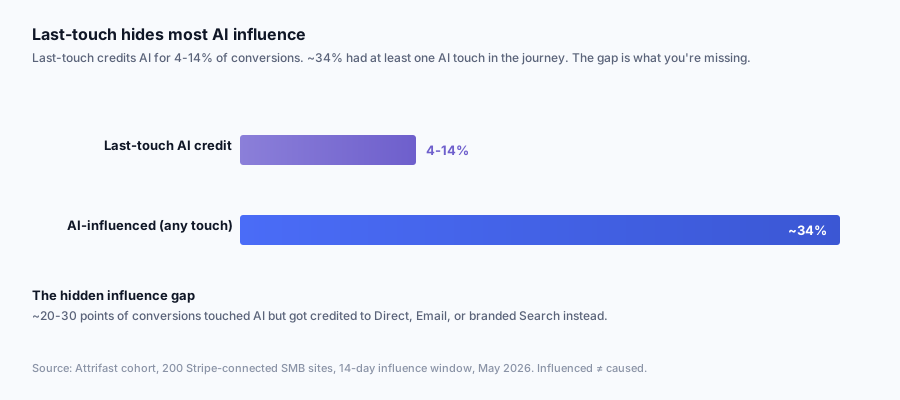
| AI-influenced conversion share (cohort, 14-day window) | 30-40% (deduped ~34%) | Attrifast 200-site benchmark [1] |
| Last-touch AI revenue share (same conversions) | 4-14% | Attrifast benchmark [1] |
| AI Discovery Share, B2B SaaS (30-day window) | 19-34% | Attrifast aggregate [1] |
| AI Discovery Share, DTC ecommerce | 6-12% | Attrifast aggregate [1] |
| Median lag, first AI touch → paid conversion (B2B SaaS) | 9.3 days | Attrifast aggregate [1] |
| Median lag, first AI touch → paid conversion (DTC) | 2.1 days | Attrifast aggregate [1] |
| Median % of GA4 Direct that is actually AI | 34% (IQR 21-47%) | Attrifast benchmark [1] |
| Average touches per B2B purchase decision | 6-8 attribution-eligible (27 research-phase) | Forrester / Aberdeen [4][7] |
| Median consideration window, SaaS ($30-150 AOV) | 14-21 days | Marketing Evolution research [3] |
| Median consideration window, DTC ($60-200 AOV) | 3-7 days | Marketing Evolution research [3] |
| ChatGPT weekly active users (Q1 2026) | ~800 million | OpenAI / Reuters [5] |
| AI Overviews trigger rate (Ahrefs, 146.1M SERPs, Sept 2025) | 20.5% of SERPs | Ahrefs [6] |
| AI Overviews organic CTR impact | -34.5% on affected queries | Backlinko 2024 [8] |
| % of ChatGPT sessions correctly attributed in default GA4 | ~18% | Attrifast aggregate [1] |
| Year GA dropped the standalone Assisted Conversions report | 2023 (GA4 transition) | Google Analytics docs [2] |
| Behavioral classifier precision / recall | 78-86% / 70-82% | Attrifast measurement [1] |
Two of those numbers carry the whole article. The first is 30-40% of paying conversions are AI-influenced — the demand-side reality of how often AI shows up in a buying journey in 2026. The second is 4-14% last-touch AI revenue — the measurement-side reality of how little of that influence any default report will credit. Everything below is what falls out when you take both numbers seriously at the same time.
Defining "AI-influenced conversion" precisely
Vague definitions are how this category gets oversold. So here is the precise one I use, stated as a single sentence and then unpacked term by term.
An AI-influenced conversion is a paying conversion whose buyer's journey included at least one AI engine session — ChatGPT, Perplexity, Claude, Gemini, or a Google AI Overview — within X days of the conversion event, regardless of whether the AI engine was the last-click source.
The default for X is 14 days. Every term in that sentence is load-bearing.
| Term in the definition | What it means precisely | Why it matters |
|---|---|---|
| "paying conversion" | A successful, non-refunded, non-test Stripe payment event | Excludes free signups and pageviews; ties the metric to revenue, not vanity |
| "buyer's journey" | The full set of first-party sessions stitched to one customer identity | Influence is a property of the journey, not of one session |
| "at least one AI engine session" | One or more sessions labeled as an AI touch (referer or behavioral) | A single AI touch is enough to flag the conversion as influenced |
| "ChatGPT, Perplexity, Claude, Gemini, AI Overview" | The five tracked AI surfaces with their domain + behavioral signals | Defines the engine set explicitly; no monolithic "AI" bucket |
| "within X days" | The configurable consideration window (default 14) | Bounds the claim; an AI touch 90 days stale should not count |
| "of the conversion event" | Measured backward from the timestamp of the Stripe payment | Anchors the window to the actual purchase moment |
| "regardless of whether the AI engine was the last click" | Influence ≠ last-touch credit | This is the entire point: it counts assists, not just closes |
The phrase to underline is the last one. An AI-influenced conversion does not require AI to be the last click, the first click, or the converting session. It only requires that an AI touch appeared somewhere in the qualifying window. That is exactly the logic of the classic assisted conversion — a concept marketing analytics has used for over a decade — applied to AI engines specifically.
It is worth stating what the definition deliberately excludes, because the exclusions are where honesty lives:
| Deliberately excluded | Why |
|---|---|
| AI touches outside the X-day window | A stale touch is coincidental, not influential |
| Zero-click AI Overview reads with no session | No session means nothing to stitch into the journey |
| Free-trial signups that never paid | The metric is revenue-anchored, not signup-anchored |
| Bot hits (GPTBot, ClaudeBot, PerplexityBot) | Crawlers are not human journeys |
| AI touches that are pure false positives | The classifier has a known ~14-22% false-positive rate; we surface confidence |
A clean way to see the definition is as a binary flag computed at conversion time:
The flag is independent of the revenue-allocation model. You can run last-touch, last-non-direct, or position-based for the dollar credit and still compute the AI-influenced flag on top, because the flag is asking a different question: not "which channel gets the dollar" but "was AI present in this journey at all."
AI-influenced vs AI assisted vs last-touch AI: three different numbers
These three terms get used interchangeably and they are not the same. The confusion is the single biggest reason the category is mis-reported.
| Term | Definition | Typical SaaS value | Question it answers |
|---|---|---|---|
| AI-influenced conversion | ≥1 AI touch anywhere in the X-day window | 30-40% | Was AI present in the journey? |
| AI assisted conversion | Synonym for AI-influenced (older GA vocabulary) | 30-40% | (Same) |
| Last-touch AI conversion | The converting session itself was an AI touch | 4-14% | Did AI close the deal? |
| First-touch AI conversion | The first observed session was an AI touch | 14-28% (AI-aware) | Did AI start the journey? |
| AI-caused conversion | AI touch was incremental (counterfactually necessary) | Unknown without a holdout | Would the sale have happened without AI? |
The first two are synonyms. The third is a strict subset of the first — every last-touch AI conversion is also AI-influenced, but most AI-influenced conversions are not last-touch AI. The fifth is the one nobody can measure from observational data, and the one most often implied by sloppy "AI drives 40% of revenue" claims. We do not claim it.
The relationship is nested:
| Nesting relationship | True? |
|---|---|
| Every last-touch AI conversion is AI-influenced | Yes |
| Every AI-influenced conversion is last-touch AI | No |
| AI-influenced ≥ first-touch AI ≥ 0 | Yes (within the window) |
| AI-influenced ≥ last-touch AI ≥ 0 | Yes |
| AI-influenced implies AI-caused | No |
This is the heritage of the assisted-conversion idea, which Google Analytics formalized in Universal Analytics with the Multi-Channel Funnels and Assisted Conversions reports [2]. An assisted conversion in UA was any channel that appeared in the conversion path but was not the last interaction. AI-influenced conversions are precisely that — assisted conversions where the assist came from an AI engine. The only thing that changed is that GA4 retired the dedicated Assisted Conversions report and, separately, cannot see most AI touches in the first place. So the concept survived; the measurement has to be rebuilt.
Why this category exists in 2026: the discovery-vs-click split
The reason AI-influenced conversions are a named category now and not five years ago is a structural split that opened up between where buyers discover and where buyers click to buy.
In the blue-link era these two were tightly coupled. A buyer searched Google, clicked an organic result, browsed, and converted — often in the same session or a tightly-cookie-tracked sequence. Discovery and click happened on the same observable surface, so last-click attribution was a tolerable approximation of influence.
AI engines decoupled them. The buyer now discovers you inside a synthesized AI answer — a surface that, by design, strips the referer, often does not produce a click at all (zero-click), and is frequently used on a different device or in an in-app browser than the one they eventually buy on. The discovery happens; the click that closes happens elsewhere; and the two are no longer stitched by the observation layer.
| Era | Discovery surface | Closing surface | Coupled? | Last-click honest? |
|---|---|---|---|---|
| 2010-2018 | Google blue links | Same/adjacent click | Tightly | Mostly |
| 2018-2023 | Google + social + content | Branded search / Direct | Loosely | Degrading |
| 2024-2026 | AI engines + Google + content | Branded search / Direct / email | Decoupled | No |
The AI clients did not strip the referer to spite analytics teams. They strip it as a privacy default so a user's conversation context does not leak to the destination site. The effect on attribution is incidental but total: the discovery touch loses its provenance the instant the user clicks through, and any session-based model then reasons over an incomplete journey graph. (The full mechanics are in the ChatGPT referral analytics guide.)
Three forces converged to make the split material rather than marginal in 2026:
| Force | 2026 magnitude | Effect on AI-influenced conversions |
|---|---|---|
| AI engine adoption | ChatGPT ~800M weekly actives [5] | More journeys contain at least one AI touch |
| Referer stripping | ~75-95% of AI clicks unreferred [1] | AI touches default into Direct, invisible to last-click |
| Consideration-window length | SaaS 14-21 days [3] | AI discovery and the closing click separate in time |
When discovery and click were coupled, "assisted conversions" was a niche report most operators ignored. Now that AI has decoupled them at scale, the assist is where the AI value lives — and ignoring the assist means ignoring 30-40% of the journeys that produced revenue.
The 4 AI-influenced journey patterns
Across the cohort, AI-influenced journeys cluster into four recognizable shapes. Naming them makes the category concrete. The shares below are illustrative of the cohort pattern, not exact constants.
| Pattern | Shape | Approx share of AI-influenced journeys | Closing channel (typical) |
|---|---|---|---|
| 1. AI discovery → direct close | AI touch, leave, return via bookmark/URL, convert | ~34% | Direct |
| 2. AI discovery → search close | AI touch, leave, branded search, convert | ~38% | Google organic (branded) |
| 3. AI discovery → email close | AI touch, signup, nurture, email click, convert | ~17% | |
| 4. AI assisted-only (AI is the close) | AI touch is also the converting session | ~11% | AI engine (last-touch) |
Only Pattern 4 is what last-touch attribution can see as AI. Patterns 1-3 — about 89% of AI-influenced journeys — get credited to Direct, branded search, or email under last-touch, with the AI touch erased.
Pattern 1: AI discovery → direct close
| Touch | Day | Real channel | As observed | Last-touch credit |
|---|---|---|---|---|
| 1 | -6 | ChatGPT citation click | Direct/(none) | 0% |
| 2 | 0 | Direct (URL recall) | Direct/(none) | 100% |
The buyer asks ChatGPT a comparison question, clicks a cited result, reads, leaves. Six days later they remember the brand, type the URL, and convert. Last-touch credits Direct twice over and never sees ChatGPT. This is the purest form of the hidden AI assist.
Pattern 2: AI discovery → search close
| Touch | Day | Real channel | As observed | Last-touch credit |
|---|---|---|---|---|
| 1 | -9 | Perplexity citation click | Direct/(none) | 0% |
| 2 | -4 | Google organic (feature query) | Google organic | 0% |
| 3 | 0 | Google branded search | Google organic (branded) | 100% |
The most common pattern in the cohort. Perplexity introduces the brand; the buyer does some Google research; then they search the brand name directly and convert. Last-touch hands 100% to branded search — which is, in effect, crediting the buyer's memory of the AI discovery to Google.
Pattern 3: AI discovery → email close
| Touch | Day | Real channel | As observed | Last-touch credit |
|---|---|---|---|---|
| 1 | -13 | Claude citation click | Direct/(none) | 0% |
| 2 | -11 | Email signup → newsletter | 0% | |
| 3 | 0 | Email click (offer) | 100% |
Claude sends a researcher to a deep page; they join the list; an email later closes the sale. Email gets 100% under last-touch. Email did close it — but Claude is why the buyer was on the list at all.
Pattern 4: AI assisted-only (AI closes)
| Touch | Day | Real channel | As observed | Last-touch credit |
|---|---|---|---|---|
| 1 | 0 | ChatGPT citation click → convert | ChatGPT (if labeled) | 100% (if labeled) |
The only pattern last-touch can credit to AI — and only if the AI session was correctly labeled, which default GA4 fails to do ~82% of the time. This is the smallest of the four patterns and the only one most dashboards can even partially see.
The distribution by vertical shifts the pattern mix:
| Vertical | P1 (direct) | P2 (search) | P3 (email) | P4 (AI close) |
|---|---|---|---|---|
| B2B SaaS | 31% | 41% | 19% | 9% |
| DTC ecommerce | 42% | 33% | 9% | 16% |
| Services / agencies | 29% | 44% | 18% | 9% |
| Creators / publishers | 36% | 30% | 22% | 12% |
Ecommerce has the highest Pattern 4 share (16%) because shorter consideration windows mean more buyers convert on the discovery session itself. B2B SaaS has the lowest (9%) because its longer 9.3-day median lag pushes the close onto a later, non-AI touch.
How to identify AI-influenced conversions in your data: 3 detection methods
You need three layers, and only the third actually produces the AI-influenced conversion count. The first two produce labeled sessions; the third stitches sessions into journeys and joins to revenue.
| Method | Catches | Misses | Coverage | Produces conversion count? |
|---|---|---|---|---|
| 1. Referer fingerprinting | AI clicks that pass a referer | Stripped-referer clicks (most) | 10-25% of AI touches | No (session-level only) |
| 2. Behavioral fingerprinting | Unreferred deep-page AI entries | True zero-click, voice | +60-70% of unreferred | No (session-level only) |
| 3. Journey join (session → customer → Stripe) | The AI-influenced flag per conversion | Cross-device anonymous journeys | 62-85% of conversions | Yes |
Method 1: Referer fingerprinting
Match document.referrer (or the server-side Referer header) against the known AI-engine domain list:
const AI_DOMAINS = {
  'chatgpt.com': 'chatgpt',
  'chat.openai.com': 'chatgpt',
  'perplexity.ai': 'perplexity',
  'www.perplexity.ai': 'perplexity',
  'claude.ai': 'claude',
  'gemini.google.com': 'gemini',
}

function labelAiTouch(referer) {
  if (!referer) return null
  try {
    return AI_DOMAINS[new URL(referer).hostname] ?? null
  } catch (_) {
    return null
  }
}
This is exact when it fires, but it only fires for the 10-25% of AI clicks that arrive with a usable referer. Perplexity passes a referer more often than the others; Claude almost never does. (Per-engine pass-through rates are in the attribution-models piece.)
Method 2: Behavioral fingerprinting
Flag a session as a suspected AI touch when all four hold: no referer, a deep-page entry (not the homepage), a new visitor, and a geo+hour cluster matching AI-engine prompt traffic on an FAQ-shaped page. This recovers most of the stripped-referer traffic.
| Signal | Threshold | Why it indicates AI |
|---|---|---|
| Referer | Empty | AI clients strip it |
| Landing page | Deep page, not homepage | AI cites specific pages, not the homepage |
| Visitor | New (no prior first-party session) | Discovery touch, not a return |
| Page shape | FAQ block / question-shaped H2s | AI cites answer-structured pages |
| Geo + hour | Matches AI prompt-traffic cluster | AI usage concentrates mid-week workday hours |
Precision is 78-86% and recall 70-82% against UTM-tagged ground truth. Good for cohort and per-site numbers; not for a single-conversion legal claim.
Method 3: The journey join
This is the one that produces AI-influenced conversions rather than AI-labeled sessions. Stitch every session a converting customer had into one timeline keyed to your first-party identifier, then on the Stripe checkout.session.completed webhook, check whether any session within the X-day window carried an AI label.
| Join requirement | Mechanism | Cookieless? |
|---|---|---|
| Session → session stitch | First-party identifier, your domain | Yes |
| Session → customer | First-party ID written to Stripe metadata at checkout | Yes |
| Customer → payment | Stripe webhook, idempotent on event.id | Yes |
| Window evaluation | Timestamp diff vs payment time | Yes |
Without Method 3, Methods 1 and 2 only tell you "an AI session happened." They cannot tell you "this paying customer's journey contained an AI touch," which is the actual definition. This is the architecture Attrifast ships, and it is why the AI-influenced number is computable at all.
The 30-40% finding: methodology and cohort breakdown
Now the number itself, with the methodology that produces it. The data is the 200-site benchmark: active Attrifast accounts with a live Stripe connection ≥90 days as of 2026-05-15, ~41.2M sessions, ~168k Stripe payment events with attribution metadata.
Headline: across the cohort, 30-40% of paying conversions were AI-influenced under a 14-day window, deduped to roughly 34% on a cohort-blended basis. "Deduped" means a customer who touched both ChatGPT and Perplexity counts once toward the influenced share, not twice.
| Cohort cut | AI-influenced share (14-day) | Last-touch AI share | Influence gap |
|---|---|---|---|
| Cohort blended | 34% | 9% | 25 pp |
| B2B SaaS | 38% | 12% | 26 pp |
| Services / agencies | 31% | 8% | 23 pp |
| Creators / publishers | 26% | 7% | 19 pp |
| DTC ecommerce | 18% | 6% | 12 pp |
The 30-40% band in the headline is the cohort-blended-to-SaaS range. Ecommerce sits below it (18%); citation-heavy SaaS sub-segments sit at or above the top of it. The number is not a universal constant — it is a starting hypothesis to test on your own data.
By AI-citation intensity of the category (the strongest predictor):
| Category | AI-influenced share (14-day) |
|---|---|
| Developer tools / OSS-adjacent | 44% |
| B2B media / content publishers | 39% |
| Analytics / data SaaS | 38% |
| Horizontal B2B SaaS | 33% |
| Considered-purchase DTC ($200+ AOV) | 22% |
| Impulse DTC ($20-80 AOV) | 14% |
| Local services | 7% |
| Regulated (healthcare, legal) | 11% |
The window length materially changes the number, which is why you must always report it:
| Consideration window | Cohort AI-influenced share | B2B SaaS share |
|---|---|---|
| 1 day (effectively last-touch) | 9% | 12% |
| 3 days | 16% | 21% |
| 7 days | 27% | 33% |
| 14 days (default) | 34% | 38% |
| 30 days | 41% | 46% |
| 60 days | 47% | 53% |
A 30-day window reads 41% cohort-blended; a 7-day window reads 27%. Both are "true." Neither is meaningful without the window stated next to it. We default to 14 days because it sits just above the SaaS median time-to-conversion (9.3 days) without inflating the count with stale, coincidental AI sessions.
Per-engine contribution to the influenced share (a customer can have more than one, so columns sum above the deduped total):
| Engine | Appears in % of AI-influenced SaaS journeys |
|---|---|
| ChatGPT | 71% |
| Perplexity | 21% |
| Claude | 18% |
| Gemini | 14% |
| AI Overviews | 9% |
Method limits, stated plainly: the sample is Stripe-native, bootstrapped-SMB-skewed, US/EU-skewed, and self-selected (sites that suspected they had AI traffic). The behavioral classifier carries a ~14-22% false-positive band. Cross-device anonymous journeys (22-38% of conversions, per the attribution piece) are an undercount, not an overcount — which means the true AI-influenced share is more likely above our number than below it.
Worked example: B2B SaaS deal with 4 AI touches
A 9-person marketing-ops team evaluates a $149/mo analytics tool over 19 days. The buyer is the team lead; two colleagues weigh in.
| Touch | Day | Real channel | As observed | Notes |
|---|---|---|---|---|
| 1 | -19 | ChatGPT (comparison query) | Direct/(none) | "Best analytics for a Stripe-native SaaS" — clicked the cited comparison page |
| 2 | -16 | Perplexity (feature query) | Direct/(none) | Followed up on a specific feature, clicked the cited docs page |
| 3 | -12 | Google organic (pillar page) | Google organic | Read the long-form guide |
| 4 | -9 | Claude (objection query) | Direct/(none) | A colleague asked Claude about a data-privacy concern, clicked through |
| 5 | -5 | Direct (pricing page) | Direct/(none) | Team lead returned to check pricing |
| 6 | -2 | ChatGPT (final sanity check) | Direct/(none) | "Is [brand] GDPR compliant" — clicked the cited compliance page |
| 7 | 0 | Google branded search | Google organic (branded) | Searched brand name, clicked top result, converted |
Seven touches, four of them AI (ChatGPT ×2, Perplexity, Claude), 19-day window, branded-search close. How each model and metric scores it:
| Model / metric | ChatGPT | Perplexity | Claude | Google organic | Direct |
|---|---|---|---|---|---|
| Last-touch | 0% | 0% | 0% | 100% | 0% |
| Last-non-direct | 0% | 0% | 0% | 100% | 0% |
| First-touch (default labeling) | 0% | 0% | 0% | 0% | 100% |
| First-touch (AI-aware labeling) | 100% | 0% | 0% | 0% | 0% |
| Linear (AI-aware, 7 touches) | 28.6% (×2) | 14.3% | 14.3% | 28.6% (×2) | 14.3% |
| U-shaped (AI-aware) | 40% (first) | ~7% | ~7% | 40% (last) | ~7% |
| AI-influenced flag | TRUE (4 AI touches present) |
The AI-influenced flag is TRUE regardless of how the revenue dollar is allocated. The revenue (under our default last-non-direct) goes to Google organic — honest, because branded search was operationally closest to the close. But the influence picture is that this customer touched AI four times, and three different engines, before they ever searched the brand name. Last-touch reports "Google organic: 1 conversion" and stops. The AI-influenced view reports "Google organic closed it; ChatGPT, Perplexity, and Claude all assisted." Both are on the dashboard; neither overrides the other.
| What each report tells the operator | Reported value |
|---|---|
| Last-touch revenue report | $149 → Google organic |
| AI-influenced flag | This deal was AI-influenced |
| Engines present | ChatGPT, Perplexity, Claude |
| AI Discovery Influence Gap contribution | +1 (influenced but not AI-closed) |
Worked example: DTC e-commerce purchase with 1 AI discovery + 1 direct close
A consumer buys a $94 espresso accessory over 3 days. Short window, impulse-adjacent.
| Touch | Day | Real channel | As observed | Notes |
|---|---|---|---|---|
| 1 | -3 | Perplexity (product-category query) | Direct/(none) | "Best milk frother for a home barista" — clicked the cited review/product page |
| 2 | 0 | Direct (URL recall) | Direct/(none) | Remembered the brand, typed the URL, bought |
Two touches, one AI, 3-day window, Direct close.
| Model / metric | Perplexity | Direct |
|---|---|---|
| Last-touch | 0% | 100% |
| Last-non-direct | 100% (no other non-direct) | 0% |
| First-touch (AI-aware) | 100% | 0% |
| Linear (AI-aware) | 50% | 50% |
| AI-influenced flag (7-day window) | TRUE | |
| AI-influenced flag (1-day window) | FALSE |
This example shows why the window choice is not academic. On the 7-day window the conversion is AI-influenced; on a 1-day window it is not, because the Perplexity touch falls outside it. For a DTC business with a 2-7 day consideration window, the 7-day flag is the honest one. Note also that under last-non-direct the revenue does go to Perplexity here — because there is no other non-Direct touch to take the credit. This is the case where the influence metric and the revenue metric happen to agree, which is more common in short DTC journeys than in long SaaS ones.
| DTC takeaway | Implication |
|---|---|
| Short windows → influence and last-non-direct often agree | The gap is smaller for DTC than SaaS |
| Pattern 4 (AI closes) is more common in DTC | 16% vs 9% for SaaS |
| Window choice flips borderline cases | Always match the window to the sales cycle |
Why last-touch attribution under-credits AI (with the math)
Last-touch does not under-credit AI out of malice; it under-credits it as a direct mathematical consequence of the time lag between the AI touch and the conversion. Here is the arithmetic.
Let p = probability a converting journey contains an AI touch within the window (the AI-influenced rate), and q = probability the converting session itself is an AI touch (the last-touch AI rate). Last-touch reports q; the true influence is p. The under-credit ratio is p / q.
| Vertical | p (14-day influence) | q (last-touch AI) | Under-credit ratio p/q |
|---|---|---|---|
| B2B SaaS | 38% | 12% | 3.2× |
| Services | 31% | 8% | 3.9× |
| Creators | 26% | 7% | 3.7× |
| DTC ecommerce | 18% | 6% | 3.0× |
| Cohort blended | 34% | 9% | 3.8× |
Last-touch under-credits AI influence by roughly 3-4× across the cohort. The driver is the lag. With a 9.3-day median lag (SaaS) and a window of 0 days (which is what last-touch effectively is), the probability that the AI touch happens to be the last touch is small.
A simple model makes it concrete. If a buyer has n touches and the AI touch position is roughly uniform across them, the chance the AI touch is the last one is about 1/n. With the cohort's 6-8 attribution-eligible touches:
| Touches in journey (n) | Approx P(AI touch is last) | Implied last-touch capture of influence |
|---|---|---|
| 2 | ~50% | Half |
| 4 | ~25% | A quarter |
| 6 | ~17% | A sixth |
| 8 | ~12.5% | An eighth |
The more touches in the journey, the worse last-touch does at capturing AI influence — and B2B SaaS journeys are exactly the long-touch case. Time-decay does only marginally better, because AI discovery touches cluster early and time-decay weights late touches. First-touch with AI-aware labeling actually captures AI influence better than any recency-weighted model — but first-touch then mis-credits everything else.
| Model | Captures early AI discovery? | Honest about the close? |
|---|---|---|
| Last-touch | No | Yes |
| Last-non-direct | No | Yes |
| Time-decay | Barely | Partially |
| Linear | Partially | Partially |
| First-touch (AI-aware) | Yes | No |
| AI-influenced flag (separate) | Yes | N/A — it is not a revenue model |
The resolution is not to find the one model that does both. It is to stop asking a single number to answer two questions. Keep a conservative revenue model for the dollar line; compute the AI-influenced flag separately for the influence line.
Position-based attribution that fairly credits AI
If you do want a single revenue model that gives AI discovery touches some dollar credit (rather than running the influence flag in parallel), position-based (U-shaped) is the most defensible choice, with one AI-specific adjustment: it only works if the AI sessions are labeled correctly upstream.
U-shaped assigns 40% to first touch, 40% to last touch, 20% across the middle. On AI journeys this is double-edged:
| Scenario | Effect of U-shaped on AI |
|---|---|
| AI is first touch, correctly labeled | AI gets 40% — fair credit for discovery |
| AI is first touch, mislabeled as Direct | Direct gets 40% — AI erased |
| AI is a middle touch | AI shares the 20% middle pool |
| AI is last touch | AI gets 40% — but this is rare (q ≈ 9%) |
So U-shaped can credit AI fairly, but only with AI-aware labeling. Without it, U-shaped is actively worse than last-touch for AI, because it hands 40% (the first-touch share) to a mislabeled Direct bucket.
A worked comparison on the 7-touch SaaS deal from earlier, AI-aware labeling on:
| Position-based variant | ChatGPT | Perplexity | Claude | Google organic | Direct |
|---|---|---|---|---|---|
| U-shaped (40/20/40) | 40% (first = ChatGPT) | shares middle | shares middle | 40% (last) | shares middle |
| W-shaped (30/30/30/10), lead = pillar read | 30% (first) | ~3% | ~3% | 30% (lead) + close | ~4% |
| Linear | 28.6% (×2 ChatGPT) | 14.3% | 14.3% | 28.6% (×2) | 14.3% |
| Recommendation by business type | Suggested revenue model | Run AI-influenced flag alongside? |
|---|---|---|
| Impulse DTC, single-session | Last-touch | Yes |
| Considered DTC ($200+ AOV) | Last-non-direct or U-shaped | Yes |
| Bootstrapped B2B SaaS | Last-non-direct (primary) | Yes |
| Sales-assisted B2B | W-shaped (AI-aware) | Yes |
| Content/publisher | U-shaped (AI-aware) | Yes |
My own default at Attrifast is last-non-direct for the revenue line plus the AI-influenced flag as a parallel metric, because it keeps the dollar report conservative and reconcilable to Stripe while still surfacing the influence honestly. Position-based is a reasonable alternative if your team prefers a single model and is disciplined about upstream labeling.
How to report AI-influenced revenue to your CEO or board
The reporting mistake that kills credibility is presenting the influence number as if it were the revenue number. Here is the format that survives scrutiny.
Show two numbers, side by side, with the gap named:
| Metric | What it is | Typical SaaS value | How to label it |
|---|---|---|---|
| AI-Influenced Conversion Share | % of conversions with ≥1 AI touch in window | 34-38% | "Pre-funnel influence / coverage" |
| Last-Non-Direct AI Revenue | $ where AI was the closing non-Direct touch | 4-14% | "Conservatively-allocated revenue" |
| AI Discovery Influence Gap | The difference between the two | ~24 pp | "AI assisted but did not close" |
A board-ready table looks like this:
| Channel | AI-Influenced Share | Last-Non-Direct Revenue % | Revenue $ |
|---|---|---|---|
| ChatGPT | 27% (of conversions) | 6.1% | $9,140 |
| Perplexity | 9% | 3.4% | $5,090 |
| Claude | 5% | 1.2% | $1,800 |
| Gemini / AI Overviews | 13% | 2.7% | $4,050 |
| AI subtotal (deduped) | 34% | 13.4% | $20,080 |
| Google organic | — | 42.1% | $63,120 |
| Branded paid search | — | 18.3% | $27,420 |
| — | 14.7% | $22,040 |
The script I give operators for the board meeting:
"34% of the customers we closed this quarter touched an AI engine while they were deciding. Of those, the final click came from branded search, Direct, or email — so our revenue report credits those channels, and that's correct. But the AI touch is upstream of all three. If we cut the content that AI is citing, we'd lose the discovery for a third of our pipeline and only see it months later as a branded-search decline we'd probably misdiagnose."
| Do | Don't |
|---|---|
| State the window length every time | Imply the number is window-independent |
| Show influence and revenue as separate rows | Sum them into one "AI revenue" figure |
| Call influence a coverage/presence metric | Call it "revenue AI drove" |
| Name the gap and explain it | Hide the gap by showing only one number |
| Caveat the classifier's error band | Present inferred touches as certainties |
The single most useful operational read: if your branded-search revenue and your AI-Influenced Share are climbing in lockstep, the branded searches are likely the closing touch on AI-discovered customers. Cutting branded-search budget would not save the spend — it would just decredit the close on a journey AI already initiated. Only the two metrics together expose that. (More on this dual-metric reporting in the attribution-models piece.)
Common mistakes when measuring AI influence
Eight patterns I see often enough to name, with the fix for each.
Mistake 1: Reporting AI-influenced share as "revenue AI drove." Influence is presence, not dollars, and not causation. Fix: label it a coverage metric and keep the revenue line on a conservative model.
Mistake 2: Omitting the window length. A 41% number on a 30-day window and a 27% number on a 7-day window are different claims. Fix: always print the window next to the number.
Mistake 3: Summing AI-influenced share and last-touch AI revenue. They overlap — every last-touch AI conversion is also AI-influenced. Summing double-counts. Fix: report them as separate, nested metrics.
Mistake 4: Trusting GA4 to compute it. GA4 retired the Assisted Conversions report and cannot label most AI touches anyway [2]. A model switch inside GA4 redistributes credit across mislabeled touches. Fix: label AI sessions upstream with server-side fingerprinting before any model runs.
Mistake 5: Treating the behavioral classifier as ground truth. It runs at 78-86% precision; some flagged AI touches are false positives. Fix: surface a confidence score, and filter to high-confidence-only for conservative board numbers.
Mistake 6: Counting bot crawls as influence. A GPTBot, ClaudeBot, or PerplexityBot hit is a crawler, not a human journey. Fix: exclude AI bot user-agents from the session table entirely; keep them in a separate crawl-activity view.
Mistake 7: Claiming causality without a holdout. AI-influenced ≠ AI-caused. Some AI touches were incidental. Fix: never say "incremental" or "caused" without a holdout or geo experiment; say "present in the journey."
Mistake 8: Picking a window that flatters the number. Stretching the window to 60 days because it reads 47% is dishonest if your sales cycle is 5 days. Fix: set the window to just above your median time-to-conversion, then leave it fixed.
| Mistake | One-line fix |
|---|---|
| Influence reported as revenue | Label it coverage, not dollars |
| No window stated | Always print the window |
| Summing influence + last-touch | Report as nested metrics |
| Trusting GA4 | Label sessions upstream |
| Classifier = truth | Surface confidence, filter high-confidence |
| Bot crawls counted | Exclude bot UAs |
| Causal claims | Say "present," not "caused" |
| Flattering window | Match window to sales cycle |
Where this fits in the broader AI measurement stack
AI-influenced conversions sit at a specific layer of the measurement stack, and it helps to place it against the adjacent layers so you buy the right tool for the right question.
| Layer | Question | Tool category | Example |
|---|---|---|---|
| 1. Citation share | Is AI mentioning us? | AI mention monitoring | Profound, Loamly, Otterly |
| 2. AI traffic | Is AI sending us sessions? | First-party analytics | Plausible, Fathom |
| 3. AI-influenced conversions | Did AI appear in paying journeys? | Journey-join attribution | Attrifast |
| 4. AI-caused revenue | Would the sale have happened without AI? | Incrementality / holdout | Custom geo experiments |
Loamly's contribution to this conversation deserves explicit credit: they popularized the phrase "AI-influenced conversions" as a qualitative recognition that AI touches matter even when they are not the last click — which is exactly the right intuition. Their product sits at Layer 1 (citation monitoring). Attrifast measures the Layer 3 claim directly: a first-party session labeled as an AI touch, joined to a Stripe payment, counted across a window over 200 sites. We share the concept and differ on whether there is a conversion-side benchmark behind it. Both layers are useful; ideally you cross-reference them — Layer 1 tells you AI is talking about you, Layer 3 tells you AI is helping you get paid. (The full tool-category map is in the ChatGPT referral analytics guide, and the strategic SEO-vs-AEO split is in AEO vs SEO 2026.)
To instrument the individual engines, the per-engine guides are: track ChatGPT traffic, track Perplexity traffic, track Claude traffic, track Gemini traffic, and track AI Overviews. The revenue join that turns labeled sessions into AI-influenced conversions is the revenue attribution feature.
Limitations
Six things this article does not establish, and you should not extrapolate past.
- AI-influenced is not AI-caused. Every number here is a presence/coverage metric. Causal incrementality requires a holdout we did not run.
- The 30-40% band is our cohort, not an industry truth. Stripe-native, bootstrapped-SMB, US/EU-skewed, self-selected. Your number will differ; measure it.
- Cross-device anonymous journeys are an undercount. 22-38% of conversions cannot be stitched cross-device without an identity match. The true AI-influenced share is more likely above our number than below it.
- The behavioral classifier has a known error band. 78-86% precision means a minority of flagged AI touches are false positives. Filter to high-confidence for conservative reporting.
- Zero-click AI Overview reads are excluded. Influence that happened entirely inside an AI answer with no session is invisible to a session-based metric. Report AIO impressions separately from Search Console.
- Window choice changes everything. A 30-day window reads ~41%; a 7-day window reads ~27%. The 14-day default is a judgment call matched to the SaaS median lag, not a law.
FAQ
What is an AI-influenced conversion?
An AI-influenced conversion is a paying conversion whose buyer journey included at least one AI engine session — ChatGPT, Perplexity, Claude, Gemini, or a Google AI Overview — within a defined consideration window (we default to 14 days) before the conversion event, regardless of whether the AI engine was the last-click source. It is the AI analog of the classic "assisted conversion." Across the 200 Stripe-connected sites Attrifast tracks, 30-40% of paying conversions were AI-influenced under a 14-day window, while only 4-14% were last-touch AI conversions. Both numbers are real; they answer different questions.
How is an AI-influenced conversion different from an AI assisted conversion?
They are the same idea under two names. "Assisted conversion" is the term Google Analytics has used since Universal Analytics for any channel that appeared in a converting path but was not the last click. "AI-influenced conversion" applies that exact concept to AI-engine touches specifically. We prefer "AI-influenced" because GA4 retired the dedicated Assisted Conversions report and cannot see most AI touches anyway (they arrive with no referer and get bucketed as Direct), so the measurement has to be rebuilt outside GA4.
What percentage of conversions are AI-influenced in 2026?
Across 200 Stripe-connected SMB sites through May 2026, 30-40% of paying conversions had at least one AI-engine touch within a 14-day window, deduped to roughly 34% cohort-blended. B2B SaaS sits at the high end (38%), DTC ecommerce at the low end (18%), and developer tools highest (44%). The range widens by vertical, by AI-citation intensity of your category, and by the window length you choose. Treat 30-40% as a starting hypothesis, not a universal constant.
Why does last-touch attribution undercount AI-influenced conversions?
Because most AI-influenced buyers do not convert on the AI-referred session. They land via an AI citation, read, leave, then return days later via branded search, a bookmark, or email and convert on that session. Last-touch gives 100% of the credit to the closing channel and 0% to the AI touch. With a median lag of 9.3 days (SaaS) from first AI touch to conversion, the AI touch is almost never the last one — so a 30-40% influence rate collapses to a 4-14% last-touch rate on the same conversions. The under-credit ratio is roughly 3-4×.
How do I detect AI-influenced conversions in my own data?
Three layers. Referer fingerprinting matches the session referer against a known AI-engine domain list (catches the 10-25% that pass a referer). Behavioral fingerprinting flags unreferred deep-page entries from new visitors on FAQ-shaped pages (recovers most stripped-referer traffic at ~80% precision). The journey join stitches every session a converting customer had into one timeline and checks whether any session in the window carried an AI label. Only the journey join produces the AI-influenced conversion count, because influence is a property of the whole journey. You need all three plus a Stripe webhook join.
Can Google Analytics show me AI-influenced conversions?
Not reliably. GA4 has no built-in channel rule for chatgpt.com, perplexity.ai, claude.ai, or gemini.google.com, and AI clients strip the referer, so AI touches land in Direct/(none) unlabeled. GA4 also retired the dedicated Assisted Conversions report; the reports that replaced it operate on labels GA4 already assigned, and those labels are wrong for AI. Switching GA4 to a position-based model just redistributes credit across mislabeled touches. The fix is upstream: label AI sessions with server-side fingerprinting before any model runs, then join to Stripe.
What is the right consideration window for measuring AI influence?
Match it to your median time-to-conversion. DTC ecommerce (2-7 day cycle): a 7-day window. B2B SaaS (14-21 day cycle): a 14-day window. Enterprise/sales-assisted (30-60 day cycle): 30 days. The longer the window, the higher the AI-influenced percentage reads, because more journeys happen to contain an AI touch — so always report the window length alongside the number. A 40% rate on a 30-day window and a 40% rate on a 7-day window are very different claims.
Does an AI-influenced conversion mean AI caused the sale?
No. AI-influenced means an AI touch was present in the journey, not that it was causal. Presence is correlation. Some AI touches genuinely initiated the consideration; some were incidental; a few are classifier false positives. The honest framing is that AI-influenced conversions are a pre-funnel influence and coverage metric, not a causal lift measurement. To claim causal lift you would need a holdout or geo experiment, which is a different and much harder study.
How do I report AI-influenced revenue to my CEO or board without overstating it?
Report two numbers side by side and label them honestly. First, AI-Influenced Conversion Share: the percentage of conversions with at least one AI touch in the window (a presence metric, ~30-40% for SaaS). Second, Last-Non-Direct AI Revenue: the dollars where an AI engine was the closing non-Direct touch (~4-14%). Never sum them. The difference is the AI Discovery Influence Gap — the slice AI helped find but did not close. Boards trust the analysis more when you show both and explain the gap.
Will the 30-40% AI-influenced conversion number keep growing?
Probably, but with uncertainty. AI-attributed sessions grew at a compounded 13.4% monthly across the cohort December 2025 to May 2026. If volume keeps compounding, the share of journeys containing an AI touch will keep rising. Two forces push back: as AI engines broaden to general-consumer use the per-touch intent quality may compress, and as zero-click AI answers improve, some journeys may resolve entirely inside the answer with no trackable site visit. Re-measure quarterly. Treat 30-40% as a 2026 snapshot, not a trajectory.
Is AI-influenced conversion measurement possible without cookies or a consent banner?
Yes. The stack is three cookieless pieces: server-side referer fingerprinting against the AI-engine domain list; a first-party session identifier scoped to your own domain (outside the cross-site cookie rules ITP and the EU ePrivacy directive target); and a server-side join from the session timeline to a Stripe Checkout via metadata. None require a third-party cookie, a device fingerprint hash, or a consent banner under most jurisdictions (verify against your own privacy review). This is the architecture Attrifast ships.
How does Loamly's "AI-influenced conversions" concept compare to Attrifast's?
Loamly popularized the phrase "AI-influenced conversions" as a qualitative idea — the recognition that AI touches matter even when they are not the last click — and that framing is correct. The difference is the evidence layer. Loamly's product is AI mention and citation monitoring (Layer 1: whether your brand appears in AI answers). Attrifast measures the conversion-side claim directly (Layer 3: a first-party session labeled as an AI touch, joined to a Stripe payment, counted across a 14-day window over 200 sites). We share the concept and differ on whether there is a benchmark behind it. Both layers are useful and ideally cross-referenced.
What is the difference between AI Discovery Share and AI-influenced conversions?
They are closely related; the difference is mostly framing. AI Discovery Share is the metric name inside the Attrifast dashboard for the percentage of converting customers who had at least one AI touch during the window. AI-influenced conversions is the same count expressed at the conversion level rather than the customer level, and maps cleanly onto the older "assisted conversion" vocabulary. For most sites the two are within rounding distance. We use "AI-influenced conversions" in writing because it travels better, and "AI Discovery Share" in the product because it sits next to the revenue-allocation column.
Should I switch my whole attribution model to credit AI-influenced conversions?
No. Run them in parallel. Your primary revenue report should stay on last-non-direct (or whatever model your finance team trusts) so the dollar lines reconcile to Stripe. The AI-influenced conversion share is an additional pre-funnel metric beside the revenue report, not a replacement. Switching your revenue model to fully credit any AI touch would over-credit AI for journeys where the touch was incidental — the mirror-image error of last-touch under-crediting it.
How accurate is the AI-influenced conversion count?
Good enough for budget and prioritization decisions, not for a single-customer audit claim. The behavioral classifier runs at 78-86% precision and 70-82% recall against UTM-tagged ground truth, so a minority of flagged touches are false positives and a minority of real touches are missed. At the cohort and per-site level these errors partly wash out and the aggregate share is directionally reliable. At the single-conversion level, treat the AI label as a probability. We surface a confidence score so you can filter to high-confidence-only for conservative reporting.
References
- Attrifast. "The 2026 AI Search Revenue Benchmark: Real Data From 200 Stripe-Connected Sites." 2026. Attrifast — The 2026 AI Search Revenue Benchmark
- Google Analytics — Default channel group definitions and the conversion-paths /…
- Marketing Evolution — Consideration windows and multi-touch attribution research
- Forrester — B2B buyer journey and self-guided buying research
- OpenAI / Reuters — ChatGPT weekly active users cross ~800 million, Q1 2026
- Ahrefs — What triggers AI Overviews? 86 factors and 146 million SERPs analyzed (20.5% of SERPs, September 2025)
- Aberdeen Group — Foundational multi-touch attribution and average-touches-per-purchase…
- Backlinko — How AI Overviews are affecting organic CTR (2024 study, ~34.5% drop)
- Adobe — Attribution IQ and Algorithmic Attribution in Adobe Analytics
- McKinsey & Company — The state of marketing and the role of AI in the customer journey
- Anthropic — Claude usage patterns and the ClaudeBot crawler documentation
- OpenAI — ChatGPT usage research and conversation-length statistics
- Pew Research Center — Americans use of generative AI, 2024-2025
- Profound — AI citation share and answer-engine visibility research
- Loamly — AI-influenced conversions and AI mention monitoring (cited as the originator of the phrase, cross-reference)
- Stripe Docs — Checkout Session metadata field and webhook delivery
- Stripe Docs — Webhook delivery guarantees and idempotency
- Plausible Analytics — How to track ChatGPT and AI search traffic. 2024
- MDN Web Docs — Referer header reference
- BrightEdge — Research on Google AI Overviews expansion and citation patterns
- Semrush — AI Overviews research: trigger patterns and citation density. Q4 2025
For the underlying dataset, see the 2026 AI Search Revenue Benchmark. For why AI traffic hides in Direct in the first place, see the ChatGPT referral analytics guide. For the attribution-model mechanics behind the influence-vs-revenue split, see Attribution Models for AI Traffic. For the strategic SEO-vs-AEO question, see AEO vs SEO in 2026. To instrument the engines, start with track ChatGPT traffic, Perplexity, Claude, Gemini, and AI Overviews; the revenue attribution feature is the join that turns labeled sessions into AI-influenced conversions.