Part of the generative engine optimization guide and AEO Hub.
I have bought, trialed, or been pitched most of the tools on this list over the past eighteen months, partly because I run AEO on attrifast.com and three client SaaS properties, and partly because people kept asking me which one to buy and I got tired of guessing. This is the comparison I wish someone had handed me before I spent a few thousand dollars learning the hard way that "AEO tool" is not one product. It is at least three products wearing the same three-letter acronym.
So this is not a "top 10, all of them are great" listicle. Every tool here gets a specific weakness, because every one of them has one. I will tell you where each fits, where it does not, and — the part most of these comparisons skip — where the entire category quietly breaks: revenue measurement. If you only read one section, read the one on why AI traffic numbers from a GA4 integration are systematically wrong, because it changes how you should read every other table in this article.
For the strategic framing of why AEO matters at all, and the honest split between AEO and classic SEO effort, start with AEO vs SEO in 2026. This piece is the buyer's guide that comes after you have decided AEO is worth a line item.
The three jobs an AEO tool can do (and why no tool does all three well)
Before any pricing table, you need the mental model, because the single most expensive mistake in this category is buying a tool for the wrong job. "AEO tool" collapses three genuinely different functions:
| Job | Question it answers | What it actually measures | Tools that lead here |
|---|---|---|---|
| Monitoring | Did AI engines cite or mention me? | Citation share, share-of-voice, sentiment across prompts | Profound, Cognizo, SE Visible, Peec, Otterly, Scrunch, Evertune, Airefs |
| Optimization | How do I get cited more? | Content gaps, schema issues, prompt opportunities | Cognizo, Goodie, AirOps, Geoptie, AthenaHQ, Airefs |
| Attribution | Did the cited traffic pay me? | Sessions joined to revenue, RPV by engine | Attrifast (revenue), AthenaHQ/Goodie (estimated) |
Almost every vendor claims all three. Almost none deliver all three to the same depth. The monitoring tools are genuinely good at monitoring and weak-to-absent on real revenue attribution. The optimization tools bolt monitoring on top of a content workflow. The one job that is consistently underserved is the third one, because doing it properly requires a payment-processor join that a GA4 integration cannot fake. Hold that thought; it is the spine of this whole comparison.
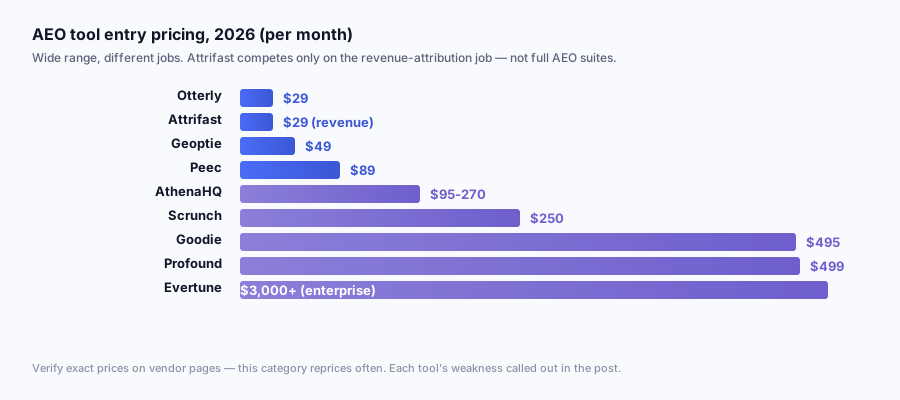
Here is the spread of every tool covered, sorted by published entry price, so you can see the shape of the market before we go tool by tool.
| Tool | Entry price (verified 1 Aug 2026) | Primary job | Self-serve trial? |
|---|---|---|---|
| Attrifast | $9.99/mo (Starter) | Attribution (revenue) | Yes, 7-day |
| AthenaHQ | $0 (Essential) / $295/mo (Starter) | Optimization + monitoring | Free tier |
| AirOps | $0 (Solo); paid tiers unpriced | Content ops + visibility | Free Solo tier |
| Airefs | $24/mo annual ($29 monthly) | Monitor + execute | Yes, 7-day on Pro |
| Otterly.ai | $29/mo (Lite) | Monitoring | Yes, length not published |
| Geoptie | $49/mo ($41/mo annual) | Optimization + monitoring | No trial advertised |
| SEOcrawl | EUR 33/mo billed yearly (Starter) | SEO + GEO suite | Yes, 14-day, no card |
| Peec AI | $95/mo (Starter) | Monitoring | Yes, length not published |
| SE Visible (SE Ranking) | $99/mo (Basic; $79/mo annual) | Monitoring | Yes, 10-day |
| Scrunch AI | $250/mo (Core) | Monitoring (enterprise) | Yes, 7-day |
| Profound | $99/mo (Starter) / $399/mo (Growth) | Monitoring (enterprise) | Yes, on Growth |
| Goodie | $399/mo (Explorer) | Optimization + monitoring | Yes, 7-day |
| Cognizo | $499/mo (Platform) | Monitor + optimize + execute | No, demo-led |
| Evertune | $800/mo (Pro) | Monitoring (enterprise) | No, demo-led |
Two health warnings on this table. First, prices and tiers move fast here — several of these repriced in the last two quarters — so treat every number as "verify on the vendor page before you sign." Every pricing page is linked in the References section; SE Visible's was read on 28 September 2026, when it was added. Second, above the tiers shown, Profound, AthenaHQ, Scrunch, Goodie, Evertune, Peec, Otterly, SE Visible, SEOcrawl and AirOps all switch to quote-only Enterprise plans with no published price. Any article that prints a specific enterprise number for these vendors made it up; I checked, and the numbers are not on their sites.
How to read these tables: the AI-engine coverage problem
One column on every comparison site is "AI engines supported," and it is the most misleading number in the category. The reason: base tiers almost never include the engines the homepage advertises, and the long-tail engines (Gemini, Google AI Mode, Claude, Copilot, Grok, DeepSeek, Meta AI) are where the add-on fees hide.
Here is the honest engine coverage by tool, noting which engines are gated behind paid add-ons:
| Tool | ChatGPT | Perplexity | Google AI Overviews | Gemini | Claude | Copilot | Long-tail (Grok/DeepSeek/Meta) |
|---|---|---|---|---|---|---|---|
| Profound | Yes (all tiers) | Growth ($399) + | Growth ($399) + | Enterprise | Enterprise | Enterprise | Enterprise (Grok, DeepSeek) |
| Cognizo | Yes (All Tiers) | Yes (All Tiers) | Yes (All Tiers) | Yes (All Tiers) | 1 of your 5 picks | Yes (All Tiers) | Yes (All Tiers) |
| Otterly.ai | Yes (all tiers) | Yes (all tiers) | Yes (all tiers) | Add-on ($9-$149/mo) | Add-on ($29-$439/mo) | Yes (all tiers) | No |
| SE Visible | Yes (all plans) | Yes (all plans) | Yes (all plans) | Yes (all plans) | Not yet (announced) | No | No |
| Peec AI | 1 of your 3 picks | 1 of your 3 picks | 1 of your 3 picks | 1 of 3, or +$30-$140/mo | Enterprise only | 1 of 3, or +$30-$140/mo | Enterprise only (DeepSeek, Qwen, Mistral) |
| Scrunch AI | Core ($250) | Core ($250) | Core ($250) | Enterprise | Enterprise | Core ($250) | Enterprise (Grok, Meta) |
| AthenaHQ | Free tier | Free tier | Free tier | Free tier | Free tier | Starter ($295) | Starter (Grok) |
| Evertune | Yes | Yes | Yes | Yes | Yes | Yes | Not itemised publicly |
| Goodie | Explorer ($399) | Explorer ($399) | Explorer ($399) | Pro (unpriced) | Enterprise | Pro (unpriced) | Enterprise (Meta, DeepSeek, Grok) |
| Geoptie | Yes | Yes | Yes ("Google AI") | Not itemised | Yes | Not listed | Not listed |
| SEOcrawl | Starter (only LLM at entry) | Growth + | Growth + | Growth + | Growth + | Growth + | Enterprise ("all LLMs") |
| Airefs | Yes (all tiers) | Traffic + crawler only | Add-on (+$10-$30/mo) | Traffic + crawler only | Traffic + crawler only | Traffic + crawler only | No |
| Attrifast | Yes (referral) | Yes (referral) | Yes (referral) | Yes (referral) | Yes (referral) | Yes (referral) | Detected via referer list |
Three cautions on this table. First, Attrifast is in a different column conceptually — it does not "monitor citations," it detects referral sessions from those engines and ties them to revenue, which is the attribution job, not the monitoring job. Second, "supports an engine" can mean anything from "samples it 100 times for statistical significance" (Evertune) to "checks it once a week" (cheaper tiers). Sampling frequency matters as much as the engine list, because LLM answers are probabilistic and a single daily snapshot is noisy.
Third, and this is the one that costs money: the engine count on a vendor's homepage is almost always the Enterprise count. Profound advertises nine answer engines; its $99 Starter tracks one. Goodie advertises eleven; its $399 Explorer tracks three. SEOcrawl says "all LLMs included"; its entry plan includes ChatGPT. AthenaHQ is the honourable exception — five engines are live on its free tier — and SE Visible is the other: the five engines it lists (ChatGPT, Perplexity, AI Overviews, Gemini and Google AI Mode, which this table has no column for) are the five every plan gets. Read the per-tier column on the pricing page, never the marketing page.
And a footnote specific to the Airefs row, because it is the one row here where "supported" splits cleanly in two. Prompt tracking — did an engine cite you — runs on ChatGPT and, as a paid add-on, Google AI Overview. Everything else is traffic and crawler detection: it tells you Claude sent a visitor or ClaudeBot read a page, not that Claude recommended you. Additional prompt-tracking engines are "available on request," which is unpriced, which by this article's standard means do not budget for them.
Plotted side by side, the gap between the two columns is the whole problem: Peec, Goodie and Profound each gate eight engines behind a tier upgrade, while Evertune, SE Visible and Geoptie hand you their full engine list at the door.
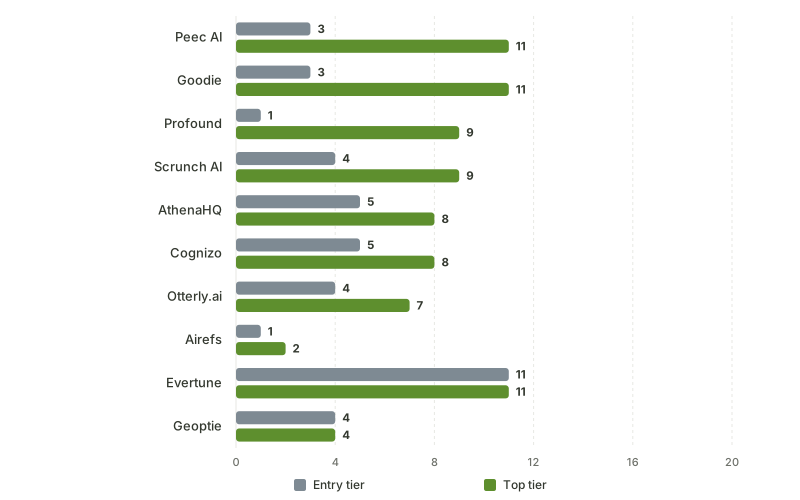
Source: Engine counts read off the 'Engines (entry / top)' column of the master comparison matrix in this article; vendor pricing pages verified 1 August 2026 (SE Visible 28 September 2026). Airefs is counted on prompt-tracking surfaces only (1 at entry, 2 with the AI Overview add-on)
Now, tool by tool. I will keep the same shape for each: who it is for, real pricing, what it does well, the specific weakness, and a verdict.
One note on the order, because you should know the bias before you read it. This list is not sorted by price or by monitoring depth. It is sorted by how I would shortlist for the job I think most buyers are actually failing at — proving the AI traffic paid — followed by the platforms that lead on execution and monitoring. I built the tool at number one, and I say so in its section along with everything it cannot do. If you only want the monitoring job, start at number two and read the master matrix; the ranking will not fight you.
1. Attrifast — the revenue-truth layer the rest of the category leaves open
Disclosure before anything else: I built this one, so read its weakness section as carefully as the pitch — it is as blunt as everyone else's here.
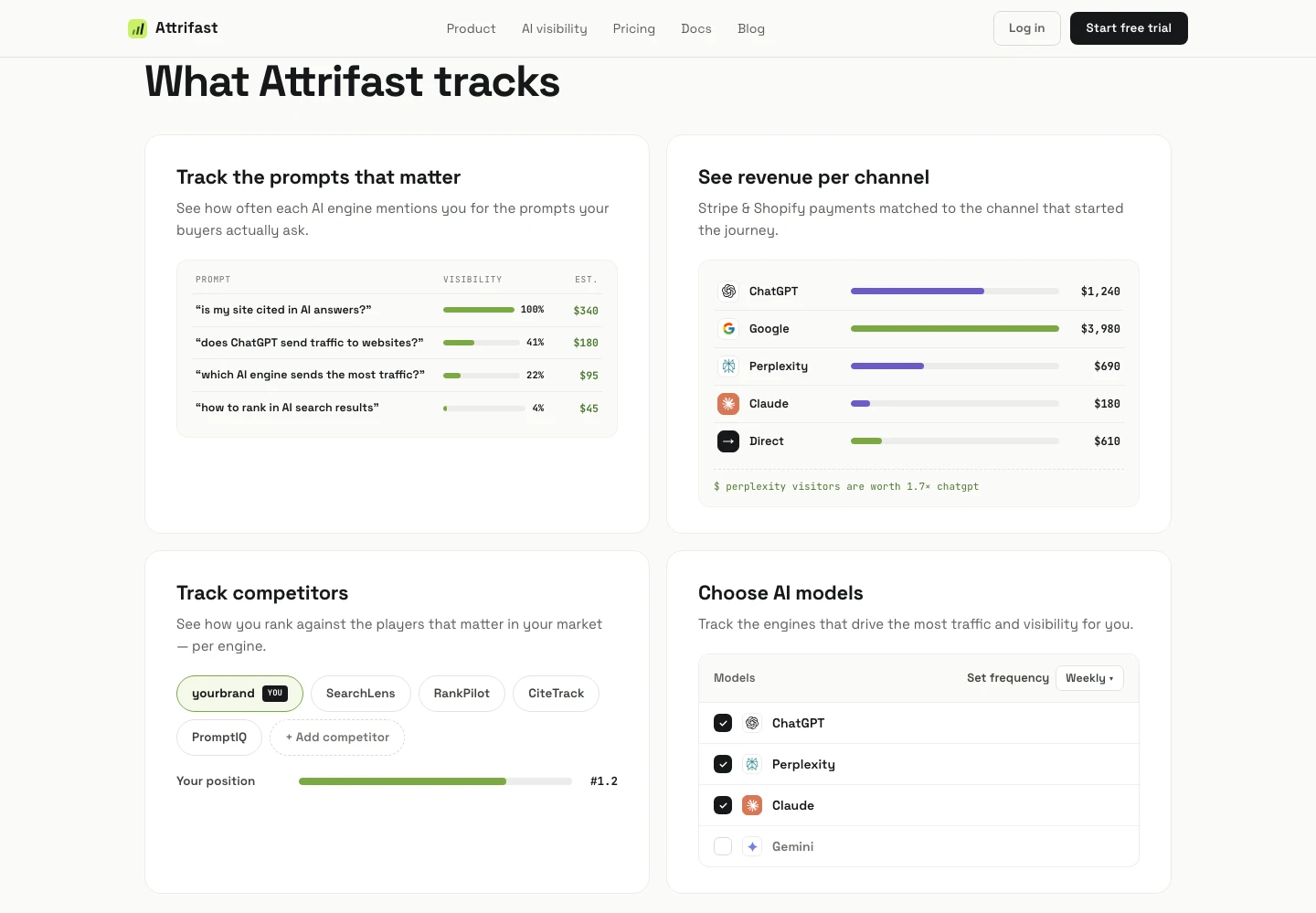
Every other tool on this list is bought alongside your analytics. Attrifast is the analytics. It is the traffic tool your marketing team already needs — channels, referrers, campaigns, geography down to city, device, browser, OS — with two things bolted into the same dashboard rather than sold as a second subscription: an AI-visibility layer that tracks which prompts cite you, and a server-side join from the session to a paid Stripe invoice. That last one is the job this category is quietly failing at, and it is why this is first on the list. If citation share is the number you are optimising and nobody has yet shown you the revenue line underneath it, start here.
Who it is for: SMB SaaS and ecommerce teams who would otherwise be paying for GA4's blind spots plus a separate AI monitor, and who need the AI traffic tied to money rather than modelled.
| Aspect | Detail |
|---|---|
| Price | Starter $9.99/mo ($99.90/yr); Pro $49/mo ($490/yr) |
| Trial | 7-day free trial. There is no free tier — the trial makes the first charge $0, it does not make the plan free |
| Job | All three: web analytics, AI visibility, and revenue attribution in one dashboard |
| Analytics | Visitors, sessions and revenue by channel, referrer, campaign and landing page; country, region and city; device, browser and OS — the GA4 surface, without the sampling or the consent banner |
| AI surfaces | AI traffic as its own KPI with its share of total; prompt-level citation counts; the sources AI engines actually read; and an AI-crawler log covering GPTBot, ClaudeBot, PerplexityBot and friends |
| Revenue | Per-engine revenue joined server-side to a Stripe Checkout via metadata — booked, not modelled |
| Cookies | None; first-party, no consent banner in most jurisdictions |
| Engine detection | ChatGPT, Perplexity, Claude, Gemini, Copilot via server-side referer fingerprinting, flagged as AI in the referrer list rather than buried in Direct |
| Starter | 1 website, 50k events/mo, 1 seat, full history retained; 10 tracked prompts auto-scanned every 30 days, 3 competitors |
| Pro | 3 websites, 100k events/mo, 5 seats, full history retained; 30 tracked prompts auto-scanned every 10 days, 8 competitors, plus sentiment, position, topics and competitor gap analysis |
| What it is NOT | A citation monitor at Profound's prompt depth, a schema grader, or a content writer |
Why it exists: Every monitoring tool here that reports "AI revenue" derives it from a GA4 integration. GA4 buckets 65-82% of ChatGPT visits into Direct/(none) because the AI client strips the Referer header [1], so that revenue figure is a systematic undercount dressed as a measurement. Attrifast does server-side referer fingerprinting against a known AI-engine domain list, behavioral fingerprinting for unreferred deep-page entries, and a server-side join from the session to a Stripe Checkout via metadata. The output is revenue per AI engine you can reconcile to your payout, not a model. Across the customer base in Q1 2026, ChatGPT-attributed sessions showed median RPV of $0.84 versus $0.51 for Google organic on the same pages — a number that only exists once the session is tied to a transaction.
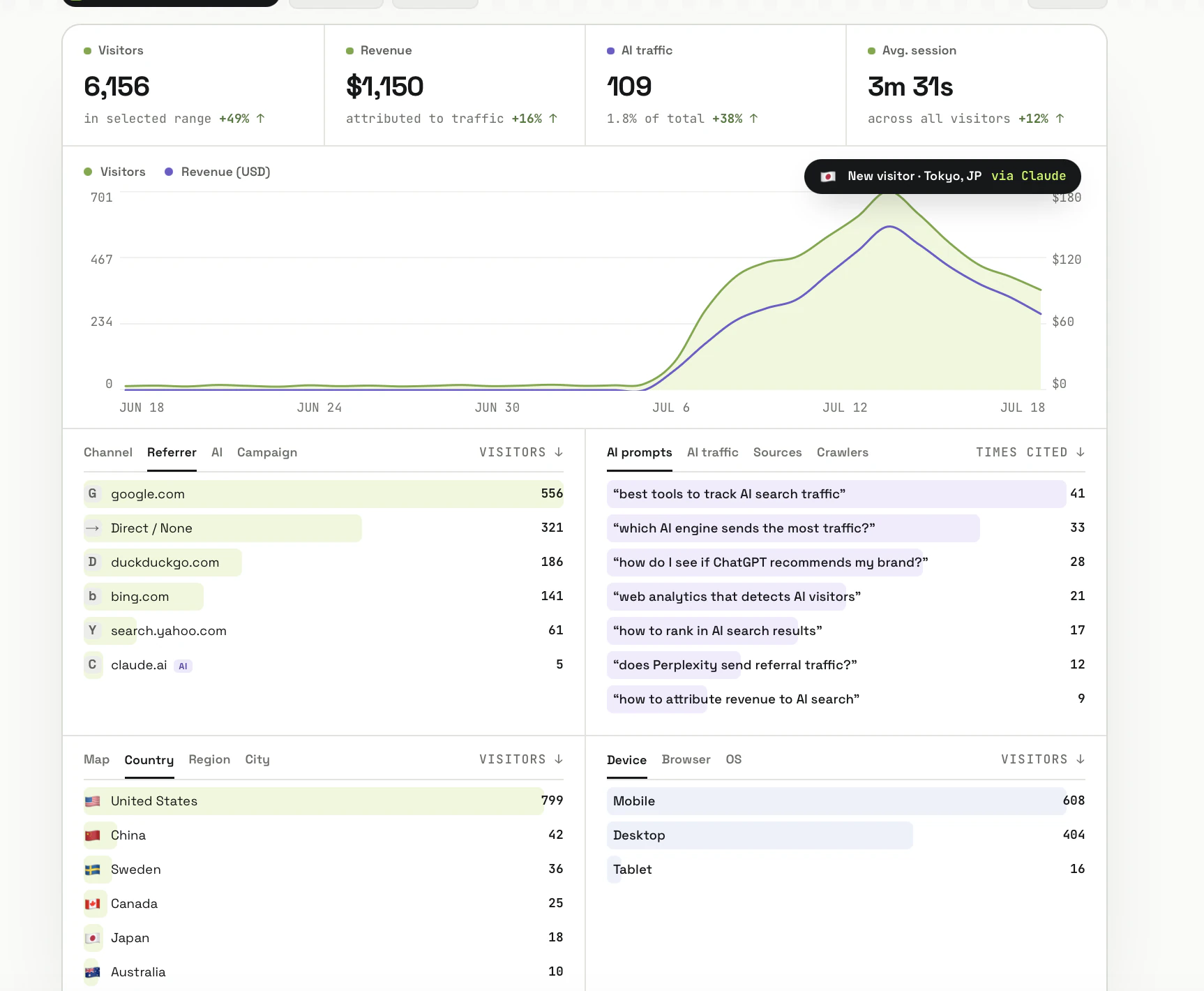
That screenshot is the whole argument in one frame. Same dashboard, same date range: the visitor line and the revenue line on one chart, AI traffic broken out as its own KPI with its share of total, claude.ai sitting in the referrer list with an AI badge instead of vanishing into Direct, and the prompts that cited us counted next to it. No second tool, no export, no join to reconcile by hand.
The specific weakness — and I mean this: prompt depth. You get 10 tracked prompts auto-scanned every 30 days on Starter and 30 every 10 days on Pro. That is enough to watch the questions your buyers actually ask; it is nowhere near a dedicated monitor, and it will not research prompts for you, grade your content or write it. If your question is "am I cited across 300 prompts on nine engines, sampled 100 times each?", buy Evertune, Peec or Profound — Attrifast cannot answer that at scale, and I would rather say so than lose you at renewal. The revenue join is also Stripe- and Shopify-native, so if you run payments through anything else, it does not apply to you today.
| Attrifast pros | Attrifast cons |
|---|---|
| Analytics, AI visibility and revenue in one dashboard | Prompt depth is small next to the dedicated monitors |
| Booked Stripe revenue per AI engine, not a GA4 model | Stripe/Shopify only (other processors: no revenue join) |
| AI referrals labelled as AI, not buried in Direct | Starter is 1 site, 1 seat, 10 prompts |
| Server-side AI-crawler log included at $9.99 | No content grading, no prompt research, no writer |
| Cookieless, no consent banner, full history retained | Built for SMB scale, not an enterprise rollout |
Verdict: Buy it to replace GA4 and answer the revenue question at the same time. If you also need prompt monitoring at hundreds-of-prompts scale, run it underneath Peec or Profound — the two jobs do not overlap, and this is the half nobody else does at the transaction level. See the mechanics in revenue attribution and the AI visibility score, plus the engine-specific guides for tracking ChatGPT traffic, Perplexity traffic, and Google AI Overviews.
2. Cognizo — monitoring, optimization and agent-run execution in one platform
Cognizo is the tool on this list that refuses to stop at the dashboard. It tracks brand presence across the major answer engines, then generates the content that closes the gaps it finds — and on its Done-for-You tier, AI agents do that work for you end to end: market research, prompt planning, content production, publishing.
Who it is for: Teams that want the work done, not another dashboard to staff.
Here is the published ladder, read off cognizo.ai/pricing on 5 August 2026 [21]:
| Plan | Price | What it is |
|---|---|---|
| Platform | Starting at $499/mo | Self-directed. 150 prompts tracked, choose 5 platforms, 8 AI-optimized articles/mo, prompt research and search volumes, AI traffic analytics, ChatGPT Ads, customer success partner |
| Done-for-You | Starting at $899/mo | Flagship tier. Agents handle market research, prompt planning, content production and publishing — 180 published articles per 6 months, lead tracking and attribution, weekly reporting, AI crawler access and protection |
| Enterprise | Custom, quote only | Tracks all platforms, tailored content volume, multiple brands and workspaces, custom integrations and API access, dedicated AI search strategist, SSO/SLA |
Note the "starting at" on both paid tiers — these are floors, not fixed prices, so the number you are quoted after the demo may be higher.
What it does well: This is the broadest single-vendor scope in the comparison. The Answer Engine Insights layer covers ChatGPT, Perplexity, Gemini, Google AI Overviews, Google AI Mode, Claude, Meta AI and Grok, and reports share of voice, sentiment, topical authority, citation analysis and competitive benchmarking rather than a single visibility score. The content layer turns the prompts you are losing into briefs, outlines and drafts inside the platform, so the gap report and the fix live in the same tool — the loop most AEO programs stall on. Prompt Volumes shows what buyers actually ask AI rather than what they type into Google. The AI Traffic Analytics layer reads AI crawler activity from your own site — which bots hit which pages, how often, with what intent — which is a genuinely server-side signal, not a GA4 derivative. And Cognizo sells ChatGPT advertising alongside organic tracking, with competitor ad copy and the OpenAI Conversions API wired into Google Ads and Search Console. Nobody else on this list offers that, and given OpenAI is now running ads inside ChatGPT, it is the one feature here that will look obvious in hindsight.
On results, its published Hat Club case study is the most specific on this list: AI visibility from roughly 6% at onboarding to more than 50% consistently in four months, peaking at 73% on tracked prompts, and 20x growth in revenue attributed to AI discovery, primarily ChatGPT [22]. That is vendor-reported and not independently audited — as every case study on every vendor site in this article is — but it names the numbers, the timeframe and the person, which most do not.
The specific weakness: price and the door you come in through. At $499/mo, only Evertune's $800 Pro tier starts higher, and there is no free tier and no self-serve signup — every plan on the page is a "Book a demo" button, so evaluation starts with a free AEO audit rather than a trial you run yourself. Watch the per-tier engine column too, the same way you should with everyone here: the Platform tier is "choose 5 platforms," and "track all platforms" is an Enterprise line item. And like every monitoring tool in this comparison, the referral half of its revenue picture connects through GA4 sessions, so it inherits the Direct/(none) blind spot described later in this article — Cognizo's own crawler analytics are server-side, but the session-to-revenue link is not a transaction join.
| Cognizo pros | Cognizo cons |
|---|---|
| Agents run research, production and publishing on Done-for-You | Second-highest entry price on this list |
| Monitoring, content and traffic analytics in one platform | No free tier; demo-led, audit-first evaluation |
| Server-side AI crawler analytics, not just GA4 | Entry tier is 5 platforms, not all of them |
| ChatGPT Ads planning and measurement — unique here | Both paid prices are "starting at," and Enterprise is quote-only |
Verdict: A strong pick, and the one I would shortlist first if the constraint is execution rather than insight. Platform at $499/mo if you want to run it yourself; Done-for-You at $899/mo if the real problem is that nobody on the team has time to act on a gap report, which is where most AEO programs actually die. Budget for a demo cycle rather than a Friday-afternoon trial.
3. Airefs — the lowest AI-visibility entry price on this list, and it executes
Airefs does the same job Cognizo does — find the gap, then close it — for a twentieth of the entry price and without a sales call. It tracks brand mentions in ChatGPT and Google AI Overview, exposes every URL the engines cited on your tracked prompts, and turns those citations into three queues you can act on: articles to publish, discussions to join, and third-party pages to get placed on. Each queue ships with the work part-done — a written article, a drafted comment, a drafted outreach email with the contact attached.
At $24/mo billed annually it is also the cheapest paid entry to AI visibility in this comparison — a dollar under Otterly's $25 annual Lite price, $17 under Geoptie's $41, and the only tool anywhere near that price that produces content rather than reporting on it. That is the loop this article says most AEO programs die on, for less than the cost of the monitoring subscription that surfaces the gap. The catch is the engine list, and it is a real one — see the weakness section, because it will disqualify Airefs for some readers on this list.
Who it is for: Bootstrapped SaaS and small marketing teams whose bottleneck is nobody having time to act on a gap report, and whose buyers are on ChatGPT and Google rather than the long tail.
Here is the published ladder, read off getairefs.com/pricing on 10 August 2026 [23]. Annual billing saves 20% and is the view the site shows by default, so the annual column is the one to price against:
| Plan | Billed annually (-20%) | Monthly | Prompts | Refresh | Articles/mo | Domains / seats |
|---|---|---|---|---|---|---|
| Lite | $24/mo ($288/yr) | $29/mo | 25 | Every other day | 1 | 1 / 1 |
| Pro | $49/mo ($588/yr) | $59/mo | 60 | Daily | 3 | 3 / 2 |
| Expert | $83/mo ($996/yr) | $99/mo | 150 | Daily | 6 | Unlimited / 20 |
| Agency | Custom, quote only | — | Custom | Custom | Custom | Custom |
Add-ons, published on the same page: Google AI Overview tracking +$10/$20/$30 per month by tier, and extra articles at $7 each on Pro and above. Two managed services carry published floors rather than quote-only buttons: Airefs Agency from $300/mo, and Brand Mentions at $250/mo flat or $100 per placement. A 7-day free trial runs on Pro and includes one article.
Worth noting against this article's own metering complaint: the opportunity queues — discussions, backlinks, article recommendations — are unlimited on every tier. What is metered is prompts, articles, and Reddit alerts (3 / 10 / 30).
What it does well: It ships work, not findings. The article recommendations are ranked by citation evidence — which pages AI actually pulled from on the prompts where you lost — and the article gets written and delivered on a schedule you set, publish-ready. Discussions merges two sources most vendors sell separately: threads AI cited while answering your prompts, and Reddit threads matching your keyword alerts, each with a generated draft reply. Backlinks lists the third-party domains AI keeps citing in your category, ranked by citation count, with contact details and a drafted email.
The traffic layer is also worth flagging in the context of this article's central argument. Airefs does not read AI traffic from GA4 — it runs its own first-party server-side tracker plus an AI crawler log covering GPTBot, ClaudeBot, PerplexityBot, Google-Extended and the rest. So its AI traffic number does not inherit the Direct/(none) blind spot described later in this article. It still is not a revenue number, because there is no payment-processor join — but the traffic underneath it is measured, not modeled. There is also an MCP server from the $49 tier, which puts the visibility data inside Claude or ChatGPT for anyone who wants to query it directly.
The specific weakness: the engine list, and I would not buy it without reading this paragraph twice. Prompt tracking covers ChatGPT and Google AI Overview only — and AI Overview is a paid add-on, not included, so the honest price for both surfaces is $34/mo on Lite annually, or $39 paying monthly. There is no Claude, Gemini, Perplexity, Copilot or long-tail prompt monitoring on any published tier; Airefs says additional LLMs are available on request, which means unpriced, which by this article's standard means do not budget for it. Perplexity, Claude and Gemini appear only in the traffic and crawler analytics, which is a different measurement — it tells you they sent you visitors, not that they cited you. Twenty-five prompts on Lite is tight in the same way Otterly's fifteen is, and Lite refreshes every other day rather than daily. Articles are metered at 1/3/6 a month, so "it writes your content" has a ceiling before the $7-per-article overage kicks in. And there is no revenue join — Airefs measures the click, not the invoice.
| Airefs pros | Airefs cons |
|---|---|
| Lowest paid AI-visibility entry on this list ($24/mo annual) | Prompt tracking is ChatGPT + Google AI Overview only |
| The only tool at that price that executes rather than reports | AI Overview is a $10-$30/mo add-on, not included |
| Articles, comment drafts and outreach emails, all citation-sourced | Claude, Gemini, Perplexity, Copilot: no prompt tracking at any published price |
| First-party server-side AI traffic — not a GA4 derivative | 25 prompts on Lite; every-other-day refresh at that tier |
| Opportunity queues unmetered on every tier | Articles capped at 1/3/6 per month, then $7 each |
| Self-serve, 7-day trial, managed tier published at $300/mo | No revenue join — measures the click, not the invoice |
Verdict: Buy it if the thing stopping your AEO program is that nobody has time to write the article, post the comment or send the email — and if your buyers live on ChatGPT and Google rather than the long tail. At $24/mo it is the cheapest way to buy the visibility job on this list, the only tool at that price that does the execution job, and its $300/mo managed tier undercuts Cognizo's Done-for-You by 3x with a published number instead of a quote. Do not buy it as a monitor: on engine breadth it is beaten by tools costing the same or less, and it says so on its own pricing page rather than advertising an enterprise engine count it will not sell you.
4. SE Visible by SE Ranking — standalone AI visibility tracking, five engines on all plans
SE Visible is SE Ranking's standalone AI brand-visibility platform, built for focused AI visibility tracking rather than bolted onto the SEO suite. It monitors how a brand shows up in AI-generated answers — mentions, share of voice, sentiment, prompts, and the sources behind those answers — across ChatGPT, Gemini, AI Mode, AI Overviews and Perplexity.
Who it is for: Agencies running AI visibility for clients, and in-house search, brand and PR teams that have to report whether the brand appears in AI answers and how it is described.
Here is the published ladder, read off visible.seranking.com on 28 September 2026 [11]. Annual billing saves 20%:
| Plan | Price | Engines | Projects | Prompts tracked daily | AI answers analyzed/mo |
|---|---|---|---|---|---|
| Basic | $99/mo list, $79/mo billed annually | 5 | 3 | 200 | ~30,000 |
| Core | $189/mo list, $151/mo billed annually | 5 | 5 | 450 | ~67,500 |
| Plus | $355/mo list, $284/mo billed annually | 5 | 10 | 1,000 | ~150,000 |
| Custom | Custom, quote only | Custom | Custom | Custom | Custom |
All three published plans track the same five engines. There are no engine add-ons and no model tiering; the plans scale on prompts, AI answers analyzed and projects — which makes it one of the few rows in the pricing-only table below where the sticker price is the real price. A 10-day free trial lets you see your own data before paying.
What it does well: SE Visible collects responses through a real browser session in the graphical interface, the same surface a person uses, rather than through API calls or answers reconstructed after the fact. Beyond presence, it reports sentiment, share of voice and average position, benchmarked against auto-suggested competitors topic by topic, and it shows the domains and URLs AI relies on, including the sources that cite a competitor but not you — the raw material for the optimization job. Metrics refresh daily, tracking can be set to a country, city or region, and the data pipes into Data Studio for auto-refreshing client reports.
The specific weakness: there is no Claude, Copilot, Grok, DeepSeek or Meta AI on any published plan yet; SE Visible says Claude is coming soon. It is built for visibility, so there is no revenue join: it tells you how AI describes and cites the brand, not which engine booked the sale. And it is not an SEO suite; rank tracking, audits, content and backlinks sit in SE Ranking, a separate product.
| SE Visible pros | SE Visible cons |
|---|---|
| Five engines on all plans, no engine add-ons | No Claude (announced) or Copilot tracking yet |
| Browser-session collection, not API calls | No revenue attribution |
| Sentiment, share of voice and source analysis | Focused on AI visibility — no SEO features |
| Daily tracking, local down to city or region | CSV export per widget; no PDF reports yet |
| Data Studio for client reporting |
Verdict: Shortlist it if you need broad engine coverage without pricing out add-ons, and if the question you answer to clients or leadership is how AI describes the brand and which sources shape that answer. Run an attribution layer alongside it if you also need revenue per engine.
Disclosure: SE Ranking sponsors this listing. Every figure above was read off visible.seranking.com on 28 September 2026.
5. Profound — the enterprise category leader
Profound is the name most people reach for when they say "AEO platform," and for enterprise it is the defensible default. It tracks brand visibility across ChatGPT, Perplexity, Google AI Overviews, and more, with a polished dashboard, a content-influence layer, and the kind of compliance posture (SOC 2, SSO/SAML) that enterprise procurement requires.
Who it is for: Large brands with a dedicated GEO or organic-search team — though its cheapest tier is now within reach of a small marketing team, with the caveats below.
Here is the published ladder, read off tryprofound.com/pricing on 1 August 2026 [2]:
| Plan | Price | Prompts / responses per month | Seats | Engines tracked |
|---|---|---|---|---|
| Starter | $99/mo, billed yearly (2 months free) | 50 prompts / 1,500 responses | 1 | ChatGPT only |
| Growth | $399/mo, billed yearly (2 months free) | 100 prompts / 9,000 responses | 3 | ChatGPT, Perplexity, Google AI Overviews |
| Enterprise | Custom, quote only | Custom | Custom | Up to 9 — adds Google AI Mode, Gemini, Copilot, Grok, DeepSeek, Claude |
A correction worth stating plainly, because this site published the wrong numbers before and other comparison articles still do: Profound has no "Lite" tier and no $499 plan. If you find a table quoting one, it is describing a ladder that does not exist on Profound's pricing page. Both published tiers are billed yearly, so the real commitment is $1,188/yr on Starter and $4,788/yr on Growth.
What it does well: Depth and polish. The competitive share-of-voice views, the breadth of the prompt library, and the Agent Analytics layer — which tracks AI-sourced traffic across unlimited domains and integrates with Cloudflare, Fastly, Vercel, Akamai and Google Analytics on every tier — are genuinely ahead of the cheaper tools.
The specific weakness: the Starter tier is a much thinner product than the price suggests. For $99/mo you get one answer engine (ChatGPT), one seat, one region, one language, no data exports, no API, no prompt-volume search and no ChatGPT Shopping. Everything most buyers picture when they picture Profound starts at $399/mo, and SSO, API access and ChatGPT Shopping are Enterprise-only with no published price. Profound does offer a free trial on Growth, so this is evaluable without a sales call — but the fullest version of the product is not. And like every monitoring tool here, its revenue picture leans on a GA integration, which inherits GA4's Direct/(none) blind spot.
| Profound at a glance | Rating |
|---|---|
| Monitoring depth (Growth and above) | Excellent |
| Engine breadth at entry tier | Poor (1 engine on Starter) |
| Engine breadth (Enterprise) | Excellent (9) |
| Ease of starting | Fair (free trial on Growth; Enterprise is sales-led) |
| SMB fit | Fair on price, poor on Starter's feature set |
| Revenue truth | Estimate only (via GA) |
Verdict: Buy Growth at $399/mo if you want the product people mean when they say "Profound." Treat Starter at $99/mo as a single-engine ChatGPT monitor, not a cheap version of the platform, and price the annual commitment rather than the monthly headline.
6. Evertune — enterprise monitoring at statistical scale
Evertune is the other serious enterprise contender. Its differentiator is statistical rigor: its own site states it "samples each prompt 100 times across every AI model" to capture true model behavior rather than a single noisy snapshot [4].
Who it is for: Brands running AI visibility as a funded channel rather than an experiment, with someone available to sit through a demo before they can buy.
Here is the published ladder, read off evertune.ai/pricing on 1 August 2026 [3]:
| Plan | Price | What is included |
|---|---|---|
| Pro | $800/mo | 100,000 prompts tracked across 11 AI models; daily, weekly or monthly frequency; global language and country tracking; 25 AI-optimized articles/mo; 3 onboarding sessions; affiliate advertising partnerships; AI retargeting |
| Enterprise | Custom, quote only | Everything in Pro plus a dedicated AI Success Manager, unlimited content generation, AI bot analytics for your domain, SSO |
I previously described Evertune's floor as "$3,000+/mo." That was wrong, and it materially misrepresented the tool — the published entry price is $800/mo, which puts it within range of a funded mid-market team rather than Fortune 500 only. Evertune also does not publish its funding total, its customer list, or any per-thousand-prompt cost comparison on its own site, so I have removed the figures this article used to carry for all three.
What it does well: The 100x sampling is the most statistically honest approach to a probabilistic problem in this whole list. If you care whether your "share of voice" number is signal or noise, this is the methodology to beat. On prompts-per-dollar, nothing else here is close: 100,000 prompts across 11 models for $800/mo is a different order of magnitude from Profound's 100 prompts at $399/mo, though the two vendors count "a prompt" differently enough that you should confirm the unit with each before comparing.
The specific weakness: every plan is demo-led. There is no self-serve signup, no free tier and no published trial, so you cannot see your own data without booking a call. Enterprise pricing is quote-only, so budget planning above $800/mo is guesswork until you talk to sales.
| Evertune at a glance | Rating |
|---|---|
| Sampling rigor (100x/prompt) | Best in category |
| Engine breadth | Excellent (11 models on Pro) |
| Published entry price | $800/mo |
| Ease of starting | Poor (demo required, no trial) |
| Revenue truth | Estimate (via integration) |
Verdict: Best-in-class methodology, and cheaper than its reputation. The demo wall, not the price, is what will stop a small team from buying it.
7. Peec AI — the mid-market sweet spot
Peec AI is the tool I most often recommend to mid-market teams that want real monitoring without enterprise pricing or enterprise sales cycles. It tracks how often your brand appears across ChatGPT, Google AI Mode, Google AI Overviews, Microsoft Copilot, Perplexity and Gemini, and benchmarks against competitors.
Who it is for: Mid-market in-house teams and agencies where speed and usability beat exhaustive engine coverage.
Here is the published ladder, read off peec.ai/pricing on 1 August 2026 [5]:
| Plan | Price | Prompts | Projects | Countries | Models included |
|---|---|---|---|---|---|
| Starter | $95/mo | 50 | 1 | 1 | any 3 of 6 |
| Pro | $245/mo | 150 | 2 | 3 | any 3 of 6 |
| Advanced | $495/mo | 350 | 5 | 3 | any 3 of 6 |
| Enterprise | Custom, quote only | Custom | Unlimited | Unlimited | Up to 11, adds Claude Sonnet 4, GPT-5 Search, DeepSeek, Qwen, Mistral |
This article previously showed Peec as $89 / $199 / $499 with a 25-prompt Starter. That ladder is out of date on every line: the entry price is $95, the Starter tier now includes 50 prompts, there is an Advanced tier in between, and Enterprise is quote-only rather than $499. All plans include unlimited users and daily tracking, and annual billing saves 15% — Peec's FAQ confirms the discount. Peec advertises a free trial but does not publish its length, so I am not going to state one.
What it does well: Fast setup, clean UI, and unlimited users on every tier, which is genuinely rare at this price — Profound gives you one seat for $99 and three for $399. Countries and languages are not metered either: Peec's FAQ states pricing is tied to prompts, not regions, so a multi-market brand is not charged extra for coverage.
The specific weakness: you pick three models and pay for the rest. Extra models are add-ons at +$30/mo on Starter, +$70/mo on Pro and +$140/mo on Advanced [5], so the real cost of broad engine coverage climbs well past the sticker. Claude and the long-tail models (DeepSeek, Qwen, Mistral, GPT-5 Search) are not purchasable at all below the quote-only Enterprise tier. If you need six engines tracked, the $95 Starter quietly becomes a $185/mo plan and still cannot give you Claude.
| Peec pros | Peec cons |
|---|---|
| Unlimited users on every tier | Extra models are paid add-ons |
| Countries and languages not metered | Base tier is 3 of 6 engines |
| Fast setup, clean UI | No revenue join (visibility only) |
| Self-serve, free trial offered | Claude and long-tail are Enterprise-only |
Verdict: The best value monitoring tool for mid-market, as long as you budget for the model add-ons up front and do not need Claude.
8. Otterly.ai — the most accessible monitoring tool
Otterly.ai is the lowest credible entry point for pure AI-visibility monitoring. At $29/mo it monitors brand mentions across four engines — ChatGPT, Google AI Overviews, Perplexity and Microsoft Copilot — with setup measured in minutes.
Who it is for: Solo operators, small teams, and anyone who wants to dip a toe into AI monitoring without a sales call.
Here is the published ladder, read off otterly.ai/pricing on 1 August 2026 [6]:
| Plan | Monthly | Billed annually (15% off) | Prompts | GEO URL audits/mo |
|---|---|---|---|---|
| Lite | $29/mo | $25/mo | 15 | 1,000 |
| Standard | $189/mo | $160/mo | 100 | 5,000 |
| Premium | $489/mo | $422/mo | 400 | 10,000 |
| Enterprise | Custom, quote only | Custom | Customizable | Custom |
Two corrections to what this article used to say. There is no $989 "Pro" tier — the ladder tops out at Premium before jumping to quote-only Enterprise. And the GEO audit is not gated: Lite includes 1,000 URL audits a month, not zero.
The engine add-on pricing is published in full, which is more transparency than most of this list offers. Per month, on top of your plan:
| Add-on engine | Lite | Standard | Premium |
|---|---|---|---|
| Google AI Mode | $9/mo | $59/mo | $149/mo |
| Google Gemini | $9/mo | $59/mo | $149/mo |
| Claude | $29/mo | $109/mo | $439/mo |
| +100 extra prompts | not available | $99/mo | $99/mo |
Otterly tracks which URLs are actually cited, so if ChatGPT mentions your brand but links a competitor's comparison article, that shows up — useful for content-gap work [6].
Priced out per tier, the add-on ladder climbs faster than the plan ladder — Claude on Premium is $439/mo, more than twice the Standard plan sitting one rung below it.
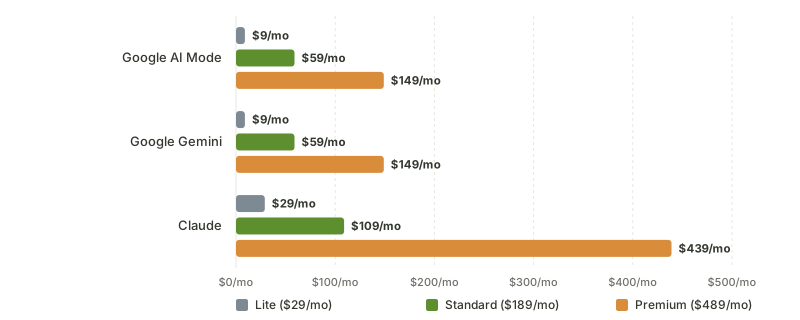
Source: Otterly.ai's published add-on table in this article, read off otterly.ai/pricing on 1 August 2026. The '+100 extra prompts' row is omitted because it is not purchasable on Lite
What it does well: Price, speed, and the citation-URL detail. Four engines on the $29 tier is the best entry-level engine coverage here — Profound gives you one for $99. Unlimited team members on every tier, including Lite.
The specific weakness: 15 prompts on the Lite tier is genuinely tight — it covers one brand check and little else — and you cannot buy extra prompts on Lite at all, so outgrowing it means a jump to Standard at $189, a 6.5x increase. Claude on Premium costs $439/mo, more than doubling that plan. Otterly's FAQ confirms a free trial for new users but does not state its length or whether a card is required, so I am not going to claim either.
| Otterly pros | Otterly cons |
|---|---|
| Lowest paid entry ($29), 4 engines included | 15 prompts on Lite is very tight |
| Add-on prices published per tier | Cannot buy extra prompts on Lite |
| Unlimited team members on every tier | Lite to Standard is a 6.5x price jump |
| Setup in minutes, self-serve | No revenue attribution |
Verdict: Best cheap entry for monitoring. Expect to graduate to Standard quickly, and price the engine add-ons before you commit.
9. Scrunch AI — monitoring plus an agent-experience layer
Scrunch AI is a monitoring platform with an interesting extra: the Agent Experience Platform (AXP), an infrastructure layer that sits between your site and AI crawlers and serves compressed, structured content optimized for LLM consumption. It also leans into hallucination detection — flagging when AI engines describe your brand inaccurately.
Who it is for: Mid-to-enterprise brands and agencies that want monitoring plus a technical layer for AI crawlers.
Here is the published ladder for brands, read off scrunch.com/pricing on 1 August 2026 [7] (scrunchai.com now 301-redirects there):
| Plan | Price | Prompts | Engines | Also included |
|---|---|---|---|---|
| Core | $250/mo | 125 | ChatGPT, Perplexity, Google AI Overviews, Copilot (4) | 5 site audits/mo, 1 brand workspace, 5 licenses, 1 country, 3 personas, 2 languages, 5 competitors |
| Enterprise | Custom, quote only | Custom | 9 — adds Claude, Gemini, Meta AI, Google AI Mode, Grok | AXP, full site audits, API, MCP, Looker Studio, SSO, dedicated account team |
Two corrections. There is no $500 "Growth" tier and no $500 "Agency Core" tier — Scrunch publishes exactly two brand plans, Core and quote-only Enterprise. And Scrunch does offer a 7-day free trial on Core; the "no free trial at all" line this article used to carry was wrong.
The more important correction is on AXP. The Agent Experience Platform is the reason most people look at Scrunch, and it is not included in the $250 Core plan — the comparison table marks it as Enterprise-only. Core also excludes Looker Studio, API access, MCP and CLI access, and caps you at one page optimization per month.
What it does well: The AXP crawler layer and hallucination/sentiment detection are features most monitoring tools lack, and nine engines on Enterprise is among the broadest coverage here. Query fan-out analysis and funnel-stage breakdowns are unusual at any price.
The specific weakness: the $250 Core tier is a demo of the thing you actually want. AXP, the API and multi-domain bot tracking all sit behind a quote-only wall, so the feature that differentiates Scrunch from a cheaper monitor has no published price at all. One country and two languages on Core also makes it a poor fit for multi-market brands, where Peec charges nothing extra for regions.
| Scrunch differentiators | Where it lags |
|---|---|
| AXP crawler-layer control (Enterprise) | AXP not included in the $250 Core plan |
| Hallucination and sentiment detection | Enterprise price is quote-only |
| 9 engines on Enterprise | Core is 1 country, 2 languages |
| 7-day free trial on Core | No transaction-level revenue |
Verdict: Strong for teams that specifically want crawler-layer control and hallucination monitoring — but budget for Enterprise, because Core does not include the crawler layer. Take the 7-day trial before you assume the $250 tier does what the marketing site describes.
10. AthenaHQ — monitoring with an optimization agent and revenue claims
AthenaHQ positions itself as "agents to win on AI search," blending monitoring with a content-optimization agent and a unified GEO score that combines citation count, sentiment, traffic impact, and query types. Notably, it advertises revenue attribution via direct Shopify and GA4 integrations — one of the few monitoring-side tools to claim the attribution job.
Who it is for: Mid-market and growth-stage brands that want monitoring and optimization in one tool, especially ecommerce on Shopify.
Here is the published ladder, read off athenahq.ai/plans on 1 August 2026 [8]:
| Plan | Price | Credits | Engines | Notable |
|---|---|---|---|---|
| Essential | Free ($25 free credit) | 300 | ChatGPT, Perplexity, AI Overviews, Gemini, Claude | Unlimited members, prompt/response analysis, Athena AI agent |
| Starter | $295/mo (Annual saves 17%) | 3,600 | 8 — adds AI Mode, Copilot, Grok | Content optimization agent, GA4 + GSC, Shopify + Webflow, CSV export |
| Enterprise | Custom, quote only | Custom | 8+ | Athena Citation Engine, SAML/OIDC SSO, persona targeting, multi-region, BI dashboards |
Three corrections to what this article previously published. AthenaHQ has no "Discover/Lite" tier at ~$95–$270 and no "Growth" tier at ~$545 — the ladder is Free, $295, and quote-only. It does have a genuinely free tier, so "no free trial" was doubly wrong. And the Enterprise plan carries no published price, so the "$2,000+/mo" figure this article used to print had no source.
One thing to price carefully: on Starter, API access and extra credits are paid add-ons billed on top of the $295, and AthenaHQ does not publish what they cost. A credit is one AI response, so 3,600 credits is your real usage cap.
What it does well: the free Essential tier is the most generous entry point in this comparison — five engines live, unlimited members, no card mentioned. That is more engine coverage for $0 than Profound gives you for $99. The single unified GEO score is coherent, and the content-optimization agent pushes it into the optimization job. The Shopify/Webflow and GA4/GSC integrations are a real attempt at the revenue question.
The specific weakness: the jump from free to $295/mo is the steepest free-to-paid cliff here, and the add-on pricing for API access and extra credits is not published, so you cannot fully budget Starter from the pricing page. More importantly for the revenue claim: attribution via GA4 inherits GA4's Direct/(none) AI blind spot, so "turning AI citations into a performance channel" via GA4 is an estimate, not a transaction-level number.
| AthenaHQ pros | AthenaHQ cons |
|---|---|
| Free tier with 5 engines live | $0 to $295 is a steep cliff |
| 8 engines on the $295 Starter | API and extra credits are unpriced add-ons |
| Content optimization agent | GA4 revenue is modeled, not booked |
| Shopify, Webflow, GA4, GSC integrations | Enterprise is quote-only |
Verdict: Start on the free tier — it is the cheapest way in this whole article to see five engines' worth of your own data. Treat its GA4-based revenue numbers as modeled, not booked, and get add-on pricing in writing before you commit to Starter.
11. Goodie — the deepest optimization and broadest engine coverage
Goodie leans hardest into the optimization job. Alongside visibility monitoring it ships a closed-loop "research → monitor → act → measure" workflow with optimization actions and revenue attribution, and at the top of its ladder it covers the broadest engine list of anyone here.
Who it is for: Brands that want monitoring and built-in content execution in one platform, and — at Pro and above — care about long-tail engine coverage (DeepSeek, Grok, Rufus, Sparky).
Here is the published ladder, read off higoodie.com/pricing on 1 August 2026 [14]:
| Plan | Price | Engines tracked | Prompts / AI responses per month |
|---|---|---|---|
| Explorer | $399/mo (yearly saves 20%) | 3 — ChatGPT, AI Overviews, Perplexity | 100 prompts / 3,000 responses |
| Pro | Not published — demo only | 7 — adds Gemini, Copilot, Rufus, Sparky | 250 prompts / 7,500 responses |
| Enterprise | Not published — demo only | Up to 11 — adds Claude, AI Mode, Meta, DeepSeek, Grok | 500+ prompts / 15,000+ responses |
Three corrections. Goodie's entry price is $399/mo, not $495. Its entry tier tracks three engines, not eleven — the eleven-model list belongs to the quote-only Enterprise plan, and Goodie's own comparison table makes that explicit. And Explorer does include a 7-day free trial with a self-serve "Try it free" button, so the "no self-serve free trial, demo-led" line this article carried was wrong for the entry tier, though correct for Pro and Enterprise.
What it does well: Explorer is the only plan in this comparison at any price that ships revenue attribution (via Google Analytics) on the entry tier, alongside 10 optimization actions a month and MCP server access. That is a real closed loop rather than a dashboard. At the Enterprise tier the engine list — including Rufus and Sparky, which almost nobody else tracks — is the broadest here.
The specific weakness: two of the three tiers have no published price at all, so the moment you need Gemini or Copilot you are in a sales conversation with no idea what it costs. And the revenue attribution on Explorer runs through Google Analytics, which means it inherits the Direct/(none) blind spot described later in this article — it is a modeled number, not a booked one.
| Goodie pros | Goodie cons |
|---|---|
| Revenue attribution on the entry tier | Only Explorer has a published price |
| 7-day free trial, self-serve on Explorer | Explorer is 3 engines, not 11 |
| Broadest engine list at Enterprise | $399/mo entry is steep for SMB |
| 10 optimization actions/mo included | GA-based revenue is modeled, not booked |
Verdict: The most complete dedicated optimization-plus-monitoring tool, if you can justify $399/mo and want the content and actions layer. Take the 7-day trial, but go in knowing Explorer tracks three engines — if you need Gemini or Copilot, you are pricing an unpublished plan.
12. Geoptie — the affordable all-in-one (and the keyword incumbent)
Geoptie is worth a careful look both because it is genuinely cheap and because it ranks for the exact "best AEO tools" queries this article targets — it publishes its own well-regarded comparison content. It combines AI-visibility tracking across ChatGPT, Claude, Perplexity and Google AI with content optimization, GEO audits, a content studio, and a keyword finder.
Who it is for: Beginners and budget-conscious SMBs that want monitoring and lightweight optimization in one affordable package.
Here is the published ladder, read off geoptie.com/pricing on 1 August 2026 [9]. Annual billing gives two months free, so the annual column is the one Geoptie shows by default:
| Plan | Monthly | Billed annually | Prompts | Brands |
|---|---|---|---|---|
| Starter | $49/mo ($588/yr) | $41/mo ($490/yr) | 15 | 2 |
| Professional | $99/mo ($1,188/yr) | $83/mo ($990/yr) | 100 | 10 |
| Enterprise | $399/mo ($4,788/yr) | $333/mo ($3,990/yr) | 400 | Unlimited |
Every tier includes unlimited audit reports, unlimited content generations and unlimited team members, which is unusual — most of this list meters seats or audits. Enterprise adds 100 more monitored prompts for $99/mo. Geoptie is also the rare vendor here whose Enterprise tier has a published price rather than a "talk to sales" button.
Two corrections. The $49/mo entry buys 15 monitoring prompts, not "25–200" — the 100- and 400-prompt caps belong to the $99 and $399 tiers. And Geoptie publishes eleven free standalone tools, not seven: GEO Audit, Content Checker, Keyword Finder, Rank Tracker, AI Visibility Checker, ChatGPT Tracker, Perplexity Tracker, Claude Tracker, GEO Checklist, Cannibalization Checker and Backlink Finder. I could not find a free trial advertised anywhere on the pricing page — the promise is "setup in 5 minutes, cancel anytime" — so the "14-day trial" this article used to claim has been removed rather than adjusted.
What it does well: Price-to-feature ratio and honest laddering. At $49/mo you get monitoring plus a content studio plus unlimited audits, which several $200+/mo tools do not bundle together. The GEO Checklist — a prioritized list of fixes designed around how LLMs extract and cite content — is the standout, and the eleven free tools make it low-risk to evaluate without paying anything.
The specific weakness: 15 prompts on Starter is as tight as Otterly's Lite tier, and Geoptie's marketing lists ChatGPT, Claude, Perplexity and "Google AI" without itemising Gemini versus AI Overviews versus AI Mode, so you cannot tell from the pricing page exactly which Google surfaces you are buying. Copilot and the long-tail models are not listed at all. Depth of monitoring is shallower than Profound or Evertune by design.
| Geoptie pros | Geoptie cons |
|---|---|
| $49/mo bundles monitor + content + audits | 15 prompts on Starter is very tight |
| Enterprise tier has a published price | Google surfaces not itemised |
| Eleven free tools, unlimited seats and audits | No Copilot, no long-tail engines |
| Beginner-friendly | No free trial advertised |
Verdict: Best affordable all-in-one for SMBs who want to both see and act without a $200+/mo bill, and the most transparent price ladder in this article. Not the tool if you need exhaustive engine coverage or enterprise-grade sampling.
13. SEOcrawl — SEO + GEO in one platform, metered by credits
SEOcrawl is a European SEO platform that folds Search Console, GA4, technical crawling, and AI-visibility tracking into one tool.
Who it is for: SEO teams (especially in Europe) who want GEO tracking integrated with their core search-data stack at a low price.
Here is the published ladder, read off seocrawl.ai/pricing on 1 August 2026 [12]. The page is denominated in euros by default (with a EUR/USD/GBP/JPY selector) and shows the yearly price by default, so the euro figures below are the ones the vendor actually publishes:
| Plan | Billed yearly | Annual total | LLM credits | Scale |
|---|---|---|---|---|
| Starter | EUR 33/mo | EUR 396/yr | 10 credits, 1 LLM (ChatGPT) | up to 100k clicks, 5 projects |
| Growth | EUR 66/mo | EUR 792/yr | 50 credits (10 prompts/week), all LLMs | 100k–1M clicks, 25 projects |
| Pro | EUR 133/mo | EUR 1,592/yr | 100 credits (20 prompts/week), all LLMs | 1–10M clicks, 100 projects |
| Agency | EUR 266/mo | EUR 3,192/yr | 250 credits (50 prompts/week), all LLMs | up to 100M clicks, 200 projects |
| Enterprise | Custom, quote only | Custom | Unlimited credits, all LLMs | Unlimited |
Three corrections, and the third one matters most. The tiers are Starter / Growth / Pro / Agency / Enterprise, not "Starter / Elite / Enterprise / Next Level." The pricing page is denominated in euros, not dollars — an earlier version of this table printed $36/$71/$144/$287, which were unsourced conversions of the euro prices, so they have been replaced with the figures SEOcrawl actually publishes rather than an exchange rate I would have to invent. More importantly: "all LLMs included, no per-engine add-ons" is not true at the entry tier. SEOcrawl's Starter plan includes 10 credits and one LLM — ChatGPT. All LLMs starts at Growth.
The trial is 14 days, no card required, on every published tier — not 7 days. Annual billing saves 33%, which the page states directly.
What it does well: Bundling GSC, GA4, crawling, and AI tracking in one login is a real value play for an SEO-led team, and EUR 33/mo billed yearly is the cheapest suite entry in this article. Credits are transparent and the weekly prompt equivalents are printed on the page, which is more honest metering than most vendors here manage.
The specific weakness: the AI module is thin where it matters. Ten credits on Starter is a fraction of what Otterly gives you for $29, and it is one engine. AI visibility is a newer, still-maturing module here, so depth lags the dedicated monitors. EU-centric focus also means US buyers should double-check feature parity.
| SEOcrawl pros | SEOcrawl cons |
|---|---|
| Cheapest suite entry (EUR 33/mo yearly) | Starter is 10 credits and 1 LLM |
| GSC + GA4 + crawl in one tool | "All LLMs" starts at Growth, not Starter |
| 14-day trial, no card, 33% annual saving | EU-centric; US parity to verify |
| Credit metering published clearly | GA4-based revenue is an estimate |
Verdict: Strong value for SEO-led teams who want their AI data beside their Search Console data. Do not buy Starter expecting multi-engine coverage — that starts materially higher up the ladder.
14. AirOps — content operations with AI-search visibility on top
AirOps is fundamentally a content-operations platform — a drag-and-drop workflow builder and a grid-based content calendar that can run AI workflows — with AI-search visibility added on the paid tiers. Think of it as an optimization/execution tool first, monitoring second.
Who it is for: Content teams that want to automate research, drafting, and publishing at scale, and track AI visibility as part of that workflow.
Here is what airops.com/pricing published on 1 August 2026 [13] — and the notable thing is what it does not publish:
| Plan | Price | Tracked prompts & pages | Content tasks | AI search visibility |
|---|---|---|---|---|
| Insights | "starting at $0/month" | — | 1,000-10,000 tasks/mo | Entry-level insights |
| Solo | Not published — "Start for Free" | 100 | 20,000 | ChatGPT insights only, monthly reports |
| Pro | Not published — "Start for Free" | 250 | 75,000 | Multi-engine insights, weekly reports, unlimited seats |
| Pages | Not published — talk to sales | Custom | Custom | Adds AI Search Visibility Insights, content refresh |
| Enterprise | Not published — talk to sales | Custom | Custom | Multiple regions, personas and languages |
AirOps publishes no price for any paid tier. The single dollar figure anywhere on its pricing page is "Insights starting at $0/month"; every other tier carries a "Start for Free" or "Talk to Sales" button and no number. This article previously printed a "$0 / $200 / $2,000 / ~$299–$500" ladder for AirOps and a "roughly 10x jump from free to capable" claim. None of that is on AirOps' pricing page, I could not source it anywhere live, and so it is gone rather than adjusted. If you need to budget for AirOps, you have to ask them.
What is verifiable: the free Solo tier is real and generous on the content side — 100 tracked prompts and pages, 20,000 content-production tasks, one Brand Kit, three Knowledge Bases, single-user access. Pro adds multi-engine insights and unlimited seats. The drag-and-drop workflow builder is the core of the product — you chain Google research, competitor scraping, AI drafting, internal linking, and meta generation into one pipeline.
What it does well: As a content-execution engine it is genuinely powerful — the Grids interface turns a content calendar into a run-it-from-here workflow, and the Brand Kit governs voice across everything you publish. If your bottleneck is producing AEO-ready content at volume, this is the strongest tool here for that job, and the free tier lets you prove it before spending anything.
The specific weakness: multi-engine AI-search visibility is gated to Pro, whose price is not published, so you cannot compare AirOps' monitoring against Otterly's or Peec's on cost at all. Solo tracks ChatGPT only. As a monitoring tool it is thin; as an attribution tool it does not pretend to play.
| AirOps pros | AirOps cons |
|---|---|
| Powerful content-execution engine | No published prices above the free tier |
| Genuinely useful free Solo tier | Solo is ChatGPT-only visibility |
| Grids + workflow automation | Thin as a monitoring tool |
| Brand Kit voice governance | No revenue attribution |
Verdict: Buy AirOps to produce content at scale, not to monitor visibility or measure revenue. Start free — and get a written quote before you plan a budget around it, because the vendor publishes nothing.
15. Bluefish — removed: the vendor appears to be gone
This article previously carried a section on Bluefish, an "agentic marketing platform for enterprises." When I re-checked every vendor page for this update on 1 August 2026, both bluefish.ai and bluefish.ai/pricing resolved to a domain-parking page reading "The domain name bluefish.ai is for sale."
There is no product page, no pricing, and no way to verify a single claim the section used to make. Rather than leave a description of a company I cannot confirm still trades, the section is deleted. If Bluefish has moved to a new domain, I have not found it; treat any comparison article still listing it — including older versions of this one — as describing a vendor it did not re-check.
The master comparison matrix
Here is everything in one place. Read it with the three-jobs framing: a tool that is great at monitoring is not a substitute for one that does attribution.
| Tool | Entry price (1 Aug 2026) | Primary job | Engines (entry / top) | Free trial | Self-serve | Real revenue join |
|---|---|---|---|---|---|---|
| Attrifast | $9.99/mo | Attribution (revenue) | 5+ (referral) | Yes, 7-day | Yes | Yes (Stripe join) |
| AthenaHQ | $0 free tier / $295/mo | Monitor + optimize | 5 / 8 | Free tier | Yes | Via GA4/Shopify (estimate) |
| AirOps | $0 free tier / unpriced | Content ops | 1 / multi | Free tier | Partial | No |
| Airefs | $24/mo annual ($29 monthly) | Monitor + execute | 1 / 2 (prompt tracking) | Yes, 7-day on Pro | Yes | No (first-party traffic, no payment join) |
| Otterly.ai | $29/mo | Monitoring | 4 / 7 (add-ons) | Yes, length unpublished | Yes | No |
| Geoptie | $49/mo ($41 annual) | Monitor + optimize | 4 / 4 | None advertised | Yes | No |
| SEOcrawl | EUR 33/mo billed yearly | SEO + GEO | 1 / all (Growth+) | Yes, 14-day, no card | Yes | Via GA4 (estimate) |
| Peec AI | $95/mo | Monitoring | 3 of 6 / 11 | Yes, length unpublished | Yes | No |
| SE Visible (SE Ranking) | $99/mo Basic ($79 annual) | Monitoring | 5 / 5 | Yes, 10-day | Yes | No |
| Scrunch AI | $250/mo | Monitoring | 4 / 9 | Yes, 7-day | Yes | No |
| Profound | $99/mo Starter, $399 Growth | Monitoring | 1 / 9 | Yes, on Growth | Yes | Via GA (estimate) |
| Goodie | $399/mo | Monitor + optimize | 3 / 11 | Yes, 7-day | Yes on Explorer | Via GA (estimate) |
| Cognizo | $499/mo Platform, $899 Done-for-You | Monitor + optimize + execute | 5 / all | No, free AEO audit | No, demo-led | Via GA4 (estimate) + server-side crawler logs |
| Evertune | $800/mo | Monitoring | 11 | No | No, demo-led | Via integration (estimate) |
A note on what is not in this table. Earlier versions carried a G2/Capterra star-rating column — "Profound ~4.5/5 on 800+ reviews," "Otterly ~4.9/5," and so on. G2, Capterra and Software Advice all return HTTP 403 to automated requests, so I cannot re-verify those numbers the way I re-verified the prices, and I am not willing to reprint a precise-looking rating I have not checked. Go look them up yourself before you weigh them; they move, and review counts matter as much as the star number.
| Tool | Time to first data | Onboarding model |
|---|---|---|
| Otterly.ai | Minutes | Self-serve, free trial (length unpublished) |
| Peec AI | Minutes-hours | Self-serve, free trial (length unpublished) |
| Geoptie | Minutes | Self-serve, "setup in 5 minutes," no trial advertised |
| Attrifast | Minutes (after script + Stripe key) | Self-serve, 7-day trial |
| Airefs | Minutes (after script install) | Self-serve, 7-day trial on Pro; managed tier from $300/mo |
| SEOcrawl | Minutes | Self-serve, 14-day trial, no card |
| SE Visible | First daily tracking run | Self-serve, 10-day free trial |
| AthenaHQ | Minutes | Self-serve free tier |
| Scrunch AI | Days | Self-serve, 7-day trial on Core |
| Profound | Days (Growth trial) to weeks (Enterprise) | Self-serve on Starter/Growth; sales-led above |
| Goodie | Minutes on Explorer | Self-serve trial on Explorer; demo above |
| Cognizo | Sales cycle (instant once onboarded) | Demo-led; free AEO audit, premade prompt set at kickoff |
| Evertune | Sales cycle | Demo-led, no trial |
The "Real revenue join" column is the one I want you to stare at. Every "estimate" in that column means the tool is inferring revenue from GA4 or a similar analytics integration that does not see the majority of AI referrals. That is not a knock on those tools at the monitoring job they are built for — it is a warning not to treat their revenue number as ground truth. Airefs earns its "No" like most of the list, but not for the same reason: its AI traffic is first-party and server-side rather than GA4-derived, so the traffic half is measured. It simply stops before the payment join.
Counted straight off that column, the shape of the category is stark: seven tools report no revenue at all, six model it from an analytics integration that cannot see most AI referrals, and one joins the session to a paid invoice.
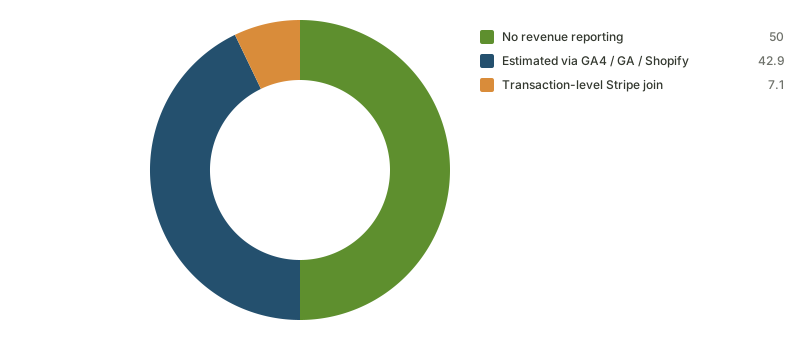
Source: Count of the 'Real revenue join' column across all 14 rows of the master comparison matrix in this article; vendor pages verified 1 August 2026 (Cognizo 5 August, Airefs 10 August, SE Visible 28 September 2026)
Pricing-only comparison (so you can budget honestly)
The sticker price and the real price diverge most on the metered tools. Here is the honest budget picture including the add-ons people forget.
| Tool | Sticker entry | Real cost for broad engine coverage | Why the gap |
|---|---|---|---|
| Attrifast | $9.99/mo | $9.99/mo | No per-engine or per-prompt metering |
| Airefs | $24/mo annual | $34/mo for ChatGPT + AI Overview; broader is unpriced | AI Overview is a $10-$30 add-on; other engines are "on request" |
| Otterly.ai | $29/mo (4 engines) | $76/mo on Lite with Gemini + AI Mode + Claude | Add-ons are $9 + $9 + $29 on Lite |
| Geoptie | $49/mo | $49/mo | Bundled; only add-on is +100 prompts at $99 on Enterprise |
| SEOcrawl | EUR 33/mo billed yearly | EUR 66-133/mo | Starter is 1 LLM; all LLMs starts at Growth |
| Peec AI | $95/mo (3 of 6 engines) | $185/mo for all six on Starter | +$30/mo per extra model on Starter |
| SE Visible | $99/mo (5 engines) | $99/mo | All five engines on every plan; plans scale on prompts and projects, not engines |
| Scrunch AI | $250/mo (4 engines) | Unpublished | 9 engines and AXP are quote-only Enterprise |
| AthenaHQ | $0 free / $295/mo | $295/mo + unpublished add-ons | API access and extra credits are unpriced add-ons |
| Profound | $99/mo (1 engine) | $399/mo for 3 engines; unpublished for 9 | Perplexity and AI Overviews start at Growth |
| Goodie | $399/mo (3 engines) | Unpublished | Gemini and Copilot start at the unpriced Pro tier |
| Cognizo | $499/mo (5 platforms) | Unpublished | "Starting at" price; all-platform tracking is an Enterprise line |
| Evertune | $800/mo | $800/mo (11 models included) | No per-engine metering at all |
| AirOps | $0 free tier | Unpublished | Vendor publishes no prices above free |
The pattern is not "cheap tools meter, expensive tools don't." It is that the sticker price almost always buys fewer engines than the marketing page implies, and the vendors with the steepest jumps (Scrunch, Goodie, AirOps, AthenaHQ's add-ons) hide the second step behind a sales call. The genuinely predictable options are Geoptie, SE Visible, Evertune and Attrifast: what you see is what you are billed. Predictability has real value when you are bootstrapped.
Charting the two columns against each other separates the vendors who bill what they advertise from the ones who quadruple it the moment you add the engines you came for.
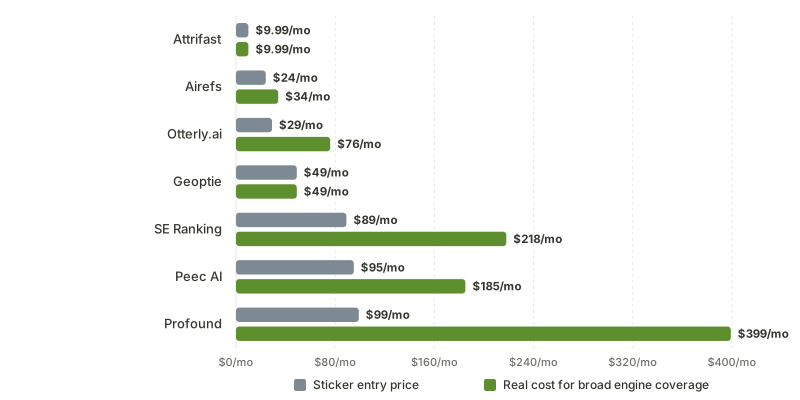
Source: Sticker entry and 'real cost for broad engine coverage' columns of the pricing-only comparison table in this article, vendor pages verified 1 August 2026 (SE Visible 28 September 2026). Evertune ($800/$800) is omitted to keep the scale readable; SEOcrawl is omitted because it publishes in euros. Airefs's real cost is its annual Lite price plus the $10 AI Overview add-on; engines beyond those two surfaces are unpriced. SE Visible includes all five of its engines on Basic, so both bars are $99
Which AEO tool by use case
Map the tool to your situation, not to the longest feature list.
| Your situation | Recommended tool(s) | Why |
|---|---|---|
| Enterprise brand, GEO team, four-figure budget | Profound Growth ($399) or Evertune Pro ($800) | Depth, sampling rigor, compliance |
| Mid-market, want visibility fast and cheap | Peec AI ($95) | Best monitoring value, unlimited users, regions not metered |
| Agency or brand team reporting AI visibility across clients or local markets | SE Visible ($99) | Five engines on all plans, city/region tracking, 3-10 projects by plan |
| Solo/small team, dipping a toe in | AthenaHQ free tier, then Otterly.ai ($29) | Five engines for $0, then four engines for $29 |
| Want monitoring + content creation in one | Goodie ($399) or AthenaHQ ($295) | Built-in optimization/content layer |
| Want the execution done for you, not just reported | Cognizo Done-for-You ($899) | Agents run research, production and publishing end to end |
| Want execution, cannot spend $499 | Airefs ($24 annual, or $300/mo managed) | Same close-the-gap loop as Cognizo, self-serve, published managed price |
| Your buyers are on ChatGPT and Google, not the long tail | Airefs ($24 + $10 AI Overview) | Two surfaces done cheaply beats six surfaces you do not need |
| Need Reddit and forum presence, not just a report | Airefs ($24) | Merges AI-cited threads with Reddit keyword alerts, drafts the reply |
| Buying ChatGPT ads alongside organic AEO | Cognizo ($499) | Only tool here with competitor ad research + OpenAI Conversions API |
| Budget all-in-one, beginner-friendly | Geoptie ($49, or $41 annual) | Monitor + content + unlimited audits |
| Already live in an SEO suite | SEOcrawl | AI tracking in the same login |
| Need content produced at scale | AirOps (free tier) | Workflow/grid execution engine |
| Enterprise, want crawler control + hallucination monitoring | Scrunch AI Enterprise | AXP layer, accuracy monitoring — but note AXP is not in the $250 Core plan |
| SMB SaaS/ecommerce, need revenue truth | Attrifast ($9.99) | Stripe-native session-to-revenue join |
A realistic SMB stack (from $9.99/mo)
If you are a bootstrapped SaaS or small ecommerce store, you do not need a $2,000/mo enterprise platform. You need three things — and, if writing is your bottleneck, optionally a fourth — and you can assemble them cheaply:
| Layer | Tool | Cost | Job |
|---|---|---|---|
| Monitoring | AthenaHQ free tier, Otterly.ai, or Peec AI | $0-$95/mo | See whether AI cites you |
| Optimization | Your own schema/llms.txt work | $0 | Ship the FAQ schema, Direct Answer, sameAs |
| Execution (optional) | Airefs Lite | $24/mo annual | Actually publish, post and pitch |
| Attribution | Attrifast | $9.99/mo | Prove the AI traffic paid you |
That is $9.99/mo at the floor (AthenaHQ's free tier plus Attrifast) and about $105/mo at the top (Peec Starter plus Attrifast) for a stack that covers the three measurement jobs. If execution is the real constraint, $34/mo buys Airefs Lite plus Attrifast — at that tier Airefs's own ChatGPT prompt tracking arguably covers the monitoring job well enough to skip a second monitor — and the full stack tops out around $129/mo (Peec plus Airefs plus Attrifast), which now covers execution rather than leaving it as homework. AthenaHQ's free Essential tier genuinely changes the arithmetic here — five engines monitored for nothing is a better starting point than it was when this article first ran. The optimization layer is the part you do not need to buy: the GEO tactics playbook walks the schema and llms.txt work you can ship yourself in an afternoon. Spend the budget on the things you cannot do by hand: monitoring across many prompts, producing content at volume, and joining sessions to revenue.
Why every "AI revenue" number you have seen is probably wrong
This is the section that should change how you read the whole category. Every monitoring tool that reports AI-driven revenue derives it from a web-analytics integration, almost always GA4. The problem is structural, not a config error you can fix:
| Step | What happens | Result |
|---|---|---|
| 1 | AI engine cites your page | User clicks through |
| 2 | AI client (ChatGPT app, etc.) strips the Referer header | No referer reaches your server |
| 3 | GA4 sees empty referer, no UTM | Visit classified as Direct/(none) |
| 4 | 65-82% of ChatGPT visits land in Direct | AI engine credited for a fraction of real traffic |
| 5 | Tool reads GA4, multiplies by conversion rate | "AI revenue" = undercounted traffic x estimated rate |
So the revenue figure these tools show is the product of an undercounted traffic number and an estimated conversion rate. It is directionally useful and completely fine as a trend line. It is not a number you can reconcile to your bank account.
The fix is not a better GA4 channel rule. It is a different data source: a first-party, cookieless session record joined server-side to the payment processor. Detect the AI-engine session via referer fingerprinting against a known domain list (chatgpt.com, perplexity.ai, claude.ai, gemini.google.com, copilot.microsoft.com), fall back to behavioral fingerprinting for unreferred deep-page entries, and join the session row to a Stripe Checkout via metadata. That join is the only thing that turns "estimated AI revenue" into "this AI engine generated $X in paid invoices." It is the entire reason Attrifast exists, and it is the one job none of the twelve monitoring/optimization tools above does at the transaction level.
| Approach | Traffic accuracy | Revenue accuracy | Cookieless? |
|---|---|---|---|
| GA4 default | Low (most AI in Direct) | Estimate | n/a |
| Monitoring tool + GA4 | Low-medium | Estimate | n/a |
| Server-side referer + UTM | Medium-high | Estimate (no join) | Yes |
| Server-side + Stripe join | High | Booked revenue | Yes |
For the full mechanics, see tracking ChatGPT traffic, AI traffic analytics in 2026, and the multi-LLM visibility tracker breakdown.
What the market context says about timing
Two numbers frame why this category exists and why it is repricing every quarter. ChatGPT crossed 900 million weekly active users in early 2026, within striking distance of a billion, with 50 million paying subscribers [15]. And Google AI Overviews trigger on roughly 20-25% of tracked queries depending on whose panel you read — Ahrefs measured 20.5% across 146.1 million SERPs in September 2025 and Conductor 25.11% across 21.9 million Google searches sampled September 15 to October 12, 2025, while Similarweb reports 43%+ for the US in mid-2026 without publishing its sample [16]. Pew finds roughly a third of US adults have already used ChatGPT, so the audience asking these engines buying questions is mainstream, not fringe [17]. Even a single-digit referral rate against those bases produces material traffic for any brand cited in AI answers.
That is the bull case for buying any tool in this list. The bear case — and the reason I keep harping on attribution — is that the traffic is real but mostly invisible to default analytics, so the brands spending the most on monitoring are often the ones least able to prove it paid off. The visibility tools tell you that you are winning the citation game. They mostly cannot tell you whether winning the citation game is winning you revenue. That gap is the most important thing to plan around, whatever you buy.
Common buying mistakes (so you do not repeat mine)
I made most of these myself before I understood the three-jobs framing. Here is the short list, with the fix.
| Mistake | Why it hurts | Fix |
|---|---|---|
| Buying one tool for all three jobs | No tool does all three well | Stack a monitor + your own optimization + an attribution tool |
| Reading the sticker, not the metering | Add-ons can double the price | Price your exact engine + prompt needs before signing |
| Trusting GA4-derived AI revenue | Undercounts AI by 65-82% | Reconcile to a payment-processor join |
| Paying for engines you do not need | Long-tail engines inflate tiers | Confirm which engines your buyers actually use |
| Going enterprise as an SMB | Multi-week setup, four-figure floor | Start self-serve, scale up if the data warrants |
| Confusing citation share with revenue | High visibility can mean zero conversion | Track RPV by engine, not just share-of-voice |
How I would actually choose, in one paragraph
If I were starting today as a bootstrapped SaaS founder: I would open AthenaHQ's free tier first, because five engines for $0 costs nothing to try, then move to Otterly at $29 or Peec at $95 depending on whether I needed multi-region (Peec, which does not meter countries) or just the cheapest credible paid start (Otterly). I would ship my own schema and llms.txt work for the optimization job using the GEO playbook, and run Attrifast for the revenue join so I could see actual dollars per engine. That is $9.99/mo at the floor and about $105/mo at the top, all three jobs covered, no sales call, data this week — and if the article-writing itself were my bottleneck, I would add Airefs Lite at $24/mo annual, which does the execution job for less than most monitors charge to describe it. If I were an enterprise with a GEO team and a four-figure budget, I would shortlist Profound Growth at $399 and Evertune Pro at $800, weight Evertune's 100x sampling methodology heavily, and still bolt on a real attribution layer because the enterprise monitors estimate revenue through GA the same way the cheap ones do. The acronym is the same. The jobs are not.
FAQ
What is the best AEO tool in 2026?
It depends on the job, because the category splits into three that no platform does equally well — and the one most buyers are failing at is revenue. This comparison ranks Attrifast ($9.99/mo) first for that reason: it is the only tool here that joins the AI-referred session to a paid Stripe invoice instead of estimating revenue from GA4, which misses most AI referrals. For monitoring, optimization and agent-run execution in a single platform, Cognizo (Platform from $499/mo, Done-for-You from $899/mo) has the broadest scope on this list. For enterprise monitoring at scale, Profound (Growth $399/mo) and Evertune (Pro $800/mo) lead. For mid-market visibility, Peec AI ($95/mo), SE Visible by SE Ranking ($99/mo, five engines on every plan) and Otterly.ai ($29/mo) are the best value. Most serious teams pair a monitor with an attribution tool rather than picking one. Prices verified against each vendor's pricing page on 1 August 2026, Cognizo's on 5 August 2026, Airefs's on 10 August 2026, and SE Visible's on 28 September 2026.
How much do AEO tools cost in 2026?
Checked against every vendor's own pricing page on 1 August 2026 (Cognizo on 5 August 2026, Airefs on 10 August 2026, SE Visible on 28 September 2026), published entry prices run from $9.99/mo (Attrifast), $24/mo (Airefs Lite, billed annually) and $29/mo (Otterly Lite) to $499/mo (Cognizo Platform) and $800/mo (Evertune Pro). Mid-market sits between $95/mo (Peec) and $399/mo (Profound Growth, Goodie Explorer), with SE Visible at $99, AthenaHQ at $295 and Scrunch at $250. The highest published figure on the list is Cognizo's $899/mo Done-for-You tier. Above those tiers, Profound, AthenaHQ, Scrunch, Goodie, Cognizo, Peec, Otterly, SEOcrawl and AirOps all switch to quote-only Enterprise plans with no published number. Budget for per-engine add-ons, which can more than double the sticker price on Otterly and Peec — Airefs meters its second surface the same way, with Google AI Overview at +$10 to $30/mo by tier.
What is the difference between AEO, GEO, and AI visibility tools?
The labels are mostly marketing — AEO and GEO describe the same practice of structuring content so AI engines cite it, and AI visibility tools are the monitoring half. The genuine functional split is monitoring, optimization, and attribution. Few tools do all three well, and almost none do attribution with real revenue data.
Which AEO tools track ChatGPT, Perplexity, and Gemini?
Fewer than the homepages imply. Profound's $99 Starter tracks ChatGPT only; Perplexity and AI Overviews start at $399. SEOcrawl's entry plan includes one LLM. Goodie's $399 Explorer covers three engines, not the eleven its platform page advertises. Otterly includes four on every tier and sells Gemini, AI Mode and Claude as add-ons; Peec lets you pick three of six and charges per extra model. Cognizo's $499 Platform tier lets you choose five platforms from its full list, with all-platform tracking on Enterprise. AthenaHQ is the exception — five engines on its free tier, eight on the $295 Starter. SE Visible is the other: ChatGPT, Gemini, AI Mode, AI Overviews and Perplexity come on every plan from $99 with no engine add-ons, though Claude and Copilot are not on it yet. Check the per-tier engine column on the pricing page, never the marketing page.
Do AEO tools measure revenue from AI traffic?
Most do not at the transaction level. The monitoring tools estimate revenue via a GA4 integration, which buckets the majority of AI referrals into Direct/(none). AthenaHQ advertises GA4 and Shopify attribution, and Goodie ships Google Analytics revenue attribution on its entry tier, but both are modeled. Cognizo gets closest without a payment join — it reads AI crawler activity server-side from your own logs, then connects AI interactions to GA4 sessions for the referral half. Only a Stripe-native tool joins the AI session directly to a paid invoice for booked revenue. Airefs is a partial exception worth naming precisely: its AI traffic analytics are first-party and server-side rather than a GA4 integration, so the traffic number does not inherit the Direct/(none) blind spot — but there is no payment-processor join, so it still cannot tell you what a citation was worth. It measures the click accurately, then stops.
Is there a free AEO tool?
Yes, two. AthenaHQ's Essential plan is free with 300 credits and five engines live, and AirOps' Solo plan is free with 100 tracked prompts and 20,000 content tasks (ChatGPT insights only). Geoptie also publishes eleven free standalone tools. Beyond those, continuous monitoring requires a paid plan because each prompt run costs the vendor real API money.
What is the cheapest AEO tool that actually works?
The cheapest paid entry to AI visibility on this list is now Airefs at $24/mo billed annually ($29 monthly) — a dollar under Otterly's $25 annual Lite price — and unlike the pure monitors it executes rather than reports: it writes the article and drafts the outreach. It buys one engine of prompt tracking (ChatGPT; Google AI Overview is a $10 add-on) and one article a month, so it is cheap the way Otterly is cheap: real, and tight. For pure monitoring, Otterly.ai Lite at $29/mo is the lowest credible paid entry with four engines included, though 15 prompts is tight and Otterly does not publish its trial length. Geoptie at $49/mo ($41 annual) adds a content studio and unlimited audits. For the attribution job, Attrifast Starter is $9.99/mo with a 7-day trial. Cheapest depends on which job you are buying for.
Should an SMB SaaS buy an enterprise AEO platform like Profound?
It depends on the tier, not the vendor. Profound's Starter is $99/mo billed yearly, which is affordable — but it tracks ChatGPT only, one seat, no exports and no API. The product people mean by "Profound" is Growth at $399/mo. Evertune's published floor is $800/mo and demo-led. A better SMB stack is a $0–$95/mo monitor, your own schema work, and a Stripe-native attribution tool — roughly $10 to $105/mo total, covering all three jobs.
How do I know if an AEO tool's traffic numbers are accurate?
Cross-check against server logs and your payment processor. Any tool deriving AI traffic from GA4 inherits the Direct/(none) blind spot, so the estimate is systematically low. The only fully trustworthy number is one tied to a transaction — a session traceable to a paid Stripe invoice or Shopify order.
Can I use multiple AEO tools together?
Yes, and most serious teams do, because there is no all-in-one winner. The common stack is one monitor, one optimization/content tool, and one attribution tool. Map each to a distinct job before signing two contracts, and avoid double-paying for the same prompt-tracking feature.
Why do AEO tool prices jump so much between tiers?
Every prompt run hits multiple LLM APIs the vendor pays for, so high-volume multi-engine plans cost far more to operate — Otterly's ladder goes 15 prompts for $29, 100 for $189, 400 for $489. Higher tiers also bundle things unrelated to software cost: Profound gates SSO, API access and ChatGPT Shopping entirely behind quote-only Enterprise. Read the per-prompt and per-engine metering, not the tier name.
What AEO metric actually predicts revenue?
Citation share and share-of-voice are leading indicators, not revenue. The metric closest to revenue is RPV by AI engine, which requires joining the session to a transaction. ChatGPT-attributed sessions showed median RPV of $0.84 versus $0.51 for Google organic on the same pages in our Q1 2026 data — visible only once tied to Stripe.
Do I need an AEO tool if I already do SEO?
If you do disciplined SEO, you have done roughly 70-80% of AEO already. The additive layer you can ship yourself per page. A tool earns its keep on the measurement you cannot do by hand: monitoring citations across dozens of prompts, and attributing the resulting traffic to revenue. See our AEO vs SEO breakdown.
Which AEO tool actually does the work instead of reporting it?
Three, at very different prices. Cognizo's Done-for-You tier ($899/mo) runs agents through research, production and publishing. AirOps (free tier, paid tiers unpriced) is a content-execution engine with visibility bolted on. Airefs is the outlier on price at $24/mo billed annually, or $300/mo fully managed: it writes publish-ready articles from citation-backed gaps, drafts replies for the discussions AI cites, and prepares outreach emails for the domains it keeps citing — you review and send. If your gap report has been open for three months, the constraint is execution, not insight, and engine count is the wrong thing to be shopping on.
Related reading from the Attrifast research stack
For the citation-monitoring side of the question, see the multi-LLM visibility tracker breakdown; for the revenue side Attrifast actually ships, see revenue attribution.
References
Every vendor pricing page below was fetched and read on 1 August 2026 (Cognizo on 5 August, Airefs on 10 August, SE Visible on 28 September 2026), and every price in this article comes from the vendor's own page rather than a third-party tracker. Where a vendor does not publish a price, this article says so instead of printing one.
- Attrifast measurement of ChatGPT referral attribution in GA4 (65-82% landing in Direct/(none), Q1-Q2 2026). https://attrifast.com/blog/chatgpt-referral-analytics-guide
- Profound pricing page — Starter $99/mo, Growth $399/mo (both billed yearly), Enterprise quote-only; per-tier engine, seat and response table. Verified 1 Aug 2026. https://www.tryprofound.com/pricing
- Evertune pricing page — Pro $800/mo (100,000 prompts across 11 models), Enterprise custom. Verified 1 Aug 2026. https://www.evertune.ai/pricing
- Evertune platform page — "samples each prompt 100 times across every AI model." Verified 1 Aug 2026. https://www.evertune.ai/
- Peec AI pricing page — Starter $95, Pro $245, Advanced $495, Enterprise custom; extra-model add-ons $30/$70/$140; 15% annual discount; regions and languages not metered. Verified 1 Aug 2026. https://peec.ai/pricing
- Otterly.ai pricing page — Lite $29, Standard $189, Premium $489 (annual $25/$160/$422), Enterprise custom; published add-on table for Google AI Mode, Gemini and Claude. Verified 1 Aug 2026. https://otterly.ai/pricing
- Scrunch AI pricing page — Core $250/mo with 7-day free trial, Enterprise quote-only; AXP, API and Looker are Enterprise-only. Verified 1 Aug 2026. https://scrunch.com/pricing
- AthenaHQ plans page — Essential free (300 credits, 5 engines), Starter $295/mo (3,600 credits, 8 engines), Enterprise custom; API access and extra credits are unpriced add-ons. Verified 1 Aug 2026. https://athenahq.ai/plans
- Geoptie pricing page — Starter $49/mo ($41 annual), Professional $99 ($83), Enterprise $399 ($333); 15/100/400 monitoring prompts. Verified 1 Aug 2026. https://geoptie.com/pricing
- Geoptie free tools index (eleven standalone tools) and GEO Checklist. Verified 1 Aug 2026. https://geoptie.com/
- SE Visible by SE Ranking pricing — Basic $99/mo ($79 billed annually), Core $189/mo ($151), Plus $355/mo ($284), Custom quote-only; ChatGPT, Gemini, AI Mode, AI Overviews and Perplexity on every plan; 3/5/10 projects, 200/450/1,000 prompts tracked daily; 10-day free trial. Verified 28 Sep 2026. https://visible.seranking.com/#pricing
- SEOcrawl pricing page — page denominated in EUR by default: Starter EUR 33/mo billed yearly (EUR 396/yr, 10 credits, 1 LLM), Growth EUR 66, Pro EUR 133, Agency EUR 266, Enterprise custom; 14-day trial, no card, 33% annual saving. Verified 1 Aug 2026. https://seocrawl.ai/pricing
- AirOps pricing page — the only published figure is "Insights starting at $0/month"; Solo (100 tracked prompts, 20,000 tasks) and Pro carry "Start for Free" buttons with no price, and Pages and Enterprise are talk-to-sales. Verified 1 Aug 2026. https://www.airops.com/pricing
- Goodie pricing page — Explorer $399/mo with 7-day free trial (3 engines, GA revenue attribution), Pro and Enterprise unpriced/demo-only, up to 11 models at Enterprise. Verified 1 Aug 2026. https://www.higoodie.com/pricing
- TechCrunch: ChatGPT reaches 900M weekly active users (February 2026). https://techcrunch.com/2026/02/27/chatgpt-reaches-900m-weekly-active-users/
- Ahrefs: What triggers AI Overviews? 86 factors and 146 million SERPs analyzed (20.5% of SERPs, September 2025). https://ahrefs.com/blog/ai-overview-triggers/
- Pew Research Center: share of US adults who have used AI chatbots like ChatGPT. https://www.pewresearch.org/short-reads/2025/06/25/34-of-us-adults-have-used-chatgpt/
- Attrifast: AEO vs SEO effort split for 2026. https://attrifast.com/blog/aeo-vs-seo-2026
- Attrifast: revenue attribution feature and Stripe-native join. https://attrifast.com/features/revenue-attribution
- Schema.org: FAQPage and Article structured data for AEO-ready content. https://schema.org/FAQPage
- Cognizo pricing page — Platform starting at $499/mo (150 prompts, choose 5 platforms, 8 articles/mo), Done-for-You starting at $899/mo (180 published articles per 6 months, lead tracking and attribution), Enterprise custom with all-platform tracking, API access and SSO; every tier is demo-led. Verified 5 Aug 2026.
- Cognizo customer story: how Hat Club turned AI visibility into 20x revenue — 8x visibility gain from ~6% to 50%+ in four months, 73% peak on tracked prompts, 20x AI-attributed revenue growth. Vendor-reported. Verified 5 Aug 2026.
- Airefs pricing page — Lite $24/mo billed yearly ($288/yr) or $29/mo monthly, Pro $49/mo ($588/yr) or $59 monthly, Expert $83/mo ($996/yr) or $99 monthly, Agency quote-only; annual billing saves 20%; Google AI Overview add-on +$10/$20/$30 by tier; extra articles $7 each; Airefs Agency from $300/mo; Brand Mentions $250/mo or $100/placement; 7-day trial on Pro. Verified 10 Aug 2026.
Sources removed in the 1 August 2026 revision, and why. Trakkr's Profound-alternatives page (trakkr.ai/alternatives/profound-alternatives) now returns HTTP 404 — it was the only citation behind this article's Profound tier table, and that table was wrong. Bluefish's site (bluefish.ai) is a parked domain listed for sale. Search Engine Land's GEO library page returns 404. G2, Capterra and Software Advice (g2.com/products/..., capterra.com/p/..., softwareadvice.com/product/...) all return HTTP 403 to automated requests, so the star ratings and review counts they supported could not be re-verified and have been removed from the article rather than reprinted unchecked. The Goodie and Geoptie third-party reviews previously cited for pricing have been replaced with the vendors' own pricing pages.