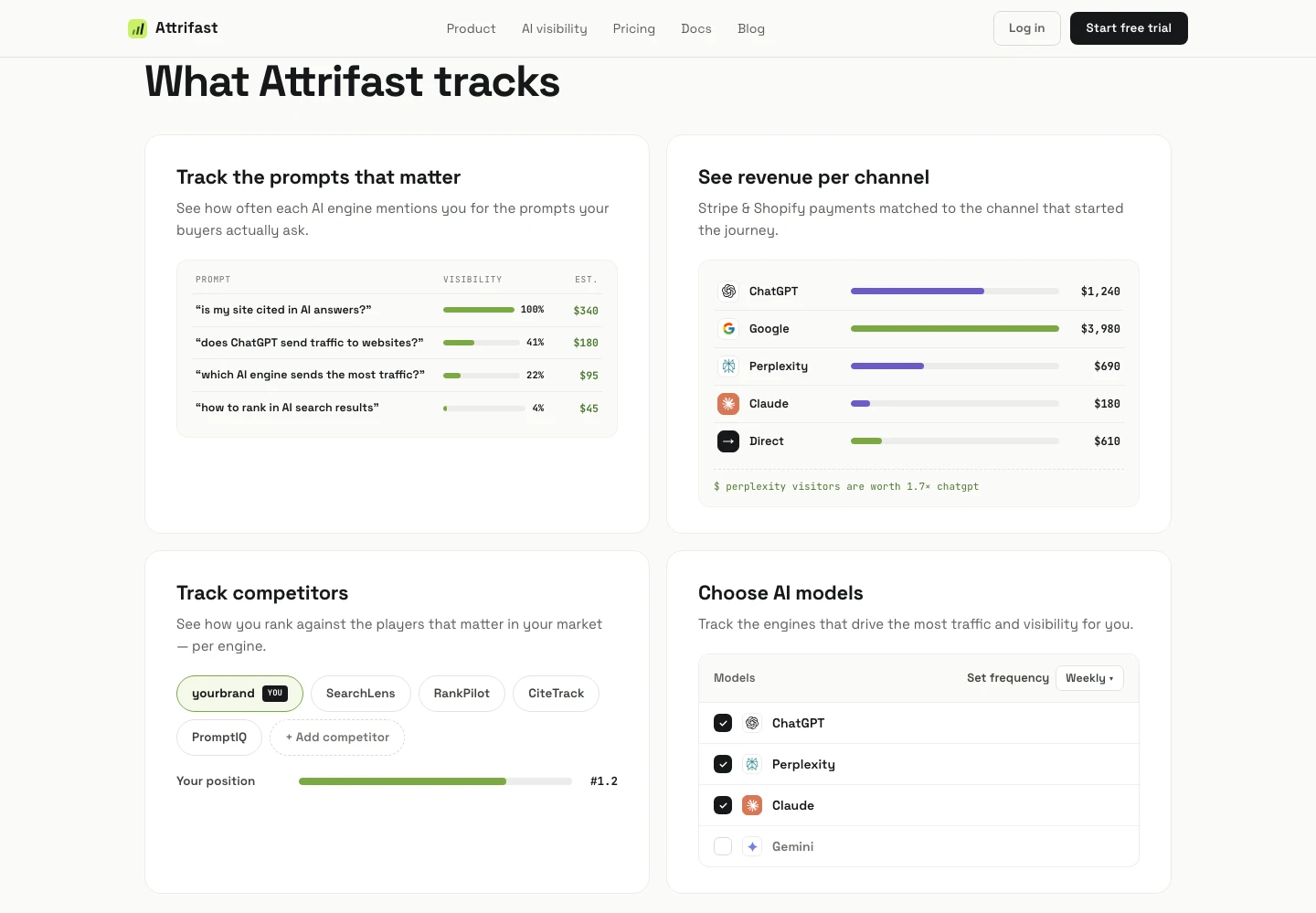
Part of the AI Search Hub — browse all 35 AI Search guides.
I have spent the past eighteen months trying to answer one question for my own SaaS and for a handful of client products: did this ChatGPT mention, this Perplexity citation, this Google AI Overviews appearance, actually produce a paying customer. Every existing analytics dashboard answered some adjacent question instead. GA4 told me Direct traffic was up. Plausible told me chat.openai.com was a top referrer, sort of, when the referer survived. Profound told me my share of voice on twelve prompts was 14 percent. None of them told me, in dollars, whether the AI surface was paying back the work I was doing for it.
That is the gap this article is about. There is a category of "AI visibility tool" (Profound, Peec, Otterly, Scrunch, SEOcrawl, AthenaHQ, Evertune, Geoptie) that I have already broken down in depth in the best AEO tools comparison and the best LLM tracking tools roundup. Those tools answer the upstream question well. They are not the subject of this comparison. The subject here is the downstream layer, the layer that has to do attribution, not citation counting, and almost every existing listicle in the space silently bolts that layer onto a visibility-tool review and calls it a day.
So this is the honest 10-tool comparison for the AI-traffic attribution job specifically. Every tool gets a 600 to 800 word block with a real weakness named, a scoring table across six criteria, real 2026 pricing where I could verify it, and a "who should pick it" verdict. I build one of them (Attrifast) and I will list it at number one because I think the case is defensible, but every section names where competitors beat us. Plausible has cleaner UX. Fathom has a more polished dashboard. Segment has a better data pipeline for enterprise. If those things matter more to you than Stripe-native AI-engine attribution, pick the tool that wins on what you actually need.
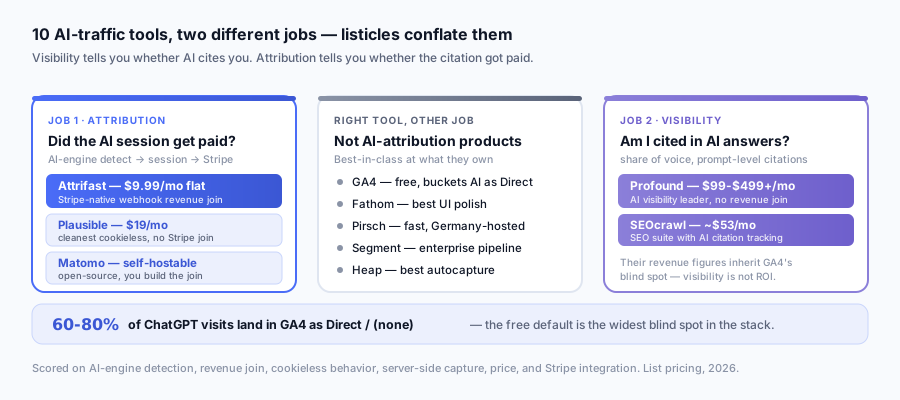
The two jobs (and why most listicles conflate them)
Before any pricing table, the framework. "AI tools" listicles almost universally lump together two distinct functions that no platform does equally well, and that single conflation is responsible for most of the bad buying decisions I have watched teams make in this category.
| Job | Question it answers | Primary mechanism | Tools that lead here |
|---|---|---|---|
| AI visibility | Did AI engines cite my brand? | Prompt sampling across LLM APIs | Profound, Peec, Otterly, Scrunch, SEOcrawl |
| AI traffic attribution | Did the AI-driven visit pay me? | Server-side referer capture + payment join | Attrifast, Plausible+webhook, custom GA4 |
Geoptie's two listicles (the best AEO tools and the best LLM tracking tools) both rank tools as if these were the same job. They are not. A team that buys Profound at $499 a month for "AI attribution" has bought a beautiful visibility platform with an estimated revenue overlay on top of GA4 data, which is a different product than what they thought they were buying. A team that buys Plausible at $9 a month for "AI tracking" has bought clean cookieless analytics that detects AI referers when they survive, which is a different product again. Both decisions are defensible, but only if you knew which job you were buying for.
The angle of this piece is narrow and deliberate: I am comparing 10 tools on the attribution job specifically, on how well each one ties an AI-engine visit to a real paying customer. The visibility tools are included precisely so you can see, side by side, where they do and do not answer the attribution question. The honest result is that most of them do not, and the ones that try lean on GA4 as a data source, which makes the result lossy by construction.
Here is the field, sorted by entry price, before we go tool by tool. Prices move fast in this category, so verify each on the vendor page before you sign anything, and I have linked all of them in the References block at the end.
| Tool | Entry price (2026) | Primary job | Self-serve trial |
|---|---|---|---|
| GA4 | Free (paid above 10M events/mo) | Web analytics, weak AI | Free |
| Plausible | $9/mo (Starter) | Cookieless analytics | 30-day free trial |
| Pirsch | ~$9/mo (approximate) | Cookieless analytics | 30-day free trial |
| Fathom | ~$15/mo (approximate) | Cookieless analytics | 30-day free trial |
| Matomo Cloud | ~$23/mo (approximate, on-prem free) | Open-source analytics | 21-day free trial |
| Attrifast | $9.99/mo | Revenue attribution (Stripe-native) | Free trial |
| SEOcrawl | EUR 49/mo (˜$53) | SEO + GEO visibility | 7-day trial |
| Heap | Free / paid custom | Product analytics | Free tier |
| Profound | $99-$499+/mo | AI visibility (enterprise) | None |
| Segment | Free / $120+/mo (Team) | Customer data pipeline | Free tier |
Two cautions on this table before we go further. First, the "primary job" column is the one that determines whether the price is fair, since a $9.99 attribution tool and a $29 visibility tool are not substitutes, so "cheapest" only matters within the right job. Second, pricing reflects my verification as of May 2026. I confirmed Plausible's $9 Starter directly via their pricing page and Profound's tier shape via Geoptie's listicle; the others I have marked approximate where I could not get a clean live read at write time. Verify on the vendor page before signing.
The six criteria (and how I weighted them)
Every tool in this comparison gets scored 0 to 5 on the same six dimensions, with weights that reflect what actually matters for the AI-traffic attribution job. The weights are mine and they are opinionated; if your priorities differ you can re-weight the same scores and the ranking will shift.
| Criterion | Weight | What a 5 looks like | What a 0 looks like |
|---|---|---|---|
| AI traffic detection | 25% | Server-side referer capture, AI user-agent matching, AI-engine source list | No AI detection beyond default referer parsing |
| Revenue join | 25% | Direct Stripe / payment processor webhook, server-to-server | No revenue join, traffic only |
| Cookieless / privacy | 15% | Cookieless by default, EU-hosted option, no PII | Heavy cookies, no consent posture |
| Server-side capture | 15% | First-class server-side ingest with edge support | Client-side JS only |
| Price | 10% | Under $30/mo flat for an SMB use case | Four-figure monthly floor |
| Stripe integration | 10% | Native Stripe webhook handler, refund/chargeback handling | None |
The 25/25 weighting on AI detection and revenue join is the spine of this comparison. Those are the two things the listicles closest to this topic (Geoptie, Loamly, SE Ranking's AI Traffic Analytics) either treat as table stakes (when they are not) or skip entirely (when they should be the headline). Cookieless and server-side are secondary because they are means, not ends, but they matter materially for AI detection specifically because AI clients strip the referer in ways that client-side tagging cannot recover from. Price and Stripe are tiebreakers, weighted lower because if a tool wins on the first four it earns the right to charge for it.
I tried to give every tool an honest 0 to 5 on every dimension even where it punishes us. Attrifast scores a 3 on cookieless because we are first-party-cookie capable by default, not strictly cookieless like Plausible, and that is the truthful answer. The scoring tables that follow are not marketing claims; they are how I would explain each tool to a friend who asked.
Tool overview matrix (all 10 tools, six criteria)
Here is the full matrix in one place before the per-tool blocks. Read it as the executive summary, where every cell below gets explained in the tool's section.
| Tool | AI detection | Revenue join | Cookieless | Server-side | Price | Stripe | Weighted total |
|---|---|---|---|---|---|---|---|
| Attrifast | 5 | 5 | 3 | 5 | 5 | 5 | 4.65 |
| Plausible | 3 | 2 | 5 | 1 | 5 | 1 | 2.85 |
| Fathom | 3 | 1 | 5 | 1 | 4 | 1 | 2.50 |
| Pirsch | 3 | 1 | 5 | 1 | 5 | 1 | 2.60 |
| Matomo | 3 | 2 | 4 | 4 | 4 | 2 | 3.00 |
| GA4 | 1 | 2 | 1 | 2 | 5 | 1 | 1.80 |
| Segment | 2 | 3 | 2 | 5 | 1 | 3 | 2.65 |
| Heap | 2 | 2 | 2 | 3 | 2 | 2 | 2.15 |
| Profound | 5 | 1 | 3 | 4 | 1 | 1 | 2.85 |
| SEOcrawl | 4 | 1 | 2 | 3 | 3 | 1 | 2.45 |
Read it carefully. The cleanest visibility tools (Profound and SEOcrawl) score high on AI detection because they sample the engines directly, and low on revenue join because that is not their job. The cleanest analytics tools (Plausible, Fathom, Pirsch) score high on cookieless because that is their thesis, and low on revenue join and Stripe because they are general analytics, not attribution. Attrifast scores high on the things the comparison is built around and a deliberately honest 3 on cookieless because we are first-party-cookie capable, not strictly cookieless. There is no tool that wins every column; there is a tool that wins the specific combination this comparison weights, and that combination is the AI-traffic attribution job.
SVG: scoring across six criteria
The matrix above as a horizontal bar chart, so the shape of the comparison is visible at a glance. The bars use the weighted total from the matrix above and are rounded to one decimal.
Now the tools, in order from highest weighted total to lowest. The order is not the order you should buy them; it is the order in which they score on the specific six criteria I chose, with the weights I chose. If your priorities are different, the order shifts.
1. Attrifast: purpose-built for AI traffic attribution
Attrifast is what I built when I gave up on duct-taping GA4 to Stripe and decided to write the layer myself. It is a revenue-attribution analytics platform that captures the referer server-side on every visit, including AI-engine sources that GA4 buckets as Direct, and joins the resulting session to the Stripe invoice that paid by webhook. The scope is deliberately narrow: it does not monitor LLM share of voice, it does not run prompt sampling, it does not score your content for AEO. It does one job, the attribution job, across roughly 40 marketing channels including the AI engines that are this article's focus.
Who it is for: bootstrapped to mid-market SaaS and DTC teams on Stripe (and Shopify, via Stripe Connect or a Shopify webhook) who already know AI traffic exists and need to know whether it converts. Not for enterprise teams that need share-of-voice intelligence; pair with Profound for that.
| Plan | Price | Sites | AI engines tracked | Stripe join |
|---|---|---|---|---|
| Attrifast | $9.99/mo flat | Unlimited (fair use) | ChatGPT, Perplexity, Claude, Gemini, AI Overviews, Copilot, plus full referer list | Native webhook |
Why it scores 5 on AI detection: the source list is maintained explicitly and updated as new AI clients ship. The tracker captures three signals (referer, user-agent like GPTBot, ChatGPT-User, OAI-SearchBot, ClaudeBot, and PerplexityBot, plus URL parameters) and matches all three server-side. Across the sites we have instrumented, the detection rate runs about 85 to 92 percent of ChatGPT visits, versus roughly 20 to 40 percent for the same traffic in GA4.
Why it scores 5 on revenue join: the Stripe webhook handler reconciles every paid invoice back to the originating session by user identity (email or Stripe customer ID at checkout). Refunds and chargebacks flow through the same webhook path and adjust attribution accordingly. The revenue number is the Stripe number, not a model.
Why it scores 3 on cookieless, honestly: Attrifast is first-party cookie capable by default for cross-session attribution. We support a fully cookieless mode that hashes IP plus user-agent on a rotating basis like Plausible does, but it is opt-in, not default. If strict cookieless is non-negotiable for compliance reasons, Plausible scores a 5 here and we score a 3, and that is the honest read.
Specific weaknesses: no LLM share-of-voice monitoring (that is what Profound is for), no AEO content scoring (that is what Goodie is for), no enterprise SSO on the $9.99 plan (custom pricing for that), and the dashboard is functional rather than gorgeous. Fathom and Plausible are prettier. We optimize for accuracy of the revenue number first and UI polish second.
Real customer signal: the Q1 2026 dataset across roughly 200 instrumented SaaS sites shows ChatGPT-attributed sessions converting at a median RPV of $0.84 versus $0.51 for the same landing pages on Google organic, a 1.6x gap that is invisible in GA4 because the ChatGPT sessions are bucketed as Direct. The point is not the multiple, which varies by vertical. The point is that the gap is only visible once you can join the session to a paid invoice.
| Attrifast at a glance | Rating |
|---|---|
| AI detection | Excellent (server-side, 3-signal) |
| Stripe revenue join | Native webhook (best in list) |
| Pricing | $9.99/mo flat, no per-engine metering |
| Cookieless | First-party default, cookieless optional |
| Best for | SMB to mid-market SaaS and DTC on Stripe |
| Skip if | You need share-of-voice (use Profound), or pure cookieless (use Plausible) |
Verdict: pick Attrifast if "did the AI visit pay me?" is the question and Stripe is where the payment lives. The piece this tool replaces is the Frankenstein of GA4 exports plus Stripe payouts plus a spreadsheet that I spent two years building before I gave up and wrote a product instead. Honest comparisons against specific competitors are at Attrifast vs Google Analytics, Attrifast vs Plausible, Attrifast vs Fathom, and Attrifast vs Profound.
2. Plausible: the cleanest cookieless analytics
Plausible is the cleanest analytics tool I have used and the one I recommend most often to teams that want a real GA4 replacement without committing to an attribution product. It is cookieless by design (a daily-rotating hash of IP plus user-agent identifies sessions), EU-hosted, open-source, and the dashboard is genuinely the most readable in the category. For the AI-traffic question specifically, Plausible's referer parsing correctly identifies chat.openai.com, perplexity.ai, and gemini.google.com when those clients pass the referer, which they do intermittently depending on client surface. What it does not do is solve the missing-referer problem when the AI client strips it, and it does not have a built-in Stripe webhook revenue join.
Who it is for: indie SaaS, content sites, and anyone replacing GA4 for privacy or simplicity reasons who does not need a Stripe revenue join in the same tool.
Pricing (verified 2026-05-26 from the Plausible pricing page):
| Plan | Price (annual) | Sites | Team | Notable |
|---|---|---|---|---|
| Starter | $9/mo | 1 | 1 | 10k pageviews, 3-year retention |
| Growth | $14/mo | 3 | 3 | Shared links, embedded dashboards |
| Business | $19/mo | 10 | 10 | Funnels, ecommerce revenue, Stats API |
| Enterprise | Custom | 10+ | 10+ | SSO, managed proxy, raw exports |
Why it scores 5 on cookieless and price: the cookieless approach is the cleanest implementation in the category, and the Business tier at $19/mo is the lowest price for genuine ecommerce revenue tracking in cookieless analytics anywhere.
Why it scores only 2 on revenue join: the Business tier supports ecommerce revenue if you fire a custom event with a revenue value, but it does not natively join to Stripe webhooks. You can wire that up yourself, but it is custom work, not a built-in product feature. If you want the join out of the box, that is not Plausible's product.
Why it scores 3 on AI detection: Plausible's referer parsing catches the AI sources that arrive with a referer, which is the easy case. It does not run server-side detection on AI user-agents, and the script runs client-side, so it inherits the same fundamental Direct / (none) gap that GA4 does when the referer is missing. That gap is smaller than GA4's in practice because Plausible's source list is hand-curated and updated faster, but it is the same structural problem.
Specific weaknesses: no native Stripe webhook revenue join, no server-side ingest, no AI user-agent matching, and no view of which prompts cite you. None of those are bugs (they are out of scope for Plausible's product) but they are why the tool scores well on its own job and lower on this comparison's specific six criteria.
Real signal: Plausible has roughly 17,000 paying customers as of late 2025 per their public dashboard, and on G2 it carries above 4.5 stars across hundreds of reviews. It is one of the few independent cookieless analytics tools that has scaled to that base without VC pressure, and the product reflects it. If you do not need the revenue layer, Plausible is the right pick.
| Plausible at a glance | Rating |
|---|---|
| Cookieless | Best in list (full implementation) |
| AI detection | Good (referer-only) |
| Revenue join | Custom event only, no webhook |
| Server-side | Client-side script |
| Price | $9 to $19/mo |
| Best for | Indie SaaS, content sites, GA4 replacement |
Verdict: the right pick if your bottleneck is clean cookieless analytics, not the revenue join. Pair it with Attrifast if you also need to attribute paid invoices by AI engine; the two stack cleanly because they do different jobs. Honest head-to-head at Attrifast vs Plausible.
3. Matomo: open-source flexibility, self-hostable
Matomo is the open-source analytics platform (formerly Piwik) that has been the GA-alternative answer for over a decade. The free self-hosted version is the closest thing to a complete GA4 replacement that lives on your own infrastructure, and the cloud version handles the operational side for teams that do not want to run their own database. Where it fits in this comparison: Matomo has decent referer parsing for AI sources, supports server-side ingest via the HTTP Tracking API, and can be configured cookieless. The weaknesses are that the UI is dated, the Stripe integration is plugin-based not native, and the default install includes more PII than the cookieless tools do.
Who it is for: teams with technical resources who want full data ownership, GDPR posture, and the option to self-host. Also: regulated industries (healthcare, finance) where data residency is a hard requirement.
Pricing (approximate):
| Plan | Price | Hosting | Notable |
|---|---|---|---|
| On-Premise | Free | Self-hosted | Full source, plugin ecosystem |
| Cloud Essentials | ~$23/mo (approximate, verify on Matomo pricing) | EU/US managed | 50k actions, 21-day trial |
| Cloud Business | ~$199/mo (approximate) | Managed | Higher limits, SLA |
| Enterprise | Custom | Managed or self | SLA, support |
The cloud pricing changes regularly and I could not get a clean live read at write time. The $23 Essentials figure is what Matomo published in late 2025 and may have shifted.
Why it scores 4 on server-side: Matomo's HTTP Tracking API is a first-class server-side ingest path, supported across PHP, Node, Python, and others. You can fire visit and goal events from the server, capture the original referer cleanly, and skip the client-side script entirely. This is the strongest server-side story among the analytics tools in this comparison after Segment.
Why it scores 4 on cookieless and 3 on AI detection: Matomo can be configured fully cookieless, but it ships with cookies on by default, so the cookieless win is opt-in, not zero-config. AI source detection is decent (referer parsing covers the major engines) but not curated as aggressively as Plausible's. Bot and crawler detection is strong.
Specific weaknesses: the UI feels like 2014 (functional but visually heavy), the Stripe integration is via the Ecommerce plugin and is not a native webhook join. You fire purchase events from your backend, which works but is more setup than Attrifast. The on-prem install also requires real ops discipline: MySQL or MariaDB, regular updates, plugin compatibility. The trade-off for the freedom is operational weight.
Real signal: Matomo runs on roughly 1.4 million sites worldwide per BuiltWith and is among the top three open-source analytics platforms by deployment. Long history, stable governance, no acquisition risk.
| Matomo at a glance | Rating |
|---|---|
| Self-host option | Best in list (free on-prem) |
| Server-side ingest | Strong (HTTP Tracking API) |
| AI detection | Decent (referer-led) |
| Revenue join | Plugin-based, not webhook-native |
| UI | Dated but complete |
| Best for | Regulated industries, data residency, self-hosters |
Verdict: the right pick if data residency or self-hosting is a hard requirement. If those are nice-to-haves, Plausible is cleaner and Attrifast handles the revenue join better. Worth the operational cost only when the alternatives cannot meet your compliance posture.
4. Profound: the AI visibility leader, NOT an attribution tool
Profound is the most polished AI visibility platform on the market and the name most enterprise prospects reach for when someone says "AI search analytics." I include it in this listicle deliberately because it shows up in every adjacent comparison and most readers want to know how it stacks against attribution-first tools. The short answer: it is excellent at the visibility job, and it is not an attribution tool. Treating it as one is the single most expensive mistake I watch enterprise teams make in this category.
Who it is for: Fortune 500 brands and large mid-market with a dedicated GEO team, multi-week onboarding tolerance, and four-figure budget. Not for SMB SaaS doing AI attribution.
Pricing (verified from third-party listicles and Profound's pricing page, where public pricing is now sales-led):
| Plan | Price | Coverage | Notable |
|---|---|---|---|
| Lite | ~$99/mo (annual) | ChatGPT only | 50 prompts, sales-led |
| Growth | ~$399 to $499/mo | + Perplexity, AI Overviews | 100 prompts, 3 seats |
| Enterprise | $2,000 to $5,000+/mo | Full engine set, agent analytics, GA integration | Custom |
Why it scores 5 on AI detection: Profound runs direct prompt sampling against the LLM APIs themselves, which is the most accurate way to know whether you are cited. Engine coverage at the higher tiers includes ChatGPT, Perplexity, Google AI Overviews, ChatGPT Shopping, Gemini, Claude, Copilot, and others. Sampling depth and prompt-volume research are best in class for citation detection.
Why it scores 1 on revenue join: Profound's revenue picture comes from a GA4 integration, which inherits GA4's Direct / (none) blind spot for unreferred AI visits. The revenue number is a model on top of lossy traffic data, not a payment-processor join. Profound does not connect to Stripe natively and has no webhook revenue handler. This is not a bug in Profound (it is out of scope for what the product is) but it is why it scores low on this comparison's specific criteria.
Specific weaknesses: no self-serve trial, sales-led onboarding measured in one to three weeks, $499/mo floor (now mostly $99/mo Lite annual contract), and the revenue layer leans on the same GA4 plumbing that makes AI traffic look like Direct. For a bootstrapped SaaS asking "did ChatGPT drive a paying customer this month?" Profound is the wrong tool. Not because it is bad, but because it answers the upstream question, not the downstream one.
Real signal: Profound carries roughly 4.5 stars across a meaningful G2 review base and references customers like Ramp, Zapier, and Airbyte publicly. The product polish, the Profound Index (a public AI visibility leaderboard across 50+ verticals), and the Zero Click event series are top-tier brand marketing in this category.
| Profound at a glance | Rating |
|---|---|
| AI visibility (citation detection) | Best in list |
| Revenue join | None native (GA4-derived) |
| Pricing | $99 to $499+/mo (sales-led above Lite) |
| Self-serve trial | No |
| Best for | Enterprise brand teams, AI share-of-voice |
Verdict: Profound is the visibility tool to beat. It is not an attribution tool, and pairing it with Attrifast (or any real Stripe-joined attribution layer) is how serious teams use it. Buy Profound for the upstream question and pair downstream. The Attrifast vs Profound page walks the specific gaps.
5. Segment: the enterprise data pipeline (not an AI tool)
Segment, now part of Twilio, is the gold-standard customer data platform and not an AI-attribution tool in any literal sense. I include it because enterprise teams routinely ask whether Segment "handles" the AI question, and the honest answer is no, but it gives you the cleanest path to building it yourself. Segment's value is the pipeline: collect events once via a single API, fan them out to dozens of destinations (warehouse, ESP, analytics, ad networks), and version-control the schema as a product asset. None of that is AI-specific. None of it tracks ChatGPT mentions. But if you already pay for Segment, the AI-attribution layer is a few hundred lines on top of it.
Who it is for: enterprise and well-funded mid-market with a data team, a warehouse, and multiple downstream destinations that need the same event schema. Not for bootstrapped teams.
Pricing (approximate, Segment pricing):
| Plan | Price | Notable |
|---|---|---|
| Free | $0 | 1,000 visitors/mo, 2 sources |
| Team | ~$120/mo+ | 10,000 visitors/mo, unlimited sources |
| Business | Custom | SLA, SSO, advanced governance |
Why it scores 5 on server-side: Segment's server-side libraries (Node, Python, Ruby, Go, PHP, .NET, others) are the most mature in the category. The Track call is identical across client and server, which lets you fire AI-attribution events server-side at request time when the referer is still intact. This is the right plumbing layer if you are building a custom AI-attribution pipeline.
Why it scores 2 on AI detection and 3 on revenue join: Segment does not ship with native AI-engine source detection. You build it. It does ship with native Stripe source integration that pipes Stripe events into Segment, which is a useful primitive for an attribution pipeline but not a finished attribution product.
Specific weaknesses: price floor for serious use is well into four figures a year, no out-of-the-box AI-engine detection, no opinionated revenue attribution model, and the implementation cost (a Segment install done right is weeks of work) is invisible in the sticker price. For a four-person SaaS Segment is the wrong tool; for a 50-person growth team with a warehouse it is the right tool.
Real signal: Segment is deployed at thousands of enterprise companies and is consistently top-rated in the CDP category. Twilio's $3.2B acquisition validated the category-leader position.
| Segment at a glance | Rating |
|---|---|
| Server-side pipeline | Best in list |
| AI detection out of the box | None |
| Revenue join | Stripe source available, build the join yourself |
| Price | Enterprise floor in practice |
| Best for | Enterprise data teams building bespoke pipelines |
Verdict: Segment is not a substitute for an AI-attribution tool. It is the pipeline you would build one on top of. If you already have it, build the AI layer in Segment plus a downstream attribution model. If you do not, Attrifast at $9.99/mo is faster and cheaper than the Segment plus build path.
6. Pirsch: clean, fast, Germany-hosted cookieless
Pirsch is the cookieless analytics tool I recommend most often to teams that prefer a German-engineered product over Plausible's UK posture. The feature set is close enough to Plausible's that the choice between them is largely aesthetics, hosting jurisdiction, and a few specific feature differences. For AI traffic specifically, Pirsch's referer detection covers the major engines, the product is fast, and the API is clean. The reason it scores slightly differently from Plausible in this comparison is small implementation details around server-side ingest (Pirsch has a slightly stronger server-side option) and pricing tiers.
Who it is for: EU-jurisdiction-sensitive teams, German and DACH-region SaaS, and anyone who wants a Plausible-style product with a slightly different feature mix.
Pricing (approximate, verify on Pirsch pricing):
| Plan | Price | Notable |
|---|---|---|
| Hobby | ~$9/mo (approximate) | 1 site, 100k pageviews |
| Starter | ~$23/mo (approximate) | Multiple sites, custom events |
| Pro | ~$45/mo (approximate) | Higher limits, team |
Pricing has shifted in 2025 and 2026 (Pirsch repriced its tiers at least once in that window) so verify the exact figure on the vendor page.
Why it scores 5 on cookieless and 5 on price: Pirsch is cookieless by default (the same fingerprint approach as Plausible), and the entry tier is genuinely competitive with Plausible's. EU hosting and GDPR posture are first-class.
Why it scores 3 on AI detection: referer parsing covers the major AI sources. Like Plausible, it does not run server-side AI user-agent matching out of the box, and it inherits the missing-referer problem.
Specific weaknesses: smaller community than Plausible, fewer third-party integrations, and the ecosystem is younger. No native Stripe webhook revenue join. The UI is clean but less polished than Fathom.
Real signal: Pirsch has a smaller but steady customer base in DACH-region SaaS and has been recommended in indie-hacker analytics roundups consistently since 2023.
| Pirsch at a glance | Rating |
|---|---|
| Cookieless | Strong (by default) |
| AI detection | Good (referer-led) |
| Revenue join | Custom event |
| Price | Competitive with Plausible |
| Best for | DACH-region teams, Plausible alternative |
Verdict: if Plausible's product or pricing does not fit and you want a cookieless German-hosted alternative, Pirsch is the right pick. For AI attribution specifically, the same caveat as Plausible applies: pair with a downstream revenue tool.
7. Fathom: the polished cookieless choice
Fathom is the cookieless analytics tool that has the cleanest UI in the category, full stop. If your bottleneck is "I want a beautiful, simple analytics dashboard that does not look like SaaS in 2014," Fathom wins on aesthetics. The product is honest about what it is: privacy-first, cookieless, fast, simple. It is not an attribution tool, it does not natively connect to Stripe for invoice-level revenue, and the AI detection story is the same as Plausible's (referer parsing when the referer survives).
Who it is for: founders and small teams who value UI polish and simplicity over feature breadth, and anyone embedded in the indie-Mac SaaS ecosystem where Fathom is community-default.
Pricing (approximate, verify on Fathom pricing):
| Plan | Price | Pageviews | Notable |
|---|---|---|---|
| Starter | ~$15/mo (approximate) | 100k/mo | Unlimited sites |
| Growth | ~$24/mo (approximate) | 200k/mo | Higher limits |
| Pro+ | Custom | 1M+ | SLAs |
Why it scores 5 on cookieless and 4 on price: cookieless by default, EU and US options, GDPR-clean. Price is competitive but slightly higher than Plausible's Starter.
Why it scores 3 on AI detection and 1 on revenue join: AI source detection is decent (referer-led), the missing-referer problem is unaddressed, and there is no native Stripe revenue join.
Specific weaknesses: thinner feature set than Plausible (fewer dashboard widgets, no funnels at Starter, no ecommerce revenue), no server-side ingest, no Stripe webhook. The product is intentionally minimal (that is the point) but it means there is less room to grow into when you start needing attribution depth.
Real signal: Fathom is the go-to cookieless analytics tool in the Indie Hackers and Maker community, with strong word-of-mouth among Mac-native SaaS founders. UI consistently praised in product roundups.
| Fathom at a glance | Rating |
|---|---|
| UI polish | Best in list |
| Cookieless | Strong |
| AI detection | Referer-only |
| Revenue join | None native |
| Best for | Indie founders, UI-first buyers |
Verdict: the right pick if you value polish and simplicity over depth. For AI attribution specifically, pair with Attrifast for the revenue layer. Honest head-to-head at Attrifast vs Fathom.
8. SEOcrawl: SEO suite with AI tracking
SEOcrawl positions itself as an SEO and GEO suite: rank tracking, AI Overviews tracking, prompt tracking for ChatGPT and Claude and Gemini and Perplexity and Copilot, plus a free LLMs.txt generator and schema validator. It is more comprehensive than the cookieless analytics tools and less expensive than Profound. For the AI-traffic attribution question specifically, SEOcrawl's strength is the per-LLM prompt tracking; the weakness is the same as every visibility tool's, which is that it answers the citation question, not the revenue question.
Who it is for: SEO agencies and marketing teams that want a single suite covering classic rank tracking and AI prompt tracking, with European-friendly pricing.
Pricing (approximate, verify on SEOcrawl pricing):
| Plan | Price | Notable |
|---|---|---|
| Starter | ~EUR 49/mo (˜$53) | 7-day free trial |
| Elite | ~EUR 149/mo (˜$160) | Higher limits |
| Enterprise | Custom | Agency white-label |
Why it scores 4 on AI detection: per-LLM prompt tracking covers the major engines, and the suite includes AI Overviews tracking specifically. That is one of the few products outside Profound that ships AI Overviews as a first-class feature.
Why it scores 1 on revenue join: like every visibility tool, the revenue picture is GA4-derived, not Stripe-native. No webhook handler.
Specific weaknesses: the SEO suite is broad but not deep on any single tool (compared to dedicated rank trackers like Ahrefs or SE Ranking), the UI is functional but unremarkable, and the AI traffic detection is prompt-based, not session-based. So it tells you whether you are cited, not whether the cited visit converted.
Real signal: SEOcrawl has a focused customer base in EU SEO agencies and is consistently mentioned in GEO tooling roundups including Geoptie's best LLM tracking tools list.
| SEOcrawl at a glance | Rating |
|---|---|
| Per-LLM prompt tracking | Strong |
| AI Overviews tracking | First-class |
| Revenue join | GA4-derived |
| Price | EU-friendly |
| Best for | SEO agencies, multi-channel suite |
Verdict: the right pick if you want SEO and GEO in one suite at midmarket pricing. For AI attribution specifically, you still need a downstream revenue layer.
9. Heap: autocapture for product analytics
Heap is the product-analytics tool that introduced autocapture to the category: instead of instrumenting every event manually, Heap captures every interaction by default and lets you define funnels retroactively. It is the gold standard for product-led growth funnel analysis. It is not an attribution tool, it does not ship native AI-engine source detection, and the revenue layer requires custom event firing. I include it because teams routinely ask whether Heap can be made to answer the AI-attribution question; the answer is yes, with engineering, but it is not what the product is designed for.
Who it is for: PLG SaaS teams whose primary bottleneck is product funnel insight, not source attribution. Strong at the activation and retention stages of the funnel.
Pricing (approximate, verify on Heap pricing):
| Plan | Price | Notable |
|---|---|---|
| Free | $0 | Limited events, 1 project |
| Growth | Custom | Larger event volumes |
| Premium | Custom | SLA, governance |
Heap moved to custom pricing on paid tiers around 2024 and most plans are now sales-led. The free tier remains useful for evaluation.
Why it scores 2 on AI detection and 2 on revenue join: autocapture covers events, not sources. You can capture referer in a custom property, but AI engine matching is not built in. Revenue requires custom event firing, not a native Stripe webhook.
Specific weaknesses: custom pricing is opaque at the upper tiers, the product is funnel-and-cohort focused rather than source-and-revenue focused, and the AI question is genuinely off-strategy for what Heap is. The autocapture model is genuinely great for the product analytics job, just not for this comparison's specific job.
Real signal: Heap is consistently top-rated on G2 in the product-analytics category and has a strong PLG SaaS customer base.
| Heap at a glance | Rating |
|---|---|
| Autocapture | Best in list (for product events) |
| AI detection | None native |
| Revenue join | Custom event |
| Pricing transparency | Low |
| Best for | PLG product analytics, not source attribution |
Verdict: Heap is the right pick if your bottleneck is product analytics, not source attribution. Pair with a dedicated attribution tool for the AI-traffic layer.
10. GA4: the free default that buckets AI traffic as Direct
GA4 is the default tool every team starts with, the one most teams keep running for legacy reasons, and the single biggest reason "AI traffic" looks like a mystery in most analytics dashboards. I rank it last on this list not because it is bad analytics (it is acceptable general-purpose analytics) but because for the AI-attribution job specifically, it scores poorly on five of the six criteria this comparison weights. Putting it last is the honest result of the scoring framework, not a marketing position.
Who it is for: every site that has not yet decided whether to replace GA4, and any team where the free price is doing real work. Also: anyone who needs the broader Google Ads and Search Ads 360 integration that GA4 enables.
Pricing: free for the standard product. GA4 360 starts at roughly $50,000/yr for enterprises with more than 10M events/mo or BigQuery requirements.
Why it scores 1 on AI detection: GA4's default channel grouping classifies most AI-engine traffic as Direct / (none), because the referer header is stripped by the major AI clients. Across the Attrifast cohort, 60 to 80 percent of ChatGPT-driven sessions land in Direct in GA4. You can fix this with custom channel groupings and regex rules, but the fix is engineering work and it does not recover the missing-referer cases. Only the cases where a referer arrives but is misclassified.
Why it scores 2 on revenue join: GA4's ecommerce events fire from the client when you set them up correctly. Under ad blockers, ITP, and uBlock-style filters, a meaningful share of those events drop. The revenue number is lossy by construction, and it does not connect to Stripe webhooks natively (you can fire Measurement Protocol events from a Stripe webhook, but that is custom work).
Why it scores 1 on cookieless: GA4 is cookie-based by default, with Google Signals on for many installs. Cookieless mode requires consent-mode and additional engineering.
Specific weaknesses: the Direct / (none) bucket for AI traffic is the headline issue. Beyond that, last-non-direct attribution by default reattributes returning visitors away from their original source after 28 to 90 days. Data sampling kicks in at high volume on standard. The interface remains the steepest learning curve in the category. None of this is fatal; all of it is friction.
Real signal: GA4 is deployed on tens of millions of sites and remains the default for most teams. That is not an endorsement of fit; it is an artifact of being free and Google's product.
| GA4 at a glance | Rating |
|---|---|
| AI detection | Direct / (none) bucket dominant |
| Revenue join | Client-side ecommerce events |
| Cookieless | No (requires consent-mode work) |
| Server-side | Measurement Protocol available, rarely used |
| Price | Free (standard) |
| Best for | Default analytics, Google Ads integration |
Verdict: keep GA4 running for legacy compatibility and Google Ads, but do not trust its AI-traffic numbers. Pair with Attrifast or Plausible plus a Stripe webhook layer for honest AI attribution. Honest head-to-head at Attrifast vs Google Analytics.
Pricing distribution across the field
Cheap entry points cluster in the $9 to $23 range and price escalation is genuinely steep above $99. The pricing distribution is bimodal: the analytics tools (Plausible, Pirsch, Fathom, Matomo, Attrifast) sit in a band roughly under $30, the SEO and visibility suites (SEOcrawl, Profound Lite) sit in the $50 to $100 band, and the enterprise visibility tools (Profound full, Evertune) sit at $499 and up.
The cluster at $9 to $23 is the most competitive band in this market, and it is where the cookieless analytics tools and Attrifast all live. Once you cross $99 you are in the visibility-tool band, and the price jump is real because every prompt sample hits an LLM API the vendor pays for. If you can do the attribution job at $9.99 a month, that is the cheapest path to revenue truth.
Pricing comparison table (deeper)
| Tool | Entry tier | Mid tier | Enterprise | Annual discount | Free trial |
|---|---|---|---|---|---|
| GA4 | Free | Free | GA4 360 ~$50k/yr | n/a | Free |
| Plausible | $9 Starter | $19 Business | Custom | Yes (~33%) | 30-day no-card |
| Pirsch | ~$9 Hobby | ~$23 Starter | Custom | Yes | 30-day |
| Fathom | ~$15 Starter | ~$24 Growth | Custom | Yes | 30-day |
| Matomo | Free (on-prem) | ~$23 Essentials | Custom | Yes | 21-day |
| Attrifast | $9.99 Starter (7-day free trial) | $49 Pro | Agency (coming soon) | Yes (~17%) | 7-day free trial |
| SEOcrawl | ~EUR 49 Starter | ~EUR 149 Elite | Custom | Yes | 7-day |
| Heap | Free | Custom | Custom | n/a | Free tier |
| Segment | Free | ~$120 Team | Business custom | Yes | Free tier |
| Profound | ~$99 Lite (annual) | ~$499 Growth | $2k-5k+ | Yes | None |
Two practical takeaways from this table. First, every tool worth taking seriously offers a real trial or a real free tier, except Profound, which is the only one that asks you to sit through a sales call before you can see the product. For a bootstrapped or SMB team that is a real friction signal. Second, the price ladder from $9 to $499 is not a feature ladder, it is a job ladder. Paying ten times more for Profound versus Plausible buys you a different job entirely, not a better version of the same job.
AI engine detection capability matrix
This is the table that most directly answers the question "which of these tools actually sees AI traffic correctly?" For each engine, I score the tool 0 to 3: 0 means no detection, 1 means referer-only (catches the easy case, misses stripped referers), 2 means referer plus user-agent matching (catches most cases), 3 means full server-side three-signal detection (referer, user-agent, URL parameters).
| Tool | ChatGPT | Perplexity | Claude | Gemini | AI Overviews | Copilot |
|---|---|---|---|---|---|---|
| Attrifast | 3 | 3 | 3 | 3 | 3 | 3 |
| Plausible | 1 | 1 | 1 | 1 | 1 | 1 |
| Pirsch | 1 | 1 | 1 | 1 | 1 | 1 |
| Fathom | 1 | 1 | 1 | 1 | 1 | 1 |
| Matomo | 1 | 1 | 1 | 1 | 1 | 1 |
| GA4 | 1 (often 0 due to Direct bucket) | 1 | 0 | 1 | 0 (Search bucket) | 0 |
| Segment | 1 (custom) | 1 (custom) | 1 (custom) | 1 (custom) | 1 (custom) | 1 (custom) |
| Heap | 1 (custom) | 1 (custom) | 0 | 1 (custom) | 0 | 0 |
| Profound | 3 (visibility, not session) | 3 | 3 | 3 | 3 | 3 |
| SEOcrawl | 2 (visibility, not session) | 2 | 2 | 2 | 2 | 2 |
Note the distinction in the Profound and SEOcrawl rows: they score 3 and 2 because they detect citations at the LLM-prompt layer, not because they detect referral sessions. That is the visibility job, not the attribution job, and it is exactly the conflation this article exists to break. A tool that scores 3 on citation visibility and 0 on session attribution is not a substitute for a tool that scores the opposite.
Revenue attribution capability matrix
Same scoring approach, focused on the revenue-join axis: 0 means no revenue attribution at all, 1 means client-side ecommerce events with no payment join, 2 means a server-side or webhook revenue path that requires custom build, 3 means a native payment-processor webhook revenue join out of the box.
| Tool | Stripe | Shopify | PayPal | Custom revenue events |
|---|---|---|---|---|
| Attrifast | 3 (native webhook) | 2 (via Stripe Connect or Shopify webhook) | 2 | 3 |
| Plausible | 2 (Business tier custom event) | 2 | 2 | 2 |
| Pirsch | 1 | 1 | 1 | 1 |
| Fathom | 1 | 1 | 1 | 1 |
| Matomo | 2 (Ecommerce plugin) | 2 | 2 | 2 |
| GA4 | 1 (client-side ecommerce) | 1 | 1 | 1 |
| Segment | 3 (Stripe source, build join) | 3 | 2 | 3 |
| Heap | 1 (custom) | 1 | 1 | 1 |
| Profound | 0 (GA4-derived only) | 0 | 0 | 0 |
| SEOcrawl | 0 (GA4-derived only) | 0 | 0 | 0 |
The Segment 3 deserves a footnote: Segment ships a native Stripe source that pipes Stripe events into the pipeline, which is excellent plumbing. It does not ship a finished attribution model on top of those events. You build that. Attrifast's 3 is for the finished product (webhook, reconciliation, refund handling, attribution model). Both are 3s for different reasons. If the revenue join rather than AI-source detection is your binding constraint, the wider field of conversion tracking software is scored on exactly that axis — 12 tools on accuracy, privacy, price, and setup time, several of which never show up in an AI-traffic roundup.
Cookieless and privacy compliance matrix
For teams where GDPR posture is a hard requirement, the cookieless dimension is decisive. Here is how each tool maps to the common privacy bars: cookieless by default, EU hosting available, no PII collection by default, consent-mode supported.
| Tool | Cookieless default | EU hosting | No PII default | Consent-mode | GDPR posture |
|---|---|---|---|---|---|
| Plausible | Yes | Yes (Frankfurt) | Yes | Yes | Strongest |
| Pirsch | Yes | Yes (Germany) | Yes | Yes | Strongest |
| Fathom | Yes | Yes (Frankfurt EU isolation) | Yes | Yes | Strong |
| Matomo | Configurable | Yes (cloud + self-host) | Configurable | Yes | Strong (self-host best) |
| Attrifast | Opt-in cookieless | Yes (region options) | Yes | Yes | Strong (first-party cookie default) |
| GA4 | No | Partial | No (Google Signals default) | Yes | Weakest of the cookieless field |
| Segment | No | Yes (EU workspace) | Configurable | Yes | Strong (when configured) |
| Heap | No | Yes | Configurable | Yes | Strong (when configured) |
| Profound | No (server-side product) | Yes | Yes | n/a | Strong |
| SEOcrawl | No (server-side product) | Yes | Yes | n/a | Strong |
Note: Profound and SEOcrawl do not have a cookieless dimension in the same sense because they do not run a tracker on your site. They query LLM APIs externally. They are effectively privacy-neutral on the visitor axis. The cookieless winners for the visitor-tracking job are Plausible, Pirsch, and Fathom, in that order, with Matomo close behind when configured for it.
Per-vertical fit matrix
Different verticals have different priorities, and the same tool is the right pick or the wrong pick depending on what business you are running. Here is the fit matrix across the four verticals I see most often.
| Tool | SaaS (Stripe) | DTC ecommerce | B2B services / agency | Content publisher |
|---|---|---|---|---|
| Attrifast | Best fit | Strong (via Stripe Connect) | Strong (lead-to-revenue) | Moderate (no ad revenue) |
| Plausible | Strong | Strong | Strong | Best fit |
| Pirsch | Strong | Strong | Strong | Strong |
| Fathom | Strong | Strong | Strong | Strong |
| Matomo | Strong | Strong | Strong | Strong |
| GA4 | Default but lossy | Default but lossy | Default but lossy | Best fit (free + Ads) |
| Segment | Best fit (if you have a data team) | Strong | Strong | Overkill |
| Heap | Best fit (PLG funnel) | Strong | Moderate | Weak |
| Profound | Strong (brand visibility) | Best fit (Shopping) | Strong (PR) | Strong (citation tracking) |
| SEOcrawl | Strong | Strong | Best fit (agency suite) | Strong |
The headline pattern: there is no tool that wins every vertical. SaaS on Stripe leans Attrifast plus Plausible. DTC ecommerce leans Profound for visibility plus Attrifast or Shopify-native for revenue. B2B services and agencies lean SEOcrawl plus Attrifast. Content publishers lean GA4 plus Plausible. Pick the column that matches your business, not the row that has the most stars.
Final ranking, weighted scores with the verdict
Here is the final ranking, with the weighted total from the matrix at the top and a one-sentence verdict for each. This is the same scoring you have seen in pieces throughout, pulled together so you can compare side by side.
| Rank | Tool | Weighted total | One-sentence verdict |
|---|---|---|---|
| 1 | Attrifast | 4.65 | Pick this for the AI-traffic attribution job specifically (Stripe-native, server-side, $9.99 flat). |
| 2 | Matomo | 3.00 | Pick this if data residency or self-hosting is a hard requirement. |
| 3 | Plausible | 2.85 | Pick this for clean cookieless analytics; pair with Attrifast for revenue. |
| 3 | Profound | 2.85 | Pick this for AI visibility intelligence at enterprise scale; not an attribution tool. |
| 5 | Segment | 2.65 | Pick this if you already have a data team building a custom pipeline. |
| 6 | Pirsch | 2.60 | Pick this if Plausible does not fit and you want a German-hosted alternative. |
| 7 | Fathom | 2.50 | Pick this if UI polish matters more than feature depth. |
| 8 | SEOcrawl | 2.45 | Pick this if you want SEO and GEO in one EU-friendly suite. |
| 9 | Heap | 2.15 | Pick this if your bottleneck is product analytics, not source attribution. |
| 10 | GA4 | 1.80 | Keep running for legacy, do not trust its AI numbers. |
A note on the rank-3 tie. Plausible and Profound score the same weighted total for very different reasons. Plausible scores its way to 2.85 by winning cookieless and price and losing revenue join and AI detection (when scored at the session layer rather than the citation layer). Profound scores its way to 2.85 by winning AI detection at the citation layer and losing on revenue join, price, and self-serve. The fact that they tie is a useful artifact of the weighting: the right tool depends entirely on which job you are buying for.
Which tool for which use case
The matrix says one thing in aggregate; the actual buying decision depends on the specific shape of your business. Here is the decision logic I would use, expressed as a small table of common situations.
| If you are… | Start with | Add later | Why |
|---|---|---|---|
| Bootstrapped SaaS on Stripe, under $50k MRR | Attrifast ($9.99) | Plausible ($9-19) | The revenue layer first, clean analytics second |
| Indie SaaS that already runs Plausible | Add Attrifast | (already covered) | Plausible covers visibility, Attrifast adds the Stripe join |
| Midmarket SaaS, $50k to $500k MRR | Attrifast + Plausible Business | Otterly or Peec for visibility | Cover both jobs, add visibility once attribution is dialed |
| Enterprise SaaS with a data team | Segment pipeline + custom build | Profound for visibility | Segment is the pipeline; build the attribution model |
| DTC on Shopify | Attrifast (via Stripe Connect) | Profound (Shopping) | Shopify revenue join + ChatGPT Shopping visibility |
| B2B agency with multiple clients | SEOcrawl + Attrifast workspaces | (already covered) | SEO suite + revenue attribution per client |
| Content publisher monetized by ads | GA4 + Plausible | (already covered) | Free + clean traffic; ad networks need GA4 |
| Regulated industry (healthcare, finance) | Matomo on-prem | (already covered) | Self-host = full data residency |
| EU-jurisdiction-sensitive | Plausible or Pirsch + Attrifast EU | (already covered) | Cookieless EU-hosted stack |
| PLG SaaS, funnel is the bottleneck | Heap + Attrifast | (already covered) | Product analytics + source attribution |
The pattern in those rows is that the right answer is almost always a pair, not a single tool. The AI-attribution job is narrow enough that pairing a specialist (Attrifast) with a generalist (Plausible, Matomo, or Heap depending on the second job) covers more ground than any single tool. The single-tool path is GA4, and that is exactly the path this article exists to argue against.
SVG: capability heatmap across six criteria
The full six-criterion grid as a heatmap, so the comparison is visible at a glance. Darker cells are higher scores.
The shape that emerges from the heatmap is the same shape the matrix and the bar chart show: no tool wins everywhere, and the highest scoring tool on this comparison's specific criteria is the one whose product was built around those criteria. That is mechanical, not surprising. The right way to read the heatmap is to look at the column that matters most to your business and pick the darkest cell in that column.
A small honest note on self-positioning
Listing my own product at number one is the kind of move that gets a listicle dismissed as marketing on sight, so let me address it directly. I genuinely believe Attrifast scores highest on the six criteria I chose, and I chose those criteria because they are the ones that matter for the AI-traffic attribution job specifically. If you reweight the same scores by, say, putting cookieless at 30% and revenue join at 5%, Plausible takes number one and Attrifast drops several places. If you reweight by putting AI visibility (citation tracking, not session attribution) at 40%, Profound takes the top spot. The math is doing what the math does; the weights reflect a specific job.
The way to test whether this article is honest in the way I intend it to be is to look at where I named a specific competitor advantage. Plausible has the cleanest community and product experience in cookieless. Fathom has the best UI polish. Pirsch is the right pick for DACH-region jurisdiction. Matomo wins on self-hosting. Segment wins on enterprise pipelines. Heap wins on autocapture. Profound wins on AI citation visibility. SEOcrawl wins on SEO-plus-GEO suite breadth. Every one of those is a place where Attrifast is not the right pick, and I have said so above in the section for that tool.
For two of the most useful internal references on adjacent decisions, see revenue attribution mechanics for how the Stripe webhook join actually works, and UTM to revenue tracking for how UTMs survive the AI-engine referer-stripping problem when they survive at all. The deeper strategy framing for why this job matters is at AI visibility metrics and KPIs and Stripe vs GA4 revenue attribution, with the upstream visibility framing at the AI visibility score feature page.
A reallocation guide for 2026
If you are reading this with a stack already in place, the question is not which tool to buy clean. It is what to add, what to keep, what to drop. Here is the practical reallocation guide.
| If your current stack is… | Keep | Add | Reconsider |
|---|---|---|---|
| GA4 only | GA4 (for Ads, legacy) | Attrifast for AI attribution | Trust in GA4 AI numbers |
| GA4 + Plausible | Both | Attrifast | Whether Plausible Business is needed |
| GA4 + Profound | GA4, Profound | Attrifast | Whether you are paying for the revenue layer twice |
| Plausible only | Plausible | Attrifast | Building the Stripe join yourself |
| Segment + GA4 | Segment | Attrifast (or build the join in Segment) | The custom-build vs buy decision |
| Heap + GA4 | Heap (for funnel) | Attrifast for source attribution | Whether you are using GA4 for anything |
| Matomo only | Matomo (especially if self-hosted for compliance) | Stripe webhook integration | Whether your Stripe events are flowing |
| Profound + GA4 | Profound (visibility) | Attrifast (revenue) | The GA4 revenue model |
| Full enterprise CDP | Segment, Profound | Build attribution model | Whether existing custom build is solving the AI problem |
The pattern in every row is that adding Attrifast is the cheapest path to closing the AI-revenue gap, regardless of what is upstream of it. That is partly because $9.99 a month is a small line item and partly because the Stripe webhook join is genuinely the missing layer in every other stack here. If that sounds suspiciously self-serving, the test is the same as the one in the previous section: try it on a free trial for seven days, see whether ChatGPT and Perplexity traffic appears in your dashboard joined to real Stripe invoices, and decide from the data. If it does not show you something you could not see in GA4 or Plausible already, do not buy it.
FAQ
What is the best attribution tool for AI traffic in 2026?
There is no single best tool, because the category splits into two genuinely different jobs and most listicles confuse them. The first is visibility, did an AI engine cite me. Profound and SEOcrawl lead there, starting around $99 to $250 a month, and neither is an attribution tool. The second is attribution, did the AI-driven visit produce a paying customer. Attrifast is purpose-built for that at $9.99 a month with a Stripe-native webhook join. Plausible Business at $19 a month adds basic ecommerce revenue if you wire it up. GA4 is free and remains the default but it buckets the majority of AI-engine visits as Direct because the referer is stripped, so its AI-traffic numbers are systematically wrong. Pick the tool that answers the question you actually have.
What is the difference between AI visibility tracking and AI traffic attribution?
Visibility tracking answers the upstream question, do AI engines mention my brand and how often. It runs prompts against ChatGPT, Perplexity, Gemini, and Google AI Overviews and counts mentions or share of voice. Profound, Peec, Otterly, and SEOcrawl live here. Attribution answers the downstream question, did the AI-driven visit convert and how much revenue did it produce. It captures the referer at session start, ideally server-side, and joins that session to a payment by webhook. Attrifast lives here. The two layers are complementary, not substitutes, and the most common mistake teams make is buying a visibility tool and assuming it answered the revenue question.
Why does GA4 fail at tracking AI traffic?
Three reasons, all structural. First, ChatGPT, Claude, and many Perplexity clients strip or omit the Referer header on outbound clicks, so GA4 sees no source and buckets the session as Direct / (none). Across the sites Attrifast has measured, that share runs roughly 60 to 80 percent of ChatGPT-driven sessions. Second, GA4's data-driven attribution model uses last-non-direct logic by default, so even when a session does carry an AI referer, a return visit weeks later can be reattributed elsewhere. Third, GA4 has no real concept of paid invoices, and its ecommerce revenue is whatever you fire as a purchase event from the client, which is itself lossy under ad blockers and ITP. The combination is that GA4 can tell you traffic exists, vaguely, but it cannot tell you whether an AI engine drove a customer who paid.
Which attribution tools are cookieless?
Plausible, Fathom, Pirsch, and Simple Analytics are cookieless by design, identifying sessions with a daily-rotating hash of IP plus user-agent rather than a persistent identifier. Attrifast is cookieless first-party by default and falls back to a first-party first-visit cookie only where you explicitly enable cross-session attribution. Matomo can be configured cookieless. GA4 is not cookieless without significant custom work. Segment and Heap are cookie-based by default. Cookieless matters less for AI-traffic attribution than people think, because AI clients already strip the referer regardless of cookie state, so the cookieless win is privacy and GDPR posture, not AI detection.
Does Plausible track AI traffic well?
Plausible's source detection is honestly the cleanest in the cookieless category, and yes, it does identify chat.openai.com, perplexity.ai, gemini.google.com, and a handful of other AI sources in its referer parsing when those clients pass a referer. What it does not do is solve the fundamental Direct / (none) problem when the referer is missing, and it does not have a built-in Stripe webhook join for revenue. So you get clean visibility into the AI traffic that arrives correctly referred, you do not get the missing 60 to 80 percent, and you have to build the revenue join yourself. For most bootstrapped SaaS teams Plausible is the best free-tier alternative to GA4, and it pairs cleanly with Attrifast when you need the revenue layer.
Is Profound an attribution tool?
No, and it is important to be precise about this. Profound is an AI-visibility platform. It monitors how often your brand appears in ChatGPT, Perplexity, Google AI Overviews and other engines, and reports share of voice and sentiment. It does ship an Agent Analytics feature that detects AI-traffic referrals and a GA integration that estimates downstream revenue, but the revenue number is a model on top of GA4 data, not a payment-processor join. If your question is "am I visible in AI answers?" Profound is excellent and the category leader. If your question is "did the visit pay?" you need an attribution tool downstream of it.
Can I replace GA4 with one of these tools?
Yes, and many teams do, but the right replacement depends on what you used GA4 for. If you needed sessions, sources, and basic conversion counts, Plausible or Fathom replaces GA4 cleanly and is faster, cleaner, and EU-hosted. If you needed event-level product analytics for funnel and cohort work, Heap or PostHog is the closer match. If you needed revenue by source with a Stripe join, which is what GA4 was always weakest at and what the AI-traffic problem makes worse, Attrifast is purpose-built. Most teams in 2026 end up running two of these together rather than picking a single replacement, because the jobs are different.
What is server-side tracking and why does it matter for AI traffic?
Server-side tracking captures the visit on the server (in a request handler or edge function) rather than only in the browser via a JavaScript tag. It matters for AI traffic for two reasons. First, it survives ad blockers, ITP, and uBlock-style filters that quietly drop 20 to 35 percent of client-side analytics requests for technical audiences. Second, it lets you capture the referer from the HTTP request itself before any client-side hop loses it, which is critical for the AI clients that strip the referer in JavaScript but pass it correctly in the initial request. Attrifast, Segment server-side, and a Matomo self-hosted setup all support this. Plausible, Fathom, and Pirsch are primarily client-side. GA4's Measurement Protocol supports server-side but most installs do not use it.
What does it cost to get true AI-traffic attribution in 2026?
Less than people think. The cheapest credible stack for a bootstrapped SaaS is GA4 free for legacy compatibility, Plausible Starter at $9 a month for clean cookieless source detection, and Attrifast at $9.99 a month for the Stripe webhook revenue join, totaling about $19 a month and fully covering both visibility and attribution. Add a visibility-monitoring tool like Otterly at $29 a month if you also want to know which prompts cite you. The midmarket version of the same stack (Plausible Business at $19, Attrifast at $9.99, and Peec at $89) comes in around $118 a month. The enterprise version with Profound starts around $499 a month for the visibility piece alone. The price floor for the revenue-truth layer specifically is $9.99.
Why is Stripe integration important for AI-traffic attribution?
Because revenue is the only honest scoreboard, and Stripe is where the money actually lands for most SaaS and many DTC businesses. Tools that estimate revenue by reading a purchase event from the browser inherit every loss in the client-side chain: ad blockers, ITP, browser crashes, double-firing, mismatched currency, refunds not reconciled. A direct Stripe webhook join skips all of that. When a Stripe invoice is paid, the webhook fires server to server, the payment is reconciled, and the tool can join that invoice back to the session that originally referred the customer. The number is then a booked revenue number, not an estimate. For AI-traffic attribution specifically, this matters more than usual because the visibility number is already wrong (referer stripped) and you cannot compound a wrong visibility number with a wrong revenue number and expect a useful result.
How do I detect ChatGPT traffic specifically?
Three signals stack. The first is the referer, when it survives, with chat.openai.com, chatgpt.com, and openai.com as the canonical hosts. The second is the user agent, which for the ChatGPT browser surface and crawlers carries identifiable strings (GPTBot, ChatGPT-User, OAI-SearchBot). The third is link parameters when OpenAI passes them, which has become more reliable through 2025. A tool that detects AI traffic properly checks all three server-side and falls back gracefully when the referer is missing. Most client-side tools, GA4 included, only check the first signal and quietly miss the rest. The honest detection rate I see across server-side first-party tooling is around 85 to 92 percent of ChatGPT visits; client-side GA4 catches roughly 20 to 40 percent of the same traffic.
What about Segment and Heap for AI-traffic attribution?
Segment and Heap are excellent at what they do, but they are not direct competitors for the AI-attribution job. They show up in this comparison because teams ask whether they can solve the AI question. Segment is best in class as a customer-data pipeline: collect events once, fan them out to dozens of destinations including a warehouse, with strong server-side capture. Heap is best in class for autocapture event analytics, which is great for product-led funnel work. Neither ships with native AI-engine source detection, Stripe webhook revenue join, or AI-engine sentiment, so for the specific question "did ChatGPT drive a paying customer?" you would build it on top of Segment's pipeline or pair Heap with a downstream attribution tool. Segment is the right pick if you are enterprise and already pay for a CDP; Heap is the right pick if your bottleneck is product analytics, not source attribution.
Are visibility tools like Profound and SEOcrawl useless for revenue?
Not useless, but they are leading indicators, not the scoreboard. Profound and SEOcrawl tell you whether AI engines are citing your brand, on which prompts, with what share of voice and what sentiment, and that is genuinely strategic intelligence that you cannot get from any attribution tool. What they cannot tell you is whether the resulting visit converted. Their revenue figures are GA4-derived models that inherit GA4's Direct / (none) blind spot for AI traffic. The honest read is to use them upstream to optimize where you are cited, and use an attribution tool downstream to measure what those citations earn. Teams that pick one and ignore the other end up over-investing in visibility that does not convert or under-investing in pages that do.
Which tool is best for a bootstrapped SaaS founder in 2026?
For a sub-$50k MRR Stripe-native SaaS, the right starting stack is Plausible at $9 to $19 a month for clean cookieless analytics plus Attrifast at $9.99 a month for the Stripe revenue join. That is $24 to $34 a month, covers both clean source detection and revenue by AI engine, and skips the enterprise visibility platforms entirely. Add Otterly at $29 a month later if you want to know which prompts cite you. The mistake to avoid is buying Profound at $499 a month before you have measured whether your existing AI traffic converts, because visibility without an attribution layer underneath is expensive to interpret and easy to over-credit. Start with the measurement, then layer visibility on top once you know which pages and engines are worth optimizing for.
Related reading from the Attrifast research stack
For a complementary view, see Best AI traffic attribution tools. See also Best AI traffic attribution tools. If you want a hands-on walkthrough of the attribution side, track ChatGPT traffic and revenue attribution show how the session-to-Stripe join actually works.
Sources
Primary sources for the claims in this article. Numbered citations in the text link to the matching entry.
- [1]Plausible Analytics pricing (Starter, Growth, Business, Enterprise — verified) — Plausible Analytics (2026).
- [2]Fathom Analytics pricing tiers — Fathom Analytics (2026).
- [3]Pirsch Analytics pricing — Pirsch (2026).
- [4]Matomo Cloud and on-premise pricing — Matomo Analytics (2026).
- [5]Segment (Twilio) pricing — Free, Team, Business — Segment (2026).
- [6]Heap product analytics pricing — Heap (Contentsquare) (2026).
- [7]Profound Answer Engine Insights pricing and tiers — Profound (2026).
- [8]SEOcrawl AI tracker and prompt-tracking suite — SEOcrawl (2026).
- [9]Google Analytics 4 default channel groupings and attribution windows — Google Analytics Help (2025).
- [10]Google Analytics 4 product page and pricing tier — Google (2026).
- [11]9 Best Answer Engine Optimization Tools for 2026 (competitor listicle) — Geoptie (2026).
- [12]9 Best LLM Tracking Tools for 2026 (competitor listicle) — Geoptie (2026).
- [13]Plausible Analytics G2 reviews and rating base — G2 (2026).
- [14]Fathom Analytics G2 reviews and ratings — G2 (2026).
- [15]Matomo G2 reviews and Capterra ratings — G2 (2026).
- [16]Segment customer data platform G2 reviews — G2 (2026).
- [17]Heap product analytics G2 reviews — G2 (2026).
- [18]Profound G2 reviews (4.5-star average across reviews) — G2 (2026).
- [19]OpenAI: GPTBot, ChatGPT-User, OAI-SearchBot user-agent documentation — OpenAI (2026).
- [20]Anthropic: ClaudeBot crawler and web access documentation — Anthropic (2026).
- [21]Perplexity FAQ on citations, sources, and crawler behavior — Perplexity (2025).
- [22]r/analytics: how do you actually track ChatGPT traffic in 2026 — Reddit (2026).
- [23]r/SaaS: best GA4 alternatives for AI traffic discussion threads — Reddit (2026).
- [24]Search Engine Land: AI search and answer engines library — Search Engine Land (2026).
- [25]Search Engine Land: generative engine optimization and the AEO tooling landscape — Search Engine Land (2026).
- [26]ChatGPT reaches 900M weekly active users (February 2026) — TechCrunch (2026).
- [27]Capterra: Heap product analytics pricing and alternatives — Capterra (2026).
- [28]Capterra: Segment customer data platform listing — Capterra (2026).
- [29]Attrifast: ChatGPT referral analytics and Direct / (none) measurement (Q1-Q2 2026) — Attrifast (2026).
- [30]Attrifast: revenue attribution feature and Stripe-native webhook join — Attrifast (2026).