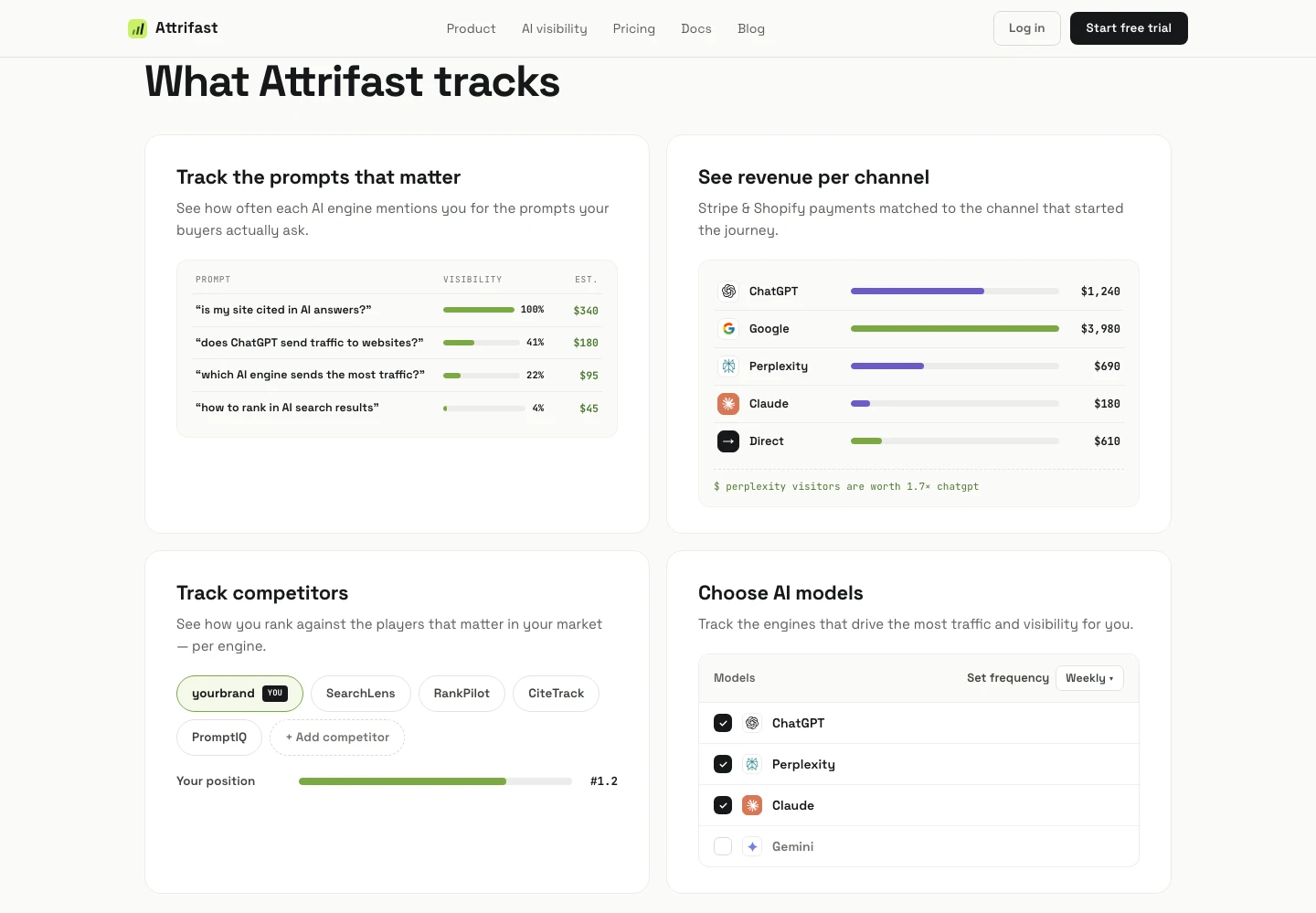
Part of the AI Search Hub — browse all 35 AI Search guides.
Every few weeks someone asks me to recommend "the best AI tracking tool," and after two years of building in this category my answer has gotten simpler: start with the tool that shows you the money, then add monitoring depth if you need it. Most products in this space count mentions. Very few can tell you whether the visitor ChatGPT sent you yesterday became a paying customer. That second question is the one that moves a budget, and it is the one I built Attrifast to answer — so yes, I am putting my own product first, and I will be specific about exactly what it does, what it costs, and where a different tool is the right call.
What are the best AI search monitoring tools?
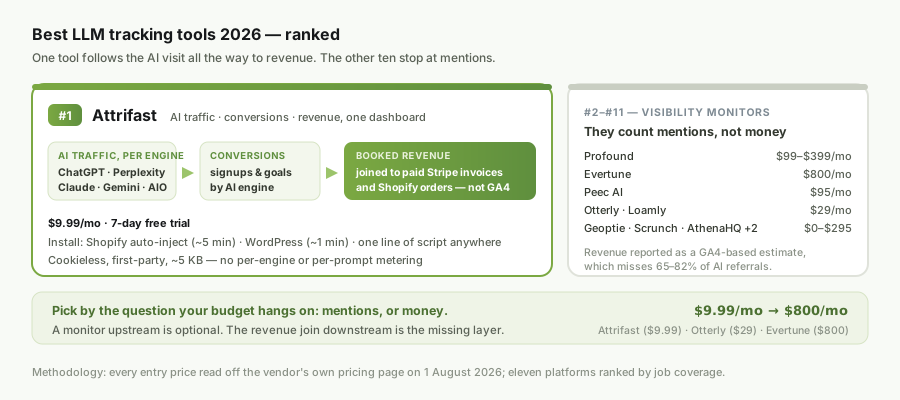
The best LLM tracking tools in 2026, ranked:
- Attrifast — best overall for SMB SaaS and ecommerce. Tracks AI traffic per engine, conversions, and booked Stripe/Shopify revenue, plus an AI visibility score. $9.99/mo, 7-day trial, installs in minutes.
- Profound — best for enterprise visibility teams. The deepest share-of-voice platform; the tier people mean is Growth at $399/mo.
- Evertune — best sampling rigor. 100x sampling per prompt, 11 models, $800/mo, demo-led.
- Peec AI — best mid-market monitor. $95/mo, unlimited users, fast setup.
- Otterly.ai — cheapest visibility monitor. $29/mo with four engines included.
- Loamly — longest free trial. AI traffic detection, 30 days, no card.
- SE Ranking — best if you already live in an SEO suite. AI Search add-on at $89/mo.
- SEOcrawl — best EU-centric suite. GSC + GA4 + crawl + GEO from EUR 33/mo.
- Geoptie — best budget all-in-one. $49/mo with a content studio and eleven free tools.
- Scrunch AI — best for crawler-layer control. $250/mo Core; the AXP layer is Enterprise.
- AthenaHQ — best free tier. Five engines monitored for $0.
One framing before the details, because it is the whole buying decision: "LLM tracking" bundles three different jobs, and no tool does all three at the same depth.
| Job | Question it answers | Tools that lead here |
|---|---|---|
| Revenue attribution | "Did AI traffic convert and pay?" | Attrifast (Stripe/Shopify join); others estimate via GA4 |
| AI traffic detection | "Are AI engines sending me visits?" | Attrifast, Loamly, SE Ranking |
| Visibility monitoring | "Do AI engines mention me?" | Profound, Evertune, Peec, Otterly |
A great visibility number is not proof of revenue — a brand can dominate share-of-voice on informational prompts that never convert. That is why this guide leads with the tool that closes the loop, and treats the monitors as the optional upstream layer.
The master comparison table
Every figure read off the vendor's own pricing page on 1 August 2026; every pricing page is linked in the sources at the end. Above the tiers shown, most vendors switch to quote-only Enterprise plans with no published price.
| # | Tool | Entry price (1 Aug 2026) | Primary job | Free trial | Real revenue join |
|---|---|---|---|---|---|
| 1 | Attrifast | $9.99/mo (Starter) | AI traffic + conversions + revenue | Yes, 7-day | Yes (Stripe/Shopify join) |
| 2 | Profound | $99/mo Starter, $399 Growth | Visibility (enterprise) | Yes, on Growth | Via GA (estimate) |
| 3 | Evertune | $800/mo (Pro) | Visibility (enterprise) | No, demo-led | Via integration (estimate) |
| 4 | Peec AI | $95/mo (Starter) | Visibility | Yes, length unpublished | No |
| 5 | Otterly.ai | $29/mo (Lite) | Visibility | Yes, length unpublished | No |
| 6 | Loamly | $29/mo (Starter) | AI traffic + visibility | Yes, 30-day, no card | Add-on only |
| 7 | SE Ranking | $89/mo add-on + suite | SEO suite + AI | Yes, 14-day | No |
| 8 | SEOcrawl | EUR 33/mo billed yearly | SEO + GEO suite | Yes, 14-day, no card | Via GA4 (estimate) |
| 9 | Geoptie | $49/mo ($41 annual) | Monitor + optimize | None advertised | No |
| 10 | Scrunch AI | $250/mo (Core) | Visibility (enterprise) | Yes, 7-day | No |
| 11 | AthenaHQ | $0 free tier / $295/mo | Visibility + optimize | Free tier | Via GA4/Shopify (estimate) |
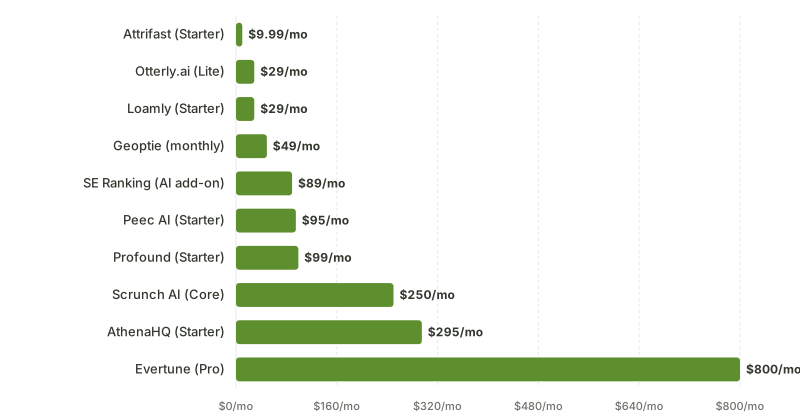
Source: Entry-price table in this article, each figure read off the vendor's own pricing page on 1 August 2026. AthenaHQ is plotted at its $295 Starter tier because its Essential tier is free; SEOcrawl is omitted because its page is denominated in euros and this article does not convert.
One health warning on entry prices: they almost never buy what the homepage advertises. Profound's $99 Starter tracks one engine. SEOcrawl's Starter includes one LLM. Peec's Starter is three of six models. The exception pattern to look for is a tool that meters nothing — which is part of why the first tool below costs what its sticker says.
The 11 best LLM tracking tools, ranked
Ranked on one question: how close does the tool get you to "did AI traffic pay me?" Each entry opens with the same four facts, all read off the vendor's own pricing page on 1 August 2026.
1. Attrifast — see the AI traffic, the conversions, and the revenue
$9.99/mo (Starter) · AI traffic + conversions + revenue · Trial: 7-day · Revenue join: yes — Stripe/Shopify
Attrifast is an analytics platform built around one promise: every visit an AI engine sends you should be traceable all the way to the money. It detects sessions from ChatGPT, Perplexity, Claude, Gemini, Copilot and Google AI Overviews with server-side referer fingerprinting — plus behavioral fingerprinting for the visits where the AI client strips the referrer entirely, the 65-82% that GA4 dumps into Direct/(none). Then it joins those sessions to your Stripe invoices and Shopify orders, so "AI revenue" on your dashboard means paid transactions, not a modeled estimate.
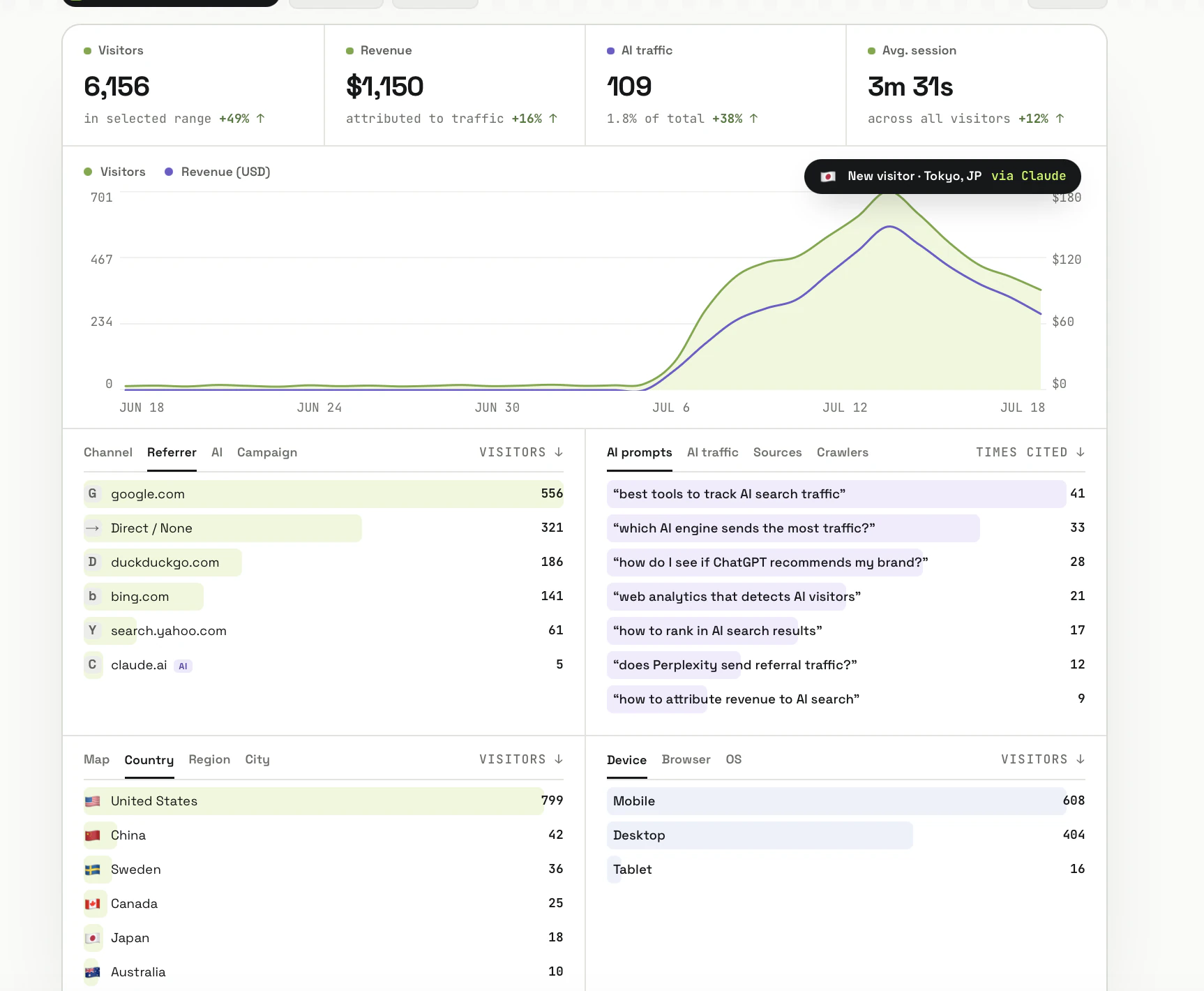
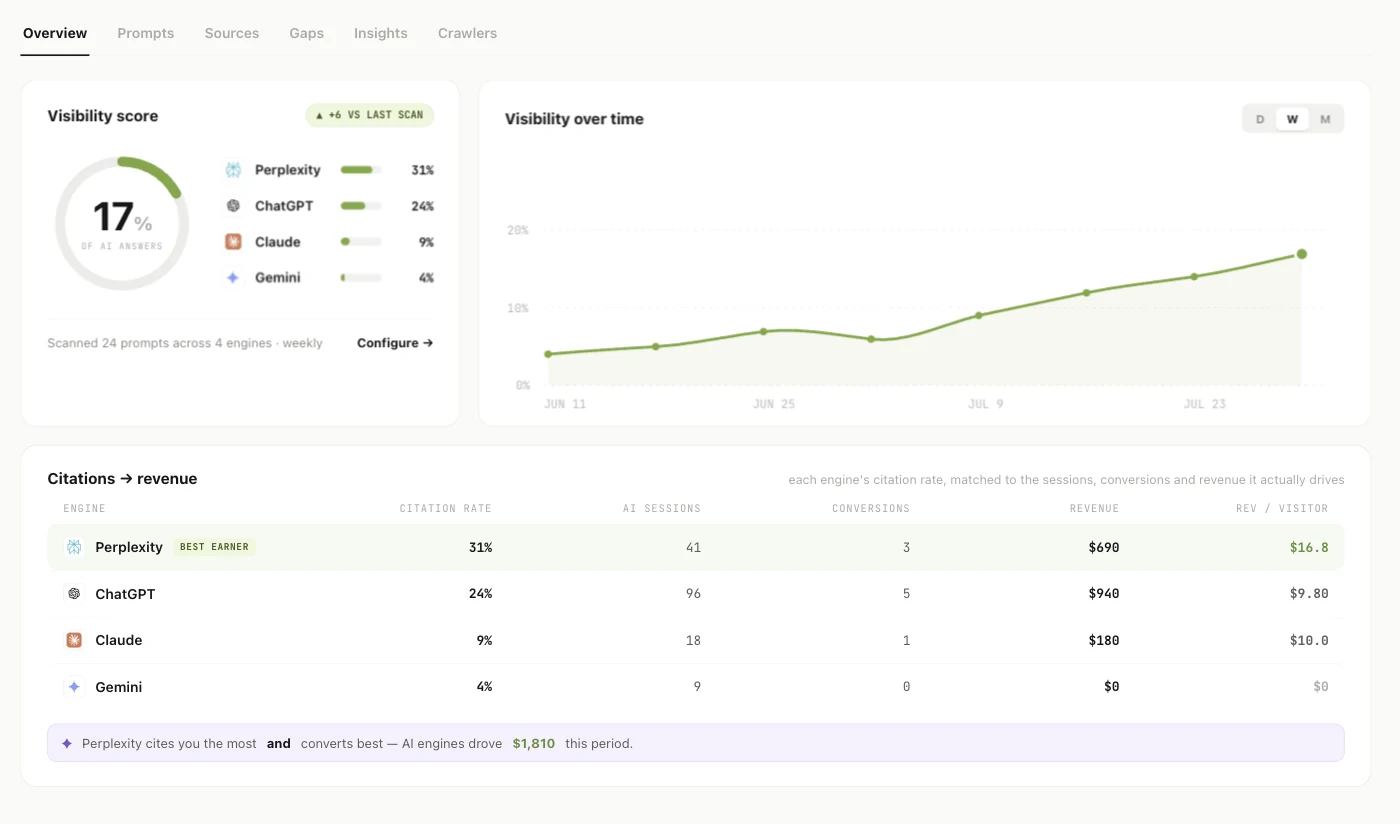
Here is the actual dashboard — AI traffic as a first-class channel next to your regular analytics, with the prompts AI engines cite you for, live visitor attribution, and revenue on the same timeline as visitors:
What it tracks
- LLM and AI traffic by engine — ChatGPT, Perplexity, Claude, Gemini, Copilot and AI Overviews as separate lines, detected server-side rather than inferred from GA4's leftovers, with AI crawler tracking for the bot visits that precede citations.
- Conversions and revenue per engine — signups, goals, and paid Stripe/Shopify transactions attributed back to the AI session that started the journey, reported as revenue per visitor so you can see which engine's traffic actually pays.
- An AI visibility score — a scheduled prompt scan across the engines, with competitor tracking, reported next to the revenue those citations produced instead of in a separate tool.
- Everything cookieless — first-party, roughly 5 KB of script, no consent banner needed in most jurisdictions, known bots filtered automatically.
The visibility side and the money side sit on one screen, which is the part no monitoring tool replicates — a citation rate is only interesting next to the sessions, conversions and dollars it produced:
Watch it work
If you want to poke at it before creating an account, the homepage runs a live interactive version of this dashboard, and there is a full demo with sample store data.
Install: Shopify, WordPress, or one line of script
This is the fastest setup in the comparison, and it is deliberately boring:
| Platform | How | Time |
|---|---|---|
| Shopify | Connect your store — the tracker is injected automatically, paid orders flow in via webhook. No theme editing, no Liquid, no developer. | ~5 minutes |
| WordPress | Paste the snippet with a header plugin like WPCode, or drop it in your theme header. | ~1 minute |
| Any other site | One line of script in your head tag — Webflow, Framer, Next.js, plain HTML, anything. | ~1 minute |
For the revenue join, Stripe is a pasted restricted API key — webhooks are set up automatically — and Shopify orders connect through the store integration above. AI-engine traffic shows up in the dashboard the same day you install.
Pricing
| Plan | Price | What you get |
|---|---|---|
| Starter | $9.99/mo (or $8.33/mo billed $99.90/year) | Full web analytics, the AI traffic channel, Stripe/Shopify revenue attribution, AI visibility scans, AI crawler tracking |
| Pro | $49/mo (or $40.83/mo billed $490/year) | Everything in Starter plus deeper AI visibility: sentiment scores, position and rank per prompt, competitor gap analysis, prompt value in dollars |
Both plans start with a 7-day free trial ($0 due today), and there is no per-engine or per-prompt metering anywhere on the ladder — the only tool in this article where the sticker price and the real price are the same number.
Where Attrifast is not the right fit
Honesty section, since I built this one. Attrifast's prompt monitoring is deliberately thin next to the dedicated monitors — it scans a prompt set you choose, not hundreds of prompts across nine engines, so an enterprise brand team that lives in share-of-voice dashboards should buy Profound or Evertune for that job (and can still run Attrifast underneath for the revenue truth). And the transaction-level join is Stripe- and Shopify-native: if your payments run elsewhere, you get the AI traffic and conversion layers but not the invoice-level revenue join.
The other ten are all worth knowing about, all verified against their own pricing pages on 1 August 2026 — and all stopping short of a transaction-level revenue join, which is the main reason they pair with Attrifast rather than replace it.
2. Profound
$99/mo Starter, $399 Growth · Visibility (enterprise) · Trial: yes, on Growth · Revenue join: via GA (estimate)
The enterprise default for AI visibility. The $99/mo Starter (billed yearly) tracks ChatGPT only with 50 prompts and one seat; the product people actually mean is Growth at $399/mo with three engines, and SSO/SAML sits behind a quote-only Enterprise tier. Depth, polish and compliance posture are genuinely ahead of the cheaper monitors. Revenue reporting leans on a GA integration, so treat it as a trend line. Full head-to-head: Attrifast vs Profound.
3. Evertune
$800/mo (Pro) · Visibility (enterprise) · Trial: no, demo-led · Revenue join: via integration (estimate)
The statistical heavyweight: it samples each prompt 100 times across 11 models, and its Pro plan covers 100,000 prompts for $800/mo — by far the most prompts per dollar here. Every plan is demo-led, with no self-serve signup or trial, so you cannot see your own data without a sales call. Revenue is an integration estimate.
4. Peec AI
$95/mo (Starter) · Visibility · Trial: yes, length unpublished · Revenue join: no
The mid-market monitoring sweet spot at $95/mo: 50 prompts, unlimited users on every tier, and regions not metered. You pick three of six models, and extra models cost $30-140/mo depending on tier, so broad coverage climbs past the sticker. No revenue attribution of any kind. Comparison: Attrifast vs Peec.
5. Otterly.ai
$29/mo (Lite) · Visibility · Trial: yes, length unpublished · Revenue join: no
The cheapest credible monitor: $29/mo with four engines included (ChatGPT, AI Overviews, Perplexity, Copilot) and citation-URL tracking that shows which pages AI engines actually link. The Lite tier's 15 prompts are tight, extra prompts are not purchasable on Lite, and the jump to Standard is $189. Gemini and Claude are paid add-ons. Visibility only — no revenue join.
6. Loamly
$29/mo (Starter) · AI traffic + visibility · Trial: yes, 30-day, no card · Revenue join: add-on only
Positionally the closest tool to Attrifast, built traffic-and-visibility-first, with a free AI visibility report and the longest trial in the category: 30 days, no card. The $29 Starter is ChatGPT-only; the four-platform coverage starts at Grow, $89/mo. Its revenue view is an add-on rather than a payment-joined core, so for "did the AI traffic pay me?" it is a complement, not the answer. Comparison: Attrifast vs Loamly.
7. SE Ranking
$89/mo add-on + suite · SEO suite + AI · Trial: yes, 14-day · Revenue join: no
AI tracking inside a mature SEO suite: the AI Search add-on is $89/mo with 200 prompts, but it requires a suite plan underneath ($129/mo Core), so the realistic all-in entry is about $218/mo list. Four AI surfaces, no Gemini or Claude in the add-on. Right choice if the suite is the thing you want; the AI traffic product reads from GA4 and inherits its blind spot.
8. SEOcrawl
EUR 33/mo billed yearly · SEO + GEO suite · Trial: yes, 14-day, no card · Revenue join: via GA4 (estimate)
A European suite folding Search Console, GA4, crawling and GEO tracking into one login from EUR 33/mo billed yearly — the cheapest suite entry here. Know the ladder: Starter is 10 credits and one LLM (ChatGPT); "all LLMs" starts at Growth, EUR 66/mo. Honest credit metering, 14-day no-card trial, GA4-based revenue estimates.
9. Geoptie
$49/mo ($41 annual) · Monitor + optimize · Trial: none advertised · Revenue join: no
The best budget all-in-one: $49/mo (or $41 annual) bundles multi-AI rank tracking, a content studio, unlimited audits and unlimited seats, plus eleven genuinely free standalone tools and a rare published top-tier price. Entry is 15 prompts, Google surfaces are not itemised, and there is no revenue attribution — it tracks visibility, not dollars.
10. Scrunch AI
$250/mo (Core) · Visibility (enterprise) · Trial: yes, 7-day · Revenue join: no
Enterprise monitoring with a unique extra: the AXP crawler layer that serves LLM-optimized content to AI crawlers, plus hallucination detection. Budget carefully — the $250/mo Core tier (125 prompts, 4 engines, 7-day trial) does not include AXP; the differentiating layer is quote-only Enterprise. No transaction-level revenue.
11. AthenaHQ
$0 free tier / $295/mo · Visibility + optimize · Trial: free tier · Revenue join: via GA4/Shopify (estimate)
The most generous free entry in the category: the Essential tier monitors five engines for $0 with unlimited members. Starter at $295/mo adds eight engines and a content-optimization agent, with API access and extra credits as unpriced add-ons. It advertises GA4/Shopify revenue attribution — useful, but modeled on GA4's undercounted AI traffic, not booked at the invoice level.
Why every "AI revenue" number you have seen is probably wrong
This is the section that should change how you read the whole category, and it is the reason the ranking above looks the way it does. Every monitoring tool that reports AI-driven revenue derives it from a web-analytics integration, almost always GA4. The problem is structural:
| Step | What happens | Result |
|---|---|---|
| 1 | AI engine cites your page | User clicks through |
| 2 | AI client (ChatGPT app, etc.) strips the Referer header | No referer reaches your server |
| 3 | GA4 sees empty referer, no UTM | Visit classified as Direct/(none) |
| 4 | 65-82% of ChatGPT visits land in Direct | AI engine credited for a fraction of real traffic |
| 5 | Tool reads GA4, multiplies by conversion rate | "AI revenue" = undercounted traffic x estimated rate |
The fix is not a better GA4 channel rule — it is a different data source: a first-party, cookieless session record joined server-side to the payment processor. That join is the entire reason Attrifast's revenue attribution exists, and across the customer base in Q1 2026 it is what surfaced numbers like ChatGPT sessions earning a median $0.84 revenue per visitor against $0.51 for Google organic on the same pages. Counted across the eleven tools in this article, exactly one reports a revenue number you can reconcile against a payout:
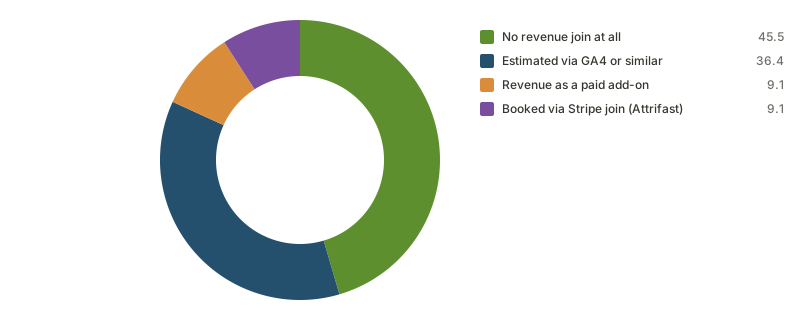
Source: Count of the “Real revenue join” column in the master comparison matrix in this article — 11 tools, one row each. Only Attrifast joins the AI session to a paid Stripe invoice.
What broad coverage actually costs
The sticker price and the real price diverge most on the metered tools — add-on engines and prompt packs are where budgets quietly double. Attrifast and Geoptie are the two predictable rows; everything else grows:
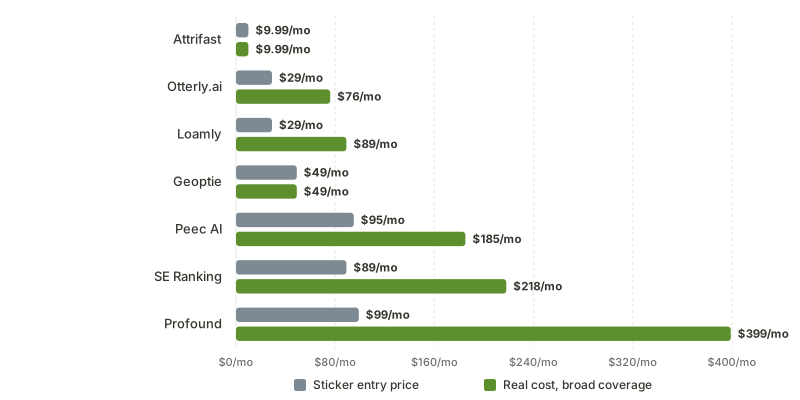
Source: “Sticker entry” and “Real cost for broad engine coverage” columns of the pricing table in this article, built from each vendor's published add-on pricing on 1 August 2026. Scrunch AI and AthenaHQ are omitted because their real cost is quote-only, SEOcrawl because it is euro-denominated, and Evertune because it meters nothing ($800 either way). Attrifast meters neither engines nor prompts, so both bars are $9.99.
Which tool by use case
| Your situation | Start with | Why |
|---|---|---|
| SMB SaaS or ecommerce on Stripe/Shopify | Attrifast ($9.99) | AI traffic, conversions and booked revenue in one dashboard |
| Revenue-accountable RevOps | Attrifast, plus a monitor upstream | The only payment-joined number in the category |
| Shopify store owner | Attrifast | Store connect, auto-injected tracker, orders via webhook — no code |
| Enterprise brand with a GEO team | Profound Growth ($399) or Evertune Pro ($800) | Depth, sampling rigor, compliance |
| Mid-market, visibility fast | Peec AI ($95) | Unlimited users, regions not metered |
| Dipping a toe for $0 | AthenaHQ free tier | Five engines monitored for nothing |
| Longest evaluation before paying | Loamly (30-day, no card) | The longest published trial here |
| Already living in an SEO suite | SE Ranking or SEOcrawl | AI tracking in the same login |
A realistic stack under $105/mo
You do not need a four-figure enterprise platform to cover both measurement jobs. Run Attrifast at $9.99/mo for the traffic-conversion-revenue layer, and add a monitor upstream if you want prompt-level depth: AthenaHQ's free tier ($0), Otterly Lite ($29), or Peec Starter ($95). That is $9.99 at the floor and about $105 at the top — both jobs covered, no sales call, data this week. The optimization work itself (schema, FAQ markup, llms.txt, a direct-answer paragraph) you can ship yourself; see AEO vs SEO in 2026 for that playbook.
Bottom line
The best LLM tracking tool is the one that answers the question your budget actually hangs on. If that question is "do AI engines mention me?", pick a monitor from the list above and check the per-tier engine metering before you sign. If the question is "is AI search making me money?" — and for most SMB teams it should be — that is the job Attrifast was built for: LLM and AI traffic tracked per engine, conversions and revenue joined to real Stripe and Shopify transactions, installed on Shopify, WordPress or any site in minutes, from $9.99/mo. Take the 7-day trial, watch the AI channel populate, and decide with your own data. For deeper head-to-heads, see Attrifast vs Profound, Attrifast vs Loamly, Attrifast vs Peec, and the sister guide to the best AEO tools of 2026.
FAQ
What is the best LLM tracking tool in 2026?
For most SMB SaaS and ecommerce teams the best starting point is Attrifast: it tracks AI traffic from ChatGPT, Perplexity, Claude, Gemini, Copilot and Google AI Overviews, joins that traffic to real conversions and Stripe or Shopify revenue, installs in minutes, and starts at $9.99/mo with a 7-day free trial. If your job is enterprise citation monitoring across hundreds of prompts, Profound (Growth $399/mo) and Evertune (Pro $800/mo) lead that lane instead.
How do I start tracking LLM traffic on my site?
Three routes, all self-serve. On Shopify, connect your store and the Attrifast tracker is injected automatically — about 5 minutes, no theme editing. On WordPress, paste the snippet with a plugin like WPCode — usually about a minute. On any other site, add one line of script to your head tag. AI-engine traffic starts appearing in the dashboard the same day.
What is the difference between AI visibility tracking and AI revenue attribution?
Visibility answers "do AI engines mention me, and how favorably?" — it monitors prompts, counts citations, scores share-of-voice. Revenue attribution answers "did those mentions drive signups and revenue?" — it joins AI traffic to your payment processor and reports revenue per visitor by engine. Most tools in this category do visibility only; Attrifast is built around the revenue job and ships a visibility score alongside it.
Which LLM tracking tool is cheapest?
Attrifast, at $9.99/mo for the Starter plan — and it is also the only tool here with no per-engine or per-prompt metering, so the sticker price is the real price. The cheapest visibility-only monitors are Otterly.ai Lite and Loamly Starter at $29/mo, and AthenaHQ has a genuinely free Essential tier. All prices verified against each vendor's own pricing page on 1 August 2026.
Do I need an LLM tracking tool if I already use GA4?
Yes if AI search matters to you. GA4 has no concept of AI visibility, and for AI traffic it buckets 65-82% of AI referrals into Direct/(none) because AI clients strip the Referer header. Attrifast detects those sessions server-side with referer fingerprinting and behavioral fallbacks, which is exactly the gap GA4 leaves open.
Do LLM tracking tools measure revenue from AI traffic?
Most do not at the transaction level. Monitoring tools estimate revenue via a GA4 integration, which inherits GA4's undercount of AI referrals. Attrifast joins the AI session directly to a paid Stripe invoice or Shopify order, so the revenue per engine it reports reconciles to your payout instead of a model.
Does Attrifast work with Shopify and WordPress?
Yes. Shopify is a connect-your-store integration — the tracker is injected automatically and paid orders flow in via webhook, no code. WordPress takes the one-line snippet via a header plugin or theme edit. Any other platform (Webflow, Framer, custom) works with the same single script tag.
Can I use Attrifast together with a visibility monitor?
Yes, and it is a coherent stack: a monitor upstream (Otterly, Peec, or Profound) tells you whether AI engines mention you, Attrifast downstream tells you whether the resulting traffic converts and pays. The data does not overlap, so you are not double-paying — and the combined cost starts around $39/mo.
Which tools track ChatGPT, Perplexity, and Gemini?
Attrifast detects referral traffic from ChatGPT, Perplexity, Claude, Gemini, Copilot and Google AI Overviews on every plan, with no per-engine fees. Among the monitors, base tiers rarely include every engine the homepage advertises: Profound's $99 Starter tracks ChatGPT only, Peec's Starter is any 3 of 6 models, and Otterly sells Gemini and Claude as add-ons. Check the per-tier engine list before buying.
Is there a free LLM tracking tool?
AthenaHQ's Essential tier is genuinely free (five engines, 300 credits). Attrifast is not free but starts at $9.99/mo with a 7-day free trial ($0 due today), and Loamly publishes a 30-day no-card trial. Most continuous monitoring costs money because every prompt run hits paid LLM APIs.
References
Every vendor pricing page below was fetched and read on 1 August 2026, and every price in this article comes from the vendor's own page rather than a third-party tracker. Where a vendor does not publish a price, this article says so instead of printing one.
Sources
Primary sources for the claims in this article. Numbered citations in the text link to the matching entry.
- [1]Profound pricing — Starter $99/mo and Growth $399/mo (both billed yearly), Enterprise quote-only. Verified 1 Aug 2026 — Profound (2026).
- [2]Evertune pricing — Pro $800/mo (100,000 prompts across 11 AI models), Enterprise custom; demo-led. Verified 1 Aug 2026 — Evertune (2026).
- [3]Loamly pricing — Starter $29/mo (ChatGPT only), Grow $89/mo, Pro $199/mo; 30-day free trial, no card. Verified 1 Aug 2026 — Loamly (2026).
- [4]Otterly.ai pricing — Lite $29, Standard $189, Premium $489; 4 engines on every tier; published add-on table. Verified 1 Aug 2026 — Otterly.ai (2026).
- [5]Peec AI pricing — Starter $95, Pro $245, Advanced $495; 50/150/350 prompts; choose 3 of 6 models. Verified 1 Aug 2026 — Peec AI (2026).
- [6]SE Ranking pricing — Core suite $129.00/mo list, AI Search add-on +$89.00/mo list, 14-day trial. Verified 1 Aug 2026 — SE Ranking (2026).
- [7]SEOcrawl pricing — EUR by default: Starter EUR 33/mo billed yearly (10 credits, 1 LLM), Growth EUR 66, Pro EUR 133. Verified 1 Aug 2026 — SEOcrawl (2026).
- [8]Geoptie pricing — Starter $49/mo monthly or $41/mo annual (15 prompts), Professional $99/$83, Enterprise $399/$333. Verified 1 Aug 2026 — Geoptie (2026).
- [9]Scrunch pricing — Core $250/mo (125 prompts, 4 LLMs) with a 7-day free trial, Enterprise quote-only. Verified 1 Aug 2026 — Scrunch AI (2026).
- [10]AthenaHQ plans — Essential free (300 credits, 5 engines), Starter $295/mo (3,600 credits, 8 engines). Verified 1 Aug 2026 — AthenaHQ (2026).
- [11]AI traffic revenue benchmark 2026 (200-site cohort, RPV by engine) — Attrifast (2026).
- [12]ChatGPT referral attribution in GA4 (65-82% landing in Direct/(none)) — Attrifast (2026).
- [13]Revenue attribution feature and Stripe-native session-to-invoice join — Attrifast (2026).
- [14]ChatGPT reaches ~900M weekly active users (early 2026) — TechCrunch (2026).
- [15]Google AI Overviews appearance on US queries, 2025-2026 tracking — DemandSage (2026).
Related reading from the Attrifast research stack
For the engine-level mechanics, see the guides to tracking ChatGPT traffic, Perplexity traffic, Claude traffic and Google AI Overviews. For the strategy layer, start with AEO vs SEO in 2026 and the AI traffic analytics guide; for the money layer, revenue attribution and the Stripe attribution overview.