Part of the AEO Hub, generative engine optimization guide, and AI Search Hub.
I have been running answer engine optimization on attrifast.com and a handful of client SaaS properties for the better part of two years, since back when "getting ChatGPT to mention you" was a curiosity rather than a line item. In that time I have shipped the schema, written the direct-answer blocks, chased the Reddit mentions, and — the part most AEO guides skip — built the attribution to find out whether any of it actually made money. Some of it did. A surprising amount of it did not, in ways you only see once you measure revenue instead of citations.
This is the complete guide I wish had existed when I started: what AEO is, how it really differs from SEO, the ranking factors that move the needle, a concrete step-by-step playbook, the tooling landscape, and — because this is the question that pays your salary — how to measure whether AEO drives revenue rather than just vanity citations. It is long because AEO is not a single trick; it is a discipline with five moving parts. If you only have time for one section, read the measurement section, because measuring AEO wrong is the most common and most expensive mistake in the category.
What is answer engine optimization?
Answer engine optimization (AEO) is the practice of structuring your content so that AI answer engines cite or mention it when they generate a response. An "answer engine" is any system that synthesizes a direct answer instead of returning a list of links: ChatGPT, Perplexity, Claude, Google AI Overviews, Gemini, Microsoft Copilot.
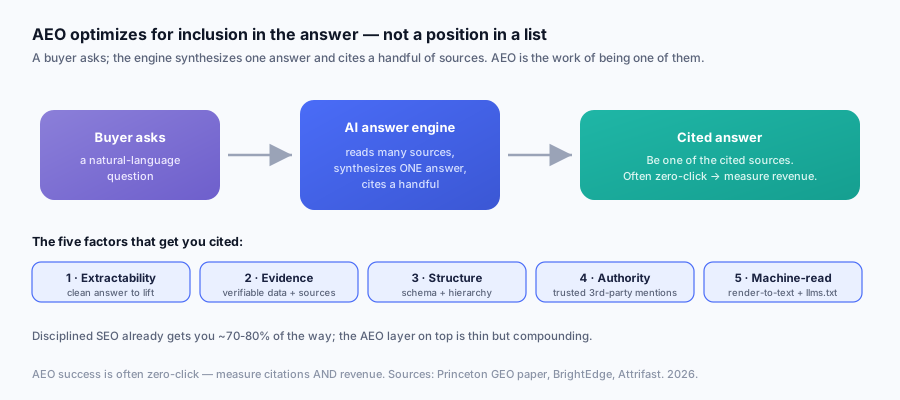
The shift is subtle but total. Classic search hands the user ten blue links and lets them choose. An answer engine reads dozens of sources, synthesizes one answer, and cites a handful of them. AEO is the work of being one of the handful. You are no longer competing for a rank in a list; you are competing for inclusion in a paragraph.
A note on vocabulary, because the acronyms multiply. AEO (answer engine optimization) and GEO (generative engine optimization) describe the same practice and are used interchangeably across the industry [20]. Some practitioners reserve AEO for direct-answer features and GEO for generative synthesis, but the tactics are identical and the distinction does not change a single thing you ship. I use AEO throughout this guide and treat GEO as a synonym; if you came here searching for one, the other is the same body of work.
Why AEO matters now
The reason this stopped being optional is volume. AI engines now intercept a meaningful and growing share of the queries that used to start on a classic search results page. AI Overviews appear on a double-digit percentage of US English queries and the trajectory is up [14][17]; ChatGPT alone reached hundreds of millions of weekly users [15]. A growing slice of your buyers now ask an answer engine before they ever see your homepage — and if the engine does not mention you, you are invisible at the exact moment of consideration. I make the full revenue case in does GEO actually drive revenue.

Source: Composite of BrightEdge AI Overviews tracking, SimilarWeb AI chatbot traffic, and Search Engine Land coverage
AEO vs SEO: what changes and what doesn't
The most useful thing I can tell you is that AEO is not a new discipline you have to learn from scratch. If you do disciplined SEO, you have already done roughly 70 to 80% of AEO — indexable HTML, clean structure, schema, internal links, and topical authority all transfer directly [6]. The additive layer is thin. I cover the full effort split in AEO vs SEO 2026 and the honest "is AEO replacing SEO" question in is AEO replacing SEO; here is the compressed comparison.
| Dimension | SEO | AEO |
|---|---|---|
| Optimizes for | Rank in a list of links | Citation inside a generated answer |
| Primary surface | Search engine results page | Synthesized AI answer |
| Unit of success | Position (1–10) | Mention rate / citation share |
| Click behavior | Position-based CTR | Often zero-click [16] |
| Core content move | Match search intent for a keyword | Give an extractable, sourced answer for a question |
| Structured data | Helpful | Critical (engines parse it directly) |
| Authority signal | Backlinks | Backlinks + third-party mentions the engine trusts |
| Measurement | Rankings, organic traffic | Citations + revenue (traffic is unreliable) |
The rows that genuinely differ from SEO are the bottom four. Structured data goes from "nice to have" to "the engine reads this to decide whether you are quotable." Authority expands beyond backlinks to include the mentions on Reddit, Wikipedia, and established publications that AI engines weight heavily when choosing sources — I go deep on this in how AI engines choose sources. And measurement breaks entirely, because the zero-click reality means traffic stops being a reliable proxy for visibility.
What does not change is the foundation. Fast, server-rendered, crawlable HTML. A logical heading hierarchy. Genuinely useful content that answers a real question. If your SEO house is in order, AEO is a renovation, not a rebuild.
The five AEO ranking factors that actually matter
Through running AEO across multiple properties and reconciling what I saw against the public research [6][12], the factors that correlate with getting cited cluster into five groups. I rank them here by how much leverage they give you per hour of work.

Source: Attrifast practitioner weighting across multiple AEO-instrumented properties, 2026
1. Extractability — give the engine a clean answer to lift
The single highest-leverage move: put a direct, self-contained answer near the top of the page, ideally in the first paragraph or a definition block, phrased the way the question is asked. Answer engines lift extractable passages; a page that buries its answer under 600 words of preamble is hard to quote. This is why every section in this guide opens with a one-sentence answer before the explanation.
2. Evidence — back every claim with something verifiable
Engines preferentially cite sources that carry specific data, named references, and verifiable claims over vague assertions. "AI traffic is growing" is unciteable; "AI Overviews appear on a double-digit percentage of US English queries per BrightEdge tracking [14]" is exactly the kind of sentence an engine reaches for. Density of verifiable evidence is one of the clearest signals separating cited pages from ignored ones.
3. Structure — make it machine-parseable
Clean HTML, a logical H1 → H2 → H3 hierarchy that mirrors how questions are asked, and FAQ + Article schema so the engine can parse your content structurally rather than guessing. I cover the implementation in schema markup for AI search and GEO. Heading hierarchy matters more than it does for classic SEO because engines use it to understand which passage answers which question.
4. Authority and trust — be a source the engine already trusts
Topical depth (a genuinely best-in-class library on a narrow topic beats scattered coverage), demonstrable author expertise, and — the one most teams underinvest in — third-party mentions on sites the engine trusts. Concentrated, authentic mentions on Reddit, Hacker News, Wikipedia, and established publications move citation rate more than almost anything else you can do on your own domain [13]. This is the slow-compounding factor; it is also the most defensible.
5. Machine-readability — don't hide content behind JavaScript
Fast server-rendered HTML, no critical content gated behind client-side rendering, and optionally an llms.txt file declaring what you want engines to use. I tested whether llms.txt actually moves the needle in should I publish llms.txt: an honest test — the short version is that it is cheap insurance, not a silver bullet. The non-negotiable here is render-to-text: if an engine can't read your content without executing JavaScript, none of the other four factors matter.
None of these five is a switch you flip. AEO is the compounding product of doing all five consistently on content that is genuinely worth citing. Anyone selling you a single tactic is selling you a fraction of the work.
A step-by-step AEO playbook
Here is the concrete sequence I run on a new property or a page I want cited. It maps directly onto the five factors above. For the broader tactical menu, see the GEO tactics playbook 2026 and the AI search optimization checklist.
- Pick the prompts, not just keywords. Start from the natural-language questions your buyers actually ask an answer engine ("best Stripe analytics for SaaS", not "stripe analytics"). These become your target prompts and your section headings.
- Write the direct answer first. For each target question, write a clean, self-contained two-to-three-sentence answer and put it at the top of the relevant section. Everything else supports it.
- Load in verifiable evidence. Add specific numbers, named sources, and citations. Replace every vague claim with a sourced one. This is the highest-effort step and the highest-return.
- Mark it up. Add Article and FAQPage schema, fix the heading hierarchy to H1 → H2 → H3, ensure the page is server-rendered. See schema markup for AI search.
- Disambiguate your entity. Use consistent naming and
sameAslinks to your authoritative profiles so the engine knows exactly who you are and doesn't confuse you with a similarly-named entity. - Earn third-party mentions. Get cited where the engines look — relevant Reddit threads, a Wikipedia presence if you qualify, guest pieces on trusted publications. Authentic and concentrated beats spammy and broad.
- Publish or update llms.txt. Cheap insurance; declare your preferred sources. Test whether it moves anything for you with the honest llms.txt test.
- Measure all three levels (next section). Without measurement you are optimizing blind.
- Refresh on a cadence. Engines reward freshness; revisit cited pages quarterly. See content refresh for AI citations.
The sequence matters: extractability and evidence (steps 2–3) give you the fastest wins, structure and entity work (steps 4–5) are one-time fixes that compound, and authority (step 6) is the slow flywheel that eventually makes you a default source.
How to measure AEO: the three levels
This is the section that separates teams who do AEO from teams who prove AEO. Measurement runs on three levels, and most teams only measure the first while guessing at the two that matter.

Source: Attrifast estimate based on customer onboarding interviews, 2026
Level 1 — Visibility: are engines citing you?
The monitoring layer. An AI visibility tool runs your prompts across engines and reports mention rate, citation share, and share-of-voice. This tells you whether the optimization worked at the citation level. For how these tools work and how to pick one, see the AI visibility tools guide and the multi-LLM tracker breakdown. Necessary, but it stops one step short of money.
Level 2 — Traffic: are cited users clicking through?
Harder than it should be. Because AI clients strip the Referer header, the majority of ChatGPT and other AI-engine visits land in GA4's Direct/(none) bucket — in our measurement, 65–82% of ChatGPT-referred sessions are never credited to ChatGPT [1]. So GA4 systematically undercounts AI traffic, and any "AI traffic" number from a GA4-based tool is a floor, not a measurement. I walk through the mechanism in why ChatGPT referral traffic doesn't show in analytics and track AI traffic without GA4.
Level 3 — Revenue: did the cited traffic pay you?
The level that matters, and the one almost no tool measures. Getting cited is worthless if the citation doesn't convert. A high citation share with flat revenue per visitor (RPV) usually means you are cited for informational queries that don't buy — a false positive a monitoring-only tool will never catch, because it stops at the citation and never sees the checkout.
Measuring this requires joining the AI-referred session to a paid transaction. This is exactly the gap Attrifast closes: it detects AI-engine referral sessions server-side (before the Referer is lost), writes a first-party session id, and joins it to the Stripe payment_intent.succeeded webhook when the visitor pays. The output is RPV by engine, by page, by prompt — the only AEO metric that is booked revenue rather than a model. For the full method, see measure GEO ROI and Stripe vs GA4 revenue attribution.
A complete AEO measurement stack covers all three levels. If you only measure Level 1, you have a vanity dashboard; if you measure all three, you can tell your board exactly which AEO work paid for itself.
AEO tools: what to buy and what to skip
You can ship the entire optimization layer yourself — direct answers, schema, internal links, llms.txt — with no tool. Where tools earn their keep is measurement, which splits into the same monitoring and attribution jobs covered above:
- Monitoring (visibility): Profound, Peec, Otterly, Scrunch, and others run your prompts and report citation metrics. Compared tool-by-tool in best AEO tools 2026 and best LLM tracking tools 2026.
- Attribution (revenue): Stripe-native tools like Attrifast join the cited session to booked revenue — the job the monitoring tools structurally leave open.
The practical answer for most teams is a small stack: one monitoring tool, one attribution tool, optimization done in-house. Resist the urge to buy a single enterprise "does everything" platform until you've proven the channel pays — and read the real cost of AI citation monitoring before you sign a four-figure contract.
Common AEO mistakes
- Measuring only citations. Visibility without revenue is vanity. Measure all three levels.
- Trusting GA4 for AI traffic. It under-counts because of the Referer strip [1]. Use server-side detection.
- Treating AEO as a replacement for SEO. It's a layer on top. Classic search still pays most of the bills.
- Chasing one tactic. AEO is the compounding effect of all five factors, not a schema hack.
- Burying the answer. If the engine can't extract a clean answer, it won't cite you.
- Ignoring third-party mentions. The on-domain work has a ceiling; trusted off-domain mentions are where citation rate compounds [13].
Frequently asked questions
How is AEO different from GEO and AI SEO? They're synonyms in practice. AEO, GEO, and "AI SEO" all describe getting AI engines to cite your content. Pick whichever term your team prefers and focus on the work, not the acronym [20].
Can small businesses do AEO? Yes, and the narrow-topic advantage often favors them — a small site that is genuinely best-in-class on one tight topic can out-cite a broad enterprise site on that topic. See the small business AI search survival guide.
Will AEO still matter if Google wins AI search? Yes. Whether the dominant answer engine is ChatGPT, Gemini, or Google AI Mode, the discipline is identical: be the extractable, sourced, trusted answer. The engine changes; the five factors don't.
Related reading from the Attrifast research stack
Start with AEO vs SEO 2026 for the effort split, how AI engines choose sources for the authority mechanics, and the GEO tactics playbook for the full tactical menu. For tooling, see best AEO tools 2026 and the AI visibility tools guide. For the revenue half, see measure GEO ROI and revenue attribution.
Sources
Primary sources for the claims in this article. Numbered citations in the text link to the matching entry.
- [1]Why ChatGPT referral traffic doesn't show in analytics (65-82% in Direct/none, Q1-Q2 2026) — Attrifast (2026).
- [2]How ChatGPT search works — citations and source selection — OpenAI Help Center (2025).
- [3]Perplexity FAQ — how Perplexity cites sources — Perplexity (2025).
- [4]Anthropic Claude — web search and citation behavior — Anthropic Help Center (2025).
- [5]Google AI Overviews — coverage tracking and citation behavior — Search Engine Land (2026).
- [6]GEO: Generative Engine Optimization (Aggarwal et al.) — what increases citation likelihood — Princeton / arXiv (2024).
- [7]Generative Engine Optimization: Growth Strategies and Metrics For the AI Era — Ahrefs (2025).
- [8]Semrush — AI Overviews and AI search research — Semrush (2025).
- [9]Schema.org — FAQPage structured data — Schema.org (2026).
- [10]Schema.org — Article structured data — Schema.org (2026).
- [11]Google Search Central — structured data general guidelines — Google (2026).
- [12]MIT Technology Review — how LLMs decide what to cite — MIT Technology Review (2026).
- [13]Reuters — Reddit content licensing deals with AI companies (third-party mention weight) — Reuters (2024).
- [14]BrightEdge — One Year Into Google AI Overviews: Google Search Usage Increases by 49% — BrightEdge (2025).
- [15]TechCrunch — ChatGPT weekly active user milestones — TechCrunch (2026).
- [16]How to Get Cited in Google AI Overviews: Own a Criterion — Backlinko (2026).
- [17]AI Search Stats 2026: Market Share, Referral, and Citation Data — SimilarWeb (2026).
- [18]Pew Research Center — share of US adults who have used AI chatbots — Pew Research Center (2025).
- [19]llms.txt proposal and specification — llmstxt.org (2025).
- [20]Search Engine Land — Generative engine optimization and the AEO landscape — Search Engine Land (2026).