
A founder emailed me last month with a screenshot of his GA4 channel report and one sentence: "I think I need to leave GA4, but every alternative I look at just counts pageviews — none of them tell me ChatGPT is sending me customers." That email is the whole article. He was right on both counts: GA4 was failing him, and most of the "GA4 alternatives" he found failed him in a different way. The honest answer to "how do I track AI traffic without GA4" is not "switch to a privacy analytics tool." It is more specific than that, and this guide is the long version of the reply I sent him.
This piece is the counterpart to two others. The GA4 AI traffic setup guide is the "make GA4 work" path — custom channel groups, GTM, BigQuery. The dark AI traffic explainer is the "here is exactly what GA4 gets wrong" diagnosis. This article is the third option: skip GA4 entirely for AI attribution. If you have read either of those, skim section 2 and go straight to the tool comparison in section 5; that is the part that does not exist elsewhere.
Quick Facts
| Metric | Value | Source |
|---|---|---|
| GA4 default channel rules covering AI engines | 0 of 17 | Google Analytics docs [1] |
| Median % of AI clicks GA4 misfiles as Direct | 65-80% | Attrifast aggregate, n=200 |
| EU DPAs that have ruled GA deployments unlawful | Austria, France, Italy (and others) | CNIL / noyb [9][10] |
| CNIL first Google Analytics GDPR decision | 10 February 2022 (US transfers ruled unlawful) | CNIL / IAPP [9][23] |
| Plausible AI-engine classification (default) | None built in | Plausible docs [3] |
| Fathom AI-engine classification (default) | None built in | Fathom docs [4] |
| Tools that join AI traffic to Stripe revenue (default) | Revenue-attribution category only | Author measurement |
| Cookieless first-party identifier consent requirement (most EU) | None when no PII / no cross-site cookie | ePrivacy / MDN [5] |
| AI bot share of total bot traffic (2024-25) | ~4-6% and rising | Cloudflare Radar [6] |
| Layers required for true AI attribution | 3 (detect, identify, join) | Author framework |
| Time to install a cookieless first-party script | < 5 minutes | Author measurement |
| GA4 historical data back-fill after migration | None; export first | Google Analytics docs [2] |
I will mark every place where a tool genuinely cannot do something with "this tool cannot do X" rather than soften it. That includes my own. Attrifast does not replace GA4's funnel exploration or audience builders, and I will say so where it matters.
TL;DR: the honest version
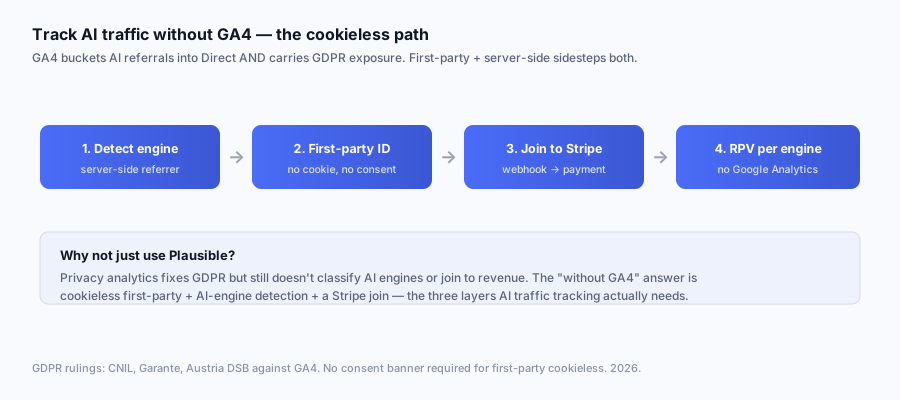
If you want AI traffic tracking without GA4, here is the compressed answer before the 5,000 words. GA4 mislabels AI referrals as Direct and carries EU compliance risk, so leaving it for AI attribution is defensible. But the popular alternatives split into two camps that each solve only half the problem. Privacy analytics — Plausible, Fathom, Simple Analytics — fix compliance but do not classify AI engines or measure revenue. Revenue attribution tools classify AI engines server-side and join to Stripe but are not general-purpose dashboards. Pick based on whether you need the AI revenue answer or just a private pageview counter.
| Your need | The honest pick | Why |
|---|---|---|
| Banner-free pageview counting | Plausible / Fathom | Cookieless, GDPR-friendly, simple |
| Know which AI engine sends revenue | Cookieless revenue attribution | Server-side AI detect + Stripe join |
| Stay on GA4 but recover some AI | GA4 + custom channel group | Recovers referred slice only |
| Funnel exploration, audiences, Ads linking | Keep GA4 (or run parallel) | First-party tools do not match this |
That table is the whole decision. The rest of the article is the evidence behind each row.
Why GA4 fails at AI traffic — reason one: the Direct bucket
GA4 fails at AI traffic first because it cannot see most of it. AI clients strip the Referer header on the majority of outbound clicks — a Referrer-Policy behavior documented on MDN[5] — GA4's default channel grouping has no rule for AI engines[1], and the result is that 65-80% of AI-referred visits land in Direct/(none) with no AI label at all. This is mechanical, not a setting you toggle. The signal GA4 needs is already gone by the time the hit arrives.
Here is the chain of events for a typical ChatGPT citation click.
The referer disappears for several independent reasons, and none of them is under your control.
| Mechanism | Why the referer is lost | Affected engines |
|---|---|---|
| Referrer-Policy: no-referrer | Client sets a policy that blanks the referer | ChatGPT desktop, several apps |
| In-app webview | Click opens inside the AI app, not a browser tab | ChatGPT mobile, Gemini app |
| HTTPS-to-app boundary | Origin is the app, not a web page | Claude, Copilot in some surfaces |
| User opens link manually | User copies the URL and pastes it later | All engines |
| Markdown link rendering | Some clients render links without a referrer source | Varies |
The per-engine pass-through rates are not uniform, which is why a single regex never fully fixes this even inside GA4.
| Engine | Approx. referer pass-through | GA4 default bucket when stripped |
|---|---|---|
| ChatGPT | 15-20% | Direct / (none) |
| Perplexity | 35-55% | Direct / (none) |
| Claude | < 5% | Direct / (none) |
| Gemini | 10-30% | Direct / (none) |
| Copilot | 10-25% | Direct / (none) |
The reason this matters is that the harder you succeed at AI visibility, the worse GA4 looks. As your citation share grows — and AI referral traffic has been climbing steadily across published trackers[21] — your Direct bucket inflates, and the operator misreads it as brand lift. I covered that misread in detail in the dark AI traffic explainer; the short version is that a 25-40% unexplained Direct jump after you start getting cited is the tell. GA4 cannot separate the AI portion of Direct from genuine direct because both arrive identically: no referer, no UTM. That is the first half of why GA4 fails.
Why GA4 fails at AI traffic — reason two: the GDPR problem
GA4 fails at AI traffic a second time, for a reason that has nothing to do with referrers: it carries real GDPR exposure in the EU. GA4 transmits data to Google's infrastructure, and several European data protection authorities have ruled specific Google Analytics deployments unlawful over US data transfers — France's CNIL[9], Italy's Garante[11], and Austria's DSB in the noyb-led complaints[10]. So even when you recover AI traffic with a custom channel group, you are recovering it inside a tool a regulator may tell you not to use. Accuracy and compliance fail together.
The regulatory timeline is not hypothetical. It is a sequence of published decisions.
| Year | Authority | Action |
|---|---|---|
| 2022 | Austria (DSB) | Ruled a site's use of Google Analytics violated GDPR |
| 2022 | France (CNIL) | Ordered a French site to stop using Google Analytics |
| 2022 | Italy (Garante) | Found Google Analytics data transfers unlawful |
| 2023 | EU-US Data Privacy Framework adopted | New transfer basis; ongoing legal challenge |
| 2024-26 | Continued scrutiny | DPAs and noyb continue monitoring GA deployments |
The Data Privacy Framework adopted in 2023[12] changed the legal basis for transfers, and it is genuinely a different situation than 2022 — I will not pretend GA4 is flatly illegal today, because it is not. But the framework is under active legal challenge, the prior rulings established that DPAs will act, and a procurement team at an EU customer will still raise GA4 in a security review. The compliance risk is a moving target, not a settled "you are fine."
| GA4 compliance concern | Status in 2026 | Practical impact |
|---|---|---|
| US data transfer | DPF in place, under challenge | Uncertainty for EU-facing sites |
| Consent banner requirement | Required for GA4 cookies | Friction + consent-decline data loss |
| IP handling | Anonymization options exist | Configuration burden, easy to get wrong |
| Data retention defaults | Configurable, often misconfigured | Audit risk |
| Customer procurement scrutiny | Common in EU B2B deals | GA4 flagged in security reviews |
Here is where the two failures compound. The consent banner GA4 requires for its cookies is itself a data-loss event: under the ePrivacy rules the CNIL enforces, non-essential analytics cookies need prior consent[19], so visitors who decline are not measured, and decline rates in the EU routinely run 20-40% depending on the banner. So in the EU, GA4 loses AI traffic to the Direct bucket and loses more traffic to consent declines on top of it. A cookieless first-party tool that needs no banner does not pay that second tax. This is why "track AI traffic without GA4" and "track traffic without a consent banner" are the same conversation for EU-facing SaaS. The deeper version of the compliance argument is in the GDPR analytics 2026 playbook.
The four GA4-alternative camps
Once you decide to track AI traffic without GA4, the alternatives sort into four camps, and the single most common mistake is assuming they all do the same job. They do not. Privacy analytics solves compliance. Revenue attribution solves the AI-and-money question. Server-log analysis solves bot visibility. And the DIY GA4-plus-custom route solves nothing GA4 did not already half-solve. Knowing which camp you are choosing is the whole decision.
| Camp | Solves | Does not solve | Best for |
|---|---|---|---|
| Privacy analytics | GDPR, banner-free pageviews | AI-engine classification, revenue | Teams who want a private GA4 swap |
| Revenue attribution | AI detection + revenue per engine | General dashboards, audiences | SaaS / ecommerce measuring ROI |
| Server-log analysis | Bot visibility, free | Human attribution, revenue, scale | Engineers auditing crawl behavior |
| GA4 + custom DIY | Referred AI slice inside GA4 | Unreferred majority, GDPR | Teams committed to GA4 |
The trap is that "privacy analytics" sounds like the obvious answer to "leave GA4," and for general traffic it is. But the founder who emailed me did not want a private pageview counter; he wanted to know whether ChatGPT was sending paying customers. Those are different products. Let me take each camp honestly.
Camp one: privacy analytics (Plausible, Fathom, Simple Analytics)
Privacy analytics tools are the best-known GA4 alternatives, and they are genuinely excellent at what they do: cookieless, lightweight, GDPR-friendly pageview and source analytics with no consent banner in most jurisdictions. Plausible[3], Fathom[4], and Simple Analytics[17] all fit this description. What they do not do by default is classify AI engines as a distinct channel or join a visit to revenue. They will show chatgpt.com as a referrer when the referer survives — the same 15-50% slice GA4 sees — but they do not infer the unreferred majority and they do not tell you which engine produced a sale.
| Capability | Plausible | Fathom | Simple Analytics |
|---|---|---|---|
| Cookieless | Yes | Yes | Yes |
| Banner-free (most EU) | Yes | Yes | Yes |
| Shows AI referrer when present | Yes | Yes | Yes |
| Dedicated AI-engine channel (default) | No | No | No |
| Infers unreferred AI visits | No | No | No |
| Revenue / Stripe join (default) | No | No | No |
| Open source option | Yes | No | No |
This is not a knock on them. If your job is to delete GA4 and keep a clean, compliant view of pageviews and top sources, any of these three is a great choice, and I recommend them often. My honest comparison pages — Attrifast vs Plausible and Attrifast vs Fathom — go deeper, but the one-line summary is: they solve privacy; they do not solve AI revenue.
Camp two: revenue attribution (cookieless first-party + Stripe)
Revenue attribution tools start from a different question: not "how many visits" but "which source produced revenue." For AI traffic that means detecting the AI engine server-side — including inferring the unreferred majority with a behavioral classifier — and joining the session to a Stripe charge. This is the camp Attrifast is in. The tradeoff is honest: a revenue attribution tool is not a general-purpose dashboard. It will not give you Plausible's elegant top-pages view or GA4's funnel exploration. It answers one question well.
| Capability | Revenue attribution (e.g. Attrifast) |
|---|---|
| Cookieless first-party | Yes |
| Server-side AI-engine detection | Yes |
| Infers unreferred AI visits | Yes (behavioral classifier) |
| Revenue per AI engine | Yes (Stripe webhook join) |
| Refund-adjusted revenue | Yes |
| General funnel exploration | No |
| Audience builders / Ads linking | No |
Camp three: server-log analysis
Server logs are the free, technical option, and they are genuinely useful for one thing: seeing AI crawlers. Grep your access logs for GPTBot and ChatGPT-User[7], PerplexityBot[18], and ClaudeBot[8] in the User-Agent, and for chatgpt.com or perplexity.ai in the Referer, and in about ten minutes you have a picture of crawl frequency and the referred slice of human visits. What logs cannot do is recover the unreferred human majority, join to revenue, or scale into a dashboard your marketing team will actually open.
| Server-log capability | Verdict |
|---|---|
| AI crawler visibility | Strong |
| Referred human AI visits | Partial (referer-only) |
| Unreferred human AI visits | This approach cannot do it |
| Revenue join | This approach cannot do it |
| Non-engineer usability | Poor |
Camp four: GA4 + custom DIY
This is the "do not leave GA4, fix it" path, and it belongs in the list because it is the most common starting point. A custom channel group plus a GTM custom dimension recovers the referred AI slice inside GA4. It does nothing about the GDPR exposure and nothing about the unreferred majority. I documented the full build in the GA4 AI traffic setup guide; it is the right choice only if you are committed to staying on GA4 for reasons unrelated to AI traffic.
What AI traffic tracking actually requires: three layers
Tracking AI traffic — with or without GA4 — requires three distinct layers, and the reason most tools feel half-finished is that they implement one or two. Layer one is detection: knowing a visit came from an AI engine, including the unreferred majority. Layer two is identity: a durable, cookieless way to recognize the same visitor across the session and the eventual purchase. Layer three is revenue: joining that identity to the actual money. Miss any layer and you cannot answer "did ChatGPT send a paying customer."
Layer one: detection
Detection has two parts because AI clients split into two populations: the minority that pass a referer and the majority that do not. The referred minority is easy — match the hostname against a known AI-engine list. The unreferred majority is the hard part, and it needs a behavioral classifier: an unreferred deep-page entry on a buying-intent query, with no UTM and no branded-search footprint, is statistically an AI referral, not a bookmark.
| AI engine | Detection domains (referred slice) |
|---|---|
| ChatGPT | chatgpt.com, chat.openai.com, oai.com |
| Perplexity | perplexity.ai, www.perplexity.ai |
| Claude | claude.ai |
| Gemini | gemini.google.com |
| Copilot | copilot.microsoft.com, bing.com/chat |
| Others | you.com, phind.com, poe.com |
| Detection signal | Catches | Limitation |
|---|---|---|
| Referer hostname match | Referred slice (15-55%) | Misses stripped-referer majority |
| Sec-Fetch-Site header | Some cross-site contexts | Inconsistent across clients |
| Behavioral classifier | Unreferred deep-page entries | Probabilistic, not certain |
| Landing-page pattern | Deep content pages | Needs intent context |
Layer two: identity
Identity is where the privacy story lives. A first-party identifier — scoped to your own domain, set by your own server — is not a third-party cookie and falls outside the cross-site tracking rules that ITP[13] and the ePrivacy directive[19] target. That is the mechanism that lets a cookieless tool run without a consent banner where GA4 cannot. The identifier exists to connect "this visit came from ChatGPT" to "this visitor later bought," nothing more.
| Identity approach | Cross-site cookie? | Consent banner (most EU) | Survives ITP |
|---|---|---|---|
| GA4 third-party-style cookie | Yes (behaves cross-site) | Required | Degraded |
| First-party identifier | No | Generally not required | Yes |
| Server-side first-party | No | Generally not required | Yes |
| Fingerprint hash | No, but PII-adjacent | Risky | N/A |
Layer three: revenue
Revenue is the layer GA4 alternatives built for privacy skip, and it is the one that turns "we got AI traffic" into "AI traffic is worth X." The clean implementation for Stripe-based SaaS is a server-side join: write the first-party session identifier into Stripe Checkout metadata, then read the resulting charge from a webhook — using the event ID as an idempotency key, since Stripe delivers at-least-once[20] — and attribute it back to the AI engine. This reads revenue from the source of truth — the actual charge — instead of trusting a client-side purchase event to survive ad blockers and consent declines.
| Revenue method | Source of truth | Survives ad blockers | Refund-aware |
|---|---|---|---|
| GA4 ecommerce event | Client dataLayer push | No | No |
| Stripe webhook join | Stripe charge | Yes | Yes |
| Manual CSV reconciliation | Stripe export | Yes | Manual |
The full revenue mechanics are in the cookieless revenue analytics feature page and the revenue attribution overview. The point for this article: revenue is a required layer, and most GA4 alternatives do not have it.
The honest tool comparison
Here is the comparison the rest of the article has been building toward, scored honestly on the three things that matter for AI traffic without GA4: AI-engine detection, revenue attribution, and GDPR posture. I score my own tool in the same table, and where it loses, it loses. No tool here is best at everything.
| Tool | AI detection (referred) | AI detection (unreferred) | Revenue / Stripe | GDPR posture | Price |
|---|---|---|---|---|---|
| GA4 (custom setup) | Partial (regex) | None | Via BigQuery + Stripe export | Fraught (EU) | Free |
| Plausible | Referrer only | None | None (default) | Strong | From ~$9/mo |
| Fathom | Referrer only | None | None (default) | Strong | From ~$15/mo |
| Simple Analytics | Referrer only | None | None (default) | Strong | From ~$9/mo |
| Attrifast | Yes | Yes (classifier) | Yes (native) | Strong | $9.99/mo |
Now the same five tools scored on the things GA4 alternatives are usually chosen for, so the picture is balanced — these are the rows where the privacy tools and GA4 win.
| Tool | Pageview dashboard | Funnel exploration | Audiences / Ads linking | Open source | Setup time |
|---|---|---|---|---|---|
| GA4 (custom setup) | Strong | Strong | Strong (native) | No | Hours |
| Plausible | Strong | Basic | No | Yes | Minutes |
| Fathom | Strong | Basic | No | No | Minutes |
| Simple Analytics | Strong | Basic | No | No | Minutes |
| Attrifast | Focused | Revenue-focused | No | No | < 5 min |
A few honest reads of these two tables:
- If you want GA4's funnel exploration and Google Ads linking, no first-party tool replaces that. Run parallel or stay.
- If you want a beautiful, compliant pageview dashboard, Plausible and Fathom beat everyone, including me, on that specific job.
- If you want to know which AI engine sent revenue, the privacy tools score "None" on detection-unreferred and revenue, and that is the column the founder who emailed me actually cared about.
- GA4 is "Free" but the EU compliance column is "Fraught," and free-but-fraught is not free for an EU-facing business.
| Decision driver | Winner | Honest caveat |
|---|---|---|
| Lowest cost | GA4 | Compliance cost is hidden, not zero |
| Best private pageviews | Plausible / Fathom | No AI channel, no revenue |
| AI revenue per engine | Attrifast | Not a general dashboard |
| Bot crawl visibility | Server logs | No human attribution |
| Funnel + audiences | GA4 | Compliance + AI blindness |
If you are weighing Attrifast specifically against GA4, the Attrifast vs Google Analytics comparison is the side-by-side; against the privacy tools, vs Plausible and vs Fathom.
Migrating off GA4 in five steps
Migrating off GA4 for AI traffic is five steps, and it is reversible at every stage because you run the new tool in parallel before you remove GA4. The biggest mistake is a hard cutover that deletes GA4 before you have verified the replacement, because GA4's historical data does not back-fill anywhere. Export first, install second, map third, join fourth, run parallel fifth.
| Step | Action | Time | Reversible? |
|---|---|---|---|
| 1 | Export GA4 history (BigQuery or CSV) | 30-60 min | N/A |
| 2 | Install cookieless first-party script | < 5 min | Yes |
| 3 | Confirm AI-engine detection | 15 min | Yes |
| 4 | Wire Stripe webhook join | 15-30 min | Yes |
| 5 | Run parallel 2-4 weeks, then remove GA4 | Ongoing | Yes until removal |
Step 1: export your GA4 history
GA4 does not let you take your historical reports with you once you delete the property, and a new tool starts from zero on install day. Before anything else, export. For most SMB sites a CSV pull of your key reports — channels, landing pages, conversions by month — is enough; if you have the BigQuery export already running, archive the dataset.
| What to export | How | Why |
|---|---|---|
| Channel report (12-24 mo) | GA4 UI CSV export | Baseline for comparison |
| Landing pages + conversions | GA4 UI / BigQuery | Validate new tool against it |
| Raw events | BigQuery export | Full archive if you have it |
Step 2: install the cookieless script
The new tool's script goes on every page, same as a GA4 tag, but it sets a first-party identifier instead of a GA4 cookie. For a cookieless first-party tool this is one snippet and under five minutes; no consent banner is needed in most jurisdictions because no cross-site cookie is set.
| Install detail | Note |
|---|---|
| Placement | Site-wide, in head or via tag manager |
| Cookie set | First-party identifier only |
| Banner needed | Generally no (confirm for your jurisdiction) |
| Performance | Lightweight script, minimal page weight |
Step 3: map AI engines
Confirm the tool is classifying AI engines, not just showing referrer hostnames. Trigger a few test visits — open one of your cited pages from a ChatGPT answer, from a Perplexity answer, and by pasting the URL directly — and confirm the referred visits land in the AI channel and the unreferred test still gets inferred. This is the step where you verify the detection layer actually works, not just the install.
| Test visit | Expected classification |
|---|---|
| Click from ChatGPT citation (referer survives) | ChatGPT / AI |
| Paste URL manually (no referer) | Inferred AI or Direct, per classifier |
| Click from Perplexity | Perplexity / AI |
| Normal Google organic | Organic, not AI |
Step 4: wire the Stripe join
This is the step GA4 alternatives built for privacy do not have, and it is the reason you are migrating in the first place. Write the session identifier into Stripe Checkout metadata, point the tool's webhook at your Stripe account, and confirm a test charge attributes back to the originating engine. The engine-specific tracking guides — track ChatGPT traffic, track Perplexity traffic, track Gemini traffic — walk the per-engine specifics.
| Join detail | Note |
|---|---|
| Metadata key | Session identifier written at checkout |
| Webhook | Tool listens for charge / refund events |
| Refund handling | Subtracted from engine revenue |
| Test | One real or test-mode charge end to end |
Step 5: run parallel, then cut
Do not delete GA4 the same day. Run both for two to four weeks, compare the new tool's totals against your exported GA4 baseline, and confirm the AI channel and revenue look right before you remove the GA4 tag. If you depend on Google Ads linking or funnel exploration, you may keep GA4 indefinitely for those and use the first-party tool only for AI revenue — that is a legitimate end state, not a failure.
| Parallel-run check | Pass criterion |
|---|---|
| Total visits roughly align | Within expected delta |
| AI channel now visible | Non-zero, sensible split |
| Revenue per engine populated | Matches Stripe payouts |
| No double-counting confusion | Team knows which tool is source of truth |
Measuring AI revenue without GA4
Measuring AI revenue without GA4 is, counterintuitively, more accurate than with it, because the Stripe join reads from the actual charge rather than a client-side event that ad blockers and consent declines erode. The metric you want is revenue per AI engine, refund-adjusted, alongside revenue per visitor so you can compare AI engines to your other channels on equal footing. Visits alone undersell AI traffic, because AI-referred visitors tend to arrive with higher intent.
| Metric | Why it matters | GA4 native? |
|---|---|---|
| Revenue per AI engine | Which engine is worth budget | No |
| Revenue per visitor (RPV) by engine | Compare AI to organic / paid | No |
| Refund-adjusted revenue | True contribution | No |
| New vs returning AI visitor | Discovery vs loyalty | Partial |
| AI share of total revenue | Channel sizing | No |
The reason AI traffic is worth measuring carefully is intent, not volume — and the underlying AI-engine usage that drives it is growing fast across measured panels[22]. A visitor who arrives from an AI citation has often read a partial answer about the problem your product solves, so they convert at a higher rate than equivalent organic on the same page. I will not give a single magic multiple because it varies by site and category — B2B SaaS skews higher, impulse ecommerce lower — but the direction is consistent: AI-referred sessions tend to out-convert generic organic, and when that traffic is hiding in GA4's Direct bucket you cannot see it doing so.
| Channel comparison | Typical pattern | Caveat |
|---|---|---|
| AI vs Google organic (B2B SaaS) | AI often higher RPV | Sample-dependent |
| AI vs Google organic (impulse ecom) | Organic often higher RPV | Retargeting fires faster |
| AI vs paid social | Varies widely | Depends on offer |
| Dark AI inside Direct | Inflates Direct conversion | Two audiences blended |
Once you have revenue per engine, the optimization loop is the same as any channel: the engines sending revenue get more content investment, the ones sending volume but no revenue get scrutiny. That loop is impossible to run on GA4 numbers that bucket every engine into Direct.
Common mistakes when leaving GA4 for AI tracking
Most failed GA4 migrations fail for predictable reasons, and almost all of them come from misunderstanding which camp of tool solves which problem. The single biggest mistake is assuming a privacy analytics tool will tell you which AI engine sent revenue — it will not, by default, and discovering that after you have deleted GA4 is a bad week.
| Mistake | Consequence | Fix |
|---|---|---|
| Assuming Plausible/Fathom classify AI engines | No AI channel, no revenue answer | Choose a revenue-attribution tool for that job |
| Hard-cutting GA4 before parallel run | Lost baseline, no comparison | Export first, run parallel |
| Forgetting to export GA4 history | History gone forever | Export channels + conversions before deleting |
| Measuring visits, not revenue | Undervalue the AI channel | Wire the Stripe join |
| Expecting first-party tool to match GA4 reports | Disappointment, churn-back | Keep GA4 for funnels if you need them |
| Treating the referred slice as the whole | Underestimate AI by 2-4x | Use a tool that infers unreferred visits |
| Ignoring the GDPR reason for leaving | Solve accuracy, keep compliance risk | Pick a cookieless, in-region tool |
| Skipping AI-engine test visits | Detection silently broken | Run step-3 test visits |
| Blocking AI crawlers to "clean up" | Cut future citations | Allow GPTBot / ChatGPT-User, instrument them |
| Trusting client-side revenue events | Ad blockers erode the number | Read revenue from Stripe webhook |
The meta-mistake is treating "leave GA4" as a single decision. It is two: leave GA4 for compliance, and adopt AI-revenue attribution for accuracy. The privacy tools do the first; a revenue tool does the second. Some teams need both products, and that is fine — Plausible for the pretty dashboard, a revenue tool for the AI money question. Pretending one tool is all four camps is how migrations go wrong.
How Attrifast fits — and where it does not
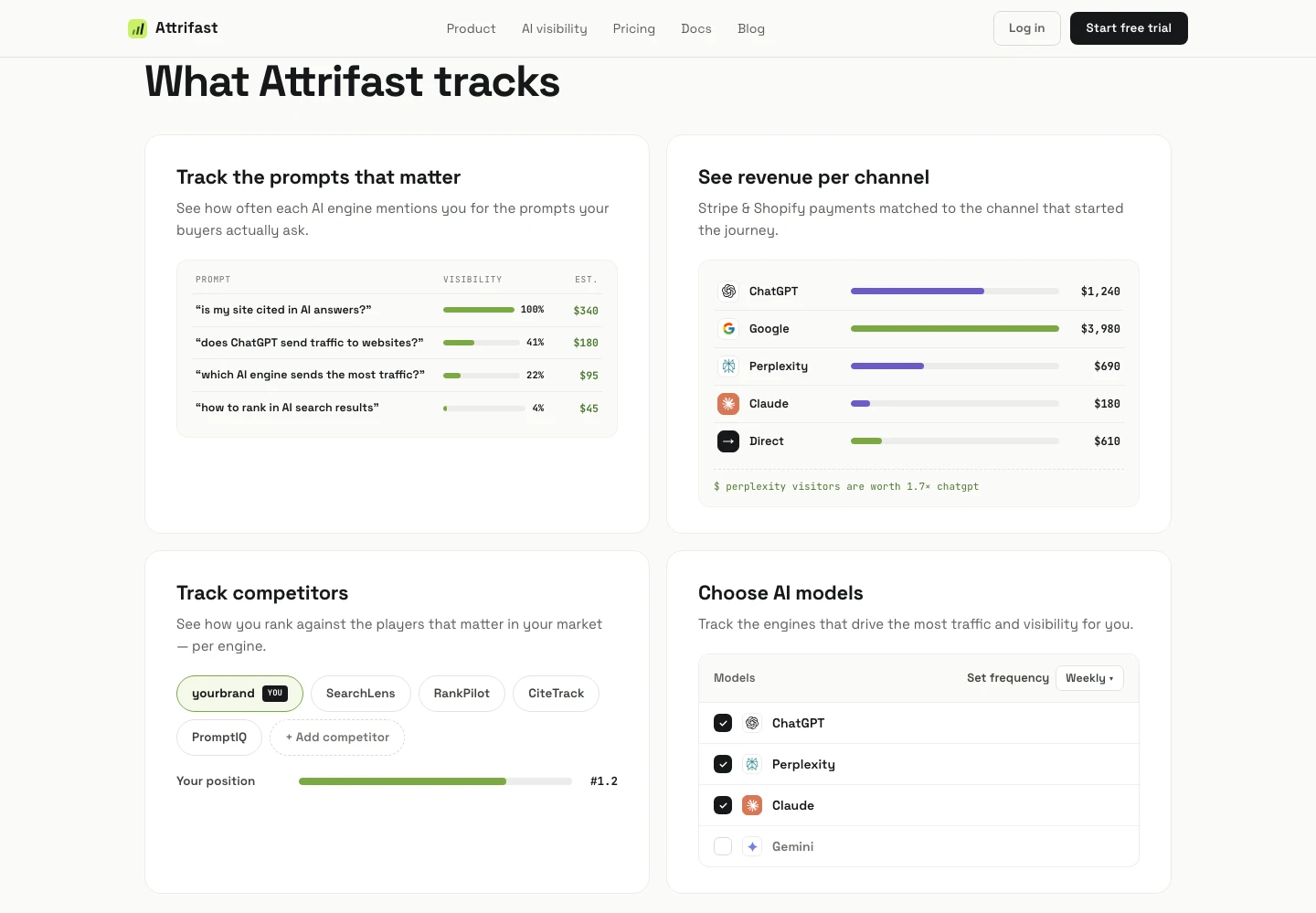
Attrifast sits in the revenue-attribution camp: a cookieless first-party script that detects AI engines server-side, infers the unreferred majority with a behavioral classifier, and joins the session to a Stripe charge to produce revenue per AI engine. It is $9.99/mo, sets no third-party cookie, needs no consent banner in most jurisdictions, and was built specifically for the question GA4 and the privacy tools both leave unanswered: which AI engine sent a paying customer.
Where it does not fit, honestly: it is not a general-purpose analytics dashboard. It will not give you GA4's funnel exploration, audience builders, or Google Ads linking, and it will not match Plausible's elegant top-pages view. If those are your primary need, keep GA4 or add Plausible. The right mental model is that Attrifast is the AI-and-revenue layer, not the everything layer.
| Question | Attrifast answer |
|---|---|
| Which AI engine sent revenue? | Yes, native |
| Cookieless and banner-free? | Yes (most jurisdictions) |
| Joins to Stripe revenue? | Yes, refund-adjusted |
| Replaces GA4 funnels / audiences? | No |
| Replaces Google Ads linking? | No |
| Setup time | Under 5 minutes |
If you want to go deeper on the mechanics: the cookieless revenue analytics feature covers the identity layer, revenue attribution covers the Stripe join, and the per-engine guides — ChatGPT, Perplexity, Gemini — cover detection specifics.
The honest bottom line
GA4 fails at AI traffic twice over: it cannot see most of it because AI clients strip the referer, and it carries EU compliance risk that regulators have already acted on. Both failures point the same direction — away from GA4 for AI attribution. But "without GA4" is not a single answer. Privacy analytics like Plausible and Fathom fix the compliance half and are the right call if you want a clean, banner-free pageview dashboard. They do not, by default, classify AI engines or measure revenue. The question most operators actually have — which AI engine is sending paying customers — needs a cookieless first-party tool that detects engines server-side and joins to Stripe.
Pick by the question you are answering. If it is "give me a private GA4 swap," the privacy tools win. If it is "show me AI revenue," a revenue-attribution tool wins, and the privacy tools score zero on that column. If you need GA4's funnels and Ads linking, keep GA4 and run a first-party tool alongside it. The one thing not to do is delete GA4, install a pageview counter, and expect to see ChatGPT revenue — that is the migration that ends in a churn-back.
If you want the AI-revenue answer without the engineering, Attrifast does the server-side detection and the Stripe join in one script for $9.99/mo. If you want to fix GA4 instead of leaving it, the GA4 AI traffic setup guide is the build, and the dark AI traffic explainer is why the problem exists in the first place.
FAQ
Can I track AI traffic without GA4 at all?
Yes, and for AI traffic specifically you are usually better off without it. GA4 has no native rule for ChatGPT, Perplexity, Claude, or Gemini, so it buckets the 65-80% of AI clicks that arrive with a stripped referer into Direct/(none). A cookieless first-party tool that classifies AI engines server-side sees those visits directly. The catch is that not every GA4 alternative does AI-engine detection — privacy analytics tools count visits but do not label engines or join to revenue.
Why does GA4 fail at AI traffic specifically?
Two compounding reasons. First, accuracy: AI clients strip the Referer header, GA4 has no AI channel rule, and AI referrals vanish into Direct/(none). Second, compliance: GA4 sends data to Google's infrastructure, and EU DPAs in Austria, France, and Italy have ruled specific GA deployments unlawful over US data transfers. GA4 is both wrong about the source and legally fraught.
Is Plausible or Fathom a good GA4 alternative for AI traffic?
They are excellent GDPR-friendly GA4 replacements for general traffic, but neither ships AI-engine classification or revenue attribution by default. They show chatgpt.com as a referrer when it survives — the same slice GA4 sees — but do not infer the unreferred majority, do not bucket engines into a clean AI channel, and do not tie a visit to a Stripe charge. They solve privacy, not AI attribution.
What does tracking AI traffic actually require, technically?
Three layers. Detection: server-side referer fingerprinting plus a behavioral classifier for the unreferred majority. Identity: a first-party identifier scoped to your own domain so it needs no consent banner in most jurisdictions. Revenue: a server-side join from the session to a Stripe charge. GA4 does none cleanly; privacy analytics tools do the identity layer only.
Will I lose data if I migrate off GA4?
You lose the historical GA4 dataset unless you export it first, which you should. You do not lose much go-forward AI fidelity because GA4 was never seeing most AI traffic anyway — the 65-80% in Direct was already invisible. The honest tradeoff is GA4's funnels, audiences, and Ads linking, which a lean first-party tool will not match; if you depend on those, run both in parallel.
Do cookieless GA4 alternatives need a consent banner?
In most cases, no. Cookieless first-party analytics that store no personal identifiers and set no cross-site cookies generally fall outside the EU ePrivacy directive's consent requirement and avoid GA4's cross-border-transfer problem. This is not blanket legal advice — it depends on what you collect and your jurisdiction — but a tool that fingerprints engines server-side and stores no third-party cookie can usually run banner-free where GA4 cannot.
How is this different from adding a GA4 custom channel group?
A custom channel group recovers only the 15-50% of AI clicks with a usable referer; the unreferred majority stays in Direct. It also does nothing about GA4's GDPR exposure. Tracking AI traffic without GA4 with a first-party tool addresses both: it infers the unreferred slice with a behavioral classifier and removes the compliance problem by never touching Google's infrastructure.
Can I measure AI revenue without GA4 ecommerce events?
Yes, and for Stripe-based SaaS it is cleaner. GA4 ecommerce revenue depends on client-side purchase events that ad blockers and consent declines degrade. A first-party tool that joins the session to a Stripe webhook reads revenue from the actual charge and attributes it to the AI engine, refund-adjusted, without trusting a client-side dataLayer push.
Which AI engines can a first-party tool detect?
The referred slice is detected by hostname: chatgpt.com and chat.openai.com for ChatGPT, perplexity.ai for Perplexity, claude.ai for Claude, gemini.google.com for Gemini, copilot.microsoft.com for Copilot, plus you.com, phind.com, and poe.com. The unreferred majority — which is most of ChatGPT and Claude traffic — is inferred by a behavioral classifier, not by hostname.
Is GA4 actually illegal in the EU?
Not flatly, no. Earlier DPA rulings (2022) found specific deployments unlawful over US transfers, but the 2023 EU-US Data Privacy Framework created a new transfer basis. That framework is under active legal challenge, and EU procurement teams still flag GA4 in security reviews, so the risk is real but a moving target rather than a settled "illegal." A cookieless, in-region first-party tool sidesteps the question entirely.
Should I block AI crawlers to clean up my Direct bucket?
No. AI crawlers like GPTBot were never in your human Direct number — GA4 filters known bots by default. Blocking them removes you from future training corpora and live-browse fetches, which slowly degrades your citation rate. The right move is to allow GPTBot and ChatGPT-User, instrument them via server logs, and fix the human attribution problem separately with a first-party tool.
Can I run a privacy tool and a revenue tool together?
Yes, and many teams do. Plausible or Fathom for the clean, compliant pageview dashboard, and a revenue-attribution tool for the AI-engine-to-Stripe question. They are different products solving different halves of "leave GA4." Running both is cheaper and clearer than forcing one tool to do all four camps' jobs.
How long does the full migration take?
The hands-on work is small: under five minutes to install the script, fifteen minutes to confirm AI detection, fifteen to thirty minutes to wire the Stripe join. The slow part is the two-to-four-week parallel run you do before removing GA4, which is deliberately unhurried so you can validate the new tool against your exported baseline before cutting over.
Does AI traffic really convert better, or is that hype?
It tends to, but the multiple is site-dependent and I will not quote a single magic number. AI-referred visitors often arrive having read a partial answer about the problem you solve, so intent runs higher than generic organic — strongly on B2B SaaS, less so on impulse ecommerce where retargeting fires faster. The point is not the exact multiple; it is that you cannot see any of it while the traffic hides in GA4's Direct bucket.
Related reading from the Attrifast research stack
For related deep-dives, see The Indie Hacker's Marketing Analytics Stack and What Does Google Know About Me? (2026 Inventory).
Sources
Primary sources for the claims in this article. Numbered citations in the text link to the matching entry.
- [1]Default channel group definitions for GA4 — Google Analytics Help (2026).
- [2]Data retention and export in GA4 — Google Analytics Help (2026).
- [3]Plausible Analytics documentation — referrers and sources — Plausible (2026).
- [4]Fathom Analytics documentation — Fathom Analytics (2026).
- [5]Referrer-Policy header — MDN Web Docs (2026).
- [6]AI crawlers and referral traffic trends — Cloudflare Radar (2026).
- [7]GPTBot and ChatGPT-User documentation — OpenAI (2026).
- [8]ClaudeBot and Anthropic crawler behavior — Anthropic (2026).
- [9]Decision ordering the company to comply — Google Analytics data transfers to the United States (public redacted version) — CNIL (published by the EDPB) (2022).
- [10]101 complaints on EU-US transfers (Google Analytics decisions) — noyb (2022).
- [11]Garante decision on Google Analytics — Garante per la protezione dei dati personali (2022).
- [12]EU-US Data Privacy Framework adequacy decision — European Commission (2023).
- [13]Intelligent Tracking Prevention (ITP) overview — WebKit (2026).
- [14]How AI search is changing referral attribution — Search Engine Land (2026).
- [15]How to Get Cited in Google AI Overviews: Own a Criterion — Backlinko (2026).
- [16]Server-side tagging and first-party measurement — Simo Ahava — Simmer (2026).
- [17]Simple Analytics — privacy-first, cookieless analytics — Simple Analytics (2026).
- [18]Perplexity bot and referrer documentation — Perplexity (2026).
- [19]Cookies and other tracking devices: the CNIL publishes new guidelines — CNIL (2019).
- [20]Webhook delivery, retries, and idempotency — Stripe Docs (2026).
- [21]63% of Websites Receive AI Traffic (New Study of 3,000 Sites) — Ahrefs (2025).
- [22]AI Search Stats 2026: Market Share, Referral, and Citation Data — SimilarWeb (2026).
- [23]CNIL is latest authority to rule Google Analytics violates GDPR — IAPP (2022).