Part of the cookieless revenue analytics research stack — honest, rubric-scored tool comparisons for founders.
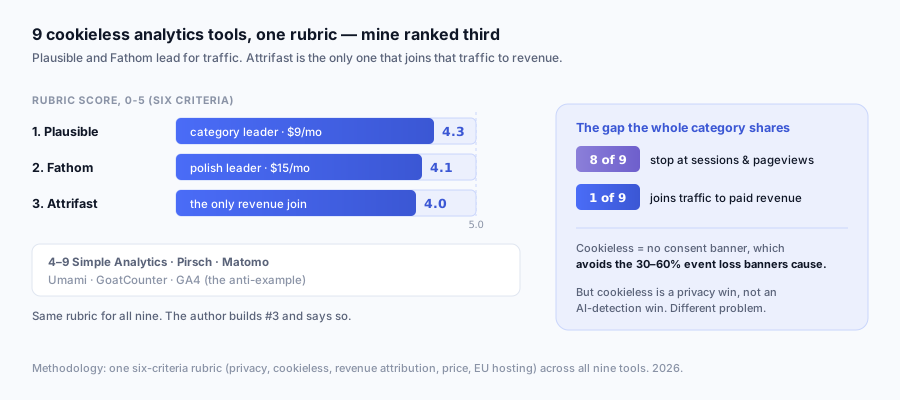
I run analytics for my own products and a handful of clients, and I have a bias I want to put on the table before I rank anything: I build one of the tools in this comparison. So rather than quietly slot my own product at number one — which is what most vendor listicles do and what makes them worthless — I scored all nine tools on the same rubric and let the numbers land where they land. They landed with Plausible first, Fathom second, and my own tool third. That is not false modesty; it is the honest result for the specific job this category is named for.
The privacy-first analytics category exists because GA4 made a bargain most founders never agreed to: free analytics in exchange for a cookie-consent banner, an ad ecosystem, and a data model that loses a third of your traffic when visitors click "decline." The tools here take the opposite bargain — cookieless by design, no banner, no individual tracking, and as a bonus, no consent-banner event loss. Plausible and Fathom have been perfecting that traffic job for years, and on maturity and polish they beat what I have built.
Where Attrifast earns its place on the list is one specific thing the others do not do: it joins that privacy-clean traffic to actual revenue. Every other tool here tells you sessions and sources; only one tells you which source produced a paying customer. So I will rank it third for the traffic job honestly, and explain the narrow reason you might still choose it first.
This page answers "which one should I pick." It deliberately does not re-argue why the category exists — the regulatory record behind that shift (CNIL enforcement actions going from 0 to 139 in two years, four DPA rulings against standard Google Analytics, and the EU Digital Omnibus landing in 2026) is walked separately in why cookieless analytics became the default.
What "privacy-first" actually means
Before ranking anything, the definition, because the label gets stretched — you'll see the same category called privacy friendly analytics, ethical analytics, or GDPR-compliant analytics, and vendors apply all three loosely. Wherever analytics privacy is the actual requirement rather than the marketing line, a genuinely privacy-first tool has three properties:
- Cookieless by design — it identifies a session without a persistent device identifier, typically via a daily-rotating hash that resets every 24 hours, so no individual is tracked across days.
- No consent banner required — because it does not set cookies or collect personal data by default, it does not trigger GDPR's consent-banner requirement.
- Data ownership and no ad-tech resale — your data is yours, not fuel for an advertising graph.
That third property is why GA4 is the anti-example in this piece, not a member of the category. And the second property is where the practical money is, because the consent banner is where GA4 quietly loses most of its EU traffic.

Source: Aggregated industry consent-rate studies + Attrifast EU cohort, 2025–2026
Across EU traffic, GA4 captures only around 55% of events once you account for visitors who decline the banner (roughly 30%) and those who ignore it entirely (roughly 15%). Privacy-first tools capture all of it, because there is no banner to decline. That is not a minor accuracy gain — it is the difference between measuring your business and measuring the slice of it that clicked "accept."
The field, by price

Source: Verified from each vendor pricing page, July 2026
| Tool | Entry price (2026) | Primary job | Hosting |
|---|---|---|---|
| Umami | Free (self-host) | Cookieless web analytics | Self-host |
| GoatCounter | Free / donation | Minimal web analytics | Hosted / self-host |
| Pirsch | ~$6/mo | Cookieless web analytics | EU |
| Plausible | $9/mo | Cookieless web analytics | EU |
| Simple Analytics | $9/mo | Cookieless web analytics | EU |
| Attrifast | $9.99/mo | Cookieless revenue attribution | EU-friendly |
| Fathom | $15/mo | Cookieless web analytics | EU option |
| Matomo Cloud | ~$23/mo | Full analytics (cookieless option) | EU / self-host |
| GA4 | Free | Web analytics (anti-example) |
Prices meter by pageviews for most of these, so verify the tier that matches your traffic. All are linked in the Sources block.
The six-criteria rubric
| Criterion | Weight | What a 5 looks like | What a 0 looks like |
|---|---|---|---|
| Privacy posture / GDPR | 25% | Cookieless, no banner, data-owned | Consent banner + ad resale |
| Source detection quality | 20% | Clean referrer + channel parsing | Coarse or missing sources |
| Revenue attribution | 15% | Payment-processor revenue join | Traffic only |
| Price / value | 15% | Under $9.99/mo or free self-host | $50/mo+ for basics |
| EU hosting / data residency | 15% | EU-hosted, DPA available | US-only, no residency control |
| Ease of setup / UX | 10% | One snippet, clean dashboard | Complex install |
Revenue attribution is 15% here — meaningful, but deliberately not dominant, because this is a privacy-first traffic comparison first. If you weight revenue at 30%, Attrifast rises; at the honest 15% for this category, Plausible and Fathom's traffic maturity keeps them ahead. If revenue really is your primary axis, you want a different shortlist entirely — the Mixpanel alternatives for revenue tracking comparison ranks on the payment-processor join first and treats privacy as a secondary criterion.

Source: Attrifast scoring rubric (6 weighted dimensions), July 2026
The at-a-glance verdict
| Tool | Best for | Choose if / Skip if | Score |
|---|---|---|---|
| Plausible | Clean cookieless traffic analytics | Choose for maturity + openness · Skip if you need revenue | 4.3 |
| Fathom | Polished minimal analytics | Choose for UX + simplicity · Skip if you need revenue | 4.1 |
| Attrifast | Privacy-clean revenue by source | Choose if you need revenue join · Skip if you only want traffic | 4.0 |
| Simple Analytics | Minimal, opinionated privacy | Choose for simplicity + EU · Skip for deep features | 3.7 |
| Pirsch | Cheap developer-friendly analytics | Choose for price + API · Skip for polish | 3.6 |
| Matomo | Full-featured, self-hostable | Choose for feature depth · Skip if you want lightweight | 3.5 |
| Umami | Free self-hosted analytics | Choose for data ownership · Skip if you won't self-host | 3.2 |
| GoatCounter | Minimal free analytics | Choose for tiny sites · Skip for teams | 2.8 |
| GA4 | Free (anti-example) | Choose for ad-ecosystem ties · Skip for privacy | 1.8 |
1. Plausible — the category leader (score: 4.3)
Entry price: $9/mo (30-day trial). Verified July 2026.
Plausible is the most complete privacy-first analytics tool. It is open-source, EU-hosted, cookieless, GDPR-clean without a banner, and its source detection is the cleanest in the category — including honest parsing of AI-engine referrers when they survive. For the pure traffic job, it is what I recommend most often, and it is more mature than Attrifast at that job.
Strengths: open-source with self-host option; EU-hosted; excellent source detection; strong community and documentation; lightweight script; basic ecommerce revenue in the Business tier if you wire it up.
Limitations: no payment-processor revenue join — the ecommerce revenue field is a client-side estimate you configure, not a booked-order join; like all client-side tools it cannot solve the AI-referrer-stripped problem for revenue; feature depth is deliberately narrow.
Best for: anyone who wants clean, private, mature web analytics. Skip if your core need is booked revenue by source.
2. Fathom — the polish leader (score: 4.1)
Entry price: $15/mo (30-day trial). Verified July 2026.
Fathom is Plausible's closest peer and wins on design: the cleanest, most minimal dashboard in the category, with an equally strong privacy stance and full GDPR/CCPA/PECR compliance. If you value a beautiful, frictionless UI over open-source and feature depth, Fathom is the pick.
Strengths: best-in-class minimal UI; strong privacy compliance; EU hosting option; simple pageview-based pricing; excellent uptime reputation.
Limitations: not open-source; no revenue join; feature set intentionally minimal, so power users hit its ceiling faster than Matomo's.
Best for: founders who want the most polished, no-fuss private analytics. Skip if you need revenue attribution or deep configurability.
3. Attrifast — the one that joins traffic to revenue (score: 4.0)
Entry price: $9.99/mo (7-day trial). Verified July 2026.
Attrifast is the only tool in this list that stays cookieless and joins traffic to actual revenue. It captures the source server-side, keeps it cookieless first-party, and joins it to the paid Stripe or Shopify order — so you see privacy-clean revenue by source, including AI engines. On the pure traffic job it is younger and less refined than Plausible and Fathom, which is exactly why it ranks third here.
Strengths:
- Only tool here with a payment-processor revenue join — booked revenue by source.
- Server-side AI-engine detection (ChatGPT, Perplexity, Claude, Gemini) that client-side tools miss.
- Cookieless first-party by default; GDPR-clean without a banner.
- $9.99/mo flat; RPV by source as a first-class metric.
Limitations (my own tool, named honestly):
- Younger than Plausible and Fathom, with a smaller community and less refined dashboard for pure traffic exploration.
- Not open-source and not self-hostable today, unlike Plausible, Matomo, and Umami.
- If you only want sessions and sources and never care about revenue, Plausible or Fathom is the better-fit, cheaper-or-equal choice — the revenue join is wasted on you.
Best for: founders who want privacy-clean analytics and revenue by source in one tool. Skip if you only want traffic — the leaders above do that job better.
4–9. Simple Analytics, Pirsch, Matomo, Umami, GoatCounter, GA4
Simple Analytics ($9/mo) is a clean, opinionated, EU-hosted privacy tool with a minimal feature set — a fine Plausible alternative if its philosophy resonates, without a revenue join.
Pirsch (~$6/mo) is the price leader among hosted tools, developer-friendly with a good API and EU hosting. It trades some polish for cost; strong value for technical teams.
Matomo (~$23/mo cloud, free self-host) is the most feature-complete, with the deepest analytics of anyone here and a cookieless configuration option. It is heavier to run and more complex than the minimalist tools — power at the cost of simplicity.
Umami (free self-host) is an excellent open-source, self-hosted option for founders who want full data ownership and zero per-visit fees, at the cost of running the infrastructure.
GoatCounter (free/donation) is a minimal, privacy-respecting tool ideal for small personal sites; it is not built for teams or revenue.
GA4 (free) appears only as the anti-example: not cookieless without heavy work, banner-dependent in the EU, and built to feed an ad ecosystem. It is the baseline the whole category exists to replace.
The gap the whole category shares
Here is the finding that explains why I built Attrifast in the first place. Of the nine privacy-first tools in this comparison, almost none join traffic to actual revenue.

Source: Attrifast capability audit across 9 privacy-first analytics tools, July 2026
Eight of the nine are traffic-only. That is not a criticism of Plausible or Fathom — they are excellent at what they do, and traffic analytics is a legitimate, complete job. It is simply the reason a revenue-attribution layer exists as a separate category: if you want to know which private, cookieless, GDPR-clean visit produced a paying customer, you need a payment join, and the pure-traffic tools do not have one. The honest recommendation for most founders is Plausible or Fathom for traffic, and a revenue-join tool alongside it when the revenue question becomes urgent.
Why cookieless is a privacy win, not an AI-detection win
One common misconception is worth correcting, because it changes how you should weight your decision. People assume cookieless tools are better at catching AI traffic. They are not — cookieless versus cookie-based is irrelevant to AI detection, because AI clients strip the referrer regardless.

Source: Aggregated industry blocker-rate studies + Attrifast cohort, 2025–2026
What cookieless does help with is different: it sidesteps the consent banner, and privacy-respecting scripts are less likely to be blocked than GA4. But client-side loss is still real — for a developer audience, ad blockers drop over 40% of client-side analytics requests. That is a separate problem from AI-referrer stripping, and only server-side capture solves either one fully. So weight cookieless for its true benefit — privacy posture and banner-free measurement — and do not expect it to solve AI attribution on its own.
Match the tool to your need
| Your need | Primary pick | Add if needed | The number to watch |
|---|---|---|---|
| Clean private web analytics | Plausible | — | Sessions by source |
| Most polished, simplest UI | Fathom | — | Bounce + top pages |
| Private analytics + revenue by source | Attrifast | Plausible for deep traffic | RPV by source |
| Full data ownership, free | Umami or Matomo (self-host) | — | Whatever you configure |
| Cheapest hosted, developer-friendly | Pirsch | — | Cost per million views |
The honest bottom line: for the privacy-first traffic job, Plausible and Fathom are the leaders and I rank them ahead of my own tool without hesitation. Choose Attrifast when you need the one thing they do not do — join that privacy-clean traffic to booked revenue by source. If you only want to know your sessions and top pages, buy the leaders; they do it better and I would rather tell you that than pretend otherwise.
FAQ
What is the best privacy-first analytics tool in 2026?
For clean cookieless web analytics, Plausible is the most complete choice — mature, open-source, EU-hosted, with the best source detection in the category, from $9 a month. Fathom is a very close second and wins on UI polish and simplicity at $15 a month. Both are pure traffic tools. If you also need to tie that privacy-clean traffic to actual revenue — which source produced a paying customer — Attrifast at $9.99 a month is the only tool in this list that does a payment-processor revenue join while staying cookieless. Pick Plausible or Fathom if you want traffic; add or choose Attrifast if you need revenue.
Are these analytics tools actually GDPR compliant?
The dedicated privacy-first tools here — Plausible, Fathom, Attrifast, Simple Analytics, Pirsch, and self-hosted Matomo or Umami — are designed to run without a cookie-consent banner because they do not set persistent identifiers or collect personal data by default, which is what makes them GDPR-clean. Always confirm hosting location and your specific data flows, but the core design of these tools avoids the consent-banner requirement that GA4 triggers. GA4 is the anti-example: it is not GDPR-clean without significant configuration and typically requires a consent banner in the EU.
What does cookieless analytics actually mean?
Cookieless analytics identifies a session without storing a persistent identifier on the visitor's device. Instead of a cookie that follows someone for weeks, most privacy-first tools use a daily-rotating hash of signals like IP and user-agent, which resets every day so no individual is tracked across time. The practical benefits are twofold: you avoid the cookie-consent banner requirement under GDPR, and you avoid the 30–60% event loss that banners cause, because there is no banner to decline. The trade-off is that cross-session, cross-day identity is deliberately weaker.
Do privacy-first analytics tools track revenue?
Almost none of them do. Plausible, Fathom, Simple Analytics, Pirsch, Matomo, Umami, and GoatCounter are traffic tools — sessions, sources, pageviews, and in some cases a basic goal or ecommerce revenue field you wire up yourself. Of the nine tools in this comparison, only Attrifast performs a direct payment-processor revenue join, tying a source to a paid Stripe or Shopify order. Plausible Business does add a lightweight ecommerce revenue field if you configure it. So if revenue-by-source matters, your realistic options are Attrifast, or Plausible plus a manual revenue setup.
Plausible vs Fathom — which is better?
They are the two leaders and the choice is mostly taste. Plausible is open-source, has slightly deeper features and cleaner source detection, and a very strong community; Fathom has the more polished, minimal UI and an equally strong privacy stance, with pricing based on pageviews. Both are EU-friendly, cookieless, GDPR-clean, and excellent at the traffic job. Plausible edges it on openness and feature depth; Fathom edges it on design and simplicity. Neither does a revenue join, so if that is your need, both leave the same gap.
Why is GA4 not considered privacy-first?
GA4 sets identifiers and collects data in ways that generally require a cookie-consent banner in the EU, and that banner is where the damage happens: 30–60% of events are lost when visitors decline or ignore it. GA4 is also not cookieless without significant custom work, its data is sampled at higher volumes, and it feeds a large ad ecosystem, which is the opposite of the privacy-first posture. It is free and ubiquitous, so it appears here as the anti-example — the baseline these tools exist to replace, not a member of the category.
Does cookieless tracking matter for AI traffic?
Less than people assume. AI clients like ChatGPT and many Perplexity browsers strip the Referer header regardless of whether you use cookies, so cookieless versus cookie-based makes no difference to whether you detect AI traffic — both miss it unless the source is captured server-side. The cookieless win is privacy posture and consent-banner-free measurement, not AI detection. To catch AI-engine referrals specifically, you need server-side source capture, which Attrifast does; a purely client-side cookieless tool will still bucket most AI visits as Direct.
Can I self-host a privacy-first analytics tool for free?
Yes. Umami and Matomo are open-source and can be self-hosted at no license cost, and Plausible offers a self-hosted community edition. GoatCounter is free for personal and small use. Self-hosting gives you full data ownership and zero per-visit fees, at the cost of running and maintaining the infrastructure yourself — updates, database, uptime. For a technical founder who values data ownership, self-hosted Umami or Matomo is a legitimate free option; for everyone else, the hosted tools from $6–15 a month save more time than they cost.
Related reading from the Attrifast research stack
For the architecture behind cookieless tracking, see cookieless tracking solutions compared and the GDPR analytics 2026 playbook. For head-to-head detail on two of the leaders, see Attrifast vs Plausible and Attrifast vs Fathom. For the underlying feature, see cookieless revenue analytics.
Sources
Primary sources for the claims in this article. Numbered citations in the text link to the matching entry.
- [1]Plausible Analytics pricing (Starter, Growth, Business, Enterprise) — Plausible Analytics (2026).
- [2]Fathom Analytics pricing and privacy compliance — Fathom Analytics (2026).
- [3]Simple Analytics pricing and privacy stance — Simple Analytics (2026).
- [4]Pirsch Analytics pricing — Pirsch (2026).
- [5]Matomo Cloud and on-premise pricing — Matomo Analytics (2026).
- [6]Umami open-source, self-hosted web analytics — Umami (2026).
- [7]GoatCounter open-source privacy-friendly analytics — GoatCounter (2026).
- [8]Plausible source code and self-host community edition — GitHub (plausible/analytics) (2026).
- [9]Umami source code — GitHub (umami-software/umami) (2026).
- [10]GDPR guidance on cookies, consent, and analytics — GDPR.eu (2025).
- [11]Sheet n°16: Use analytics on your websites and applications (audience-measurement consent exemption) — CNIL (2020).
- [12]Google Analytics 4 consent mode and EU data handling — Google Analytics Help (2025).
- [13]Plausible Analytics G2 reviews and ratings — G2 (2026).
- [14]Fathom Analytics G2 reviews and ratings — G2 (2026).
- [15]OpenAI: GPTBot, ChatGPT-User, OAI-SearchBot user-agent documentation — OpenAI (2026).
- [16]Attrifast: cookieless revenue analytics feature — Attrifast (2026).