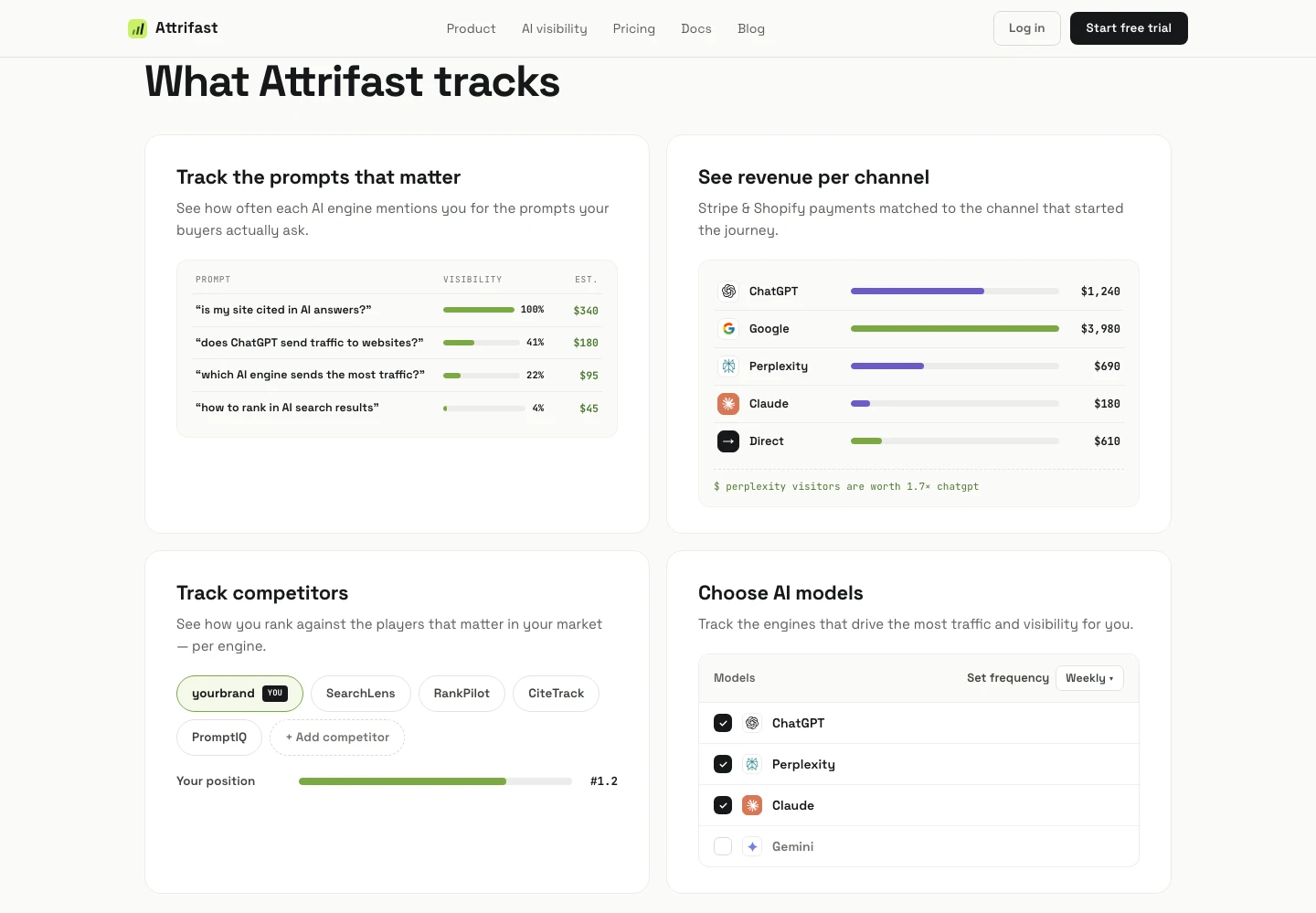
Part of the Attrifast for Stripe research stack — honest, rubric-scored tool comparisons for founders.
I have spent two years trying to answer two different questions about my own Stripe account, and it took me embarrassingly long to notice they were different questions. The first: how is my recurring revenue behaving — MRR, churn, expansion, LTV. The second: where did the customers who are paying me actually come from. I kept buying tools for the first question and expecting them to answer the second, and they never did, because they cannot.
Baremetrics gave me a gorgeous MRR chart and a churn number I trusted. ChartMogul gave me cohort LTV that changed how I priced. Neither could tell me that a paying customer originally arrived from a Reddit thread, a ChatGPT answer, or a Google ad — because that information is not in Stripe. Stripe knows the payment happened. It does not know what marketing brought the human who made it.
That distinction is what this comparison is about. I scored eight Stripe analytics tools on the same rubric and split them explicitly by job. I will list Attrifast at number one for the channel-attribution job specifically, because that is what it is built for, but the whole point of the piece is to show you where the MRR-monitoring tools genuinely beat it. If you want to know your net revenue retention by cohort, Baremetrics and ChartMogul win, and I say so in their sections.
The two jobs "Stripe analytics" blurs together
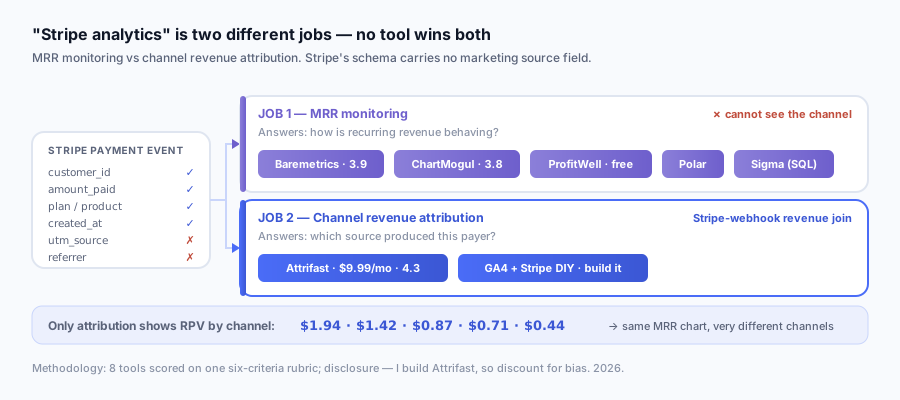
Before pricing, the framework. "Stripe analytics" tools split into two jobs, and buying the wrong one for your question is the most common mistake I see founders make.
| Job | Question it answers | What it reads | Tools that lead here |
|---|---|---|---|
| MRR monitoring | How is my recurring revenue behaving? | Stripe subscription data | Baremetrics, ChartMogul, ProfitWell |
| Channel attribution | Which source produced each paying customer? | Session source + Stripe invoice join | Attrifast |
MRR monitoring reads what is already in Stripe: subscriptions, invoices, charges, cancellations. From that it computes MRR, ARR, churn, expansion, contraction, and LTV. This is genuinely valuable and it is the more mature category — Baremetrics and ChartMogul have been refining it for a decade.
Channel attribution reads something Stripe does not have: the marketing source of the visitor, captured at their first session. It stores that source against a first-party identifier and joins it to the Stripe invoice when the payment webhook fires. Only then can a dashboard say "this $290 annual plan came from a Perplexity citation." No amount of querying Stripe data produces that, because the source was never in Stripe to begin with.

Source: Attrifast tool-capability audit across 8 Stripe analytics tools, July 2026
Roughly 70% of what the tools in this category collectively measure is MRR shape and payment operations. Channel revenue attribution — and especially the AI-engine split — is a thin slice, and it is the slice most founders are actually missing when they ask "where is my growth coming from."
The field, by price
Here is the full field, sorted by entry price. Several tools are free or metered by revenue volume, so verify each on the vendor page before you commit; all are linked in the Sources block.

Source: Verified from each vendor pricing page, July 2026
| Tool | Entry price (2026) | Primary job | Free option |
|---|---|---|---|
| Stripe Dashboard | Free | Basic revenue views | Yes |
| Stripe Sigma | Free tier / usage-priced | SQL over Stripe data | Yes |
| GA4 + Stripe DIY | Free (license) | Custom attribution build | Yes |
| Attrifast | $9.99/mo | Channel revenue attribution | 7-day trial |
| Polar | Free / usage-priced | Stripe-native MRR + orders | Yes |
| ProfitWell Metrics | Free | MRR + churn metrics | Yes |
| ChartMogul | ~$100/mo | Subscription analytics | Free launch tier |
| Baremetrics | ~$129/mo | MRR + churn + dunning | 14-day trial |
Two cautions. First, "free" splits into two meanings here: Stripe Dashboard and ProfitWell Metrics are genuinely free products, while GA4+Stripe DIY is free in license terms but costs real engineering time to build and maintain. Second, ChartMogul and Baremetrics both meter by tracked revenue, so the entry price climbs as you grow — confirm the tier that matches your MRR.
The six-criteria rubric
Every tool is scored 0 to 5 on the same six dimensions, weighted for the founder question "where did my paying customers come from, and how is that revenue behaving." The weights are mine; re-weight toward MRR depth if that is your priority and the ranking shifts.
| Criterion | Weight | What a 5 looks like | What a 0 looks like |
|---|---|---|---|
| Channel-revenue attribution | 25% | Session-to-Stripe-invoice join by source | No marketing source at all |
| MRR / churn / LTV depth | 20% | Full cohort retention + expansion | Basic revenue total only |
| AI-traffic detection | 15% | Server-side ChatGPT/Perplexity/Claude split | Buckets AI as Direct |
| Setup effort | 15% | One snippet + Stripe webhook | Warehouse + custom pipeline |
| Price for indie SaaS | 15% | Flat, under $30/mo | $500/mo+ or heavy build |
| Payment ops / finance | 10% | Disputes, dunning, SQL reporting | None |
Note that channel attribution and MRR depth together carry 45% of the weight, split roughly evenly — this rubric respects both jobs rather than pretending one is the only one that matters.

Source: Attrifast scoring rubric (6 weighted dimensions), July 2026
The at-a-glance verdict
| Tool | Best for | Choose if / Skip if | Score |
|---|---|---|---|
| Attrifast | Channel revenue attribution | Choose if you need revenue-by-source · Skip if you only want MRR shape | 4.3 |
| Baremetrics | MRR monitoring + dunning | Choose for churn/dunning depth · Skip if you need channel attribution | 3.9 |
| ChartMogul | Subscription cohort analytics | Choose for LTV/cohorts · Skip if you want source attribution | 3.8 |
| ProfitWell Metrics | Free MRR metrics | Choose for free MRR dashboards · Skip if you need attribution | 3.5 |
| Polar | Stripe-native MRR + orders | Choose for a free Stripe-native dashboard · Skip for deep cohorts | 3.3 |
| Stripe Sigma | SQL over Stripe data | Choose for custom finance queries · Skip for marketing questions | 3.0 |
| Stripe Dashboard | Free basic revenue views | Choose as a free baseline · Skip for channel or cohort depth | 2.6 |
| GA4 + Stripe DIY | Custom build | Choose if you have eng time · Skip if you want it to just work | 2.2 |
Now the tool-by-tool detail, ranked for the founder question above.
1. Attrifast — channel revenue attribution (score: 4.3)
Entry price: $9.99/mo flat (7-day trial). Verified July 2026.
Attrifast answers the question Stripe data cannot: which marketing channel produced each paying customer. It captures the source server-side at the first session, stores it first-party, and joins it to the Stripe invoice when the payment webhook fires — so the revenue is a booked, reconciled invoice, split by channel including ChatGPT, Perplexity, Claude, and Gemini.
Strengths:
- Session-to-Stripe-invoice join by source — booked revenue, not a client-side estimate.
- Server-side AI-engine detection with a per-engine revenue line.
- Cookieless first-party by default; clean GDPR posture, no consent-banner throttling.
- $9.99/mo flat, no revenue metering.
- Revenue-per-visitor (RPV) by channel as a first-class metric.
Limitations (named honestly):
- Not an MRR-monitoring suite. It shows revenue by source, not the deep churn, expansion, and cohort-retention analytics that Baremetrics and ChartMogul specialize in. If net revenue retention by cohort is your core question, you want one of them alongside Attrifast, not instead of it.
- No dunning/failed-payment recovery workflow — Baremetrics Recover is purpose-built for that and Attrifast does not compete.
- No SQL query layer over raw Stripe objects; for ad-hoc finance queries, Sigma is the tool.
Best for: Stripe SaaS founders who need to know which channel their revenue came from. Skip if your only question is MRR shape — a free MRR dashboard covers that.
2. Baremetrics — MRR monitoring and dunning (score: 3.9)
Entry price: ~$129/mo (14-day trial), meters by tracked revenue. Verified July 2026.
Baremetrics is the mature leader for MRR monitoring. It plugs into Stripe and gives you MRR, ARR, churn, LTV, and a genuinely excellent dunning product (Recover) that claws back failed payments. For understanding how your recurring revenue behaves, it is hard to beat.
Strengths: best-in-class MRR/churn/LTV dashboards; strong dunning and failed-payment recovery; public "Open" benchmarks; clean UX.
Limitations: no channel attribution — it reads Stripe, which has no marketing source, so it cannot tell you where a customer came from; priced above the indie-SaaS comfort zone and meters by revenue; overlaps with what Stripe's own dashboard now does for free at the basic end.
Best for: SaaS teams that want deep MRR monitoring and dunning. Skip if your question is channel revenue, not revenue shape.
3. ChartMogul — subscription cohort analytics (score: 3.8)
Entry price: ~$100/mo (free launch tier). Verified July 2026.
ChartMogul is Baremetrics' closest peer, with a particular strength in cohort and segmentation analysis. If you want to slice retention and LTV by plan, geography, or cohort, ChartMogul's segmentation is the reason to pick it over Baremetrics.
Strengths: excellent cohort and segmentation analytics; flexible subscription metrics; solid data-quality tooling; free launch tier for early-stage.
Limitations: same structural gap as Baremetrics — no marketing source, so no channel attribution; priced for funded startups at the paid tiers; a reporting tool, not a source-of-truth for where growth originates.
Best for: subscription businesses that want deep cohort and LTV segmentation. Skip if you want to know which source produced the revenue.
4–8. ProfitWell, Polar, Sigma, Stripe Dashboard, GA4 DIY
ProfitWell Metrics (free) is a remarkably good free MRR dashboard — MRR, churn, and basic LTV at no cost. It is the right first tool for a bootstrapped founder who wants revenue shape and nothing more, but it does not do channel attribution.
Polar (free / usage-priced) is a clean, Stripe-native MRR and orders dashboard that many indie founders like for its simplicity and open ethos. It covers revenue shape well; it does not join sessions to a marketing source.
Stripe Sigma (free tier / usage-priced) is a SQL layer over your raw Stripe data — superb for custom finance and payment-ops reporting, useless for marketing questions because the source is not in the schema.
Stripe Dashboard (free) now gives solid basic revenue and subscription views out of the box, and for many early-stage stores it is enough for the MRR question. It has no channel attribution and no cohort depth.
GA4 + Stripe DIY (free license) is the build-it-yourself route: capture source in GA4, export to BigQuery, run your own Stripe webhook handler, and join the two. It works and it is fully in your control, but it is a real engineering project — expect to spend meaningful time building the session-to-invoice join and more time maintaining it as GA4 and Stripe evolve. For most founders, a $9.99/mo tool is cheaper than the hours.
RPV: what channel attribution actually unlocks
The reason to add channel attribution to your Stripe stack is that it changes decisions the MRR dashboard cannot. The clearest example is revenue per visitor by channel — the number that tells you where the next hour of marketing effort should go.

Source: Attrifast 200-site cohort (SaaS subset), Stripe checkout webhook join, Q2 2026
In our SaaS cohort, Claude sessions produced the highest RPV at about $1.94, ahead of Perplexity ($1.42) and ChatGPT ($0.87), all above Google organic ($0.71) and well above Google Ads ($0.44). None of this is visible in a Baremetrics or ChartMogul dashboard, because they never see the source. And a lot of this revenue is hiding: as the next chart shows, a third of what most tools label "Direct" is really AI-referred once you capture the source server-side.

Source: Attrifast 200-site cohort (SaaS subset), Direct-bucket decomposition, Q2 2026
About 34% of the revenue sitting in Direct in our cohort was AI-referred — customers who found the product through ChatGPT, Claude, or Perplexity, clicked through with the referrer stripped, and later paid. If you are optimizing spend off a dashboard that credits all of that to Direct, you are flying blind on your fastest-growing channel.
Match the tool to your question
| Your question | Primary pick | Add if needed | The number to watch |
|---|---|---|---|
| How is my MRR behaving? | ProfitWell (free) or Baremetrics | — | Net revenue retention |
| Which channel produced my revenue? | Attrifast | Free MRR dashboard for shape | RPV by channel |
| I need cohort LTV segmentation | ChartMogul | Attrifast for source truth | LTV by cohort |
| I need custom finance queries | Stripe Sigma | — | Whatever you can SQL |
| I want it all and have eng time | GA4 + Stripe DIY | — | Whether the build is worth it |
The pattern: MRR tools and attribution tools answer different questions, and the cheapest way to close the channel-revenue gap on top of any MRR dashboard is a payment-joined attribution tool. If that sounds self-serving, the test is the same as always — run a free trial for a week, see whether ChatGPT, Claude, and Perplexity revenue appears joined to real Stripe invoices, and decide from the data.
FAQ
What is the best Stripe analytics tool in 2026?
There is no single best tool, because the category splits into two jobs. If you want to monitor MRR, churn, and LTV, Baremetrics ($129/mo) and ChartMogul ($100/mo) are the mature leaders and ProfitWell Metrics is a strong free option. If you want to know which marketing channel produced each paying Stripe customer — including AI engines like ChatGPT and Perplexity — that is a different job, and Attrifast is purpose-built for it at $9.99 a month with a payment-webhook join. Most SaaS founders eventually run one of each, because MRR dashboards and channel attribution answer different questions.
What is the difference between Stripe MRR analytics and Stripe attribution?
MRR analytics reads your Stripe data and tells you the shape of your recurring revenue: MRR, ARR, churn, expansion, LTV, and cohort retention. Baremetrics, ChartMogul, and ProfitWell live here. Attribution answers a question Stripe data alone cannot: which marketing channel first brought the customer who is now paying you. That requires capturing the source at the visitor's first session and joining it to the eventual Stripe invoice by webhook. MRR tools tell you how your revenue behaves; attribution tools tell you where it came from. They are complementary, not substitutes.
Can Baremetrics or ChartMogul tell me which channel my revenue came from?
Not on their own. Baremetrics and ChartMogul are excellent at MRR, churn, and LTV, but they read Stripe data, and Stripe data has no marketing source attached to a payment. Neither tool captures the first-touch source at the visitor's session, so they cannot tell you that a paying customer originally came from ChatGPT, a Reddit thread, or a Google ad. To get channel-level revenue you need a tool that joins the session source to the Stripe invoice — that is the attribution job, and it sits alongside your MRR dashboard rather than inside it.
Is Stripe Sigma an analytics tool?
Stripe Sigma is a SQL query layer over your raw Stripe data. It is powerful for payment operations, custom finance reporting, and anything you can express as a query against charges, subscriptions, and disputes. What it is not is a marketing analytics tool: there is no marketing source in the Stripe schema, so Sigma cannot tell you which channel drove a customer no matter how good your SQL is. Use Sigma for finance and ops questions; use an attribution tool for channel-revenue questions.
How do I connect my Stripe revenue to marketing channels?
You capture the visitor's source at their first session — ideally server-side so it survives AI clients and ad blockers — store it against a first-party identifier, and then join that identifier to the Stripe invoice when the payment webhook fires. When done server-to-server, the revenue number is a booked, reconciled invoice rather than a client-side estimate. Attrifast does this natively with a snippet plus a Stripe webhook; the DIY version is GA4 plus BigQuery plus your own Stripe webhook handler, which works but is a real engineering project to build and maintain.
What is the cheapest way to get Stripe channel attribution?
For MRR monitoring alone, ProfitWell Metrics is free and Stripe's own Dashboard gives you basic revenue views at no cost. For channel attribution — tying a Stripe payment to the source that produced it — Attrifast at $9.99 a month is the lowest-cost purpose-built option. The free alternative is a GA4+Stripe DIY build, but it is only "free" in license terms; it costs engineering time to build the session-to-invoice join and keeps costing maintenance as Stripe and GA4 change. For most bootstrapped founders, $9.99/mo is cheaper than the hours the DIY build consumes.
Does Attrifast replace Baremetrics or ChartMogul?
No — they do different jobs and pair well. Baremetrics and ChartMogul are the better tools for MRR, churn, expansion, and cohort LTV; that is their core competency and Attrifast does not try to replace it. Attrifast answers the channel question they cannot: which source produced each paying customer, including AI engines. The common stack for a Stripe SaaS under $50k MRR is a free or low-cost MRR dashboard for revenue shape plus Attrifast for revenue-by-source truth. Buy the one that answers the question you actually have, and add the other when the second question shows up.
Why does so much Stripe revenue show up as "Direct"?
Because the marketing source is usually lost before the payment happens. ChatGPT, Claude, and many Perplexity clients strip the Referer header, so those high-intent visits land in Direct in whatever analytics you use. Dark-social shares in DMs and private communities do the same. Ad blockers and ITP drop more. When those sessions later convert to a Stripe payment, the payment inherits the Direct label. In our SaaS cohort, about 34% of revenue sitting in Direct was actually AI-referred once we captured the source server-side. Fixing it requires server-side source capture, not a better MRR dashboard.
Related reading from the Attrifast research stack
For the mechanics of joining a Stripe payment to its marketing source, see the Stripe attribution complete guide and Stripe vs GA4 revenue attribution. For the bootstrapped-founder playbook that ties this together, read SaaS marketing attribution without spending $800/mo. For the underlying feature, see revenue attribution and Attrifast for Stripe.
Sources
Primary sources for the claims in this article. Numbered citations in the text link to the matching entry.
- [1]Baremetrics pricing and plans — Baremetrics (2026).
- [2]ChartMogul subscription analytics pricing — ChartMogul (2026).
- [3]ProfitWell Metrics free subscription analytics — ProfitWell (Paddle) (2026).
- [4]Stripe Sigma: SQL queries over Stripe data — Stripe (2026).
- [5]Stripe Dashboard reporting and revenue views — Stripe (2026).
- [6]Stripe webhooks: events and payment_intent.succeeded — Stripe (2026).
- [7]Polar: open-source-friendly Stripe-native billing and analytics — Polar (2026).
- [8]Google Analytics 4 BigQuery export for custom attribution — Google Analytics Help (2025).
- [9]Baremetrics Open: public MRR and SaaS benchmarks — Baremetrics (2026).
- [10]OpenAI: GPTBot, ChatGPT-User, OAI-SearchBot user-agent documentation — OpenAI (2026).
- [11]Anthropic: ClaudeBot crawler and web access documentation — Anthropic (2026).
- [12]Perplexity FAQ on citations, sources, and crawler behavior — Perplexity (2025).
- [13]ChartMogul G2 reviews and ratings — G2 (2026).
- [14]Baremetrics G2 reviews and ratings — G2 (2026).
- [15]Attrifast: Stripe attribution complete guide — Attrifast (2026).
- [16]Attrifast: revenue attribution feature and Stripe-native webhook join — Attrifast (2026).