I install conversion tracking for a living, and AnyTrack is one of the few tools in this category I have never wanted to argue with. It does a real job, it does it competently, and the people it is built for are genuinely underserved by everything else on the market.
That is not the same as saying you should buy it. Most of the traffic landing on "anytrack review" searches is not affiliate marketers — it is founders who saw a tool that promises "true ROAS tied to real sales" and wondered whether it solves their channel-attribution problem. For a large slice of those people, the honest answer is no, and I would rather say that plainly than pad a comparison table.
So this review has a spine: what AnyTrack actually is under the marketing, what it does better than almost anyone, where it structurally stops, what it costs, and two explicit lists — who should buy it and who should not. I verified every price and every integration count myself on 1 August 2026, directly from AnyTrack's public pricing page and integration catalog [1][2]. I counted the catalog by hand rather than trusting the "100+" number on the homepage, and the count turned out to be the single most revealing fact in this review.
What is AnyTrack, actually?
Strip the homepage copy and AnyTrack is three mechanisms wired together.
One: a tracking tag that tags things for you. When the tag loads, AutoTag scans the page for external links, forms, and checkout redirects, works out which platform each one points at, and appends AnyTrack's click ID using the parameter that platform expects — s1 through s5 for ClickBank, tid for CJ, subid for Impact [4]. Alongside it, AutoTrack watches for four client-side events — OutboundClick, FormSubmit, ViewContent, AddToCart — and fires them with the element's attributes attached, no custom code [5].
Two: a conversion catcher. The sale itself is recorded server-side, at the source: your store's backend, your CRM, or the affiliate network's postback. AnyTrack then merges that server-side conversion with the browser session that produced the click ID and resolves identity across sessions and devices [10].
Three: a fan-out. Once the conversion is stitched, AnyTrack hashes the customer data and pushes the event into every connected ad platform's server-side API: Meta's Conversions API, Google's Enhanced Conversions for Web, TikTok's Events API, Microsoft's UET offline conversions, and S2S endpoints for Outbrain and Taboola [6][12].
AnyTrack's own framing for this is "tracking in, tagging out" [10], and it is accurate. The product is a data-routing layer whose customer is really the ad platform's bidding algorithm. The reports you look at are a byproduct.
That framing matters because it tells you what the tool optimises for. Every design decision — the click ID, the SubID mapping, the session meter — serves the goal of getting a clean, deduplicated conversion event into an auction. If your goal is instead to answer "which of my channels produced this month's revenue," you are using a delivery pipeline as a reporting tool.
AnyTrack pricing in 2026: the full ladder
Here is the ladder as published on 1 August 2026 [1]. I have added the effective cost per 1,000 included sessions, which AnyTrack does not show and which changes how the plans read.
| Plan | Price/mo | Sessions/mo | Websites | Effective $/1,000 sessions | Key unlock |
|---|---|---|---|---|---|
| Free | $0 | 5,000 | 1 | $0.00 | AutoTrack, AutoTag, server-side tracking, cookieless tracking, conversions and campaign reports |
| Starter | $100 | 100,000 | 1 | $1.00 | All 6 ad platforms, 100+ integrations, real-time Conversion API, deduplication, enhanced conversions |
| Personal | $150 | 500,000 | 3 | $0.30 | Cross-domain tracking, GA4, 2 outgoing webhooks, custom integrations, custom conversions |
| Advance | $300 | 3,000,000 | 10 | $0.10 | Unlimited Conversion API, 10 webhooks, multiple ad accounts, dedicated support, 10 team members |
Paid plans carry a 14-day free trial with a reminder five days before billing starts, annual billing gives two months free (so Starter works out at $1,000 a year rather than $1,200), extra websites on Advance cost $30/month each, and overage runs between $0.20 and $0.40 per 1,000 sessions depending on plan [1]. The old Basic plan is deprecated and unavailable to new signups. One naming note while we are here: there is no tier called AnyTrack Pro — if you arrived from an "AnyTrack Pro review" search, the plans people usually mean are Starter or Personal, and every number in this section applies to them.

Source: Attrifast calculation from AnyTrack published plan prices and session allowances, anytrack.io/pricing, verified 1 August 2026
Two things jump out of that chart.
First, the ladder is steeply non-linear. Advance costs three times Starter and gives you thirty times the sessions. If you are anywhere near 100,000 sessions a month, Starter is the worst value on the board at $1.00 per 1,000 sessions.
Second — and this is the genuinely odd one — at Starter volume, overage is cheaper than the plan. You pay $1.00 per 1,000 included sessions and $0.40 per 1,000 sessions beyond them. That tells you the $100 is not really buying sessions; it is buying access to the integration catalog and the Conversion API. The session number is a packaging device, not a cost driver. Worth knowing before you upgrade a tier to "buy headroom" you could have covered in overage for less.
What does AnyTrack do genuinely well?
I want to be specific here, because "it's good at what it does" is the kind of sentence reviewers write when they have not looked.
Affiliate network coverage nobody else is close to
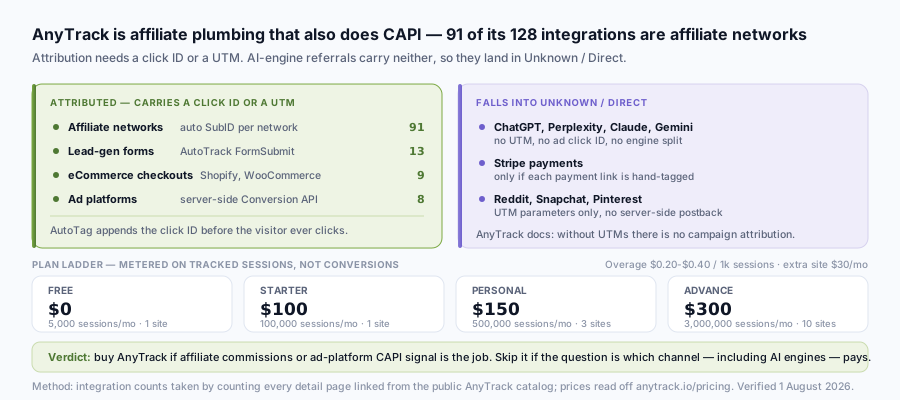
I counted every integration detail page linked from AnyTrack's public catalog on 1 August 2026. The total is 128 listings, and the distribution is lopsided in a way the marketing never says out loud.

Source: Attrifast count of every integration detail page linked from anytrack.io/integrations, 1 August 2026
Ninety-one of the 128 are affiliate networks — CJ Affiliate, Impact, Awin, Rakuten, Partnerize, ClickBank, Everflow, Digistore24, MaxBounty, Admitad, and a long tail of vertical networks down to sportsbook and VPN affiliate programs [3]. Thirteen are lead-generation platforms, nine are eCommerce checkouts, eight are ad platforms, and the remaining seven are analytics, custom webhooks, and odds and ends.
(A small consistency note, since I am being fussy: the affiliate-networks catalog page says "80+," the pricing page says "90+," and my count of live detail pages says 91. Everyone is roughly right.)
If you are an affiliate marketer, this is the whole ballgame. Getting a commission from Impact or ClickBank back into Meta's auction as a deduplicated server-side event, automatically, with the right SubID parameter per network, is a job that otherwise eats a developer week per network. I have not found another tool that covers this many networks at this price.
AutoTag removes an entire class of human error
The most common reason attribution breaks in the wild is not a technical failure. It is a human forgetting to tag a link. AutoTag attacks that directly: it appends the click ID to links, forms, and checkout redirects at page load, before the visitor can click, and picks the correct parameter name per destination [4].
The documentation is also refreshingly honest about the edge case — links injected into the page later (an offer button that appears when a video ends) may or may not be caught, and AnyTrack tells you to test rather than assume [4]. Vendors who document their own failure modes tend to be the ones whose products survive contact with production.
Server-side postbacks that survive the browser
Browser pixels lose conversions. Safari's Intelligent Tracking Prevention and full third-party cookie blocking [13], ad blockers, and consent refusals all silently drop events, and refresh-on-thank-you-page double-counts the ones that get through. AnyTrack's answer is to record the conversion at the source and deliver it server-side to each platform's API [6][10][12].
This is table stakes for serious media buyers in 2026, and AnyTrack implements it without asking you to stand up a server-side GTM container or hire anyone. That is real value, and it is the reason the $100 entry price is defensible for its actual audience.
Where does AnyTrack stop?
Four places, and none of them are secret — three are documented by AnyTrack itself.
It cannot attribute anything that arrives without a UTM or a click ID
This is the load-bearing limitation. AnyTrack's attribution documentation states it directly: attribution relies on UTM parameters to identify the traffic source, and "without UTM parameters, AnyTrack cannot attribute conversions to specific campaigns" [7]. The companion troubleshooting article explains what happens when the click ID does not travel — the conversion lands under Unknown or Direct, real but unattributed [9].
For paid media this is fine, because you control the URLs and you tag them. For everything else it is a wall. Organic search does not carry your UTMs. Neither does a link inside an AI answer. AnyTrack's own docs note that networks without a direct integration — Reddit, Snapchat, Pinterest — are "tracked with UTM parameters instead" [6], which is another way of saying: tag it yourself or lose it.
There is no AI-engine split, and that bucket is not small
Since AI referrals carry no UTM and no ad click ID, they land in the same undifferentiated Unknown/Direct pile as everything else untagged. That was a rounding error in 2023. It is not now.

Source: Attrifast 200-site benchmark, Stripe-connected cohort, 2026
In the Attrifast 200-site benchmark, 34% of what analytics files as "Direct" is actually AI-referred, and small businesses undercount their AI traffic by a median of 64% [14]. That AI traffic also converts at 2.7% against 1.4% for Google organic — it is not filler traffic, it is the good stuff, sitting in the one bucket your tool cannot name.
Worse, the engines are not interchangeable. Pooling them hides a five-fold spread in what a visit is worth:

Source: Attrifast 200-site benchmark, cohort-blended RPV, 2026
A Perplexity visitor is worth $1.42 and a Google AI Overviews visitor $0.29. If those are one line in your report, you cannot make a single sensible decision about where to put content effort. This is the same structural problem that makes dark AI traffic in GA4 so hard to reason about, and adding a conversion-routing layer on top does not fix it — it inherits it.
Stripe is a Zapier job, not an integration
Stripe does not appear in AnyTrack's eCommerce catalog at all. That list is Shopify, WooCommerce, SamCart, ThriveCart, Funnelish, FunnelKit, CopeCart, Memberful, and Whop [2]. Neither Paddle, Chargebee, nor Lemon Squeezy are there either.
AnyTrack does document a Stripe path, and it is worth reading before you assume it is a checkbox [8]. You append ?client_reference_id=--CLICK-ID-- to every Stripe payment link so AutoTag can substitute the click ID [11]. Then you build a Zapier or Make automation on Stripe's checkout.session.completed event — or wire a raw Stripe webhook — pointed at an AnyTrack custom integration. Then you map each event attribute by hand. Then you remember that Stripe sends amounts in cents and divide by 100 before sending.
It works, and the docs are clear. But count the failure modes: a payment link created without the parameter, a Zap that silently stops, a mapping that drifts after a Stripe API change, a subscription renewal or refund that never fires checkout.session.completed at all. This is the difference between a conversion event and a payment-processor-verified revenue join — one is a signal you send to an ad platform, the other is a number you can reconcile against your bank. If you want the long version of why those are not the same thing, we wrote it up in Stripe vs GA4 revenue attribution.
The meter is sessions, not conversions
AnyTrack bills on tracked sessions — every visit, returning or new, regardless of pageviews [1]. That is a reasonable proxy for platform cost and a poor proxy for value delivered.
Concretely: a content-heavy DTC site with 400,000 monthly sessions and 300 orders sits on Personal at $150/month. A lean B2B SaaS with 20,000 sessions and the same 300 conversions sits on Starter at $100/month. The first business is paying more for the same number of attributed outcomes because it publishes blog posts. If your traffic-to-conversion ratio is wide — which describes almost every content-led SaaS — the session meter is quietly working against you.
AnyTrack alternatives: how the price compares across the category
Every number below came off the vendor's own pricing page on 1 August 2026 — I re-read all seven that afternoon rather than copying a roundup. Hyros is the one entry that needs a caveat: hyros.com/pricing now returns a 404 and the live pricing page carries no numbers at all, so the $230 figure survives only on a legacy URL that still renders it, quoted "per month w/annual plan" [19] — what that price actually buys relative to a payment-join tool is broken down in Attrifast vs Hyros.
| Tool | Entry price/mo | Primary job | Payment-verified revenue join | AI engines split out |
|---|---|---|---|---|
| Attrifast | $9.99 (Pro $49) | Revenue per channel | Native Stripe | Yes |
| SegMetrics | $57 at 30k contacts [15] | Funnel and lifetime-value attribution | Yes, via processor integrations | No |
| AnyTrack | $100 (free tier available) | Conversion routing to ad platforms and networks | Manual, via Zapier | No |
| Triple Whale | $219 (Foundation, GMV-tiered) [17] | DTC ecommerce analytics | Shopify-native | Partial |
| Hyros | $230 w/annual plan, legacy page only [19] | Ad-spend attribution for high-spend buyers | Yes | No |
| Wicked Reports | $499 (Measure) [18] | Long-cycle multi-touch attribution | Yes | No |
| Northbeam | From $1,500 (Starter; higher tiers quote-only) [16] | Enterprise media-mix attribution | Yes | No |

Source: Vendor pricing pages, all read 1 August 2026. Northbeam's $1,500/mo Starter tier is omitted to keep the scale readable
Read that chart the right way round. AnyTrack is not expensive for its category — it is one of the cheaper serious options, and the free tier is a genuine on-ramp that most of its competitors do not offer. The gap between $9.99 and $100 is not a value judgement; it is two different products. One routes conversion events into ad auctions; the other reports which channel produced the revenue. Comparing them on price alone is how people end up with the wrong tool at the right budget.
Who should buy AnyTrack?
I would recommend it without hesitation to four groups.
Affiliate marketers. This is the clearest recommend in the whole review. If your revenue arrives as commissions from CJ, Impact, ClickBank, Awin, Everflow, or any of the other 85-odd networks in the catalog, and you buy paid traffic to those offers, AnyTrack is doing something no general analytics tool does. Ninety-one network integrations with automatic per-network SubID handling is a moat, and $100/month against a media budget is a rounding error.
Media buyers who need CAPI signal quality. If your Meta or Google campaigns are underperforming because the pixel is losing 20–40% of conversions to browser restrictions, feeding deduplicated server-side events back into the auction is the highest-leverage fix available, and AnyTrack ships it without a server-side GTM project [6][12].
Info-product and funnel businesses. ClickFunnels, SamCart, ThriveCart, Systeme.io, GoHighLevel, and Typeform are all first-class integrations [2]. If your stack is a funnel builder plus a checkout plus paid traffic, AnyTrack was built for your exact shape.
Agencies running multiple client sites. Advance at $300/month covers 10 websites, 10 team members, multiple ad accounts, and multiple tracking pixels, with extra sites at $30 each [1]. Per client, that is inexpensive, and the defensible cross-platform reporting is a real deliverable.
Who should not buy AnyTrack?
Three groups, and I would say this to their face at a conference.
Stripe-based SaaS founders. Your conversion is a subscription, not a one-time checkout, and your channels are mostly untagged: organic search, AI engines, newsletters, Reddit threads, word of mouth. AnyTrack needs a UTM or a click ID to attribute anything [7], your best traffic has neither, and Stripe itself is a Zapier project [8]. You would be paying $100/month minimum for plumbing you do not need while the question you actually asked — which channel made the money — stays unanswered.
Anyone whose primary question is "which channel is working?" AnyTrack answers "did this conversion reach the ad platform, and which campaign gets credit." Those look similar on a slide and are different in practice. If you have no meaningful paid spend, the entire fan-out layer — the thing you are paying for — is inert.
Teams where AI search is a growing share of discovery. If you have watched Direct traffic climb while Google organic flattens, you are almost certainly looking at AI referrals. A tool with no engine-level split will file all of it as Unknown and you will keep guessing. Understanding what "Direct" traffic actually contains is the first step; getting per-engine revenue is the second.
For that second group, the honest recommendation is a tool built around the payment join rather than the ad-platform postback. That is what we build: Attrifast is $9.99/month on Starter and $49/month on Pro, with a 7-day free trial and $0 due today, it connects to Stripe natively rather than through a Zap, and it reports revenue per channel with AI engines as named lines. It does not send conversions back to Meta or Google — if you need that, buy AnyTrack, and the side-by-side Attrifast vs AnyTrack breakdown lays out exactly where the line falls.
The verdict
AnyTrack is a good product with a precisely defined audience and pricing that is fair for that audience. Its catalog tells you who that audience is more honestly than its homepage does: 71% affiliate networks is not an accident of history, it is the product.
Buy it if commissions and ad-auction signal are your problem. Do not buy it because you want to know which channel pays — including the AI engines that increasingly do. Those are different tools, and the industry's habit of pretending otherwise is how attribution budgets get wasted. If you want the framework for choosing between the return metrics themselves, our breakdown of ROAS vs MER vs RPV is the companion piece to this one.
Rating, stated plainly: strong recommend for affiliate and paid-media operators; not the right tool for Stripe-native SaaS or for anyone measuring AI-driven revenue.
Frequently asked questions
How much does AnyTrack cost in 2026? Verified on 1 August 2026: Free at $0 for 5,000 sessions and one website; Starter $100/month for 100,000 sessions; Personal $150/month for 500,000 sessions and three websites; Advance $300/month for 3,000,000 sessions and ten websites. Paid plans include a 14-day trial, annual billing gives two months free, extra sites are $30/month, and overage runs $0.20–$0.40 per 1,000 sessions [1].
Is AnyTrack better than Hyros? Different budgets and different jobs. Hyros starts around $230/month on an annual commitment and is aimed at high-spend media buyers who want call-tracking and long-window ad attribution. AnyTrack starts at $100/month with a free tier and is aimed at affiliate and funnel operators who need network postbacks. AnyTrack's own comparison documentation positions it against Voluum and ClickMagick rather than Hyros, which tells you where it thinks it competes.
Does AnyTrack replace Google Analytics? Not really, and it does not try to. GA4 becomes an integration on Personal and above. AnyTrack gives you conversion, campaign ROAS, landing-page and customer-journey reports with First Click and Last Click models [7], but not GA4's behavioural analysis. Most teams run both.
Can I use AnyTrack for a Shopify store? Yes — Shopify is one of its nine eCommerce integrations and one of the better-documented ones, with cart permalinks, line-item handling, and dedicated Google Ads and TikTok Ads guides [2]. If Shopify revenue attribution is the whole job, also weigh it against the Shopify-specific attribution options.
What happens if I exceed my session limit? AnyTrack notifies you as you approach the cap and bills overage at the start of the next cycle, at $0.20–$0.40 per 1,000 excess sessions depending on plan [1]. Nothing stops tracking mid-month.
Does AnyTrack work without cookies? It advertises cookieless and redirectless tracking on every plan including Free [1], built on first-party session data rather than third-party cookies. That is the correct architecture for a post-ITP world [13], and it is one of the things AnyTrack got right early.
What are the best AnyTrack alternatives? It depends on which of AnyTrack's two jobs you actually need. If the job is revenue-per-channel reporting with a native payment join, Attrifast ($9.99/month, Stripe-native, AI engines split out) is built around exactly that. For funnel and lifetime-value attribution, SegMetrics starts at $57/month; for DTC ecommerce dashboards, Triple Whale starts at $219/month; for high-spend media buying, Hyros runs around $230/month on annual terms; and Wicked Reports ($499) and Northbeam (from $1,500) serve longer cycles and enterprise media mix. If the job is affiliate-network postbacks specifically, AnyTrack's own closest competitors are Voluum and ClickMagick — none of the tools above replicate its 91-network catalog.
References
- AnyTrack pricing — Free, Starter $100, Personal $150, Advance $300, overage and trial terms. Verified 1 August 2026
- AnyTrack integration catalog — every integration detail page by category. Counted 1 August 2026
- AnyTrack affiliate network integrations — CJ, Impact, Awin, Cake and the rest of the catalog
- AnyTrack AutoTag — automatic click-ID injection and per-network SubID parameter mapping
- AnyTrack AutoTrack — OutboundClick, FormSubmit, ViewContent and AddToCart event detection
- AnyTrack Conversion API — server-side delivery to Meta, Google, TikTok, Microsoft, Outbrain and Taboola
- AnyTrack attribution explained — the UTM requirement, First Click and Last Click models
- AnyTrack Stripe integration — client_reference_id tagging and Zapier webhook mapping
- Why conversions show as Unknown or Direct in AnyTrack
- AnyTrack server-side tracking — "tracking in, tagging out"
- Stripe Checkout Session object — client_reference_id and metadata fields
- Google Ads enhanced conversions for web — server-side conversion measurement
- Full third-party cookie blocking and more — why browser pixels lose conversions
- AI traffic revenue benchmark 2026 — 200 Stripe-connected sites, RPV and conversion by engine
- SegMetrics pricing — Launch $57/mo at 30k active contacts, Grow $197/mo, Scale $397/mo (accessed 1 August 2026)
- Northbeam pricing — Starter "starting at $1,500 / per month" under $1.5m/yr media spend; Professional and Enterprise quote-only (accessed 1 August 2026)
- Triple Whale pricing — Free, Foundation $219/mo, Automate $749/mo, tiered by annual GMV (accessed 1 August 2026)
- Wicked Reports pricing — Measure $499/mo, Scale $699/mo, Maximize $999/mo, Enterprise from $4,999 (accessed 1 August 2026)
- Hyros legacy pricing page — renders
$230 / per month w/annual planat the first tier;hyros.com/pricingreturns 404 (accessed 1 August 2026)