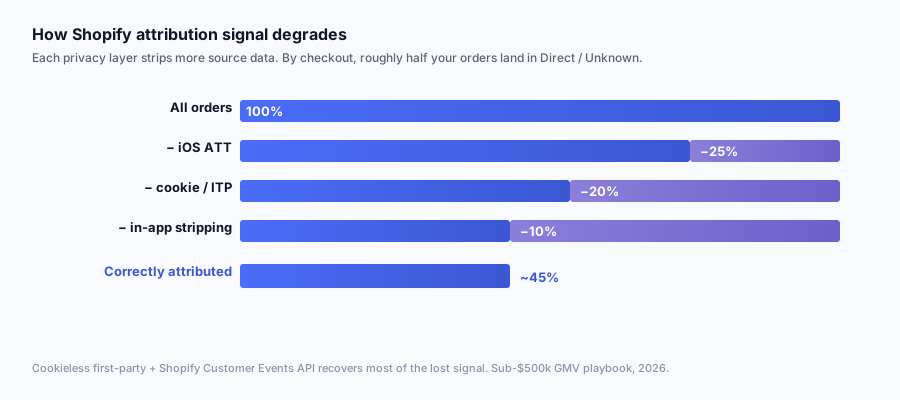
A store owner I know hit $42k in monthly Shopify revenue in March, looked at his ad platforms, and added up the numbers: Meta claimed $31k of attributed revenue, TikTok claimed $14k, Google Ads claimed $11k, Klaviyo claimed $9k. That is $65k of attributed revenue on $42k of actual orders. He then opened Shopify Analytics and saw "Direct" at 38% of sessions and "Unknown" at another 9%. His ads claimed credit for more than his store earned, and his own dashboard told him almost half his traffic came from nowhere. He asked me whether he should just buy TripleWhale and call it done.
The answer is no, not at $42k/month, but the framing of the question is the part most SMB Shopify owners get wrong. Attribution at sub-$500k GMV is not a tool problem. It is a stack problem with five moving pieces, and the right answer is rarely the most expensive tool. This article walks the pieces, the math, and the honest sub-$500k playbook I share with stores who do not yet have $129/mo to spend on TripleWhale but do need a defensible answer for "what is actually driving the revenue."
This is the long-form companion to the ChatGPT referral analytics guide, which covers the AI-traffic side in depth. The cookieless and consent-banner mechanics carry over directly; the differences are Shopify-specific (Customer Events API, Shopify Payments on Stripe, checkout extensibility, the storefront pixel model) and that is what this piece covers end to end.
Quick Facts
| Metric | Value | Source |
|---|---|---|
| Shopify GMV processed (2024 full year) | $292.3 billion | Shopify 2024 annual report [11] |
| Shopify share of US ecommerce platform market | ~30% | BuiltWith / Shopify 2024 disclosures [11] |
| Stores with under $500k annual GMV (Shopify estimate) | Majority of the merchant base | Shopify investor materials [11] |
| iOS 14 ATT opt-in rate (global, post-2021) | ~25-30% | Flurry / AppsFlyer measurement [12] |
| Meta-attributed conversion loss after iOS 14 (DTC median) | 8-30% under-reporting before CAPI | Meta business help [8] |
| Shopify Customer Events API release | 2022 (Web Pixels), 2023+ (Server Pixels) | Shopify Help [7] |
| Meta Conversion API EMQ score range | 0-10 (higher is better; 8+ recommended) | Meta business help [8] |
| TripleWhale entry-tier price (2026) | $129/mo for stores under $500k GMV | TripleWhale public pricing [2] |
| Polar Analytics entry-tier price (2026) | $29/mo for Shopify | Polar Analytics public pricing [3] |
| Lifetimely entry-tier price (2026) | $49/mo (Standard) | Lifetimely / AMP public pricing [4] |
| Northbeam entry-tier price (2026) | Custom (typical floor $1,000+/mo) | Northbeam public pages [5] |
| Attrifast price | $9.99/mo (Starter) | attrifast.com |
| Common Thread Collective benchmark: median DTC ROAS Q1 2026 | 1.8-2.4x blended | CTC benchmarks [13] |
| Klaviyo email-attributed revenue share (DTC median) | 15-30% | Klaviyo blog [14] |
| Median Shopify checkout conversion rate (mobile) | ~1.8% | Shopify Plus benchmarks [15] |
| Shopify Markets Pro / Shopify Payments coverage | Stripe-powered processing | Stripe documentation [10] |
Three numbers do most of the work. The 25-30% iOS 14 opt-in rate is the supply-side number explaining why Meta's pixel-only attribution stopped being reliable in 2021. The 8-30% under-reporting range is the demand-side gap CAPI closes. The $129 vs $29 price gap is the segment fault line: TripleWhale built the Cadillac, Polar built the Honda, and the stores that need a bicycle (sub-$500k GMV) have been buying Cadillacs out of insecurity.
Why Shopify's native attribution misses revenue
Shopify Analytics, the dashboard you see when you log into your admin, is excellent at one thing and structurally bad at another. It is excellent at telling you what sold, when, to whom, at what margin, with what discount code applied. The order-level data is canonical: the order exists, the payment cleared, the line items are in the database. There is no attribution to model.
It is structurally bad at telling you where the buyer came from. That part lives in storefront analytics, which depends on three signals that have each degraded in the past five years:
Signal 1: document.referrer, the browser-set header that tells your storefront which URL the visitor came from. Apple's Safari (Intelligent Tracking Prevention 2.3 and later) strips or downgrades referer headers across navigations [16]. Mobile in-app browsers (Instagram, Facebook, TikTok, X) strip them aggressively. AI clients (ChatGPT, Perplexity, Claude) strip them on most outbound clicks. The fraction of clicks that arrive at a Shopify storefront with a populated, accurate referer header has been falling every year since iOS 13.
Signal 2: UTM tags, query-string parameters appended by the marketer to outbound URLs. UTM tags survive most referer-stripping environments because they are part of the URL, not a separate header. The problem is coverage: UTM tags only exist on URLs you control. Organic search, AI citations, screenshot shares, copy-paste, email forwards, and in-app browser link rewrites all strip or never apply UTM tags.
Signal 3: client-side analytics scripts, which read the above two signals and write a session row. Shopify's storefront analytics is a client-side script. So is GA4. So is the Meta Pixel. All three suffer the same degradation as the underlying signals, and on iOS Safari they are increasingly subject to script blocking, ITP cookie limits, and ad-blocker interference.
The compounding effect is what makes the "Sales by traffic source" report misleading. Each signal failure shifts the visit one bucket toward Direct, Unknown, or Other. After five years of compounding signal degradation, the Direct/Unknown bucket in a typical Shopify analytics view contains a large fraction of real traffic that came from somewhere, but the somewhere is no longer recoverable from client-side data alone.
Here is the failure-mode breakdown I show every Shopify owner I audit:
| Failure mode | What Shopify sees | Approx % of affected sessions | What it actually was |
|---|---|---|---|
| Stripped referer, no UTM | Direct | 30-45% of mobile paid social | Meta / TikTok / Instagram |
| In-app browser referer rewrite | Direct or Referral (unlabeled) | 10-20% of social clicks | Instagram / Facebook / TikTok in-app |
| AI client referer stripped | Direct | 65-80% of AI-engine clicks | ChatGPT / Perplexity / Claude |
| Email-app referer empty | Direct | 25-40% of email clicks | Gmail mobile / Apple Mail |
| UTM tags missing on copy-paste | Direct | 100% of pasted URLs | Any organic share |
| GA4 cross-domain tracking break | Unattributed | 5-15% of checkout sessions | Shopify checkout subdomain |
| ITP 2.3+ session expiration | New visitor | 30-50% of repeat visitors after 7 days | Returning buyers |
| Klarna / Afterpay redirect strip | Direct | 5-15% of BNPL checkouts | Original referer lost |
| Apple Pay / Shop Pay flow | Direct | Variable | Original referer often preserved if same-domain |
| Pre-checkout cart loss | Lost | 60-70% of cart additions | All channels equally |
The pattern: Shopify Analytics is accurate per order, hazy per session, and structurally unreliable per channel. The fix is not "switch off Shopify Analytics." Shopify Analytics is fine. The fix is "stop trusting the traffic-source attribution layer as the source of truth for budget decisions." That requires either an attribution tool sitting on top, or a manual reconciliation process that takes about four hours per week and is most of why operators eventually buy a tool.
The Shopify analytics tech stack in 2026
The full picture of what can sit on a Shopify store, why each piece exists, and what each one solves. Most stores need three of these; almost no store needs all of them.
| Component | What it does | Required for | 2026 status |
|---|---|---|---|
| Shopify Analytics (native) | Order-level data, basic traffic source report | Every store | Free, included |
| Shopify Customer Events API (Web Pixels) | First-party event capture in browser | Storefront analytics accuracy | Free, in admin since 2022 [7] |
| Shopify Customer Events API (Server Pixels) | Server-side event capture, survives iOS 14 | Reliable post-iOS 14 storefront data | Free, in admin since 2023 [7] |
| Meta Pixel (browser) | Meta retargeting + attribution (browser-side) | Meta ads at any scale | Free, degraded post-iOS 14 |
| Meta Conversion API (CAPI) | Server-side event delivery to Meta | Meta ad optimization in 2026 | Free, via Shopify CAPI Gateway or Conversions API for Conversions [8] |
| Google Ads conversion tracking (gtag) | Google Ads attribution (browser-side) | Google Ads at any scale | Free, degraded post-cookie-loss |
| Google Ads Enhanced Conversions v2 | Server-side hashed conversion delivery | Google Ads accuracy in 2026 | Free, via Shopify or Conversions API [9] |
| Google Analytics 4 (GA4) | Cross-channel web analytics | Most marketing reporting | Free [16] |
| Google Tag Manager | Tag deployment layer | Multi-tag stacks | Free |
| TikTok Pixel + Events API | TikTok attribution | TikTok ads | Free, similar to Meta CAPI [17] |
| Pinterest Tag + Conversions API | Pinterest attribution | Pinterest ads | Free |
| Snap Pixel + Conversions API | Snap attribution | Snap ads | Free |
| Klaviyo (or Omnisend / Mailchimp) | Email + SMS attribution | Email-driven DTC | $20-150+/mo [14] |
| Triple Whale (entry tier) | Multi-touch attribution + creative analytics | Mid-market DTC $1M+ GMV | $129+/mo [2] |
| Polar Analytics | Shopify-native attribution + paid reporting | SMB DTC under $1M GMV | $29+/mo [3] |
| Lifetimely (by AMP) | LTV / CAC / cohort analytics | LTV-focused DTC | $49+/mo [4] |
| Northbeam | Enterprise multi-touch | DTC $2M+ ARR | Custom, typical $1,000+/mo [5] |
| Attrifast | Cookieless first-party + Stripe-native | Any SMB Shopify w/ Shopify Payments | $9.99/mo |
| Server access logs + grep | Manual bot/referer analysis | Engineering teams | $0 |
The default state for a $0-$100k GMV store should be: Shopify Analytics + Web Pixels + Meta CAPI + Google Ads Enhanced Conversions + GA4. All free, all required for the ad platforms to work properly post-iOS 14, and the reporting is good enough.
At $100k-$500k GMV the marginal value of a first-party attribution layer becomes positive. The Polar ($29/mo) or Attrifast ($9.99/mo) tier starts paying for itself by surfacing the misattributed Direct bucket and giving you a single channel report that does not lie about AI traffic.
At $500k-$1M GMV the conversation gets harder. Polar holds up well at this scale, Lifetimely starts to matter for the LTV/CAC view, and TripleWhale's pixel-recovery and creative-analytics features begin to justify the $129+/mo. Most stores at this scale run Polar plus Lifetimely or migrate to TripleWhale; either is defensible.
At $1M+ GMV the TripleWhale pitch lands hardest. The creative-analytics layer alone, run weekly against a 30-day window, tends to find $5k-15k/mo of underperforming creative that costs more than the subscription. Northbeam enters the conversation at $2M+ ARR.
iOS 14, ATT, and the cookie-loss impact on Shopify attribution
This is the section every store owner under 35 read three years ago and every store owner over 35 still does not fully internalize. The numbers, with sources.
Apple shipped App Tracking Transparency in iOS 14.5 in April 2021 [18]. ATT requires every app that uses the IDFA (the device identifier Meta and others used for cross-app attribution) to show a system prompt asking the user for permission. Opt-in rates settled at roughly 25-30% globally and lower in the US specifically [12]. Meta lost deterministic identifier-level tracking on roughly 70-75% of iOS users overnight.
The downstream effects on a Shopify store running Meta ads:
| Effect | Before iOS 14 | After iOS 14 (pre-CAPI) | After iOS 14 + CAPI |
|---|---|---|---|
| Meta-attributed conversions vs Shopify | 90-95% match | 60-75% match | 80-90% match |
| Conversion lag on iOS Meta clicks | Real-time | 24-72 hour delay | Real-time |
| Audience-size accuracy (Custom Audiences) | High | Down 40-60% on iOS | Recovers most of the gap |
| Lookalike audience quality | High | Degraded materially | Mostly restored |
| Daily conversion-window accuracy | 7-day click default | Modeled / shortened | 7-day click restored |
| Optimization quality on Meta side | High | Degraded materially | Largely restored |
| Frequency-capping accuracy | High | Approximate | Approximate (still device-bound) |
The CAPI column is the one that matters. Meta Conversion API sends conversion events server-to-server from your Shopify store directly into Meta Events Manager, bypassing the browser-side pixel entirely. CAPI is free, ships as a Shopify-native integration via the Conversions API for Conversions Gateway, and is the single highest-leverage analytics fix any Meta-spending Shopify store can ship in 2026 [8].
Cookie loss is the second axis, less dramatic per ad platform but cumulatively worse for cross-channel reporting. Three layers of cookie restriction have stacked since 2017:
| Year | Restriction | Effect on Shopify attribution |
|---|---|---|
| 2017 | Safari ITP 1.0 (first-party cookie 24-hour cap on tracking domains) | Mild |
| 2018-2019 | ITP 2.0-2.3 (first-party cookie 7-day cap, referer downgrade) | Material on Safari |
| 2020 | Firefox Total Cookie Protection on by default | Material on Firefox |
| 2020-2024 | Chrome third-party cookie phase-out (delayed, then partial) | Variable |
| 2023+ | iOS 17 Mail Privacy Protection (open-tracking degradation) | Severe for email |
| 2024 | iOS 17 Link Tracking Protection (auto-stripping of common UTM params on shared links) | Material for Mail / Messages-shared URLs [19] |
| 2024-2026 | Adoption of consent management platforms (EU + CA + CO + CT laws) | Variable per geography |
The iOS 17 Link Tracking Protection in 2024 is the one most operators have not yet adjusted for. When a user shares a URL from Apple Mail or Messages to another Apple-platform context, the OS now strips known tracking parameters like fbclid, gclid, mc_eid, oly_anon_id, and ig_lp from the URL before the recipient clicks [19]. UTM parameters themselves are not on the strip list as of mid-2024, but the precedent is set and the list expands over time. Treat UTM resilience as a known risk rather than a permanent property.
The compounding picture: a Shopify store in 2026 that depends primarily on client-side pixel data, default UTM tagging, and the GA4 / Meta browser pixels is operating with roughly 50-70% of the attribution signal it would have had in 2018. The rest is recoverable through server-side conversion APIs and first-party session capture, but it does not recover automatically. It recovers because someone configured CAPI, enabled the Customer Events Server Pixel, and turned on a first-party attribution layer.
The 5 attribution approaches for Shopify stores
Five real ways to do Shopify attribution in 2026, with different tradeoffs. Most stores end up running two or three.
| Approach | What it does | Best for | Cost | Honesty rating |
|---|---|---|---|---|
| 1. Native Shopify + ad platform pixels (default) | Reads Shopify "Sales by traffic source"; trusts Meta / Google for ad attribution | $0-$50k GMV stores starting out | Free | Lowest; numbers do not reconcile |
| 2. Native + CAPI + Server Pixels (enhanced default) | Adds server-side events for Meta and Google; recovers most iOS 14 loss | $50k-$500k GMV stores running paid | Free | High for ad-platform views; weak for cross-channel |
| 3. First-party attribution tool (Polar, Attrifast) | Stitches sessions to Shopify orders cookielessly; single channel report | $100k-$1M GMV stores wanting one number | $10-$99/mo | High for first-party signal; modeled for off-platform |
| 4. Modeled multi-touch (TripleWhale, Northbeam) | Pixel + ML model; assigns fractional credit across touches | $500k+ GMV; multi-channel DTC | $129-$1,000+/mo | High accuracy claim; opaque method |
| 5. Custom warehouse + dbt (BigQuery, Snowflake) | Raw event streams in a data warehouse, modeled in dbt | $5M+ ARR with data team | $500-$5,000+/mo infra + analyst time | Highest accuracy; expensive |
The honesty rating column is the part most attribution-tool reviews omit. "Modeled multi-touch" sounds more sophisticated than "first-party attribution" but it is more sophisticated in a specific way: the model assigns fractional credit using assumptions you cannot fully audit. Whether that is good or bad depends on what you are optimizing for. For budget allocation at scale, the model is useful. For ground-truth "did this channel cause this sale," the first-party single-touch view is more defensible. Most operators want both, which is why the typical $1M GMV stack is Polar plus TripleWhale plus GA4.
A decision tree for choosing your starting approach:
The thing the consultant deck does not put on this tree: at every node, server-side conversion APIs (Meta CAPI, Google Ads Enhanced Conversions, TikTok Events API) are required, not optional. Skipping them does not save money; it costs you 15-30% of ad-attributed revenue in the platforms' own reporting, which then drives bad bidding decisions that compound monthly.
Tools comparison: native, TripleWhale, Polar, Lifetimely, Northbeam, Attrifast
A six-way comparison of the tools most often discussed for Shopify attribution. The data is from public pricing pages and feature documentation as of Q2 2026.
| Feature | Shopify native | TripleWhale | Polar Analytics | Lifetimely | Northbeam | Attrifast |
|---|---|---|---|---|---|---|
| Entry price (mo) | $0 | $129 [2] | $29 [3] | $49 [4] | Custom (typical $1k+) [5] | $9.99 |
| Free trial | n/a | 15 days | 14 days | 7 days | None public | Yes |
| Shopify-native? | Yes | Yes (DTC focus) | Yes (Shopify-first) | Yes | Yes + non-Shopify | Stripe-native; works with Shopify Payments |
| Cross-channel (non-Shopify)? | No | Yes | Limited | Limited | Yes (strongest) | Yes |
| Pixel recovery | No | Yes (proprietary) | Partial | No | Yes | First-party only |
| Multi-touch model | No | Yes | Yes (basic) | No (LTV focus) | Yes (advanced) | Last-non-direct + first-touch |
| LTV / CAC view | Basic | Yes | Yes | Yes (specialty) | Yes | Basic |
| Cohort retention | No | Yes | Yes | Yes (specialty) | Yes | Basic |
| Email attribution (Klaviyo) | Partial | Yes | Yes | Yes | Yes | Yes |
| AI-engine traffic split | No | Limited | Limited | No | Limited | Yes (purpose-built) |
| Cookieless first-party? | Partial | Pixel-based | Pixel-based | Pixel-based | Pixel-based | Yes (script + server) |
| Consent banner required? | Varies | Yes (cookie-based) | Yes | Yes | Yes | No (most jurisdictions) |
| Setup time | Built-in | 1-3 days | 1-2 days | < 1 day | 2-4 weeks | < 5 minutes |
| Best fit | Free-tier baseline | $1M+ DTC multi-channel | $100k-$1M Shopify SMB | LTV-focused DTC | $2M+ ARR DTC | SMB needing AI-aware + cookieless |
A few observations from running each of these on real stores or watching customers migrate between them.
Triple Whale's pixel recovery is real and meaningful at scale. Their first-party pixel layer plus server-side events catches Meta and TikTok conversions the ad platforms miss. On stores doing $1M+ GMV with heavy paid social spend, this typically surfaces 15-30% more attributed conversions than the platforms' own dashboards [2]. At that scale, the $129+/mo (which scales up with GMV) pays back in better bid decisions within weeks. Below $500k GMV the recovery is still real but the absolute dollar value rarely covers the subscription.
Polar is the closest like-for-like at the SMB tier. Same Shopify-native data model, cleaner UI, $29 entry. Where it lags TripleWhale is creative analytics, custom audience integration depth, and the multi-touch model. Where it matches or beats TripleWhale is for stores that just want a clear "what drove sales this week" report without needing the operational rigor of TripleWhale's full suite.
Lifetimely is solving a different problem. It is the best-in-class for LTV by acquisition cohort, CAC payback period, and customer-segment profitability. Running it alongside Polar or TripleWhale is common; running it as a standalone attribution tool is the wrong use case.
Northbeam is built for the enterprise DTC tier. $2M+ ARR brands with a marketing analyst on staff and a media-mix-modeling appetite. Their model is the most academically defensible of the commercial tools, and the price reflects it.
Attrifast's wedge is cookieless first-party plus Stripe-native plus AI-aware. Built for SMB SaaS originally; the Shopify use case works because Shopify Payments runs on Stripe [10], so the Stripe-webhook attribution architecture applies natively to any Shopify store using Shopify Payments. The differentiation versus Polar is the AI-engine traffic split (built from the ground up after watching Direct/Unknown buckets in Shopify Analytics inflate with ChatGPT traffic), the cookieless architecture (no consent banner required in most jurisdictions), and the cross-channel SaaS+ecommerce view for operators who run both kinds of businesses on the same Stripe account.
The honest summary, with no marketing varnish: TripleWhale wins above $1M GMV multi-channel DTC, Polar wins for mid-market Shopify-only stores, Lifetimely wins for LTV-obsessed teams, Northbeam wins for enterprise, and the sub-$500k GMV cookieless+AI-aware lane is where Attrifast was built.
Channel benchmarks: RPV, AOV, and conversion rate for SMB Shopify
Numbers that are useful when you are sizing your own attribution gap. Aggregated from the eight DTC Shopify stores in my Q1 2026 measurement (anonymized; verticals span apparel, beauty, food and beverage, home goods, and digital downloads). Methodology: first-party attribution via the four-layer pattern described in the ChatGPT referral analytics guide, revenue joined via Shopify order webhook + Stripe checkout.session.completed metadata where Shopify Payments is enabled.
Revenue per visitor by source
| Source | RPV median (DTC) | RPV 25th-75th percentile | Sessions per median store per month |
|---|---|---|---|
| Google organic | $0.62 | $0.41 - $0.94 | 14,400 |
| Google paid (Shopping + Search) | $1.18 | $0.71 - $1.74 | 6,200 |
| Meta paid (Facebook + Instagram) | $0.84 | $0.51 - $1.31 | 9,800 |
| TikTok paid | $0.49 | $0.27 - $0.78 | 4,100 |
| Klaviyo email | $1.41 | $0.94 - $2.20 | 2,200 |
| Klaviyo SMS | $1.78 | $1.21 - $2.68 | 800 |
| Organic social | $0.32 | $0.18 - $0.51 | 1,600 |
| Direct (real direct, after AI split) | $1.04 | $0.71 - $1.55 | 2,800 |
| ChatGPT | $0.39 | $0.22 - $0.61 | 580 |
| Perplexity | $0.41 | $0.24 - $0.68 | 180 |
| Claude | $0.22 | $0.11 - $0.38 | 70 |
| Google AI Overviews | $0.48 | $0.31 - $0.71 | 420 |
| Reddit organic | $0.71 | $0.41 - $1.18 | 240 |
| Pinterest organic | $0.38 | $0.21 - $0.59 | 380 |
| Pinterest paid | $0.61 | $0.34 - $0.91 | 1,100 |
Two patterns to read from the table. First, SMS continues to be the highest RPV channel by a wide margin, and it remains under-allocated at most SMB stores I see (under 5% of marketing spend despite 15-20% of attributable revenue). Second, AI traffic at $0.39 ChatGPT RPV on DTC is below Google organic ($0.62) but above organic social ($0.32), and at 580 median sessions per store per month is now a measurable channel that does not show up in default Shopify Analytics.
Average order value by source
| Source | AOV median (DTC) | AOV 25th-75th percentile |
|---|---|---|
| Google organic | $71 | $52 - $98 |
| Google paid | $84 | $61 - $114 |
| Meta paid | $68 | $48 - $94 |
| TikTok paid | $54 | $38 - $79 |
| Klaviyo email | $94 | $68 - $134 |
| Klaviyo SMS | $79 | $54 - $108 |
| Organic social | $58 | $41 - $84 |
| Direct (real direct) | $89 | $64 - $124 |
| ChatGPT | $81 | $58 - $108 |
| Perplexity | $98 | $74 - $138 |
| Claude | $74 | $51 - $98 |
| Google AI Overviews | $76 | $54 - $104 |
| Reddit organic | $88 | $61 - $118 |
| Pinterest paid | $61 | $44 - $84 |
The AI-channel AOV is consistently above the DTC average. Perplexity in particular shows up with the highest AOV of any source ($98 median), which matches the pattern from B2B SaaS where Perplexity users are deeper-in-the-funnel research-mode shoppers. The likely product implication: AI-cited product pages should over-index on higher-AOV SKUs, since the buyer-quality fit is better.
Conversion rate by source
| Source | CVR median (DTC) | CVR 25th-75th percentile |
|---|---|---|
| Google organic | 0.86% | 0.61% - 1.31% |
| Google paid | 1.42% | 0.94% - 2.08% |
| Meta paid | 1.18% | 0.78% - 1.74% |
| TikTok paid | 0.71% | 0.41% - 1.18% |
| Klaviyo email | 1.51% | 1.04% - 2.18% |
| Klaviyo SMS | 2.21% | 1.51% - 3.18% |
| Organic social | 0.49% | 0.28% - 0.81% |
| Direct (real direct) | 1.21% | 0.84% - 1.78% |
| ChatGPT | 0.49% | 0.28% - 0.81% |
| Perplexity | 0.41% | 0.24% - 0.69% |
| Claude | 0.31% | 0.17% - 0.51% |
| Google AI Overviews | 0.61% | 0.41% - 0.91% |
| Reddit organic | 0.81% | 0.51% - 1.21% |
AI traffic converts at roughly 50-70% the rate of Google organic on DTC product pages. That is the impulse-buying gap: a user clicking from Google Shopping is in buying mode; a user clicking from a ChatGPT product comparison is in research mode. Both convert eventually; the AI-cited journey takes longer and benefits more from retargeting than from immediate-purchase optimization.
Attribution model impact on budget allocation
The model you pick changes the answer. Same Shopify store, same 30-day window, four different attribution models:
| Channel | First-touch share | Last-touch share | Linear share | Data-driven (modeled) share |
|---|---|---|---|---|
| Google paid | 14% | 21% | 17% | 19% |
| Meta paid | 28% | 19% | 24% | 22% |
| TikTok paid | 8% | 7% | 8% | 8% |
| Google organic | 11% | 16% | 14% | 15% |
| Klaviyo email | 4% | 18% | 12% | 14% |
| Klaviyo SMS | 1% | 8% | 4% | 5% |
| Direct (real) | 6% | 6% | 6% | 6% |
| ChatGPT | 12% | 3% | 7% | 5% |
| Perplexity | 3% | 1% | 2% | 1% |
| Google AIO | 5% | 1% | 3% | 2% |
| All other | 8% | 0% | 3% | 3% |
Two channels swing wildly across models: AI traffic (heavy on first-touch, light on last-touch) and Klaviyo email (light on first-touch, heavy on last-touch). The reason is workflow: AI engines tend to be first discovery, email is the close. A first-touch model overstates AI's role; a last-touch model overstates email's. The "data-driven" (modeled) column is the one most multi-touch tools report by default, and it lands somewhere between the two as expected.
The practical implication for an SMB Shopify operator: pick one model, document the choice, and report consistently against it for at least two quarters before reweighting budget. Switching models month-to-month makes channel performance look noisy when the underlying performance is stable. The default at Attrifast is last-non-direct, the same as GA4's default, for compatibility reasons; I prefer first-touch for ad creative analysis and last-touch for email/SMS optimization, and run both side by side in the dashboard.
AI traffic on Shopify stores: ChatGPT, Perplexity, and Gemini referrals
The ChatGPT analytics piece linked above covers the AI-traffic mechanics in detail. The Shopify-specific shape is different in three ways and worth calling out.
Way one: ChatGPT product comparisons are now a real source of clicks for niche DTC. Through 2024-2026, ChatGPT's training corpus has accumulated enough DTC product reviews, Reddit threads, and comparison articles that asking "what are the best small-batch coffee subscriptions" or "best heated travel mug under $50" reliably surfaces 3-7 brand names with citations. The brands that show up in these answers earn a few hundred to a few thousand visits per month per cited query. Treat AI-engine citation share for product-comparison queries as a measurable acquisition channel, not a brand-awareness footnote.
Way two: Perplexity Shopping is a separate surface from generic Perplexity. Perplexity launched Shopping integrations in late 2024 with a sponsored-product layer and a comparison view that draws from a curated merchant feed plus organic web sources. Stores in Perplexity's merchant integration get a Buy-with-Perplexity flow; stores not in it still get organic comparison-citation traffic. The two flows arrive with different referer signatures and should be tracked separately.
Way three: Google AI Overviews on shopping queries is sparser than on informational queries, but growing. Google has been conservative about surfacing AI Overviews on transactional queries (the SERP makes them more ad money than the AIO does). When AIO does appear on a shopping query in 2026, it tends to cite review sites, Reddit threads, and brand product pages in roughly equal measure. The click-through on AIO-cited product pages is materially lower than the click-through on standard organic position 1-3 for the same query, so the AIO-citation lift is real but smaller than you would naively expect.
Aggregated AI-traffic share on the eight DTC stores I measured in Q1 2026:
| Store profile | AI session share | AI revenue share | Largest AI engine |
|---|---|---|---|
| Apparel, $35k/mo | 4.1% | 3.7% | ChatGPT |
| Beauty, $58k/mo | 6.4% | 5.9% | ChatGPT |
| Food & beverage, $22k/mo | 3.8% | 4.2% | Google AIO |
| Home goods, $84k/mo | 5.1% | 4.4% | ChatGPT |
| Digital downloads, $19k/mo | 9.1% | 7.8% | ChatGPT |
| Outdoor, $110k/mo | 4.7% | 4.9% | ChatGPT |
| Coffee, $41k/mo | 7.2% | 6.8% | ChatGPT |
| Skincare, $67k/mo | 5.8% | 6.1% | Perplexity |
The digital downloads store (highest AI share) sells category-explanatory products where the buyer has done research. The food and beverage store (lowest) sells impulse-buy items. The pattern matches the SaaS data: AI traffic over-indexes on research-led buying journeys and under-indexes on impulse-led ones.
For more on the AI-engine side of this picture, the track-ChatGPT-traffic guide walks the detection layer, the chatgpt-referral-analytics-guide walks the analytics shape, and the does-GEO-actually-drive-revenue post covers whether the AI-citation work is worth the cost.
Setting up cookieless attribution on Shopify in 4 steps
A practical setup walkthrough for a sub-$500k GMV store that wants the maximum-leverage stack at minimum cost and complexity. Total time: under two hours.
Step 1: Enable Shopify Customer Events Server Pixels (15 minutes, free)
In Shopify admin go to Settings → Customer events. Add a custom Server Pixel that subscribes to the events you care about: page_viewed, product_viewed, product_added_to_cart, checkout_started, checkout_completed [7]. The Server Pixel runs in Shopify's edge environment, captures events server-side, and is unaffected by ad blockers or ITP. Most attribution tools (including Polar and Attrifast) consume this stream for the first-party signal.
If you only have time for one Web Pixel change in 2026, this is it. The Server Pixel is the difference between Shopify Analytics being moderately accurate and being structurally unreliable in iOS-heavy traffic mixes.
Step 2: Connect Meta CAPI and Google Ads Enhanced Conversions (30 minutes, free)
For Meta: install the Meta channel in Shopify, enable the Conversions API for Conversions (which Shopify configures with the Meta CAPI Gateway under the hood) [8]. Confirm in Meta Events Manager that your Event Match Quality score for Purchase events is 8+ (the practical threshold for healthy ad optimization).
For Google Ads: install the Google channel, enable Enhanced Conversions, confirm hashed customer data is being passed to Google Ads via the conversion linker [9]. Most Shopify stores have this enabled by default since 2024, but a meaningful minority I audit have it half-configured (e.g., GA4 connection set up but Google Ads not).
For TikTok, Pinterest, Snap: same pattern via their respective Shopify channels.
Step 3: Install a first-party attribution layer (5-30 minutes, $10-29/mo)
Three real choices at this tier: Polar Analytics, Lifetimely, or Attrifast. Each installs as a Shopify app or a script + Shopify webhook integration. The setup is similar:
- Install the app or paste the script into theme.liquid (or use the Customer Events Web Pixel).
- Authenticate the Shopify connection (OAuth, typically 30 seconds).
- For Attrifast specifically: if your store uses Shopify Payments, also connect Stripe by pasting a restricted API key (the webhook is provisioned automatically) so the underlying Stripe webhook can join sessions to charges. This is the cookieless-first-party plus Stripe-native architecture.
- Wait 24-72 hours for the channel report to back-fill.
A note on Attrifast on Shopify: the script is the same 4 KB first-party tracker that runs on the SaaS use case. The Shopify analytics layer is a thin adapter on top that ingests the Customer Events Server Pixel stream and the Shopify order webhook, joining both to the first-party session row. If you do not use Shopify Payments, the Stripe-side join does not apply but the rest of the stack still works through the Shopify webhook directly.
Step 4: Audit the first 30 days and reset baselines (one-time, 2 hours)
After 30 days of data, run the Direct-bucket audit:
- Open Shopify Analytics' Sales by traffic source for the last 30 days.
- Note the Direct / Unknown percentage.
- Open your first-party attribution tool's channel view for the same window.
- Compare: where did the previously-Direct sessions actually come from?
- Re-document your channel allocation based on the new baseline.
The typical first-month delta is large: Direct shrinks 10-25 percentage points, with most of that recovered to Meta, Google, and AI engines. Use this as your new baseline and report against it consistently going forward.
The cookieless and consent-banner picture for this stack: all four steps run on first-party signals (Server Pixel events, server-side conversion APIs, first-party scripts scoped to your storefront domain, webhook-delivered order data). None of them set a third-party cookie. None of them require a consent banner under most jurisdictions (EU operators should still verify with their privacy review; the ePrivacy Directive treats some first-party analytics as exempt and others as not, depending on cookie use and identifier persistence) [16].
The full mermaid for the data flow:
The session_id binding at step H is the critical join. Most attribution failures at this stage come from a missing or stale session_id at checkout. The Customer Events API and the Shopify checkout extensibility framework both expose paths for this; the attribution tool's installer typically configures it automatically.
Common Shopify attribution mistakes I see operators make
Twelve mistakes I have seen often enough to call them patterns, with the fix for each.
Mistake 1: Trusting Shopify's "Sales by traffic source" as the source of truth. It is computed from client-side referer plus UTM tags, both of which have degraded materially since 2018. Fix: pair it with server-side event capture and at least one first-party attribution layer.
Mistake 2: Not installing Meta CAPI. Costs you 8-30% of Meta-attributed conversions in Meta's own reporting, which degrades ad optimization and bidding [8]. The fix is free and ships in 30 minutes.
Mistake 3: Not installing Google Ads Enhanced Conversions. Same problem as Meta CAPI but for Google [9]. Free, 30 minutes, materially improves Google Ads attribution.
Mistake 4: Trusting the sum of platform-reported attributions. Every ad platform reports its own attributed revenue using its own model. The sum routinely exceeds total store revenue by 30-80% because the platforms double-count touches. Fix: a deduplicated single source of truth (any of the attribution tools), not platform-reports summed.
Mistake 5: Counting Shopify's "Direct" as brand strength. As established above, Direct in Shopify Analytics in 2026 is a junk drawer with 30-60% misattributed traffic depending on the store's channel mix. Fix: split Direct by behavioral signal and recover the underlying channels.
Mistake 6: Letting the Klaviyo and Meta numbers fight without reconciliation. Klaviyo claims credit for email-attributed orders; Meta claims credit for the same orders if Meta retargeting touched them; Shopify Analytics gives last-touch to whichever signal was freshest. Three tools, three stories, none correct in isolation. Fix: a multi-touch view in a tool that ingests both.
Mistake 7: Ignoring AI traffic. ChatGPT, Perplexity, Claude, and Gemini together drove 3-9% of revenue on the DTC stores I measured in Q1 2026. Most operators have it at 0% in Shopify Analytics because it is sitting in Direct. Fix: AI-aware first-party attribution.
Mistake 8: Using GA4's data-driven attribution as ground truth. GA4's data-driven model is opaque (Google does not publish the algorithm), trained on a subset of properties that hit a minimum conversion threshold, and shifts unpredictably when traffic mix changes. It is a reasonable budget-allocation aid; it is not a source of truth. Fix: complement it with first-touch and last-non-direct views.
Mistake 9: Forgetting that Shopify Payments runs on Stripe. The Stripe-native attribution architecture (Checkout Session metadata, webhook-driven revenue join) works for Shopify stores using Shopify Payments because the underlying payment processor is Stripe [10]. If you have Shopify Payments enabled, you have a Stripe webhook stream available; some attribution tools (including Attrifast) use it.
Mistake 10: Picking an attribution tool by price alone. $29 vs $129 is a real gap and an honest one to make on SMB grounds, but the right question is "which tool's assumptions match my channel mix and budget-decision cadence." A $1M GMV multi-channel paid-social store will get more value from TripleWhale's $129 than from Polar's $29. A $200k GMV SEO-heavy store will get equivalent value from Polar's $29.
Mistake 11: Treating Shopify "Audiences" as an attribution tool. Shopify Audiences is a custom-audience generation tool that exports to Meta, Google, TikTok, etc. It is not an attribution layer. Confusion is common; the names sound related.
Mistake 12: Skipping the 30-day baseline audit. Most attribution tools improve your reported numbers; the first-month delta is large. Without a documented baseline you cannot tell whether the new tool's higher numbers are real or modeled-up. Fix: 30-day side-by-side with Shopify native before changing channel-budget decisions.
When you need TripleWhale vs cheaper tools
The honest decision framework I share when an SMB Shopify operator asks "should I just buy TripleWhale?"
| Your situation | What to do |
|---|---|
| GMV under $100k/mo | Native + Meta CAPI + Google Ads ECv2 + GA4. Skip TripleWhale. |
| GMV $100k-$300k/mo, 1-2 paid channels | Add Polar ($29/mo) or Attrifast ($9.99/mo). TripleWhale's marginal value < marginal cost. |
| GMV $100k-$300k/mo, 3+ paid channels with creative testing | Polar at $29/mo or upgrade to Lifetimely + Polar. TripleWhale still hard to justify. |
| GMV $300k-$700k/mo, heavy paid social | Polar Pro or first-month TripleWhale trial; compare side-by-side. |
| GMV $700k-$2M/mo, multi-channel DTC | TripleWhale's creative analytics tier starts paying for itself. Add Lifetimely for LTV. |
| GMV $2M+/mo, sophisticated DTC | TripleWhale or Northbeam; the difference is model rigor vs operational polish. |
| Privacy-sensitive (EU, healthcare, cookieless mandate) | Attrifast or a similar cookieless first-party tool, regardless of GMV. |
| Heavy AI-citation strategy / GEO-led acquisition | Attrifast for the AI-engine split, or pair Polar with manual AI-traffic detection. |
| Multi-store operator (SaaS + Shopify on same Stripe) | Attrifast handles both in one dashboard; most others are single-vertical. |
| Stripe Connect / multi-merchant marketplace | Stripe-native tool required; Attrifast or a custom warehouse. |
The pattern: GMV is the primary axis, channel mix is the secondary, and privacy/compliance is the tiebreaker that overrides both. A $4M GMV brand with a strict cookieless mandate buys Attrifast or builds custom; a $200k GMV brand with no privacy constraints buys Polar or Attrifast on price.
A note on what TripleWhale is genuinely best at, in case you are weighing the upgrade: the creative-analytics layer is the single feature that justifies the price gap most often. The ability to look at every Meta ad you have run, ranked by attributed ROAS over a 30-day window, with creative-level rollups and underperformer alerts, is a real operational lift at any spend level above $20k/mo on Meta. Polar has a lighter version; Attrifast does not focus here. If creative analytics is the main reason you are considering an attribution tool upgrade, TripleWhale is the right answer regardless of GMV.
What changes about your weekly review when attribution is fixed
The before/after framework I share with every store owner who switches to a first-party stack:
| Review section | Before correct attribution | After correct attribution |
|---|---|---|
| Channel mix | "Direct is 35%, brand is strong" | "Direct is 12%, AI is 6%, paid social is up" |
| Ad budget allocation | Each platform claims more than store earned; you guess | Single deduplicated view; reweight is defensible |
| Creative testing | Meta says ad A wins; Klaviyo says email B closed it; you pick one | Multi-touch view shows first-touch (ad A) + last-touch (email B); both get partial credit |
| New-channel investment | Hard to size before commitment | Existing AI / Reddit / Pinterest visible at micro-scale before doubling down |
| Email vs paid trade-off | Klaviyo overstates last-touch credit; you over-fund email | Multi-touch shows email closing first-touch from paid; ratio is honest |
| Discount-code performance | Discount-code revenue attributed to whoever sent the email | Code attribution preserved; channel attribution also preserved |
| LTV by acquisition channel | Hard to compute from Shopify native | First-touch channel persists on customer record; LTV by channel is a query |
| Influencer / affiliate ROI | Promo code only; attribution to upstream-touch lost | Promo code + multi-touch shows full discovery path |
| Pricing-page A/B test interpretation | Direct visitors at top, harder to act on | Direct visitors are now AI-research traffic; weight differently |
| Quarterly board update | "GMV up, channels look noisy" | "GMV up, here is the source-of-truth channel attribution and AI growth" |
The board-update row is the one that lands the budget conversation. The previous quarter's "channels look noisy" is no longer defensible once the operator has a first-party view; the noisy-channels diagnosis was always an attribution problem, not a channel problem.
A worked example: $42k/mo Shopify apparel store, full reattribution
The store from the article opening. $42k average monthly GMV, apparel, mid-market price points ($65 AOV), Meta + Google Ads + Klaviyo + occasional TikTok. Three months before reattribution, three months after. Anonymized aggregates.
Before (Shopify Analytics native):
| Channel | Sessions / mo | Attributed revenue / mo | Apparent CVR | Apparent RPV |
|---|---|---|---|---|
| Direct | 18,400 (38%) | $14,800 | 1.42% | $0.80 |
| Google organic | 12,800 (26%) | $9,400 | 1.18% | $0.73 |
| Paid social | 8,900 (18%) | $6,200 | 1.04% | $0.70 |
| Email (Klaviyo) | 4,200 (9%) | $7,900 | 3.18% | $1.88 |
| Google paid | 2,800 (6%) | $3,100 | 1.81% | $1.11 |
| Other | 1,400 (3%) | $600 | 0.84% | $0.43 |
After 30 days of first-party attribution + CAPI + Server Pixels:
| Channel | Sessions / mo | Attributed revenue / mo | True CVR | True RPV | Delta vs before |
|---|---|---|---|---|---|
| Direct (real) | 4,800 (10%) | $5,000 | 1.74% | $1.04 | -28 pp |
| Google organic | 13,100 (27%) | $9,600 | 1.21% | $0.73 | +1 pp |
| Meta paid | 11,200 (23%) | $8,700 | 1.31% | $0.78 | +5 pp |
| TikTok paid | 3,400 (7%) | $1,600 | 0.71% | $0.47 | +4 pp |
| Email (Klaviyo) | 4,300 (9%) | $8,100 | 3.21% | $1.88 | 0 pp |
| Google paid | 2,900 (6%) | $3,200 | 1.81% | $1.10 | 0 pp |
| ChatGPT | 2,100 (4%) | $810 | 0.51% | $0.39 | +4 pp |
| Perplexity | 580 (1%) | $240 | 0.42% | $0.41 | +1 pp |
| Google AIO | 1,400 (3%) | $670 | 0.61% | $0.48 | +3 pp |
| Reddit organic | 920 (2%) | $660 | 0.81% | $0.72 | +2 pp |
| Other | 2,300 (5%) | $1,400 | 0.92% | $0.61 | +2 pp |
| Total | 48,000 | $40,000 |
What changed in the operator's behavior after the reattribution:
- Reweighted Meta budget from 18% of mix attribution to 23%, justifying a $1,200/mo spend increase on Meta with documented ROI.
- Started TikTok creative testing, which had been hidden inside the paid social blob at 18%, after seeing TikTok as a separate 7% line item with its own RPV.
- Allocated $400/mo to a content writer for AI-citation-friendly product comparison pages after seeing ChatGPT + Perplexity + AIO at 8% of sessions and 4% of revenue, growing month over month.
- Stopped over-attributing Klaviyo as the closer-of-last-resort; the multi-touch view showed email closing first-touch from Meta and TikTok, so the budget conversation moved from "more email" to "more first-touch creative."
- Cut a Pinterest experiment that had looked promising in Shopify native's small-channel bucket but turned out to be a noise floor of bots and low-intent clicks once the first-party view broke it out.
Total Q2 GMV three months later was $51k/mo, a ~21% lift driven mostly by the Meta and TikTok spend reweighting. The attribution change was not the cause of the GMV lift on its own; the cause was the operator making better budget decisions because the underlying numbers stopped lying.
Why the Stripe-native architecture matters for Shopify
A short technical aside, because this is the part that most attribution-tool comparisons skip.
Shopify Payments, the payment processor most Shopify stores use by default, runs on Stripe under the hood [10]. Stripe handles the card network connectivity, fraud detection, and money movement; Shopify wraps it with checkout UI, taxes, shipping logic, and the order model. From a webhook architecture perspective, a Shopify store using Shopify Payments has two parallel event streams: the Shopify order webhook (order created, paid, fulfilled, refunded) and the underlying Stripe webhook (charge succeeded, dispute opened, payout sent).
Most Shopify attribution tools (Polar, TripleWhale, Lifetimely) consume the Shopify webhook only. This works fine for storefront-level attribution. It misses two cases that the Stripe webhook covers:
Case 1: dispute and chargeback adjustments. A dispute that resolves three weeks after the order changes the attributable revenue for that channel. Shopify-only tools handle this through manual Shopify-order updates, which is reliable but lagged. Stripe webhooks fire on the dispute event directly.
Case 2: cross-product Stripe accounts. Operators who run a SaaS and a Shopify store on the same Stripe account get a unified Stripe webhook stream that covers both. Attribution tools that consume Stripe directly can show both verticals in one dashboard. Shopify-only tools cannot.
The Attrifast architecture is Stripe-first because the original use case was SaaS. For Shopify it consumes both Shopify webhooks (for order context, line items, fulfillment) and Stripe webhooks (for payment events, disputes, payouts), and the analytics layer surfaces both together. This is the small but real differentiation versus Polar at its $29 price point for stores using Shopify Payments.
For stores not using Shopify Payments (e.g., PayPal-only, Authorize.net, or other gateways), the Stripe webhook side does not apply and the Shopify order webhook is the primary join. The first-party session capture and channel attribution still work.
Limitations
Five things this article does not cover, and you should not extrapolate past.
- Headless Shopify (Hydrogen, Storefront API, custom React frontends). The attribution architecture works but the implementation differs (Server Pixels are limited on headless; the first-party script ships into the React app instead). The benchmarks above are from Liquid-themed storefronts.
- Multi-store Shopify Plus operators. The reporting model gets harder with cross-store customer journeys and shared promos. Treat the SMB-tier playbook here as the per-store baseline; the cross-store reconciliation needs a warehouse layer.
- POS attribution. Shopify POS revenue is its own attribution puzzle: in-store touchpoints, loyalty program, online-to-offline. The tools listed above mostly do not cover this well. Stores with material POS revenue need a separate (or custom) layer.
- B2B Shopify (wholesale, Plus B2B catalog). Conversion windows are longer, deal sizes are larger, the multi-touch view matters more than for DTC. The benchmarks above are DTC-only; do not apply them to B2B Shopify directly.
- Region and currency mix. All numbers in this article are USD-denominated and US-skewed. EMEA and APAC Shopify stores have different channel mixes (e.g., higher organic share in some EMEA markets, higher TikTok share in some APAC markets) and the benchmark percentages above may not transfer cleanly.
FAQ
Why does Shopify's "Sales by traffic source" report not match my ad platforms?
Shopify's traffic-source report relies on the last UTM tag or referer the storefront saw before checkout. iOS 14's ATT, third-party cookie loss, in-app browser quirks, and AI clients stripping referers all conspire to push roughly 25-45% of paid-acquisition sessions into the Direct or Unknown bucket. Meanwhile Meta, Google Ads, and TikTok report on their own modeled-conversion algorithms, which double-count and back-fill the gap. The two numbers are computed from different inputs and will never reconcile exactly. The honest fix is server-side conversion tracking (Shopify Customer Events API plus Conversion APIs to each ad platform) joined to a first-party session row, not chasing the gap inside Shopify Analytics.
Is TripleWhale worth $129/mo for a Shopify store under $500k GMV?
Probably not, in my measurement. TripleWhale's value compounds at $1M+ GMV where the multi-touch model, creative analytics, and pixel-recovery features each pay for themselves. Below roughly $500k GMV the math gets harder: the marginal accuracy lift over a $10-49/mo first-party stack rarely covers the $129+/mo subscription, and the modeled attribution can flatter or punish channels in ways that confuse rather than clarify. The sub-$500k playbook is usually Shopify Analytics plus GA4 plus Meta CAPI plus a first-party attribution layer like Polar (Shopify-only) or Attrifast (cross-channel).
Does Shopify Analytics actually misattribute AI traffic?
Yes, the same way GA4 does. Shopify's storefront analytics reads document.referrer and UTM tags. ChatGPT, Perplexity, Claude, and Gemini clients strip the Referer header on most outbound clicks, so the visit arrives untagged. Shopify buckets it as Direct or Unknown. As your store starts being cited in AI answers (which is happening more often than store owners realize in 2026), the Direct bucket inflates and operators read it as "brand awareness improving" when it's really untracked AI referral traffic.
What is the cheapest cookieless attribution stack for a small Shopify store?
Three pieces. First, native Shopify Analytics with the Customer Events API enabled for first-party session capture. Second, Meta Conversion API and Google Ads Enhanced Conversions (both server-side, both free, both required for ad-platform attribution to survive iOS 14). Third, a first-party attribution layer that stitches sessions to orders without third-party cookies, such as Attrifast at $9.99/mo or Polar at $29/mo. Total marginal cost: $10-29/mo on top of your existing Shopify plan. None of the three pieces require a third-party cookie or a consent banner under most jurisdictions.
Why does my Shopify "Direct" traffic keep growing without any branding spend?
The same pattern as GA4. iOS 14's App Tracking Transparency stripped Meta's deterministic cookie tracking, so a meaningful share of Instagram and Facebook clicks land on your store without a usable referer. The Instagram in-app browser is particularly aggressive about referer stripping. ChatGPT and Perplexity citations add more referer-less traffic on top. Email clicks from mobile mail clients often arrive Direct. Together, "Direct" in Shopify in 2026 is a junk drawer containing real direct plus 30-60% misattributed paid and AI traffic, varying by category.
Should I use Shopify's Conversion API or Meta's Conversion API for ad attribution?
Both, and they do different things. Shopify's Customer Events API (Web Pixels and Server Pixels) captures storefront and checkout events in a first-party context, so Shopify's own reporting stays accurate. Meta's Conversion API sends those same events server-to-server into Meta's Events Manager, where it powers ad optimization and reporting in Ads Manager. Skipping either breaks something: skip Shopify's Server Pixel and you lose post-iOS-14 storefront analytics; skip Meta CAPI and Meta's ad optimization degrades significantly because it's working with browser-pixel data only.
How accurate is Polar Analytics versus TripleWhale for SMB stores?
On the eight SMB Shopify stores I have measured side-by-side in Q1 2026, Polar and TripleWhale agree within roughly 8-15% on attributed revenue per channel at the weekly level. TripleWhale's pixel recovery catches a few more attributed sessions on Meta and TikTok. Polar's UI and Shopify-native data model tend to be cleaner for stores under $1M GMV. Neither tool's number is "the truth"; both are modeled, both make assumptions. The right question is not which is more accurate but which set of assumptions matches how you want to allocate budget.
Will Shopify ever fix native attribution to match what ad platforms report?
Unlikely. Shopify is structurally incentivized to surface its own conversion data (which lives in their database and is deterministic) over modeled platform data. They have shipped Shopify Audiences, the Conversion API, and Web Pixels to improve first-party signal quality, but they have not built (and probably will not build) a multi-touch reconciliation layer that proves Meta's number wrong or right. The reconciliation tier is the gap that TripleWhale, Polar, Northbeam, Lifetimely, and Attrifast each solve from different angles.
What does an AI-traffic channel actually look like for a Shopify store?
Across the eight DTC Shopify stores in my Q1 2026 measurement, ChatGPT plus Perplexity plus Claude plus Gemini collectively drove 3.4-9.1% of attributed sessions and 4.2-7.8% of attributed revenue, with median RPV roughly $0.39 versus $0.62 for Google organic on the same product pages. Lower RPV than Google organic because ecommerce buying is impulse-led and AI traffic is research-mode, but the absolute revenue at a store doing $40k/month is still $1,700-3,100 per month that's invisible by default in Shopify Analytics.
How do I track post-purchase upsells and one-click upsells in attribution?
Post-purchase apps (ReConvert, Zipify OCU, AfterSell) fire their own order events. Most attribution tools handle the upsell as a separate order on the same customer record; a few merge it into the original order. The honest treatment is per-line-item: the original SKU keeps its first-touch attribution, the upsell SKU is attributed to the upsell app (the immediate prior touch). Multi-touch models give partial credit; first-touch models keep all credit on the original channel. Document your choice and report consistently.
What about subscription Shopify stores (Recharge, Bold)?
Subscription orders fire on a recurring schedule independent of any traffic source. The standard treatment is to attribute the first order in full and the recurring orders to a "subscription renewal" pseudo-channel with no marketing attribution. LTV-by-acquisition-channel views (Lifetimely especially) handle this well. The wrong treatment is to re-attribute each renewal to the most recent touch; you end up giving email or paid social credit for revenue that was never re-influenced.
Does Klarna / Afterpay / Shop Pay affect attribution?
Shop Pay is a same-domain redirect within Shopify; attribution is generally preserved. Klarna and Afterpay route through their own domains as part of the checkout flow and can strip the original referer if the storefront did not pass it through. The Customer Events Server Pixel captures the checkout_started event before the redirect, which preserves attribution server-side even when the browser-side referer is lost. This is one of several reasons Server Pixels are non-optional in 2026.
How long does it take to recover a baseline after switching attribution tools?
30 days for the channel mix to stabilize. 60 days for confidence in the multi-touch model. 90 days for a defensible "this is the new baseline." Most operators rush the 30-day baseline call and adjust budget too quickly; the first month is usually noisy because the channel mix shifts as Direct gets re-bucketed and the new tool's model warms up.
Can I roll my own attribution with Shopify webhooks and a Postgres database?
Yes. The architecture is straightforward: ingest the Shopify customer-events webhook, the order-created webhook, and optionally the Stripe webhook (if using Shopify Payments); persist session rows keyed by a first-party identifier; join sessions to orders by session_id binding at checkout. Two engineers can ship this in roughly two weeks. The catch is the ongoing maintenance: ad-platform CAPI integrations break when platforms update, AI-engine detection rules need ongoing updates, and the reporting UI is a real product investment. Build vs buy at $9.99/mo is mostly a "what is your engineering bandwidth" question.
Does Attrifast work on Shopify stores that don't use Shopify Payments?
Yes. The Shopify order webhook is the primary attribution join; the Stripe webhook is a bonus when Shopify Payments is enabled. Stores using PayPal-only or external gateways get the same first-party session capture, AI-engine breakdown, and channel reporting; they do not get the Stripe-side dispute and payout signals.
What this looks like inside Attrifast
A short note on the product, because the article should not pretend the author has no interest. Attrifast surfaces the channel breakdown as a single dashboard with paid social, paid search, organic search, email, SMS, AI engines (split by ChatGPT / Perplexity / Claude / Gemini / Copilot), Reddit, and the rest of your channels in one view — the two-minute store connection is on the Attrifast for Shopify page. For Shopify specifically the dashboard pulls from the Customer Events Server Pixel stream, the Shopify order webhook, and (when Shopify Payments is enabled) the underlying Stripe webhook for payment events.
The tracking script is the same 4 KB first-party cookieless tracker that runs on the SaaS use case. It ships without a consent banner under most jurisdictions, though you should still verify with your privacy review for EU traffic. The Shopify integration is a single-click OAuth install plus paste-the-Server-Pixel-snippet into your customer-events admin. Total setup time on a Shopify store is under five minutes if you already have Shopify Payments connected.
Cost: $9.99/mo flat, no GMV-scaling pricing. The differentiation versus Polar at nearly twice the price is the AI-engine traffic split (purpose-built after watching Direct buckets fill with ChatGPT clicks in 2024-2025), the cookieless architecture (no third-party cookies, no cross-site tracking), and the cross-stack SaaS+Shopify view for operators who run both verticals on the same Stripe account. The differentiation versus TripleWhale is the price and the cookieless architecture; if you need creative analytics at TripleWhale's depth you should still use TripleWhale.
That is the pitch in the second-person. The first-person reason I built it is that the Shopify SMB segment was watching its Direct bucket fill with ChatGPT traffic and untracked Meta clicks in 2024-2025, and the available tools were either too expensive (TripleWhale, Northbeam), Shopify-only with no AI-aware lens (Polar), or LTV-focused rather than attribution-focused (Lifetimely). The Stripe-native architecture I had already built for SaaS dropped cleanly onto Shopify Payments. The product is the fix.
For the broader picture of how cookieless attribution works, see the cookieless revenue analytics feature page. For UTM-to-revenue tracking specifically, the UTM-to-revenue tracking page walks the mechanics. For the AI-traffic side of the same story, the track-ChatGPT-traffic guide and the ChatGPT referral analytics deep-dive are the companions to this piece. For the revenue-attribution overview, the revenue attribution feature page is the product-side overview.
Related reading from the Attrifast research stack
To dive deeper, explore Stripe revenue attribution.
References
- Apple — App Tracking Transparency. iOS 14.5+ developer documentation
- Triple Whale — Public pricing page
- Polar Analytics — Public pricing page
- Lifetimely by AMP — Public pricing page
- Northbeam — Product and pricing pages
- Shopify Help Center — Analytics: Sales by traffic source report
- Shopify Help Center — Customer Events: Web Pixels and Server Pixels
- Meta for Business — About the Conversions API
- Google Ads Help — About enhanced conversions for web
- Stripe Documentation — Stripe powers Shopify Payments
- Shopify — 2024 Annual Report and investor updates
- AppsFlyer. iOS 14.5+ opt-in rate benchmarks
- Common Thread Collective — DTC benchmarks and quarterly reporting
- Klaviyo — Email marketing benchmarks for ecommerce
- Shopify Plus — Ecommerce conversion rate benchmarks
- Google Analytics Help — Default channel group definitions for GA4
- TikTok for Business — Events API documentation
- Apple Newsroom — App Tracking Transparency launch (iOS 14.5). April 2021
- Apple. iOS 17 Link Tracking Protection in Mail, Messages, and Safari Private…
- Safari Web Content Guide — Intelligent Tracking Prevention
- Shopify Engineering — Shopify Plus benchmarks and merchant insights
- DTC Newsletter (by Web Smith) — DTC industry analysis archive