Part of the revenue attribution research stack — honest, rubric-scored tool comparisons for founders.
I have spent the last year answering one narrow question for a handful of small Shopify stores: which marketing source actually produced this order. Not which source got the last click. Not which source sent the most sessions. Which one, in dollars, put a paid order into the store's Shopify Payments or Stripe balance.
Every app I tried answered a slightly different question. Shopify's native reports showed me last-click orders by source, with a big Direct bucket I could not explain. Triple Whale showed me a beautiful blended-ROAS dashboard built around my Meta pixel, which was useless for a store whose growth was coming from Reddit and ChatGPT, not paid social. Polar showed me the same shape at a similar price. GA4 showed me sessions, and told me Direct was up 40% quarter over quarter, which is another way of saying it had no idea where the growth came from.
That gap — sessions and ROAS on one side, revenue-by-true-source on the other — is what this comparison is about. I scored nine apps on the same rubric, gave each a real weakness, and I will list Attrifast at number one because I think the case holds for the specific job of tying a source to a paid order under $500k GMV. But every section names where a competitor beats us. If paid-social creative reporting is your growth engine, Triple Whale wins and I say so.
The two jobs Shopify attribution apps confuse
Before any pricing table, the framework. "Shopify attribution" apps lump together two distinct jobs that no single tool does equally well, and confusing them is how store owners end up paying $219 a month for a tool that does not answer their actual question.
| Job | Question it answers | Primary mechanism | Apps that lead here |
|---|---|---|---|
| Ad-platform attribution | Which ad and creative drove ROAS? | Pixel + ad-account API join | Triple Whale, Polar, Northbeam |
| Source-to-revenue attribution | Which source produced this paid order? | Server-side source capture + payment join | Attrifast, Audiense Online/Elevar (partial) |
The first job is about paid media. If you spend real money on Meta, Google, and TikTok and you live and die by creative iteration, you want a pixel-native suite that reads your ad accounts and shows ROAS by creative. Triple Whale and Polar are excellent at that, and Northbeam is the enterprise version.
The second job is about truth. It asks, for every order, which source first brought this customer, and it captures that source server-side so it survives the AI clients and dark-social shares that strip the referrer. Then it joins that source to the actual paid order, not an estimated pixel event. This is the job most under-$500k-GMV stores actually have, because their growth is a messy blend of organic, email, Reddit, and increasingly AI engines — not a clean paid-social funnel.
Most listicles rank these apps as if they did the same job. They do not. A store that buys Triple Whale for "Shopify attribution" has bought a paid-media suite; a store that buys Attrifast has bought a revenue-truth layer. Both are defensible — if you knew which one you were buying.
The field, by price
Here is the full field, sorted by entry price, before we go app by app. Prices move fast in e-commerce apps and several meter by order volume, so I re-read all seven vendor pricing pages on 1 August 2026 rather than carrying forward the figures this article shipped with in July. Two of them had changed company outright: getelevar.com/pricing now 301s to audiense.com, where the product is sold as "Audiense Online (Elevar)" [4], and lifetimely.io now 301s to useamp.com, where it is sold as AMP [6]. Both moved price as well as domain, Elevar by more than 4x.

Source: Vendor pricing pages, all read 1 August 2026. Northbeam ($1,500 Starter) is omitted to keep the scale readable; Polar Analytics is omitted because it publishes no price
| App | Entry price (read 1 Aug 2026) | Primary job | Free trial |
|---|---|---|---|
| Shopify native reports | Free (in-platform) | Last-click orders by source | N/A |
| GA4 | Free | Web analytics, weak on AI | Free |
| Attrifast | $9.99/mo | Source-to-revenue (payment join) | 7-day free trial |
| Littledata | Flex from $0.35/order; Scale from $159/mo at 1,500 orders [5] | Server-side tracking pipe to GA4 | 30-day free trial (500-order cap) |
| AMP (formerly Lifetimely) | Free up to 50 orders/mo, then from $79/mo [6] | LTV + P&L dashboards | Free tier |
| Triple Whale | $219/mo (Foundation, GMV-banded) [1] | Ad-platform attribution suite | Free "Founders Dash" tier; paid plans are "Book a walkthrough" |
| Audiense Online (Elevar) | $225/mo (Core, 2k orders) [4] | Server-side conversion tracking | 15 days free |
| Polar Analytics | Not published — demo-gated [2] | Ad-platform attribution + BI | None advertised |
| Northbeam | From $1,500/mo (Starter) [3] | Enterprise MTA | None (sales) |
Three cautions on this table. First, the "primary job" column determines whether the price is fair — a $9.99 revenue-join tool and a $219 paid-media suite are not substitutes, so "cheapest" only matters within the right job. Second, Littledata, AMP, Audiense Online and Triple Whale all meter — by order count in the first three cases and by trailing-12-month GMV in Triple Whale's — so your real cost climbs above the entry number as you grow. Third, two entries here resist a single number on purpose: Polar publishes none at all, and Littledata's cheapest plan has no monthly base, only a $0.35 per-order rate, so a 400-order month costs about $140 and a 40-order month costs about $14.
Where the revenue leaks: the mis-attribution problem
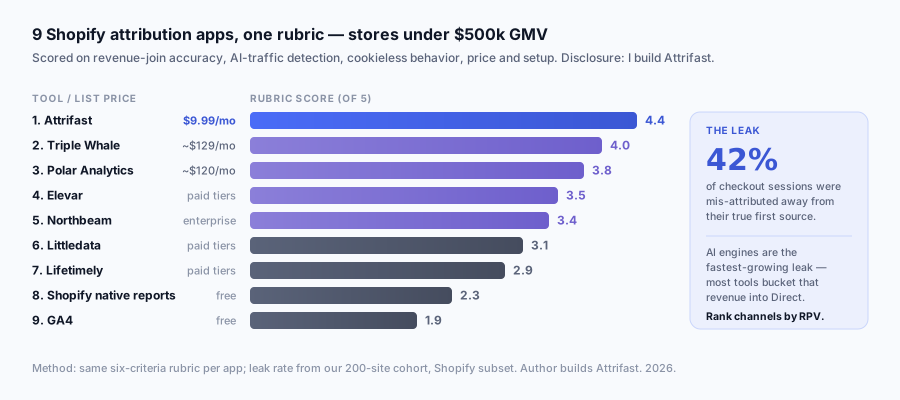
Before scoring apps, the problem they exist to solve. Across the Shopify subset of our 200-site cohort, I looked at where checkout sessions get bucketed versus where the order's revenue truly originated. The picture is the reason "Direct" is the most misleading line in most Shopify dashboards.

Source: Attrifast 200-site cohort (Shopify subset, n=71), Q1–Q2 2026
Only about 58% of checkout sessions were correctly attributed to their true first source. The rest leaked, and the fastest-growing leak is AI engines: ChatGPT and Perplexity strip or omit the referrer, so a client-side pixel records those high-intent visits as Direct. Dark social — links shared in DMs, Slack, and private communities — accounts for another chunk, and consent-banner and ITP loss takes the remainder.
This matters because the leak is not random. AI-referred and email sessions convert well above average, so when they get dumped into Direct, you systematically under-credit your best sources and over-credit whatever got the last click. An attribution app that only reads the client-side referrer inherits this entire blind spot.
The six-criteria rubric
Every app in this comparison is scored 0 to 5 on the same six dimensions, weighted for what matters for the source-to-revenue job on a store under $500k GMV. The weights are mine and opinionated; if paid-social depth matters more to you, re-weight and the ranking shifts.
| Criterion | Weight | What a 5 looks like | What a 0 looks like |
|---|---|---|---|
| Revenue-join accuracy | 25% | Direct payment/order join, reconciled | Estimated pixel revenue only |
| AI-traffic detection | 20% | Server-side ChatGPT/Perplexity/Claude split | Buckets AI as Direct |
| Cookieless / privacy | 15% | Cookieless first-party, no banner needed | Cookie + pixel, consent loss |
| Setup effort | 15% | One snippet or native app install | Tag manager + data-layer work |
| Price for under-$500k GMV | 15% | Flat, under $30/mo | $500/mo+ or order-metered |
| Ad-platform depth | 10% | Native pixel + creative reporting | No ad-account integration |
Note the last row: ad-platform depth is only 10% here, because the job I am scoring is revenue truth, not creative optimization. If you flip that weight to 30%, Triple Whale and Polar rise and Attrifast falls — which is exactly the honest trade-off, not a flaw in either tool.

Source: Attrifast scoring rubric (6 weighted dimensions), July 2026
One disclosure about these scores: they were assigned in July 2026, before the 1 August 2026 price re-check above. I have not re-derived them, because inventing a new decimal to match a correction is the habit this piece is trying to avoid. Read them knowing that Audiense Online (Elevar) would score lower on the "price for under-$500k GMV" dimension than 3.5 implies now that its entry tier is $225 rather than the ~$50 I originally scored, and that Polar's price dimension is now unscoreable rather than merely expensive.
The at-a-glance verdict
| App | Best for | Choose if / Skip if | Score |
|---|---|---|---|
| Attrifast | Source-to-revenue truth under $500k GMV | Choose if organic/email/AI drive revenue · Skip if you need creative reporting | 4.4 |
| Triple Whale | Paid-social-heavy DTC | Choose if Meta/TikTok creative is your engine · Skip if ad spend is modest | 4.0 |
| Polar Analytics | BI + ad attribution for growing DTC | Choose if you want a custom BI layer · Skip if you want cheap and simple | 3.8 |
| Audiense Online (Elevar) | Server-side conversion accuracy | Choose if you feed GA4/ads server-side · Skip if you want revenue-by-source dashboards | 3.5 |
| Northbeam | Enterprise MTA | Choose if you spend $1M+/yr on ads · Skip if under $500k GMV | 3.4 |
| Littledata | Clean server-side data into GA4 | Choose if GA4 is your source of truth · Skip if you want a payment join | 3.1 |
| AMP (Lifetimely) | LTV + P&L views | Choose if you want cohort LTV · Skip if you want channel attribution | 2.9 |
| Shopify native | Free last-click baseline | Choose as a free starting point · Skip if you need AI/dark-social truth | 2.3 |
| GA4 | Free web analytics | Choose for legacy compatibility · Skip for revenue-by-source | 1.9 |
Now the app-by-app detail, ranked.
1. Attrifast — the revenue-truth layer (score: 4.4)
Entry price: $9.99/mo flat, $99.90/yr, 7-day free trial (Pro is $49/mo, $490/yr). Verified 1 August 2026.
Attrifast is built for exactly one job: capture the true source of a Shopify visit server-side, then join it to the paid order so you see revenue and revenue-per-visitor by source — including the AI engines everything else buckets as Direct. It installs as a single snippet plus a Shopify/Stripe webhook, and it is cookieless first-party by default, so it measures cleanly in the EU without a consent banner throttling it.
Strengths:
- Direct payment/order join — the revenue number is a booked order, not an estimated pixel event.
- Server-side AI-traffic detection: ChatGPT, Perplexity, Claude, and Gemini each get their own revenue line.
- Cookieless first-party by default; strong GDPR posture with no banner dependency.
- $9.99/mo flat — no order metering, no per-channel fees.
- Revenue-per-visitor (RPV) as a first-class metric, which is the number that actually ranks channels.
Limitations (my own tool, named honestly):
- No native ad-platform pixel management or creative-level reporting. If your growth is Meta/TikTok creative iteration, Attrifast does not do that job — pair it with the native ad managers or keep a paid-media suite.
- Younger than Triple Whale and Polar; smaller app-store review base and fewer pre-built integrations.
- Multi-touch path visualization is intentionally simple; if you want a full MTA credit-distribution model across dozens of touchpoints, Northbeam is deeper.
Best for: stores under $500k GMV whose revenue is a blend of organic, email, Reddit, and AI engines and who want the truth of which source paid, cheaply. Skip if paid-social creative reporting is the reason you are buying.
2. Triple Whale — the paid-social suite (score: 4.0)
Entry price: $219/mo on Foundation, banded by trailing-12-month GMV; Automate is $749/mo. There is a free "Founders Dash" tier, but no free trial is advertised on the paid tiers — both route to "Book a walkthrough." Read off the pricing page on 1 August 2026 [1].
Triple Whale is the category's most polished paid-media attribution suite, and for a store spending real money on Meta and TikTok it earns its price. Its pixel, blended-ROAS views, and creative-level reporting are genuinely best-in-class, and its dashboard is the nicest in this list.
Strengths: native ad-platform pixel + creative reporting; blended ROAS across channels; strong mobile app; large, active user community.
Limitations: built for paid-social-heavy stores, so a lot of the value is unused if ads are not your engine; revenue for organic and AI-driven sessions is pixel-estimated, not payment-joined; pricing climbs with order volume and the entry tier is thin; cookie/pixel reliance inherits consent-banner loss.
Best for: DTC brands where Meta/TikTok creative iteration drives growth. Skip if you are under $500k GMV with modest ad spend — you are paying for depth you will not use.
3. Polar Analytics — BI plus attribution (score: 3.8)
Entry price: not published. On 1 August 2026 Polar's pricing page rendered eight empty price placeholders where the figures should be, and every call to action on it — ten of them — was "Book a demo," with no free trial advertised anywhere on the page [2]. An earlier version of this article carried a "~$120/mo" figure for Polar; I could not substantiate it against the live page, so it is deleted rather than rounded.
Polar sits next to Triple Whale: ad-platform attribution plus a flexible BI layer that lets you build custom dashboards across your Shopify, ad, and email data. For a growing store that wants to slice its own metrics, Polar's BI flexibility is its edge.
Strengths: strong ad-platform integrations; flexible custom-metric BI; clean multi-store support; good for operators who want to build their own views.
Limitations: you cannot budget it without booking a call, which rules it out for anyone doing a self-serve comparison; the BI power is wasted if you just want revenue-by-source; pixel/cookie reliance and consent loss; no direct payment-processor revenue join for organic/AI sessions.
Best for: growing DTC brands that want a customizable BI layer on top of attribution. Skip if you want cheap, simple, and revenue-truth-focused.
4. Audiense Online, formerly Elevar — server-side conversion accuracy (score: 3.5)
Entry price: $225/mo on Core, covering up to 2,000 orders a month, free for 15 days; Advanced is $650, Premium $1,250, and Elite starts at $3,000, with per-order overages from $0.50 down to $0.04 [4]. Read off the pricing page on 1 August 2026.
Two corrections here since this article first ran, and both matter. Elevar has been folded into Audiense: getelevar.com now redirects to audiense.com, where the product is sold as "Audiense Online (Elevar)" [4]. And the entry price is $225/mo, not the "~$50/mo" this article previously printed — a 4.5x error that moved Elevar out of the cheap-add-on bracket entirely and changes who should shortlist it.
Elevar's job is data quality: it captures conversions server-side and feeds clean, deduplicated events to GA4, Meta CAPI, Google Ads, and your data layer. It makes your other tools more accurate rather than being a revenue dashboard itself.
Strengths: excellent server-side event accuracy; strong Meta CAPI and Google Ads server-side integration; recovers pixel loss for ad platforms; solid for technical stores.
Limitations: it is a data pipe, not a revenue-by-source dashboard — you still read the numbers in GA4 or your ad accounts; setup involves data-layer configuration; no native payment-processor revenue join or RPV metric; and at $225/mo entry it is now priced above Triple Whale's cheapest paid tier while doing a narrower job.
Best for: stores that want maximum server-side conversion accuracy feeding GA4 and ad platforms, and have the order volume to justify $225 a month for plumbing. Skip if you want a ready-made revenue-by-source view.
5. Northbeam — enterprise MTA (score: 3.4)
Entry price: its Starter tier reads "starting at $1,500 / per month" for brands under $1.5m a year in media spend; Professional (>$250k/mo spend) and Enterprise (>$500k/mo) are both "Contact us for a quote" [3]. Read off the pricing page on 1 August 2026.
Northbeam is a serious multi-touch attribution platform for brands spending seven figures a year on ads. Its modeling is deep and its incrementality features are real. It is also over-built and over-priced for any store under $500k GMV, which is why it scores where it does for this audience — a high-spend brand would rate it far higher.
Strengths: deep MTA modeling; media-mix and incrementality analysis; enterprise-grade for high ad spend.
Limitations: priced out of the SMB segment; overkill for stores whose growth is organic/AI; sales-led onboarding, no self-serve trial; heavy for the job most small stores have.
Best for: DTC brands spending $1M+/yr on paid media. Skip if you are under $500k GMV.
6–9. Littledata, AMP (Lifetimely), Shopify native, GA4 (scores: 3.1, 2.9, 2.3, 1.9)
Littledata (Flex from $0.35/order; Scale from $159/mo) is a clean server-side tracking pipe that fixes Shopify's GA4 data quality — valuable if GA4 is your source of truth, but it is plumbing, not a payment-joined revenue view. Its cheapest plan has no monthly base at all, just a per-order rate, which makes it genuinely cheap for a low-order store and not cheap at volume; the first named monthly tier, Scale, starts at $159/mo and includes 1,500 orders, and Plus starts at $792/mo for 10,000. There is a 30-day free trial capped at 500 orders [5].
AMP, formerly Lifetimely (free up to 50 orders/mo, then from $79/mo) shines at cohort LTV and P&L dashboards, which is a different job than channel attribution; buy it for lifetime-value analysis, not for source-to-revenue. lifetimely.io now redirects to useamp.com. The ladder is banded by monthly orders — the $149/mo tier covers up to 3,000 — with named tiers at $499, $749 and $999 above that, plus a $75/mo Amazon add-on [6].
Shopify's native reports (free) give a fine last-click baseline by source and UTM, and every store should read them — but they mis-bucket AI-engine and dark-social sessions into Direct, so treat them as a floor, not the answer.
GA4 (free) remains the default web-analytics tool and is worth keeping for legacy compatibility, but for revenue-by-source on a Shopify store it is the weakest option here: it buckets the majority of AI-engine visits as Direct and has no concept of a paid order beyond a client-fired purchase event.
RPV: the number that actually ranks your channels
Every app above shows something. The question is whether it shows the number that changes your decisions. For a Shopify store, that number is revenue per visitor by source — because it ranks channels by money produced, not clicks sent.

Source: Attrifast 200-site cohort (Shopify subset), Stripe/Shopify checkout join, Q2 2026
In our cohort, Perplexity sessions produced an RPV of about $1.71 and ChatGPT about $0.94, both above Google organic ($0.82) and well above Meta ads ($0.61). Email was strongest at $1.38. The AI engines send far fewer visits than Meta, but each visit is worth roughly 1.5–2.8x more — and if those visits are sitting in your Direct bucket, you cannot see that, so you keep over-investing in the low-RPV channel with the loud click count. That is the practical cost of mis-attribution, and it is why the revenue-join dimension is weighted highest in the rubric.
Why AI-referred revenue is the fastest-growing blind spot
The mis-attribution problem is not static — it is getting worse, because AI-engine referrals to Shopify stores are growing fast and they are precisely the traffic that client-side pixels miss.

Source: Attrifast 200-site cohort (Shopify subset), monthly AI-referral index
Indexed to January 2025, AI-referred Shopify sessions in our cohort more than tripled for ChatGPT and grew over 5x for Perplexity by mid-2026. As shopping behavior shifts toward asking an AI engine "what's the best X for Y," this traffic becomes a larger share of high-intent visits — and any attribution app that reads only the client-side referrer will keep dumping it into Direct. That is the structural reason server-side AI-traffic detection is weighted at 20% in the rubric, second only to the revenue join itself.
Match the app to your store
| Your situation | Primary pick | Add if needed | The number to watch |
|---|---|---|---|
| Under $500k GMV, organic/email/AI-driven | Attrifast | Shopify native for last-click sanity | RPV by source |
| Paid-social-heavy, $500k+ GMV | Triple Whale ($219/mo) or Polar (quote) | Attrifast for organic/AI revenue | Blended ROAS + RPV |
| Want maximum server-side accuracy into GA4 | Audiense Online, formerly Elevar | Attrifast for the revenue view | Conversion match rate |
| Enterprise, $1M+/yr ad spend | Northbeam | — | Incrementality |
| Just starting, zero budget | Shopify native + GA4 | Attrifast at $9.99 when Direct gets big | Direct-bucket % |
The pattern in every row is that for the specific job of knowing which source produced a paid order, adding a payment-joined tool is the cheapest way to close the gap, regardless of what paid-media suite sits above it. If that sounds self-serving, the test is simple: run a free trial for a week, see whether ChatGPT, Perplexity, and email revenue appears in your dashboard joined to real Shopify orders, and decide from the data. If it does not show you something Shopify's native reports already showed you, do not buy it.
FAQ
What is the best Shopify attribution app in 2026?
It depends on your ad spend. For stores under $500k GMV that sell mostly through Stripe or Shopify Payments and want revenue joined to the real source, Attrifast is the pick at $9.99 a month with a payment-webhook join and server-side AI-traffic detection. If you run heavy paid social and want native ad-platform pixel management and creative-level reporting, Triple Whale earns its price at $219/mo on its Foundation tier, as its own pricing page rendered it on 1 August 2026. Polar Analytics is the other serious option in that lane, but it publishes no price at all — every plan card routes to a demo booking — so you cannot budget it in advance. Shopify's native reports and GA4 are free but both bucket a large share of AI-engine and dark-social sessions as Direct, so their source numbers understate what actually drove the sale.
Is Triple Whale worth it for a small Shopify store?
Triple Whale is genuinely strong, but it is built for stores spending real money on Meta and Google ads — its pixel, creative reporting, and blended-ROAS views are the reason to buy it. For a store under roughly $500k GMV with modest ad spend, you are paying $219 a month on its cheapest paid tier for depth you will not fully use, and you still do not get a direct payment-processor revenue join for organic and AI-driven sessions. If paid social is your engine, keep Triple Whale. If organic, email, and AI referrals drive most of your revenue, a $9.99 payment-join tool covers the job for roughly a twentieth of the cost.
Do Shopify's built-in reports track marketing attribution?
Partly. Shopify's native reports show sessions and orders by source using the referrer and UTM parameters, and the marketing analytics section gives a last-click view. What they do not do well: AI-engine referrals (ChatGPT, Perplexity, and Claude strip or omit the referrer, so those visits land in Direct), dark-social sharing, and multi-touch paths. Across our Shopify cohort, roughly 42% of checkout sessions were mis-bucketed away from their true first source. Native reports are a fine free baseline; they are not a substitute for a tool that captures the source server-side and joins it to the paid order.
Which Shopify attribution app is cheapest?
Shopify's native reports and GA4 are free. Among paid apps that actually tie a source to revenue, Attrifast is the lowest at $9.99 a month flat. Everything else is materially more expensive than most 2026 roundups claim; here is what each vendor's own page rendered on 1 August 2026. Lifetimely — now AMP, at useamp.com — is free up to 50 orders a month and then starts at $79/mo. Littledata's usage tier starts at $0.35 per order with no monthly base, and its first named monthly plan, Scale, starts at $159/mo for 1,500 orders. Triple Whale's Foundation tier is $219/mo. Elevar is now sold as Audiense Online after getelevar.com began redirecting to audiense.com, and its Core tier is $225/mo for up to 2,000 orders. Northbeam publishes a Starter tier at "starting at $1,500 / per month" and is over-built for stores under $500k GMV. Polar Analytics publishes no price at all. Verify each on the vendor's pricing page before you sign — e-commerce app pricing moves quickly, several meter by order volume, and two of these vendors changed domain in the past year.
How do I track ChatGPT and Perplexity traffic to my Shopify store?
You need server-side source capture, because ChatGPT and many Perplexity clients strip the Referer header on outbound clicks, so a client-side pixel sees no source and the session lands in Direct. A tool that reads the referrer and user-agent from the initial HTTP request (server-side) catches these visits and can then join them to the paid order. Attrifast does this natively and splits ChatGPT, Perplexity, Claude, and Gemini into their own revenue lines. Triple Whale and Polar detect some AI referrers when they survive but do not join them to a payment-processor invoice.
What is revenue per visitor (RPV) and why does it matter for Shopify?
Revenue per visitor is total revenue divided by visitors from a given source. It matters because it ranks channels by the money they actually produce, not by click volume. A source can send a lot of low-intent traffic (high sessions, low RPV) or a little high-intent traffic (low sessions, high RPV). In our Shopify cohort, Perplexity sessions produced an RPV of about $1.71 versus $0.61 for Meta ads — far fewer visits, but each one worth roughly 2.8x more. Attribution apps that only show sessions or last-click orders hide this; RPV is the metric that tells you where the next dollar of effort should go.
Does Attrifast replace Triple Whale or Polar Analytics?
For the revenue-attribution job — tying a source to a paid order — yes, and for roughly a twentieth of Triple Whale's entry price. What Attrifast does not replace is native ad-platform pixel management and creative-level ad reporting; if your growth depends on iterating Meta and TikTok creative, Triple Whale and Polar do that job and Attrifast does not. The common setup for a store under $500k GMV is to drop the expensive suite, run Attrifast for revenue-by-source truth, and use the native ad managers for creative. Above roughly $500k GMV with serious paid social, keep the suite and add Attrifast for the organic and AI-driven revenue it cannot see.
Are these apps GDPR compliant and cookieless?
It varies. Attrifast is cookieless first-party by default, which keeps it clean under GDPR without a consent banner blocking measurement. Polar and Triple Whale rely on a pixel and cookies for parts of their tracking, so they inherit consent-banner loss. Shopify's native reports use first-party data tied to the store. GA4 is not cookieless without significant custom work and drops 30–60% of events to consent banners in the EU. If EU privacy posture matters to you, weight the cookieless dimension heavily — it changes both your compliance exposure and how much traffic you actually measure.
Related reading from the Attrifast research stack
For the deeper mechanics of tying a Shopify order to its source, see the Shopify revenue attribution guide and how ChatGPT shopping revenue attribution works. If you want to understand the metric this whole comparison hinges on, ROAS vs MER vs RPV breaks down why revenue-per-visitor beats click-based metrics. For the underlying feature, see revenue attribution and Attrifast for Stripe.
Sources
Primary sources for the claims in this article. Numbered citations in the text link to the matching entry.
- [1]Triple Whale pricing — Founders Dash free forever, Foundation $219/mo, Automate $749/mo, banded by trailing-12-month GMV; paid tiers CTA is "Book a walkthrough" (accessed 1 August 2026) — Triple Whale (2026).
- [2]Polar Analytics pricing — no figures published; every plan card renders an empty price placeholder and routes to "Book a demo" (accessed 1 August 2026) — Polar Analytics (2026).
- [3]Northbeam pricing — Starter "starting at $1,500 / per month" under $1.5m/yr media spend; Professional and Enterprise quote-only (accessed 1 August 2026) — Northbeam (2026).
- [4]Audiense Online (Elevar) pricing — Core $225/mo at 2k orders, Advanced $650/mo, Premium $1,250/mo, Elite from $3,000/mo, free for 15 days; getelevar.com now redirects here (accessed 1 August 2026) — Audiense (formerly Elevar) (2026).
- [5]Littledata plans — Flex from $0.35/order with no monthly base, Scale from $159/mo at 1,500 orders, Plus from $792/mo at 10,000 orders, 30-day free trial capped at 500 orders (accessed 1 August 2026) — Littledata (2026).
- [6]AMP (Lifetimely) pricing — free up to 50 orders/mo, paid from $79/mo, M $149/mo up to 3,000 orders, XL $499, XXL $749, Unlimited $999; lifetimely.io now redirects here (accessed 1 August 2026) — AMP (formerly Lifetimely) (2026).
- [7]Shopify analytics and marketing reports documentation — Shopify Help Center (2026).
- [8]Google Analytics 4 default channel groupings and attribution windows — Google Analytics Help (2025).
- [9]Shopify: capturing UTM parameters and referrer for order attribution — Shopify Developers (2026).
- [10]OpenAI: GPTBot, ChatGPT-User, OAI-SearchBot user-agent documentation — OpenAI (2026).
- [11]Perplexity FAQ on citations, sources, and crawler behavior — Perplexity (2025).
- [12]Triple Whale Shopify App Store listing and reviews — Shopify App Store (2026).
- [13]Polar Analytics Shopify App Store listing and reviews — Shopify App Store (2026).
- [14]GDPR guidance on cookies, consent, and analytics — GDPR.eu (2025).
- [15]Attrifast: Shopify revenue attribution guide — Attrifast (2026).
- [16]Attrifast: revenue attribution feature and Stripe-native webhook join — Attrifast (2026).