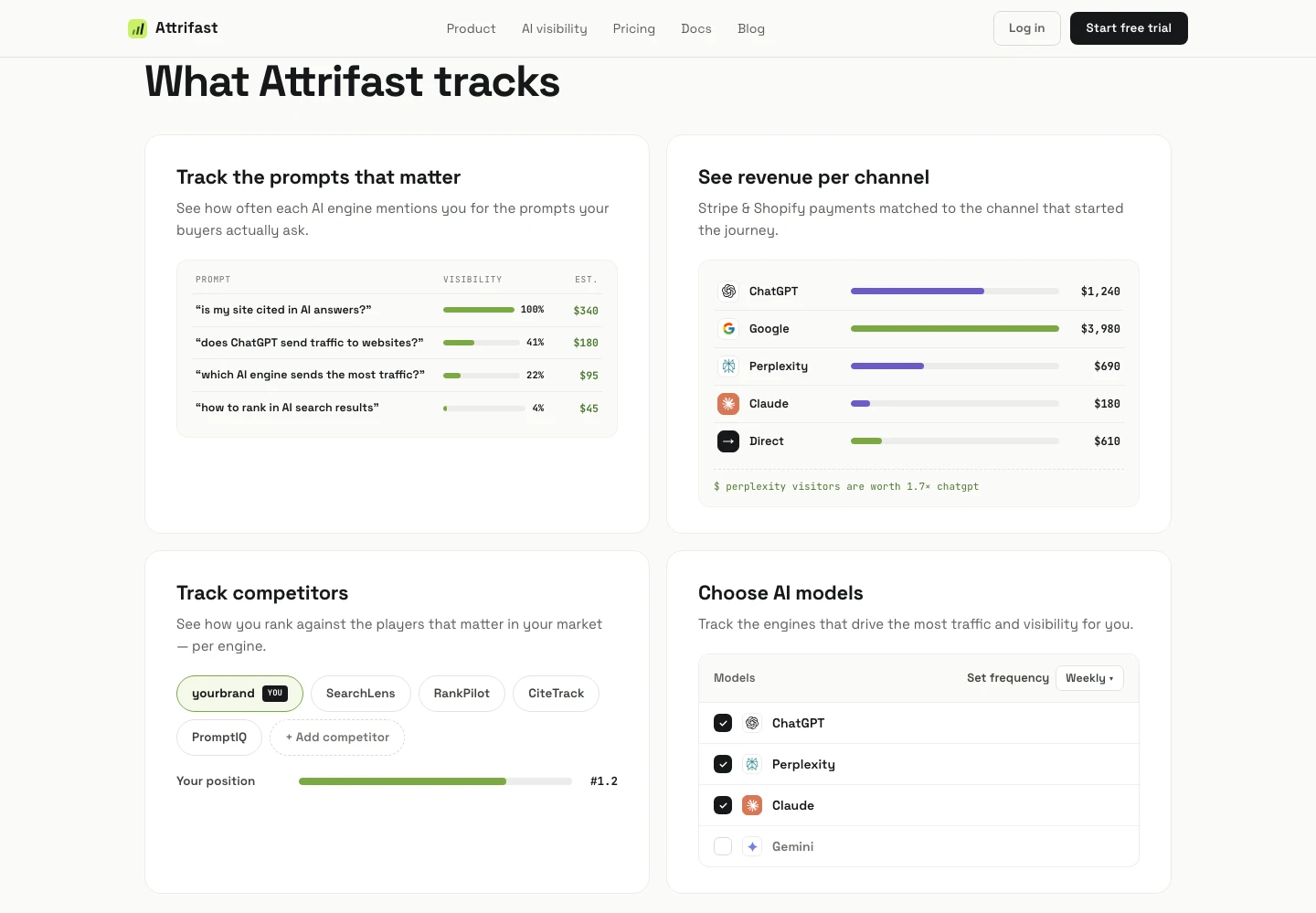
Part of the revenue attribution research stack — honest, rubric-scored tool comparisons for founders.
Let me start by being unusually direct for a piece written by a competitor: Triple Whale is a good product, and for a store spending real money on Meta and TikTok, it is the right product. I am ranking it number one in this comparison, ahead of my own tool, because on the dimension it was built for — paid-social attribution and creative reporting — it beats everything else here, including Attrifast. If that is the job you have, you can stop reading and keep your subscription.
This piece is for the brands who have a different job and are paying Triple Whale prices for it anyway. I have watched a handful of small DTC stores install Triple Whale, admire the dashboard, and then quietly realize that most of their value came from the pixel-and-creative machinery they barely touched, because their actual growth was coming from a Reddit thread, an email list, and — increasingly — people asking ChatGPT what to buy. For those stores, $219 a month buys depth they do not use and still leaves the revenue question half-answered.
So I scored seven alternatives on the same rubric, named where each one beats Triple Whale and where it does not, and I put my own tool at number two with its limitations spelled out. The honest summary is up top: keep Triple Whale if paid social is your engine; look at a cheaper payment-joined tool if it is not.
Why brands look for a Triple Whale alternative
There are really only three reasons, and which one is yours determines which alternative fits.
- Price. Triple Whale's cheapest paid tier is Foundation at $219 a month, and the ladder is banded by your trailing-12-month GMV, so the bill rises as you grow [1]. For a store under $500k GMV, that is a meaningful line item, and the cheaper tools here range from free to $225.
- Fit. A large share of Triple Whale's value is native ad-platform pixel management and creative-level reporting. If your growth is organic, email, or AI-driven rather than paid-social, you are paying for capability you do not exercise.
- The revenue question. Triple Whale estimates revenue for organic and AI sessions from its pixel, not from the actual paid order. Brands that want booked revenue by source — the invoice, joined to the channel — need a payment-joined tool.
If your reason is #1 or #3, a cheaper payment-joined tool likely fits. If your reason is only #2, you may just need a smaller Triple Whale plan, or Polar. Be honest with yourself about which one it is before you switch.
The two jobs, and why the ranking respects both
| Job | Question it answers | Primary mechanism | Tool that leads |
|---|---|---|---|
| Paid-social attribution | Which ad and creative drove ROAS? | Ad-account pixel + API join | Triple Whale |
| Source-to-revenue attribution | Which source produced this paid order? | Server-side capture + payment join | Attrifast |
This is why Triple Whale sits at #1 and Attrifast at #2 rather than the other way around: the rubric weights both jobs, and Triple Whale wins the paid-media job decisively while Attrifast wins the revenue-truth job decisively. Neither ranking is a trick — they lead on different dimensions, and the head-to-head below shows exactly which.

Source: Attrifast head-to-head scoring, 6 rubric dimensions, July 2026
Triple Whale leads on ad-platform depth, creative reporting, and dashboard polish. Attrifast leads on revenue-join accuracy, AI-traffic detection, and price. It is a genuine split, and pretending otherwise would be exactly the kind of vendor-biased ranking this piece is trying to avoid.
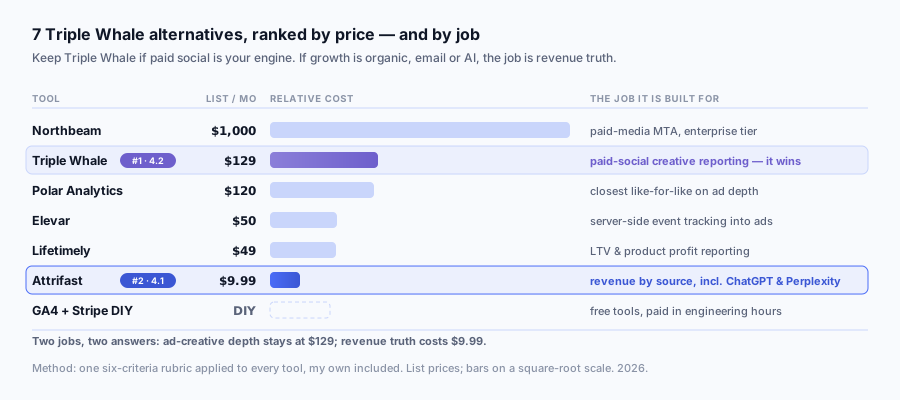
The field, by price
I re-read all six vendor pricing pages on 1 August 2026 rather than carrying forward last quarter's numbers, and two of the six had changed identity outright. getelevar.com/pricing now 301s to audiense.com, where the product is sold as "Audiense Online (Elevar)" [4]. lifetimely.io now 301s to useamp.com, where it is sold as AMP [5]. Both moved price as well as domain, and in Elevar's case by more than 4x.

Source: Vendor pricing pages, all read 1 August 2026. Northbeam ($1,500 Starter) is omitted to keep the scale readable; Polar Analytics is omitted because it publishes no price
| Tool | Entry price (read 1 Aug 2026) | Primary job | Free trial |
|---|---|---|---|
| GA4 + Stripe DIY | Free (license) | Custom attribution build | Free |
| Attrifast | $9.99/mo | Source-to-revenue (payment join) | 7-day trial |
| AMP (formerly Lifetimely) | Free up to 50 orders/mo, then from $79/mo [5] | LTV + P&L | Free tier |
| Triple Whale | $219/mo (Foundation, GMV-banded) [1] | Paid-social attribution suite | Free "Founders Dash" tier; paid plans are "Book a walkthrough" |
| Audiense Online (Elevar) | $225/mo (Core, 2k orders) [4] | Server-side conversion tracking | 15 days free |
| Polar Analytics | Not published — demo-gated [2] | Ad-platform attribution + BI | None advertised |
| Northbeam | From $1,500/mo (Starter) [3] | Enterprise MTA | None |
Three notes on that table, because they are the parts most roundups get wrong. Triple Whale advertises no self-serve trial on its paid tiers — the CTA on Foundation and Automate is "Book a walkthrough," and the only no-commitment entry is the free Founders Dash tier [1]. Polar publishes nothing: on 1 August 2026 its pricing page rendered eight empty price placeholders where the figures should be, and every call to action on it — ten of them — was "Book a demo" [2]. And Northbeam does publish a floor — "starting at $1,500 / per month" for brands under $1.5m a year in media spend — with only its Professional and Enterprise tiers quote-only [3].
Several of these meter with volume, so the gap widens as you grow. Annualizing each vendor's own published entry rate makes the spread concrete.

Source: Each vendor's published entry rate as read on 1 August 2026, multiplied by 12. Polar Analytics is excluded because it publishes no rate to annualize
At the published entry rates, Triple Whale's Foundation tier annualizes to $2,628 against $119.88 for Attrifast billed monthly, or $99.90 on the yearly plan — a difference of roughly $2,500 a year. That is not an argument that Triple Whale is overpriced; it is an argument that you should only pay it if you use the paid-social depth it buys. If you do not, that $2,500 is the cost of a capability you are not exercising. Note that this is a like-for-like comparison of entry rates only: Triple Whale's band rises with GMV and Attrifast's does not, so the gap grows rather than shrinks as the store scales.
The six-criteria rubric
| Criterion | Weight | What a 5 looks like | What a 0 looks like |
|---|---|---|---|
| Revenue-join accuracy | 25% | Direct payment/order join, reconciled | Estimated pixel revenue only |
| Ad-platform depth | 20% | Native pixel + creative reporting | No ad-account integration |
| AI-traffic detection | 15% | Server-side ChatGPT/Perplexity split | Buckets AI as Direct |
| Price for small DTC | 15% | Flat, under $30/mo | $500/mo+ or order-metered |
| Setup effort | 15% | One snippet or native app | Warehouse + pipeline |
| Cookieless / privacy | 10% | Cookieless first-party | Cookie + pixel, consent loss |
Note that ad-platform depth carries 20% here — more than in a pure revenue-attribution rubric — precisely because this comparison is about replacing a paid-media tool, so it would be dishonest to under-weight the thing Triple Whale is best at.

Source: Attrifast scoring rubric (6 weighted dimensions), July 2026
One disclosure about these scores: they were assigned in July 2026, before the 1 August 2026 price re-check below. I have not re-derived them, because inventing a new decimal to match a correction is exactly the habit this piece is trying to avoid. Read them knowing that Audiense Online (Elevar) would score lower on the price dimension than 3.4 implies now that its entry tier is $225 rather than the ~$50 I originally scored, and that Polar's price dimension is now unscoreable rather than merely expensive.
The at-a-glance verdict
| Tool | Best for | Choose if / Skip if | Score |
|---|---|---|---|
| Triple Whale | Paid-social creative reporting | Choose if Meta/TikTok is your engine · Skip if ad spend is modest | 4.2 |
| Attrifast | Revenue-by-source truth, cheaply | Choose if organic/email/AI drive growth · Skip if you need creative reporting | 4.1 |
| Polar Analytics | Ad attribution + custom BI | Choose for BI flexibility · Skip if you want cheap and simple | 3.8 |
| Northbeam | Enterprise MTA | Choose if $1M+/yr ad spend · Skip if under $500k GMV | 3.6 |
| Elevar | Server-side conversion accuracy | Choose to feed ads/GA4 server-side · Skip if you want a dashboard | 3.4 |
| Lifetimely | LTV + P&L | Choose for cohort LTV · Skip for channel attribution | 2.9 |
| GA4 + Stripe DIY | Custom build | Choose if you have eng time · Skip if you want it to just work | 2.2 |
1. Triple Whale — keep it if paid social is your engine (score: 4.2)
Entry price: $219/mo on Foundation, banded by trailing-12-month GMV; Automate is $749/mo. There is a free "Founders Dash" tier, but no free trial is advertised on the paid tiers — both route to "Book a walkthrough." Read off the pricing page on 1 August 2026 [1].
The tool everything here is measured against. Triple Whale's native pixel, blended-ROAS views, and creative-level reporting are the best in this comparison, and its dashboard and mobile app are the most polished. For a paid-social-heavy brand, it earns its price.
Strengths: best-in-class paid-social attribution and creative reporting; polished dashboard and mobile app; large, active community; broad ad-platform integrations.
Limitations: priced above the small-DTC comfort zone and meters up; revenue for organic and AI sessions is pixel-estimated, not payment-joined; AI-engine referrers frequently land in Direct; pixel/cookie reliance inherits consent-banner loss.
Best for: DTC brands whose growth is Meta/TikTok creative. Skip if you are under $500k GMV with modest ad spend.
2. Attrifast — revenue truth for a twentieth of the price (score: 4.1)
Entry price: $9.99/mo flat, $99.90/yr, 7-day free trial (Pro is $49/mo, $490/yr). Verified 1 August 2026.
Attrifast does the job Triple Whale leaves half-answered: it captures each source server-side and joins it to the actual paid order, so revenue by source is booked, not estimated — and it splits ChatGPT, Perplexity, Claude, and Gemini into their own lines rather than dumping them in Direct. At $9.99 against Foundation's $219 it is roughly a twentieth of Triple Whale's entry price.
Strengths:
- Direct payment/order join — booked revenue by source, not pixel estimate.
- Server-side AI-engine detection with per-engine revenue lines.
- Cookieless first-party by default; clean GDPR posture.
- $9.99/mo flat, no order metering.
- RPV by source as a first-class metric.
Limitations (my own tool, named honestly):
- No native ad-platform creative reporting. This is the specific thing Triple Whale is #1 for, and Attrifast does not replace it — if creative iteration drives your growth, keep a paid-media suite.
- Smaller integration library and younger app-store presence than Triple Whale.
- Simple multi-touch path view; Northbeam is deeper for full MTA credit distribution.
Best for: small DTC brands whose growth is organic, email, and AI-driven and who want booked revenue by source cheaply. Skip if paid-social creative reporting is why you are shopping.
3–7. Polar, Northbeam, Elevar, Lifetimely, GA4 DIY
Polar Analytics (price not published) is the closest like-for-like on ad-platform depth, with a more flexible BI layer than Triple Whale but a slightly less polished out-of-the-box experience. Choose it if you want to build custom dashboards; it shares Triple Whale's gap on payment-joined organic/AI revenue. Be aware you cannot budget it in advance: on 1 August 2026 its pricing page rendered an empty price placeholder on every plan and sent all of them to "Book a demo," with no free trial advertised [2]. Earlier roundups — including an earlier version of this one — circulated a "~$120/mo" figure for Polar; I could not substantiate it against the live page, so it is gone rather than softened.
Northbeam (from $1,500/mo) is the enterprise multi-touch platform for brands spending seven figures a year on ads. Its Starter tier reads "starting at $1,500 / per month" for brands under $1.5m a year in media spend, with Professional and Enterprise quote-only [3]. It out-models everyone on incrementality and media mix, and it is wildly over-built for anyone under $500k GMV — which is why it scores where it does for this audience.
Audiense Online, formerly Elevar ($225/mo Core) is a server-side conversion-accuracy pipe, not a dashboard: it makes your ad platforms and GA4 more accurate. Two things changed here since this article first ran. The brand moved — getelevar.com now redirects to Audiense — and the entry price is $225/mo for up to 2,000 orders, not the ~$50 figure this piece previously carried; above Core it is $650, $1,250 and from $3,000 a month, with 15 days free [4]. That is a 4.5x correction, and it moves Elevar out of the "cheap data-quality add-on" bracket entirely. Still valuable if data quality is your bottleneck, but you still read the numbers elsewhere.
AMP, formerly Lifetimely (free up to 50 orders/mo, then from $79/mo) is an LTV and P&L tool — a different job than channel attribution. lifetimely.io now redirects to useamp.com; the ladder is banded by monthly orders, with the $149/mo tier covering up to 3,000 orders and named tiers at $499, $749 and $999 above that [5]. Buy it for cohort lifetime-value analysis, not for source-to-revenue.
GA4 + Stripe DIY (free license) is the build-your-own route: capture source in GA4, export to BigQuery, join to Stripe via your own webhook handler. It works and it is fully in your control, but it is a real engineering project to build and maintain — and for most small brands, a $9.99/mo tool is cheaper than the hours.
What your best channels are actually worth
The reason to get revenue-by-source right — rather than pixel-estimated ROAS — is that it changes where you spend the next hour. For small DTC brands in our cohort, the ranking of channels by revenue per visitor looks nothing like the ranking by ad spend.

Source: Attrifast 200-site cohort (DTC subset), checkout webhook join, Q2 2026
Email ($1.44 RPV) and Perplexity ($1.71) topped the list, with ChatGPT ($0.94) and Google organic ($0.82) well ahead of Meta ads ($0.61) and TikTok ads ($0.47). A brand optimizing entirely off a paid-social dashboard sees the bottom two rows in high resolution and the top two barely at all — because the AI and email revenue is estimated or bucketed into Direct. That is the practical gap a payment-joined tool closes, and it is why the revenue-join dimension is weighted highest in the rubric.
Match the alternative to your reason for leaving
| Your reason for leaving | Best alternative | Keep instead if… | The number to watch |
|---|---|---|---|
| Too expensive, growth is organic/AI | Attrifast | Paid social is actually your engine | RPV by source |
| Want ad depth with a flexible BI layer | Polar Analytics (price quoted on a demo) | You value polish over BI flexibility | Blended ROAS |
| Need enterprise MTA modeling | Northbeam (from $1,500/mo) | You are under $500k GMV | Incrementality |
| Just need better data quality | Audiense Online, formerly Elevar ($225/mo) | You want a ready-made dashboard | Match rate |
| Want it all, have eng time | GA4 + Stripe DIY | You would rather it just work | Build ROI |
The honest bottom line: do not leave Triple Whale to save money if paid social is your engine — you will miss the creative reporting within a month. Leave it if you are paying for depth you do not use, and replace it with a payment-joined tool that answers the revenue question it never fully did. The way to know which camp you are in is to run a cheaper tool in parallel for a few weeks and let the two dashboards settle the argument.
FAQ
What is the best Triple Whale alternative in 2026?
It depends on why you are leaving. If you still need ad-platform depth, Polar Analytics is the closest like-for-like — but note that Polar publishes no price at all. On 1 August 2026 its pricing page rendered empty price placeholders on every plan card and routed all of them to "Book a demo," so budget for a sales conversation rather than a number. If you are a smaller brand whose growth is a blend of organic, email, and AI referrals rather than heavy paid social, Attrifast at $9.99 a month covers the revenue-attribution job — tying each source to a paid order — for roughly a twentieth of Triple Whale's $219/mo Foundation tier. Be honest about the trade-off, though: Triple Whale genuinely wins on paid-social creative reporting, and no cheaper tool here fully replaces that specific capability.
Why do people look for Triple Whale alternatives?
Three reasons come up repeatedly. First, price: Triple Whale's cheapest paid tier, Foundation, is $219 a month as its own pricing page rendered it on 1 August 2026, and the ladder is banded by your trailing-12-month GMV, so the bill rises as you grow. Second, fit: much of Triple Whale's value is in paid-social pixel and creative reporting, and brands whose growth is organic, email, or AI-driven do not use that depth. Third, the revenue question: Triple Whale estimates revenue for organic and AI sessions from its pixel rather than joining it to the actual paid order, so brands that want booked revenue by source look for a payment-joined tool. The right alternative depends on which of these three is your reason.
Is there a cheaper tool than Triple Whale that still tracks revenue?
Yes. Attrifast at $9.99 a month joins each source to the actual paid Stripe or Shopify order, which is a stricter definition of "tracks revenue" than pixel-estimated ROAS — and it detects AI-engine referrals server-side, which Triple Whale buckets into Direct. What Attrifast does not give you is Triple Whale's native ad-account creative reporting. So it is cheaper and more accurate for revenue-by-source, and less capable for paid-social optimization. For a small brand not living on Meta creative iteration, that is usually the right trade.
Triple Whale vs Polar Analytics — which is better?
They are close peers built for the same paid-media job. Triple Whale has the more polished dashboard and mobile app and a larger community; Polar has a more flexible BI layer that lets you build custom metrics and dashboards across your data. For a growing DTC brand that wants to slice its own numbers, Polar's flexibility is the edge; for a brand that wants the most refined out-of-the-box paid-social attribution, Triple Whale is more polished. One practical difference: Triple Whale publishes its ladder (Foundation $219/mo, Automate $749/mo, checked 1 August 2026) while Polar publishes no figure at all, so you can price Triple Whale before you talk to anyone and you cannot do that with Polar. Neither joins organic or AI-driven revenue to the actual paid order, so both leave the same gap that a payment-joined tool fills.
Does Triple Whale track ChatGPT and Perplexity traffic?
Partially. Triple Whale can detect some AI-engine referrers when the client passes a referrer, but ChatGPT and many Perplexity clients strip the Referer header, so those high-intent visits frequently land in Direct in Triple Whale's pixel-based view — and even when detected, the revenue is estimated, not joined to the paid order. To split ChatGPT, Perplexity, Claude, and Gemini into their own revenue lines reliably, you need server-side source capture joined to the payment, which is the specific job Attrifast is built for.
Can I switch from Triple Whale without losing my attribution history?
Your historical Triple Whale data stays in Triple Whale; attribution tools generally do not import each other's models because they capture sources differently. The practical approach is to run the new tool in parallel for a few weeks so you build fresh history and can compare its source-by-source revenue against Triple Whale's before you cancel. Because a payment-joined tool like Attrifast starts recording booked revenue by source from day one, the parallel window is usually short — you are comparing two live sources of truth, not waiting on a migration.
When should a brand keep Triple Whale instead of switching?
Keep Triple Whale when paid social is genuinely your growth engine — when you spend real money on Meta and TikTok and your week-to-week decisions are about creative and audiences. That is the job Triple Whale is best at, and none of the cheaper alternatives here replaces its ad-account creative reporting. The brands that should switch are the ones under roughly $500k GMV whose revenue is a blend of organic, email, Reddit, and AI engines, who are paying for paid-social depth they barely touch. If in doubt, run a cheaper payment-joined tool in parallel for a month and let the two dashboards tell you which job you actually have.
Related reading from the Attrifast research stack
For the full field including the free and native options, see best Shopify attribution apps 2026. For the mechanics of tying a source to an order, read the Shopify revenue attribution guide and how ChatGPT shopping revenue attribution works. For the underlying feature, see revenue attribution and Attrifast for Stripe.
Sources
Primary sources for the claims in this article. Numbered citations in the text link to the matching entry.
- [1]Triple Whale pricing — Founders Dash free forever, Foundation $219/mo, Automate $749/mo, banded by trailing-12-month GMV; paid tiers CTA is "Book a walkthrough" (accessed 1 August 2026) — Triple Whale (2026).
- [2]Polar Analytics pricing — no figures published; every plan card renders an empty price placeholder and routes to "Book a demo" (accessed 1 August 2026) — Polar Analytics (2026).
- [3]Northbeam pricing — Starter "starting at $1,500 / per month" under $1.5m/yr media spend; Professional and Enterprise quote-only (accessed 1 August 2026) — Northbeam (2026).
- [4]Audiense Online (Elevar) pricing — Core $225/mo at 2k orders, Advanced $650/mo, Premium $1,250/mo, Elite from $3,000/mo, free for 15 days; getelevar.com now redirects here (accessed 1 August 2026) — Audiense (formerly Elevar) (2026).
- [5]AMP (Lifetimely) pricing — free up to 50 orders/mo, paid from $79/mo, M $149/mo up to 3,000 orders, XL $499, XXL $749, Unlimited $999; lifetimely.io now redirects here (accessed 1 August 2026) — AMP (formerly Lifetimely) (2026).
- [6]Triple Whale Shopify App Store listing and reviews — Shopify App Store (2026).
- [7]Polar Analytics Shopify App Store listing and reviews — Shopify App Store (2026).
- [8]Triple Whale G2 reviews and ratings — G2 (2026).
- [9]Google Analytics 4 BigQuery export for custom attribution — Google Analytics Help (2025).
- [10]OpenAI: GPTBot, ChatGPT-User, OAI-SearchBot user-agent documentation — OpenAI (2026).
- [11]Perplexity FAQ on citations, sources, and crawler behavior — Perplexity (2025).
- [12]Anthropic: ClaudeBot crawler and web access documentation — Anthropic (2026).
- [13]GDPR guidance on cookies, consent, and analytics — GDPR.eu (2025).
- [14]Shopify: Web Pixels API and order attribution — Shopify Developers (2026).
- [15]Attrifast: best Shopify attribution apps 2026 — Attrifast (2026).
- [16]Attrifast: revenue attribution feature and Stripe-native webhook join — Attrifast (2026).