Part of the affordable marketing attribution research stack — every vendor number below was read off the vendor's own page, with the date attached.
I went looking for the Hyros price the way a buyer would: I typed hyros.com/pricing into a browser. On August 1, 2026, that URL returns a 404.
The Pricing link in the site's own navigation goes somewhere else entirely — to a page headed "Get A Custom Quote," with four cards asking whether you sell software, physical goods, courses, or things closed on a phone call. Every card ends at a booking form. There is not a single number on the page [1].
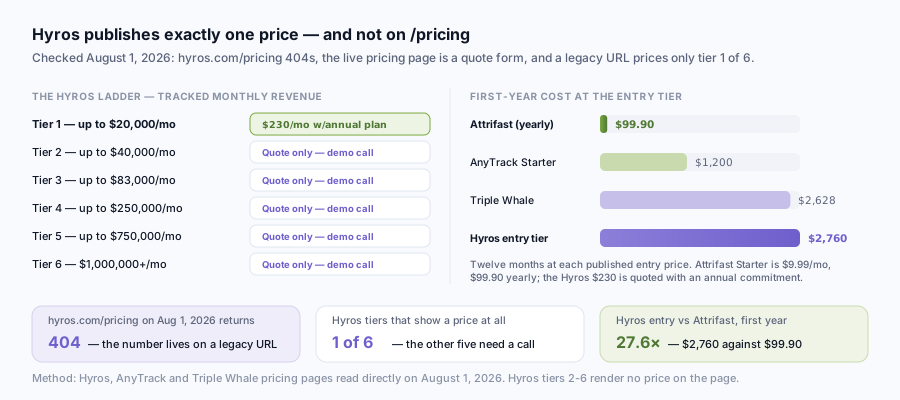
There is one number left on the site, on an older pricing URL that has not been taken down: $230 per month with an annual plan, for up to $20,000 in tracked monthly revenue. That page carries a slider with six rungs — $20k, $40k, $83k, $250k, $750k, $1m+ in tracked monthly revenue — and only the first one renders a price [2].
That is the whole honest answer to "how much does Hyros cost," and everything else in this article is about what that structure means for your budget. I build Attrifast, a $9.99-a-month revenue attribution tool, so I have an obvious interest here. I have tried to keep this piece to arithmetic you can re-run and pages you can open yourself.
Is Hyros pricing actually public?
No — and the way it is not public is unusual enough to be worth documenting, because it changes how you should approach the buying process.
Here is exactly what I found on August 1, 2026:
| Where I looked | HTTP status | What it shows |
|---|---|---|
hyros.com/pricing | 404 | Nothing. The obvious URL is dead. |
hyros.com/pricing-ai-tracking (the "Pricing" nav link) | 200 | "Get A Custom Quote." Four business-model cards, all routing to a booking form. No prices [1]. |
hyros.com/pricing-ai-tracking-og (legacy page, still live) | 200 | Tier slider: $20k / $40k / $83k / $250k / $750k / $1m+ tracked monthly revenue. Renders $230 / per month w/annual plan at the first rung only [2]. |
hyros.com/pricing-air-agent | 200 | The AIR remarketing agent, priced separately at ~$0.10 average per message, 500-message monthly minimum [3]. |
The legacy page is candid about why the call exists. It says each account is customised to the user's business model and assigned a one-to-one analyst trained in that business type, and that "due to this level of customization we require a quick call to set you up" [2]. That is a real reason, not a dodge — a dedicated analyst genuinely is part of what you are buying. But it does mean you cannot budget for Hyros from your desk.

Source: Attrifast check of seven attribution vendor pricing pages, August 1, 2026
I checked seven attribution vendors the same afternoon. Six publish an entry number you can read without talking to anyone: AnyTrack [6], Triple Whale [7], Wicked Reports [8], SegMetrics [9], Attrifast [13] and Northbeam, whose Starter tier reads "starting at $1,500 / per month" for brands under $1.5m a year in media spend — though its Professional and Enterprise tiers are quote-only, gated behind "greater than $250k/mo" and "$500k/mo" in media spend respectively [10]. One vendor publishes nothing on its live pricing page at all: Hyros.
That split is informative in itself. Demo-gated pricing is the signal of a vendor whose median deal is large enough that a salesperson's time is worth spending on it.
How much does Hyros cost per month?
The entry number is $230 per month, and the annual qualifier matters: the page says "per month w/annual plan," so $230 is the annualised monthly rate, not a month-to-month rate you can cancel next week [2]. There is no published month-to-month equivalent.

Source: Read directly from each vendor pricing page, August 1, 2026
Against the rest of the field, all read on August 1, 2026:
| Tool | Entry tier | Entry price | Meter | Price on the page? |
|---|---|---|---|---|
| Attrifast | Starter | $9.99/mo ($99.90/yr) | Flat | Yes, self-serve [13] |
| SegMetrics | Launch | $57/mo at 30k contacts | Active contacts | Yes [9] |
| AnyTrack | Starter | $100/mo | Sessions + sites | Yes [6] |
| Triple Whale | Foundation | $219/mo at the lowest GMV band | Annual GMV | Yes, walkthrough offered [7] |
| Hyros | Business, tier 1 | $230/mo w/annual plan | Tracked monthly revenue | Legacy page only [2] |
| Wicked Reports | Measure | $499/mo | Annual revenue band | Yes [8] |
| Northbeam | Starter | Starting at $1,500/mo | Monthly media spend | Starter yes; Professional and Enterprise quote-only [10] |
Two footnotes on that table, because attribution pricing moves faster than most software pricing. Triple Whale's entry paid tier was widely quoted lower earlier in 2026; what its own page rendered on August 1, 2026 was $219 [7]. SegMetrics' $57 Launch tier is quoted at 30,000 active contacts and climbs with your list, so a larger list lands materially higher [9]. This is exactly why an undated pricing article is worth nothing — if a comparison does not tell you when it was checked, assume it is stale.
What drives the Hyros price up?
The meter is tracked monthly revenue. Not ad spend, not sessions, not seats — revenue that passes through the tracking.

Source: Hyros legacy pricing page tier slider, read August 1, 2026
The six rungs are $20,000, $40,000, $83,000, $250,000, $750,000 and $1,000,000-plus per month [2]. That is a 50× spread from the bottom rung to the published top, and the price ladder underneath it is invisible.
Metering on revenue has a specific consequence worth naming plainly: your attribution bill goes up because you succeeded, not because you used more software. A business that doubles from $20k to $40k in tracked monthly revenue does not generate twice as much attribution work — the same pixels fire, the same reports render — but it steps a rung. That is a legitimate value-based pricing choice and plenty of good companies make it. It is also the single most common reason people go looking for the Hyros price in the first place: they are already on it, they grew, and the renewal quote moved.
Three other things push the number up:
- The AIR remarketing agent. Priced separately at roughly $0.10 average per message with a 500-message monthly minimum — a $50/month, $600/year floor before you send anything at real volume [3]. There is a VIP setup track for brands above $50k/month in revenue on the same page.
- The human layer. The one-to-one analyst, custom setup and VIP support described on the legacy pricing page are bundled into the tier, not sold separately [2]. That is real cost on their side, and it is part of why the entry price starts where it does.
- Agency and multi-client structures. Hyros runs a separate agency track for firms managing several client accounts [5], which prices differently again.
What are you actually paying for at $230 a month?
This is where I want to be careful, because it would be easy for a competitor to be glib here. Hyros is not an expensive dashboard. It is a specific machine, and the machine has four parts:
| What you are paying for | What it actually does | Who needs it |
|---|---|---|
| Ad-platform callbacks | Sends attributed conversion data back into Meta, Google and the rest so their bidding algorithms optimise on your revenue rather than their pixel's guess. This is the same category of mechanism Google documents as enhanced conversions [11]. | Anyone spending enough that a few percent of bid efficiency is real money |
| Call tracking | Ties phone calls, attendance, call quality and pipeline stages back to the ad that produced them [4] | High-ticket, call-closed funnels — coaching, agencies, info products, B2B services |
| Long-window customer journeys | Tracks a customer and their transactions back to an original source over years, with attributed LTV and forecasting [2] | Businesses with long, multi-purchase relationships |
| A dedicated analyst | A named human trained in your business model who sets the account up and reviews it [2] | Teams without an in-house analyst, which is most teams under 50 people |
Notice what is not in that list: cheap. None of those four parts is something a $10-a-month tool can plausibly deliver. The callback machinery alone requires maintained integrations with every major ad platform's conversion API, and those APIs change constantly. The analyst is a salary.
So the fair criticism of Hyros pricing is not "it costs too much." It is narrower: you only get the value if you exercise all four parts. If you do not run ads at scale, the callbacks are inert. If nothing closes on a phone call, the call tracking is decoration. If your product is a $29/month subscription with a two-week decision cycle, the multi-year journey tracking is over-engineered for you.
What does Hyros cost over twelve months compared with the alternatives?
Here is the twelve-month arithmetic at each tool's entry tier, using the prices each vendor published on August 1, 2026.

Source: Twelve months at each published entry price, vendor pricing pages read August 1, 2026
| Tool | Entry tier | Monthly | 12 months, billed monthly | 12 months, billed annually | Commitment | Buy without a call? |
|---|---|---|---|---|---|---|
| Attrifast | Starter | $9.99 | $119.88 | $99.90 | None, cancel anytime | Yes — 7-day free trial, $0 due today [13] |
| AnyTrack | Starter | $100 | $1,200 | $1,000 (2 months free) | None | Yes — free tier plus 14-day trial [6] |
| Triple Whale | Foundation | $219 | $2,628 | $2,190 (2 months free) | None stated | Free plan yes; paid tiers offer a walkthrough [7] |
| Hyros | Business, tier 1 | $230 w/annual plan | Not published | $2,760 | Annual | No — booking form only [1][2] |
| Hyros + AIR minimum | tier 1 + 500 msgs/mo | $280 | Not published | $3,360 | Annual | No [3] |
The headline ratio: the Hyros entry tier costs about 27.6× what Attrifast Starter costs over a first year — $2,760 against $99.90. If you pay Attrifast monthly instead of yearly, it is 23×.
Two honest qualifications on that ratio. First, it compares entry tiers, and entry tiers serve different businesses; a company doing $700k a month in tracked revenue is not choosing between these two products. Second, and more importantly, the products do different jobs. Attrifast does not push conversions back into Meta's bidding algorithm and does not track phone calls. A 27× price difference where the cheaper tool does a strictly smaller job is not a scandal — it is a market with two ends. The mistake is only ever buying the expensive end for the cheap end's problem.
If you want the feature-by-feature version of that trade-off rather than the budgeting version, the Attrifast versus Hyros head-to-head lays out the capability table row by row. This piece stays on the money.
Who is Hyros genuinely worth it for?
The clean way to answer "is Hyros worth it" is a break-even calculation rather than a vibe. Hyros's core promise is that better attribution data makes your ad spend more efficient. So: how much more efficient does your spend have to get before $230 a month pays for itself?
| Monthly ad spend | Efficiency gain needed to cover $230/mo | Realistic? |
|---|---|---|
| $2,000 | 11.5% | Hard. You are betting on a very large lift. |
| $5,000 | 4.6% | Possible, but the tool has to earn it every month. |
| $10,000 | 2.3% | Reasonable. This is roughly the threshold. |
| $25,000 | 0.92% | Comfortable. |
| $50,000 | 0.46% | Easy to clear with better bid signal alone. |
| $100,000 | 0.23% | The subscription is a rounding error on the media budget. |
That table is just $230 divided by the spend figure, and you should re-run it with your own number rather than take mine. It puts the honest threshold somewhere around $10,000 a month in paid spend — which is close to, though slightly below, the $100k/month-plus profile where Hyros's own customer list clearly lives.
Three profiles where I think Hyros is straightforwardly the right purchase:
1. High-ticket, call-closed funnels. Coaching, consulting, agencies, courses, anything where a $4,000 sale happens on a Zoom call after four ads and two emails. Hyros's call tracking layer ties attendance and pipeline stage back to the originating ad [4], and nothing at the cheap end of the market does that. If your close happens on a phone, this is the category-defining reason to pay.
2. Media buyers running $50k+/month across several platforms. At that spend, the callback loop is the product. Feeding attributed revenue back into ad-platform bidding, rather than letting each platform grade its own homework, is worth a real percentage — and a real percentage of $50k is $230 many times over.
3. Agencies managing several client accounts. The dedicated-analyst model and the agency track [5] fit a firm that needs one defensible source of truth across clients and can amortise the cost across retainers.
Who is overpaying for Hyros?
The people I would gently talk out of it:
Businesses where paid ads are a minority channel. If half your growth comes from organic search, a newsletter, a community and word of mouth, you are buying a paid-media instrument to measure a non-paid-media business. This is more common than it sounds — and it is getting more common. In the Attrifast 200-site benchmark, 34% of what GA4 files as "Direct" is actually AI-referred traffic, and SMBs undercount their AI traffic by a median of 64% [12]. If a third of your unattributed traffic is people arriving from ChatGPT or Perplexity, an ad-centric tool will not surface it, no matter what tier you are on.
Subscription SaaS with short decision cycles and low ACV. A $29/month product bought after a fifteen-minute trial does not need multi-year journey reconstruction or call attribution. It needs to know which source produced the paid invoice. That is a smaller question with a much cheaper answer.
Anyone who bought it for "attribution" and opens it monthly. The analyst-plus-callback model earns its price through weekly decisions. If nobody on your team is changing bids based on what the dashboard says, you are paying for a very good instrument that nobody reads.
Businesses that grew past a tier without renegotiating. Because the meter is tracked revenue, a good year moves you up the ladder automatically. It is worth asking, at renewal, what the tier actually bought you versus the previous one.

Source: Entry monthly price divided by the $20,000 ceiling of the first Hyros tier, vendor pricing pages read August 1, 2026
One more way to see it: at the top of the first Hyros tier — $20,000 in tracked monthly revenue — the entry price is 1.15% of revenue. Triple Whale's Foundation tier is 1.10%, AnyTrack's Starter is 0.50%, and Attrifast Starter is 0.05%. There is no universal right answer for what share of revenue attribution should consume, but 1.15% is a number worth saying out loud before you sign an annual commitment.
What is the cheap end of this market, honestly?
If the break-even table put you on the wrong side of the line, the question becomes what you actually give up by spending less.
Attrifast sits at the far opposite end from Hyros, and the differences are structural rather than cosmetic:
| Hyros | Attrifast | |
|---|---|---|
| Entry price | $230/mo, annual plan [2] | $9.99/mo, or $99.90/yr [13] |
| How you buy | Booking form [1] | Self-serve, 7-day free trial, $0 due today |
| Meter | Tracked monthly revenue, six tiers | Flat |
| Core mechanism | Ad-platform callbacks + call tracking | Server-side source capture joined to the paid Stripe invoice |
| Ad-platform optimisation feeds | Yes | No |
| Call tracking | Yes [4] | No |
| AI engines as separate revenue lines | Not broken out | Yes — ChatGPT, Perplexity, Claude, Gemini |
| Dedicated analyst | Yes [2] | No |
I am not going to pretend that is feature parity, because it plainly is not. Hyros does two significant things Attrifast does not do at all, and if you need them, $9.99 does not buy them at any volume.
What Attrifast does instead is answer one narrower question exactly: which source produced this paid invoice. The Stripe-native revenue attribution join matches the session that started a customer's journey to the actual payment object, server-side, without cookies. That matters most for the channels ad tools ignore — in the 200-site benchmark, AI traffic converts at 2.7% against 1.4% for Google organic, and revenue per visitor runs $1.42 for Perplexity and $0.87 for ChatGPT. Those are lines an ad-centric tool has no reason to break out, because they are not ad channels.
The mid-market between the two ends is real too. AnyTrack, which we compare directly, is $100 a month and does push conversions back into six ad platforms — a genuine partial substitute for the Hyros callback layer at under half the price [6]. For DTC brands, the Triple Whale alternatives field covers the ecommerce-shaped options. And if you want the wider landscape rather than this one head-to-head, the marketing attribution software comparison scores the whole category on a common rubric.
How should you actually run the Hyros pricing call?
Since you cannot budget from the website, the call is the pricing page. Go in with numbers rather than questions.
- Know your tracked monthly revenue before you dial. It determines your rung, and it is the only input that matters. If you are at $18k and growing, ask what happens at $21k.
- Ask for the month-to-month price, not just the annual rate. The $230 figure is explicitly the annual-plan rate [2]. The month-to-month number is not published anywhere; only the rep can tell you.
- Ask what each rung above yours costs. You are signing an annual commitment into a ladder you cannot see. Get the next two rungs in writing.
- Ask whether AIR is included or separate. It is priced separately on its own page at roughly $0.10 per message with a 500-message minimum [3]. Confirm what is in the quote.
- Ask what percentage of your revenue currently comes from paid. Not to them — to yourself, out loud, before the call. If the answer is under half, run the break-even table again with only your paid-attributable revenue.
- Ask what happens to attribution for non-ad channels. If organic, email, referral and AI-engine traffic are a meaningful share of your revenue, find out how each is reported before you commit for a year.
That last point is the one I would push hardest on, and not only because it is where my own product lives. The measurement stack most businesses need in 2026 is not one tool — it is an ad-side instrument if you spend enough to need one, plus a payment-side instrument that tells you the truth about everything else. If you want the vocabulary for arguing about which metric each side owns, the ROAS versus MER versus RPV breakdown is the shortest useful primer, and Attrifast for Stripe covers the payment-side join specifically.
The bottom line on Hyros pricing
Hyros costs at least $230 a month on an annual plan, meters on tracked monthly revenue through six tiers, and publishes essentially none of that where a buyer can find it — the obvious pricing URL 404s and the live one is a quote form [1][2]. Verified August 1, 2026.
It is a serious instrument for a serious job: if you spend north of $10,000 a month on ads, and especially if your funnel closes on phone calls, the break-even arithmetic works and the callback machinery and call tracking are worth paying for. If paid media is a side channel, your ACV is small, or your growth increasingly arrives from search and AI engines that ad tools cannot see, you are buying a race car to do the shopping.
The uncomfortable part is that you cannot tell which one you are from Hyros's website. You can tell from your own numbers — so run the break-even table before you book the call.
FAQ
How much does Hyros cost in 2026?
The only price Hyros renders anywhere on its own site is $230 per month with an annual plan, covering up to $20,000 in tracked monthly revenue. That figure sits on a legacy pricing URL, hyros.com/pricing-ai-tracking-og, which I read on August 1, 2026. The current pricing page shows no numbers at all — it asks you to pick a business model and book a call. Above the first tier the ladder continues at $40,000, $83,000, $250,000, $750,000 and $1,000,000-plus in tracked monthly revenue, and none of those rungs displays a price. So the honest answer is: $230 per month is the floor, an annual commitment is assumed, and everything above the floor is a negotiation.
Is Hyros pricing public?
Not in any practical sense. As of August 1, 2026, hyros.com/pricing returns a 404, and the Pricing link in the site navigation goes to a page headed 'Get A Custom Quote' with four business-model cards that all route to a booking form. One legacy page still renders the $230 entry number, but five of the six tiers on it are unpriced. Compare that with AnyTrack, Triple Whale, Wicked Reports, SegMetrics and Attrifast, all of which publish their numbers where anyone can read them, and even Northbeam, which publishes a $1,500/mo Starter tier before it starts asking for a call.
What makes the Hyros price go up?
Tracked monthly revenue is the primary meter — the tier ladder steps at $20,000, $40,000, $83,000, $250,000, $750,000 and $1,000,000-plus per month, so your bill rises as you succeed rather than as you use more of the product. On top of that, the AIR remarketing agent is a separate line priced at roughly $0.10 per message with a 500-message monthly minimum, which is a $600-a-year floor before you send anything meaningful. Larger accounts also get a dedicated analyst and custom setup, and that human layer is part of what the tier price buys.
Is Hyros worth it?
It is worth it when the ad-platform feedback loop pays for itself. At $230 a month, or $2,760 for the first year, Hyros has to recover about $230 a month of otherwise-wasted ad spend. If you spend $10,000 a month on ads, that is a 2.3% efficiency gain; at $50,000 a month it is 0.46%, which is very achievable. At $2,000 a month in ad spend it needs an 11.5% gain, which is a much harder bet. The rough dividing line is around $10,000 a month in paid spend, and the case gets stronger the more of your funnel runs through sales calls.
Does Hyros have a free trial or self-serve signup?
No. Every path on the pricing page ends at a booking form, and Hyros explains on the legacy pricing page that the call exists so it can check your tech stack and assign an analyst trained in your business model. Its AIR remarketing product is the exception, offering a free-trial entry point and a 90-day refund window. For comparison, Attrifast is a 7-day free trial with $0 due today and no call, AnyTrack has a permanent free tier plus a 14-day trial, and Triple Whale has a free plan.
What is the cheapest honest alternative if Hyros is out of budget?
It depends on which job you actually have. If you need conversions pushed back into six ad platforms, AnyTrack starts at $100 a month and publishes its price. If you need to know which source produced each paid Stripe invoice — including organic, email and AI engines — Attrifast is $9.99 a month, or $99.90 a year, with a 7-day free trial. What none of the cheap options replicate is Hyros's call tracking and its ad-platform callback machinery, so pick on the job rather than on the number.
How does Hyros pricing compare with AnyTrack and Triple Whale?
Verified on August 1, 2026: AnyTrack's Starter tier is $100 a month, Triple Whale's Foundation tier is $219 a month at its lowest GMV band, and the Hyros entry tier is $230 a month on an annual plan. Over twelve months that is $1,200, $2,628 and $2,760 respectively, against $99.90 a year for Attrifast Starter on the yearly plan. The bigger difference is not the number but the shape: AnyTrack, Triple Whale and Attrifast let you read the price and buy it, while Hyros requires a call to learn anything past the first rung.
References
- Hyros — pricing page: "Get A Custom Quote," four business-model cards, no prices displayed (accessed August 1, 2026)
- Hyros — legacy pricing page: tracked-revenue tier slider ($20k/$40k/$83k/$250k/$750k/$1m+) and "$230 / per month w/annual plan" (accessed August 1, 2026)
- Hyros — AIR agent pricing: ~$0.10 average per message, 500-message monthly minimum, VIP setup above $50k/mo revenue (accessed August 1, 2026)
- Hyros — call tracking: calls, attendance, quality, conversions and pipelines (accessed August 1, 2026)
- Hyros — agency program and multi-client accounts (accessed August 1, 2026)
- AnyTrack — pricing: Free, Starter $100/mo, Personal $150/mo, Advance $300/mo, annual gets two months free (accessed August 1, 2026)
- Triple Whale — pricing: Free, Foundation $219/mo, Automate $749/mo, tiered by annual GMV (accessed August 1, 2026)
- Wicked Reports — pricing: Measure $499/mo, Scale $699/mo, Maximize $999/mo, Enterprise from $4,999 (accessed August 1, 2026)
- SegMetrics — pricing: Launch $57/mo, Grow $197/mo, Scale $397/mo at 30,000 active contacts (accessed August 1, 2026)
- Northbeam — pricing: Starter "starting at $1,500 / per month" under $1.5m/yr media spend; Professional gated at >$250k/mo media spend and Enterprise at >$500k/mo, both quote-only (accessed August 1, 2026)
- Google Ads Help — About enhanced conversions: sending first-party conversion data back to the ad platform
- Attrifast — 200-site benchmark: AI share of GA4 "Direct," conversion rates and revenue per visitor by engine
- Attrifast — pricing: Starter $9.99/mo ($99.90/yr), Pro $49/mo ($490/yr), 7-day free trial with $0 due today