Comparison Guide

Mixpanel alternative for revenue tracking: 5 tools compared in 2026

Vincent Ruan
Vincent RuanFounder, Attrifast ·

Mixpanel is an excellent product analytics platform. It is not a revenue attribution tool. It has no native Stripe integration, no Shopify connection, and tracking actual payment revenue requires custom webhook engineering that most small teams never complete. This guide compares five Mixpanel alternatives for founders and marketers whose primary question is not "how do users behave in my app?" but "which channel drives paying customers?"

Updated March 2026 · 12 min read
TL;DR
  • Mixpanel is a world-class tool for product analytics — user behavior, retention cohorts, activation funnels. It is genuinely excellent for that job.
  • For revenue attribution (which marketing channel drove which Stripe payment), Mixpanel requires custom engineering and still misses subscription renewals that happen without a browser session.
  • Attrifast is the only purpose-built Mixpanel alternative for revenue tracking — native Stripe integration, cookie-free, setup in 2 minutes, flat $9.99–29/mo.
  • Running Attrifast alongside Mixpanel is a valid hybrid: Mixpanel for in-product behavior, Attrifast for marketing revenue attribution.

Why people search for a Mixpanel alternative

Mixpanel's free tier converts users into paying customers effectively — and that means a lot of people discover the tool's constraints only after they have started depending on it. The three most common reasons founders and small teams look for a simpler Mixpanel alternative are pricing, complexity, and a mismatch between the tool's design intent and their actual question.

1

Event-based pricing escalates with growth

Mixpanel's free tier covers 1 million events per month — enough for early stage. The Growth plan charges approximately $0.000083 per event. A product that grows its traffic from 10K to 100K monthly active users can watch its Mixpanel bill climb from free to $833/mo without changing a single configuration. This creates billing anxiety that product-led teams often do not anticipate when they sign up.

2

Event instrumentation is an engineering project

Mixpanel requires you to design an event taxonomy, write tracking calls in your codebase for every meaningful user action, and maintain that instrumentation as your product evolves. For a two-person startup, this is often an engineering week you cannot afford. The alternative — leaving instrumentation shallow — means your Mixpanel data is not representative of actual user behavior.

3

Mixpanel was designed for product teams, not for marketing or founders

Mixpanel's core use cases are retention analysis, activation funnel optimization, and in-app behavioral cohorts. These are product team workflows. If your primary question is "which UTM source drove the most Stripe revenue last month," Mixpanel does not answer it natively — and the workarounds require more engineering than most founders realize.

What Mixpanel does exceptionally well

Before evaluating alternatives, it is important to be honest about Mixpanel's genuine strengths. It has earned its market position. If any of the following describes your primary analytics need, Mixpanel is likely a better fit than a simpler alternative.

Behavioral funnels

Mixpanel's funnel analysis is class-leading. You can define multi-step funnels, compare conversion rates across cohorts, and identify exactly where users drop off in your signup or activation flow.

Retention analysis

The retention curve in Mixpanel is genuinely useful for understanding user stickiness. You can see which features correlate with day-30 retention and build roadmap decisions on that data.

Cohort comparison

Mixpanel allows you to compare behavioral patterns across user segments defined by any property or action. This is invaluable for understanding how different acquisition channels affect activation.

Flexible event exploration

The Explore and Insights interfaces in Mixpanel allow ad-hoc analysis on any event dimension. For a product analyst or data-minded PM, this flexibility is hard to replicate with simpler tools.

The honest assessment: Mixpanel is one of the best product analytics tools available. If your team actively uses retention curves, behavioral cohorts, and funnel analysis to make product decisions, Mixpanel earns its cost. The problem is that many small teams sign up for product analytics and find that their most urgent question is actually a marketing question: which channel is generating revenue?

Where Mixpanel falls short for revenue attribution

These are not configuration problems or setup errors. They are architectural limitations that arise from the fact that Mixpanel was built for a different use case than marketing revenue attribution.

1

No native Stripe integration

Mixpanel has no built-in connection to Stripe's payment webhooks or Shopify's order data. To attribute a Stripe charge to the marketing channel that drove the conversion, you need to: (1) capture the Mixpanel distinct_id at checkout, (2) store it in your database, (3) write a Stripe webhook handler that fires a Mixpanel revenue event with the stored ID, and (4) handle edge cases like failed payments, refunds, and subscription upgrades. This is an engineering project, not an analytics configuration.

2

Subscription renewals are invisible

Subscription revenue from Stripe fires on Stripe's servers with no browser session. Even if you successfully instrument initial subscription attribution in Mixpanel, every subsequent renewal — which may represent 80–90% of your MRR — happens outside any browser context. Mixpanel has no mechanism to attribute this recurring revenue to the original acquisition channel.

3

Cookie-based tracking requires a consent banner

Mixpanel uses cookies and device identifiers to track users across sessions. Under GDPR and PECR, this requires a consent management platform and a consent banner for EU and UK visitors. On B2B SaaS sites, 30–40% of European visitors routinely decline consent — which means a significant portion of your EU traffic and conversions is either excluded from reports or replaced with modeled estimates.

4

Event-based pricing penalizes revenue-generating traffic spikes

The moments when you most want attribution data — a Product Hunt launch, a viral post, a successful ad campaign — are the exact moments when Mixpanel's event-based pricing generates a surprise invoice. You are paying more for analytics precisely when your business is generating more revenue.

Mixpanel vs Attrifast: head-to-head comparison

A direct comparison of Mixpanel and Attrifast across the ten dimensions that matter most when your primary goal is attributing marketing spend to actual revenue.

Primary focus

Mixpanel

Product analytics & user behavior

Attrifast

Marketing revenue attribution

Revenue tracking

Mixpanel

Manual events only (custom setup)

Attrifast

Native — pulled from Stripe

Stripe integration

Mixpanel

Attrifast

Shopify integration

Mixpanel

Attrifast

Privacy / GDPR

Mixpanel

Requires consent banner (cookie-based)

Attrifast

Cookie-free — no banner required

Setup time

Mixpanel

Hours to days (event taxonomy required)

Attrifast

2 minutes (script tag + OAuth)

Pricing

Mixpanel

Free tier → Growth from $20/mo (event-based)

Attrifast

$9.99–29/mo flat (no event metering)

Best for

Mixpanel

Product teams, engineers, PMs

Attrifast

Founders, marketers, small teams

Attribution model

Mixpanel

In-product funnel events only

Attrifast

UTM → session → payment (server-side)

Consent required

Mixpanel

Yes (EU/UK users)

Attrifast

No

Comparison reflects default out-of-box capabilities. Mixpanel can approximate some revenue tracking with significant custom engineering investment.

Mixpanel vs Attrifast: monthly cost at different event volumes

Mixpanel's free tier is generous at launch. The Growth plan's event-based pricing becomes a significant line item as your product scales. Attrifast is flat-rate regardless of traffic volume.

Mixpanel Growth plan
Attrifast flat rate

At launch (low traffic)

< 100K events/mo

Mixpanel
Free tier
Attrifast
$9.99/mo

Growing startup

5M events/mo

Mixpanel
$415/mo
Attrifast
$29/mo

14x more expensive

Scaling business

10M events/mo

Mixpanel
$833/mo
Attrifast
$29/mo

29x more expensive

High-traffic site

50M events/mo

Mixpanel
$2,083/mo
Attrifast
$29/mo

72x more expensive

Mixpanel pricing estimates based on the Growth plan at ~$0.000083/event after free tier. Actual invoices vary by plan and negotiated rates. Attrifast is always flat-rate.

Setup time: 2 minutes vs days of engineering

The gap in setup complexity between a product analytics tool and a dedicated revenue attribution tool is larger than most people expect. Here is what each setup actually involves.

Attrifast2 minutes

Engineering required: No

  1. 1Add 1 script tag to <head>
  2. 2Connect Stripe via OAuth (60 seconds)
  3. 3Or connect Shopify via one-click integration
  4. 4View revenue-by-channel dashboard
MixpanelDays to weeks

Engineering required: Yes

  1. 1Sign up and create a project
  2. 2Plan your event taxonomy (hours)
  3. 3Instrument events in your codebase
  4. 4Write custom Stripe webhook handler
  5. 5Match session IDs to payment events
  6. 6QA and validate data accuracy

5 best Mixpanel alternatives for revenue tracking in 2026

Honest assessments — including what each tool does not do well. No affiliate commissions influence these rankings.

1

Attrifast

Recommended

Best Mixpanel alternative for revenue attribution

$9.99–29/mo

2 minutes setup

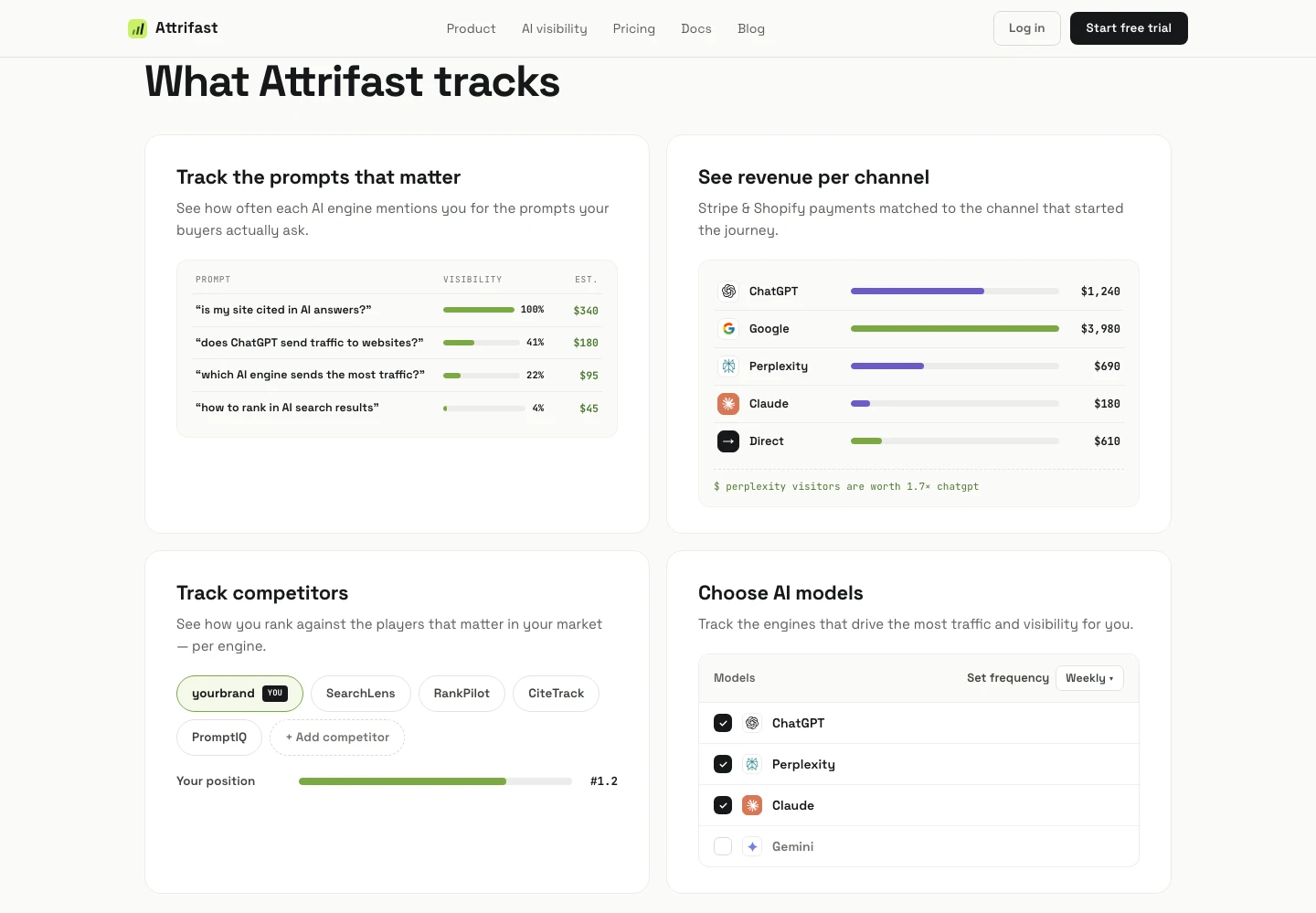
Attrifast is purpose-built for the exact use case Mixpanel does not serve: connecting marketing channels to actual Stripe revenue. Install a 4KB script tag, connect Stripe via OAuth in 60 seconds, and your first revenue-by-channel report appears in minutes. No event taxonomy to design, no engineering handoff, no event-based billing surprises. Pricing is flat at $9.99–29/mo regardless of traffic volume.

StripeShopifyCookie-free

Best for

Stripe founders and small teams who need revenue attribution without a data engineering team

Not for

In-product behavioral analytics, funnel cohort analysis inside the app, A/B test tracking

2

Amplitude

Product analytics with more affordable pricing than Mixpanel

Free → Growth (custom)

Hours (event planning required) setup

Amplitude is Mixpanel's closest direct competitor — it offers funnel analysis, retention curves, behavioral cohorts, and a generous free tier (up to 50,000 monthly active users). If your need is product analytics depth, Amplitude deserves serious evaluation. Its Starter plan is free and usable. Like Mixpanel, it has no native Stripe integration and tracking revenue requires custom event instrumentation. It is a Mixpanel alternative for product teams, not a Mixpanel alternative for revenue tracking.

StripeShopifyCookie-free

Best for

Product teams wanting Mixpanel-style analytics at lower cost

Not for

Revenue attribution, marketing channel ROI, Stripe-native data

3

PostHog

Open-source product analytics with self-hosting option

Free → $0.000225/event

Hours (self-host) or minutes (cloud) setup

PostHog is an open-source product analytics platform that covers session replay, feature flags, A/B testing, and behavioral funnels. The cloud-hosted free tier is generous (1M events/mo free). Like Mixpanel and Amplitude, PostHog tracks product events — it does not natively pull revenue data from Stripe. If you want to self-host your analytics and avoid vendor lock-in on the behavioral analytics side, PostHog is worth evaluating. For revenue attribution, it is the wrong tool.

StripeShopifyCookie-free

Best for

Engineering-led teams wanting open-source product analytics with session replay

Not for

Non-technical founders, revenue channel attribution, Stripe integration

4

Heap

Auto-capture product analytics — no manual instrumentation

Free (limited) → Enterprise (custom)

30 minutes (auto-capture script) setup

Heap differentiates itself from Mixpanel by auto-capturing all user interactions without manual event tracking — you retroactively define events from the captured data instead of pre-instrumenting them. This removes the engineering burden for product analytics. Heap acquired Contentsquare in 2023 and now offers session replay capabilities. Pricing has historically been opaque and enterprise-oriented. Like Mixpanel, Heap has no native Stripe revenue connection.

StripeShopifyCookie-free

Best for

Product teams who want retroactive event analysis without pre-planning event taxonomy

Not for

Revenue attribution, small business budgets, Stripe-native tracking

5

Plausible + manual revenue tracking

Cookie-free traffic analytics with a separate revenue spreadsheet

$9–19/mo

5 minutes setup

Plausible Analytics is the leading privacy-first, cookie-free web analytics tool. It is fast, GDPR-compliant without a consent banner, and genuinely simple. Its limitation is that it tracks traffic, not revenue — there is no native Stripe integration, and revenue-per-visitor is not a metric it supports. Some founders use Plausible alongside a manual Stripe dashboard or spreadsheet to approximate channel ROI. This works at very early stage but breaks down once you have multiple channels and want attribution accuracy.

StripeShopifyCookie-free

Best for

Early-stage founders who just need privacy-compliant traffic analytics

Not for

Accurate revenue attribution, multi-channel ROI, Stripe-native data

When to use Mixpanel vs when to use Attrifast

The right answer depends entirely on the question you need answered. Use this decision matrix to identify which tool fits your actual use case.

Attrifast

You need to know which marketing channel (Google, Twitter/X, SEO, email) drives the most Stripe revenue

Native server-side Stripe connection shows exact revenue by UTM source with zero custom code

Mixpanel

You want to analyze user behavior inside your SaaS app — feature adoption, activation funnels, retention cohorts

Mixpanel is industry-leading for in-product behavioral analytics and cohort exploration

Attrifast

You want to understand which ad campaigns drive actual paying Shopify customers (not just traffic)

Stripe integration pulls order data server-side, not via browser pixel that can be blocked

Mixpanel

Your product team runs weekly A/B tests and needs funnel drop-off analysis by cohort

Mixpanel's funnel builder and cohort comparison tools are purpose-built for this workflow

Attrifast

You're a solo founder spending $1K/mo on ads and need to know what's working before your runway ends

Revenue attribution in 2 minutes at $9.99/mo — no engineering required, answers the question immediately

Mixpanel

You have a dedicated analytics engineer and need custom event tracking across mobile, web, and backend

Mixpanel's SDKs and Lexicon (event dictionary) are industry-standard for multi-platform instrumentation

The hybrid approach: use both

Many teams run Mixpanel for in-product behavioral analytics and Attrifast for marketing revenue attribution simultaneously. The two tools answer different questions and the scripts co-exist without interference. Attrifast's 4KB script has negligible performance impact alongside Mixpanel's SDK.

How to migrate from Mixpanel to Attrifast (or use both)

You do not have to choose immediately. The recommended approach is to run both tools in parallel for a month before making a decision. Here is the exact sequence.

1

Sign up for Attrifast free trial

No credit card required. Your Mixpanel account stays active — you are running both simultaneously.

2

Install the Attrifast script tag

One line of HTML in your <head>. It co-exists with Mixpanel's SDK without conflict. The script is 4KB.

3

Connect Stripe

Stripe connection is OAuth-based and takes 60 seconds. Shopify uses a one-click app install. Revenue data starts appearing immediately.

4

Run both tools for 30 days

Compare Mixpanel's channel data (from custom events) with Attrifast's revenue-by-channel report (from server-side payment data). The gap is often significant.

5

Decide what you actually need

Keep Mixpanel if your team actively uses behavioral cohorts, funnels, and A/B test analysis. Many founders discover Attrifast alone answers the revenue question they actually cared about.

What transfers from Mixpanel to Attrifast

  • Your UTM parameter strategy — Attrifast reads the same utm_source, utm_medium, utm_campaign parameters
  • Your understanding of which channels drive traffic — now connected to actual revenue data
  • Your conversion goals — reformulated as Attrifast revenue attribution rules

What you give up

  • In-product behavioral analytics — funnel exploration, retention curves, cohort analysis inside your app
  • Mixpanel's flexible Explore interface for ad-hoc event analysis
  • Any existing Mixpanel dashboards your product team relies on

Frequently asked questions

What is the best Mixpanel alternative for revenue tracking?

Attrifast is the only lightweight Mixpanel alternative specifically built for revenue attribution rather than product analytics. It connects natively to Stripe via server-side integrations, shows revenue by marketing channel in real time, requires no event instrumentation, and is cookie-free by design. Setup takes 2 minutes and pricing starts at $9.99/mo — no event-based billing. For product teams who need behavioral analytics at lower cost, Amplitude is the closest Mixpanel competitor.

Does Mixpanel track Stripe revenue?

Mixpanel has no native Stripe integration. To track Stripe revenue in Mixpanel, you need to write a custom webhook handler that fires a Mixpanel event on payment confirmation, capture the Mixpanel distinct_id at checkout, and match it to the payment event server-side. This requires engineering time, fails silently when misconfigured, and does not track subscription renewals that happen without a browser session. Attrifast handles all of this automatically via its native Stripe connection.

Is Mixpanel good for marketing attribution?

Mixpanel was designed for product analytics — tracking user behavior inside an application, running retention analyses, and analyzing activation funnels. Marketing attribution (connecting UTM parameters to revenue from a payment processor) is a different problem. Mixpanel can approximate it with custom events, but it requires significant engineering setup and still misses server-side payment events like subscription renewals. If marketing attribution is your primary need, a dedicated tool like Attrifast answers that question more accurately and with zero engineering overhead.

How much does Mixpanel cost for a growing startup?

Mixpanel offers a free tier covering up to 1 million events per month. The Growth plan is event-priced at approximately $0.000083 per event. At 5 million monthly events, that is roughly $415/mo. At 10 million events, approximately $833/mo. At 50 million events, around $2,083/mo. Enterprise pricing is custom and negotiated. A product that grows its traffic will see Mixpanel costs escalate automatically. Attrifast is a flat $9.99–29/mo regardless of traffic volume.

Can I use Attrifast and Mixpanel at the same time?

Yes — many teams run both simultaneously. Mixpanel handles in-product behavioral analytics: feature adoption, retention curves, cohort analysis. Attrifast handles marketing revenue attribution: which channel brought the visitors who converted into paying customers. The two tools answer different questions and do not conflict. Attrifast's script tag co-exists with Mixpanel's JavaScript SDK without interference.

Does Mixpanel require a GDPR consent banner?

Yes. Mixpanel uses cookies and browser storage to track users across sessions, which requires explicit consent under GDPR and PECR for EU and UK visitors. This means you need a consent management platform and a consent banner, and you lose data for visitors who decline — typically 30–40% of European users on B2B sites. Attrifast is cookie-free by design, which means it does not require a consent banner and does not have a consent-related data gap.

Mixpanel vs alternatives — entry to mid-volume monthly cost (USD)

Source: Mixpanel official pricing page; Plausible/Fathom/SegMetrics vendor pages

Stop guessing which channel drives your revenue

Connect Stripe and see exact revenue by marketing channel in 2 minutes. No event instrumentation, no consent banners, flat $9.99–29/mo.

Start free trial →

Loved by 500+ users