The indie hacker analytics question has a wrong answer that gets repeated in every Indie Hackers Slack and every r/SaaS thread: "just install Mixpanel and Segment, they have free tiers." Both have free tiers. Both are wrong-fit for someone at $1,200 MRR with no marketing hire and no product analyst. The right answer is smaller and less ambitious, and it does more useful work at lower cost. I have run analytics stacks at every MRR band from $0 to $50k+ on three of my own products and helped roughly 40 other indie hackers wire theirs. The pattern is consistent enough that I now treat it as a four-stage progression with stage-specific tools and stage-specific anti-tools.
This article is the long version of the advice I give in DMs when an indie founder asks "what should I use for analytics?" The companion pieces on GA4's AI-traffic blind spot and the AEO vs SEO effort split go deeper on the attribution mechanics; this one is the stack-selection meta-decision that sits one level up. If you are a solo founder or a two-person team and your MRR sits anywhere between $0 and $50k, the stack below is the one I would build today.
Quick Facts
| Metric | Value | Source |
|---|---|---|
| Median Indie Hackers product MRR (top 1,000, 2025) | ~$1,400/mo | Indie Hackers product database [1] |
| Stripe Atlas-incorporated startups achieving $1k MRR in year 1 | Roughly 23% | Stripe Atlas annual report [2] |
| Median time from launch to $1k MRR for IH-listed products | ~14 months | Indie Hackers data export [1] |
| Bootstrapped SaaS that reach $10k MRR within 24 months | Roughly 8% | MicroAcquire/Acquire.com listings analysis [3] |
| Median analytics tool count at $0-1k MRR (n=40, my sample) | 2 | Author's measurement, 2024-2026 |
| Median analytics tool count at $10-50k MRR (n=40) | 4 | Author's measurement |
| Median analytics spend as % of MRR at $5k MRR | 3.8% (often too high) | Author's measurement |
| Indie hackers who say they "do not look at" their analytics weekly | ~38% | r/SaaS weekly poll, 2025 [4] |
| Mixpanel free-tier event limit (2026) | 20M events/mo | Mixpanel pricing page [5] |
| PostHog cloud free tier (2026) | 1M events/mo | PostHog pricing [6] |
| Plausible cheapest paid tier (2026) | $9/mo (10k pageviews) | Plausible pricing [7] |
| Fathom cheapest paid tier (2026) | $15/mo (100k pageviews) | Fathom pricing [8] |
| HubSpot Starter Marketing minimum (2026) | $20/seat/mo + scaling tiers | HubSpot pricing [9] |
| Segment free tier (2026) | 1k MTUs/mo, 2 source/destination cap | Segment pricing [10] |
| Stripe Sigma queries on standard plan | Free included | Stripe Sigma docs [11] |
Two of those numbers do most of the work for the rest of this article. The median IH product is at roughly $1,400 MRR. The median analytics spend as a percentage of MRR I see at $5k MRR is 3.8%, which is roughly double what it should be at that stage. Most indie hackers are not under-buying analytics. They are buying the wrong analytics for their stage.
Why indie hackers screw up analytics (in both directions)
The Indie Hackers archive going back to 2018 has the same conversation play out every six months. Someone posts "what analytics tools are you using?" The replies are a stack-fetish parade: Mixpanel, Amplitude, Segment, HubSpot, Heap, Hotjar, FullStory, June, PostHog, Customer.io, Statsig, GrowthBook. The replier almost never says what their MRR is. The asker installs three of them, spends a weekend configuring, never looks at the dashboards, and the cycle repeats.
The structural error is treating analytics tool selection as a category question ("what's the best tool?") instead of a stage question ("what's the right tool for $X MRR?"). The answer at $500 MRR is genuinely different from the answer at $50k MRR, and neither is "Mixpanel" — if event-level product analytics is what you're actually shopping for, the Mixpanel-alternative comparison covers that decision on its own.
Two failure modes I see often enough to give them names.
Failure mode 1: the enterprise-tool trap at $2k MRR. The founder reads a Lenny's Newsletter case study about how Notion uses Amplitude. They install Amplitude (free tier, no card). They spend 8 hours wiring SDK events. They define 4 funnels. The first funnel has 12 events in it total because their product has not been used enough yet. The dashboards are mostly empty. By month two they have stopped opening Amplitude. By month four they hit the free-tier ceiling on something obscure and the upsell email arrives. By month six they cancel and write a Hacker News comment that "Amplitude is overrated." The actual problem was not Amplitude; the actual problem was buying Amplitude two product-iteration cycles before they had data to put in it.
Failure mode 2: the attribution blind spot at $20k MRR. The founder has Plausible and a Stripe dashboard. They are growing 8% MoM. They started spending on ads. They have no idea which channel is converting because they never wired the Stripe-to-channel join. They look at Plausible (sessions up), they look at Stripe (revenue up), and they assume the ads are working. Three months later they shut off ads to test, revenue stays flat, and they realize 90% of the new MRR was organic the entire time. They burned $14k on something they thought was working. The fix would have been a $9.99/mo revenue-attribution tool or a weekend of Stripe-webhook code. They bought neither.
The two failures are mirror images of each other. Overbuy on event tracking. Underbuy on revenue attribution. Repeat at every MRR band until the founder writes the same Indie Hackers post a year later.
The pattern in one table:
| MRR band | What indie hackers actually do | What they should do |
|---|---|---|
| $0-1k | Install GA4 + Mixpanel + maybe HubSpot Starter | Plausible/Fathom free + hand-rolled Stripe Sheet |
| $1-10k | Add Hotjar, Customer.io, Segment trial, June, PostHog | Add one paid tool: revenue attribution |
| $10-50k | Try to make Segment work, debate Mixpanel vs Amplitude | Add email automation + weekly digest, instrument what closes deals |
| $50k+ | Either still on the duct-tape stack, or paid 5 tools | Now CDP + event analytics + CRM start earning their seat |
Tomasz Tunguz has written for years about the "tools you do not need yet" problem at early-stage SaaS [12]. The same logic applies harder to indie hackers, because the marginal hour spent on tool configuration is competing with the marginal hour spent on the product or on customer conversations. Indie hackers do not have a Director of Analytics to absorb the configuration cost. The tool tax is paid in the founder's time, which is the single most expensive resource on the company.
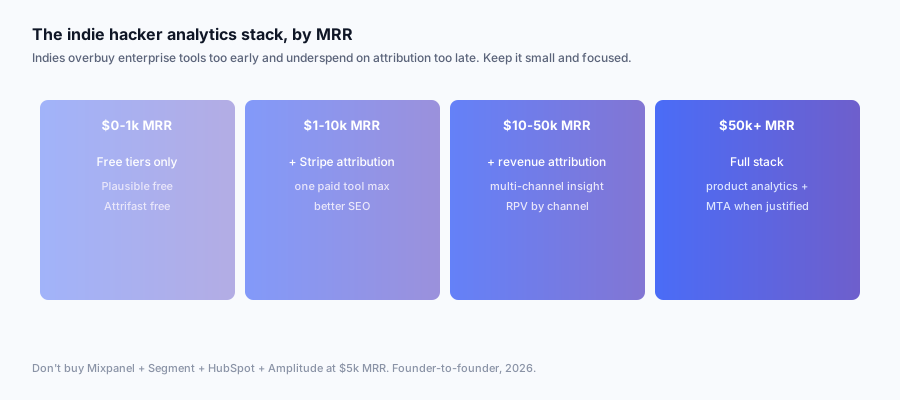
The 4-stage stack by MRR (overview)
Before walking each stage, here is the framework in one table. The numbers are guidelines, not gospel. The transitions happen on a sliding scale, and a SaaS with a long sales cycle hits the higher stages at lower MRR than a self-serve product.
| Stage | MRR range | Primary goal | Tool count | Analytics spend | Setup time |
|---|---|---|---|---|---|
| Stage 1: Survival | $0-1k | Confirm anything works | 1-2 | $0/mo | 90 min |
| Stage 2: Wedge | $1-10k | Find the channel that converts | 2-3 | $9-49/mo | 4 hr |
| Stage 3: Scale | $10-50k | Allocate budget across channels | 3-4 | $50-200/mo | 8 hr |
| Stage 4: Team | $50k+ | Coordinate marketing + product analytics | 5-7 | $300-1,500/mo | Ongoing |
The progression is monotonic in budget but not in tool count. The transitions that matter:
The transition triggers are not MRR thresholds alone. Each transition has a behavioral trigger: paid acquisition starting, multi-channel becoming real, a marketing hire. Promoting yourself to the next stack stage before the trigger fires is the most common overbuy error.
Stage 1: $0-1k MRR — minimum viable analytics
At this stage the only question your analytics needs to answer is "is anything working at all?" The signal you need is whether traffic is arriving, whether anyone is signing up, and whether anyone is paying. Three data points. That is the entire job.
The stack:
| Tool | Purpose | Cost | Setup time |
|---|---|---|---|
| Plausible free (self-hosted) or Fathom 7-day trial | Traffic and referrer | $0 | 15 min |
| Stripe Dashboard | Revenue and customer events | $0 | Already on Stripe |
| Google Sheet or Notion table | Signup log, manually updated weekly | $0 | 20 min |
| Stripe Sigma | SQL on your own Stripe data | $0 included | 30 min to write first 5 queries |
| Hand-rolled email webhook (Stripe → Discord/Slack) | Real-time "someone paid!" notification | $0 | 25 min |
Total: $0/mo. Total setup: roughly 90 minutes. The reason this works at $0-1k MRR is that the dashboards you need are simple enough that the free-tier limits never bind. Plausible's self-hosted Docker image is free forever and covers up to whatever traffic your VPS can serve. Fathom's free trial gives you 7 days of real instrumentation, which is enough to either fall in love with privacy-friendly analytics or migrate to Plausible.
Stripe Sigma is the underused piece. It is free with any standard Stripe account in 2026 [11], and it gives you SQL access to your own Stripe data: customers, subscriptions, charges, refunds, disputes. Five queries a solo founder should write first:
| Query | Why it matters |
|---|---|
SELECT count(*), sum(amount) FROM charges WHERE created > now() - interval '30 days' | This week's revenue, this month's revenue |
SELECT email, created FROM customers ORDER BY created DESC LIMIT 20 | Latest customers (good for outreach) |
SELECT email, count(*) FROM charges JOIN customers ON ... GROUP BY email ORDER BY count DESC | Top customers by transaction count |
SELECT date_trunc('week', created), count(*) FROM customers GROUP BY 1 ORDER BY 1 | Weekly signup trend |
SELECT status, count(*) FROM subscriptions GROUP BY status | Active vs canceled vs trialing |
Those five queries do more for an indie hacker than a fully-configured Mixpanel instance, and they cost zero dollars and zero events.
The Discord webhook is the morale tool. Wire Stripe's checkout.session.completed to a Discord webhook that posts "$X from email@example.com" to a channel only you read. The Indie Hackers podcast episodes from Courtland Allen's interviews repeatedly mention how the "ping when someone pays" notification is psychologically load-bearing for solo founders in the first 18 months [13]. The dopamine is fuel. Free dashboards are easy to ignore; a Discord ping is not.
What to NOT install at Stage 1
| Tool | Why not yet |
|---|---|
| Mixpanel | You do not have enough events for cohort analysis to mean anything |
| Amplitude | Same problem, plus heavier SDK weight on your tiny app |
| HubSpot Starter | $20/seat/mo for CRM features you do not need at 12 customers |
| Segment | The whole point of Segment is routing data to multiple destinations; you have one |
| Hotjar / FullStory | Session replay on 80 sessions/month is not actionable data |
| GA4 | Optional. The cookie banner cost exceeds the data value at this scale |
Pieter Levels has written and tweeted variants of "use one tool, the dumbest one, until it stops working" [14]. The dumbest possible analytics tool at $0-1k MRR is a Google Sheet you update on Sundays with a tally of signups, payments, and where they came from. It is not glamorous. It is the entire job at this stage.
Time budget at Stage 1
| Activity | Hours per month |
|---|---|
| Initial setup | 1.5 (one-time) |
| Weekly review (Sunday, 30 min) | 2 |
| Discord/Slack notification triage | 0 (passive) |
| Reconciling tool mismatches | 0 (one tool, no mismatches) |
| Total monthly time | 2 |
Two hours a month. The whole point of Stage 1 is to spend no more than that on analytics so you can spend the rest of your time on product and customers. The founders who get to Stage 2 are the ones who resist installing things.
Stage 2: $1-10k MRR — add Stripe attribution and better SEO measurement
Around $1k MRR something changes. You probably have 20-50 paying customers. You are starting to think about acquisition, and this is the point where analytics built for SaaS — MRR by channel, not pageviews — starts earning its keep. You may have run a Product Hunt launch, posted on Hacker News, or started paying for one channel (Reddit ads, Google Search, sponsorships). The question your analytics needs to answer becomes "which channel is actually converting?" not "is anything working?"
The Stage 2 stack:
| Tool | Purpose | Cost | Setup time |
|---|---|---|---|
| Plausible paid or Fathom Lite | Sessions, referrers, top pages | $9-15/mo | 30 min |
| Attrifast (or equivalent) | Channel-to-Stripe revenue attribution | $9.99/mo (7-day free trial) | 2 min |
| Stripe Sigma | Revenue analytics | Free | already done |
| Discord/Slack webhook | Real-time pay notifications | Free | already done |
| Google Search Console | Free organic search data | Free | 20 min to verify |
Total: $38-44/mo. The biggest single jump from Stage 1 is the addition of revenue attribution, which is the one piece of paid software a bootstrapped founder should buy first. Below $1k MRR the channel mix is not legible because the N is too small. Above $1k MRR there are signals worth reading: which page converted, which campaign paid back, which content brought the customer who upgraded.
Why revenue attribution before event tracking
The case for buying attribution before event tracking, at this stage:
| Question | Answered by | Cost to answer |
|---|---|---|
| "Did anyone use my onboarding flow?" | Event tracking (Mixpanel/PostHog) | Hours of SDK wiring + ongoing maintenance |
| "Which channel paid me this month?" | Revenue attribution (Attrifast/Plausible+Stripe) | 2-minute install or weekend code |
| "What's my activation rate?" | Event tracking | Multi-day setup, requires user-ID stitching |
| "Should I keep spending on Reddit ads?" | Revenue attribution | Real ROI number within 30 days |
| "Where do users drop off in pricing?" | Session replay (Hotjar) | Subjective interpretation, not numbers |
| "Which content piece brought paying users?" | Revenue attribution | Direct revenue-per-post in dashboard |
The pattern: revenue attribution answers questions that change spending decisions. Event tracking answers questions that change product decisions. At Stage 2 the spending decisions matter more, because product decisions cannot be optimized without users and users need spending decisions to find them.
What goes into the Stage 2 revenue attribution layer
Three working pieces, whether you buy or build:
- First-touch and last-touch UTM capture. Every URL you publish gets tagged. Every signup writes the UTM source to your database.
- Server-side referrer fingerprinting. Catches the ~70% of organic and AI traffic that does not carry a UTM tag. Domain list matched against
chatgpt.com,google.com,news.ycombinator.com,reddit.com,producthunt.com,indiehackers.com, plus your category-specific referrers. - Stripe webhook join. On
checkout.session.completed, look up the customer's stored UTM source and write a row to yourpayments_by_channeltable.
The DIY version is roughly 80 lines of TypeScript or Python and a weekend of work. The buy version is Attrifast at $9.99/mo plus 2 minutes of script installation. The breakeven on building versus buying depends on whether you have any other priority that weekend. Most indie hackers who try to DIY revenue attribution end up with something that works 80% of the time and has bugs around consent banners, multi-touch sessions, and Stripe subscription renewals. The "right" answer is whichever moves you on to product work faster.
Tyler Tringas of Calm Company Fund has written about the "build vs buy at the indie hacker scale" calculus, which mostly favors buying anything that costs less than 2 hours of equivalent founder time per month [15]. A $9.99/mo tool that saves a half-day of monthly reconciliation pays for itself at any reasonable founder hourly rate.
Stage 2 vendor lock-in risk table
| Tool | Lock-in severity | Migration time if you switch | Data export option |
|---|---|---|---|
| Plausible self-hosted | None | n/a, you own the data | Direct DB access |
| Plausible cloud | Low | 2 hours | Full CSV export |
| Fathom Lite | Low | 2 hours | Full CSV export |
| Attrifast | Low | 4 hours | Full Stripe data + session table CSV |
| Stripe Sigma | None | 0 hours, runs on your Stripe data | SQL output |
| GA4 | High | Painful, schema is opaque, BigQuery export only | Limited |
| Mixpanel | Medium | Days, requires event reformatting | JSON export |
| HubSpot | High | Weeks, CRM data + contact properties | API export only |
The lock-in column is one indie hackers underweight. The cost of a tool is not just the monthly fee; it is the difficulty of migrating off when you outgrow it. Tools that read from your own database (Stripe Sigma) or write to your own database (privacy-first analytics that lets you export) carry near-zero lock-in. Tools that ingest into a proprietary schema (Mixpanel, GA4, HubSpot) carry meaningful migration cost. At indie hacker scale, prefer the no-lock-in tools, because you will switch them more than once.
What to NOT add at Stage 2
| Tool | Why not yet |
|---|---|
| Segment | Not enough destinations to justify the routing layer |
| Mixpanel paid | Free tier (20M events) is generous; you do not need it |
| Amplitude paid | Same logic; free tier covers Stage 2 cleanly |
| HubSpot CRM | $20/seat/mo for a contacts table you could keep in Notion |
| Customer.io | Wait until you have a defined onboarding sequence to automate |
| Heap | The auto-capture pitch is real but the data noise at small scale is worse |
| FullStory | Session replay on small N is a time sink, not a tool |
The reverse question: what would change at Stage 2 that would justify adding one of these? Two patterns. First, if you have a clear in-product activation step you want to A/B test, PostHog free tier earns its seat (more on this in Stage 3). Second, if you start running a structured outbound email sequence, Loops or Customer.io paid plans earn their seat. Neither needs to happen yet for most Stage 2 indie hackers.
Stage 3: $10-50k MRR — dedicated revenue attribution, multi-channel insight
The MRR doubles a few more times and the analytics requirements shift again. You probably now have 3-5 active channels (organic SEO, paid search, content marketing, AI-engine citations, email, maybe paid social). You probably have a defined onboarding sequence. You probably wake up at least twice a month wondering whether to keep spending on ads.
The Stage 3 stack:
| Tool | Purpose | Cost | Setup time |
|---|---|---|---|
| Plausible Business or Fathom Pro | Sessions, referrers, top pages | $19-29/mo | already done |
| Attrifast paid tier | Per-channel revenue, AI-engine breakdown | $9.99/mo | already done |
| Loops or Customer.io | Email automation, lifecycle | $25-75/mo | 2-4 hours setup |
| PostHog cloud free | Optional: product-side events for activation | $0 (1M events free) | 2-3 hours |
| Stripe Sigma | Revenue analytics | Free | already done |
| Weekly digest cron | Auto-email or Slack post of key numbers | $0 (Vercel cron + 50 lines of code) | 2 hours |
Total: $73-153/mo. The big addition here is email automation, because at this MRR band the lifetime value math finally makes lifecycle automation pay back. The second addition is the weekly digest, which is the most underrated piece of an indie hacker stack and the one I keep recommending and almost nobody installs.
The weekly digest is the actual win at Stage 3
You now have four or five tools. Logging into each weekly is a 20-minute chore that gets skipped on busy weeks. The fix is to push the numbers to you instead of pulling them. A cron job that runs every Monday at 8 AM and emails you (or posts to a Slack channel) the following:
Week of 2026-05-18
─────────────────
MRR: $14,820 (+$340 WoW, +$1,290 MoM)
Signups: 84 (+12% WoW)
Trial conversions: 18 (21.4%)
Churn: 2 ($89 MRR)

Top channels (revenue):
1. Google organic    $4,210  ↑8%
2. ChatGPT citation  $3,180  ↑21%
3. Content marketing $2,890  ↑3%
4. Direct/(typed)    $1,940  ↓4%
5. Reddit            $1,420  ↓18%

Top pages this week (sessions):
1. /                  4,210  (3.2% conv)
2. /pricing             892  (12.1% conv)
3. /blog/...            712  (1.1% conv)

Top new customer:
shopify-merchant-x.com  ($299/mo, source: ChatGPT citation)

Anomalies:
- Reddit conversion -18% WoW, worth checking ad copy
- 3 high-value trials starting this week, prioritize onboarding
That email takes 50 lines of Python or Node and roughly 2 hours to write. It hits your inbox once a week. You read it on your phone over coffee. You skip logging into four dashboards. Decisions get made on the bus instead of on a Sunday at the laptop.
The Indie Hackers Slack archive has a recurring thread about "automated weekly reports" where the consensus is that founders who ship them do better than founders who promise themselves they will look at the dashboards more often [13]. The dashboards are not the problem. The dashboards exist. The problem is the activation energy to look at them.
Stage 3 channel attribution: where AI traffic finally shows up correctly
At Stage 3 you almost certainly have meaningful AI-engine traffic and you almost certainly have no idea how much. The pattern from the ChatGPT referral analytics piece is universal: AI referrals land in GA4 as Direct, in Plausible as referer-tagged for the ~20% with referers and Direct for the rest, in Stripe as untracked.
The Stage 3 channel breakdown that an honest indie hacker dashboard should look like:
| Channel | Typical % of MRR at $20k MRR (median IH SaaS) | What it requires to track correctly |
|---|---|---|
| Google organic | 25-40% | Plausible or Fathom shows it; GA4 also fine |
| Google paid (Search) | 0-15% | UTM tagging on ad URLs, easy |
| ChatGPT / Perplexity / Claude | 10-25% (and rising in 2026) | Server-side referrer + behavioral fingerprint |
| Content marketing (own blog) | 10-20% | Internal UTM scheme + first-touch attribution |
| Reddit / HN / community | 5-15% | Referer-tagged for most, some Direct leak |
| Email (lifecycle + newsletter) | 5-15% | UTM on every link, easy |
| Direct (real type-in / bookmark) | 5-15% (less than GA4 says) | Hardest to verify, residual category |
| Affiliate / partner | 0-10% | Coupon codes or unique URLs |
The single biggest delta between what indie hackers think their channel mix looks like and what it actually looks like at Stage 3 is the AI-engine row. Most indie hackers I have audited at $10-30k MRR have 8-20% of revenue coming from AI engines and zero of it labeled correctly. They are making "Direct is up, brand must be working" arguments that are wrong in mechanism even when the conclusion happens to be partially right.
Stage 3 cost breakdown by channel mix
Real-world examples, anonymized but based on actual stacks I have set up or audited:
| Profile | MRR | Tools | Monthly spend | % of MRR |
|---|---|---|---|---|
| Content-led SaaS, solo founder | $14k | Plausible $19, Attrifast $9.99, Loops $49, PostHog free | $78 | 0.6% |
| Paid-acquisition DTC | $22k | Fathom $30, Attrifast $9.99, Klaviyo $80, GA4 free | $120 | 0.5% |
| Developer tools, OSS-adjacent | $18k | Plausible $19, Attrifast $9.99, Loops $49, PostHog free, Cal.com | $78 | 0.4% |
| Niche B2B with sales-assisted | $32k | Plausible $29, Attrifast $9.99, Customer.io $75, Notion CRM | $114 | 0.4% |
| Heavily-paid-ads SaaS | $26k | Fathom $30, Attrifast $9.99, Customer.io $75, GA4 free, Triple Whale $129 | $244 | 0.9% |
Most stage-3 indie founders should sit at 0.5-1.0% of MRR for analytics tooling. Above 2.0% means you are probably paying for tools that overlap. The "Triple Whale" line in the last example is the warning case; ecommerce attribution tools start at $129/mo and creep upward, and they earn their seat only if you are spending serious money on paid social.
What to NOT add at Stage 3
| Tool | Why not yet |
|---|---|
| Segment | Routing layer still not needed at single-team scale |
| HubSpot Marketing Hub | $800/mo+ for features your stack covers for $100 |
| Marketo | Enterprise marketing automation, wrong fit |
| Pardot | Same problem; sales-team-focused, wrong stage |
| Tableau / Looker | Premature BI at this MRR; Stripe Sigma + spreadsheet covers it |
| Mode Analytics | Same as above |
| Heap auto-capture paid | Free tier still covers Stage 3 if you must use Heap |
The single most expensive mistake I see at Stage 3 is paying for HubSpot Marketing Hub Starter. The $20/seat/mo entry pricing is misleading; the real cost is the per-contact escalation curve and the constant upsell pressure into Marketing Hub Pro at $800+/mo. Two-seat HubSpot at the Pro tier is $1,600/mo, which is 8% of MRR at $20k MRR. That is a tool budget that should belong to a $200k MRR business with a marketing team, not a $20k MRR solo founder.
Stage 4: $50k+ MRR — when to upgrade to a "real" stack
This is where the indie hacker rules genuinely change. At $50k+ MRR you probably have a marketing hire or a content lead. You probably have multiple acquisition channels that all need attention. You probably have a real product analytics question because the product is now complex enough to optimize. The tools the previous stages refused start earning their seat.
The candidate Stage 4 stack (pick subset based on team shape):
| Tool | Purpose | Cost | Earns its seat when |
|---|---|---|---|
| Segment or RudderStack | CDP routing across 3+ destinations | $120-450/mo (Segment), free OSS (RudderStack) | You have 3+ marketing-tool destinations |
| PostHog Cloud paid | Product analytics + experiments | $200-600/mo at $50k MRR scale | You ship A/B tests monthly |
| Mixpanel paid | Cohort retention, advanced funnel | $61+/mo plus event volume | You have a product analyst weekly |
| Amplitude paid | Same as Mixpanel | $61+/mo plus events | Same as Mixpanel |
| HubSpot Marketing Hub Pro | Marketing automation, CRM | $800+/mo | You have a marketing hire |
| Customer.io | Lifecycle email | $150-450/mo at scale | You have 3+ active drip sequences |
| Attrifast Pro | Per-channel revenue at scale | $49/mo | You have AI-engine traffic worth tracking |
| Looker Studio or Mode | Custom dashboards | Free (LS) or $400+/mo (Mode) | You have a data hire or analyst |
| Triple Whale or Northbeam (ecom only) | Multi-touch ecom attribution | $129-1,000+/mo | DTC with $30k+/mo ad spend |
Total budget at Stage 4 sits between $300/mo (small team, mostly free tools) and $1,500/mo (full stack with paid CDP, event analytics, CRM). The right answer is rarely "all of the above" and the right answer is never "all of the above immediately." Stage 4 is the first stage where the right approach is "pick the two or three tools that match the next hire."
The "next hire" framework for Stage 4 tool selection
| Next hire | Tools that earn seat | Tools to defer |
|---|---|---|
| Marketing manager / growth marketer | HubSpot, Customer.io, Triple Whale (if ecom) | Mixpanel, PostHog paid |
| Product manager | Mixpanel or Amplitude, PostHog Cloud paid, GrowthBook/Statsig | HubSpot, Marketo |
| Content / SEO lead | Ahrefs/Semrush paid, Clearscope, Surfer | Segment, Mixpanel |
| Sales hire | HubSpot Sales Hub or Pipedrive, Apollo | Mixpanel, Amplitude |
| Customer success | Customer.io, Intercom or Plain | Segment, BI tools |
| Data analyst | Segment, dbt, Mode/Looker | HubSpot Pro, Customer.io Pro |
The pattern: tools and hires come in pairs. A marketing hire makes HubSpot useful. A product hire makes Mixpanel useful. Hiring nobody and buying both is the failure mode that produces $2,000/mo of analytics spend with nobody who opens the dashboards.
Lenny Rachitsky's newsletter has the recurring "stage-appropriate stack" framework that maps tool adoption to team size [16]. The indie hacker version of the same framework is harder, because the team size is "1" for longer and the temptation to buy a tool to substitute for a hire is real. The honest answer: tools cannot substitute for hires. They can only multiply hires.
Stage 4 anti-patterns
The three anti-patterns I have seen burn the most money at $50-100k MRR indie SaaS:
Anti-pattern 1: Segment without a destination strategy. Segment is a router. If you have one destination (your warehouse, say), you do not need Segment. If you have three destinations and a clear data plan, Segment earns its $120-450/mo seat. The middle case (two destinations and no plan) is the one that costs $200/mo for the next 18 months and produces zero new decisions.
Anti-pattern 2: HubSpot Pro without a marketing hire. $800+/mo for a tool that requires a full-time operator to use. The CRM piece is fine; the marketing automation piece needs a marketer. Buying HubSpot Pro as a founder is paying enterprise pricing for hobby-grade usage.
Anti-pattern 3: Mixpanel + Amplitude + PostHog all running at once. I have seen this stack three times. It always ends with the founder picking one. Pick one first. Save the duplicate dollars.
Stage 4 decision matrix: buy vs. build for each component
| Component | Buy when | Build when |
|---|---|---|
| Web analytics | Always buy at this stage; building is a hobby project | Never (unless you are an analytics company) |
| Event tracking | Buy PostHog or Mixpanel; SDK quality matters | Never (Self-hosted PostHog OK for OSS-leaning teams) |
| Revenue attribution | Buy if AI engines or paid mix is material | Build only if you have a strong analytics-engineer hire |
| Email automation | Always buy; the deliverability problem is genuinely hard | Never |
| Session replay | Buy Hotjar/FullStory only if optimizing checkout/onboarding | Never |
| CRM | Buy HubSpot/Pipedrive when sales hire arrives | Notion CRM until sales hire |
| CDP / routing | Buy Segment if 3+ destinations; RudderStack OSS for cost-cutters | Self-hosted RudderStack is a real option |
| BI / dashboards | Looker Studio (free) until analyst arrives; then Mode | Spreadsheets are fine, longer than you think |
The "do not buy this yet" list
The flip side of the stage-by-stage stack is the list of tools indie hackers buy that they should not buy yet. This is the section I get the most pushback on, mostly from people who work at the vendors in question. The pushback is fine. The data on what indie hackers actually use these tools for at low MRR supports the list.
| Tool | Threshold (do not buy below this MRR) | Why |
|---|---|---|
| Mixpanel paid | $20k MRR | Free tier covers 20M events/mo; paid features are for product teams |
| Segment paid | $25k MRR | The routing value requires 3+ destinations with clear use cases |
| HubSpot Starter (paid) | $30k MRR | Per-contact cost compounds; CRM features replaceable with Notion until sales hire |
| HubSpot Marketing Hub Pro | $100k MRR | $800+/mo justifies only with marketing hire |
| Amplitude paid | $40k MRR | Same logic as Mixpanel; free tier is enough |
| Heap paid | $20k MRR | Auto-capture pitch attractive but data noise at small scale is real |
| FullStory | $30k MRR | Session replay value scales with traffic volume |
| Hotjar paid | $9.99k MRR | Free tier (35 sessions/day) covers Stage 1-2 indie hacker needs |
| Customer.io paid | $10k MRR | Loops or Buttondown free/cheap covers earlier stages |
| Klaviyo (ecom) | $5k MRR (DTC) | Free tier up to 500 contacts; upgrade only when list size justifies |
| Tableau / Looker (paid) | $200k MRR | BI tooling at indie hacker scale is overkill |
| Segment Enterprise | $500k MRR | The Enterprise tier of any tool is a yellow flag at indie scale |
| Marketo | Never as indie hacker | Wrong stage product entirely |
| Pardot | Never as indie hacker | Same |
| Snowflake (data warehouse) | $200k MRR | Postgres + dbt or Stripe Sigma covers indie hacker BI cleanly |
The single most common purchase regret I hear in DMs is HubSpot Starter at $2-5k MRR. The pattern: the founder reads a HubSpot case study, signs up for the $20/seat/mo entry tier, imports their contacts, never wires it into their product workflow, gets the price-escalation email at the next renewal, cancels, and lost both money and the time spent on import. The fix is a Notion table with five columns and a Stripe-webhook sync, which covers the same ground until you have a sales hire.
The second most common regret is Mixpanel at $1-3k MRR. The free tier is genuinely free. The problem is not money; the problem is the maintenance load of an SDK you wire and then ignore. Every event you instrument is a contract with your future self to update the event schema as the product evolves. Indie hackers who install Mixpanel at $1k MRR almost universally end up with a schema graveyard by $5k MRR and abandon the tool by $10k MRR.
Free tier vs paid: the real cost of free analytics tools
The "free" in free analytics tools is not free. The cost is paid in other dimensions, and indie hackers who optimize naively for monthly subscription cost end up paying more in time and switching cost than the paid alternative would have charged.
The four hidden costs of free analytics tools:
| Cost | Free tools that have it | Paid tools that avoid it |
|---|---|---|
| Time-to-value setup overhead | GA4 (cookie banner, schema), Mixpanel (SDK + funnel definition) | Plausible (15 min), Attrifast (2 min) |
| Migration cost when you outgrow | Mixpanel (event schema reformatting), GA4 (proprietary schema) | Plausible (CSV export), Attrifast (CSV export) |
| Implicit price (your data) | GA4 (Google uses your data), Mixpanel (anonymized aggregation) | Privacy-first tools generally do not |
| Configuration complexity to maintain | GA4 (channel groups, custom dimensions), Mixpanel (event taxonomies) | Privacy-first tools have minimal config surface |
The Hacker News thread from late 2025 on "why I left GA4 after 18 months on Plausible" had the consensus that the $9/mo paid tier of a privacy-first tool was the best dollar a bootstrapped founder spent that year [17]. The pattern: founders save $9/mo on GA4 and pay $200/mo equivalent in configuration time, cookie banner legal review, and the eventual migration when they decide GA4 is not worth the trouble.
The math on a $9/mo Plausible vs. free GA4 over a 2-year window:
| Cost component | GA4 (free) | Plausible ($9/mo) |
|---|---|---|
| Subscription | $0 | $216 |
| Cookie banner implementation | 4 hours | 0 hours |
| Cookie banner legal review (EU/UK) | $200-500 one-time | $0 |
| Schema configuration | 6 hours | 0.5 hours |
| Monthly maintenance | 1 hour/mo = 24 hours | 0 hours |
| Migration cost when you eventually switch | 8-16 hours | 1 hour |
| Total (founder time at $50/hr) | $2,100-2,700 + cash | $241 |
Free GA4 costs roughly 10x what paid Plausible costs over 24 months when you account for the founder time. Same comparison holds for Mixpanel free vs. PostHog paid, and for HubSpot free vs. Notion CRM. The free tier of an enterprise tool is almost always more expensive than the paid tier of an indie-scale tool, because the enterprise tool was designed for someone with a configuration team you do not have.
Time vs. money tradeoff for indie hackers
Every analytics decision is a tradeoff between three things: founder time, monthly cash, and decision quality. Indie hackers are time-constrained and cash-constrained, which makes the optimization harder than for a funded startup. The framework I use:
The decision tree is restrictive on purpose. Most analytics tools fail one of the four filters, and the failed-filter test ("would you look at it weekly?") is the one that kills the largest share of installs.
The Pieter Levels rule of thumb is "if you do not check it daily it is decoration" [14]. The slightly more permissive indie hacker version is "if you do not check it weekly it is decoration." Anything in your stack you do not look at weekly is paying rent for no value. Cull aggressively.
The time-vs-money breakeven table:
| Founder time saved per month | Justifies tool cost up to |
|---|---|
| 1 hour | $50/mo (at $50/hr founder rate) |
| 2 hours | $100/mo |
| 4 hours | $200/mo |
| 8 hours | $400/mo |
| 16 hours | $800/mo |
For most indie hackers, an analytics tool that saves 2-4 hours per month of reconciliation work justifies $100-200/mo. That budget covers Plausible ($19) + Attrifast ($9.99) + Loops ($49) + a digest tool ($0), with room to spare. The budget does not cover Mixpanel ($61+) + Segment ($120+) + HubSpot Starter ($20+) for the same hours-saved value, because those tools mostly do not save hours at indie hacker scale; they add hours.
Common indie hacker analytics mistakes (the patterns I see most often)
Twelve mistakes I see often enough across the indie hacker stacks I audit to call them patterns, with the fix for each.
Mistake 1: Installing five tools at $500 MRR. The founder reads a Lenny's Newsletter case study about how Notion uses Amplitude, installs Amplitude, then installs Mixpanel because a different post mentioned it, then installs Segment because someone said you "need" a CDP. By $1k MRR they have three analytics tools and zero working dashboards. Fix: one tool at $0-1k MRR. That is the rule.
Mistake 2: Trusting GA4 on AI traffic. GA4 buckets ChatGPT, Perplexity, Claude, and Gemini referrals as Direct/(none) because the AI clients strip referer headers. The founder sees a Direct spike, attributes it to "brand," and misses the actual AI-citation channel that is driving the traffic. Fix: read the ChatGPT referral analytics guide and instrument server-side AI-engine detection.
Mistake 3: Wiring 200 product events before having a funnel that matters. Mixpanel or PostHog installed, every button click instrumented, no funnel defined, no insight generated. Fix: define the 3 events that matter (signup, activation, payment) and instrument only those until you have a specific question that needs more.
Mistake 4: Not connecting Stripe to attribution. Plausible installed for traffic, Stripe for revenue, no join between them. The founder cannot answer "which channel paid this month?" Fix: revenue attribution layer at Stage 2.
Mistake 5: Logging into 4 dashboards instead of pushing a weekly digest. Stage 3 problem. Fix: build the weekly digest cron. 50 lines of code. Game-changing.
Mistake 6: Buying HubSpot Starter "because we'll grow into it." You will not. The escalation curve is faster than your MRR curve. Fix: stay on Notion CRM until you have a sales hire.
Mistake 7: Letting tools sit installed but unused for months. Every tool in your stack pays rent. Audit quarterly. If you did not open it in 30 days, cancel. Fix: calendar reminder.
Mistake 8: Over-attributing to last-touch. A user discovers you via a ChatGPT citation, returns three weeks later via a Google search, and pays. Last-touch credits Google. First-touch credits ChatGPT. Both are partially right. Fix: at least track both; ideally use a position-based or time-decay model. See the multi-touch attribution piece for the deeper version.
Mistake 9: Counting trials as conversions. A trial signup is not revenue. Counting them as if they were inflates your channel quality numbers and leads to misallocated ad spend. Fix: tie attribution to first paid Stripe charge, not signup.
Mistake 10: Reconciling tool mismatches manually every week. GA4 says one number, Stripe says another, Mixpanel says a third. The founder spends a Sunday trying to make them tie. They never tie because they measure different things at different boundaries. Fix: pick one source of truth for each question and stop reconciling.
Mistake 11: Ignoring email as a channel. Email lifecycle is the highest-ROI marketing channel at most stages and indie hackers under-instrument it. Fix: UTM-tag every link in every email, track per-email click and conversion rate.
Mistake 12: Not auditing analytics setup before a Product Hunt or HN launch. The launch spike comes, the attribution is broken, and the founder has no idea where the surge of signups came from or how many converted. Fix: pre-launch checklist that verifies all UTM tags, all webhook firings, all tracking pixels. 30 minutes the day before.
The pattern across all twelve: the failure mode is configuration drift, not tool selection. The right tool installed poorly is worse than the wrong tool installed well. Indie hackers should optimize for fewer tools, more deeply configured, with a working revenue join, before optimizing for breadth.
Stage-by-stage decision matrix (the cheat sheet)
The whole article condensed into one decision table for the indie hacker who skipped to the end:
| Decision | $0-1k MRR | $1-10k MRR | $10-50k MRR | $50k+ MRR |
|---|---|---|---|---|
| Web analytics | Plausible self-hosted (free) | Plausible $9-19/mo | Plausible $19-29/mo | Plausible + GA4 sanity check |
| Revenue attribution | Stripe Dashboard + Sheet | Attrifast $9.99/mo | Attrifast $9.99/mo | Attrifast Pro $49/mo (Agency tier coming soon) or build |
| Event tracking | None | None | PostHog free tier | PostHog paid / Mixpanel |
| Loops free / Buttondown | Loops $25-49/mo | Loops or Customer.io $49-150 | Customer.io $150-450 | |
| CRM | Notion / Airtable | Notion / Airtable | Notion / Airtable | HubSpot Sales (with hire) |
| Session replay | None | None | Hotjar free tier (optional) | Hotjar paid / FullStory |
| BI / dashboards | Spreadsheet | Spreadsheet | Looker Studio free | Mode / Looker (with analyst) |
| CDP / routing | None | None | None | Segment / RudderStack |
| AI engine attribution | Spot-check manually | Attrifast built-in | Attrifast built-in | Attrifast + custom layer |
| Total monthly spend | $0 | $30-50 | $75-200 | $300-1,500 |
| Number of tools | 2 | 3 | 4-5 | 5-7 |
| Setup hours total | 1.5 | 4 | 8 | 20+ |
| Founder hours/month | 2 | 3 | 4 | 8+ (or hire) |
The progression is intentionally conservative on the upgrade side. Indie hackers should err toward staying at a lower stage longer than the MRR strictly dictates, because the tool-stage transition cost is real and the under-stacked founder has more time for product than the over-stacked founder.
Internal links and where to read next
If this stack guide is a starting point, the deeper pieces on each component live elsewhere on the site. For revenue attribution mechanics, the revenue attribution feature page walks the architecture and the ChatGPT referral analytics piece covers the AI-engine measurement gap in detail. For positioning against the alternatives indie hackers usually consider, Attrifast vs Plausible, Attrifast vs Mixpanel, and Attrifast vs PostHog walk the specific tradeoffs. For stage-specific positioning, Attrifast for bootstrapped SaaS and Attrifast for Stripe explain why the Stripe-native pattern matters more for indie hackers than for funded teams. For the AEO/SEO effort allocation, the AEO vs SEO 2026 piece is the strategic-decision companion. The marketing ROI calculator is the quick utility for sizing channel decisions before installing anything.
Limitations
Five things this stack guide does not cover, and you should not extrapolate past.
- Funded startups. Everything above assumes a bootstrapped founder paying out of personal cash or revenue. A YC-funded company with 12-18 months of runway has different optimization criteria; spend on tools that compress decision time, even if the per-MRR ratio looks high. The "1% of MRR" rule does not apply to funded startups.
- Agency / consulting analytics. If you run a services business with hourly billing, the stack should optimize for client reporting (probably Plausible cloud + a notion dashboard), not for revenue attribution per channel.
- Marketplace and platform businesses. Two-sided marketplaces have take-rate attribution problems that this guide does not address. Specialized tools and probably a data hire are required earlier.
- Enterprise B2B with long sales cycles. The Stage 3-4 transition happens at lower MRR for sales-assisted SaaS with 6-month sales cycles, because the channel-to-revenue join is genuinely harder when the lag is long. Consider HubSpot or Salesforce earlier than the table suggests.
- The numbers in this guide are 2026 snapshots. Vendor pricing changes, free tiers shrink and expand, new tools enter. The framework (stage-aware, small-and-focused) is durable. The specific tool recommendations should be re-validated annually.
FAQ
What is the cheapest analytics stack that still gives me real signal as an indie hacker?
At $0-1k MRR the minimum viable stack is two tools and zero dollars. Plausible Analytics free tier or Fathom free trial for sessions, plus a hand-rolled Stripe webhook that writes signups and payments to a Google Sheet or Airtable. That gives you traffic, signups, payments, and a join between them. Total cost: $0. Total setup time: 90 minutes. The single biggest mistake at this stage is buying Mixpanel, Amplitude, or HubSpot before you have any meaningful traffic to instrument. Free tools beat paid tools when your N is under 1,000 events per month, because the dashboards in free tools force you to look at what matters instead of building beautiful charts of noise.
When should a bootstrapped founder actually buy a paid analytics tool?
Around $1-2k MRR is the right time for one paid tool, not three. The first paid tool I recommend is whatever closes the loop between traffic and revenue: a privacy-friendly analytics tool with Stripe integration ($9-29/mo) or a Stripe-native attribution layer ($9.99/mo Attrifast tier). The wrong first paid tool is anything with the word "enterprise" in the pricing page or anything that costs more than 5% of your MRR. The rule I share with every indie hacker who asks: your analytics budget should be the smaller of $50/mo or 1% of MRR until you cross $5k MRR. Above that, 2% of MRR is the ceiling, not the floor.
Is Mixpanel worth it for an indie hacker?
No, not until you cross roughly $20k MRR and have a product team of at least two people who will actually open the dashboard weekly. Mixpanel's free tier (20M events per month) is genuinely generous in 2026, but the product is built for cohort analysis at scale and the configuration overhead is real. Most indie hackers who install Mixpanel use it for the first month, never define a single funnel, and forget it exists by month three. PostHog is the cheaper functional substitute up to ~$10k MRR, and Plausible plus a Stripe-native attribution tool covers 90% of what an indie hacker actually needs to know up to $50k MRR. The Mixpanel case unlocks when you have a multi-page in-product flow worth optimizing, which most indie SaaS products do not for the first 18 months.
Why do indie hackers underspend on attribution but overspend on event tracking?
Because event tracking feels like product work and attribution feels like marketing work, and indie hackers are mostly engineers who prefer product work. Wiring Mixpanel events into a React app is satisfying and concrete. Wiring a Stripe webhook to join sessions to payments is unglamorous plumbing that requires understanding consent banners, referer headers, and idempotency. The result is a typical indie hacker stack with 200 instrumented in-product events and zero working revenue attribution. The reverse is what generates real decisions: 5 working channel attribution rows beats 200 events you never look at. Spend the first $9.99 of analytics budget on closing the traffic-to-revenue loop, not on instrumenting another button click.
What is the honest stack at $10k MRR for a solo founder?
Plausible or Fathom for traffic ($9-15/mo), Attrifast or a self-hosted alternative for revenue attribution ($9.99/mo or DIY), Stripe Sigma for revenue analytics (free if you use Stripe), one of Loops or Customer.io for email ($25-75/mo), and a simple cron-based weekly digest in Slack or email that pushes the numbers to you so you do not have to log into five dashboards. Total: $49-105/mo and maybe 4 hours of setup. The tools indie hackers buy at $10k MRR that they should not are HubSpot ($800/mo and up), Segment ($120/mo minimum), and Amplitude (free tier exists but the upsell starts at $61/mo with a fast escalation curve). Those three are correct purchases at $50k+ MRR with a team of 3+, not at $10k MRR with a solo founder.
When do I outgrow the indie hacker stack?
Around $50-75k MRR with a marketing hire or a content lead, the stack starts to creak in three specific places: cross-channel deduplication (you have paid ads, organic, AI referrals, and email all touching the same leads), cohort retention analysis on real product usage, and CRM-style lifecycle data on individual customers. At that point you graduate to one of three patterns: keep the simple stack and add Segment as a routing layer ($120-450/mo), keep PostHog and add a CDP-lite like RudderStack open source (free if self-hosted), or accept the enterprise stack reality and budget $1-3k/mo across HubSpot, Mixpanel, and a paid Segment plan. The right answer depends on whether your next hire is marketing-focused (lean toward HubSpot) or product-focused (lean toward Mixpanel/Amplitude).
Should I use GA4 at all as an indie hacker?
Maybe, but not as your primary analytics. GA4 is free and ships acquisition-channel rules out of the box, which makes it useful as a sanity check against your privacy-first analytics tool. The cost is the cookie consent banner you now legally need in the EU and UK, the Direct/(none) misattribution problem on AI referrals, and the configuration overhead to make the data trustworthy. Most indie hackers I know who use both keep Plausible or Fathom as the source of truth and check GA4 once a month for the channel groupings GA4 does correctly (paid search, paid social, email). If you only have time to maintain one analytics tool, drop GA4.
How do I track revenue per marketing channel without a CDP or a tag manager?
Two pieces. First, capture the first-touch and last-touch UTM parameters in your own database when a user signs up, stored against the user row. Second, on every Stripe webhook (checkout.session.completed, invoice.payment_succeeded), join the Stripe customer back to the user row and tag the payment with the stored UTM source. Total code: about 80 lines of TypeScript or Python. Total infra: a webhook endpoint, your existing database, and a Stripe API key. This is the architecture Attrifast packages, but a solo founder can ship a passable version in a weekend. The key constraint is using first-party cookies or sessionStorage scoped to your own domain, not third-party tracking pixels.
What is the time cost of a bad analytics stack at $5k MRR?
Real, and roughly 4-8 hours per month of founder time spent reconciling numbers across tools that disagree. The Hacker News thread on Mixpanel vs Amplitude vs PostHog from late 2025 has dozens of comments from indie founders describing this exact tax. The pattern: GA4 says one number, Stripe says another, Mixpanel says a third, none of them tie. The founder spends a Sunday afternoon trying to reconcile, gives up, and makes the channel-spend decision on vibes. The single highest-leverage analytics decision an indie hacker can make is picking one source of truth for revenue attribution and refusing to second-guess it. The point of the analytics stack is to enable decisions, not to be comprehensive.
Do I need PostHog if I already have Plausible and Attrifast?
Probably not until $10-20k MRR. Plausible covers page-level web analytics; Attrifast covers revenue attribution. PostHog adds in-product event tracking (button clicks, feature usage, funnels), which only matters once you have a defined activation step worth optimizing. The free tier of PostHog Cloud (1M events/mo as of 2026 [6]) is generous enough that you can add it cheaply when you do need it. Adding it before you have a clear product question to answer just produces another empty dashboard.
How do I avoid the "tool sprawl" trap at Stage 3?
Quarterly audit. Open every tool you pay for. If you have not logged in within the last 30 days, cancel. If you have logged in but did not change a decision based on what you saw, cancel. The audit takes 30 minutes and saves an average of $50-150/mo across the indie hacker stacks I have reviewed. The corollary rule: do not install a new tool without retiring at least one. The slot count is fixed.
What is the indie hacker equivalent of "data-driven decision making"?
Looking at the weekly digest, reading three lines, making one decision, and getting back to product work. The full "data-driven decision making" pitch from enterprise SaaS implies an analyst team, a dashboard culture, and a constant flow of insight. An indie hacker does not have any of that. The indie hacker version is "have one number that is honest, look at it weekly, act on the trend, ignore everything else." That is sufficient for nearly every channel-spend and content-prioritization decision at $0-50k MRR.
Related reading from the Attrifast research stack
To dive deeper, explore cookieless revenue analytics.
References
- Indie Hackers — Products and MRR leaderboard
- Stripe — Stripe Atlas annual report on incorporated companies
- Acquire.com (formerly MicroAcquire) — SaaS marketplace listings and exit benchmarks
- r/SaaS subreddit — Weekly poll archive: how often do founders look at their analytics?
- Mixpanel — Pricing and free tier event limits
- PostHog — Cloud pricing and free tier limits
- Plausible Analytics — Pricing and plan tiers
- Fathom Analytics — Pricing page
- HubSpot — Marketing Hub pricing and tier breakdown
- Segment (Twilio) — Free tier and pricing
- Stripe — Sigma SQL-based analytics documentation
- Tomasz Tunguz — Tools you do not need yet at early-stage SaaS
- Indie Hackers — Podcast archive with Courtland Allen (founder interviews 2017-2025)
- Pieter Levels — Personal blog and X archive on solo founder operations
- Tyler Tringas / Calm Company Fund — Bootstrapping essays and operator letters
- Lennys Newsletter — Stage-appropriate product and growth tool selection
- Hacker News — Discussion threads on analytics tool selection
- Y Combinator — Essays archive on startup metrics and analytics
- MicroConf — Talks archive on bootstrapped SaaS operations and analytics
- Product Hunt — Launch leaderboard and analytics post-launch case studies
- Indie Hackers Stripe Leaderboard — Verified MRR rankings for bootstrapped products
For the deeper attribution mechanics that sit underneath the stack recommendations above, see the ChatGPT referral analytics piece. For the AEO/SEO effort split that complements the channel attribution work, the AEO vs SEO 2026 piece is the strategic-decision companion. For the Stripe-native attribution architecture in product form, the revenue attribution feature page covers how Attrifast packages the four-layer pattern. For comparisons against the most common indie hacker alternatives, Attrifast vs Plausible, Attrifast vs Mixpanel, and Attrifast vs PostHog walk the tradeoffs explicitly. For the stage-specific positioning, Attrifast for bootstrapped SaaS and Attrifast for Stripe address the indie hacker buyer directly.