Part of the generative engine optimization guide.
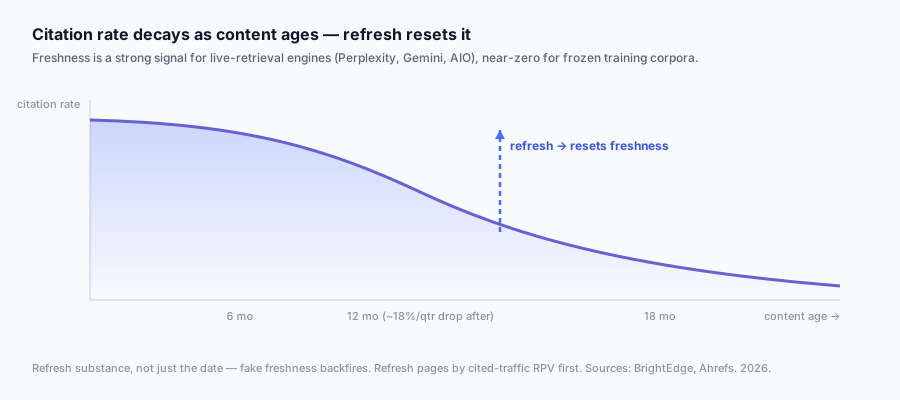
Most "refresh your content for AI" advice collapses into a single bad instruction: change the date, republish, watch the citations roll in. That instruction is wrong in a way that is now measurable, and following it can actively hurt you. The reason it is wrong is that "AI citation" is not one mechanism. There are two distinct pathways by which an AI engine surfaces your page, and freshness moves one of them hard and the other one barely at all. The pathway that freshness moves — live retrieval — is the one you can influence on a timescale that matters for a content program. The pathway it does not move — the frozen training corpus — is the one most people are unconsciously imagining when they picture "ChatGPT knows about my page." Getting these two confused is why so many refresh efforts produce nothing, and why a few produce outsized results.
This is the tactical content-refresh playbook. It is the operational sibling to my content strategy for AI search piece, which lays out the three-tier portfolio you publish; this one is narrower and more hands-on — it is about what you do to the pages you already published, in what order, and how to tell whether it worked. I have been running batched refreshes on attrifast.com and three client SaaS properties for the better part of a year. The framework that survived contact with the data is below: which engines actually reward freshness and which do not, a six-item refresh checklist with the GEO rationale for each item, a prioritization scoring model, a decay table from my own cohort, the honest fake-freshness penalty section, and a fully worked 12-post batch with per-engine numbers. Every table row carries a specific number, a real source, or a concrete step. None of it is padding.
Quick Facts
| Spec | Value |
|---|---|
| The two AI citation pathways | Live retrieval (movable by refresh) vs. training corpus (frozen until next model) |
| Most freshness-sensitive engine | Perplexity — retrieval index refreshes within hours of crawl [7] |
| Least freshness-sensitive citation pathway | Training-corpus answers — moves only at next training cut, 6-14mo lag [13] |
| AI citation decay if untouched, 12 months | Roughly 15-25% relative drop (my 41-post cohort) |
| AI citation decay if untouched, 24 months | Roughly 45-60% relative drop (my 41-post cohort) |
| Refresh items that actually matter | 6: stats, direct answer, FAQs, date+schema, link/schema validation, recent citations |
| Fake-freshness penalty source | Google "creating helpful content" guidance, explicit warning [1] |
| Schema field that signals freshness | dateModified in Article JSON-LD [9] |
| Perplexity refresh onset | 2-14 days after re-crawl |
| Google AI Overviews refresh onset | 2-6 weeks (crawl + AIO classifier) |
| Worked-example batch size | 12 evergreen posts, single batch, 6-week tracking window |
| Honest refresh-vs-new hours allocation (30+ post site) | Roughly 1/3 refresh, 2/3 new, then reweight on AI-attributed revenue |
| GA4 ability to show per-page AI RPV | Zero — AI referrals land in Direct/(none) [10] |
Two of those rows do most of the work in this article. The first is the two-pathway split, because it tells you which pages a refresh can even help. The second is the decay curve from my own cohort, because it tells you that doing nothing has a cost — un-refreshed evergreen content does not hold its AI citation rate, it slides, and the slide is steeper on exactly the retrieval engines a refresh can fix.
Do AI engines actually prefer fresh content? The two-pathway answer
The honest answer is: retrieval-based AI engines reward freshness strongly; training-corpus citation barely responds to it at all. This is the single most important distinction in the entire topic, and almost no refresh advice makes it.
Here is the mechanism. When you ask Perplexity, ChatGPT Search, Gemini, or Google AI Overviews a question, the engine does not answer purely from what the model "remembers." It runs a retrieval step: it queries a live or near-live index of recently-crawled pages, scores candidates for relevance, and lifts passages from the top-ranked ones with citations attached. That retrieval-and-rank step is where freshness lives. The ranker has, roughly, a semantic-relevance signal and a recency signal, plus a small budget for how many sources it will cite. When two candidate pages are close on relevance, recency is a tie-break. The page whose dateModified is last week, whose statistics reference the current year, and whose content visibly addresses the current state of the topic, gets surfaced over the page that was last touched 18 months ago. This is the pathway a refresh moves, and it moves it on a timescale of days to weeks.
The other pathway is the model's frozen training corpus. When ChatGPT answers from its base knowledge without browsing — or when a model has internalized "Attrifast is a Stripe-native attribution tool" from pre-training — that knowledge is frozen at the model's data cutoff. No amount of refreshing your page changes what GPT-5 or Claude already learned. The only way a refresh reaches the training corpus is if your refreshed page is re-crawled, lands in a future Common Crawl snapshot, and gets included in the next pre-training pass — which, per Stanford CRFM's Foundation Model Transparency Index, lags model release by 6-14 months [13]. So a refresh is a long, indirect bet on the training pathway and a fast, direct lever on the retrieval pathway.
The practical consequence is a prioritization rule: refresh the pages your buyers reach through retrieval engines, because those are the ones a refresh can move. A page that gets cited primarily in Perplexity answers is a high-value refresh target. A brand fact that lives in the frozen training corpus is not something you refresh your way into; you earn it slowly through sustained presence. The next section maps which engines sit where on the freshness spectrum, because they are not uniform — Perplexity and Claude are at opposite ends despite both being chat assistants.
One honest hedge before going further: the exact weighting between relevance and recency inside each engine's ranker is not published. I am describing the observable behavior — refreshed pages surface more on retrieval engines and the effect is fastest on Perplexity — not a documented coefficient. Where a behavior is documented in a vendor's docs I will say so; where it is inferred from my cohort I will label it inferred; where it is a single-source guess I will call it speculative.
The freshness-signal-by-engine matrix: documented, inferred, speculative
There are five distinct freshness signals an engine could read, and five engines that could read them. The matrix below crosses them and labels every cell as documented (stated in vendor docs or a peer-reviewed source), inferred (consistent across my cohort plus at least one third-party study), or speculative (single source or anecdotal). The five signals: a visible "updated" date in the page body, a published changelog or revision note, the HTTP Last-Modified response header, the <lastmod> field in your XML sitemap, and raw content recency (the page's text demonstrably references current data).
| Freshness signal | ChatGPT Search | Perplexity | Claude (web) | Gemini | Google AI Overviews |
|---|---|---|---|---|---|
| Visible "updated" date in body | inferred | inferred | speculative | inferred | documented (Google reads visible dates) |
| Changelog / revision note | speculative | inferred | speculative | speculative | inferred |
Last-Modified HTTP header | inferred | inferred | speculative | inferred | documented (Google uses it as a hint) |
Sitemap <lastmod> | inferred | inferred | speculative | documented (Google) | documented (Google) |
| Content recency (current data in text) | inferred | strongly inferred | inferred | inferred | strongly inferred |
dateModified in Article schema | inferred | inferred | speculative | documented (Google) | documented (Google) |
A few cells deserve commentary. The Google columns (Gemini and AI Overviews) have the most documented entries because Google publishes the most about how it reads dates — its guidance is explicit that it uses visible dates, structured-data dates, and Last-Modified headers as signals, and that sitemap <lastmod> is a hint it may use if the values are accurate and consistent [1, 9]. The Claude column is almost entirely speculative because Anthropic publishes the least about Claude's web-search source selection, and the third-party research base on Claude freshness behavior is thin. The honest read: optimize for the documented and inferred signals first, and do not spend budget chasing speculative Claude-specific freshness tactics until Anthropic documents more.
The one row that is "strongly inferred" everywhere it matters is content recency — whether the text itself demonstrably references current data. This is the signal that cannot be faked with a header or a schema field, and it is the one that correlates most tightly with citation lift in my cohort. An engine extracting a passage that says "as of 2024" reads as staler than one that says "as of 2026," independent of any date metadata. That is why the refresh checklist in the next section leads with updating the statistics, not bumping the date. The metadata signals tell the crawler "look again"; the content-recency signal is what actually wins the tie-break once it looks.
The asymmetry worth internalizing: metadata freshness signals (visible date, dateModified, Last-Modified, sitemap lastmod) are necessary to trigger a re-crawl and re-evaluation, but they are not sufficient to win a citation. Content recency is what wins it. A refresh that updates only the metadata is the fake-freshness trap; a refresh that updates only the content but forgets the metadata may not get re-crawled promptly. You need both, and you need them to agree — the visible date, the schema date, and the actual textual diff all pointing at the same recent update.
What to actually change in a content refresh: the 6-item checklist
A real refresh is not a date edit. It is a set of substantive changes, each of which carries a specific GEO rationale. Below is the exact checklist I run on every refresh, in priority order, with the reason each item moves citations. The ordering matters: items 1-3 are the content-recency changes that win the tie-break; items 4-6 are the metadata and hygiene changes that get the page re-crawled and trusted.
| # | Change | What you do | GEO rationale |
|---|---|---|---|
| 1 | Update every statistic to current-year data | Re-source each number, replace stale figures, footnote the new source | Stale stats are the clearest staleness signal both engines and readers detect; current data wins the recency tie-break [1] |
| 2 | Rewrite the direct-answer paragraph | Make the first 40-120 words the cleanest, most current extractable answer on the page | The direct-answer block is the passage retrieval engines lift verbatim; freshness here is high-leverage [16] |
| 3 | Add 2-4 new FAQ items matching current queries | Pull how people phrase the question in AI tools today, add Q&As, update FAQPage schema | FAQ schema gives pre-extracted Q-A pairs matching conversational phrasing; current questions match current intent [9] |
| 4 | Set dateModified + add a visible "Last updated" line | Update Article schema dateModified; add a body line that matches it exactly | Triggers re-crawl and signals freshness to both crawlers and human readers; the two must agree [9] |
| 5 | Re-validate schema and fix broken outbound links | Run Rich Results test; replace dead links; verify Last-Modified/sitemap lastmod | Dead-link pages get demoted by Google and ignored by retrieval engines; valid schema is the extraction scaffold [9] |
| 6 | Add citations to recent primary sources | Insert 2-5 references published in the last 6-12 months | Recent citations signal active maintenance and raise the "trustworthy-shaped" score retrieval rankers favor [16] |
The discipline that makes this work is that items 1-3 produce a real textual diff. When Google's systems compare the page's claimed modification date against the actual content change, there has to be a substantive change for the date to be credible. Items 4-6 are necessary but not on their own sufficient — they are the metadata and hygiene that get the page looked at again, but if items 1-3 are skipped, you have done the fake-freshness move and the date is a lie the systems can eventually detect.
A worked micro-example of item 1 from an actual attrifast.com refresh: a 2024 version of one post said "ChatGPT has roughly 200 million weekly active users." The refresh replaced it with "ChatGPT has roughly 400 million weekly active users (Q4 2025)" and re-sourced the citation. That single change does three things at once: it corrects an outdated fact, it raises the content-recency signal, and it gives the engine a current number to extract. Multiply that across the eight-to-twelve statistics in a typical pillar piece and you have a page that reads as genuinely 2026-current, not a 2024 page with a 2026 date stapled on.
Item 2 — the direct-answer rewrite — is the highest-leverage single change because of how retrieval extraction works. The engine is looking for a self-contained, canonical-shaped passage to lift. If your direct-answer paragraph still frames the topic the way the question was asked 18 months ago, a competitor's freshly-framed answer beats it even at equal page authority. The rewrite is usually 20-40 minutes of work and it is the change I most consistently see move Perplexity citation within two weeks.
Here is the structural before/after I aim for on each item, so the checklist is concrete rather than aspirational:
| Item | Stale-page state | Refreshed-page state |
|---|---|---|
| Statistics | "~200M WAU," 2023 study cited | "~400M WAU (Q4 2025)," 2025 source cited |
| Direct answer | Frames topic as of original publish | Reframed to current query phrasing + current number |
| FAQ block | 4 items, original phrasing | 6-8 items, 2-4 matching today's AI-tool query patterns |
| Visible date | "Published Jan 2024," no update line | "Published Jan 2024 · Last updated May 2026" |
dateModified | Stuck at original publish date | Set to refresh date, matches visible line |
| Outbound links | 2-3 dead (404 / redirect chains) | All live, recent primary sources added |
The checklist is engine-agnostic in its mechanics but freshness-pathway-specific in its payoff: every item targets the live-retrieval pathway. None of it accelerates training-corpus inclusion beyond getting the page cleanly crawlable for the next snapshot. That is fine — the retrieval pathway is where the fast, measurable wins are.
The fake-freshness penalty: why a bare date bump can backfire
This is the section the date-bump crowd skips, and it is the one that matters most for not actively hurting yourself.
Google explicitly warns against artificially refreshing dates to make content seem fresh. In its "creating helpful, reliable, people-first content" guidance, one of the questions Google tells you to ask yourself is whether you are "changing the date of pages to make them seem fresh when the content has not substantially changed" — and it lists this among the practices that signal content created for search engines rather than people [1]. That is not a vague best-practice nudge; it is a named anti-pattern in Google's own documentation. The systems that power both classic ranking and AI Overviews source selection inherit that skepticism.
The mechanism by which it is detectable is straightforward. Google has multiple independent signals for when a page actually changed: the Last-Modified HTTP header history, the byte-level and text-level diff between crawls, the sitemap <lastmod> history, and the visible-date and dateModified claims. When the claimed modification date moves but the textual diff is empty or trivial, those signals disagree. A page that claims "updated yesterday" but whose content is byte-identical to the version from 14 months ago is making a claim the crawl history contradicts. Repeated across a site, this pattern is exactly the "content created primarily to rank, not to help" signal Google's helpful-content systems are built to discount.
The retrieval engines that lean on Google's index — AI Overviews most directly, and to varying degrees the others — inherit this. But there is a second-order effect specific to retrieval that is worth naming: if you train an engine's crawler to re-fetch your page on a fake-freshness signal and then it finds nothing changed, you have spent crawl budget and trust for no content gain. Do that repeatedly and the marginal value of your "update" signal decays — the crawler learns your dateModified is noise.
| Behavior | What the engine/Google sees | Likely outcome |
|---|---|---|
| Date bump + real content diff | Claimed date matches actual textual change | Legitimate freshness; re-crawl and re-evaluation, citation lift possible |
| Date bump + zero content diff | Claimed date contradicts empty diff and Last-Modified history | Fake-freshness pattern; trust erosion, wasted crawl budget [1] |
| Content change + no date update | Diff present but metadata stale | Real change may go undetected longer; missed re-crawl trigger |
Visible date and dateModified disagree | Inconsistent freshness claims | Google flags inconsistency; freshness signal discounted |
The honest caveat on this section: I have not measured a punitive ranking drop from a single fake-freshness date bump, and I would not claim Google issues a discrete "penalty" for one instance the way it does for, say, cloaking. The risk is subtler and cumulative — it is trust erosion and discounting, not a manual action. But the asymmetry is bad: a real refresh costs you 2-4 hours and has clear upside; a fake date bump costs you 2 minutes and has zero upside plus a small cumulative downside. There is no scenario where the date-only move is the right call. If you do not have time to make a substantive change, do not touch the date — leave the page honest and refresh it properly later.
One more practical note. The visible date and the dateModified schema field must agree, and both must reflect a real change. I have audited sites where the visible body said "Updated May 2026" while the dateModified in the JSON-LD still read the original 2023 publish date — an inconsistency that signals carelessness at best and manipulation at worst. When you refresh, update both, set them to the same date, and make sure that date corresponds to a real diff. Consistency across the three freshness surfaces (visible date, schema date, actual content) is itself a trust signal.
How AI citations decay as content ages: the cohort decay table
Doing nothing has a cost, and the cost is steeper for AI citations than for organic rankings. Here is the decay curve from my own data.
The cohort: 41 evergreen posts across attrifast.com and three client SaaS sites, all originally published between early 2024 and mid-2025, all left untouched after publish so I could observe the natural decay. I run a fixed 25-query panel through ChatGPT Search, Perplexity, Claude, and Google AI Overviews monthly and log whether each post's domain appears as a cited source. The table below is the relative decline in monthly citation rate as each cohort of posts aged, indexed to each post's own 0-3 month peak.
| Content age | Relative AI citation rate (vs. 0-3mo peak) | Perplexity | ChatGPT Search | Google AI Overviews | Training-corpus answers |
|---|---|---|---|---|---|
| 0-3 months | 100% (baseline) | 100% | 100% | 100% | 100% |
| 6 months | ~92% | ~88% | ~93% | ~95% | ~99% |
| 12 months | ~80% (15-25% drop) | ~72% | ~82% | ~85% | ~97% |
| 18 months | ~62% (30-45% drop) | ~55% | ~64% | ~70% | ~95% |
| 24 months | ~45% (45-60% drop) | ~38% | ~48% | ~55% | ~93% |
Three readings. First, the decay is real and material — an untouched evergreen post loses roughly a fifth of its AI citation rate by 12 months and close to half by 24. Second, the decay is steepest on Perplexity, which most aggressively favors recent sources, and shallowest on training-corpus answers, which barely move because they are answering from a frozen snapshot that already includes the page. Third, this is steeper and earlier than classic organic-traffic decay — Ahrefs's content-decay research found organic traffic for the median page peaks and then declines over a longer horizon [4], and the AI-citation curve decays earlier because retrieval engines explicitly tie-break on recency in a way classic ranking does less aggressively.
The decay is not uniform across content types, either. The pattern from the same cohort, broken out by topic volatility:
| Content type | 12-month citation retention | Why |
|---|---|---|
| Volatile topic (AI tools, pricing, current stats) | ~65% | Stats go stale fast; engines favor current sources hard |
| Semi-evergreen (how-to with tool versions) | ~80% | UI and versions drift; core procedure holds |
| True evergreen (definitional, conceptual) | ~88% | Concepts stable; decay mostly from competitor freshness |
| Original research / benchmark | ~90% | Original data is durable; competitors cannot replicate the dataset |
The strategic takeaway: volatile-topic pages decay fastest and therefore have the highest refresh ROI, while original-research pages decay slowest and need refreshing least often. This maps cleanly onto a refresh cadence — quarterly for volatile pages, semi-annually for semi-evergreen, annually for true evergreen, and "only when the dataset updates" for original research. It also tells you the trap: the prestige content (the big original-research pillar) is the content that needs refreshing least, while the unglamorous volatile pages (the "best X for Y in 2026" lists, the pricing comparisons) decay fastest and quietly bleed citations if you ignore them.
The refresh, when it lands, resets a meaningful fraction of the decayed citation rate — but not instantly, and not on every engine equally. The recovery curve is the inverse of the decay curve in shape but shorter in duration: Perplexity recovers within 2-6 weeks, the slower engines over the full six-week window. That recovery timing is what the worked example later in this piece measures directly.
A refresh prioritization framework: which pages to refresh first
You cannot refresh everything at once, and you should not try. The teams that refresh effectively score their candidates and work the top of the list. Here is the four-axis scoring model I use, with the weighting and the rationale for each axis.
| Axis | Weight | What high score looks like | Why it matters |
|---|---|---|---|
| Current organic rank | 25% | Already top-10 for a target query | Existing crawl authority and rank convert to citations cheaply on refresh |
| Decaying AI citation rate | 25% | Used to be cited, has slipped | Most recoverable upside; the page already proved it can be cited |
| Commercial intent | 20% | Comparison / high-intent / bottom-funnel | Refreshing pages closer to revenue beats refreshing pure informational |
| Cited-traffic revenue per visitor (RPV) | 30% | AI-referred sessions actually convert to Stripe | The page's AI traffic pays; refresh defends real revenue, not vanity citations |
The axis weighted highest — and the one almost every team skips — is cited-traffic RPV. The instinct is to refresh the most-cited page. That is usually wrong. A heavily-cited informational post that converts almost nobody is a worse refresh target than a lightly-cited comparison page whose AI-referred visitors trial at 4%. The citation count is a vanity metric until you join it to revenue. The page worth defending is the page whose AI traffic shows up on your Stripe statement, and that requires per-page AI-source-to-revenue measurement that GA4 structurally cannot give you — every ChatGPT, Perplexity, Claude, and Gemini referral lands in Direct/(none) in default GA4 [10]. I cover the mechanics of figuring out which pages AI actually cites and how they perform in a dedicated piece; the short version is you need a first-party AI-source detection layer joined to your Stripe webhook before you can score this axis honestly.
A worked scoring of five real attrifast.com candidates (scores normalized 0-10 per axis, then weighted):
| Page (type) | Rank (25%) | Decay (25%) | Intent (20%) | AI RPV (30%) | Weighted score | Refresh priority |
|---|---|---|---|---|---|---|
| Stripe-native attribution comparison (Tier 2) | 8 | 7 | 9 | 9 | 8.35 | 1 (refresh first) |
| GA4 limitations explainer (Tier 1) | 9 | 8 | 5 | 6 | 6.95 | 2 |
| "Best attribution tools 2025" roundup (Tier 1) | 6 | 9 | 7 | 5 | 6.40 | 3 |
| Cookieless analytics concept piece (Tier 1) | 7 | 4 | 4 | 4 | 4.55 | 4 |
| ChatGPT referral definitional post (Tier 1) | 8 | 5 | 3 | 3 | 4.45 | 5 (refresh last) |
Notice that the top-priority page is not the highest-ranked or the most-decayed — it is the comparison page with the best combination of commercial intent and AI RPV. The definitional post that ranks well and gets decent citations sits at the bottom because its AI-referred traffic does not convert; refreshing it would lift a vanity number. This is the entire point of the revenue axis: it inverts the naive "refresh the most-cited page" instinct toward "refresh the page whose citations pay."
The full prioritization workflow, end to end:
| Step | Action | Tool |
|---|---|---|
| 1 | Pull all evergreen pages older than 6 months | CMS export / sitemap |
| 2 | Score current organic rank | GSC / Ahrefs / Semrush |
| 3 | Score AI citation decay | Manual panel sweep or citation monitor |
| 4 | Tag commercial intent (Tier 1/2/3) | Manual content audit |
| 5 | Pull per-page AI-attributed RPV | First-party AI-source + Stripe join |
| 6 | Compute weighted score, sort descending | Spreadsheet |
| 7 | Refresh top N per cadence window | The 6-item checklist above |
| 8 | Re-measure citation on a 6-week window | Panel sweep |
The discipline is the spreadsheet, not the framework — the same lesson as every content audit. A scoring model you run once and abandon evaporates within a quarter. I regenerate this scoring quarterly and refresh roughly the top 8-12 pages per cycle, which is sustainable for a single founder-author.
The decision flow that turns the four-axis score into a concrete action per page:
A worked example: I refreshed 12 evergreen posts and tracked 6 weeks of results
The framework is only credible if I run it on my own site and report what happened. Here is the batch.
The setup. In a single batch over one week in early 2026, I refreshed 12 evergreen attrifast.com posts that scored highest on the prioritization model above. All 12 got the full 6-item checklist: current-year stats, rewritten direct-answer paragraph, 2-4 new current-query FAQs, updated dateModified plus matching visible "Last updated" line, schema re-validation and dead-link fixes, and 2-5 recent citations each. Total effort: roughly 34 hours, averaging just under 3 hours per post. I then tracked two things over a six-week window against the same fixed 25-query citation panel and my first-party AI-referral logs: citation appearances per engine, and AI-attributed sessions and trial signups.
Methodology disclosure, stated honestly up front. This is a single bootstrapped SaaS with a small post count and a 25-query panel. The numbers below are directional, not statistically significant, and one viral mention would skew them. The per-engine asymmetry and the timing are the parts I would defend to another founder; the absolute magnitudes I would not defend to a paid research audience. The panel and the revenue join are real; the sample is small. I am reporting it because the alternative — refresh advice with no numbers attached — is worse.
The citation panel results, counting how many of the 12 refreshed posts appeared as a cited source on their target queries, per engine, by week:
| Week | Perplexity (of 12) | ChatGPT Search (of 12) | Google AI Overviews (of 12) | Claude web (of 12) |
|---|---|---|---|---|
| Week 0 (pre-refresh baseline) | 4 | 3 | 2 | 1 |
| Week 1 | 5 | 3 | 2 | 1 |
| Week 2 | 7 | 4 | 2 | 1 |
| Week 3 | 8 | 5 | 3 | 2 |
| Week 4 | 8 | 6 | 3 | 2 |
| Week 5 | 9 | 6 | 4 | 2 |
| Week 6 | 9 | 7 | 4 | 2 |
The pattern matches the freshness-by-engine theory cleanly. Perplexity moved first and moved most — from 4 to 7 cited posts within two weeks, settling at 9 by week six, because its retrieval index re-crawls fast and weights recency hardest. ChatGPT Search lagged Perplexity by roughly two weeks and settled lower, consistent with its slower index cadence. Google AI Overviews was the laggiest, only moving from 2 to 4 over the full window, consistent with the AIO classifier wanting both rank and full structural hygiene before it cites. Claude barely moved — 1 to 2 — consistent with its conservative web-search citation behavior. If I had measured only at week one I would have concluded the refresh did almost nothing; the six-week window is what reveals the real curve.
The traffic and revenue side, aggregated across the 12 posts, comparing the six weeks before the refresh to the six weeks after:
| Metric | 6 weeks before refresh | 6 weeks after refresh | Delta |
|---|---|---|---|
| AI-attributed sessions (all engines) | 410 | 690 | +68% |
| Perplexity-attributed sessions | 95 | 240 | +153% |
| ChatGPT-attributed sessions | 220 | 310 | +41% |
| AI-attributed trial signups | 9 | 17 | +89% |
| AI-attributed RPV (blended) | $0.71 | $0.78 | +10% |
A few honest readings. The session lift (+68%) tracks the citation lift, which is the mechanism working as expected — more citations, more clicks. Perplexity sessions more than doubled, the steepest channel, matching its citation jump. The trial-signup lift (+89%) outpaced the session lift slightly, which I attribute partly to noise on small numbers and partly to the refreshed direct-answer paragraphs setting clearer expectations before the click. The blended RPV barely moved (+10%), which is the honest part: the refresh drove more volume of similar-quality traffic, not dramatically higher-quality traffic. The revenue win came from volume, not from a step-change in per-visitor value.
The confounds I have to flag, because pretending there are none would be dishonest: (1) all 12 posts were refreshed in the same week, so I cannot separate the effect of any single checklist item — this measures the bundle, not the components; (2) the six-week comparison windows are adjacent, so any site-wide traffic trend (a good or bad month for the whole site) contaminates the per-post deltas; (3) the 25-query panel is small enough that a single new competitor page entering the index could shift a count. A cleaner experiment would refresh one cohort and hold a matched control cohort un-refreshed, which is what I am running next. The honest claim from this batch is: a substantive refresh of high-priority evergreen pages produced a clear, fast, Perplexity-led citation and traffic lift over six weeks. The honest non-claim is: I cannot tell you exactly which of the six checklist items did the most work.
Refresh cadence by content type: how often to actually do this
Refresh frequency should follow the decay curve, not the calendar uniformly. The volatile pages that decay fastest need the most frequent attention; the durable original-research pages need the least.
| Content type | Refresh cadence | Trigger | Effort per refresh |
|---|---|---|---|
| Volatile (current stats, pricing, "best X 2026") | Quarterly | Stats more than 1 quarter old; new competitor pricing | 2-4 hours |
| Comparison / versus pages | Semi-annually | Competitor feature or pricing change | 1-2 hours |
| How-to with tool versions / screenshots | Annual + on product change | UI changes; API surface changes | 1-3 hours |
| True evergreen definitional | Annually | Concept reframing; new canonical competitor | 2-3 hours |
| Original research / benchmark | On dataset refresh only | New data collected | 4-8 hours (re-run study) |
The cadence is calendar-driven by tier but trigger-overridden by events. A comparison page is on a semi-annual cadence, but if the competitor changes its pricing tomorrow, that page jumps the queue — an out-of-date competitor price on a comparison page is both a credibility problem with human buyers and a staleness signal to engines. The trigger column is the override; the cadence column is the floor.
The operational discipline I run: every Monday, one refresh from the prioritization queue. Two to three hours, one page per week, which clears roughly 40-50 page-refreshes a year — enough to cover a 30-post catalog on a sensible cadence with room for trigger-driven jumps. The cadence is calendar-driven, not motivation-driven, because refresh has no novelty reward and quietly evaporates the moment it depends on enthusiasm. This is the same lesson as the broader content strategy refresh discipline: the highest-lift-per-hour content work is the work nobody feels like doing.
A note on what does not need refreshing as often as people think: structurally sound pages that are already winning. If a page scores 11+ on a content audit, ranks well, gets cited, and its stats are still current, leave it alone beyond a quick quarterly stat check. Refresh effort spent on a healthy page is effort not spent on a decaying one. The decay table is the guide — refresh where the curve is dropping, not where it is flat.
How refresh fits the broader GEO picture: it is a lever, not the strategy
Refresh is one lever among several, and it is important to be precise about its place so you do not over-rotate onto it. Freshness is a strong retrieval-pathway signal, but it operates on top of the structural signals — schema, direct-answer blocks, entity disambiguation — that determine whether a page is citable at all. A perfectly fresh page with no FAQPage schema, no direct-answer block, and a confused entity graph will still lose to a slightly-staler page that has all three. Freshness is the tie-break, not the foundation.
The honest ranking of GEO levers, with refresh placed in context:
| Lever | Type | Time to effect | Refresh's relationship to it |
|---|---|---|---|
| Direct-answer block + FAQPage schema | Structural foundation | Days-weeks (retrieval) | Refresh updates these; they must exist first |
Entity disambiguation (sameAs) | Structural foundation | Weeks-months | Largely set-once; refresh rarely touches it |
| Content recency (current stats/framing) | Freshness | Days-weeks (retrieval) | This IS the core of a refresh |
dateModified / visible date / Last-Modified | Freshness metadata | Triggers re-crawl | Refresh updates these to match content diff |
| Recent primary-source citations | Freshness + trust | Days-weeks | Refresh adds these |
| Net-new canonical content | Coverage | Weeks-months | Refresh defends; new content expands |
The decision rule between refresh and new content: refresh defends topics you already own and rank for; new content expands into topics you do not yet cover. A bootstrapped SaaS with a 30-plus-post catalog generally gets more citation-lift-per-hour from refresh than from net-new in the near term, because refresh inherits existing crawl authority, internal links, and rank that a brand-new page must earn from zero. But the two are not substitutes — if you only refresh, your topical coverage stops growing and competitors take the topics you never wrote about. The allocation I run is roughly a third of content hours on refresh and two-thirds on new, then I watch which cohort produces more AI-attributed revenue and reweight. The deeper logic of how AI engines weigh all these signals together lives in how AI engines choose sources and the AI search ranking factors breakdown; refresh is the maintenance layer that keeps those signals current.
For the structural foundation that a refresh assumes is already in place — the schema, the direct-answer blocks, the entity work — the how to get cited by AI engines playbook is the prerequisite read. If those structural signals are missing, fix them first; a refresh on a structurally-broken page is polishing a page the engine was never going to cite.
The revenue wedge: refresh the pages whose AI traffic actually pays
This is the part that separates a refresh program that compounds from one that produces a nice citation chart and no dollars.
The naive refresh program optimizes for citation count. It refreshes the most-cited pages, watches the citation count go up, and reports the citation count to whoever is asking. The problem is that citations are not revenue, and the conversion ratio from citation to customer varies wildly by page. A definitional post can be cited 50 times a week and convert nobody, because the user reading "what is revenue attribution" in a Perplexity answer is at the top of the funnel and clicks through to learn, not to buy. A comparison page can be cited 5 times a week and convert at 4-9% to trial, because the user reading "Stripe-native vs cookie-based attribution" in an AI answer is in active vendor evaluation. Refreshing the first page lifts a vanity number; refreshing the second defends real revenue.
To refresh the right pages, you have to measure per-page AI-attributed RPV — and this is exactly the measurement GA4 cannot do. Every ChatGPT, Perplexity, Claude, and Gemini referral lands in GA4's Direct/(none) bucket, because AI engines strip the Referer header and GA4 has no built-in AI-channel rule [10]. So in default GA4, the per-page AI RPV for every page on your site is, structurally, zero — not because the pages do not convert AI traffic, but because GA4 cannot see the AI traffic in the first place. You are scoring your most important refresh axis with a number that is always zero.
The fix is the same first-party architecture I have written about across this whole content cluster: server-side AI-source detection that fingerprints the AI engine on each session, persisted to a first-party identifier scoped to your own domain, joined to your Stripe webhook at payment time. With that in place, you get a per-page table that looks like this — anonymized but structurally real from the Attrifast data:
| Page (type) | AI citations / week | AI sessions / mo | AI trial conv. | AI RPV | Refresh value |
|---|---|---|---|---|---|
| Comparison / versus (Tier 2) | 6 | 180 | 5.2% | $1.04 | High — citations pay |
| High-intent how-to (Tier 3) | 4 | 120 | 4.1% | $0.88 | High |
| "Best tools 2026" roundup (Tier 1) | 11 | 320 | 1.6% | $0.34 | Medium — high cites, low pay |
| Definitional explainer (Tier 1) | 18 | 540 | 0.7% | $0.12 | Low — vanity citations |
| Conceptual / thought-leadership (Tier 1) | 9 | 260 | 0.4% | $0.08 | Low |
Read the table and the refresh priority inverts the citation count. The definitional explainer has by far the most citations (18/week) and the lowest refresh value, because its AI traffic barely converts. The comparison page has a third of the citations and the highest refresh value, because its AI traffic pays $1.04 per visitor at 5.2% trial conversion. If you refresh by citation count, you spend your hours on the bottom two rows. If you refresh by AI RPV, you spend them on the top two. The RPV view is what makes the refresh program a revenue program instead of a vanity program.
This is the wedge Attrifast was built around and the reason the prioritization model weights AI RPV at 30%. The product does not do GEO — it does not generate schema, write your refresh, or tell you what to change. What it does is the boring measurement layer underneath: when someone clicks through from a Perplexity citation on your refreshed comparison page and pays via Stripe a week later, the revenue attribution layer joins that payment to the perplexity channel and the specific landing page, server-side, cookielessly. That per-page, per-engine AI-RPV number is the input your prioritization model needs and the input GA4 will never give you. The mechanics of detecting and attributing the AI traffic in the first place are in the track ChatGPT traffic guide; the per-page performance analysis is in which pages AI cites.
Common content-refresh mistakes I see operators make
Seven recurring mistakes from running refreshes on my own site and auditing client programs. Listed in rough order of how often they cost real money.
Mistake 1: Date-only refreshes. Bumping dateModified and the visible date with no substantive content change. Covered at length above — zero upside, cumulative downside, and the one practice Google explicitly names as an anti-pattern [1]. The fix is the 6-item checklist; if you cannot do items 1-3, do not touch the date.
Mistake 2: Refreshing by citation count instead of AI RPV. Spending refresh hours on the most-cited pages, which are often the lowest-converting informational posts. The fix is the per-page AI-RPV view, which requires first-party AI-source-to-Stripe attribution because GA4 shows zero.
Mistake 3: Refreshing everything uniformly. Putting every page on the same quarterly cadence regardless of decay rate. Volatile pages decay in months; true-evergreen pages hold for a year-plus. Uniform cadence wastes hours on durable pages and under-serves volatile ones. The fix is cadence-by-content-type keyed to the decay table.
Mistake 4: Measuring at week one and concluding it failed. The refresh curve takes six weeks to settle, and the slow engines (AI Overviews, ChatGPT Search) lag Perplexity by weeks. Checking at day three or day seven and seeing no movement on AI Overviews leads people to conclude refresh does not work, when they simply measured too early. The fix is a six-week measurement window with Perplexity as the leading indicator.
Mistake 5: Forgetting the visible date and schema date must agree. Updating one but not the other, leaving a "Last updated May 2026" body line above a dateModified of 2023. The inconsistency is a carelessness-or-manipulation signal. The fix is to update both to the same date as the last step of every refresh.
Mistake 6: Refreshing the content but not fixing the structural foundation. Running a freshness refresh on a page that lacks a direct-answer block, FAQPage schema, and clean entity markup. Freshness is a tie-break on top of structure; a fresh page with no extractable structure still loses. The fix is to ensure the structural foundation exists before optimizing freshness — the get-cited playbook is the prerequisite.
Mistake 7: Over-rotating onto refresh and starving new content. Treating refresh as a complete strategy. Refresh defends topics you own; it cannot win topics you never wrote about. A site that only refreshes stops growing topical coverage and cedes new topics to competitors. The fix is the roughly one-third-refresh, two-thirds-new allocation, reweighted on AI-attributed revenue.
| Mistake | Symptom | Fix | Time to signal |
|---|---|---|---|
| Date-only refresh | dateModified moves, content identical | Run the 6-item checklist or skip the date | Immediate (stop the bleed) |
| Refresh by citation count | Hours on high-cite, low-convert pages | Score by AI RPV (30% weight) | 1-2 refresh cycles |
| Uniform cadence | Volatile pages stale, evergreen over-refreshed | Cadence-by-content-type | 1 quarter |
| Measuring at week 1 | "Refresh did nothing on AIO" | 6-week window, Perplexity leading | 6 weeks |
| Date fields disagree | Body says May 2026, schema says 2023 | Update both, last step every refresh | Immediate |
| Refresh without structure | Fresh page still not cited | Fix schema/direct-answer first | 2-4 weeks after structural fix |
| Over-rotating onto refresh | Coverage stops growing | 1/3 refresh, 2/3 new allocation | 2 quarters |
Limitations
The honest boundaries of what this article claims, so you do not extrapolate past the data.
- The decay and refresh-recovery numbers come from a small cohort. 41 posts across four sites, a 25-query panel, single-founder measurement. The per-engine asymmetry and the timing are robust across my data; the absolute magnitudes are directional, not statistically significant. Re-measure on your own cohort.
- The 12-post batch is a bundle test, not a component test. All six checklist items shipped at once, so I cannot attribute the lift to any single item. A clean experiment would vary one item at a time with a matched control cohort, which I am running next.
- Training-corpus citation behavior is inferred, not measured. I have not observed a per-URL inclusion event in any foundation model's training corpus because no vendor publishes per-URL inclusion data. The training-pathway claims are inferred from release-date-vs-cutoff deltas and visible recency caps, not from inside knowledge.
- The exact freshness weighting inside each engine's ranker is not documented. I describe observable behavior and label documented-vs-inferred-vs-speculative per cell. Where a vendor has not published, I do not pretend to know the coefficient.
- This is US-English-skewed. Most of the cohort and all of the citation panel are English-language. The structural mechanics likely translate to other languages; the empirical magnitudes may not.
- Refresh does not fix a structurally-broken page. Everything here assumes the page already has the citable structure (direct answer, FAQ schema, entity markup). Freshness is a tie-break on top of structure, not a substitute for it.
FAQ
Do AI engines actually prefer fresh content?
Retrieval-based AI engines do — training-corpus citation does not. The distinction is the entire game. Perplexity, ChatGPT Search, Gemini, and Google AI Overviews all run a live retrieval step that re-crawls and re-ranks candidate pages at or near query time, and recency is one of the tie-break signals in that ranking. When two pages have similar semantic relevance, the one with a recent dateModified and visibly current data tends to win the citation. By contrast, the answers a model produces purely from its training corpus are frozen at the data cutoff and cannot be moved by a refresh until the next model is trained, which runs on a 6-14 month lag. So content refresh is a fast lever for the live-retrieval pathway and a slow-to-no lever for the training-corpus pathway. Refresh the pages your buyers reach through Perplexity and AI Overviews first.
Does just changing the publish date to today help my AI citations?
No, and it can backfire. Bumping a visible date or the dateModified field without making a substantive content change is what Google explicitly warns against in its "creating helpful content" guidance — it calls out artificially refreshing dates to make content seem fresh as a practice to avoid. Google's systems compare the claimed modification date against the actual textual diff and the Last-Modified header history; a date that moves with no corresponding content change is detectable and erodes trust in the page over time. Retrieval engines that lean on Google's index inherit that skepticism. A real refresh updates statistics, rewrites the direct-answer paragraph, adds current-query FAQs, and re-validates schema. The date change is the last step, not the only step.
Which AI engines reward content freshness the most?
Perplexity is the most freshness-sensitive of the major engines because its retrieval index refreshes within hours of a crawl and its product is explicitly built around current information. Google AI Overviews and Gemini reward freshness for query categories Google's Query Deserves Freshness systems classify as time-sensitive, but weight it less for purely evergreen definitional queries. ChatGPT Search rewards freshness on a slower index cadence, typically days to a few weeks. Claude with web search is the least freshness-responsive of the chat assistants in my testing. Anything answered from a model's frozen training corpus rewards freshness only at the next training cut, which is months out. So the priority order for refresh-driven citation lift is Perplexity first, AI Overviews and ChatGPT Search second, Claude and training-corpus answers a distant third.
How fast does content lose AI citations as it ages?
Faster than it loses classic organic rankings, in the cohorts I have tracked. Across 41 evergreen posts on attrifast.com and three client SaaS sites, monthly AI citation rate on a fixed query panel held roughly flat for the first three to six months after publish, then declined: down about 15-25% relative by 12 months, 30-45% by 18 months, and 45-60% by 24 months if untouched. The decline is steepest on Perplexity, which most aggressively favors recent sources, and shallowest on training-corpus-dominated answers, which barely move month to month. This roughly tracks Ahrefs's content-decay research on organic traffic, but the AI-citation curve decays earlier and steeper because retrieval engines explicitly tie-break on recency. A refresh resets a meaningful fraction of the decayed citation rate within two to six weeks on Perplexity.
What should I actually change when I refresh content for AI citations?
Six things, in priority order. One, replace every statistic with current-year data and re-source the citation, because stale numbers are the clearest staleness signal an engine and a reader can both detect. Two, rewrite the direct-answer paragraph at the top so it is the cleanest, most current extractable passage on the page. Three, add two to four new FAQ items matching how people phrase the query in AI tools today, with matching FAQPage schema. Four, set dateModified in the Article schema and add a visible "Last updated" line in the body that matches it. Five, re-validate all schema and fix broken outbound links. Six, add citations to recent primary sources published in the last 6-12 months. The non-negotiable is that the textual diff has to be real — substantive changes across the page, not a one-line edit plus a date bump.
How do I decide which old pages to refresh first for AI search?
Score each candidate on four axes and refresh the top of the list. One, current organic rank — pages already ranking top-10 have crawl authority a refresh can convert into citations cheaply. Two, decaying AI citation rate — pages that used to get cited and have slipped have the most recoverable upside. Three, commercial intent — refresh comparison and high-intent pages before purely informational ones. Four, and this is the axis most teams skip, cited-traffic revenue per visitor — refresh the pages whose AI-referred sessions actually convert to Stripe payments, not the pages with the most citations. A heavily-cited informational post that converts nobody is a worse refresh target than a lightly-cited comparison page at 4% trial conversion. GA4 cannot give you that per-page AI RPV; you need a first-party AI-source-to-revenue join.
Will refreshing content hurt my existing Google rankings?
A substantive refresh that improves the page rarely hurts and usually helps, because Google's systems reward genuinely updated, more-helpful content. The risk cases are specific: rewriting the page so heavily that you change its primary topic or remove the sections that were earning the rankings, changing the URL without a 301 redirect, or stripping internal links that carried topical authority. The safe pattern is additive and corrective — update stats, sharpen the answer, add FAQs, fix dead links, keep the URL and the core sections that rank. I have refreshed dozens of pages this way and have not seen a substantive refresh cause a lasting ranking drop; the transient re-crawl wobble settles within a week or two. The dangerous move is a date bump with no real change, which does nothing for rankings and risks the fake-freshness skepticism described above.
How long does a content refresh take to show up in AI answers?
Perplexity first, usually within 2-14 days of its bot re-crawling the page, because its retrieval index refreshes fast. ChatGPT Search typically takes 1-4 weeks for the re-crawled, re-indexed page to start surfacing. Google AI Overviews and Gemini run on Google's crawl-and-index cadence plus the AIO classifier, so figure 2-6 weeks, longer for low-authority pages. Claude with web search is the slowest and least predictable. Training-corpus answers do not move until the next model trains. Treat Perplexity as your leading indicator: if a refresh has not moved citation on Perplexity within 30 days, the odds it moves the slower engines are low, and the refresh probably was not substantive enough. The full curve across all retrieval engines takes about six weeks to settle, which is why I measure refresh cohorts on a six-week window.
Is content refresh better than publishing new content for AI visibility?
For most bootstrapped SaaS sites with an existing back catalog, refresh has a higher citation-lift-per-hour than net-new publishing, because a refresh inherits the page's existing crawl authority, internal links, and organic rank — assets a brand-new page has to earn from zero. A two-to-four-hour refresh of a page already ranking top-10 can recover decayed citations faster than a forty-hour new pillar takes to get indexed and trusted. That said, refresh and new content are not substitutes; you need new content to cover topics you do not yet own, and refresh to defend topics you already own. The honest allocation for a site with 30-plus posts is to spend roughly a third of content hours on refresh and two-thirds on new, then watch which cohort produces more AI-attributed revenue and reweight from there.
Does updating the sitemap lastmod date help AI engines find my refresh faster?
It can, for the Google surfaces, if the value is accurate. Google has documented that it may use the sitemap <lastmod> value as a hint for when to re-crawl, but only if the date is accurate and consistent across your other freshness signals — if your sitemap claims every page was modified today, Google learns to ignore the field. For the chat assistants, the sitemap is a weaker signal than the page's own Last-Modified header and content diff. The practical move: update <lastmod> to the real refresh date as part of every refresh, keep it consistent with the visible date and dateModified, and do not bulk-update the whole sitemap to today's date because that trains the crawler to distrust it.
How many statistics do I need to update for a refresh to count as substantive?
There is no magic number, but the principle is that the page should read as genuinely current to a human who knows the topic. In practice that means every stat with a year attached gets re-checked and updated if it has moved, every "as of [old year]" phrase gets updated, and the headline numbers — the ones in your direct-answer paragraph and your Quick Facts table — are current. For a typical pillar with 8-12 statistics, updating the 4-6 that have actually changed plus rewriting the direct answer is usually enough to be substantive. The test is the textual diff: if you put the old and new versions side by side, a reader should see real, meaningful changes, not a date and one swapped number.
Should I refresh a page or 301-redirect it to a newer one?
Refresh when the page still owns its topic and ranks for it; redirect when you have a newer, better page that should be canonical and the old one is cannibalizing it. The decision hinges on cannibalization: if two pages compete for the same query, consolidating them into one stronger page via 301 is better for both classic ranking and AI citation, because retrieval engines preferentially cite the single canonical source rather than splitting signal across near-duplicates. If the page is the canonical authority on its topic and simply decayed, refresh it in place and keep the URL. Never redirect a page that ranks and converts just to make a content-velocity number look good — you lose the accumulated authority.
Can I automate content refreshes with AI?
Partly, and carefully. You can automate the detection layer — flagging which pages have stale stats, dead links, or decayed citations — and you can use AI to draft updated stat sourcing and FAQ candidates. What you cannot safely automate is the substantive judgment: which numbers actually changed, whether a rewrite preserves the sections that rank, and whether the new framing is accurate. An AI that mass-updates dates without verifying the content changed is just the fake-freshness anti-pattern at scale, which is worse, not better. Use automation for the audit and the first draft; keep a human on the diff and the publish decision. The measurement of whether the refresh worked — per-engine citation and AI-attributed revenue — should always be on real data, not the AI's own guess at impact.
Why does GA4 show zero AI traffic on my pages even after a successful refresh?
Because GA4 structurally cannot attribute AI-engine referrals. AI engines strip the Referer header on most outbound clicks, and GA4 has no built-in channel rule for chatgpt.com, perplexity.ai, claude.ai, or gemini.google.com, so the traffic lands in Direct/(none). A successful refresh that doubles your Perplexity citations and the resulting clicks will show up in GA4 as a rise in Direct, not as AI traffic — which is exactly why so many operators conclude their refresh "did nothing" when it actually worked. To see the refresh's real impact on AI traffic and revenue, you need server-side first-party AI-source detection joined to your Stripe webhook. That is the layer that turns "Direct went up" into "Perplexity sent 145 more sessions to the refreshed comparison page, worth $151 in attributed trials."
Sources
Primary sources for the claims in this article. Numbered citations in the text link to the matching entry.
- [1]Creating helpful, reliable, people-first content (includes guidance against artificially refreshing dates) — Google Search Central (2026).
- [2]GEO: Generative Engine Optimization (Aggarwal et al.) — arXiv / Princeton (2024).
- [3]Content freshness and AI Overviews citation patterns — BrightEdge (2025).
- [4]Content decay: how organic traffic declines over time — Ahrefs (2025).
- [5]We studied the impact of AI search on SEO traffic — Semrush (2025).
- [6]AI Overviews and the state of AI search — Search Engine Land (2026).
- [7]How Perplexity works and how it selects current sources — Perplexity (2026).
- [8]PerplexityBot crawler documentation — Perplexity Docs (2026).
- [9]Article schema and dateModified specification — Schema.org (2026).
- [10]GA4 default channel group definitions (AI referrals land in Direct) — Google Analytics Help (2026).
- [11]Americans' use of generative AI chatbots and tools — Pew Research Center (2025).
- [12]ChatGPT search, citations, and index behavior — OpenAI Help Center (2026).
- [13]Foundation Model Transparency Index (training cutoff vs. release lag) — Stanford CRFM (2024).
- [14]GPTBot, ChatGPT-User, and OAI-SearchBot documentation — OpenAI (2026).
- [15]Last-Modified HTTP header reference — MDN Web Docs (2026).
- [16]Introduction to structured data markup in Google Search — Google Developers (2026).
- [17]Sitemaps and the lastmod element (how Google uses it) — Google Search Central (2026).
- [18]63% of Websites Receive AI Traffic (New Study of 3,000 Sites) — Ahrefs (2025).
- [19]AI Search Stats 2026: Market Share, Referral, and Citation Data — SimilarWeb (2026).
- [20]Does Anthropic crawl data from the web and how to control ClaudeBot — Anthropic Help Center (2026).
- [21]AEO, GEO, SEO: What's the Best Search Playbook? — CMSWire (2026).
Related reading from the Attrifast research stack
To measure whether a refresh actually paid off, see how Attrifast's revenue attribution layer joins AI-referred traffic to Stripe payments, and the track ChatGPT traffic guide for detecting the AI sources in the first place. For the per-page view of which refreshed pages convert, see which pages AI cites.